
International Research Journal of Engineering and Technology (IRJET) e-ISSN: 2395-0056
Volume: 11 Issue: 04 | Apr 2024 www.irjet.net p-ISSN: 2395-0072
International Research Journal of Engineering and Technology (IRJET) e-ISSN: 2395-0056
Volume: 11 Issue: 04 | Apr 2024 www.irjet.net p-ISSN: 2395-0072
Nilakshi Devi1, Shakuntala Laskar2
1Nilakshi Devi: Research Scholar, Assam Don Bosco University, Assam, India
2 Shakuntala Laskar: Professor, Assam Don Bosco University, Assam, India
Abstract – Maize is a staple food crop for many communities in India, especially in regions where it serves as a primary source of nutrition. It's consumed in various forms like cornmeal, popcorn, and as whole kernels. The agriculture sector is significantly important to India's economy. To stop crop loss and the spread of illness, early detection of plant diseases is essential. Farmers or plant pathologists will typically physically examine the plant leaf to determine the type of illness. Due of the various drawbacks of conventional inspection, scientists are focusingonimplementingtechnology to streamline the procedure. To improve maize leaf disease detection precision, pre-trainedmodelssuchasVGG16,VGG19, ResNet152 and EfficientNetB7 have been employed. The EfficientNetB7 model outperforms the others, with an accuracy rate of 98.56 %. This enhances cropproductivityand guarantees the model's high degree of accuracyforillnessesof the maize leaf.
Key Words: Agriculture, Artificial Intelligence, Deep Learning, Transfer Learning, Pre-Trained Models (PTMs), Visual Geometry Group (VGG)
InIndiamaizeisthethird-mostimportantcerealcropafter wheat and rice[1]. Maize is extensively used as fodder for livestocksuchaspoultry,cattle,andpigs.Itshighnutritional content and digestibility make it a valuable component of animal feed. Maize is a versatile crop with numerous industrial applications. It's used in the production of cornstarch, corn syrup, ethanol, and other bio-fuels. Additionally,maizeby-productslikecornoilandcorngluten meal have various industrial uses [2]. Due to its many applications as food, feed, fodder, and raw materials for variousindustrialitems,itishighlyvaluedallovertheworld. Maize is very susceptible to a variety of plant diseases, despite its high nutritional value. Maize cultivation offers diversitytoIndianagriculture,especiallyinregionswhere it's grown alongside other crops. Its resilience to various climatic conditions makes it an important crop choice for farmers, contributing to agricultural sustainability and resilience. Maize leaf diseases have a major effect on the amount and quality of products produced from maize. Diseasesaffectingmaizecerealsareinfluencedbysoiltype, temperature, and rainfall. It can be challenging to identify and categorize plant diseases in agriculture, even though they can be helpful in monitoring large agricultural fields
andidentifyingdiseasesymptomsassoonastheyappearon plantleaves.Theclassificationanddetectionofcropdiseases arethemostcrucial technical andeconomical elementsin theagriculturalsector.Fordiseasesofthemaizeleaftobe treatedandcontrolledearlydetectionisessential.Thereare numerous traditional techniques for classifying and identifyingdiseasesinmaizeleaves,suchasusingchemicals, human operators, etc. However, there are a number of drawbackstothetraditionalmethodsforidentifyingmaize leaf diseases, including the fact that they are expensive, prone to error, time-consuming, inconsistent, and ineffectual. They also require specialized tools and plant diseaseknowledge.Featurerepresentationandextraction arethetwomainlimitationsofmachinelearning.Incurrent days,deeplearninghasgreatlyadvancedtheidentificationof plantdiseases[3].Convolutionneuralnetworks(CNNs)are widely employed for illness diagnosis in academia and industry [4]. Deep learning has come a long way in the previous several years. It can now extract useful feature representations from a vast array of input pictures. Deep learning broadens the application of computer vision in precision agriculture by enabling detectors to diagnose agricultural illnesses fast and correctly, in addition to improvingplantprotectionprecision.Numerousindustries, suchasthosethatmakefoodanddrink,poultry,andanimal feed, require maize.A major component in the low maize productionisthenumerousinfectionsthatwreakhavocon the crop, drastically reducing its overall yield [5]. Consequently,farmersstandtobenefitgreatlyfromadevice thatcanidentifyplantillnessesbasedontheappearanceof the plant and its telltale symptoms. The development of diseaseinthehostplantisfavouredbylowtemperatures, cloudy conditions, and high humidity.Southern Corn Leaf Blight (SCLB) and Maydis Leaf Blight (MLB), is a fungal disease that affects maize and is caused by the plant pathogen Bipolarismaydis,orCochliobolusheterostrophus, as it is sometimes called Bipolaris Maydis (Nisikado) ShoemakeristhecauseofSouthernmaizeleafblight(SCLB), alsoknownasMaydisleafblight(MLB),afatalfoliardisease that affects maize and has a wide geographic spread. Globally, producing regions developed in warm, humid environments. Early indications of the disease are little regions of necrosis that hover like haloes. The cause of southernrustisthefungusPucciniapolysora.Eventhough southernrustisusuallythoughtofasatropicalillness,itcan appear in areas of the United States and Canada that are importantformaizeproduction.Therearetypicalrust-like
International Research Journal of Engineering and Technology (IRJET) e-ISSN: 2395-0056
Volume: 11 Issue: 04 | Apr 2024 www.irjet.net
signs, but the pustules are smaller and almost invariably located on the upper leaf surface. Spores appear orange whentheycomeoutofthepustule.
TheintegrationofAIinmaizeleafdiseasedetectionoffers numerous benefits, ranging from early detection and accuratediagnosistocost-effectivenessandsustainability. Bytransferringknowledgefromthesedomains,themodel caneffectivelylearnrelevantfeaturesformaizeleafdisease detection with a smaller amount of annotated data. Pretrained models have learned generic features that are broadlyapplicableacrossdifferentimagerecognitiontasks. Byfine-tuningthesemodelsonmaizeleafdiseasedatasets, transfer learning enables the adaptation of these generic features to specific characteristics of maize leaves and diseases. This process often leads to better generalization performance, especially when faced with variations in imagingconditions,leafmorphology,ordiseasesymptoms.A modest corpus of literature also discusses the different formsofmaizeillnesses.Athree-stepanalysismethodwas developed byChad DeChant et al.[6]toascertain whether thepicturesincludeddiseasedleaves.Matchingpredictions were aggregated into distinct heat maps, which were subsequentlyfedintoafinalCNNtrainedtoidentifyifallof theimagesinthesetcontainedinfectedplants.Thethreestage architecture of this model is designed to improve performance. With a 96.7% accuracy rate, the system performsbetterthanaverage.GoogLeNetandCifar10,deep learning-based models for diagnosing leaf diseases, were proposed by Xihai Zhang et al. [7]. A collection of five hundredimages,sourcedfromotherplacessuchasGoogle andPlantVillage,depictvariousperiodswhendiseaseson maizeleaveswerecommon.Atthetopoftheclassification hierarchy,theGoogLeNetmodelcanidentifyeightdistinct types of maize leaf diseases with an average accuracy of 98.9%. Malusi Sibiya et al. [8] trained a CNN network to recogniseandcategorisemaizeleafillnessesusingNeuroph byusingasmartphonecamera,imagesofthediseasestaken inseveralmaizefields,andthePlantVillagewebsite.Three distincttypesofmaizeleafdiseaseswereselected:common rust (Puccinia sorghi), northern corn leaf blight (Exserohilum), and grey leaf spot (Cercospora). Northern maizeleafblight(Exserohilum)wasidentifiedandclassified by CNN with a high accuracy rate of 99.9%. An improved DenseNetarchitecturewasproposedbyAbdulWaheedetal. [9]forthepurposeofdiscoveringandclassifyingmaizeleaf diseases.TheyalsotrainedfourmorepopularCNNmodels for the detection and categorization of maize leaf disease, namely EfficientNet, XceptionNet, NASNet, and VGGNet. 12,332 photos in all, meticulously gathered from several sources, are categorized into 4 types of crops: the Cercospora-causedgreyleaf spot(1644images),common rust (3816 images), healthy crop (3720 images), and northern leaf blight (3152 images). With an accuracy percentage of 98.06%, the recommended DenseNet
p-ISSN: 2395-0072
producedimpressiveresults.Deeplearningmethodswere suggestedbyMd.AshrafulHaqueetal.[10]todetectmaize cropdisease.Deeplearninghasbeensuggestedasamethod foridentifyingimagesofafield-infectedmaizecrop.Three major diseases Turcicum Leaf Blight, Maydis Leaf Blight sheath Blight, and Banded Leaf Three different network configurationsweresimulatedusingthemaizedataset.The results of the trial showed that the maximum accuracy of Inception-v3 GAP was 95.99%. A new CNN model named LeafNet was introduced in [11] to classify the tea leaf diseasesandachievedhigheraccuracythanSupportVector Machine(SVM)andMulti-LayerPerceptron(MLP)
In [12], two DL models named modified MobileNet and reducedMobileNetwereintroduced,andtheiraccuracywas neartotheVGGmodel;thereducedMobileNetactuallygot 98.34%classificationaccuracyandhadafewernumberof parametersascomparedtoVGGwhichsavestimeintraining themodel.Astate-of-the-artDLmodelwasproposedin[13] namedPlantdiseaseNetwhichwasremarkablysuitablefor thecomplexenvironmentofanagriculturalfield.In[14],five typesofappleplantdiseaseswereclassifiedanddetectedby the state-of-the-art CNN model named VGG-inception architecture. It outclassed the performance of many DL architectures like AlexNet, GoogLeNet, several versions of ResNet, and VGG. It also presented inter object/class detectionandactivationvisualization;itwasalsomentioned foritsclearvisionofdiseasesintheplants.
Fivegroupsofimages Northernmaizeleafblight,Common rust,Southernrust,GreyLeafSpot,andHealthyleaf were selectedfromthePlantVillageDatasetasshowninFig1.
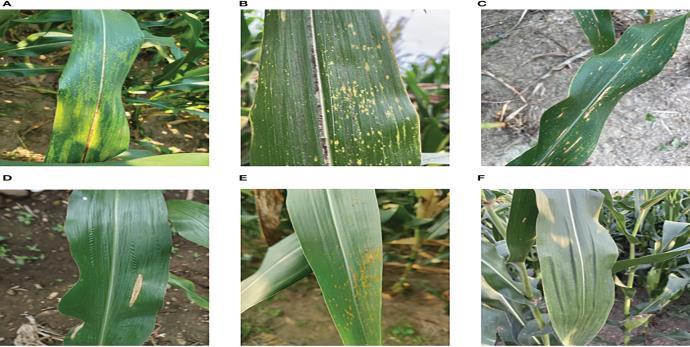
3810photostotalfromthecollectionareincluded,withthe names of the diseases represented by five classes. The dataset includes 900 healthy photos, 760 images with common rust damage, 700 images with grey leaf damage, 650imageswithSouthernrustdamage,and800imageswith Northern maize leaf blight damage. Deep learning models requirealargedatasetinordertofunctionwell.UsingKeras' Imagedatagenerator,theimagesareresizedto224x224
International Research Journal of Engineering and Technology (IRJET) e-ISSN: 2395-0056
Volume: 11 Issue: 04 | Apr 2024 www.irjet.net p-ISSN: 2395-0072
pixelsizes,afterwhichmodificationslikerotation,zoom,and shiftaremade.
This section presents the data and main classifier models usedinthisinvestigation.GoogleColabhasbeenusedinthe implementation of the current study. Fig 2 displays the classificationmodel'sworkingdiagram.Thisresearchuses an alternative way to categorize illnesses of maize leaves. Afterpre-processing,theprocessofobtainingfeaturesfrom theonesthatalreadyexistisknownasfeatureextraction. Next,thedatasetisappropriateforclassification.
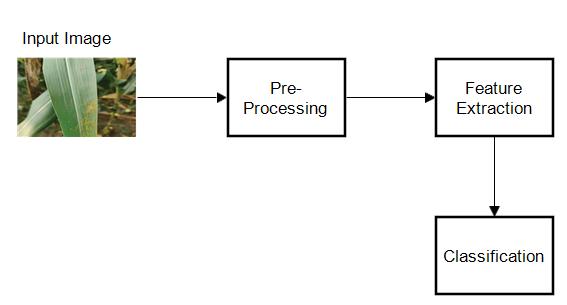
Fig 2: Methodology
Thissectionexplainsthemethodsusedtoextractthemost information from images of maize leaves. Among the methodsemployedarepicturesegmentation,imagescaling, and colour space conversion. All of the photos in the collectionhave beenreducedinsizeto224by 224pixels. TheircolourspacesarethenconvertedtoHSVforfurther processing.IntheHSVcolourspace(Value),hue,saturation, andbrightnesslevelsofcolourareallrepresentedbythree distinct terms [15]. An improved version of the Inception architecture,knownasInception-v3,hasfewerparameters andgoodcomputingefficiencywhilescalingup.Since2012, as the intricacy of the models employed in the ImageNet dataset has grown, so has success; yet, a large number of themremaincomputationallyinefficient.TheEfficientNetB7 model is a conglomeration of CNN models [16]. There are eight models in the EfficientNet group, and accuracy significantlyoutpacesgrowthinderivedparameternumbers asthenumberofmodelsrises.UnlikepreviousCNNmodels, EfficientNet replaces the Rectifier Linear Unit (ReLU) activationfunctionwiththeSwishactivationfunction.Deep learning architectures aim to increase the visibility of smaller,moreefficientmodels[17] Theprimarycomponent of EfficientNet; yet, because of its larger FLOPS (floating pointoperationspersecond)budget,itisutilizedsomewhat morethanMobileNetV2[20].Detaileddiscreteconvolutions are used in this design, which almost doubles calculation efficiencyoverstandardlayers[18].Thekernelsizecontrols thedimensionsofthe2Dconvolutionwindow. Initially,the images are reduced to 256 x 256 pixels for shallow networks,224x224pixelsforVGG16andVGG19,and299x 299pixelsforearlynetworks.Wedothemodeloptimization
andpredictionontheserescaledimages.Secondly,allpixel values are split by 255 to make them consistent with the baselinevaluesofthenetwork.Samplenormalizationisthe thirdstage.Normalizationfacilitatesmoreefficientend-toend training. Transfer learning in maize leaf disease detection enhances data efficiency, generalization performance, convergence speed, and adaptability while conserving computational resources. By leveraging knowledge from related domains, transfer learning contributes to the development of more accurate, robust, andscalableAI-basedsolutionsformanagingmaizediseases andensuringglobalfoodsecurity.
Pre-trainedmodelsaredeeplearningmodelsthathavebeen trained on large datasets for general tasks such as image recognition,naturallanguageprocessing,orothermachine learningtasks.Thesemodelshavelearnedtoextractfeatures andpatternsfromdatathroughtheprocessoftrainingon massiveamountsoflabeledorunlabeleddata.
5.1. Visual Geometry Group 16 (VGG 16)
VGG16isaconvolutionalneuralnetworkarchitecturethat gained prominence for its simplicity and effectiveness in image classification tasks [19]. Developed by the Visual GeometryGroupattheUniversityofOxford,VGG16consists of 16 layers, including 13 convolutional layers and 3 fully connectedlayersasshowninFig3.
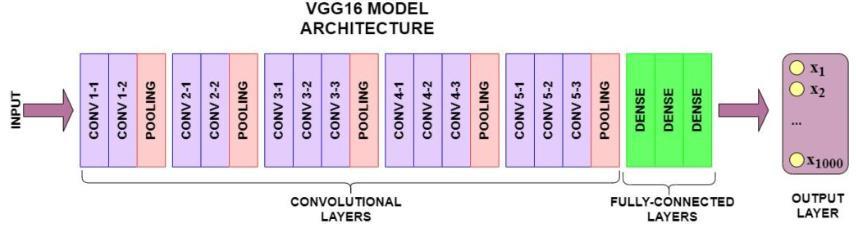
One of its key characteristics is the use of small (3x3) convolutional filters with a stride of 1 and max-pooling layers (2x2) with a stride of 2, which contributes to its uniformarchitecture.Despiteitsdeepstructure,VGG16 is relatively easy to understand and implement, making it a popularchoiceforresearchersandpractitionersinthefield ofcomputervision.Althoughnewerarchitectureshavesince surpassed its performance, VGG16 remains an essential benchmark and serves as a foundational model for understandingdeepconvolutionalneuralnetworks.
5.2. Visual Geometry Group 19 (VGG19)
VGG19isaconvolutionalneuralnetworkarchitecturethat builds upon the success of its predecessor, VGG16. Like VGG16,itwasdevelopedbytheVisualGeometryGroupat
Volume: 11 Issue: 04 | Apr 2024 www.irjet.net
theUniversityofOxford.The'19'initsnamereferstothe total number of layers, which includes 16 convolutional layers and 3 fully connected layers. VGG19 maintains the simplicity and uniformity of architecture seen in VGG16, withsmall(3x3)convolutionalfiltersandmax-poolinglayers (2x2).
ResNet152 stands as a pinnacle in the realm of deep convolutional neural networks (CNNs), particularly renownedforitsunprecedenteddepthandgroundbreaking architectural innovation. Developed by researchers at Microsoft Research, ResNet152 introduced the concept of residuallearning,whichrevolutionizedhowdeepnetworks aretrained.Fig4showsthearchitectureofResNet152.
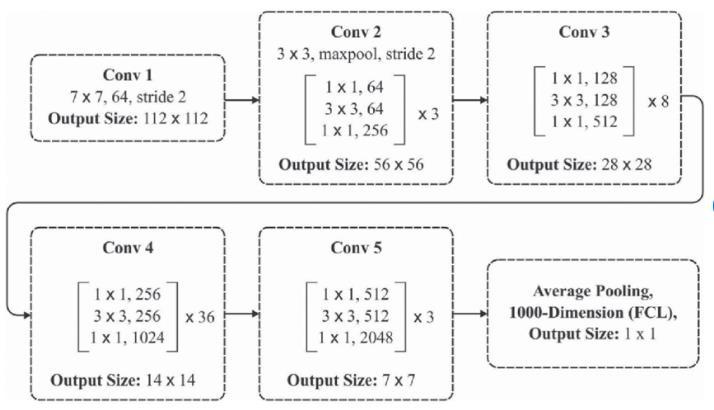
Fig 4: Architecture of ResNet152.
Residuallearningaddressesthevanishinggradientproblem by introducing shortcut connections, or skip connections, thatallowthenetworktobypasscertainlayers,effectively enablingthenetworktolearnresidualfunctionsratherthan directly learn the underlying mapping [21]. Its influence extends beyond performance benchmarks, shaping the landscape of deep learning research and inspiring subsequentarchitecturaladvancements.
EfficientNetB7 represents a significant advancement in neural network design, characterized by its remarkable balance between model size and performance [22]. Developed by Google AI, EfficientNetB7 is part of the EfficientNet family, which leverages a novel compound scalingmethodtooptimizemodelparametersforefficiency and effectiveness. This approach systematically scales the depth, width, and resolution of the network to achieve superior performance with fewer parameters, making EfficientNetB7 particularly well-suited for resourceconstrainedenvironmentsasshowninFig5.
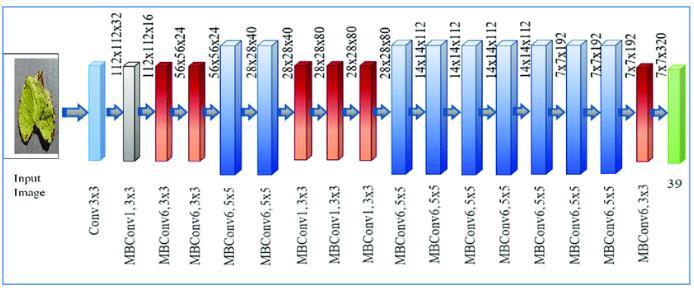
Despite its efficiency, EfficientNetB7 exhibits impressive accuracy across various computer vision tasks, including image classification, object detection, and semantic segmentation. Its efficient architecture makes it highly deployableinreal-worldapplicationswherecomputational resourcesarelimited,whileitspowerfulfeatureextraction capabilitiesensurehighperformance.EfficientNetB7stands as a testament to the importance of balancing model complexityandefficiency,settinganewstandardforneural network design in the era of constrained computing resources.
Studies in the literature indicate that a useful method for classifying maize illnesses is to pre-train models using transfer learning. The experimental results are assessed usingpopularpre-trainedmodelsincludingVGG16,VGG19, ResNet152andEfficientNetB7.
The 3810 picture dataset is divided in 80:20 ratio into trainingandtestingsetsinordertoconduct thetests.The trainingsetconsistsof3000photographs,whilethetesting set contains 810 photos. The image is resized to the resolution needed for the standard size required by the VGG16,VGG19,InceptionV3,andEfficientNetB7models.The experimentalresultsinTableIshowthattheVGG16hasa precisionof92.10%andaclassificationaccuracyof92.10 %.Inaddition,VGG19hasoutperformedVGG16inaccuracy with 94.17 % precision and 94.23 % accuracy. Moreover ResNet152hasanaccuracyof95.52%.Withanaccuracyof 98.56 %, the EffectiveNetB7 model surpassed the other modelsasshowninTable1.Furtherahightrainingaccuracy wasobtainedfromthismodel.
Table1: Results obtained from PTMs
International Research Journal of Engineering and Technology (IRJET) e-ISSN: 2395-0056
Volume: 11 Issue: 04 | Apr 2024 www.irjet.net p-ISSN: 2395-0072
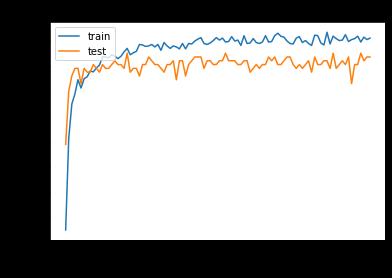
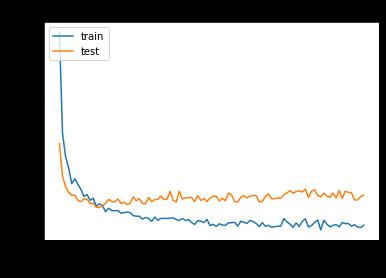
Fig 6: Curves (a) training accuracy (b) model loss
7. CONCLUSION
This work facilitates the early detection of maize leaf diseases, which is important in preventing crop loss and disease spread. A number of plant diseases are reliably predictedbytheCNNmodel.Uponevaluatingtheefficacyof multiple pre-trained CNN models, such as VGG16, VGG19, ResNet152andEfficientNetB7,themostaccuratemodelis identifiedbasedonperformancemetrics.Duringtesting,the model'sperformanceevaluationcriteria precision,recall, accuracy, and F1 score are applied. With an accuracy of 98.56%,theEfficientNetB7modelwasthemostaccurate.AIpoweredsystemscandetectmaizeleafdiseasesatanearly stage, even before they are visible to the naked eye. This earlydetectionenablesfarmerstotakepreventivemeasures promptly, such as applying fungicides or adjusting agriculturalpractices,tomitigatethespreadandimpactof diseases.Byaccuratelyidentifyinganddiagnosingdiseases in maize plants, AI contributes to optimizing crop yields. Timely intervention based on AI-generated insights can prevent significant yield losses caused by diseases, ultimatelyensuringfoodsecurityandeconomicstabilityfor farmers.
[1]W.Zeng,H.Li,G.Hu,andD.Liang,“Identificationofmaize leafdiseasesbyusingtheSKPSNet-50convolutionalneural networkmodel,” Sustainable Computing: Informatics and Systems,35,100695,2022.
[2]S.John,andA.L.Rose,“MachineLearningTechniquesIn PlantDiseaseDetectionAndClassification-AStateofTheArt,” INMATEH-AgriculturalEngineering,65(3),2021.
[3] A. Priyadharshini, S. Arivazhagan, M. Arun and A. Mirnalini, “Maizeleaf disease classification using deep convolutional neural networks,”Neural Computing and Applications,31,8887-8895,2019.
[4]S.Mishra,R.Sachan,andD.Rajpal,“Deepconvolutional neuralnetwork based detection system for real-time corn plantdiseaserecognition,”ProcediaComputerScience,167, 2003-2010,2020.
[5]K.P.Panigrahi,A.K.Sahoo,andH.Das,“ACNNapproach for corn leaves disease detection to support digital agriculturalsystem,”In20204thInternationalConference on Trends in Electronics and Informatics (ICOEI)(48184) (pp.678-683).Ieee,2020.
[6] B. K. Abdulaziz, S. Kamaruzaman, A. Khairulmazmi, A. Zulkifli, S. Mohd, and A. Norzihan, “Characterisation and pathologicalvariabilityofExserohilumturcicumresponsible for causing northern corn leaf blight (NCLB) disease in Malaysia.,”MalaysianJournalofMicrobiology,13(1),41-49, 2017.
[7] V. K. Malik, M. Singh, K. S. Hooda, N. K. Yadav, and P. K.Chauhan, “ Efficacy of newer molecules, bioagents and botanicals against maydis leaf blight and banded leaf and sheathblightofmaize,”Theplantpathologyjournal,34(2), 121,2018.
[8] M. Sibiya, and M. Sumbwanyambe, “ Automatic fuzzy logic-basedmaizecommonrustdiseaseseveritypredictions with thresholding and deep learning,” Pathogens, 10(2), 131,2021.
[9] H. A. Craze, N. Pillay, F. Joubert, D. K. Berger, “ Deep LearningDiagnosticsofGrayLeafSpotinMaizeunderMixed DiseaseFieldConditions,”Plants,11(15),1942,2022.
[10] Q. Sun, L. Li, F. Guo, K. Zhang, J. Dong, Y. Luo, and Z. Ma,“Southern corn rust caused by Puccinia polysora Underw: a review,” Phytopathology Research, 3(1), 111,2021.
[11]C.DeChant,T.Wiesner-Hanks,S.Chen,E.L.Stewart,J. Yosinski, M. A. Gore, and H. Lipson, “ Automated identificationofnorthern leafblight-infectedmaizeplants from field imagery using deep learning,” Phytopathology, 107(11),1426-1432,2017.
[12] X. Zhang, Y. Qiao, F. Meng, C. Fan, and M. Zhang, “ Identification of maize leaf diseases using improved deep convolutional neural networks,” Ieee Access, 6, 3037030377,2018.
International Research Journal of Engineering and Technology (IRJET) e-ISSN: 2395-0056
Volume: 11 Issue: 04 | Apr 2024 www.irjet.net p-ISSN: 2395-0072
[13]M.Sibiya,andM. Sumbwanyambe, “Acomputational procedurefortherecognitionandclassificationofmaizeleaf diseases out of healthy leaves using convolutional neural networks,”AgriEngineering,1(1),119-131,2019.
[14] A. Waheed, M. Goyal, D. Gupta, A. Khanna, A. E. Hassanien, and H. M. Pandey, “An optimized dense convolutionalneuralnetworkmodelfordiseaserecognition andclassificationincornleaf,”ComputersandElectronicsin Agriculture,175,105456,2020.
[15]M.Haque,S.Marwaha,C.K.Deb,S.Nigam,A.Arora,K.S. Hooda,andR.C.Agrawal,“Deeplearning-basedapproachfor identificationofdiseasesofmaizecrop,”Scientificreports, 12(1),1-14,2022.
[16]J. Hu,Q. Jiang,R.Cong, R.,W.Gao,andF.Shao, “Twobranch deep neural network for underwater image enhancement in HSV color space,” IEEE Signal Processing Letters,28,2152-2156,2021.
[17]G.G.Amaje,“SweetPotatoLeafDiseaseDetectionAnd Classification Using Convolutional Neural Network,” (Doctoraldissertation,2022
[18] G. Marques, D. Agarwal, and L. de la Torre Díez, “Automated medical diagnosis of COVID-19 through EfficientNet convolutional neural network,” Applied soft computing,96,106691,2020.
[19]Q.Xiang,X.Wang,R.Li,G.Zhang,J.Lai,andQ.Hu,“Fruit image classification based on Mobilenetv2 with transfer learningtechnique,”InProceedingsofthe3rdinternational conferenceoncomputerscienceandapplicationengineering (pp.1-7),2019.
[20] H. Garg, B. Sharma, S. Shekhar, and R. Agarwal, “Spoofing detection system for e-health digital twin using EfficientNet Convolution Neural Network.,” Multimedia ToolsandApplications,81(19),26873-26888,2022.
[21] X. Zhang, Y. Zhu, K. A. Kremling, M. C. Romay, R. Bukowski,Q.Sun,F.Lu,“Genome-wideanalysisofdeletions inmaizepopulationrevealsabundantgeneticdiversityand functionalimpact,”TheoreticalandAppliedGenetics,1-18, 2022.
[22] C. Xu, C. Yu, and S. Zhang, “Lightweight Multi-Scale Dilated UNet for Crop Disease Leaf Image Segmentation,” Electronics,11(23),3947,2022.