
International Research Journal of Engineering and Technology (IRJET) e-ISSN: 2395-0056
Volume: 11 Issue: 04 | Apr 2024 www.irjet.net p-ISSN: 2395-0072

International Research Journal of Engineering and Technology (IRJET) e-ISSN: 2395-0056
Volume: 11 Issue: 04 | Apr 2024 www.irjet.net p-ISSN: 2395-0072
Bhavani R1, Harikrishna P2, Sabarinathan S3, Yaswanth K4
1234Dept. of Computer Science and Engineering, Government College of Engineering Srirangam, Tamil Nadu, India
Abstract - In today's dynamic job market, both job seekers and recruiters face challenges in matching skills to job requirements efficiently. The Job and Skills Recommendation System (JSRS) aims to address this by providingpersonalizedrecommendationstojobseekersand recruiters based on their respective needs and preferences. For job seekers, JSRS offers a user-friendly interface where they can input their skills, qualifications, and career preferences. Leveraging advanced algorithms and machine learning techniques, JSRS analyzes this information along with historical job data to generate tailored job recommendations. These recommendations consider factors such as job relevance, career growth opportunities, and geographical preferences, enabling job seekers to discover suitable job openings quickly and easily. Ultimately, JSRS aims to bridge the gap between job seekers and recruiters, facilitating mutually beneficial connections that drive successintoday'scompetitivejobmarket.
Key Words: Machine Learning, Natural Language Processing, Job and Skills Recommendation System, K Nearest Neighbor, Term Frequency-Inverse Document Frequency.
In today's rapidly evolving job market, the process of matching job seekers with suitable employment opportunitiesandrecruiterswithqualifiedcandidateshas become increasingly complex. With the abundance of job postings and resumes available online, both job seekers and recruiters face the daunting task of sifting through vast amounts of information to find the perfect match. Traditional methods of recruitment often rely on manual sorting and keyword matching, which can be timeconsuming,inefficient,andpronetobiases.
To address these challenges, advanced technologies such as Artificial Intelligence (AI) and Machine Learning (ML) are being leveraged to develop innovative solutions that streamline the job search and recruitment process. One such solution is the development of JSRS, which aim to revolutionize the way job seekers find employment opportunities and recruiters identify top talent. By utilizing sophisticated algorithms and data analytics techniques, JSRS offers personalized recommendations basedontheskills,preferences,andrequirementsofboth jobseekersandrecruiters.
This section aims to review the existing t techniques for jobandskillrecommendation. Alsaifetal.[1]developeda bi-directional recommendation system using NLP techniques to match job seekers with job recruiters. The system includes web scraping, data pre-processing, NLP modeltraining,andbi-directionalmatchingsteps,utilizing sa.indeed.com data. Named entities detection and validation using precision metrics were conducted, with Word2vec employed for term retrieval to enhance matching efficiency. Mahalakshmi et al. [2] developed a Job Recommendation System focusing on skill sets to aid college graduates in finding fitting employment. It analyzes resumes to suggest tailored job opportunities and recommend skill enhancements. Employing preprocessing techniques and cosine similarity, it offers hierarchical job recommendations, aiming to reduce unemployment and foster career growth. Desai et al. [3] developed an Automated Job Recommendation System using Collaborative Filtering for personalized job suggestions. The system integrates user-based and itembased algorithms, utilizing student resumes and recruitment details for tailored recommendations. It encompasses data preprocessing, collaborative filtering, and evaluation phases, offering a promising solution to traditional job search inefficiencies. Mhamdi et al. [4] developed a Job Recommendation System using Profile Clustering and Job Seeker Behavior analysis, offering personalized suggestions by clustering job attributes and aligning with user behavior. Enhance accuracy by integrating Word2vec and k-means clusterings. Punitavathietal.[5]proposedathree-tierarchitecturefor an online job and candidate recommendation system, utilizing PHP Standards Recommendation (PSR) and text field filtering for efficient data management. The model integrates recommender system technology and web services to provide personalized recommendations, ensuring privacy through encryption. Their system effectively manages data flow, tackling information overload in online recruiting for robust and personalized recruitmentprocesses.
International Research Journal of Engineering and Technology (IRJET) e-ISSN: 2395-0056
Volume: 11 Issue: 04 | Apr 2024 www.irjet.net p-ISSN: 2395-0072
3.1
Figure 1 depicts the overall system architecture of the proposed system. The system architecture comprises three phases: User Login, Admin Login, and Recruiters Login. Users access the system using their credentials to upload resumes for the Job Seekers Recommendation System. Resumes, typically in PDF or DOC format, are processed to extract and convert them into Term Frequency-InverseDocumentFrequency(TF-IDF)vectors. Simultaneously,jobpostingsarescrapedfromLinkedInor retrievedfromthesystem'sdatabase.Jobdescriptionsare parsed to extract skills, transformed into TF- IDF vectors, facilitating recommendation of the top K jobs to users using a and K-Nearest Neighbors (KNN) algorithm. Recruiters can upload job descriptions upon logging in. ThesedescriptionsareconvertedintoTF-IDFvectorsafter extraction.Resumesstoredinthedatabaseareanalyzedto extractskills,alsotransformedinto TF-IDF vectors.These components streamline the recommendation of the top K resumes to recruiters, aiding in efficient candidate selection. Admin login credentials provide access for editing and maintaining the database within the system forsmoothoperationandmanagement.
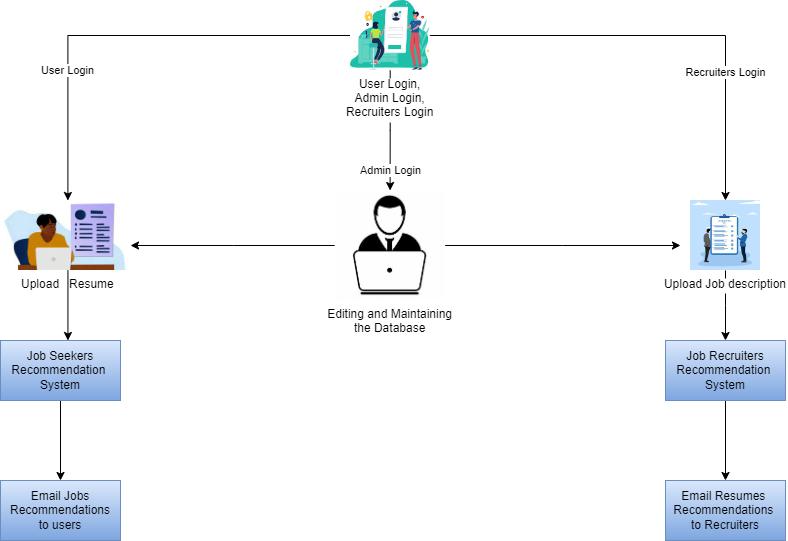
Fig.1SystemArchitecture
3.2 Recommendation Engine
Inrecommendationenginethatworksonusersideaswell as recruiters side uses TF-IDF vectorization, KNN algorithm.
Textual data in the resumes and job descriptions are converted to numerical vectors using TF-IDF. TF-IDF assigns Determine the weights of words by considering theirfrequenciesinadocumentrelativetotheirfrequency across all documents, capturing the importance of each wordasgiven(1). Where
K-nearest neighbors (KNN) algorithm serves as a crucial component for recommending top job opportunities to users. KNN works by calculating the similarity between data points based on their features. By identifying the K nearest neighbors in the feature space, the algorithm recommendsthemostrelevantjobopportunitiestousers. ThestepsfollowedinK-NNalgorithmisgivenbelow.
Input: X: training data, Y: class labels of X, K: number of nearestneighbors.
Output: Classoftestsamplex.
Start
Classify(X,Y,x)
1.foreachsamplexdoCalculatetheDistance: d(x,X)= endfor
2.Classifyxinthemajorityclass:
Web scraping serves as a crucial component in gathering job postings from LinkedIn, enriching the system's database with a diverse array of opportunities. Python, a popular programming language renowned for its robust
International Research Journal of Engineering and Technology (IRJET) e-ISSN: 2395-0056
Volume: 11 Issue: 04 | Apr 2024 www.irjet.net p-ISSN: 2395-0072
webscrapingcapabilities,isemployedtoimplementthese functionalities. Leveraging Python libraries such as Beautiful Soup and Scrapy, the system programmatically accesses and extracts data from LinkedIn's, Indeed etc. webpages.
These libraries offer powerful tools for parsing HTML content, navigating web elements, and extracting relevant job information efficiently. Admin login functionalities oversee the integration of Python-based web scraping methods into the system, ensuring seamless data acquisition and management. The extracted job postings are subsequently converted into a Comma-Separated Values (CSV) file format, enabling easy storage, retrieval, and manipulation within the system's database. Overall, Python's versatility and the utilization of web scraping techniques enhance the system's capability to provide users with up-to-date and relevant job opportunities, contributingtoamoreefficientandeffectivejobmatching platform.
Figure2depictsthesystemarchitecturecomponentofthe Job Seekers Recommendation System. The job seekers recommendation system facilitates resume uploads, initiatingaprocesswhereresumesareconvertedintotext format for analysis. Advanced text processing techniques are then applied to extract relevant information, subsequently transformed into TF-IDF vectors, representing term significance for numerical analysis. Concurrently, job postings are scraped from LinkedIn, storing detailed descriptions in a CSV file, including titles and required skills. These job descriptions undergo text feature extraction, followed by conversion into TF-IDF vectors akin to resumes, enabling numerical representation. Upon TF-IDF conversion of both resumes and job descriptions, the KNN algorithm is deployed. This algorithm computes similarity between TF-IDF vectors of job seekers' skills and job requirements, identifying K nearest job positions aligning with the user's profile. Recommended job positions are then displayed to users, offering personalized opportunities. The process integrates text processing, web scraping, TF-IDF vectorization, and KNN algorithm, optimizing job recommendationforenhancedjobseekingexperiences.
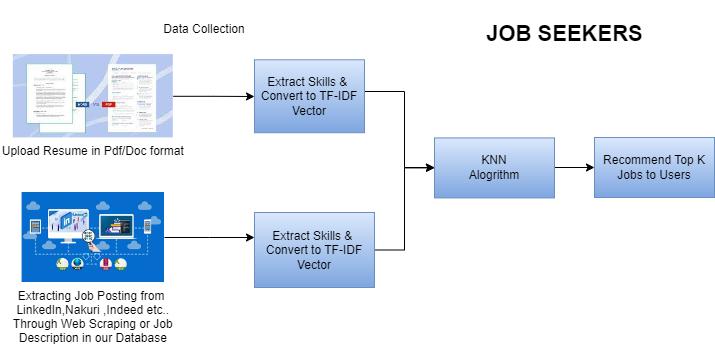
Fig.2JobSeekersRecommendationSystem
Figure3depictsthesystemarchitecturecomponentofthe Job Recruiters Recommendation System. The job recruitersrecommendationsystembeginswiththeupload of job descriptions in text format, where text extraction isolates pertinent details such as titles, descriptions, and requisite skills. Extracted text undergoes conversion into TF-IDF vectors, weightingterms basedon their frequency relative to other descriptions in the database, facilitating efficient storage and comparison. Concurrently, user resumes stored in the database are subject to skill extraction via Natural Language Processing (NLP) techniques,identifyingkey qualificationsandskills.These arethenconvertedintoTF-IDFvectors,weightedbasedon frequency across all resumes in the system. Both job descriptions and resumes are represented as TF-IDF vectors,enablingtheapplicationoftheKNNalgorithm for recommendation. KNN calculates the distance between TF-IDF vectors to identify the K nearest resumes for each job description, facilitating effective matching. The recommended resumes, identified by the KNN algorithm, arethendisplayedtojobrecruitersforreviewthroughthe system's interface. Recruiters can assess these recommendations to identify candidates closely aligned with the job requirements specified in the descriptions. This process streamlines candidate selection for job recruitersbyleveragingTF-IDFvectorizationandtheKNN algorithm, ensuring efficient identification of suitable candidatesfortheirjobopenings.
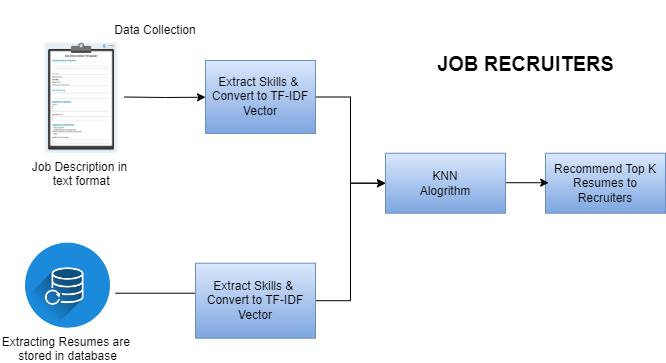
Fig.3JobRecruitersRecommendationSystem
International Research Journal of Engineering and Technology (IRJET) e-ISSN: 2395-0056
Volume: 11 Issue: 04 | Apr 2024 www.irjet.net
The experimental evaluation of the JSRS was aimed at assessingitsperformanceacross variouscomponentsand functionalities. By conducting rigorous experiments, the effectiveness, efficiency, and usability of the system in facilitating job matching and talent recommendation processesweresoughttobeevaluated.Inthissection,the findings and outputs obtained from the experimental analysis are presented, starting with an overview of the systemarchitectureandmethodologyperformance.
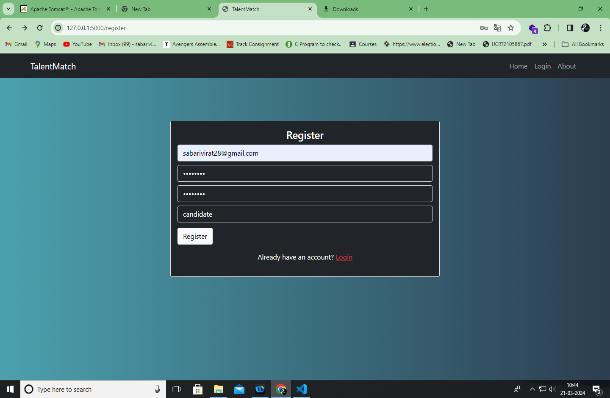
New users begin the user login process by registering through a form, providing email, password, and confirming password. They select between candidate registration, input necessary details, and upon successful registration, are directed to the login page. Here, users access their profiles and associated functionalities by enteringtheiremailandpasswordasgiveninfigure4.
Admin login directly accesses the database, bypassing the registration form. Upon successful authentication, the admin gains immediate access to the database for editing and maintenance purposes. This streamlined process enhances efficiency in managing system data given in figure5.

Newrecruitersbegintheuserloginprocessbyregistering through a form, providing email, password, and confirming password. They select between company registration, input necessary details, and upon successful registration, are directed to the login page. Here, users access their profiles and associated functionalities by enteringtheiremailandpasswordasgiveninfigure6.

Performance metrics introduced, such as precision, recall, F1 score, and accuracy, are pivotal in assessing the effectiveness of our job recommendation system. Analyzing these metrics ensures accurate and impactful recommendations, elevating the user experience. Continuous optimization based on these evaluations underscores our commitment to delivering reliable solutions for job seekers and recruiters. Table 1 displays thejobdomaincategoriesutilizedintheconfusionmatrix.
International Research Journal of Engineering and Technology (IRJET) e-ISSN: 2395-0056
Volume: 11 Issue: 04 | Apr 2024 www.irjet.net p-ISSN: 2395-0072
Table 1: JobDomainClass
The table 2 below summarizes the performance metrics for various job roles in our recommendation system. Thesemetricshelpusevaluatehowaccuratelythesystem recommendsrelevantjobrolestousers.
Table 2: PerformanceMetricsTable
Negatives, False Positives (FP), and False Negatives (FN).
Mathematically, it can be represented as:

The performance metrics of the JSRS project, including precision, recall, F1 score, and accuracy, offer comprehensive insights into the effectiveness of our job recommendation system. Through rigorous experiments, it is observed that, the JSRS recommends jobs to the job seekers and recruiters with an accuracy of 87.37%. It recommends jobs that are most relevant to the skill sets specifiedintheresumeandjobdescription.
JSRSrevolutionizesjobsearchandrecruitmentusingNLP, ML, and web scraping, simplifying job seeking and candidate screening. It employs web scraping from platforms like LinkedIn, Indeed, and Naukri for accurate job postings, NLP for TF-IDF vectorization, KNN for personalized recommendations. JSRS offers tailor-made dashboards for job seekers, enhancing matching and bridgingthegapbetweencandidatesandrecruitersinthe competitive job market. Future enhancements for JSRS include refining recommendation algorithms, integrating diverse job data sources, and exploring advanced technologies for optimization while ensuring privacy, security, and regulatory compliance. JSRS's evolution hinges on its adaptability to market dynamics and user requirements, empowering talent acquisition and career advancementforindividualsandorganizations.

Precision: Indicates how accurately the system recommends a specific job role. It is calculated as ,whereTPisthenumberofTruePositivesandFPis thenumberofFalsePositives.
[1] Alsaif S. A., Sassi Hidri M ,Ferjani I , Eleraky H. A., & Hidri A (2022). NLP-based bi-directional recommendation system: Towards recommending jobstojobseekersandresumestorecruiters.BigData andCognitiveComputing,6(4),147.

Recall: Measures the system's ability to capture all relevant instances of a job role. It is calculated as ,whereFNisthenumberofFalseNegatives.
F1 Score: Balances precision and recall, providing an overall measure of the system's effectiveness. It is calculatedas

Accuracy: The accuracy of a classification model is calculated as the ratio of the sum of True Positives (TP) and True Negatives (TN) to the total number of predictions made, which includes True Positives, True
[2] Mahalakshmi G, Arun Kumar A, Senthilnayaki B, Duraimurugan J ,(2022). Job recommendation system based on skill sets: International journal of creative researchthoughts(IJCRT),10,ISSN:2320-2882
[3] Desai, V., Bahl, D., Vibhandik, S., & Fatma, I. (2017). Implementationofanautomatedjobrecommendation system based on candidate profiles. Int. Res. J. Eng. Technol, 4(5),1018-1021
[4] Mhamdi,D.,Moulouki,R.,ElGhoumari,M.Y.,Azzouazi, M.,&Moussaid,L.(2020).Jobrecommendationbased on job profile clustering and job seeker behavior. ProcediaComputerScience,175,695-699
International Research Journal of Engineering and Technology (IRJET) e-ISSN: 2395-0056
Volume: 11 Issue: 04 | Apr 2024 www.irjet.net p-ISSN: 2395-0072
[5] Punitavathi,D.,Shinu,V.,Kumar,S.,&Sp,V.P.(2019). Online job and candidate recommendation system. International Research Journal of Multidisciplinary Technovation,1(3),84-89.