
International Research Journal of Engineering and Technology (IRJET) e-ISSN: 2395-0056
Volume: 11 Issue: 04 | Apr 2024 www.irjet.net p-ISSN: 2395-0072
International Research Journal of Engineering and Technology (IRJET) e-ISSN: 2395-0056
Volume: 11 Issue: 04 | Apr 2024 www.irjet.net p-ISSN: 2395-0072
Purushottam Varshney1 , Paras Chandra2 , Rohan Kumar Sinha3 , Ms. Sakshi Malhotra4
1 B. Tech student, Information Technology, Galgotias College of Engineering & Technology, Uttar Pradesh, India
2 B. Tech student, Information Technology, Galgotias College of Engineering & Technology, Uttar Pradesh, India
3 B. Tech student, Information Technology, Galgotias College of Engineering & Technology, Uttar Pradesh, India
4 B. Tech faculty, Information Technology, Galgotias College of Engineering & Technology, Uttar Pradesh, India
Abstract - Agriculture is the main source of earning for various farmers. Their earning largely depends on the crop yield and the amount paid for their crops. In India, the crop yield is not up to the expectation. This happens due to low soil fertility, not growing desired crops according to the need of the soil, exhaustive over use of fertilizer. This low crop yield adversely affects the famers living condition. The low crop yield is the major reason for the plight of the farmers. The present work focuses on recommendation of suitable crops to be sown in the particular field or soil and also endorsing the farmer in sprinkling desired amount of fertilizer in the soil for the particular crop so that the farmer can make significant profit. Our work focuses on recommending four to five crops which are suitable for growing in particular type of field or soil either corresponding to the N, P, K, pH values entered by the farmer or district wise suitable crops. This system uses different parameters such as pH, N, P, K values to predict the suitable crops. Our work also facilitates endorsing farmer in sprinkling the required amount of fertilizer in their field for the particular crop by using the N, P, K values. The proposed system will give suggestion to the farmer to meet up the required deficient nutrient and minerals in the soil. This paper also contains about the various algorithms and their accuracy for recommending crops. Our work uses the Naïve Bayes Algorithm for recommending the suitable crops to the farmers. We have used this algorithm as it is highly efficient, easy to implement and works for high dimensional data. This algorithm is highly accurate in high dimensional space and data The accuracy along with algorithm is well represented in a table. Our present work aims to address the low crop yield problem and offering farmers choices to grow one or more crops out of four to five crops suitable for the particular soil i.e. companion cropping so that they could make high profit and also maintains soil fertility.
Key Words: Naïve Bayes Algorithm, Crop Yield, High Dimensional data, Crop Companion
1.INTRODUCTION
Food is a fuel that our body requires to carry day to day functions. Food directly relates to crop farming. Cultivations of crops encompasses many agricultural practices taken care by farmers. The economists failed to evolve a system fair to farmers. As farmers are not
technically skilled, so they require a smart solution that can assist them in increasing the efficiency and profitability of cultivation. And those solutions can be producedbysmartagriculture.
Smart agriculture, also known as precision agriculture, is an innovative approach to farming that integrates technology and data analytics to optimize crop yields, reduce waste, and minimize environmental impact. Precision agriculture (PA) is an agricultural management concept based on monitoring, measuring and responding tointer-fieldand intra-field variabilityofcrops.PAisalso sometimes referred to as precision agriculture, satellite agriculture, on-demand agriculture, and site-specific crop management (SSCM). Precision agriculture uses information technology (IT) to ensure that crops and soil receive exactly what they need for optimal health and productivity. It also ensures profitability, sustainability and environmental protection. It takes into account aspects such as soil type, terrain, weather, plant growth andyieldsincropmanagement.
Smart agriculture projects use a variety of cutting-edge technologies, including sensors, drones, and machine learning algorithms, to collect and analyze data about soil conditions, weather patterns, plant growth, and other key variables. These machines help to collect the data of variousnutrientandmineralsuchasN,P,K,pHetc. along with their value of the agriculture land soil. By applying advanced analytics and automation, farmers can make more informed decisions about planting, fertilizing, watering, and harvesting crops, leading to increased efficiency and profitability. Overall, smart agriculture represents an exciting opportunity to transform the way we grow food and manage natural resources. By harnessing the power of technology and data, we can create a more sustainable, efficient, and equitable food systemthatbenefitsfarmers,consumers,andtheplanet.
After the data is collected, predictive analytics software uses the collected data to provide guidance to farmers regarding crop rotation, optimal planting times, harvesting, and soil management. Agricultural control centerscanintegratesensordataandimaginginputswith other data to enable farmers to identify fields that need
International Research Journal of Engineering and Technology (IRJET) e-ISSN: 2395-0056
Volume: 11 Issue: 04 | Apr 2024 www.irjet.net p-ISSN: 2395-0072
treatment and determine the optimal amount of water, fertilizerandpesticidestoapply.
This helps farmers avoid wasting resources and prevent runoff, ensuring the soil contains the right number of nutrients for optimal health while reducing costs and controlling the farm's environmental impact. There are othernumerousbenefitsofprecisionagriculturesuchas-
i. Costreduction-Theabilitytopreciselyreducethe amount of fertilizer, herbicide or seed in areas where it will not be economical to use is one of thekeybenefitsofprecisionagriculture.
ii. Increased profitability- Increasing yields through the use of high-resolution agronomic principles while reducing costs increases overall profitability. Farmers Edge offers one of the lowestpriced,highvaluepackagesintheindustry throughouruniqueapplicationoftechnology.
iii. Increased sustainability- Ensuring that applied plant-basedproductsactuallyreachtheplantand do not impact the environment elsewhere not only delivers better results, but also promotes a safer environment and may even give you access tonewmarketsforyourcropsinthefuture.Using our accurate services, we have been able to quantifythatonaverageaFarmersEdgeVariable Rate (VR) customer has reduced their carbon footprint by over 10% while increasing production!
iv. Better harvest- One of the most significant benefits of precision farming is the ability to understand the nutrient levels on the farm and the soil types on the farm. We know that fields and geographies are not created equal, and this can affect the amount of nitrogen mineralization, water holding capacity, and much more. By understanding these differences, we can make sure we don't overdo nitrogen, which can lead to lodging, or we can increase nutrients like potassium that help with stability in areas where it'slow.Totopitalloff,wecandoVRdesiccation, which means we can have lower desiccant on hilltops or sandy areas and higher rates on lowlying areas to ensure your crop is easily harvested.
v. Increased land values- We know that accuracy is an excellent practice from an agronomic point of view,butitcanalsoaffectthevalueoflandprices, asshownhere.
vi. Higher resolution Understanding your farmFarmers know their soil better than anyone else. Precision farming gives you the ability to understand why certain areas of your farm are not producing or producing better, giving you a basis for making decisions that continually improvethefarm.
vii. Better understanding of yield in season- Using accurate imagery or accurate weather services can not only help you understand areas of your farm that are facing problems or need more attention, but with this combination of farm and field information, we can provide an accurate yield forecast for the season. , enabling better decision-makingbothfromanagronomicpointof view and for marketing or asset purchase purposes.
They are all interconnected, but they are only the beginningofthevaluethatprecisionagriculturebrings.As technology improves, the use of technology improves and we continue to improve products, experiences and outcomesforfarmersfromtheHighLevelofCanadatothe DeepSouthofAustralia.
[1] Dr. S. Usha Kiruthika, Dr. S. Kanaga Suba Raja. “Design and Implementation of Fertiliser Recommendation System for Farmer”. This paper aims to estimate nutrient dimension of soil and suggest appropriate fertilizer. Their methodologies comprise of four stages- (i) soil analysis (ii) data preprocessing (iii) Data Analysis (iv) Recommendation. They have collected theNPKratioofthesoilnutrientusingNPKsensor.
Thegathereddataareprocessedusingmachinealgorithm toidentifythecorrectfertiliserrequiredforthatsoil.
[2] Suresh, G., A. Senthil Kumar, S. Lekashri, and R. Manikandan. “Efficient Crop Yield Recommendation System Using Machine Learning for Digital Farming”. This proposed system uses the data acquired by the locationofthelandandsuggeststheeffectivecropsbased on the soil fertility of that area. The system also provides therequiredquantityoffertilizers.
The work mainly used two datasets to produce the required output. One dataset is the sample dataset of locationanditssoilfertilityparametersandtheotherone is for the crop data according to soil parameters. In order to suggest crops and fertilizer, the framework utilizes the calculationsofsupportvectormachine.
This proposed work utilizes supervised machine learning algorithm to suggest appropriate crops to maximize the yield.Thesystemrecommendedparticularcropsbasedon nutrients (N, P, K and pH) values of the soil for the crops likerice,maize,blackgram,carrotandradish.
[3] Aqeel-ur-Rehman, Abu Zafar Abbasi, Noman Islam and Zubair Ahmed Shaikh, “A Review of Wireless Sensors and Networks’ Applications in Agriculture” This particular paper reviewed the applications of wireless sensors, WSN technology and its network
International Research Journal of Engineering and Technology (IRJET) e-ISSN: 2395-0056
Volume: 11 Issue: 04 | Apr 2024 www.irjet.net p-ISSN: 2395-0072
application in various aspects of agriculture. Also, this paper presented the different systems available for this particulardomain.
Thispaperpresentedtheusecaseofdifferenttechnologies in different aspects of agriculture such as irrigation, fertilization, pest control, horticulture and greenhouse. For the irrigation purpose, they reviewed the work of Damas et al. [4] in which they developed and tested remotely controlled, automatic irrigation system which utilizes WLAN network to connect all the regions and control themfromacontrolsystem.Andalso,thework of Morais et al. [5] which implemented wireless data acquisition network to collect climate and soil moisture data for smart irrigation in Portugal. Similarly, for fertilization they reviewed different works in which GPS technology,sensorsandBluetoothtechnologywasusedto collect the data of soil and its nutrients to maximize crop yield.
[6] Dhruvi Gosai, Chintal Raval, Rikin Nayak, Hardik Jayswal, Axat Patel, “Crop Recommendation System using Machine Learning”.Thebad qualityofcropisalso due to the either excessive fertilizer or using not enough fertilizer.ThisproposedsystemofIoTandMLisusingthe soil sensors and collecting the information by observing the soil parameters. This lowers the probability of the degradationofthesoilandhelpsmaintaincrophealth.
By the use of Kaggle dataset based on different soil and climateparameterfordifferentcropshasbeenpickedand pre-processed means removal of the noise and also identifying most suitable and relevant attribute from the dataset. Then by the help of the Decision Tree classifier methodology, the model was trained and by the help of SVMcropsareclassifiedaswellasregressionchallenge.It ismainlyusedinclassificationchallengeandusinglogistic regression for the model binary dependent variables. XG boostisusedtomaintaintheaccuracy.
[7] Qiming Zhou & Ali Ismaeel, “Integration of maximum crop response with machine learning regression model to timely estimate crop yield”. This literature utilizes the satellite remote sensing data to predict crop yield. The collected data is then utilized by machinelearningmodelstopredicttheyield.
In the study, they integrated the maximum Enhanced Vegetation Index (EVI) during the crop growing season with the Machine Learning Regression (MLR) models to estimate the crop yield for wheat and rice in Pakistan’s Punjab province. They utilized the five-fold crossvalidationmodelforpredictiveaccuracy.
Theproposedsystemwasabletopredictthecropyield68 weeks before he harvests. The prediction then further can be utilized in the formulation of agricultural policies forsocial,environmentalandeconomicprogress.
[8] Suporn Pongnumkul, Pimwadee Chaovalit, and Navaporn Surasvadi, “Applications of SmartphoneBased Sensors in Agriculture: A Systematic Review of Research”. This article systematically reviews smartphone application that are mentioned in various research literatures that utilizes built-in smartphone sensorsforprovidingsolutionstoagriculturalproblems.
The study showcases that GPS and cameras are the most popular sensors utilized in the reviewed research papers. Other smartphone sensors such as accelerometer, gyroscope, light sensors and moisture sensors utilization is very complex and only comes with expensive devices whichisnotaffordableforfarmers.
The utilization of camera for disease detection and crop water needs estimation has been done using image processing of the leaves that can be captured through smartphonecameras.
[9] N.Bhavya,K.Govinda,“TargetedYieldApproachof Fertiliser Recommendation for Sustaining Soil and Crop Productivity ”This researchpaperaimstofocuson fertilizer recommendation to increase crop recommendation.ThisresearchusesSTCR(SoilTestCrop Response)technique,whichusesthetestvaluesofsoiland targeted yield equation. STCR is one of the most scientific approaches to nitrogen application for crops among the differenttypesoffertilizerrecommendation.
3. PROPOSED SYSTEM
3.1 System Architecture
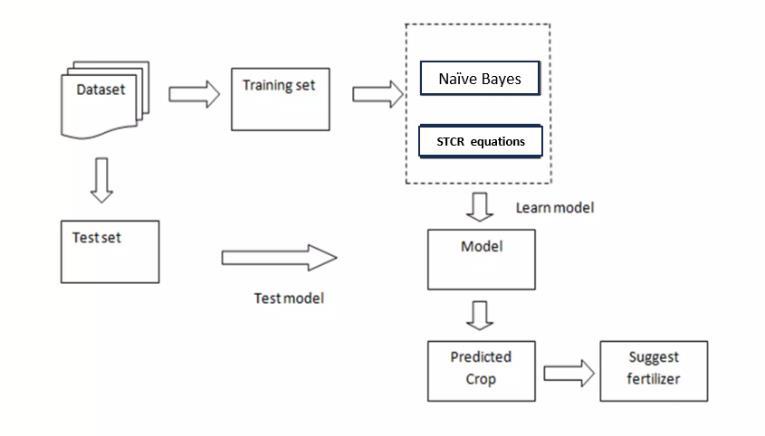
Fig.1: Backendmodulearchitecture
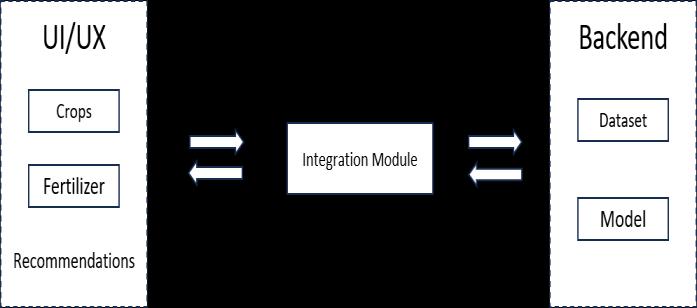
Fig.2: Frontendmodulearchitecture
International Research Journal of Engineering and Technology (IRJET) e-ISSN: 2395-0056
Volume: 11 Issue: 04 | Apr 2024 www.irjet.net p-ISSN: 2395-0072
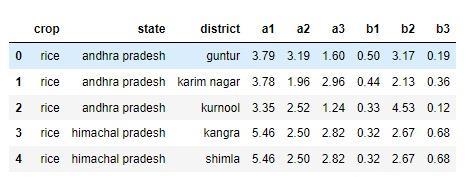
Proposed methodology for crop recommendations can be implemented on Agricultural Crop dataset available on Kaggle. It containsNPK parameters of soil, pHlevel of soil and weather conditions required for particular crop. For fertilizer recommendations, the dataset is prepared from STCR recommendation report of ICAR-IISS, Bhopal. It consists the coefficients of regression equations for respectivecropandarea.
3.3 Backend Module
a. Naïve Bayes Algorithm
BasedontheBayestheorem,theNaiveBayesalgorithmis astraightforwardprobabilisticclassifier.Itoperatesunder thenaiveassumptionthattheexistenceorabsenceofone featureimpliesthe existenceorabsenceofotherfeatures. Given a set of features, the algorithm calculates the probability of each class and outputs the class with the highestprobability.
The following steps make up the Naive Bayes general methodology:
1. Cleaning,formatting,anddividingthedatasetinto training and testing sets are all part of data preprocessing.
2. Selecting the pertinent features from the dataset that will be used to train the model is known as featureextraction.
3. Totrainthemodel,determinetheprobabilitiesof each class given a set of features using the training set. The algorithm erroneously assumes that every feature is independent of every other feature.
4. Utilizing the testing set to gauge the model's effectivenessisknownastestingthemodel.Given the features in the testing set, the algorithm calculates the probability of each class and outputstheclasswiththehighestprobability.
5. Utilizing performance metrics like recall, accuracy, precision, and F1 score, among others, toassessthemodel'sperformance.
6. Adjusting the model's parameters and/or choosingnewfeaturestoenhanceitsperformance isknownasfine-tuning.
The Naive Bayes algorithm, in general, is a straight forward but efficient classification algorithm that can be appliedtoavarietyoftasks,suchastextclassification,and spamfiltering
Decision Tree is a supervised machine learning algorithm thatcanbeusedforclassificationandregressionanalysis. It works by recursively partitioning the data into smaller subsetsbasedonthevaluesoftheinputfeaturesandthen making a prediction based on the subset's majority class or average output value The benefits of decision trees include their ability to handle both categorical and continuous input features, their interpretability, and their handling of missing data. Non-linear relationships between input features and output variables can also be handledbydecisiontrees.
c. SVM
SVMcanbeusedforclassificationandregressionanalysis. The goal of classification is to predict the class of a given data point, whereas the goal of regression is to predict a continuousoutputvariable.SVMfindsthebesthyperplane for categorising the data: The hyperplane is a decision boundary that divides data into different classes. SVM attempts to find the optimal hyperplane that maximises the margin between the hyperplane and the nearest data points of each class. This is known as the maximum marginhyperplane.
Theaccuracyofvariousalgorithmusedforrecommending thecropsareshowninthebelowtable:
Table 1: Algorithmcomparisontable
After testing with all the algorithm along with accuracy, wefindthataccuracyofNaïveBayesAlgorithmishighest. Ithelpstorecommendthecropswithhighprecision.
International Research Journal of Engineering and Technology (IRJET) e-ISSN: 2395-0056
Volume: 11 Issue: 04 | Apr 2024 www.irjet.net p-ISSN: 2395-0072
The proposed system estimates the soil nutrient content as provided by the user and recommends the suitable fertilizer content required for targeted yield by utilizing the particular STCR fertilizer recommendation equations fortheprovidedfieldlocation
The general STCR equations used for recommendations are:
) ( ) (1) ( ) ( ) (2) ( ) ( ) (3)
Where,FN:fertilizerN(kgha-1);FP2O5: fertilizerP2O5 (kg ha-1); FK2O: fertilizer K2O (kg ha-1); SN: soil test value of available N (kg ha-1); SP2O5: soil test value for available P2O5 (kg ha-1); SK2O: soil test value for available K2O (kg ha-1); NR: nutrient requirement; CF: contribution of nutrientsfromfertilizer;CS:contributionofnutrientfrom soil.[9]
The ratios and varies according to vivid crops, soil typeandlocations.So,we’vesubstitutedthem variablesai andbirespectivelyforabovethreeequationsas:
part, and which help us design our web pages from right inside our markup or .js/.jsx/.ts/.tsx files. It is a utilityfirst CSS framework that is used to build designs in markup.
c. Flask
Flask is a micro web framework written in Python. It is classified as a microframework because it does not require particular tools or libraries. It has no database abstraction layer, form validation, or any other components where pre- existing third-party libraries provide common functions. However, Flask supports extensionsthatcanaddapplicationfeaturesasiftheywere implemented in Flask itself. Extensions exist for objectrelational mappers, form validation, upload handling, various open authentication technologies and several commonframeworkrelatedtools.
Crop recommendation uses the Naïve Bayes model to predict most suitable crops for the field by analyzing the NPK, pH values and weather conditions of the area as enteredbytheuser.
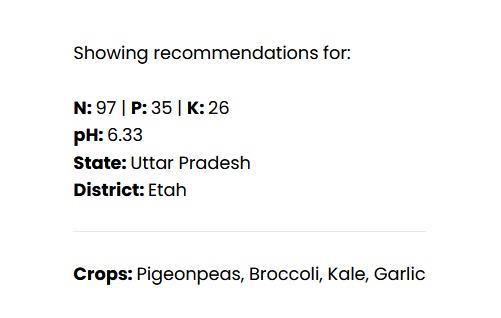
Fig-2:Croprecommendations
The user inputs the crop he wants with soil nutrients content and the location of field. Now, with the details of locationandcrop,variables‘a’and‘b’arefetchedfromthe dataset prepared and fertilizers are calculated and recommended.
a. React JS
React is a JavaScript library for building user interfaces. React is used to build single-page applications. React allows us to create reusable UI components. React is a JavaScript library for web native user interfaces. The frontend and UI of this project is implemented using it with a third-party library 'react-router-dom' for routing purpose.
b. Tailwind CSS
Tailwind is a CSS framework that provides us with single purpose utility class which areopinionated for the most
The fertilizer recommendation module utilizes STCR fertilizer recommendation equations for fertilizer recommendationsforthecropandareadetailsenteredby theuser.
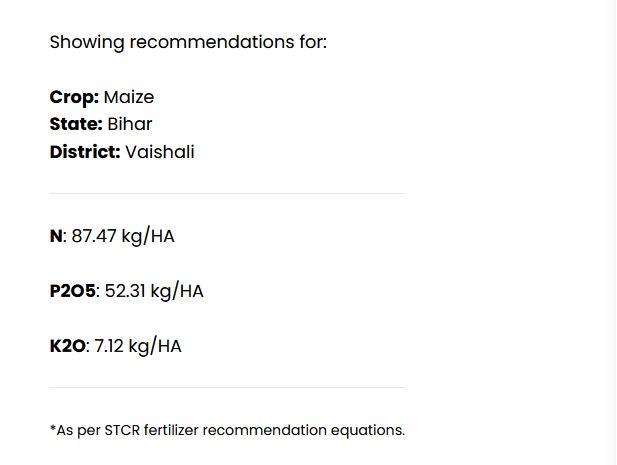
Fig -3:Fertilizerrecommendations
International Research Journal of Engineering and Technology (IRJET) e-ISSN: 2395-0056
Volume: 11 Issue: 04 | Apr 2024 www.irjet.net p-ISSN: 2395-0072
We proposed a crop recommendation system in this reportusing machine learning and artificial intelligence techniques. The system is intended to assist farmers in making informed crop and fertiliser management decisions, which can improve crop yield while reducing environmental impact. Our results showed that the proposed system predicted crops with high accuracy and precision, used companion farming techniques, and of fertiliser.Thesystemoutperformedotherapproachesand demonstrated the potential for crop improvement, companion farming techniques, and fertiliser reduction. Our research also aims to recommend suggestion and solution for the required deficiency of fertiliser. Our research helps to advance precision agriculture and sustainable crop management practises. Farmers can use the system to optimise crop and fertiliser management, reduceenvironmentalimpact,andincreaseprofitability
Wehavetakeneffortsinthisproject.However,itwouldnot have been possible without the kind support and help of many individuals and organizations. We would like to extend my sincere thanks to all of them. We are highly indebted to Ms. Sakshi Malhotra for their guidance and constant supervision. We are extremely indebted to Dr. Sanjeev Kumar Singh, HoD-IT, Dr. Javed Miya and Ms. Archana Das, Project Coordinator, Department of Information Technology, GCET for their valuable suggestions and constant support throughout my project tenure
1. Dr.S.UshaKiruthika,Dr.S.KanagaSubaRaja.“Design and Implementation of Fertiliser Recommendation System for Farmer”, TEST, Vol.83, Issue.5, MarchApril2020,pp-8840-8849
2. Suresh, G., A. Senthil Kumar, S. Lekashri, and R. Manikandan. “Efficient Crop Yield Recommendation System Using Machine Learning for Digital Farming”, International Journal of Modern Agriculture, Volume 10,No.1,2021
3. Aqeel-ur-Rehman,AbuZafarAbbasi,NomanIslamand Zubair Ahmed Shaikh, “A Review of Wireless Sensors andNetworks’ApplicationsinAgriculture”,Computer Standards & Interfaces, Volume 36, Issue 2, 2014, Pages263-270,ISSN0920-5489
4. M. Damas, A.M. Prados, F. Gómez, G. Olivares, HidroBussystem:fieldbusforintegratedmanagement of extensive areas of irrigated land, Microprocessors andMicrosystems,25(2001)177-184.
5. R. Morais, A. Valente, C. Serôdio, A wireless sensor network for smart irrigation and environmental monitoring, in: EFITA/WCCA Joint Congress on IT in Agriculture,Portugal,2005,pp.845-850.
6. Dhruvi Gosai, Chintal Raval, Rikin Nayak, Hardik Jayswal, Axat Patel, “Crop Recommendation System using Machine Learning”, International Journal of Scientific Research in Computer Science, Engineering and Information Technology, May-June - 2021, 7 (3): 554-557
7. Qiming Zhou & Ali Ismaeel, “Integration of maximum crop response with machine learning regression model to timely estimate crop yield”, Geo-spatial Information Science, 24:3, 474-483, DOI: 10.1080/10095020.2021.1957723
8. Suporn Pongnumkul, Pimwadee Chaovalit, and Navaporn Surasvadi, “Applications of SmartphoneBased Sensors in Agriculture: A Systematic Review of Research”, Hindawi Publishing Corporation Journal of Sensors, Volume 2015, Article ID 195308, http://dx.doi.org/10.1155/2015/195308
9. N. Bhavya, K. Govinda, “Targeted Yield Approach of Fertiliser Recommendation for Sustaining Soil and Crop Productivity.”, Emerging Issues in Agricultural Sciences, Volume: 5, July 2023, ISBN: 978-81-1931573-4