
International Research Journal of Engineering and Technology (IRJET) e-ISSN:2395-0056
Volume: 11 Issue: 04 | Apr 2024 www.irjet.net p-ISSN:2395-0072
International Research Journal of Engineering and Technology (IRJET) e-ISSN:2395-0056
Volume: 11 Issue: 04 | Apr 2024 www.irjet.net p-ISSN:2395-0072
Tridib
Khute1, Bhupendra Kumar Kumbhkar2, Mrinal Pawar3, Priyanka Devi4
1B.Tech Student, Dept. of Information Technology, Govt. Engineering college Bilaspur, C.G, India
2B.Tech Student, Dept. of Information Technology, Govt. Engineering. college Bilaspur, C.G, India
3B.Tech Student, Dept. of Information Technology, Govt. Engineering college Bilaspur, C.G, India
4Assistant Professor, Dept. of Information Technology, Govt. Engineering college Bilaspur, C.G, India
Abstract - Fake information has emerge as a pervasive problem in today’s virtual age, posing substantial demanding situations to statistics integrity and public discourse. This paper examines the usage of device getting to know to come across fake news. The research makes a speciality of growing and trying out system gaining knowledge of algorithms that could distinguish among credibleinformationassetsandfraudulentfacts.
The review begins with a comprehensive review of the existing literature on link detection, highlighting limitations and gaps in current methodologies. Data types including real and synthetic media are collected and preprocessed to extract relevant features including textual content, metadata, and language samples Using various machine learning algorithms such as logistic regression, random forest, and neural networks are used and compared for better performance in classifying false informationAnalyticalmetricssuchasaccuracy,precision, recall, and F1 score are used to evaluate the performance of machine learning models. Significant factor analysis is performed to identify key determinants of false positives, which contribute to the interpretation of the model. The research also explores cluster learning methods and sample clustering strategies to further enhance classification accuracy and robustness. The research results show promising results in the detection of fake news, showingthe abilityof machine learningtodealwith misinformation The findings contribute to the advancement of fake news detection technology, and inform news organisations, social media channels andlaw enforcement agencies gain valuable insights for addressingthefakenewsepidemic.
Key Words: Machine Learning, Natural Language Processing, Fake news, Data Preprocessing, Logistic Regression,RandomForest,DecisionTreeClassifier.
For the purpose of the research paper on fake news prediction the use of machine getting to know, we are abletodefinefakenewsas:
"Fake news refers to intentionally false or deceptive information offered as legitimate news.[1] This misinformation can be created and disseminated via
numerous mediums, such as social media platforms, news web sites, and different online resources. Fake news often aims to control public opinion, unfold propaganda, or generate clickbait for financial advantage. It may additionally contain fabricated memories,distortedrecords,ormisattributedresources, in the long run undermining the credibility of dependable journalism and posing widespread challengestotheintegrityofstatisticsecosystems."
Preserving Information Integrity: With the rapid dissemination of information facilitated by digital platforms, the prevalenceof fakenewsposesa threatto theintegrityofinformationecosystems.MitigatingSocial and Political Impacts: False information propagated through fake news can have far-reaching consequences on social and political landscapes, including electoral processes, public policy decisions, and community cohesion. Enhancing Media Literacy: Fake news prediction research contributes to the development of tools and methodologies for enhancing media literacy among users. Supporting Fact-Checking Efforts: Predicting fake news complements the efforts of factchecking organisations and journalists in verifying the accuracy of information. Machine learning algorithms can assist in the automated identification of potentially false or misleading claims, thereby expediting the factchecking process and enabling more timely corrections andretractions.
Finally, the fake news detection is very helpful and importantinthisvirtualage.
Machine learning makes it easy to extract relevant features from news content, metadata, and context. Considering different aspects of the data, including linguistic characteristics, such as vocabulary and style, social characteristics such as user engagement and distribution, and source credibility considerations a, machinelearningmodelscanbetterdistinguishbetween trueandfakenews.Machinelearningprovidesflexibility and scalability, allowing false alarm prediction
International Research Journal of Engineering and Technology (IRJET) e-ISSN:2395-0056
Volume: 11 Issue: 04 | Apr 2024 www.irjet.net p-ISSN:2395-0072
algorithmstoevolveandimproveovertime.Asnewfake news emerges and methodology evolves, machine learning algorithms can be developed and retrained on updated data sets to improve deception detection in terms and consistency in various fields. These algorithms are trained on labelled datasets containing examplesofrealandfakenewsstories,enablingthemto identifypatternsandindicatorsoffraudulentcontent
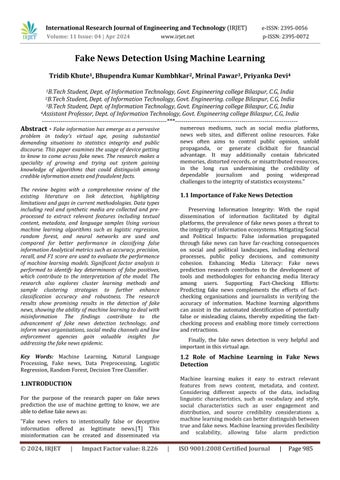
Gatheringthedatasetfromtheinternetthathaslabelled news articles both genuine and fake. For our project we used the dataset from the Kaggle for making the ML model. Preprocessing is the nothing but the process of making the row data the computer friendly so the data can be fit in the model and we train our model. It includesclearing,includingtextnormalization,removing noise and ensuring data quality. It includes 52.30% is fakenewsand47.70%realnews.
Source of fake news data: The major source of our fake dataset is Kaggle, often hosts datasets related to fake news detection competitions or challenges. These datasets may include labelled examples of fake and genuinenewsarticles,alongwithassociatedmetadata.
InthedatasetincludesTrue.csvthatcontainsRealnews andFake.csvthatcontainsFakenews.Themaintargetof the dataset in the class column in it includes two values ‘0’and ‘1’. Were ‘0’ is represents as ‘Real’ and ‘0’ is representsas‘Fake’.Itincludes52.30%isfakenewsand 47.70%realnews.
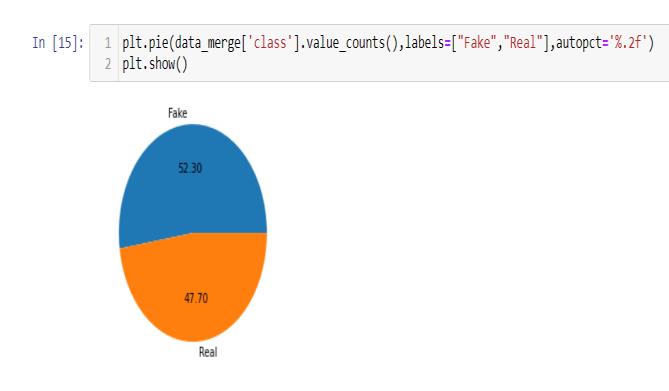
Data Cleaning:
Locating and fixing errors or discrepancies in the data. Fromduplicatesandoutlierstomissingnumbers.Itfixes them all. It also hands the missing data in dataset this situation performs data cleaning seamlessly. It involves handling of missing data, noise etc. By ignoring the tuplesandfillingthemissingvalues.
Data Integration:
In data integration is part of data preprocessing this process integrates data that extracted from multiple sources to outline and create a single dataset. In this projectwealsogetsomenewsfromtheinternetsources andintegrateitintheKaggledatasetandmakethesingle dataset.
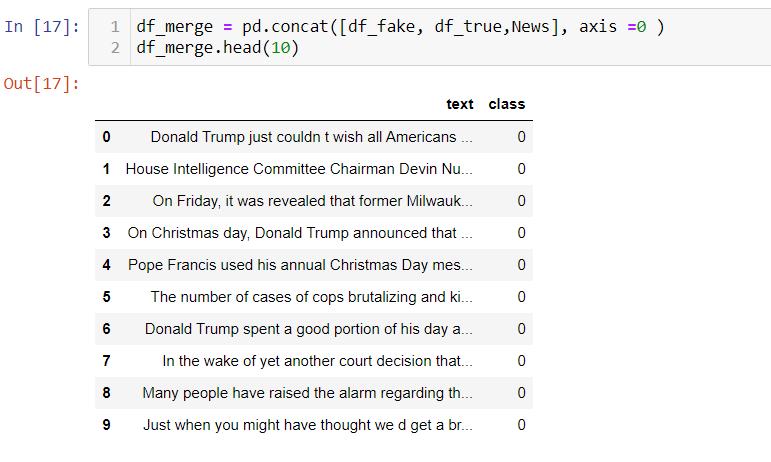
Fig-1: DataIntegration
Text Cleaning:
Lowercasing: Convert all text to lowercase to ensure uniformity and avoid duplication of features based on case sensitivity. Removing Punctuation: Eliminate punctuation marks as they may not contribute significantlytodistinguishingbetweengenuineandfake newsTF-IDFVectorization:Converttextdocumentsinto numerical vectors using TF-IDF (Term FrequencyInverse Document Frequency) to represent the importance of words in distinguishing between documents. Word Embeddings: Utilise pre-trained word embeddings such as Word2Vec, GloVe, or fastText to representwordsinacontinuousvectorspace,capturing semantic relationships between words. Dimensionality Reduction: Apply dimensionality reduction techniques such as Principal Component Analysis (PCA) or tdistributed Stochastic Neighbour Embedding (t-SNE) to reduce the dimensionality of feature vectors while preservingrelevantinformation.
International Research Journal of Engineering and Technology (IRJET) e-ISSN:2395-0056
Volume: 11 Issue: 04 | Apr 2024 www.irjet.net p-ISSN:2395-0072
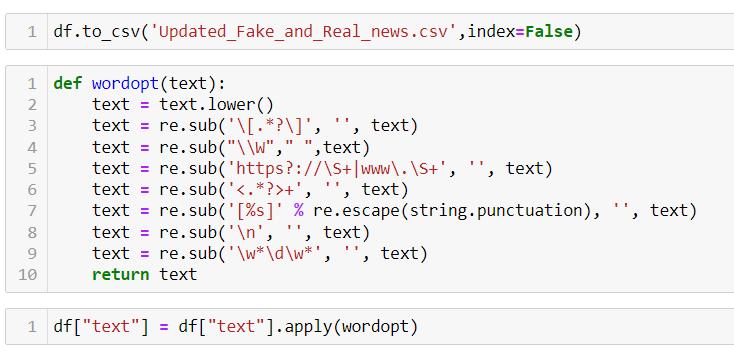
Fig-2: Textcleaning
2.3 Feature extraction method
Logistic Regression:
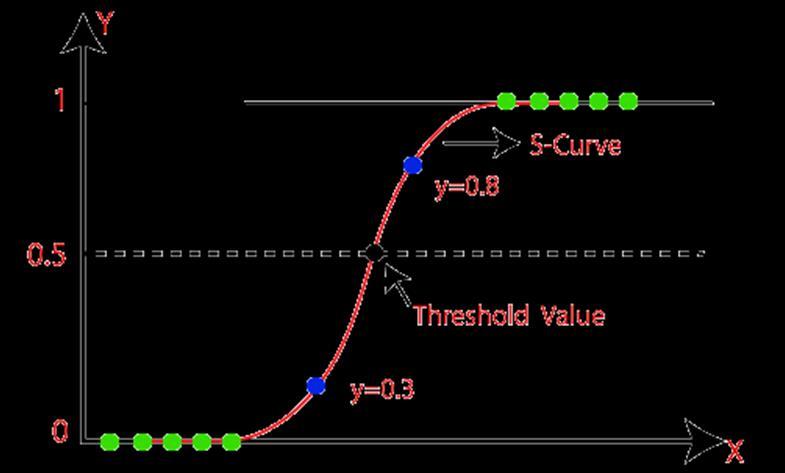
Logistic regression is one of the most popular Machine learning algorithms that comes under Supervised Learning techniques. [2]ItcanbeusedforClassification as well as for Regression problems, but mainly used for Classification problems. Logistic regression is used to predictthecategorical dependentvariablewiththehelp of independent variables.[3] The output of the Logistic Regression problem can be only between 0 and 1. Logistic regression can be used where the probabilities between two classes are required. Such as whether it will rain today or not, either 0 or 1, true or false etc. Logistic regression is based on the concept of Maximum Likelihood estimation. According to this estimation, the observed data should be most probable. In logistic regression, wepasstheweighted sumof inputsthrough anactivation function thatcanmapvalues in between 0 and 1.[4] Such activation function is known as sigmoid function and the curve obtained is called sigmoid curve orS-curve.[5]
SigmoidFunction:
·Mapsthepredictivevaluestoprobabilities.
· Sigmoid Function maps any real value into another valuebetween0and1.
· Hence it forms a curve like the “S” Form. This S-form curveiscalledtheSigmoidfunctionorlogisticfunction.
Where:Z=b0X0+b1X1+… +bnXn[Here,X0(bias)is always1]
Xiisindependentvariablei=0,1,2……...,n
DecisionBoundary:
Thresholdclassifieroutputy’orh0(x)at0.5:
If h0(x)0.5,predict“y=1”
Ifho(x)<0.5,predict“y=0”
Random Forest:
Random Forest is a popular machinelearning algorithm that includes supervised learning methods.[6] It can be usedforClassificationandRegressionproblemsinML.It is based on the concept of cluster learning, which is the process of combining multiple classifiers to solve a complex problem and improve the performance of the model.[7] As the name suggests, "Random Forest is a classifierthathasanumberofdecisiontreesindifferent subsets of a given dataset and takes an average to improve [8]the prediction accuracy of that dataset Instead of relying on it." on one decision tree, a random foresttakespredictions."fromeachtreeandpredictsthe final outcome based on the majority vote on predictions."Sincetherandomforestcombinesmultiple treestopredicttheclassofthedataset,itispossiblethat some decision trees may predict the correct output, while others may not. But together, all the trees predict the correct output.[9] Therefore, below are two assumptionsforabetterRandomForestclassifier:
There should be some actual values in the feature variable of the dataset so that the classifier can predict accurate results rather thanaguessedresult.[10]
The predictions from each tree must have very lowcorrelations.
Althoughdecisiontreesarecommonsupervisedlearning algorithms, they can be prone to problems such as bias and overfitting. However, when multiple decision trees areclusteredinrandomforeststructures,moreaccurate results are predicted, especially when individual trees are unrelated to each other. The random wooded area set of rules is made of a group of selection bushes, and each tree within the ensemble is made from a records
International Research Journal of Engineering and Technology (IRJET) e-ISSN:2395-0056
Volume: 11 Issue: 04 | Apr 2024 www.irjet.net p-ISSN:2395-0072
pattern drawn from a schooling set with substitute, referred to as the bootstrap pattern. Of that education sample, one-0.33 of its far set aside as test records, knownastheout-of-bag(oob)sample,whichwe’llcome lower back to later. Another instance of randomness is then injected thru feature bagging, adding extra variety to the dataset and decreasing the correlation amongst selection trees. Depending at the sort of trouble, the dedication of the prediction will vary. For a regression assignment, the character decision timber could be averaged, and for a category mission, a majority votei.E. The maximum common express variable will yield the predicted elegance. Finally, the oob pattern is then usedforcross-validation,finalisingthatprediction.
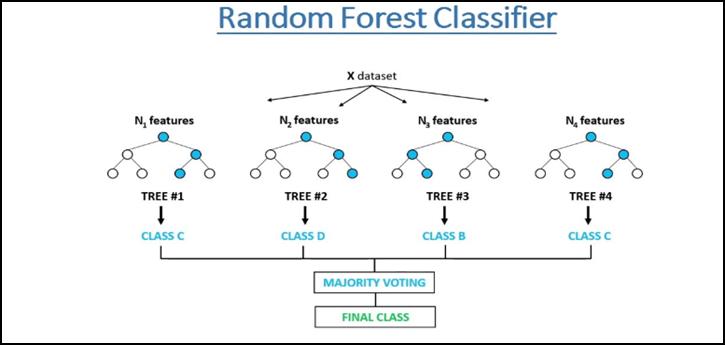
Fig. -4: RandomForestClassifier
Decision Tree:
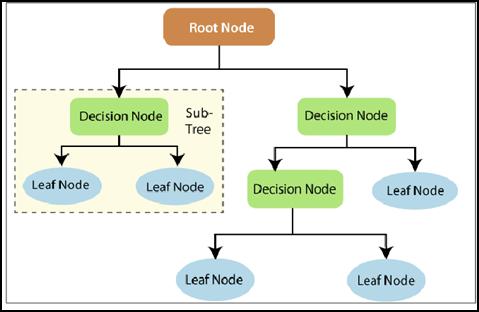
Decision Trees (DTs) are a non-parametric supervised learning method used for classification and regression. Themainaimistocreateamodelthatpredictsthevalue ofatargetvariablebylearningsimpledecisionrulesthat are inferred from the data features.[11] A tree can be visualized as a piecewise constant approximation. In a decision tree, there are two nodes: the Decision Node and Leaf Node. Decision nodes are used to make decisions and have multiple branches, while Leaf nodes aretheoutputofthesedecisionsanddonotcontainany further branches.[12] The decisions or tests are performed on the basis of features of the given dataset.[13] It is a graphic representation for obtaining all possible solutions to a problem or decision based on provided conditions. It is identified as a decision tree since,resemblingatree,itstartswiththerootnodeand thenexpandsonotherbranches,constructingatree-like structure. In a decision tree, to predict the class of the givendataset,thealgorithminitiatesfromtherootnode of the tree. This algorithm compares the values of the root attribute with the record (real dataset) attribute and, based on the comparison, follows the branch and jumps to the next node.[14] For the next node, the algorithm once more compares the attribute value with the other sub-nodes and moves further. The process continuesuntilitreachestheleafnodeofthetree.[15]
Training:
M.L. The term ML model refers to the model artifact generatedbythetrainingset.
Thetrainingdatamusthavethecorrectresponse,known asthetargetortargettype.Thelearningalgorithmlooks forpatternsinthetraining data thatmapthe inputdata featurestothetarget(theresponseyouwanttopredict), andgeneratesanMLmodelthatcapturesthesepatterns Training the model simply means learning (identifying) optimal values for all weights and being biased against Oded models.[16] In supervised learning, a machine learning algorithm generates a model by analysing multiple models and tries to find models that minimize losses;Thisprocessiscalledempiricalriskreduction.
Testing:
Machine learning testing helps identify problems in models that may miss routine analytical metrics. This problem can be caused by code or data enabling each component of the ML system where outliers can affect model performance among other things heterogeneous distributionandpartitioningThiscanalsohelptoreduce future problems with the model over the time of use to achieve a certain level of quality assurance for the sample.[17]
ML models are often used for modelling, and while analyticaltheoryisusedtopredicttheperformanceofa data set, model testing focuses on observing the expected behaviour of the model and is needed because unobserved information path can occur in the workplace. With prototypes, unprecedented challenges can be encountered, and testing makes your prototype moreviableunderdifferentcircumstances:
• Adversary attacks: Test models can help identify possible adversary attacks. Instead of having these attacksoccuratthemanufacturingsite,themodelcanbe testedwithcompetingsamplestoincreaseitsrobustness beforeuse
International Research Journal of Engineering and Technology (IRJET) e-ISSN:2395-0056
Volume: 11 Issue: 04 | Apr 2024 www.irjet.net p-ISSN:2395-0072
• Data Integrity and Bias: Generally, data collected from most sources is unstructured and may reflect human biasesthatcanodelduringtraining.Thesebiasescanbe duetogender,race,religion,sexualityoraspecificgroup that has different outcomes in the population based on thelevelofuseCanbemissedbiascanbemissedduring research because it draws attention focus more on performance and not on the behaviour of the model giventhefunctionaldatainthiscase.
• Spot failure modes: Failure modes can occur when trying to use ML systems in production. These can be due to performance bias failure, robustness failure or model input failure. Some of these failures may be missed by the inspection criteria even though they may indicate problems. A model with 90% accuracy means thatitisdifficulttogeneralizethemodelwith10%ofthe data.Thatcanmotivateyoutoanalysethedataandlook for errors so you can get better insights on how to deal with it. This is not all-inclusive and it is important to establish a set of tests for possible scenarios to be encounteredtohelpidentifyfailuremechanisms
4. Results & Performance Analysis
Accuracy:
ML models are trained on historical data, and their accuracylargelydependsonthequalityandrelevanceof this data. ML model testing helps identify bugs between predicted and actual outcomes, allowing developers to fine-tune the model and enhance its accuracy. [18] Accuracy isthepercentage ofcorrectclassificationsthat is trained. Machine learning model achieves generally speaking, interesting standards for good accuracy is above 70% In our model we use the cream prediction models that are Logistic regression, Decision tree classification, Random Forest classification and our all modelsaregetting98%accuracyforpredictingthenews fakeorrealSowecansaythatisagoodaccuracyofour model.
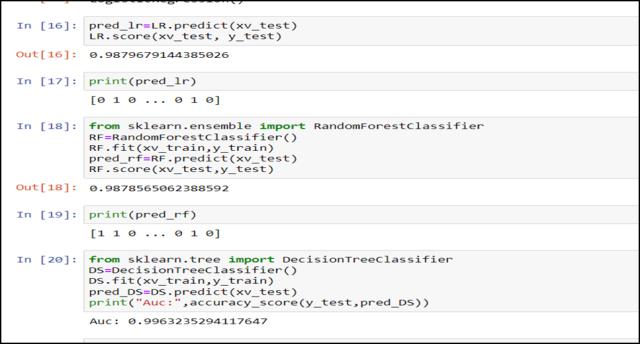
Fig. -6: AccuracyofModels
Precision:
The Precision meter checks the prediction accuracy of the positive square. Specificity refers to the number of known/accepted factors that are actually relevant. It is calculated by dividing the true positive by the total positive.
Recall:
Themodel’sabilitytofindallrelevantcasesinadataset. Mathematically, we define recall as the number of true positivesdividedbythenumberoftruepositivesandthe numberoffalsenegatives.[19]
F1-Score:
TheF1scorecapturestheclassifier’saccuracyandrecall by taking their harmonic mean and combining it into a single metric. It is primarily used to compare the performance of two distributions. Suppose classifier A hasmorerecallandclassifierBhashigheraccuracy. Generally, an F1 score > 0.9 is considered good. A score of0.8to0.9isconsideredgood,andascoreof0.5to0.8 isconsideredaverage.IftheF1scoreislessthan0.5,the model is considered to perform poorly. Our all model is getting >0.9 F1-score so its show that all models all consideredgoodtrainingandtesting.
Classification report:
The classification report shows the status of key classification metrics in each class. This provides a deeper insight into classifier behaviour than the global accuracythatcanmaskfunctionalweaknessesinasingle multiclass problem class. It displays your model’s precision, recall, F1 score and support. It provides a better understanding of the overall performance of our trainedmodel.[20]
International Research Journal of Engineering and Technology (IRJET) e-ISSN:2395-0056
Volume: 11 Issue: 04 | Apr 2024 www.irjet.net p-ISSN:2395-0072
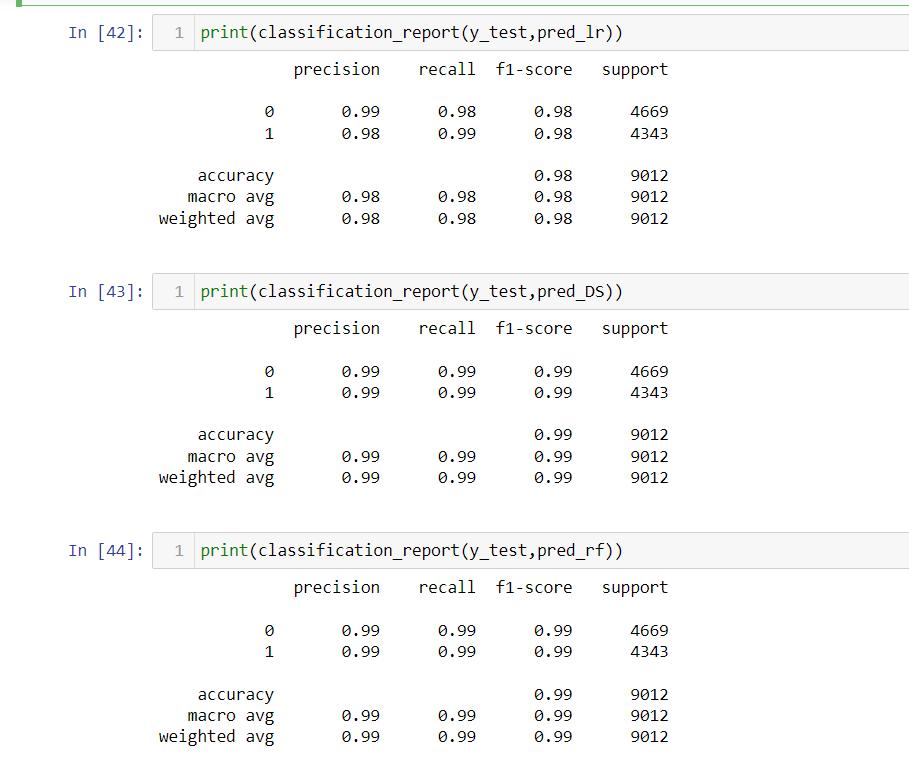
Fig-7: ClassificationReport
By comparison of the all three models Logistic Regression, Random Forest and Decision tree classifier the accuracies are respectively 98%, 99% and 99%. All are giving >90% it means its preferred as the good model. But in all of three model the Random Forest and Decision Tree are considered as the best model as comparetotheLogisticRegressionmodel
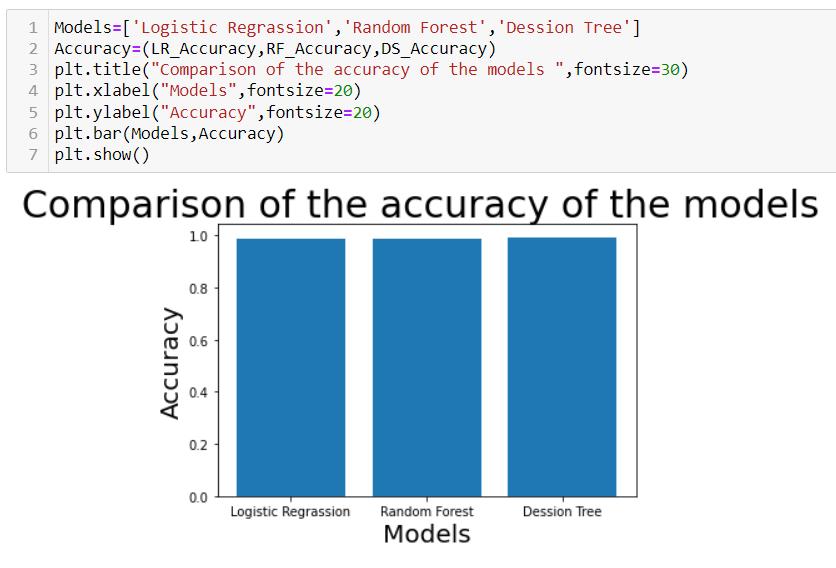
Fig-8: ComparisonofAccuracyoftheModels
Adataflowdiagrammapsouttheflowofinformationfor any process or system. It uses the defined symbols like rectangle circles and arrows plus short taste labels to sow data and push up storage pointers and the route between each destination. The flow of data of a system or a process is represented by DFD. [21] It also gives insightintotheinputsand theoutputof eachentityand the process itself. Data fraud describes the information transferringbetweendifferentpartsofthesystem. The dataflow diagram for the ‘Fake News detection’ its start from the taking the content of the news the do the preprocessingontomakingitclearerandmoreefficient after the pre-processing of the data to do deleting the unnecessary symbols from the text and to the vectorizing of the cleaned text at last putting it in the machinelearningmodelitpredictsin0or1formmeans Fake or Real. The dataflow diagram shows the all the processofthedatafromstattoendinginthestructured formformakingitclearerandmoreunderstandable
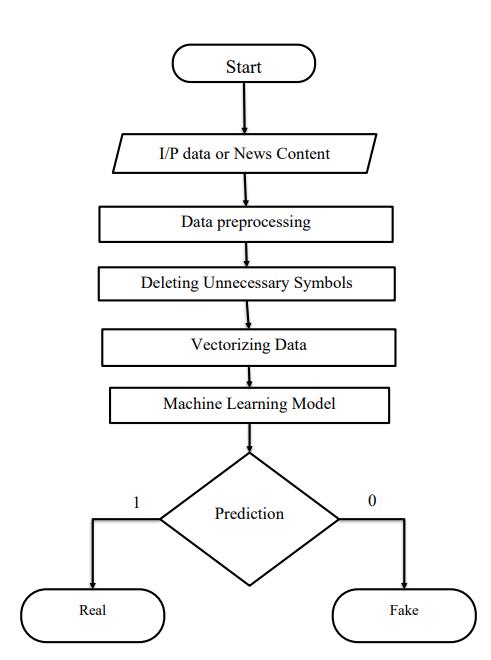
Fig-8: DataFlowDiagram
International Research Journal of Engineering and Technology (IRJET) e-ISSN:2395-0056 Volume: 11 Issue: 04 | Apr 2024 www.irjet.net p-ISSN:2395-0072
The paper on fake news detection using machine learningconcludeswithanimportantcontributiontothe effort to deal with misinformation. The study demonstrates the effectiveness of machine learning algorithmssuchaslogisticregressionandrandomforest in accurately classifying fake news data Through rigorous analysis and comparison, research demonstrates the ability of machine learning models to distinguish between credible news sources and fraudulent information. The findings highlight the importance of feature engineering, model selection, and evaluation metrics in a robust fake news detection system. Feature need analysis helps to understand key indicators of false information, increasing model interpretability and reliability. The study also explores ensemble learning methods and model ensemble techniquestoachieveclassificationaccuracyandfurther improve the robustness of pseudo-information techniques. The results of this research extend to news organisations, social media platforms and law enforcement agencies, providing insights into effective strategiestoidentifyandreducethespreadoffakenews Future work in the field requires a deeper learning process, incorporate semantic analysis and provide modelgeneralisationtofalsenewclaims Itcanalsohelp preserveintegrity
[1]Researchguides:Fakenewsandinformationliteracy: Whatisfakenews?.WhatisFakeNews?-FakeNewsand Information Literacy - Research Guides at University of Oregon Libraries. (n.d.). https://researchguides.uoregon.edu/fakenews/issues/d efining
[2] Logistic regression summary (DOCX).CourseSidekick. (n.d.).https://www.coursesidekick.com/informationsystems/1571288
[3] Linear regression vs logistic regression - javatpoint www.javatpoint.com. (n.d.). https://www.javatpoint.com/linear-regression-vslogistic-regression-in-machine-learning
[4] Linear regression vs logistic regression - javatpoint www.javatpoint.com. (n.d.-a). https://www.javatpoint.com/linear-regression-vslogistic-regression-in-machinelearning#:~:text=In%20logistic%20regression%2C%20 we%20pass,sigmoid%20curve%20or%20S%2Dcurve.
[5] Fake news detection using machine learningjavatpoint. www.javatpoint.com. (n.d.-a). https://www.javatpoint.com/fake-news-detectionusing-machine-
learning#:~:text=Machine%20learning%20algorithms% 20used%20for,as%20either%20real%20or%20fake.
[6] Sahil Khalkar, Rushikesh Nimbhore, Atharva Pardeshi, Sanket Kanade and V.K.Barbudhe. IOT Based Data Monitoring in Secured Block Chain Architecture, International Journal for Modern Trends in Science and Technology, 2023, 9(11), pages. 0104.https://doi.org/10.46501/IJMTST0911001
[7]Tutorials - javatpoint. www.javatpoint.com. (n.d.-d). http://www.javatpoint.com/
[8] Machine learning random forest algorithmjavatpoint. www.javatpoint.com. (n.d.-d). https://www.javatpoint.com/machine-learningrandom-forest-algorithm
[9] Anusha, H. (2022, January 28). Bootstrapped Aggregation(bagging):. Medium. https://medium.com/@hemaanushatangellamudi/boots trapped-aggregation-bagging-481f4812e3ea
[10] Analytics vidhya: The ultimate place for generative AI, Data Science andData Engineering.AnalyticsVidhya| The ultimate place for Generative AI, Data Science and Data Engineering. (n.d.). https://www.analyticsvidhya.com/
[11] Analytics vidhya: The ultimate place for generative AI, Data Science andData Engineering.AnalyticsVidhya| The ultimate place for Generative AI, Data Science and Data Engineering. (n.d.). https://www.analyticsvidhya.com/
[12]Choubey,V.(2020,October28). Decisiontree-endto end implementation. Medium. https://medium.com/analytics-vidhya/decision-treeend-to-end-implementation-adf1bc246254
[13] Kiran, K. (2023, March 3). Decision tree. LinkedIn. https://www.linkedin.com/pulse/decision-tree-kajalkiran
[14] Decision tree algorithm in Machine LearningJavatpoint. www.javatpoint.com. (n.d.-a). https://www.javatpoint.com/machine-learningdecision-tree-classification-algorithm
[15] E. Subramanian, M.Mithun Karthik ,G.Prem Krishna,V.Sugesh Kumar, D.Vaisnav Prasath, ”Solar PowerPredictionUsingMachineLearning”
[16] Khanam, Z., Alwasel, B. N., Sirafi, H., & Rashid, M. (2021). Fake news detection using machine learning approaches. IOP Conference Series: Materials Science and Engineering, 1099(1), 012040. https://doi.org/10.1088/1757-899x/1099/1/012040
International Research Journal of Engineering and Technology (IRJET) e-ISSN:2395-0056
Volume: 11 Issue: 04 | Apr 2024 www.irjet.net p-ISSN:2395-0072
[17] Kaliyar, R. K., Goswami, A., Narang, P., & Sinha, S. (2020). FNDNet – a deep convolutional neural network for fake news detection. Cognitive Systems Research, 61, 32–44.https://doi.org/10.1016/j.cogsys.2019.12.005
[18]https://www.testingxperts.com/blog/ml-testing
[19] Precision and recall - shiksha online. shiksha. (n.d.). https://www.shiksha.com/onlinecourses/articles/precision-and-recall
[20] Kharwal, A. (2021, July 7). Classification report in MachineLearning:AmanKharwal.thecleverprogrammer https://thecleverprogrammer.com/2021/07/07/classifi cation-report-in-machine-learning
[21] GfG. (2023, September 20). What is dfd(data flow diagram)?. GeeksforGeeks. https://www.geeksforgeeks.org/what-is-dfddata-flowdiagram/