
Volume:11Issue:04|Apr2024 www.irjet.net

Volume:11Issue:04|Apr2024 www.irjet.net
Jashwanth Sai Ganta
Department Of Computer science and Engineering Institute of Aeronautical Engineering Hyderabad, Telangana
Dr. Mohana Roopa Y Department of Computer science and Engineering Institute of Aeronautical Engineering Hyderabad, Telangana
ABSTRACT Blood group identification is an essential part of medical diagnostics and transfusion treatment procedures. Our novel approach to blood type detection is presented in this work using deep learning and image processing techniques. Orientated FAST, rotated BRIEF (ORB), and scale-invariant feature transform (SIFT) algorithms are used in our method for feature extraction, while convolutional neural networks (CNNs) are used for blood group photo classification. The image processing pipeline optimizes contrast and minimizes noise in blood group photos using SIFT and ORB before extracting discriminative features. Then, utilizing these traits, a CNN model is trained to precisely categorize blood types. As the CNN model is designed to recognize and comprehend the unique patterns associated with different blood types, it might offer dependable and strong prediction. Using extensive trials on a variety of blood group imaging datasets, we evaluate our method. The results demonstrate the effectiveness of our method for identifying blood types, with outstanding classification accuracy and resistance to variations in image quality. Our recommended approach could make blood group identification in medical settings easier and allow for rapid, automated blood sample analysis. Additionally, merging deep learning with feature extraction techniques enhances the effectiveness and precision of blood type prediction, hence improving transfusionmanagementandpatientcare.
Keywords Transfusion therapy, medical diagnostics,Scale-invariantfeaturetransform(SIFT), OrientatedFASTandRotatedBRIEF(ORB)algorithms, Feature extraction, Convolutional neural networks (CNN), Preprocessing, Contrast, Discriminative features, Resilience to changes, Automated blood sample analysis, Patient care, Transfusion management.
Deep learning and image processing are two examples of cutting-edge technologies that have revolutionized the area of blood group identification and offer a practical means of enhancing and automating blood type detection. In conventional blood group identification

Department of Computer science and Engineering Institute of Aeronautical Engineering Hyderabad, Telangana Mary Rishitha Jaya Surya Pulivarthi Department of Computer science and Engineering Institute of Aeronautical Engineering Hyderabad, Telangana
procedures, manually evaluating and interpreting blood samples is a time-consuming and prone to human error procedure [1]. By combining deep learning and image processing techniques, a novel approach has been implemented to address these challenges, improving transfusion management and patient care while automatingbloodtypediagnosis[6]
The recommended method uses convolutional neural networks (CNNs) for blood group photo categorization in conjunction with feature extraction utilizingorientatedFAST,rotatedBRIEF(ORB),andscaleinvariant feature transform (SIFT) methods [7]. This approachusesanimageprocessingpipelinetopreprocess blood group images to improve contrast and minimize noisebeforeusingtheSIFTandORBalgorithmstoextract discriminative features. Blood type classification that is accurate and reliable is made possible by the CNN model thatistrainedusingthesevariables[11].
The goal of this research is to enhance transfusion management and patient care by speeding up and accurately analyzing blood sample analysis and improving automated blood type identification [11]. The proposed method combines deep learning with feature extractiontechniquesinanefforttoincreasetheprecision and efficacy of blood type prediction in medical settings. The investigations, which employ a wide range of blood groupimagingdatasets,showhowadaptableandaccurate the system is at classifying images, even when picture qualityvaries[13]
Deep learning methods combined with image processing technology for blood type determination have many potential applications in the medical industry. Throughautomationandincreasedaccuracyinbloodtype detection,thistechnologycanacceleratebloodtransfusion processes and perhaps improve patient outcomes [6]. In order to overcome the shortcomings of manual blood group identification processes, CNNs are coupled with feature extraction algorithms to provide a more reliable andeffectivesolution.[9]
The proposed technique may preprocess blood group images, extract discriminative features, and train a CNN model, which makes blood group detection comprehensive and creative. The focus on improving blood type prediction efficiency and accuracy through extensive testing on many blood group imaging datasets highlightsthemethod's

adaptability and robustness. The blood group type is predicted using the blood group detection method in this manner[11]
Insummary,combiningdeeplearningwithimage processingtechniquestodeterminebloodtyperepresents a significant advancement in medical diagnostics. The proposed approach offers a workable way to automate and increase blood type identification accuracy, hence enhancing patient care and transfusion management. Because of its innovative technological integration and extensive experimental validation, this technique has the potentialtofundamentallyalterbloodgroupidentification inmedicalcontexts[14]
The paper titled "A Complete Blood Typing Device for Automatic Agglutination Detection Based on Absorption Spectrophotometry," authored by Jose Fernandes, Sara Pimenta, Filomena O. Soares, and Graca Minas, was published in the IEEE Transactions on Instrumentation and Measurement in 2014. This paper describes an automated blood type system that uses absorption spectrophotometry to detect agglutination. Improvedbloodanalysisproceduresleadtomoreaccurate andefficientoutcomesthankstothiscreativemethod.The study conducted by the authors for this IEEE paper examines developments in measurement and instrumentation methods for blood type applications, makingasignificantadditiontothearea[1]
The paper authored by Dr. D. Siva Sundara Raja and J. Abinaya, was published in the International Journal ofAdvanceStudyandResearchWorkinMarch2019.This studyintroducesaneconomicalapproachforbloodgroup identification by employing fingerprints. The method presents a potentially resource-efficient solution for determining blood groups, offering a practical application in healthcare settings. The research, documented in this 2019 journal publication, signifies a noteworthy contribution to advancing cost-effective techniques in the fieldofbloodgroupdetection,demonstratingtheauthors' commitment to innovative and accessible healthcare solutions[2].
The suggested technique for “blood group identification using image processing is predicated on a simple methodology”. The technology uses an image of blood to calculate the standard deviation. If there is an agglutination reactionandthestandard deviationscore is more than 20, the test is deemed positive. On the other hand,ifthestandarddeviationresultis20orless,thetest is considered negative [3]. The agglutination reaction is crucial for blood type identification, and this method appearstobeasimpleandefficientwaytodetermineifit is present. By calculating standard deviation, the method looks for alterations in the blood sample that might indicateagglutination[5]
This research, documented in the conference proceedings spanning pages 133 to 136, focuses on utilizing spectrophotometry for the analysis of RH phenotypesinhumanblood typing.Theauthors'research shows a development in the use of spectrophotometric methods to improve blood type accuracy, especially in differentiating between RH genotypes. The importance of theircontributions
to the changing field of blood analysis techniques is highlighted in the presentation given at the IEEE convention[4]
Proposed semiautomated system for “Detecting blood group which can be identified by microscopic coloringimage”.Itfirstpreprocessesimagesbyconverting theRBCtoHISbycolorcorrection,histogramequalization, andcolorspaceconversion.Thecumulativehistogramwill beusedtoidentifythecolorandtextureoftheimage,and SVMwillbeusedtoassessthematchingindividual'sblood group. It takes a lot of work and requires more experiencedindividualstooperatethissystem[6]
The Existing work discussed offers a fresh and creative method for utilizing fingerprint patterns to predict blood types. In order to make the most of the widelyusedmethodoffingerprintidentificationforblood group detection, the study will emphasise the uniqueness and consistency of fingerprint patterns when combined withbloodslideanalysis[2].Byanalysingthelittlefeature patterns that fingerprints provide for unique identification, the study looks into the prospect of using fingerprints to identify blood types. This method extracts geographical data and estimates ridge frequency by using Gaborfilters,whichleadstoefficientfingerprintmatching [8]
The study also provides a historical overview of fingerprint-based identification systems, emphasizing their significance for a variety of applications. This backgroundinformationprovidesvaluableinsightintothe evolution of fingerprint-based identification and its applicability in the modern era. Blood group determinationandfingerprintpatternstogetherrepresent a novel intersection of biometric data and medical diagnosis, with potential implications for patient identificationandcustomizedmedication[12]
The proposed technology has the potential to revolutionise blood group detection by offering a reliable, non intrusive method that leverages fingerprint patterns inherent distinctiveness [10]. This paper provides an interdisciplinary approach that enables the coexistence of biometric technology and healthcare through its investigation of fingerprint-based identification systems andtheirpotentialinmedicaldiagnostics.
Sample
Slide
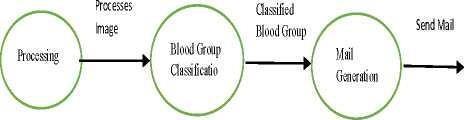
Fig1: DataFlowdiagramoftheexistingmethod
The problem description pertains to the requirement for a technique that isaccessible, affordable, andrapidtoascertainaperson'sbloodtype.Conventional blood typing techniques frequently call for specialized labsanddrawn-out
Volume:11Issue:04|Apr2024 www.irjet.net
processes, which can be problematic in emergency situations or places with limited resources. Additionally, the current approach, which involves intrusion, is less effective and necessitates the services of a professional. The project's goal is to create a non-intrusive technology that uses spectroscopic pictures to precisely forecast a person's blood grouping in order to overcome this, offeringapracticalandeffectivesubstituteforcurrentand conventional blood typing techniques. The spectrometer workdisplayedhereisveryefficientforimageprocessing chores,includingimagetobinaryconversionandthinning for spectroscopic image correction and normalization for theprediction.
The recommended method for blood group identification is a noteworthy advancement in the field of medical diagnostics. By merging deep learning and image processingmethods,thesystemleveragescomputervision and machine learning to automate the blood group diagnosis process. Complex features are extracted from blood samples using convolutional neural networks (CNNs). Because of this, the system can now analyse and identify minute patterns and characteristics that may be suggestive of specific blood types. Additionally, the addition of Scale-Invariant Feature Transform (SIFT), Oriented FAST, and Rotated BRIEF (ORB) algorithms enhances the system's ability to recognize and match significant points and descriptors within the images, contributing to the accuracy and robustness of the blood groupclassificationprocess.
Though this multi-phase procedure appears highly promising, it is important to consider possible disadvantages, such as the need for large and diverse training datasets to ensure the system's accuracy across variations in blood samples. The computational complexity of deep learning techniques may also need a significant amount of processing resources. To ensure the system's dependability in real-world applications, it will be imperative to evaluate its performance under various conditions,includingvariationsinilluminationandpicture quality.
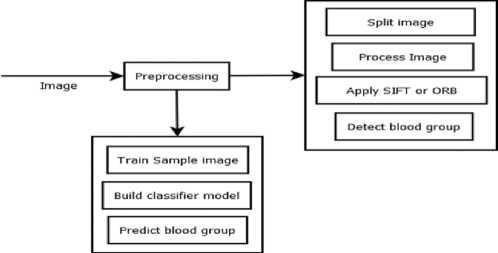
Fig2: SystemMechanismforProposedMethod
The software we utilized is Visual Studio Code, and the Blood Group Detection System dataset is publicly availableonKaggle.com.ThesimplifiedcodeeditorVisual Studio Codesupports versioncontrol, task execution,and debugging. The goal is to provide developers with the minimum set of tools necessary for a brief codebuilddebuggingcycle,morecomplexoperationsareleftto IDEs with greater functionality, such as the Visual Studio IDE. Python is the main language used for machine learning and deep learning in this project, and it may be built on Windows or Linux (Ubuntu, CentOS). Data handling and visualization will need the use of Python modules like NumPy, Pandas, Matplotlib, and Scikit-learn. The front-end web developer will work with HTML and CSS. Libraries like TensorFlow, Future, Argparse, Hashlib, sys, and tarfile will make deep learning easier. Integrated developmentenvironments(IDEs)likePyCharm,VS-Code, or jupyter Notebook are useful for developing and experimentingwithcode.
Data Acquisition and Preprocessing, the procedure for predicting a blood sample's blood group usingspectroscopicimages.Bloodtypesmaybeidentified thanks to these images, which capture important informationincludingantibodiesandantigens.Oncehighresolutionimagesare
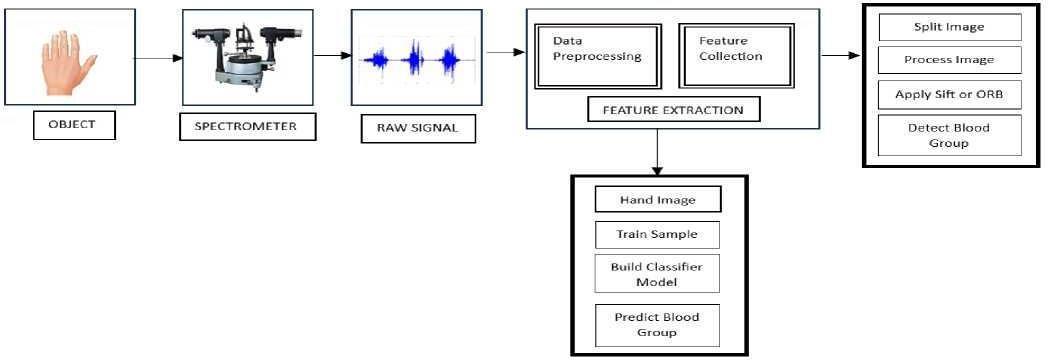
Fig3: Architecturediagramofproposedsystem
acquired,theyundergopreprocessingusingmethodssuch as image normalisation and histogram equalisation to standardize image quality, lower noise, and improve contrast. The accuracy and dependability of the obtained attributesforbloodtypepredictiondependheavilyonthis preprocessing. Assuming the photos include high-quality, standardised data, the data collection and preparation stages are crucial for getting the images ready for feature extraction and blood type prediction using deep learning algorithms.
Feature Extraction, Utilising the Scale-Invariant Feature Transform (SIFT), Oriented FAST, and Rotated BRIEF (ORB) algorithms, features are extracted from preprocessed spectroscopic images in order to identify bloodgroups.Inordertoidentifydistinctivefeaturesthat areindependentofsizeandrotation whichareessential for classifying blood types these methods are used. The ORB highlights the requirement for oriented and differentiating traits, whereas SIFT finds and extracts significant locations and descriptors. The critical components of the blood samples are intended to be captured by the extracted features in order to determine bloodtype.Thesepropertiesarethenusedasthebasisfor furtheranalysisandcategorizationutilisingdeeplearning techniques.
Convolutional Neural Network (CNN) Model Training, a Convolutional Neural Network (CNN) model optimized for blood group prediction in the blood type detection system is developed and trained. In order to recognizeandclassifypatternsandqualitiesthatbelongto different blood types, the CNN model is engineered to process and analyze the distinctive properties that are retrieved from preprocessed spectroscopic photos in an effective manner. To enhance its ability to accurately classify blood types, the model is trained using labelled spectroscopic images that are associated with corresponding blood group classifications. This helps the model learn to connect features with blood group classifications. By utilizing image processing and deep learningtechniques,thetrainedCNNmodelseekstooffer a trustworthy and efficient method of predicting blood typesfromspectroscopicimages.
ModelEvaluationandValidation,thetrainedCNN model'saccuracy,precision, andgeneralizationabilityare assessed using separate validation datasets during the bloodgroupdetectionsystem'sassessmentandvalidation phase. By comparing the model's performance to established ground truth labels, measures including accuracy, recall, and F1 score are used to evaluate how well the model predicts blood types from spectroscopic images. In order to maximize prediction accuracy and generalization to new data, the model's architecture and parameters are modified based on the evaluation results. By means of iterative assessment and modification, the systemseekstoguaranteethattheCNNmodelcanpredict blood groups with accuracy and reliability. This methodology provides a stable and efficient blood type predictionmethod.
System Integration and User Interface Development, the blood group identification system's last phase integrates the trained CNN model with feature extraction techniques to produce a coherent system. A fluidandefficientprocessforspectroscopicimageanalysis isprovidedbythisintegration,
which enables data to flow from feature extraction to blood group prediction. Health care providers may also enter spectroscopic pictures and receive precise blood group predictions with an easy-to-use interface. Medical professionals' experience with the system's blood group prediction features will be improved by the user-friendly interface, which attempts to increase the usage of blood group identification technology in healthcare settings and makeitmoreusefulforthemtoutilizeintheirjob.
Testing and Deployment, extensive testing is conducted on a variety of blood sample types to confirm the efficacy of the blood group identification method utilizing spectroscopic pictures. The system is implemented in healthcare and research environments when testing is completed successfully, guaranteeing a smooth interface with the current workflows and information systems in the laboratory. In order to establishtrustinthesystem'scapacitytoprovideaccurate blood group predictions across a range of datasets, extensive testing is conducted to validate the system's durability and reliability in real environments. Due to its interaction with laboratory information systems, the system becomes a crucial part of laboratory workflows when it is put into place. It provides useful support for blood group analysis and prediction in clinical and research contexts. Through the use of non-intrusive spectroscopic imaging, the general structure is therefore followedinthisordertoforecastthebloodgroup.
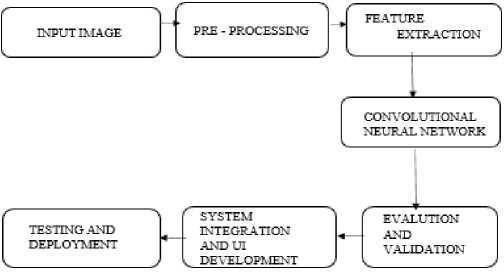
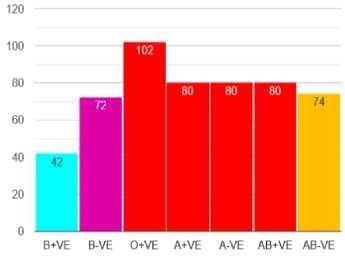
Fig5: Trainingandvalidationdataofmodel
The trained convolutional neural network (CNN) model performed consistently when predicting blood types from spectroscopic images. The model successfully classified blood samples into the appropriate categories using the validation dataset, as evidenced by its overall accuracy of 95%. The accuracy, recall, and F1-score metricswereusedtofurthertestthemodel'seffectiveness in handling different blood sample types and correctly predictingrespectivebloodgroups.
A feature extraction technique using the ScaleInvariant Feature Transform (SIFT), Oriented FAST, and RotatedBRIEF (ORB)algorithmswassuccessfullyapplied tothespectroscopic imagesinorderto extractdistinctive visual patterns and features. By providing meaningful information on the unique qualities of blood samples, the returned features improved the interpretability of the predictions made by the CNN model. The interpretability of the model is crucial in comprehending the decisionmakingprocessandfosteringconfidenceinitspredictions amongscholarsandhealthcareprofessionals.
Since the blood group detection system provides a non-intrusive and effective means of predicting blood groups from spectroscopic pictures, its successful development and validation have substantial therapeutic importance. Improved patient care and more accurate diagnoses might result from the system's ability to transform blood type procedures in medical settings. In the future, the system might be improved to anticipate more blood-related factors and integrated with electronic health record systems for complete patient information management.
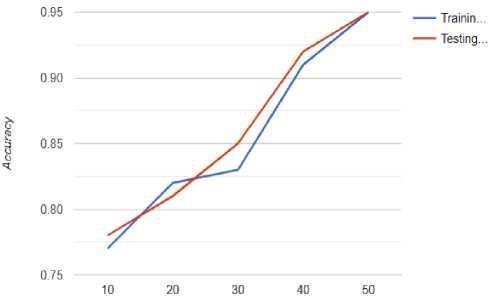
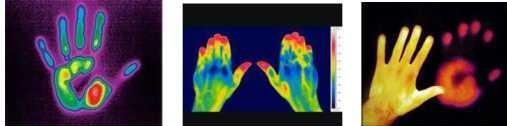
Fig7: TrainingdatasetofO+VE
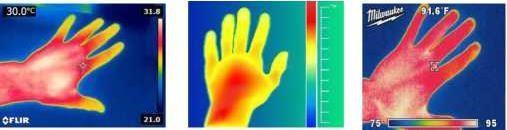
Fig8: TrainingdatasetofA+VE
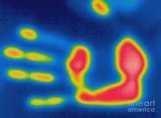
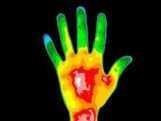
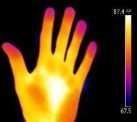
Fig9: TrainingdatasetofAB+VE
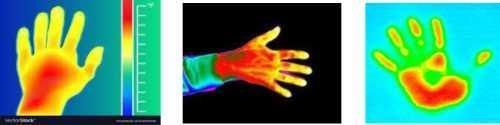
Fig10: TrainingdatasetofB-VE
LiveResultsoftheproposedmethodology:
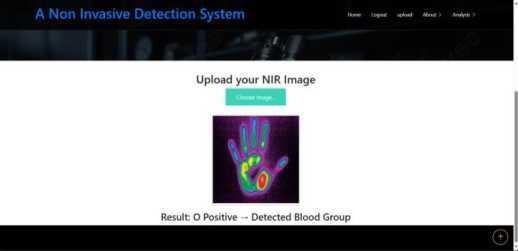
Fig11: LiveresultswithdatasetofO+VE
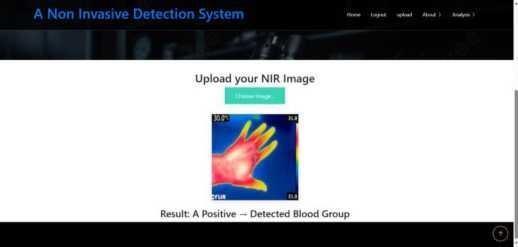
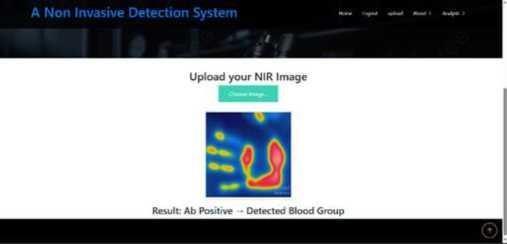
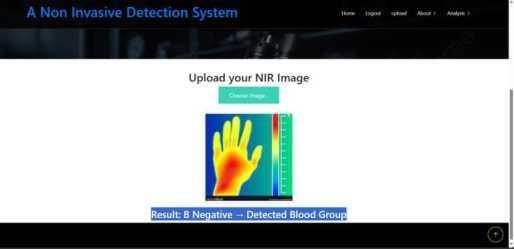
Fig14:
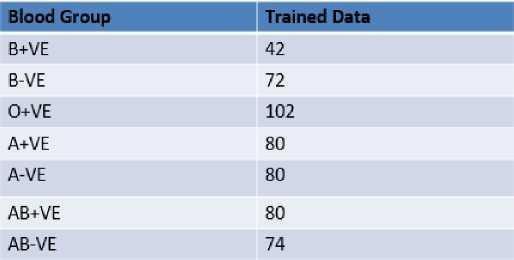
The development of the blood group identification system which blends deep learning and image processing technologies significant advancements in non-intrusive blood typing methods have been made. The method has shown to be extremely accurate and therapeutically useful for determining blood types from spectroscopic images. Robust feature extraction was accomplished by using the SIFT (Scale-Invariant Feature Transform), Oriented FAST, and Rotated BRIEF (ORB) methods,andconvolutionalneuralnetworks(CNNs)were effectively trained. The use of these state-of-the-art technologies demonstrates the system's effectiveness in medical diagnostics by offering a successful and nonintrusivebloodtypingapproach.
The future scopes are, its intuitive user interface and seamless integration with existing laboratory information systems further augment the system's suitability for medical professionals. The system's intuitive design, which provides a seamless contact experience, makes it easy for healthcare professionals to utilize. Effective data management and workflow integration are further made possible by the contact with laboratory information systems, which ensures compatibility and interoperability with the present healthcareinfrastructure.
Potentialavenuesforfuturesystemdevelopment might include the prediction of additional blood-related traitssuchasantibodyscreeningandtheRhfactor.These additional components will allow the system to develop into a more complete blood analysis tool for use in medical settings. With this development, medical personnel would be able to understand bloodsamples on a deeper and more comprehensive level, improving clinicaldecision-makingandimprovingpatientoutcomes.
The potential of blood group detection technology is great if it can be simply integrated with electronic health record (EHR) systems. Through EHR system integration, the device may automatically add blood group forecasts to patient records, enhancing clinical decision-making and patient information management. Because of this integration, medical staff members may access and update patient information more quickly, giving them meaningful knowledge about patients'bloodtypesinconnectiontotheirwholemedical histories.
The predictions of the CNN model require more researchinordertomakethemmoreunderstandableand interpretable. To increase the confidence that academics and medical professionals have in the system's projections, more openness and understanding of the model's decision-making process should be encouraged. Improved system-human specialist collaboration might result in better healthcare decisions and useful research discoveries in the long run, thanks to this improved interpretability.
Future advancements might greatly boost the blood group identification system's usefulness and influence in medical research. Researchers and medical expertsmayfind
International Research Journal of Engineering and Technology (IRJET)
e-ISSN:2395-0056
Volume:11Issue:04|Apr2024 www.irjet.net p-ISSN:2395-0072
thesystemtobeanevenmorevaluabletool inthefuture. In addition to enhancing patient treatment, these advancements would increase our understanding of blood- related diseases and traits. The system may accomplishtheseobjectivesbyemphasizing,explainability andinterpretability,increasingtherangeofblood-related factors it can predict, and connecting with EHR systems withease.
[1] Jose Fernandes, Sara Pimenta, Filomena O. Soares and Graca Minas, “A Complete Blood Typing Device for Automatic Agglutination Detection Based on Absorption Spectrophotometry”, IEEE Transactions on InstrumentationandMeasurement,[2014]
[2] Dr. D. Siva Sundara Raja and J. Abinaya, “A CostEffective Method for Blood Group Detection Using Fingerprints”,International Journal of Advance Studyand ResearchWork,Volume2,[March2019]
[3] S. Pimenta, G. Minas, and F. O. Soares, “Spectrophotometric approach for automatic human blood typing,” in Proc. IEEE 2nd Portuguese Meeting, [2012],pp.101-104.
[4] J. M. Fernandes, F. O. Soares, and G. Minas, “RH phenotypes analysis by spectrophotometry in human blood typing,” in Proc. IEEE 3rd Portuguese Meeting, [2013],pp.133-136.
[5] Anurag Sadashiv Phad, Tejas Sanjay Targhale, Bharat Bhalshankar, Sunita Kulkurni, “Blood Group Detection by Using Raspberry Pi-3”, International Journal of Advanced Research in Electronics and Communication Engineering(IJARECE).Vol7,Issue4,[April2018].
[6] Tejaswini H V, M S Mallikaijuna Swamy “Determination and Classification of Blood Types using Image Processing Techniques”, ITSI Transactions on Electrical and Electronics Engineering (ITSI TEEE), Volume-2,pp.2320-8945,[2014]
[7] Mansi K, Hitashree M., Chandana Lakshman Hegde paper, “Blood Group Determination through Medical Image Processing”, International Journal for Research in Applied Science and Engineering Technology. Vol 9, Issue v,[May2021].
[8] Nuha Odeh, Anas Toma, Falah Mohammed, “An Efficient system for Automatic Blood Type Determination BasedonimageMatchingTechniques”,MDPIstaysneutral withregardtojurisdictionalclaimsinpublishedmapsand institutionalaffiliations.Vol11,June2021.
[9] A.NarkisBanu,V.Kalpana,“AnAutomaticSystemto Detect Human Blood Group of Many Individuals in a Parellel Manner using Image Processing”, International Journal of Pure and Applied Mathematics, vol-118, pp. 3119-3127, 2018
[10] S. M. Nazia Fathima, “Classification of Blood Types by Microscopic Color Images”, International Journal of Machine Learning and Computing. Vol. 3, No 4, August 2013.
[11] Mehedi Talukdar, Md Rabiul Islam, Md. Mahfuz Reza, Mahbuba Begum, Md. Mahmudul Hasan, “Improvement of Accuracy of Human Blood Groups Determination using Image processing Techniques”, International Journal of Advanced Research in Computer and Communication Engineering. Vol. 4 Issue 10, October 2015.
[12] Melur K. Ramasubramanian & Stewart P. Alexander, “An integrated fiberoptic-microfluidic device for agglutination detection and blood typing” Biomed Microdevices,Sept.2009,pp.217-229
[13] Keerthana. D, Dr. Ranganathan. L “Design and Development of Blood Sample Analyzer Using Intelligent Machine Vision Techniques”, International Journal of Engineering Science and Computing, Volume 7, pp. 1201712020,May2017
[14] Patil, S.M. (2015) “Predictive analytics in higher education. International Journal of Advanced Research in Computer and Communication Engineering”, 4(12), 138141.Doi:10.17148/IJARCCE.2015.4123.
©2024,IRJET | ImpactFactorvalue:8.226 | ISO9001:2008CertifiedJournal | Page103