
International Research Journal of Engineering and Technology (IRJET) e-ISSN: 2395-0056
Volume: 11 Issue: 04 | Apr 2024 www.irjet.net p-ISSN: 2395-0072
International Research Journal of Engineering and Technology (IRJET) e-ISSN: 2395-0056
Volume: 11 Issue: 04 | Apr 2024 www.irjet.net p-ISSN: 2395-0072
1Dr.V.Ashok kumar,2R.Likitha,3L.Harshavardhan,4R.Akhilsai,5P.Durga Ramyasri
1Professor, 2,3,4,5Student, Department of Electronics and Communication Engineering, Aditya Institute of Technology and Management, Tekkali.
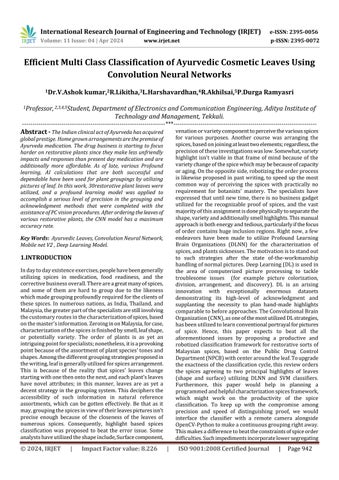
Abstract - The Indian clinical act of Ayurveda has acquired global prestige. Home grown arrangementsarethepremiseof Ayurveda medication. The drug business is starting to focus harder on restorative plants since they make less unfriendly impacts and responses than present day medication and are additionally more affordable. As of late, various Profound learning, AI calculations that are both successful and dependable have been used for plant groupings by utilizing pictures of leaf. In this work, 30restorative plant leaves were utilized, and a profound learning model was applied to accomplish a serious level of precision in the grouping and acknowledgment methods that were completed with the assistance of PC vision procedures. After orderingtheleavesof various restorative plants, the CNN model has a maximum accuracy rate
Key Words: Ayurvedic Leaves, Convolution Neural Network, Mobile net V2 , Deep Learning Model.
Indaytodayexistenceexercises,peoplehavebeengenerally utilizing spices in medication, food readiness, and the correctivebusinessoverall.Thereareagreatmanyofspices, and some of them are hard to group due to the likeness whichmadegroupingprofoundlyrequiredfortheclientsof these spices. In numerous nations, as India, Thailand, and Malaysia,thegreaterpartofthespecialistsarestillinvolving thecustomaryroutesinthecharacterizationofspices,based onthemaster'sinformation.ZeroinginonMalaysia,forcase, characterizationofthespicesisfinishedbysmell,leafshape, or potentially variety. The order of plants is as yet an intriguingpointforspecialists;nonetheless,itisaprovoking pointbecauseoftheassortmentofplantspecies'tonesand shapes.Amongthedifferentgroupingstrategiesproposedin thewriting,leafisgenerallyutilizedforspicesarrangement. This is because of the reality that spices' leaves change startingwithonethenontothenext,andeachplant’sleaves have novel attributes; in this manner, leaves are as yet a decentstrategyinthegroupingsystem.Thisdeciphersthe accessibility of such information in natural reference assortments, which can be gotten effectively. Be that as it may,groupingthespicesinviewoftheirleavespicturesisn't precise enough because of the closeness of the leaves of numerous spices. Consequently, highlight based spices classification was proposed to beat the error issue. Some analystshaveutilizedtheshapeinclude,Surfacecomponent,
venationorvarietycomponenttoperceivethevariousspices for various purposes. Another course was arranging the spices,basedonjoiningatleasttwoelements;regardless,the precisionoftheseinvestigationswaslow.Somewhat,variety highlight isn't viable in that frame of mind because of the varietychangeofthespicewhichmaybebecauseofcapacity oraging.Ontheoppositeside,robotizingtheorderprocess islikewiseproposedinpastwriting,tospeedupthemost common way of perceiving the spices with practically no requirement for botanists' mastery. The specialists have expressedthatuntilnewtime,thereisnobusinessgadget utilized for the recognizable proof of spices, and the vast majorityofthisassignmentisdonephysicallytoseparatethe shape,varietyandadditionallysmellhighlights.Thismanual approachisbothenergyandtedious,particularlyifthefocus ofordercontainshugeinclusionregions.Rightnow,afew endeavors have been made to utilize Profound Learning Brain Organizations (DLNN) for the characterization of spices,andplantssicknesses.Themotivationistostandout to such strategies after the state of-the-workmanship handlingofnormalpictures.DeepLearning(DL)isusedin the area of computerized picture processing to tackle troublesome issues (for example picture colorization, division, arrangement, and discovery). DL is an arising innovation with exceptionally enormous datasets demonstrating its high-level of acknowledgment and supplanting the necessity to plan hand-made highlights comparabletobeforeapproaches.TheConvolutionalBrain Organization(CNN),asoneofthemostutilizedDLstrategies, hasbeenutilizedtolearnconventionalportrayalforpictures of spice. Hence, this paper expects to beat all the aforementioned issues by proposing a productive and robotizedclassificationframework forrestorativesortsof Malaysian spices, based on the Public Drug Control Department(NPCB)withcenteraroundtheleaf.Toupgrade theexactnessoftheclassificationcycle,thisrevieworders the spices agreeing to two principal highlights of leaves (shape and surface) utilizing DLNN and SVM classifiers. Furthermore, this paper would help in planning a programmedandhelpfulcharacterizationspicesframework, which might work on the productivity of the spice classification. To keep up with the compromise among precision and speed of distinguishing proof, we would interface the classifier with a remote camera alongside OpenCV-Pythontomakeacontinuousgroupingrightaway. Thismakesadifferencetobeattheconstraintsofspiceorder difficulties.Suchimpedimentsincorporatelowersegregating
International Research Journal of Engineering and Technology (IRJET) e-ISSN: 2395-0056
Volume: 11 Issue: 04 | Apr 2024 www.irjet.net p-ISSN: 2395-0072
power between weeds and some harvest, same species fluctuation dismissal, various species fluctuation acknowledgment, complex highlights to be extricated, etc, prompting the requirement for further developed classificationspeedandexactness.
Todatenumerousanalystshaveproposedafewstrategies what’s more, the principal point of each and every explorationisinferringanewarrangementordevelopment to take care of this issue of recognizable proof also, arrangement of therapeutic plants. These strategies are talkedaboutbeneathinthissegment.
Dileep M. R. what's more, Pournami P.N. [1] proposed a ConvolutionalBrainOrganization(CNN)modelforgrouping andthegroupingisperformedutilizingsoftmaxandSVM classifiers. Beginning V3 is used for the productive component extraction from the dataset. This model accomplishedacharacterizationexactnessof96.76%andit istriedwithleaftestsfrom40therapeuticplants.
JingWeiTanetal.[2]proposedaD-Leafisavenation-based CNN model,whichutilizesCNN forincludeextractionand ANN forcharacterization.Edge identification isutilized to removevenationsubtletiesfromresizedleafpictures.The characterizationexactnessofD-Leafmodelis94.88%D.
Venkataramaetal[3].Introducedaproficientstrategyfor leafcharacterization,itisPCVisionBasedmodeltofindthe element for order of given restorative plant leaves what's more, to recover its therapeutic subtleties. This model purposes Probabilistic Brain Organization classifier to recognize leaf. It comprises of steps like pre-handling, include extraction, grouping, recovery of restorative qualities and so forth. furthermore, the include vector computation and similitude matching are including for characterization.
R.Jananietal.[4]fosteredaFakeBrainOrganization(ANN)based model tocharacterize the restorativeplant by their highlightsliketone,surfaceandstateofleaves.Themodel involved36leavesforpreparing,7leavesforapprovaland 20leavesfortesting,63leavesaltogether.Outof20unique elements of leaves, 8 insignificant conspicuous highlights were recognized to arrange the leaves. Minimization, whimsy,skewness,kurtosis,energy,relationship,aggregate change and entropy are those insignificant 8 highlights. Exactnessofthismodelis94.4%.
Plant species arrangement has been concentrated widely utilizingdifferentadvancements. Profoundlearningoffers greatoutcomesfurthermore,highexactnessovertraditional characterizationtechniques.Characterizationofcompound passesonstillshouldbeexamined.Thereisasyetaneedto foster a proficient technique for ordering all types of restorativeleaves.
To catch the pictures for our dataset, we used a scope of instruments.OneofthecellphonesutilizedwastheRedmi Note 8, outfitted with a 13-megapixel camera and a pixel thicknessof409ppi(pixels per inch).Furthermore, other cell phones, similar to the Xiaomi 7, included an eightmegapixel camera with a pixel thickness of 269 ppi. The Samsung Cosmic system A51 model had a 32-megapixel camera.
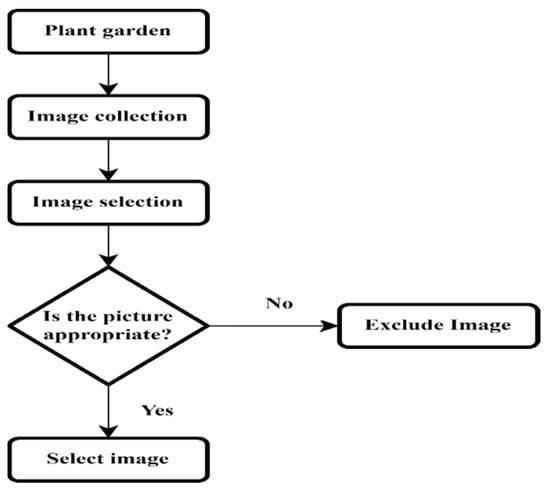
Figure 1 presents a flowchart delineating the information assortment process. It starts with catching the pictures straightforwardly utilizing the cell phone cameras. These picturesweregottenfromthedifferentkindsofcellphones referenced before. Our dataset involves 3000 pictures arranged into 30 unique classes. All the dataset of leaf imageswherecollectedfromKagglewebsite.
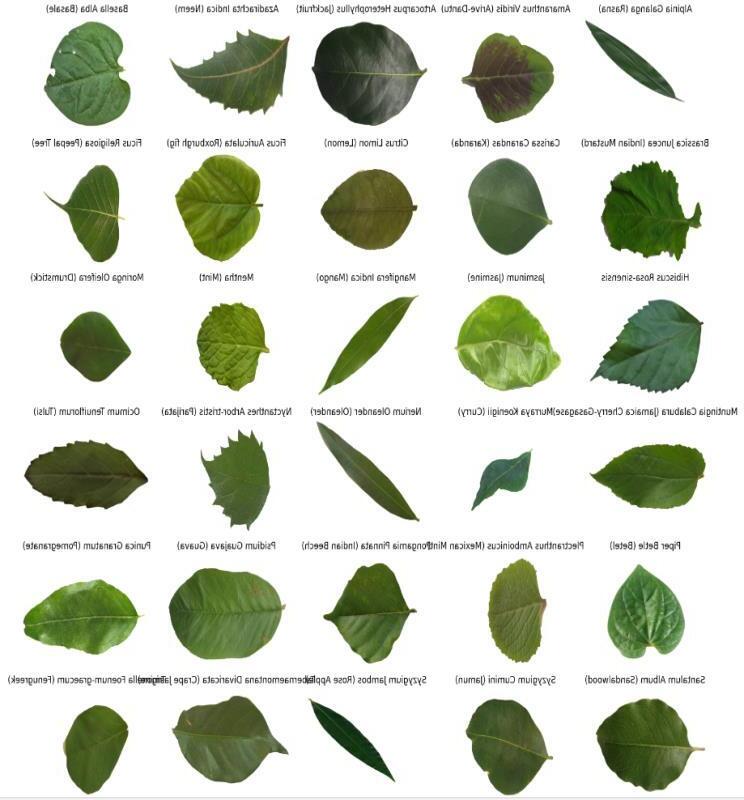
InFigure1,wegiveoneexamplepicturetoeveryoneofthe ten animal categories addressed in the dataset. Figure 2. Tests for ten types of therapeutic plants: Alpinia Galanga (Rasna), Amaranthus Viridis (Arive-Dantu), Artocarpus Heterophyllus (Jackfruit), Azadirachta Indica (Neem), Basella Alba (Basale), Brassica Juncea (Indian Mustard), Carissa Carandas (Karanda), Citrus Limon (Lemon), Ficus Auriculata (Roxburgh fig), Ficus Religiosa (Peepal Tree), Hibiscus Rosa-sinensis, Jasminum (Jasmine), Mangifera Indica (Mango), Mentha (Mint), Moringa Oleifera (Drumstick),MuntingiaCalabura(JamaicaCherry-Gasagase), Murraya Koenigii (Curry), Nerium Oleander (Oleander), Nyctanthes Arbor-tristis (Parijata), Ocimum Tenuiflorum (Tulsi), Piper Betle (Betel), Plectranthus Amboinicus (MexicanMint),PongamiaPinnata(IndianBeech),Psidium Guajava(Guava),PunicaGranatum(Pomegranate),Santalum Album(Sandalwood),SyzygiumCumini(Jamun),Syzygium Jambos(RoseApple),TabernaemontanaDivaricata(Crape Jasmine),TrigonellaFoenum-graecum(Fenugreek).
METHODOLOGY:
The research focuses on identifying the medicinal herb in real-timeusingthemobileapp.Theresearchiscomposedof threestagestrainingtestinganddeployment.
Training:inthisstage,firstthedataarecollectedfromthe Kaggle website. Next, the data are split into training, validation, and testing. The gathered data undergo processingtechniqueslikeresizingandaugmentation.The trainingandvalidatingdataareusedtotrainthedesigned DLmodel.
Testing: after training and validating the DL model, the testingwasdoneontestdata.Thisphaseisusedtofinalize theDLmodelifthemodelgivesasatisfactoryresponse.
PicturePre-handlingisthegoalofthepreprocessingmove toward convert the filtered pictures into an information design that is acknowledged by CNN, which is an element of227x227x3. Pictures were utilized in RGB design and changedoverintothe227x227x3arrangementintheevent that they were not in the requireddesign. Our dataset has pictures of changing aspects, so wefirst cushioned the picturestoNxNaspectsbyperformingscaling.Lastly,resized thecushionedpicturesto227x227x3aspectsbyperforming scaling.
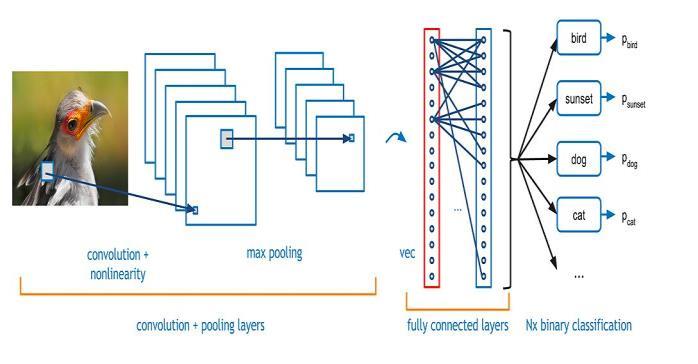
Component Extraction: All the planned CNN models are preparedandtriedutilizingAyurvedicdatasetandresults areanalyzedagainstInitiationV3results.WeplannedCNN modelswithvariousnumberoflayers,numberofchannels andchannelsizewithdifferingpreparingchoices.Anumber ofconvolutional,max-pooling,andSoftMaxlayers,aswellas the quantity of neurons set in the initial two completely associatedlayers,decidetheexhibitionofthesemodels.The proposedAyurvedicCNNisplannedinlightoftheoutcomes of these examinations. The precision of the model profoundlydependsonthequantityofpicturesutilizedfor preparing the model. Once the preparation and approval processes are finished, the pictures from the test set are giventoacquiretheprecisionofthemodel.TheAyurvedic model then, at that point, yields the preparation and approval exactness by means of the precision chart, and characterizationexactnessbymeansofthedisarraygrid.As you can see Fig.3 the design of Convolution Brain Organization our BeginningV3 additionally utilizes same CNN with additional layers. All essential activity like Max pooling,ThickLayerwhichwillhappen.Hereasingraph5 Convolution Brain Organizations are there yet in unique Origin V3 model it is pre trained Convolution Brain Organization model which utilizes 48 layers profound. SampleworkflowofCNN.
International Research Journal of Engineering and Technology (IRJET) e-ISSN: 2395-0056
Volume: 11 Issue: 04 | Apr 2024 www.irjet.net p-ISSN: 2395-0072
RESUTLS AND DISCUSSION:
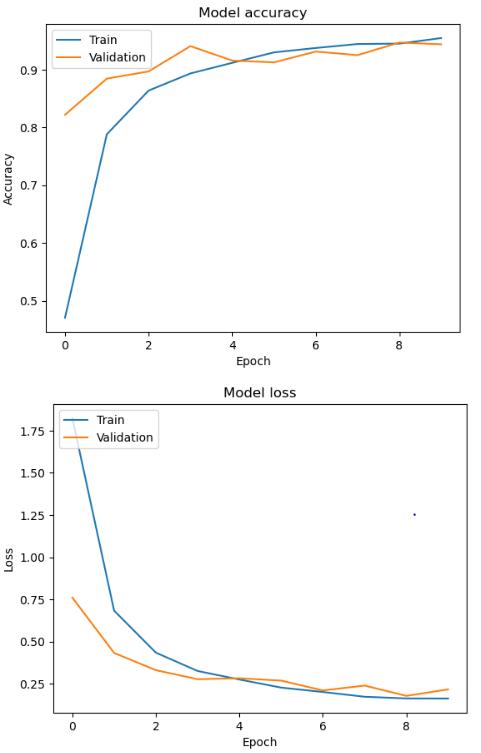
Figure5:Thisistheresultofmodelvalidationaccuracy andlosswithrespecttoepochs.
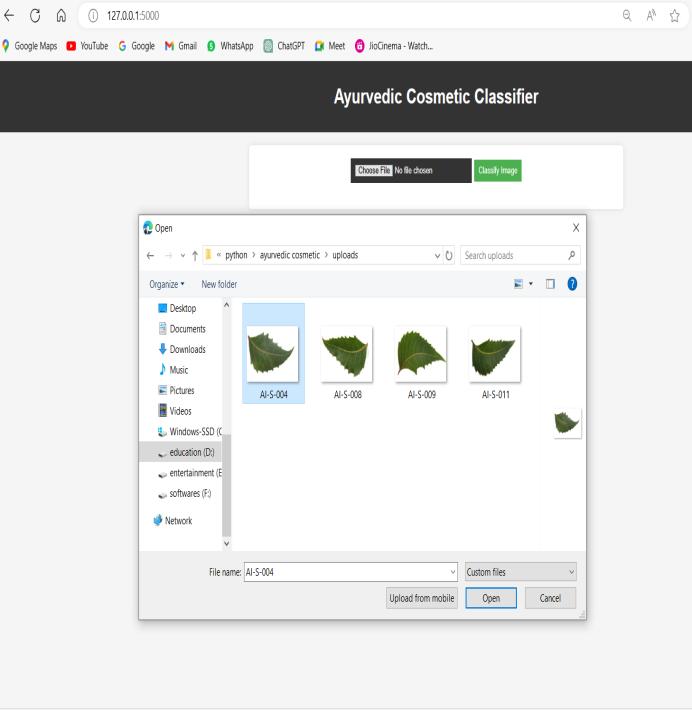
Figure6:.Resultofwebpageloaded,Selectinganinput imagetoclassifybythemodel
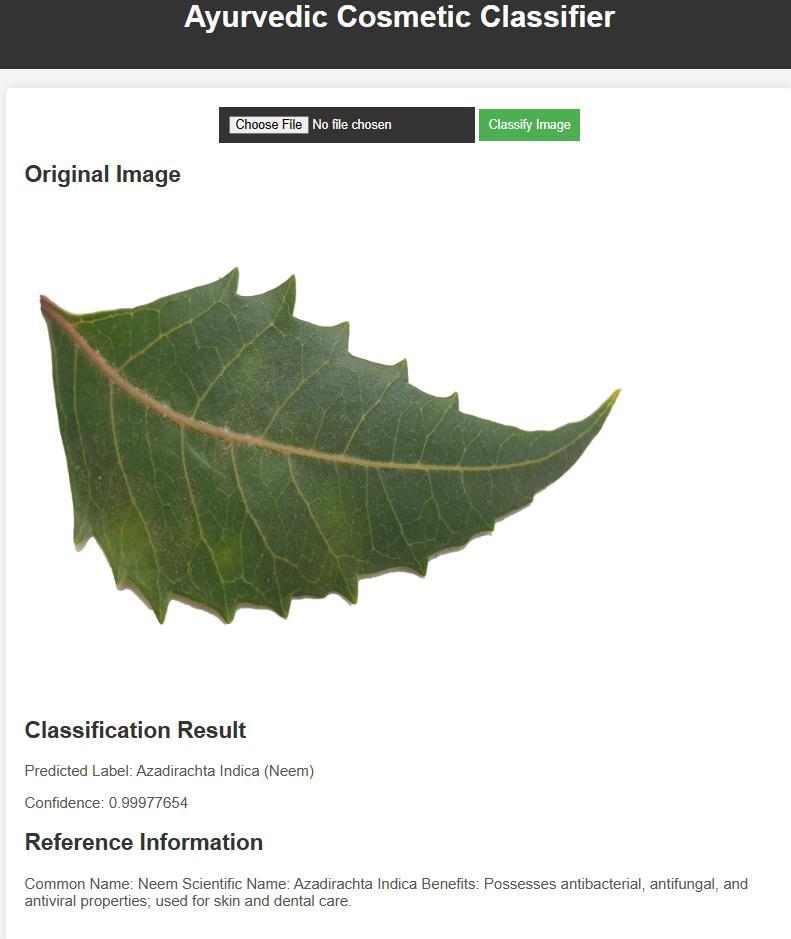
Figure7:ClassifiedResultofinputimagewithrespectto labelandpredictionconfidenceandreferenceinformation
CONCLUSION AND FUTURE SCOPE:
In this review, we foster a profound learning based therapeutic plants leaves characterization model which dependsallalonepreparedandtrieddataset.Itisacquired the efficient precision which is 97 %. In this proposed frameworkuseSanskritwordsforrecognizingthenamesof Restorative plants. In expansion, it very well might be of extraordinaryassistancetodrugspecialiststoperceivethe rightrestorativeplantinthefieldoftherapeuticplantleaves grouping, as well as help during the time spent making drugs.
[1] S. Prasad, P. S. Kumar, and D. Ghosh, ‘‘An efficient low vision plant leaf shape identification system for smart phones,’’ Multimedia Tools Appl., vol. 76, no. 5, pp. 6915–6939,Mar.2017.
[2] D. N. Duong, T. L. Le, and H. Vu, ‘‘A Web-based plant identificationapplicationusingmulti-organimagesquery,’’ in Proc. AUN/SEED-Net Regional Conf. Comput. Inf. Eng., Vietnam,Oct.2015.
International Research Journal of Engineering and Technology (IRJET) e-ISSN: 2395-0056
Volume: 11 Issue: 04 | Apr 2024 www.irjet.net p-ISSN: 2395-0072
[3]D.M.C.Dissanayake,andW.G.C.W.Kumara(2021),―Plant LeafIdentificationbasedonMachineLearningAlgorithms‖, SriLankanJournalofTechnology2021SpIssue60-66ISSN 2773-6970.
[4] V. Satti, A. Satya, and S. Sharma, ‘‘An automatic leaf recognition system for plant identification using machine visiontechnology,’’Int.J.Eng.Sci.Technol.,vol.5,no.4,p. 874,2013.
[5]B.S.Anami,S.S.Nandyal,andA.Govardhan,‘‘Acombined color, texture and edge features based approach for identificationandclassificationofIndianmedicinalplants,’’ Int.J.Comput.Appl.,vol.6,no.12,pp.45–51,Sep.2010.
[6] M. F. A. Jabal, S. Hamid, S. Shuib, and I. Ahmad, ‘‘Leaf features extraction and recognitionapproachesto classify plant,’’J.Comput.Sci.,vol.9,no.10,p.1295,2013.
[7]S.AnanthiandS.V.Varthini,‘‘Detectionandclassification ofplantleafdiseases,’’Int.J.Res.Eng.Appl.Sci.,vol.2,no.2, pp.763–773,2014.
[8]T.Munisami,M.Ramsurn,S.Kishnah,andS.Pudaruth, ‘‘Plant leaf recognition using shape features and colour histogram with K-nearest neighbour classifiers,’’ Procedia Comput.Sci.,vol.58,pp.740–747,Jan.2015.
[9]O.H.Babatunde,L.Armstrong,J.Leng,andD.Diepeveen, ‘‘Asurveyofcomputer-basedvisionsystemsforautomatic identificationofplantspecies,’’J.Agricult.Informat.,vol.6, no.1,pp.61–71,Jan.2015.
[10] J. Chaki and R. Parekh, ‘‘Plant leaf recognition using shapebasedfeaturesandneuralnetworkclassifiers,’’Int.J. Adv.Comput.Sci.Appl.,vol.2,no.10,pp.41–47,2011.
[11] Z. Zulkifli, P. Saad, and I. A. Mohtar, ‘‘Plant leaf identificationusingmomentinvariants&generalregression neuralnetwork,’’inProc.11thInt.Conf.HybridIntell.Syst. (HIS),2011,pp.430–435.
[12] N. Valliammal and S. N. Geethalakshmi, ‘‘Automatic recognitionsystemusingpreferentialimagesegmentation forleafandflowerimages,’’Comput.Sci.Eng.,Int.J.,vol.1,no. 4,pp.13–25,2011.
[13]Owais A. Malik, Nazrul Ismail,Burhan R.Hussein and UmarYahya(2022),―AutomatedReal-TimeIdentificationof Medicinal PlantsSpecies in Natural Environment Using DeepLearningModels ACaseStudyfromBorneoRegion‖, Malik, O.A.; Ismail, N.; Hussein,B.R.; Yahya, U. Automated Real-Time Identification of Medicinal Plants Species inNaturalEnvironmentUsingDeepLearningModels ACase StudyfromBorneoRegion.Plants2022,11,1952. https://doi.org/10.3390/plants11151952.
[14]K.David,P.James,and P.Mathew,‘‘Authomaticplant leaf classification for a mobile field guide (an Android application),’’Dept.Elect.Eng.,StanfordUniv.,Stanford,CA, USA, Tech. Rep., 2012. [Online]. Available: https://stacks.stanford.edu/file/druid:rz261ds9725/ Knight_Painter_Potter_PlantLeafClassification.pdf
[15]S.G.Wu,F.S.Bao,E.Y.Xu,Y.-X.Wang,Y.-F.Chang,and Q.-L. Xiang, ‘‘A leaf recognition algorithm for plant classification using probabilistic neural network,’’ in Proc. IEEEInt.Symp.SignalProcess.Inf.Technol.,Dec.2007,pp. 11–16.[16]X.Gu,J.-X.Du,andX.-F.Wang,‘‘Leafrecognition basedonthecombinationofwavelettransformandGaussian interpolation,’’inProc.Int.Conf.Intell.Comput.,China,2005, pp.253–262.