
Volume: 11 Issue: 04 | Apr 2024 www.irjet.net p-ISSN: 2395-0072
Volume: 11 Issue: 04 | Apr 2024 www.irjet.net p-ISSN: 2395-0072
Mohit Patil1 , Anurag Bhat2 , Prafull Neve3, Pravin Garud4, Prof. Shekhar Gulwade5
1Mohit Patil SPPU (Jayawantrao Sawant College of Engineering)
2Anurag Bhat SPPU ((Jayawantrao Sawant College of Engineering)
3Prafull Neve SPPU ((Jayawantrao SawantCollegeofEngineering)
4Pravin Garud SPPU ((Jayawantrao SawantCollegeofEngineering)
5 Asst. Professor Shekhar Gulwade Dept. of Mechanical Engineering, JSCOE, Maharashtra, India ***
Abstract - Photovoltaic modules provide a workable answer to the issue of power generation in remote regions by directly and cleanly converting sunshine into electricity. When there is a relatively low demand for electrical power, they are extremely helpful. Rather than installing additional panels, we can utilize a tracking system, which increases power, to maximize the amount of electricity extracted according to demand. By ensuring that PV modules are always facing the sun during the day, the solar tracker built and designed for this project maximizes the power production of the modules. Any scenario where solar modules are utilized could employ the tracker. This would prove particularly efficacious in scenarios where minimal modules are neededand optimal efficiency is paramount.
Key Words: Photovolatic Modules, Sun Tracking, ElectricityGeneration
Solar energy is one of the most promising renewable energy sources because of its enormous potential for conversion into electrical power. The Photo-Voltaic (PV) effect, which converts solar radiation into electrical energy, is a very promising technology that has no ecological impact and is quiet, clean, and dependable. It also requires very little maintenance. Sales in this market segment have grown exponentially over the last several years, indicating a significant demand for photovoltaic conversion systems in the next decades. The European PhotovoltaicIndustryAssociation(EPIA)recentlyreleased marketresearchestimatesstatingthattheinstalledpower of PV conversion equipment climbed from approximately 1GWin2001tonearly23GWin2009.
Although PV panel conversion efficiency has steadily increased due to technology advancements, the majority of commercial panels still have efficiencies of little more than 20%. The technological community that works with solar energy harnessing technology is always looking for new ways to improve the conversion efficiency of PV panels.SolutionsforincreasingPVefficiencyincludesolar tracking, optimizing the geometry of the solar cells, increasing their capacity to capture light, using new materials, etc. The amount of light radiation that enters
the PV panels determines how much power they can produce.
A static PV panel's incident radiation changes continuouslyduetotheongoingvariationofthesun-earth relative location. When the direction of solar radiation on the panel surface is perpendicular, the point of maximum receivedenergyisobtained.Installingaphotovoltaicpanel on a solar tracking device that tracks the sun's path can therefore boost the panel's output energy. The PV conversion efficiency of the system is increased because, incontrasttotraditionalfixedPVpanels,mobilePVpanels powered by solar trackers are maintained at optimal insolationthroughouttheSun'scycle.PVpanelswithsolar trackers installed may see tens of percent increases in output energy, particularly in the summer when solar energy is more valuable. Solar cells, also referred to as photo-voltaicorPVcells,transformsolarradiationintoDC electricity. Compared to other renewable energy sources, photovoltaics (PVs) have the extra benefit of being noiseless and requiring little upkeep. A tracking system needs to be able to track during cloud cover, return the collector to its starting position at the end of the day, and trackthesunwithaparticulardegreeofaccuracy.
Growinginpopularityquickly,solarenergyisasignificant waytoincreasetheamountofrenewableenergyavailable. Therefore,itisessentialthatthoseworkinginengineering professionsarefamiliarwiththetechnologyrelatedtothis field. The design and development of a microcontrollerbased solar panel tracking system is presented in this study. Because solar tracking keeps the solar array pointed toward the sun, more energy may be generated. Eventually,afunctionalsystemwillbeshowntoverifythe design.Issuesandpotentialfixeswillalsobediscussed.
Design and construction of a microcontroller based single axis solar tracker. S. Zubair1, A. Suleiman2, H. T. Abdulazzez2, B. A. Salihu1
Solarenergyisrapidlygainingpopularityasanimportant meansofexpandingrenewableenergyresources.Assuch, it is vital that those in engineering fields understand the technologies associated with this area. This paper presentsthedesignandconstructionofamicrocontrollerInternational Research Journal of Engineering and Technology (IRJET) e-ISSN: 2395-0056
International Research Journal of Engineering and Technology (IRJET) e-ISSN: 2395-0056
Volume: 11 Issue: 04 | Apr 2024 www.irjet.net p-ISSN: 2395-0072
based solar panel tracking system. Solar tracking allows more energy to be produced because the solar array is able to remain aligned to the sun. A working system will ultimately be demonstrated to validate the design. Problems and possible improvements will also be presented.
Design of two axes sun tracking controller with analytically solar radiation calculations ARTICLE in RENEWABLE AND SUSTAINABLE ENERGY REVIEWS MARCH 2015 Saban Yilmaz, Oguzhan Akgol, Muharrem Karaaslan
Photovoltaic systems have gained a great deal of interest in the world and these studies performed on this subject havebeengainingmoreandmoreimportance.Inorderto designnewPVsystemsthatwillbeinstalledtooperate in more efficient and more feasible way, it is necessary to analyzeparameterslikesolarradiationvalues,theangleof incidenceofthegenus,temperatureetc.Therefore,inthis study, theoretical works have been performed for solar radiation and angle of incidence values of any location, plus an experimental study was carried out on a system tracking the sun in two axes and in a fixed system. The performedprototypeisalsoadaptedintoaPVsystemwith 4.6 kW power. Theoretical data are consistent with the dataobtainedfromthePVsystemwith4.6kWpower.This study will be an important guide for the future PV power stations.
Time operated solar tracking for optimum power generation Asst. Prof. K. Sambasiva rao, P. Harish, V N. V. Ramana, M. V. S. Krishna teja
The growth or energy demand in response to industrialization,urbanizationandsocialaffluencehasled to an extremely uneven global distribution of primary energy consumption. The Sun, Wind, Waves and geothermal heat are renewable energy sources that will never run out. They are perpetual or self renewing. The rate ofconsumption does not exceed rate of renewability. The cost of generating electricity from wind and solar power has decreased by 90% over the past 20 years. Maximizingpoweroutputfromasolarsystemisdesirable to increase the efficiency of a solar tracing system. To maximizethepoweroutput fromsolarpanels,weneedto keep the panels aligned with the sun. In this paper, the design of an efficient solar tracking system based on Real Time Clock (RTC) using microcontroller is described. The proposed tracking system is a low cost, high accurate, moreefficientwithlowpowerconsumption.
Two Ways of Rotating Freedom Solar Tracker by Using ADC of Microcontroller By Sobuj Kumar Ray, Md. Abul Bashar, Maruf Ahmad & Fahad Bin Sayed
Solartrackersareusedtoimproveelectricpowerradically of photovoltaic panel by using different sensor. The sensorsretrievethesolarradiation.Thispaperpresentsa simple method, low cost microcontroller based solar
tracker of two ways of rotating freedom in order to achieve the right positioning of photovoltaic solar cell to getthemuchsunlightduringthedaylightsessionandasa result produce more electricity. This tracking system is developed with two direct current motor operated by a PIC16F72 microcontroller which processes the sensors (LDR) information by its internal ADCanalog to digital converterwithFuzzylogicandsendcorrectinformationto motor controller IC-LM392D by which motor is operated. The motor is so operated that the panel can rotates two ways suchashorizontallyandverticallyofits direction. A comparison has been made on a conventional solar followerplantandtruckingsystem.
Design and Implementation of a Sun Tracker with a Dual-Axis Single Motor for an Optical Sensor-Based Photovoltaic System Jing-Min Wang and Chia-Liang Lu
The dual threats of energy depletion and global warming place the development of methods for harnessing renewable energy resources at the center of public interest. Solar energy is one of the most promising renewable energy resources. Sun trackers can substantially improve the electricity production of a photovoltaic (PV) system. This paper proposes a novel design of a dual-axis solar tracking PV system which utilizes the feedback control theory along with a fourquadrant light dependent resistor (LDR) sensor and simple electronic circuits to provide robust system performance. The proposed system uses a unique dualaxisACmotorandastand-alonePVinvertertoaccomplish solar tracking. The control implementation is a technical innovation that is a simple and effective design. In addition, a scaled-down laboratory prototype is constructed to verify the feasibility of the scheme. The effectiveness of the Sun tracker is confirmed experimentally.Toconclude,the resultsof thisstudy may serve as valuable references for future solar energy applications.
Solar Tracking System Using Stepper
Anuraj and Rahul Gandhi
Solar energy is rapidly advancing as an important means ofrenewableenergyresource.Solartrackingenablesmore solar energy to be generated because the solar panel is able to maintain a perpendicular profile to the sun’s rays. Thoughinitial costofsettingupa solartrackingsystemis high, this paper proposes a cheaper solution. Design and constructionofaprototypeforsolartrackingsystemwith singledegreeoffreedom,whichdetectsthesunlightusing Light Dependent Resistors (LDR), is discussed in this paper.Thecontrolcircuitforthesolartrackerisbasedon an ATMega16 microcontroller. This is programmed to detectthesunlightthroughtheLDRsandthenactuatethe stepper motor to position the solar panel where it can receivemaximumsunlight.Comparedwithanyothertype of motor, the stepper motor is more controllable, more energy efficient, more steady and has high tracking accuracy and suffers little environmental effect.
International Research Journal of Engineering and Technology (IRJET) e-ISSN: 2395-0056
Volume: 11 Issue: 04 | Apr 2024 www.irjet.net p-ISSN: 2395-0072
Theoreticalanalysisandresearchresultshavebeenshown inthispapertoadvocatethatthedesignedsystemrealized precise automatic tracking of the sun and can greatly improvetheutilizationofsolarenergy.
This paper presents the design of a solar tracking system driven by a mnicrochip PIC 18F452 micro controller. The system is based on two mechanisms. The first one is the search mechanism (PILOT) which locates the position of the sun. The second mechanism(intelligent PANELS) aligns itself with the PILOT only if maximum energy possible could be extracted. On top of that the main advantage of the technique is that the rotation only takes place,if the energy obtainedin the newpositionis higher thenthatconsumedbythepanelsduringthetransition.So there are two mechanisms, one for the search which is mounted on a miniature motor and consumes only small amountofenergy.Itsroleistolocatethebestpositionfor maximumenergyextraction.Thesecondoneisthepanels mechanism which rotates to the position when energy extractionisoptimal.
Nikesh. D. Watane Rakesh. A. Dafde
This paper presents the hardware design and implementation of a system that ensures a perpendicular profile of the solar panel with the sun in order to extract maximumenergyfallingon itrenewableenergyisrapidly gaining importance as an energy resource as fossil fuel prices fluctuate. The unique feature of the proposed systemisthatinsteadoftakingtheearthasitsreference,it takes the sun as a guiding source. Its active sensor constantly monitors the sunlight and rotates the panel towards the direction where the intensity of sunlight is maximum. The light dependent resistor’s do the job of sensingthechangeinthepositionofthesunwhichisdealt by the respective change in the solar panel’s position by switching on and off the geared motor the control circuit does the job of fetching the input from the sensor and gives command to the motor to run in order to tackle the changeinthepositionofthesun.Withtheimplementation the proposed system the additional energy generated is around 25% to 30% with very less consumption by the system itself. In this paper, an improvement in the hardware design of the existing solar energy collector system has been implemented in order to provide higher efficiencyatlowercost.
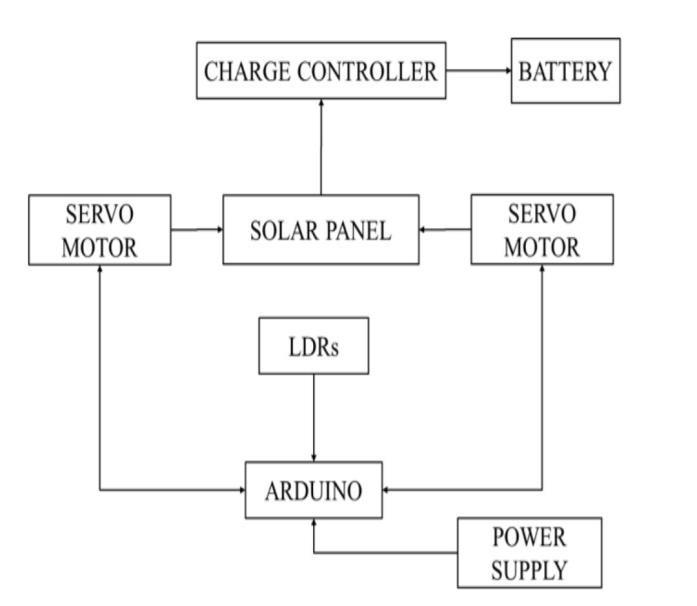
FigureNo.01BlockDiagram
The Sun tracking solar panel consists of two LDRs, solar panelandaservomotorandATmega328Microcontroller. Two light dependent resistors are arranged on the edges of the solar panel. Light dependent resistors produce low resistance when light falls on them. The servo motor connectedtothepanelrotatesthepanelinthedirectionof Sun. Panel is arranged in such a way that light on two LDRsiscomparedandpanelisrotatedtowardsLDRwhich have high intensity. When the intensity of the light falling on right LDR is more, panel slowly moves towards right and if intensity on the left LDR is more, panel slowly moves towards left. In the noon time, Sun is ahead and intensityoflightonboththepanelsissame.Insuchcases, panelisconstantandthereisnorotation.
The following figure shows the circuit diagram of the system:
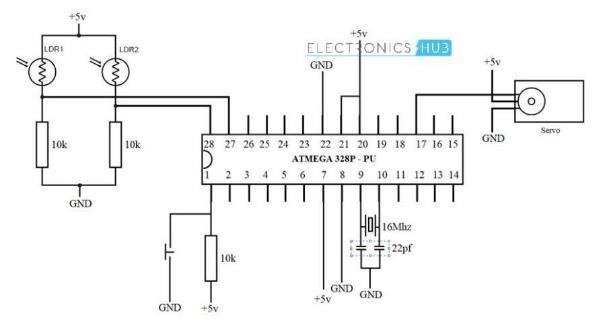
FigureNo.02CircuitDiagram
Solar trackers are essentially devices with solar panels installedonthemthatfollowthesun'spathacrossthesky tomakesurethepanelsreceivethemostsunlightpossible throughouttheday.Followingitsdiscoveryofsunlight,the trackerwill attemptto navigatealongthetrail inorder to identify the best sunlight. Numerous components are neededfortheSolarTracker'sdesign.TheSolarTracker's
International Research Journal of Engineering and Technology (IRJET) e-ISSN: 2395-0056
Volume: 11 Issue: 04 | Apr 2024 www.irjet.net p-ISSN: 2395-0072
design and construction may be broken down into six basic components, each of which has a primary role and must cooperate harmoniously with the others to accomplishasmoothoperation.
Methods of Tracker Mount
1. Single axis solar trackers
A horizontal axle or a vertical axle can be found on single axis solar trackers. In tropical climates with shortdaysandahighnoonsun,thehorizontaltypeis utilized. In high latitudes when the sun does not rise very high yet summer days can be very lengthy, the vertical type is employed. The most popular and straightforward method is the single axis tracking system.
2. Double axis solar trackers
Double axis solar trackers are able to track the apparentmotionofthesunpreciselyanywhereinthe world because they have both a horizontal and a vertical axle. Since astronomical telescopes use this kindof technologyfor control,a plethora ofsoftware is available to automatically predict and track the sun's journey across the sky. Solar panel efficiency canberaisedby30–40%bytrackingthesun.Asolar reflector is also focused toward the concentrator on heliostat systems using the dual axis tracking mechanism.
Methods of Drive
1. Active Trackers
Activetrackersarecontrolledbyacontrollerthat reacts to the direction of the sun using motors and gear trains. Two photo sensors, like as photodiodes, are usually arranged differently in light-sensing trackers such that they each produceanullwhenexposedtothesameamount of light. They should be 90 degrees apart and omnidirectional mechanically. This will result in maximal sensitivity since the steepest portion of theircosinetransferfunctionswillbalanceatthat point.
2. Passive Trackers
Inorderforapassivetrackertomoveinresponse to an imbalance, a low boiling point compressed gas fluid is driven to one side or the other by solarheatproducinggaspressure.
3. RESULT AND DISCUSSIONS
It was important to compare the experiment findings for the fixed panel with the smart solar tracker system in order to validate the proposed modeling. A few easy experiments were run to get this data. Figure shows the
experimentsetup for both thefixedandtrackingsystems. Thesetsweremountedthreemetersabovethegroundon ametalframe.Amultimeterthatwasattachedtothesolar cells was used to record the readings for the open-circuit voltage and current. Throughout the whole test time, sunny weather was taken into consideration for the experiment. During the tests, a local wind speed of approximately0.8m/s(1.6knots)wasreported,whilean averagetemperatureofapproximately30˚Cwasrecorded.
First, a solar panel mounted to the surface was used for the test. Next, a tilting mechanism with a DC motor, as seenabove,wasused.
Theobservationsthatweremadearedisplayedbelow.
TableNo.01Observation
International Research Journal of Engineering and Technology (IRJET) e-ISSN: 2395-0056
Volume: 11 Issue: 04 | Apr 2024 www.irjet.net p-ISSN: 2395-0072
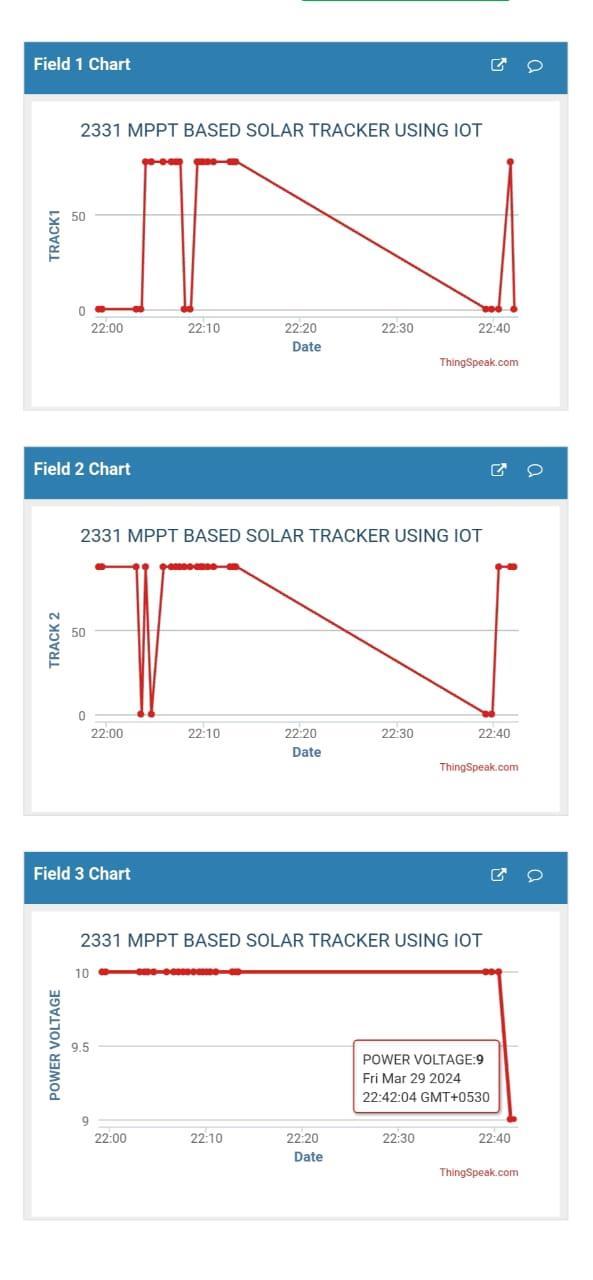
FigureNo.01ThingSpeakResult
4. CONCLUSION
Starting with the solar tracking system design for the experimental setup using a micro controller. All of the componentsoftheexperimentalsetupareproducinggood results, and when we compare tracking using LDR with Fixed Solar Panel System, we find that the efficiency of MicroControllerBasedSolarTrackingSystemisimproved by 30- 45%. By employing Step-Down T/F and 220V AC,
the necessary power is employed to run the motor. In addition, the sun is continuously tracked by this tracking device. In the long run, this system proves to be more economical and efficient. According to the data, there is a 30% boost in efficiency with an autonomous tracking system as compared to a non-tracking system. Future work can still be done to improve the solar tracker's additional characteristics, such as wind and weather protection
1. RizkJ.andChaikoY.“SolarTrackingSystem:More Efficient Use of Solar Panels”, World Academy of Science,EngineeringandTechnology412008.
2. Filfil Ahmed Nasir, Mohussen Deia Halboot, Dr. ZidanKhamis A.“Microcontroller-Based Sun Path Tracking System”, Eng. & Tech. Journal, Vol. 29, No.7,2011.
3. Alimazidi Mohammad, Gillispie J, Mazidi, Rolin D. McKinlay, “The 8051 Microcontroller and Embedded Systems”, An imprint of Pearson Education.
4. ] Mehta V K, Mehta Rohit, “Principles of Electronics”,S.Chand&CompanyLtd
5. Balagurusamy E, “Programming in ANSI C”, Tata McGraw-HillPublishingCompanyLimited
6. Damm, J. Issue #17, June/July 1990. An active solartrackingsystem,HomeBrewMagazine.
7. Koyuncu B and Balasubramanian K, “A microprocessor controlled automatic sun tracker,” IEEE Trans. Consumer Electron., vol. 37, no.4,pp.913-917,1991.
8. Konar A and Mandal A K, “Microprocessor based automatic sun tracker,” IEE Proc. Sci., Meas. Technol.,vol.138,no.4,pp.237-241,1991.