

STOCK MARKET PREDICTION USING HYBRID LSTM-ARIMA AND SENTIMENT ANALYSIS ON NIFTY STOCK INDEX
Dr. S. Annie Joice
1 ,
U. Mohamed Baashith
2 , R. Manikandan3 , P. Sathasiva Pandi4
1Assistant Professor, Department of CSE, Government College of Engineering, Srirangam, Tamilnadu, India 2,3,4UG student, Department of CSE, Government College of Engineering, Srirangam, Tamilnadu, India
Abstract - This paper presents a hybrid approach for stock market price prediction by integrating Long Short-Term Memory (LSTM), Auto Regressive Integrated Moving Average (ARIMA), and sentiment analysis derived from Twitter data. The proposed hybrid LSTM-ARIMA model involves gathering company-specific data, segmenting it into three components based on trend, seasonal, and residual characteristics, and incorporating tweets for sentiment analysis. The proposed model utilizes LSTM to handle seasonal and residual data, ARIMA for trend data, and sentimentanalysistogaugemarket sentiment. The hybrid model demonstrates enhanced predictive accuracycomparedtostandaloneLSTMandARIMA models, underscoring the efficacy of integrating these methods. Tweets obtained from Twitter are utilized to inform decisions regarding stock transactions. Results highlight the significant impact of sentiment analysis on improving overall prediction performance. The hybrid LSTM-ARIMA model outperforms the standalone models and gives an MAE of 0.58, RMSE of 1.16, MAPE of 0.01. The hybrid LSTM-ARIMA model achieves best accuracy for every stock when contrasted with the two standalone models (ARIMA & LSTM). This paper contributes to the advancement of stock market prediction methodologies and recommends the user to buy or sell a particular stock.
Keywords: Hybrid LSTM-ARIMA Model, Sentiment Analysis, Seasonal, Residual, Trend
1. INTRODUCTION
The stock market, as a dynamic and complex system, constantly challenges investors and analysts to develop moreaccuratepredictionmodels.Inrecentyears,machine learningtechniques[1]haveemergedaspowerfultoolsfor forecastingfinancialmarkets.
Historical stock market prediction methods have predominantlyreliedonsingularmodels,suchasARIMAor LSTM[2][3][4].Thispaperaimstobridgethegapbetween LSTM and ARIMA, two widely used models, by combining themtobetterunderstandthecomplexpatternsinfinancial data. LSTM excels at capturing long-term dependencies, while ARIMA is effective in modeling trend data. This combinationleveragesthestrengthsofeachmodel,creating asynergythatpromisesenhancedforecastingaccuracy.In addition to the hybrid modeling approach [5], this paper introducessentimentanalysisasacrucialcomponent[6].In
aneradominatedbysocialmedia,understandingtheimpact of public perception on stock prices is paramount. By incorporating sentiment analysis of tweets related to a specific company, the model integrates real-time market sentiment,providingamoreholisticperspective.Thechoice ofdata sourcesispivotal toanypredictionmodel.Forthe hybrid approach, historical stock market data is sourced, which is then divided into seasonal, residual, and trend components. Concurrently, relevant tweets from Twitter pertainingtotheselectedcompanyarecollected,providing the sentiment analysis algorithm with a rich dataset. This meticulouscurationofdiversedatasourcesensuresthatthe model is not only comprehensive but also capable of adapting to the multifaceted nature of stock market dynamics. This paper is driven by the recognition that accurate stock market predictions empower investors to makeinformeddecisions,mitigatingrisksandmaximizing returns.ByembracingahybridLSTM&ARIMAmodelwith sentimentanalysis,thispaperaspirestocontributetothis evolving landscape, pushing the boundaries of what is possibleinforecastingstockmarketprices.
This paper investigates into this realm, proposing a hybridapproach[5]thatcombinesLSTMandARIMAmodels with sentiment analysis [6]. This integration aims to overcomethelimitationsofstand-alonemodels,providinga morerobustandreliablepredictionframework.
Therestofthepaperisorganizedasfollows:Section2 summarizes the related work on stock market price prediction.Section3describestheproposedhybridLSTMARIMAmodelwithsentimentanalysis,aswellasthetraining procedure. Section 4 describes the dataset, and its preprocessingfortraining. Further,theexperimentalresults andperformanceanalysisarealsoincludedinthissection.In Section5,theconclusionandfutureresearchdirectionare highlighted.
2. RELATED WORK
Researchers and practitioners extensively investigatedvariousapproachestodevelopmodelscapable offorecastingstockprices,addressingthechallengingand complex task of stock market price prediction. In their studies, they explored key areas and methods commonly used in this field. Zhao et al. [7] employed time series relational models for stock price prediction, enhancing
International Research Journal of Engineering and Technology (IRJET) e-ISSN: 2395-0056
Volume: 11 Issue: 04 | Apr 2024 www.irjet.net p-ISSN: 2395-0072
forecasting accuracy by analyzing historical data and incorporating relational structures. Widiputra et al. [8] proposed a model that combined Convolutional Neural Networks (CNN) and LSTM networks to predict multiple parallel financial time series, leveraging CNN for feature extractionandLSTMforsequentiallearning.Nelsonetal.[9] trained and evaluated an LSTM model for predicting an increase in the stock's price within the next 15 minutes. Bhandarietal.[10]proposedamodelimplementedinsingle andmulti-layerLSTMarchitectures,andtheirperformance wasanalyzedusingvariousevaluationmetricstoidentifythe bestmodel.Hatanoetal.[11]proposedamodelthatutilized featuresgeneratedusing Sentence-BERTfortweetdata to train LightGBM (Gradient Boosting Machine), to predict suddenchangesinclosingprices.Antadetal.[12]proposed amodelfocusedonusinghistoricaldataforpredictionand aimedtoenhanceprecisionbyemployinglinearregression models. Kapoor et al. [13] proposed a model that utilized multi-layer hierarchical LSTM networks to predict stock prices. Leveraging deep learning techniques, LSTMs processed historical data to forecast future prices. This necessitated computational resources and programming expertise in a machine learning framework such as TensorFloworPyTorch.Kaeleyetal.[14]proposedamodel tested for longer time windows and incorporated new technicalindicatorfeaturestoimprovetheperformanceof RNN models in stock price prediction. Aldhyani et al. [15] proposed a hybrid model that integrates Convolutional NeuralNetwork(CNN)andLSTMnetworkstoforecastthe closingpricesofcompaniesusingdeeplearningtechniques. Alfonsoetal.[16]illustratedwithanapplicationtothestock market using neural networks to predict the stock prices with less error rates. Cao et al. [17] introduced a hybrid forecastingmodelcombiningLSTMandCEEMDAN,withthe goal of improving the accuracy of stock market price predictions. The performance of the model is assessed through linear regression analysis. Feng et al. [18] introducedadeeplearningtechniquecalledRelationalStock Ranking(RSR)torankstocksandcapturetheirrelationships in a time-sensitive manner. Wang et al. [19] introduced a novel method termed Adaptive Long-Short Pattern Transformer (ALSP-TF) for stock ranking, demonstrating superiorexperimentalresultscomparedtostate-of-the-art stock forecastingtechniques.Zhaoetal.[20]introduced a unified time-series relational multi-factor model (TRMF), incorporating a self-generating relations (SGR) algorithm capableofautomaticallyextractingrelationalfeatures
3. PROPOSED SYSTEM
3.1
System Architecture
Leveraging the integration with Yahoo Finance, historical stock pricedetails forthechosencompanyover thepastyearsarefetchedseamlessly.Simultaneously,recent tweets related to the company are pulled from Twitter to provide additional contextual information. These tweets
undergo Natural Language Processing (NLP) to prepare themforsentimentanalysis,discerningwhethertheyconvey positive,negative,or neutral sentiments[17].Thefetched stock market data undergoes preprocessing to enhance accuracy.Historicalstockmarketdataisdecomposedinto trend, seasonal, and residual components. Each of the componentsistrainedontheirown.Predictionresultsfrom allthreecomponentswereaddedforthefinalpredictionof stock.
Subsequently, a Hybrid LSTM & ARIMA model is employed to forecast the future stock price of the chosen company.Oncetrained,themodelgeneratesforecastsbased onthelearnedpatternsfromthehistoricalstockpricedata andsentimentanalysisofrelevanttweets. Uponcompletion ofthetrainingandtestingphases,thealgorithmprovidesa forecastvalueforthestockpriceoftheparticularcompany. Figure1demonstratestheoverallsystemarchitectureofthe stockmarketpricepredictionmodel.
The proposed system is divided into three major components:a)Collectionofthestockdatasuchastheopen, close, high, low, adjusted close prices & volume and preprocessing of tweets for sentiment analysis, b) classificationofstocktickerusingLSTM,ARIMAandHybrid LSTM-ARIMAandc)PerformanceAnalysisofthedifferent models.

3.2 Methodology
3.2.1
Collection of Stock Ticker
Datasetispreparedfromtickersofhistoricalstock marketdatafromYahooFinanceAPIandthetweetsforthe sentiment analysis are extracted using Twitter API. To conduct the study, data from the Indian Stock Market’s NationalStockExchange(NSE)Nifty50indexspanningfrom Jan1,2022tothecurrentdate,encompassingnearly2years ofdata.Latesttweetsforthepast7daysarefetchedtoget
Fig -1:SystemModel
Volume: 11 Issue: 04 | Apr 2024 www.irjet.net p-ISSN: 2395-0072
accurate prediction results. The implementation of this modelensuresamoreeffectivediscernmentofsentiments expressed in tweets, ultimately assisting in assessing community perceptions of the company and its potential impactonthestockmarket.
3.2.2 Long Short-Term Memory (LSTM)
LSTM is an efficient method for time series forecasting.LSTMcanbeabletorememberinformationover alongperiodoftimeanditisbestsuitedforstockmarket priceprediction[6][7][9].Ithelpsusunderstandpatterns over time. It looks at the seasonal and leftover (residual) parts of the stock data. This approach trains the LSTM on some data and then checks how well it does on new data. Thisway,itlearnsfromthepastandappliesthatlearningto make predictions. LSTM is like a sophisticated tool that remembersandunderstandshowthestockmarketbehaves over different seasons, helping to make better prediction. LSTMisatypeofrecurrentneuralnetwork(RNN)designed tomodeltemporalsequencesandlong-termdependencies. Inthecontextofstockmarketprediction,LSTMcanbeused tolearnpatternsandtrendsfromhistoricalstockpricedata
3.2.3 Auto-Regressive Integrated Moving Average (ARIMA)
The Auto-Regressive Integrated Moving Average (ARIMA) method focuses on predicting stock prices by understandingandanalyzingthelong-termtrendinthedata. Trained on historical data representing the trend component,ARIMAprovidesinsightsintosustainedmarket movements. After training, the model's effectiveness is assessedusingaseparatetestingdataset.Thisstepensures thatARIMA'scapacitytocaptureandforecasttrendsinstock prices is accurate and reliable. By concentrating on the underlying trends in the stock market data, ARIMA complements the short-term focus of other models, contributingtoamorecomprehensiveandrobustprediction framework. The ARIMA model is a popular time series forecastingmethod,commonlyusedforstockmarketprice prediction.
3.2.4 Sentiment Analysis Model
Inthispaper,thetweetsabouttheselectedcompany havebeenextractedfromTwitter.Tweetsnotrelevanttothe company are removed. Text preprocessing of tweets are performed using Regular Expressions. The presence of hashtagsandspecifiesinthetextincreasesthelengthofthe messageandtherebydecreasingtheabilityoftheanalysis model to classify the sentiments. Hence, they have been removed. Further, the tweets have been converted to lowercase and multiple whitespace characters have been replaced with a single whitespace character. After preprocessing the dataset additional tree features will be usedtohighlightthefeatureswhicharethemosteffectiveto predicttheclosingpriceofthestock.Scikit-learnimplement
an estimator that uses randomized decision tree to fit differentsubsetofthedatasetbyutilizingthemeanmethod. Hencethepredictionaccuracyofthemodelisimprovedand theoverfittingofthedatasetiscontrolled.Forourstudythe proposed model extracts all tweets that specify either the company name, stock name or name of any of the board memberscurrentlyinthecompany.
3.2.5 Hybrid LSTM and ARIMA Model
EachofthemodelsARIMAandLSTMhastheirown strengthsandweaknesses.ARIMAdoesnotworkwellwith non-linear timeseries. On the other hand, LSTM can work withlinearandnon-lineartimeseriesdata.However,LSTM requireslongtrainingtime.Byconsideringthesefactors,a hybridmodelisimplementedanditworkswiththeirown expertise. The proposed hybrid model is expected to give more accurate predictions compared to the standalone models.Thehybridmodelcanmakemodelsworktogether to overcome each other's weaknesses. The hybrid model captures both short-term patterns and long-term trends, providingamorecomprehensiveandsubtletypredictionof stock prices. The synergy achieved through hybrid model contributes to a more reliable and effective forecasting model.
Integratingsentimentanalysisenrichesthehybrid model by considering public opinion from Twitter. This fusion of market sentiment with quantitative predictions enhancesthemodel'sunderstandingofstockbehavior.By exploring how sentiments align with stock movements, valuableinsightsemerge.Thisintegrationcapturesnotonly numerical trends but also the emotional context of the market, providing a more holistic approach to stock price prediction. It allows the model to respond to both factual marketdataandthesubjectiveaspectsofinvestorsentiment foramoresubtleanalysis.
4. EXPERIMENTAL EVALUATION
4.1
Environment Specification
The study has been done using x86-based processor. Furthermore, the machine has 8GB of RAM and 1TB Hard disk. The models are constructed using hybrid LSTM and ARIMAmodelsinmachinelearningwiththehelpofKeras andTensorFlowlibrariesavailableinPython.
4.2 Dataset
TheStockdataisdecomposedintotrend,seasonaland residualdatausingstatsmodellibrary.TheLSTMmodelis appliedtobothseasonalandresidualdataandARIMAmodel isappliedtotrenddata.Eachofthedatadecomposedinto trend, seasonal and residual component are trained individually.Thedecompositionoftimeseriesdataisshown in Chart 1. The stock prediction is calculated using the formula: International Research Journal of Engineering and Technology (IRJET) e-ISSN: 2395-0056
Volume: 11 Issue: 04 | Apr 2024 www.irjet.net p-ISSN: 2395-0072


(b)
Chart – 1: TimeSeriesDecompositionofData
(a)TrenddecompositionGraph (b)Seasonal&ResidualComponentGraph
Table -1: ExperimentalSetup
ProcessName S.No Action
Input 1. Collecthistoricaldataofstock pricesfromYahoofinance
2. Collect tweets from Twitter forsentimentanalysis
Environment
Configuration 3. VScode
4. Importallnecessarylibraries andpackages
Data Preprocessing 5. It involves applying normalization,datareduction, datatransformation,anddata
Model Compilation
cleaningonthecollecteddata
Training and Testing 6. Build a prediction model trained on hybrid LSTM and ARIMA
7. The dataset is split into 80% for training and 20% for testing.
8. Set 1000 epochs for Hybrid LSTM and ARIMA model training(0,1,0)
Performance Report 9. Generatepredictionreport 10. Generatemodelaccuracywith anerrorrate
Prediction 11. Predict tomorrow's stock price for a particular organization
4.3 Analysis
The hybrid LSTM-ARIMA model was trained and evaluatedonthedatasetusingLSTMarchitecturewiththree layers,eachcomprising50units,andadropoutrateof0.1. ThemodelwasoptimizedusingtheAdamoptimizerwitha meansquarederrorlossfunctionover1000epochs.TheAIC value is evaluated to obtain the better ARIMA model and configured in the order of (p, d, q) – (0, 1, 0).The performanceofthehybridmodelwasassessedusingseveral metrics.Thefollowingvaluesrepresenttheforecastedstock prices for Ashok Leyland. The root mean squared error (RMSE)forthehybridmodelwas1.16.Themeanabsolute error(MAE)forthehybridmodelwas0.58.Additionally,the mean absolute percentage error (MAPE) for the hybrid modelwas0.01.
The accuracy of the hybrid model was evaluated basedonitsabilitytopredictthetrendcomponentsofthe timeseriesdata.
4.4 Deployment
Deployment of a stock market price prediction projectinvolvedsettingupauser-friendlyinterfacethrough aweb-basedplatformbuiltontheFlaskframework.Users couldaccesstheapplicationthroughawebbrowsertofetch thepredictedpriceforaparticularstockmarket.Thedata wasfetchedfromYahooFinance,andpreprocessingofdata tookplaceatthebackendoftheproject.Theflaskbackend handledthetrainingandtestingofdatausingahybridLSTM and ARIMA model. Sentiment analysis using the Natural Language Processing (NLP) technique was applied to processTwitterdataandcategorizethetweetsintopositive, negative,andneutralsentiments.Evaluationmetricssuchas Root Mean Squared Error (RMSE), Mean Squared Error (MSE), Mean Absolute Error (MAE), and Mean Absolute International Research Journal of Engineering and Technology (IRJET) e-ISSN: 2395-0056
International Research Journal of Engineering and Technology (IRJET) e-ISSN: 2395-0056
Volume: 11 Issue: 04 | Apr 2024 www.irjet.net p-ISSN: 2395-0072
Percentage Error (MAPE) were utilized to assess the accuracy and performance of the stock price predictions generated by the Hybrid LSTM & ARIMA model. Table 2 specifies the final prediction result for Ashok Leyland limited.UtilizingFlaskenabledseamlessinteractionbetween usersandtheapplication,providingapredictedvalueofa stock market price promptly and effectively. The Chart 2 illustratestheaccuracyofeachmodelinpredictingthestock priceofAshokLeylandLimited.

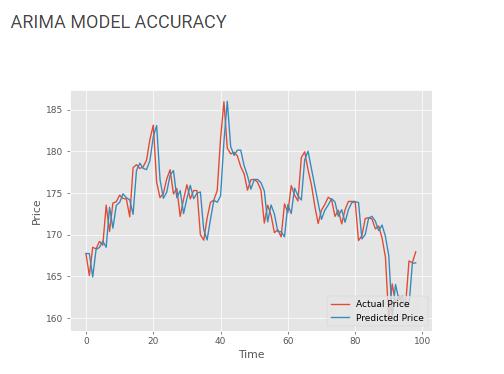


Chart – 2: AccuracypredictionsofDifferentModel
(a)LSTMModelAccuracyforAshokLeyland
(b)ARIMAModelAccuracyforAshokLeyland
(c)HybridModelAccuracyforAshokLeyland
(d)SentimentAnalysischartforAshokLeyland
(e)LossgraphforLSTM
(f)LossgraphforHybridmodel
(a)
(b)
(c)
(d)
(e)
(f)
International Research Journal of Engineering and Technology (IRJET) e-ISSN: 2395-0056
Volume: 11 Issue: 04 | Apr 2024 www.irjet.net p-ISSN: 2395-0072
– 2: FinalpredictionresultofAshokLeylandLimited
5. CONCLUSION
Thepaperaimedtopredictstockmarketpricesby combiningforecastingtechniqueswithsentimentanalysis. The combination of Long Short-Term Memory (LSTM) and Auto-Regressive Integrated Moving Average (ARIMA) in a hybrid model is effective, demonstrating better predictions thanusingeithermodelalone.Theresultsindicatedthatthe hybridmodelwassuccessfulinreducingerrorsinpredicting stockprices.Thedecompositionofdataintotrend,seasonal andresidual andapplyingthedata tothe rightcomponent improvestheaccuracyofthehybridmodel. Lookingahead, further research was suggested to strengthen sentiment analysis,explorenewdatasources,andutilizemoreadvanced machinelearningmodelstoadapttothedynamicnatureof markets. Ultimately, the work contributedvaluable insights for investors, analysts, and researchers seeking a practical andaccurateapproachtounderstandingandpredictingstock marketmovements.
REFERENCES
[1] R.Behera,S.Das,S.Rath,S.Misra,andR.Damasevicius, “Comparative Study of Real Time Machine Learning Models for Stock Prediction through Streaming Data,” JUCS-JournalofUniversalComputerScience,vol.26,no. 9, pp. 1128–1147, Sep. 2020 , doi:10.3897/jucs.2020.059.
[2] K.Chen,Y.Zhou,andF.Dai,“ALSTM-basedmethodfor stock returns prediction: A case study of China stock market,” 2015 IEEE International Conference on Big Data(BigData),Oct2015,pp.2823-2824.
[3] S.ChenandL.Ge,“Exploringtheattentionmechanismin LSTM-based Hong Kong stock price movement prediction,” Quantitative Finance, vol. 19, no. 9, pp. 1507–1515, Jul. 2019, doi: 10.1080/14697688.20191622287.
[4] T.FischerandC.Krauss,“Deeplearningwithlongshortterm memory networks for financial market predictions,”EuropeanJournalofOperationalResearch, vol. 270, no. 2, pp. 654–669, Oct. 2018, doi: 10.1016/j.ejor.2017.11.054.
[6] P.Mehta,S.Pandya,andK.Kotecha,“Harvestingsocial media sentiment analysis to enhance stock market prediction using deep learning,” PeerJ Computer Science,vol.7,p.e476,Apr.2021,doi:10.7717/peerjcs.476.
[7] C.Zhao,P.Hu,X.Liu,X.Lan,andH.Zhang,“StockMarket AnalysisUsingTimeSeriesRelationalModelsforStock Price Prediction,”Mathematics,vol.11,no. 5,p. 1130, Feb.2023,doi:10.3390/math11051130.
[8] H. Widiputra, A. Mailangkay, and E. Gautama, “Multivariate CNN-LSTM Model for Multiple Parallel FinancialTime-SeriesPrediction,”Complexity,vol.2021, pp.1–14,Oct.2021,doi:10.1155/2021/9903518.
[9] B. Reddy and U. J.C, “Prediction of Stock Marketusing Stochastic Neural Networks,” International Journal of InnovativeResearchinComputerScience&Technology, vol. 7, no. 5, pp. 128–138, Sep. 2019, doi: 10.21276/ijircst.2019.7.5.1.
[10] H. N. Bhandari, B. Rimal, N. R. Pokhrel, R. Rimal, K. R. Dahal,andR.K.C.Khatri,“Predictingstockmarketindex usingLSTM,”MachineLearningwithApplications,vol.9, no. 100320, p. 100320, May 2022, doi: 10.1016/j.mlwa.2022.100320.
[11] T.Mankar,T.Hotchandani,M.Madhwani,A.Chidrawar, andC.S.Lifna,“StockMarketPredictionbasedonSocial SentimentsusingMachineLearning,”2018International Conference on Smart City and Emerging Technology (ICSCET),Jan.2018,doi:10.1109/icscet.2018.8537242.
[12] S. Antadet al., “Stock Price Prediction Website Using LinearRegression-AMachineLearningAlgorithm,”ITM Web of Conferences, vol. 56, p. 05016, 2023, doi: 10.1051/itmconf/20235605016.
[13] A.Q.Mdetal.,“Noveloptimizationapproachforstock priceforecastingusingmulti-layeredsequentialLSTM,” AppliedSoftComputing,vol.134,p.109830,Feb.2023, doi:10.1016/j.asoc.2022.109830.
[14] H. Kaeley, Y. Qiao, and N. Bagherzadeh, “Support for Stock Trend Prediction Using Transformers and Sentiment Analysis,” arXiv.org, May 17, 2023. https://arxiv.org/abs/2305.14368.
[15] T. H. H. Aldhyani and A. Alzahrani, “Framework for PredictingandModelingStockMarketPricesBasedon DeepLearningAlgorithms,”Electronics,vol.11,no.19, p.3149,Sep.2022,doi:10.3390/electronics11193149.
[5] H.HeandS.Dai,“Apredictionmodelforstockmarket based on the integration of independent component analysisandMulti-LSTM,”ElectronicResearchArchive, vol. 30, no. 10, pp. 3855–3871, 2022, doi: 10.3934/era.2022196.
Table
International Research Journal of Engineering and Technology (IRJET) e-ISSN: 2395-0056
Volume: 11 Issue: 04 | Apr 2024 www.irjet.net p-ISSN: 2395-0072
[16] G. Alfonso and D. R. Ramirez, “A Nonlinear Technical Indicator Selection Approach for Stock Markets. ApplicationtotheChineseStockMarket,”Mathematics, vol. 8, no. 8, p. 1301, Aug. 2020, doi: 10.3390/math8081301.
[17] J.Cao,Z.Li,andJ.Li,“Financialtimeseriesforecasting model based on CEEMDAN and LSTM,”Physica A: StatisticalMechanicsanditsApplications,vol.519,pp. 127–139,Apr.2019,doi:10.1016/j.physa.2018.11.061.
[18] F. Feng, X. He, X. Wang, C. Luo, Y. Liu, and T.-S. Chua, “Temporal Relational Ranking for Stock Prediction,”ACMTransactionsonInformationSystems, vol. 37, no. 2, pp. 1–30, Mar. 2019, doi: 10.1145/3309547.
[19] P.Xia,Z.Li,W.Zhang,andB.Li,“AdaptiveLong-Short Pattern Transformer for Stock Investment Selection,” Proceedings of the Thirty-First International Joint Conference on Artificial Intelligence, Jul. 2022, doi: 10.24963/ijcai.2022/551.
[20] C.Zhao,X.Liu,J.Zhou,Y.Cen,andX. Yao,“GCN-based stock relations analysis for stock market prediction,” PeerJ, vol. 8, pp. e1057–e1057, Aug. 2022, doi: 10.7717/peerj-cs.1057.