
International Research Journal of Engineering and Technology (IRJET) e-ISSN:2395-0056
Volume: 11 Issue: 04 | Apr 2024 www.irjet.net
p-ISSN:2395-0072
International Research Journal of Engineering and Technology (IRJET) e-ISSN:2395-0056
Volume: 11 Issue: 04 | Apr 2024 www.irjet.net
p-ISSN:2395-0072
A.Hussain Lal1*, S.Sakthi1, G.Surendar1, A.Muthusamy1
1Department of Mechanical Engineering, Arifa Institute of Technology, Esanoor, 611103, Tamilnadu, India. ***
ABSTRACT-Micromachining domain requires machining techniques that would fulfill the severe demands like machining quality, higher machining rate, dimensional accuracy, economy and so on. Among the many available non-conventional machining methods electrochemical machining is under continuous research to adopt it on commercial scale to fulfill the industry-specific applications. Al7075, a heat treatable alloy is widely employed for structural components in automotive and aero-space industries. Composites are made out of Al7075 alloy to enhance its properties by reinforcing with appropriate ceramic compounds. This study examines the applicability of electrochemical micromachining (EMM) to Al2O3 added Al7075 composite. The process input factors investigated are voltage, duty cycle and electrolyte concentration and the performance analyzed through responses such as machining rate (MR) and radial overcut (ROC). Taguchi’s L9 design is used for experimental investigation to find the effect of process parameters and also carry out single-response as well as TOPSIS optimization. Electrolyte concentration was found to be the dominant parameter on the process. The TOPSIS method yielded the parametric combination of 12V, duty cycle of 70% and NaNO3 concentration of 40 g/lit to achieve higher MR and lower ROC.
Keywords: Electrochemicalmicromachining;Al7075/Al2O3composite;machiningrate;radialovercut;Taguchi;TOPSIS
1. INTRODUCTION
Asanenergysavingmeasureandtomakethestructureslight-weight,structuralcomponentsinmanyindustriesare now made with lighter materials like aluminium alloys instead of using heavier materials. Al7075 alloys particularly find application in automobile, aero and mobile industries to exploit their superior mechanical properties [1]. Still these lightweightmaterialslikeAl7075arefounddeficienttocertainextentlikeinhardnessandtensilestrengthwhichcanbeenhanced byreinforcinghardceramicparticlesintothesuchasAl2O3andothersintothematrixofthealloyinanuniformmanner[2]. Thecapabilityofelectrochemicalmicromachiningprocessistestedthroughexperimentationfordifferentmaterialslikepure metals, alloys and composites, different electrolytes and also applying various input conditions and approaches. Nimonic 75 alloyusedinaeroindustryhasbeenmachinedunderEMMsuccessfullyusingacidifiedelectrolyteandun-acidifiedelectrolyte (NaNO3+NaCl). The un-acidified electrolyte provided better performance and the parameters have been optimized using Topsis technique [3].Micro-circular impressions have been generated on stainless steel work-piece using EMM and it has reportedthatlesserpulse-ontime,higherfrequencylevelandusageofmixedelectrolyte(sodiumnitrate&sodiumchloride) yieldedgoodresults[4].TheinnerwallsofcoolingchannelhasalsobeenmachinedforturbulationpurposethroughEMMby using electrically conducting gelatinous electrolyte at selected regions in the work-piece [5].Three different electrode materials, namely copper, bronze and tungsten-carbide have been used as tool electrodes to machine nickel-aluminiumbronze alloytocomparetheirperformance. Copper removed maximumamount of material,tungsten-carbideprovided good surface quality and less overcut while bronize exhibited moderate performance between these two materials [6]. In the process of EMM study, temperature effect on outcomes has also been studied by applying ultraviolet rays to the electrolyte solutiontoraisetemperaturetothreedifferentlevels.Thestudyhasalsoemployedthreedifferentoptimizationmethodslike GRA (Grey Relational Analysis), VIKOR (VlseKriterijumska Optimizacija I Kompromisno Resenjeto) and TOPSIS (The optimization techniques such as similarity to ideal solution) to compare the results [7]. Attempts have also been made to generate square holes through EMM process on SS-321 specimen using H2SO4 solution [8]. Even magnetic fields have also been used to localize the machining and avoid machining spreading to other adjacent areas [9]. Aluminium7075 composite reinforced with alumina and borosilicate glass powder has been machined under EMM to produce micro-holes on it using NaNO3 and NaCl electrolytes individually. Sodium chloride solution performed lesser due to its aggressive nature. The optimizedinputcombinationreportedis10Voltsofvoltage,1.2Ampereofcurrentand12micro-secondspulse-ontime[10]. ToreducethedefectsintheprocessofEMM,laserenergyassistedhybridmachininghasbeenappliedandtheprocessquality
International Research Journal of Engineering and Technology (IRJET) e-ISSN:2395-0056
Volume: 11 Issue: 04 | Apr 2024 www.irjet.net
p-ISSN:2395-0072
improved[11].EMMprocesshasalsobeenappliedusingmaskofnon-conductingtypeonthesurfacenotrequiringmachining and quality micro holes were obtained [12]. An aluminium composite containing Al6061+ GGBS (ground granulated blast furnace slag) has also been machined under EMM process using NaNO3 solution to investigate the effect of reinforcement percentage. It is reported that increase inall input parameters like machining voltage, duty-cycle, electrolyte-concentration andpercentageofreinforcementincreasedbothmachiningrateandtheovercutofthemachinedmicro-hole[13].Blindholes havebeenmachinedonhighproportionceramiccompoundsaddedaluminiumcomposite(Al+SiC)throughelectrochemicaljet machiningusingsodiumchloridesolution.Theprocesscausedmanymicro-pitsonthesurfaceoftheworkmaterialduetojet effectandtheun-dissolvingnatureofSiCparticles.Theprocesshasbeenrecommendedforaluminiumcompositescontaining large fraction of ceramic compounds [14]. Al7075 composite machined under EMM process using sodium nitrate solution heated through induction heating. The performance was revealed through machining speed, overcut of the hole and delaminationformationandtheprocessparameterswereoptimizedusingTOPSIStechnique[15].
Theexperimentalsetupusedforthestudyisgiveninfigure1.Thesetupcomprisesalltheessentialsub-unitsrequired to carry out electrochemical micro-machining in a single axis of vertical tool movement along with a pulse generator to provide pulsed power. Compared to continuous power,the use of pulsed power provides pulse-off time during every pulse periodduringwhichthemachiningstopsandthetimeisutilizedtoflushthedebrisfromthemachiningsite[16].
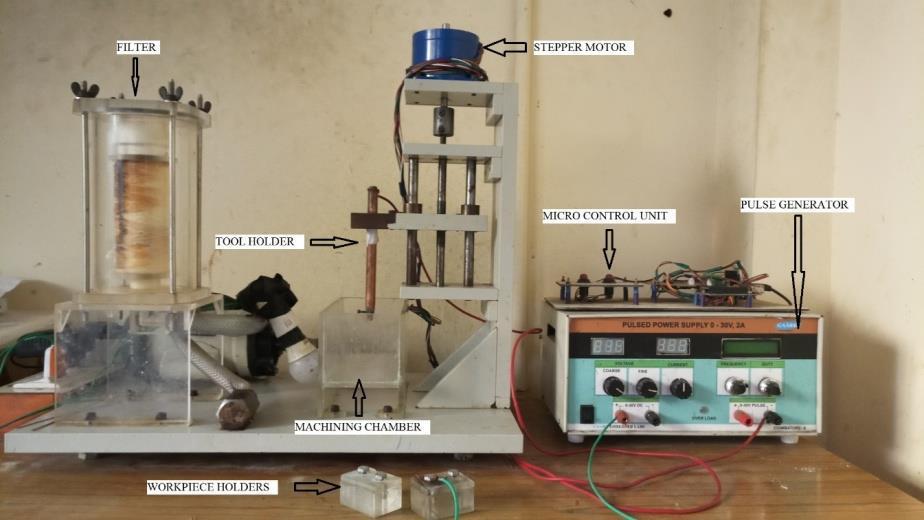
The work material used as anode was Al7075 composite containing 2% of Al2O3 ceramic compound. The work materialwascutto100mmX50mmX0.6mmfromthecastcomposite.Astainlesssteelneedleof850micrometerdiameter with conical end (400 micrometer diameter) was employed in the cathode terminal as tool. To control stray machining and ensure localized removal, the tool surface was insulated laterally with polymer material. The electrolyte used for the experimentswasNaNO3solution,apassiveelectrolyteknowntoproducequalitymachining.
Theinputfactorsconsideredforthisinvestigationweremachiningvoltage,dutycycle(Itisthepercentageofpulse-on timein the total pulse periodof one pulse-on time + pulse-offtime).and electrolyte concentration( taken in gramper litre) that were found to be among the dominant process parameters as per literature study [17]. The electrode gap of 40 micrometer and the current frequency of 50 Hertz are kept constant for all the experiments. For a frequency of 50Hz, one pulseperiodis1/50,whichisequalto20milli-seconds.Herethedutycycleof60%refersto12:8i.e12millisecondsofpulseontimeand8millisecondsofpulse-offtimeinthetotalof20milliseconds.Theprocessparametersandtheirappliedlevelsare givenintable1.
International Research Journal of Engineering and Technology (IRJET) e-ISSN:2395-0056
Volume: 11 Issue: 04 | Apr 2024 www.irjet.net
Table -1: Processparametersandlevels
The objective of the investigation is to drill micro-holes on the aluminium composite specimens through EMM and studytheperformance.TheoutputparametersconsideredforperformanceevaluationareMachiningRateandRadialOvercut. Themachiningrateisestimatedthroughdividingthethicknessoftheworkmaterialbymachining time.Theradialovercutis obtainedbydividingthedifferencebetweenthediameterofthemachinedholeandthediameterofthetoolbytwo.
The initial input parameters were set by running preliminary trial runs. The experimental input values have been designedasperTaguchi’sL9OrthogonalArray.Theeffectsandcontributionsofeachfactorontheprocesshavebeenstudied and the input parameters have been optimized using TOPSIS technique to get a single set of optimal values to achieve both maximummachiningrateandminimumradialovercut.
Theresultsobtainedfromtheexperimentationandtheoptimizationprocessisdiscussedinthefollowingsections.
3.1 Optimization Process
The experiments have been carried out as per L9 Orthogonal Array and the results calculated from the obtained readingsofmachiningtimeandthemicro-holediameteraregivenbelowintable2.
Table -2: ExperimentalResults
32 Single –Response Optimization: Taguchi Process
In the Taguchi process, finding the Signal to Noise ratio is the crucial step in the process of optimizing the input parameters.Thestepsarediscussedbelow.
SNratio:
One of the objective of this investigation is improving the MR and reducing the overcut while processing the Al composite under EMM. The expressions used for the calculation of S/N Ratio varies depending on whether the said performance parameter is required to be improved, reduced or nominal. In this research increase in MR and decrease in
International Research Journal of Engineering and Technology (IRJET) e-ISSN:2395-0056
Volume: 11 Issue: 04 | Apr 2024 www.irjet.net
2395-0072
overcutarerequired.Hence,higherthebetterforMRandsmallerthebetterforovercutareusedandthecorrespondingS/N ratioequationsgiveninequations(1)and(2).HighertheBetter:

SmallertheBetter:
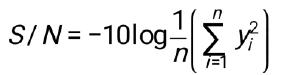
Here,“n”isatotalnumberofobservationsand“y”istheobservedreading.
The S/N ratio responses andtheir mean effects plots are obtained by employingMinitab19 software. The Mean effects plots forMRandROCarepresentedinfigures2and3respectively.
FromtheanalysisoftheMaineffectsplotofMR(Fig.2),the combinationofvoltage12V,Dutycycle80%andNaNO3 Concentration40g/litareidentifiedasoptimalparametersforattainingmaximumMRamongtheparameterlevelsapplied.
The combination involves the high level input of voltage and duty cycle and the low level value of electrolyte concentration. When the voltage is high, the electron movements would be forceful and hence more number of ions are removed from the anode work material leading to increased machining rate. For increase in duty ratio, the pulse-on time increaseswhichmeansmoretimeisavailableformachiningandnaturallythemachiningratetendtoincrease.Inthecaseof increased electrolyteconcentration, more ions will be availablein thesolution whichmayleadtoclogging of inter electrode gap (machining area) or passivation mechanism. It is because of this reason that medium level of electrolyte concentration leadstomaximumMR.PastresearchworkshaveshownsimilarresultsinEMMstudy[18].
Thecontributionofdifferentparametersappliedintheprocesscanbefoundoutthroughanalysisofvarianceandits outcomesarepresentedintable4.
ANOVAforMRwasdoneandtheresultsareplottedintable4. TheANOVAofMR, exhibitsthatvoltageprovidesthe mostsignificantcontributionof40.51%.Anddutycycle’scontributionis35.46%whichalsoasignificantfactor.
International Research Journal of Engineering and Technology (IRJET) e-ISSN:2395-0056
Volume: 11 Issue: 04 | Apr 2024 www.irjet.net p-ISSN:2395-0072
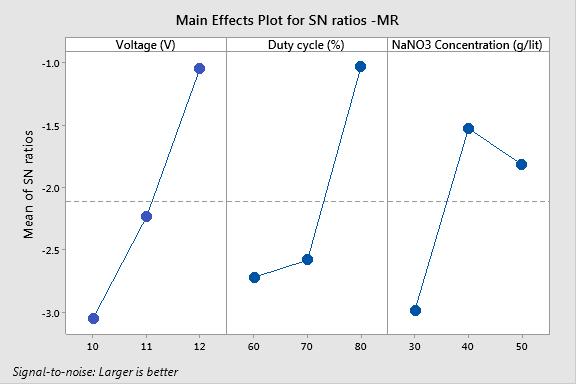
Chart -1: SNratioPlotofMR
Table -4: AnalysisofVarianceofMR
ThemaineffectsplotofROC(Fig.3)revealsthattheoptimalcombinationforattaininglowerovercutisgivenbylevel 3ofvoltage(high)andlevel1ofdutycycle(low)andlevel3NaNO3Concentration(high)whichrespectivelyarevoltage12V, Dutycycle60%andNaNO3Concentration50g/lit.
Theoptimized resultsclearlyreveal thatthe voltage of 12Vprovidesoptimum forceto the ionsleading toincreased machining speed and also restricting the tendency to stray cut. The duty cycle of level 1 gives the lowest possible pulse-on timeandthemaximumpulse-offtime.Whenthepulse-offtimeismore,extendedtimewillbeavailableforflushingthedebris fromthemachiningareawhichlowersthetendencyforstraymachining.Ifthesledgedepositedattheinterelectrodegapare more it may cause short circuit resulting in sparks and cut the adjacent areas. The high level of electrolyte concentration producesrequirednumberofionsinthechargecarryingsolutiontocausereactionsinthemachiningarea.
FromtheANOVAvaluesofROCtable6,itcanbenoticedthat,NaNO3Concentrationisthemost dominantfactorfor ROCintheEMMprocessofAlcompositecomparedtovoltageanddutycyclewhichplaylesssignificantroles.Itisclearfrom this revelation that electrolyte concentration level is significant for EMM as it is basically an ionic dissolution process that causematerialremovalfromtheanodematerial.
International Research Journal of Engineering and Technology (IRJET) e-ISSN:2395-0056
Volume: 11 Issue: 04 | Apr 2024 www.irjet.net p-ISSN:2395-0072
Table -5: ResponseTableforS/NRatiosofROC
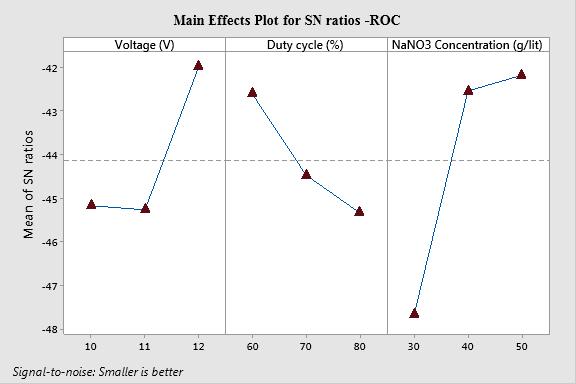
Chart -2: S/NratioPlotofROC
Table -6: AnalysisofVarianceofROC
Toachieverequired magnitudeofdifferentperformanceparametersofaprocessfromasinglesetofoptimuminput factors,multi-objective optimization iscarried out. TOPSISis onesuchoptimization techniquethat provideseffective results [19].TOPSIStechniqueisfollowedformulti-objectiveparametricoptimizationinthiswork.Theprocessisdetailedbelow.
ThefirststepinTOPSISmethodistheprocessofidentifyingdecisionmatrixwhichisgenerallyrepresentedby(rij)andgiven inequation3.Nexttothis,weightforeachresponseistobeallocated.Thedecisionmatrixandthepreferredweightsareused todefinetheNormalizedvalueandrelatedexpressionisgiveninequation(4).(Note:������isithvalueofexperimentalorder‘j’)
| Page858
International Research Journal of Engineering and Technology (IRJET) e-ISSN:2395-0056
Volume: 11 Issue: 04 | Apr 2024 www.irjet.net
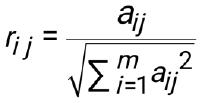
p-ISSN:2395-0072
(3)
Vij =Wi xrij (4)
Here��i=weightofji
Nextintheprocess,Positiveandnegativeidealsolution(S+andS-)arecalculatedusingequations5and6. (5) (6)
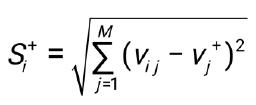
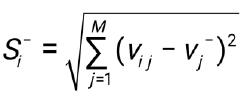
Infinalstep,CC(closenesscoefficient)isdeterminedthroughequation7.OnceCCisevaluated,Rankisgiventoexperiments, consideringtheorderfromthehighervaluesofCC. (7)
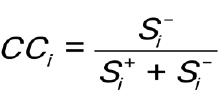
ThenormalizationvaluesofSeparation measuresandtheClosenessCoefficientvaluesofMRandROCobtainedfrom TOPSISanalysisarepresentedintable7.Alltheprocessparametersinvolvedaregivenequalweightinthisstudy.Thetable 7 revealsthatthehighestCCvalueisobtainedforexperimentnumber7withthevalueof0.8673.TheleastvalueforCCisfound forexperimentnumberone.BasedonCCvaluesthepreferredrunorderislikethis:7>9>4>3>8>2>5>6>1.Theresponsetable (Table 9) obtained from the analysed reveals that NaNO3 Concentration as the most dominant factor (58.46%) followed by voltage(25.63%)anddutycycleshowinginsignificantimpactontheprocess.
Theionspresentintheelectrolytesolutionshowgreat impactontheprocessbecauseelectrochemicalprocessworks on the principle of electrolysis and the machining mainly due to ionization process. The influence of voltage is to provide forcible movements to the ions which if not at higher level may not have a significant impact on the process. If duty cycle is withinthelimitofprovidingenoughtimeformachiningandflushing,itsimpactwouldnotberealised.
The main effects plot for CC* of TOPSIS study is given in figure 4 for the input parameters. The plot shows that V3D2C2istheoptimalconditionforobtainingmaximumMRandminimumROC.Theoptimumcombinationis12V(level3of voltage),70%dutycycle(level2)and40g/lit(level2ofelectrolyteconcentration).
It can be observed from the results that 12V gives enough force to relieve from the anode satisfying both the requirementsofmaximummachiningrateandminimumovercut.Mediumleveldutycycleof70%providessufficientpulse-off time to achieve the objectives. Also the medium level of NaNO3 concentration in the solution generates adequate ions to supportmachiningspeedandmaintainlocalizedmachining.TheEMMprocessisinfluencedbymanyotherfactorsapartfrom the ones we select for study. Also the interactions between different process parameters are a complicated issue which requirescontinuousresearch[20].
International Research Journal of Engineering and Technology (IRJET)
Volume: 11 Issue: 04 | Apr 2024 www.irjet.net
Table -7: S/Nratio,Normalization,CCcalculationsofTOPSIS
Table -8: ResponseTableforSignaltoNoiseRatios–CC*
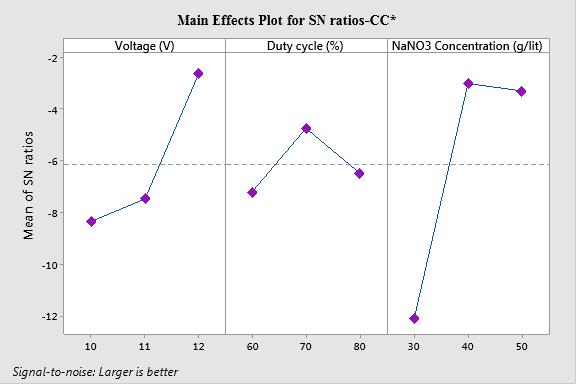
Chart -3: SNratioPlotofCC*
Table -9: AnalysisofVariance-CC*
International Research Journal of Engineering and Technology (IRJET) e-ISSN:2395-0056
Volume: 11 Issue: 04 | Apr 2024 www.irjet.net p-ISSN:2395-0072
The optimized combination may not be available in the experimental set. Hence confirmation experiment should be conducted to verify the result of the optimal set. The details of the confirmation experiment are shown in table 10. The experimental result of the optimized set (voltage 12V, Duty cycle 70% and NaNO3 Concentration 40 g/lit) is compared with the parameter set of first experiment to evaluate the improvement. The optimal set gave a machining rate of 0.978 μm/s (against0.578μm/sofinitialset)andaradialovercutof98μm(against284μmofinitialset).Optimalparameterswerefound toproduceconsiderableimprovementintheCCvalue.
Table 10. Confirmationtestdetails
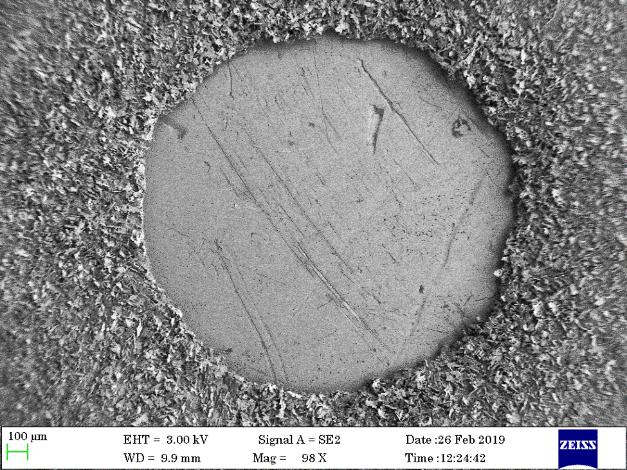
Themicro-holesgeneratedontheAl7075Al2O3compositespecimensat12V,60%dutycycleand50g/litelectrolyte concentrationisshowninfigure5.Theholegeneratedat11V,60%dutycycleand40g/litelectrolyteconcentrationisshown infigure6.
2: SEMmicrographofmicro-holeproducedat12V,60%dutycycleand50g/lit
International Research Journal of Engineering and Technology (IRJET) e-ISSN:2395-0056
Volume: 11 Issue: 04 | Apr 2024 www.irjet.net p-ISSN:2395-0072
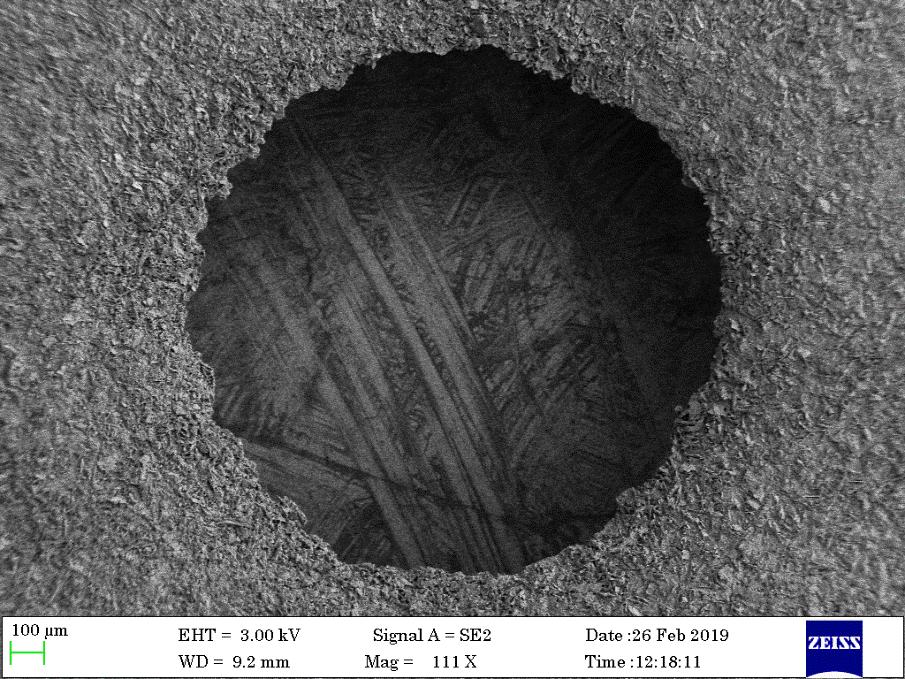
Fig. -3: SEMmicrographofmicro-holeproducedat11V,60%dutycycleand40g/lit
The edge of the circumference of the micro hole at some places look rough and irregular with protruding particles. Thecompositespecimencontainsaluminium(majorpart),alloyingmetalsandalittleamountofalumina(ceramicmaterial). Theelectricalconductivityofthesemetalsdifferfromoneanotherandtheelectrolytesolutioncouldnotdissolvetheceramic material.Thisinhomogeneouscompositionoftheanodematerialresultsintheunevendissolutionatthecircumference.
The main objective ofthis work istostudy the performance of electrochemical micromachining processtogenerate micro holes on Al7075/ Al2O3 composite specimens and optimize the process parameters to achieve maximum machining rateandminimumradialovercut.Theimportantresultsoftheexperimentalworkaregivenbelow.
● The EMM process can be successfully used to generate quality micro holes on Al7075/ Al2O3 composite specimens with optimizedparameters.
● Single-objectiveoptimizationbyTaguchiyieldedthecombinationof12V,Dutycycle80%andNaNO3Concentration40g/lit for attaining maximum machining rate and the combination of 12V, duty cycle 60% and NaNO3 concentration 50 g/lit for obtainingminimumradialovercut.
● The TOPSIS multi-response optimization process revealedthe parametriccombination of 12V, dutycycle 70%and NaNO3 concentration40g/litforachievingbothmaximummachiningrateandminimumovercutsimultaneously.
● The optimal set of parameters obtained through TOPSIS was validated through confirmation experiment which yielded considerableimprovementintheincreaseofmachiningrate(69.2%)andinthereductionofradialovercut(65.5%)compared toinitialsetofparameters.
● TheinfluenceofelectrolyteconcentrationonEMMprocesswasfoundtobesignificantinachievingdimensionalaccuracyof thehole.
● Itwasalsoobserved that machining voltageinfluencesmainly the rate of machining whereasthe impact of dutycycleand electrolyteconcentrationismorepronouncedonradialovercut.
[1]RPramoda,GBVeereshKumara,PSShivakumarGoudab&Arun TomMathew,‘AStudyontheAl2O3reinforcedAl7075 MetalMatrixCompositesWearbehaviorusingArtificialNeuralNetworks’,MaterialsToday:Proceedings5(2018)pp:11376–11385
International Research Journal of Engineering and Technology (IRJET) e-ISSN:2395-0056
Volume: 11 Issue: 04 | Apr 2024 www.irjet.net p-ISSN:2395-0072
[2] Veeresh Kumar G B, ‘Synthesis and Property Evaluation of Al7075- Al2O3 Composites’, 2011, https://www.researchgate.net/publication/319288422
[3]CSShamli,PHariharan ,N YuvarajandERajkeerthi,‘Studyandevaluation ofprocessparameteronNimonic 75alloyby Electrochemicalmicromachining’,2020,IOPConf.Ser.:Mater.Sci.Eng.923012021
[4] S. Kunar1,E. Rajkeerthi , K. Mandal , and B. Bhattacharyya, ‘Fabrication of array of micro circular impressions using differentelectrolytesbymasklesselectrochemicalmicromachining’,ManufacturingRev.7,15(2020)
[5] Kun Wang ,Yubiao Wang and Qi Shen, ‘Electrochemical Machining of Turbulated Cooling Channel Using Gelatinous Electrolyte’,Int.J.Electrochem.Sci.,15(2020)5430–5439,doi:10.20964/2020.06.73
[6] Sarangapani Palani, Poovazhagan Lakshmanan & Rajkumar Kaliyamurthy (2020), ‘Experimental investigations of electrochemical micromachining of nickel aluminum bronze alloy’, Materials and Manufacturing Processes, DOI: 10.1080/10426914.2020.1813888
[7]K.G.Saravanan,R.ThanigavelanandM.Soundarrajan,’ComparisonofElectrochemicalMicromachiningPerformanceusing TOPSIS, VIKOR and GRA for Magnetic field and UV rays heated Electrolyte’, Bulletin of the Polish Academy of Sciences TechnicalSciences,Vol.69(5),2021,Articlenumber:e138816DOI:10.24425/bpasts.2021.138816
[8] Gu Mingcheng , Zeng Yongbin and Meng Lingchao, ‘Electrochemical Micromachining of Square Holes in Stainless Steel in H2SO4’,Int.J.Electrochem.Sci.,14(2019)414–426,doi:10.20964/2019.01.40
[9] M. Baoji, P. Cheng, K. Yun, and P. Yin, “Effect of magnetic field on the electrochemical machining localization,” Int. J. Adv. Manuf.Technol.,vol.102,no.1–4,pp.949–956,2019,doi:10.1007/s00170-018-3185-1.
[10] S.Ramesh and V.Subburam, 2019 ‘Electrochemical Micromachining of Aluminium Alloy Composite’, Advances in ManufacturingTechnology,LectureNotesinMechanicalEngineering,https://doi.org/10.1007/978-981-13-6374-0_36
[11] Krishna Kumar Saxena , Jun Qian and Dominiek Reynaerts, ‘A tool-based hybrid laser-electrochemical micromachining process: Experimental investigations and synergistic effects’, International Journal of Machine Tools and Manufacture 155 (2020)103569
[12]S.Maniraj,R.Thanigaivelan,R.Viswanathanand P.Elumalai,‘Experimental investigationofMRR andROCinaluminium metalmatrixcomposites’,MaterialsToday:Proceedings,Volume45,Part2,2021,Pages1102-1106
[13]ZhuangLiu,Chao,ChaoGuo,YiQiuandChangshuiGao,‘ElectrochemicalJetMachining ofHighVolumeFractionofSiCp/Al Composite using Electrolyte of Sodium Chloride’, IOP Conf. Series: Earth and Environmental Science 440 (2020) 022006, doi:10.1088/1755-1315/440/2/022006
[14]N.Rajan,R.Thanigaivelan,andK.G.Muthurajan,“MachinabilitystudiesonanA17075compositewithvaryingamountsof B4Cusinganinduction-heatedelectrolyteinelectrochemicalmachining,”Mater.Tehnol.,vol.53,no.6,pp.873–880,2019
[15] Pooranachandran, K., Deepak, J., Hariharan, P. & Mouliprasanth, B. (2019). Effect of flushing on electrochemical micromachining of copper and inconel 718 alloy. Advances in Manufacturing Processes, Lecture Notes, in Mechanical Engineering.SpringerNatureSingaporePteLtd.https://doi.org/10.1007/978-981-13-1724-8_6
[16] Leese, R., & Ivanov, A. (2018). Electrochemical micromachining: Review of factors affecting the process applicability in micro-manufacturing. Proceedings of the Institution of Mechanical Engineers, Part B: Journal of Engineering Manufacture, 232(2)195–207.(sagepub.co.uk/journalsPermissions.nav).https://doi.org/10.1177/0954405416640172.
[17] Subburam Venkatajalapathy and Ramesh Sengottuvelu, ‘Micro-ECM drilling of Copper Alloy and Taguchi Optimization’, AppliedMechanicsandMaterialsVols766-767(2015)pp818-824.
© 2024, IRJET | Impact Factor value: 8.226 | ISO 9001:2008
International Research Journal of Engineering and Technology (IRJET) e-ISSN:2395-0056
Volume: 11 Issue: 04 | Apr 2024 www.irjet.net p-ISSN:2395-0072
[18] V. Subburam, S. Ramesh, P.N. Mohan Kumar and A. Srinivasan, ‘Performance optimisation of electrochemical micromachiningofmicro-holesonInconel625alloy’,Int.J.PrecisionTechnology,Vol.8,No.1,2018,pp:66-84
[19] Krishna Kumar Saxena, Xiaolei Chen, Maria RosariaVetrano , Jun Qian & Dominiek Reynaerts, ‘Real-time on-machine observations close to interelectrode gap in a tool-based hybrid laser-electrochemical micromachining process’, Scientific Reports/natureresearch, Sci Rep 10,16797(2020).https://doi.org/10.1038/s41598-020-73821-7