
International Research Journal of Engineering and Technology (IRJET) e-ISSN: 2395-0056
Volume: 11 Issue: 04 | Apr 2024 www.irjet.net p-ISSN: 2395-0072
International Research Journal of Engineering and Technology (IRJET) e-ISSN: 2395-0056
Volume: 11 Issue: 04 | Apr 2024 www.irjet.net p-ISSN: 2395-0072
Padmini Mishra1 , Ganesh Sethi2 , Nitish Kumar Prasad2 , Bhumika Pradhan2 , Alok Chandra Mishra2
1Assistant professor, ECE department , GIETU, Gunupur, Odisha, India 2UG Scholar, ECE department, GIETU, Gunupur ,Odisha , India
Abstract - TheSolarMonitoringSystemprojectisaforwardlooking initiative designed to elevate the efficiency and reliability of solar energy systems. By integrating continuous monitoring of solar radiation levels with precise measurements of voltage and power output, this system provides users with a comprehensive understanding of solar panelperformance.Utilizingadvancedsensorsandintelligent algorithms, the Solar Monitoring System delivers real-time data analysis through a user-friendly interface, facilitating seamlessaccess,andresponsetocriticalperformancemetrics. The interface serves as a centralized hub for data visualization, supporting both real-time monitoring and historical analysis. To enhance user experience, the system incorporates an alert mechanism, notifying users of any deviations from expected performance parameters and the goalofthis solar monitoringsystemis to measurethecurrent generated by the solar panel, displays it on an alphanumeric LCD, and control a DC motor based on the solar power generation. In essence, the Solar Monitoring System project aims to simplify and enhance the monitoring of solar energy systems, contributing to the broader goals of sustainable energy solutions and the continual advancement of solar technology and through monitoring methods, users can analyze and optimize the use of renewable energy, leading to reducedconcernsassociatedwithelectricityconsumption.This project addresses this need by proposing a sophisticated yet user-friendlysystemthatintegratescontinuoussolarradiation monitoring with precise measurements of voltage and power output. The project's primary objective is to empower users with the tools and insights necessary to optimize the performance of their solar panels.
Key Words: Arduino, Resistor, C Motor, ACS712, LM044(LCDDisplay),SolarPanel.
TheSolarMonitoringSystemprojectrepresentsasignificant stridetowardsenhancingtheperformanceandreliabilityof solar energy systems, responding to the growing need for efficientandsustainableenergysolutions.Inthecontextof escalating environmental concerns and the increasing adoption of solar technologies, the need for real-time, comprehensivemonitoringsystemshasbecomeimperative. This project addresses this need by proposing a sophisticated yet user-friendly system that integrates continuous solar radiation monitoring with precise
measurements ofvoltageandpoweroutput.The project's primary objective is to empower users with the tools and insightsnecessarytooptimizetheperformanceoftheirsolar panels. By leveraging advanced sensors and intelligent algorithms, the Solar Monitoring System delivers not only real-time data but also a historical perspective on the system'sperformance.Thisenablesuserstomakeinformed decisions regarding maintenance, troubleshooting, and overall systemoptimization. TheSolarMonitoring System projectisnotjustaboutdatacollection;it'saboutproviding userswithaproactiveapproachtosolarpanelmanagement. Theinclusionofadynamicsuntrackingmechanismensures accurate solar radiation readings, while high-precision sensors monitor the electrical performance of the panels. Additionally,analertsystempromptlynotifiesusersofany deviations from expected performance, allowing for swift intervention to minimize downtime and maximize energy production. Ambuj Gupta Student et al [1] In this study proposed and explored the application of the use of RaspberryPiasamicrocontroller-basedcomputerinsolar monitoringsystemstheyhaveexploredtheversatilityand cost-effectiveness of Raspberry Pi in collecting and transmittingdatafromsolarpanelstheintegrationofAnalog to Digital Convertors (ADCs), such as MCP3008, has been investigated for precise data acquisition in solar metering systems. Solar Infrared et al [2] In this study proposed InfraredThermographyhasemergedasapowerfultoolfor inspecting photovoltaic solar systems, enabling nonintrusive and comprehensive analysis. Literature underscoresitspotentialtodetectissuessuchasdamageto cells,lossofefficiency,andfirehazards.Theapplicationof infraredcamerasforlarge-scalesolarsystemassessmentis gainingprominenceduetoitsefficiencyincapturingdetailed thermalinformation.ManishKatyarmaletal[3]Inthisstudy theresearchersemphasizetheuseofweb-basedinterfaces asapracticalsolutionforremotelymonitoringsolarplants. The majority of solar installations being in hard-to-reach locations necessitates a dedicated approach for real-time monitoringanddataaccess.SavithaKrishnaetal[4]Inthis study the focus is on real-time data analysis and representation is crucial for understanding the dynamic performance of individual units and the entire solar microgrid system. Studies highlight the importance of actionable insights derived from continuous monitoring, contributing to efficient decision-making and system maintenance. The literature recognizes and addresses the challengesencounteredduringthetransformationofsolar
International Research Journal of Engineering and Technology (IRJET) e-ISSN: 2395-0056
Volume: 11 Issue: 04 | Apr 2024 www.irjet.net p-ISSN: 2395-0072
microgrids. K.G.Srinivasanetal [5]Inthisstudyliterature explores the impact analysis of smart monitoring on renewableenergyusage.Researchersdiscusshowreal-time data and analysis contribute to increased awareness, efficiencyimprovements,andthe resolution of electricityrelated issues. A. Gupta et al [6] In this study proposed applicationsofIoTintherenewableenergysector,offering insightsintohowIoTcanbemonitoringandenhancingthe performanceofsolarenergysystemsfocusingonthespecific aspectofdusttrackingonsolarpanels,thisworkexplores techniqueswithinIoT-basedsystems.Itmayshedlighton innovativemethodstokeepsolarpanelscleanandoptimize power generation. H. M. Ahmed et al [7] In this study analyzetheuseofArduinoUnoinsolarpowermonitoring systems.Itmaycoveraspectssuchassystemarchitecture, dataacquisition,andthereal timemonitoringcapabilities provided by Arduino. The advantages, challenges, and potential innovations associated with this integration. Focusingonthemanufacturingprocessofsolarpanelsand theuseofsiliconwafers,thisliteraturesurveymayprovidea detailedunderstandingofthetechnologybehindsolarpanel productionanditsimpactonenergygeneration.
S.M.Patiletal[8]InthisstudyproposedapplicationsofIoT intherenewable energysector,offeringinsightsintohow IoT can be monitoring and enhancing the performance of solarenergysystemsfocusingonthespecificaspectofdust tracking on solar panels, this work explores techniques withinIoT-basedsystems.B.Shrihariprasathetal[9]Inthis study an overview of various solar tracking systems, discussingdifferenttechnologies,approach,andtheirimpact onenergyefficiency.Exploringtheconceptofhybridpower systems,theintegrationofArduino basedsolarmonitoring with other renewable sources, providing a more comprehensivesolutionforsustainableenergy.S.Singhetal
[10] In this study an overview of IoT applications in renewable energy, exploring various technologies and challenges associated with integrating IoT into energy monitoringsystemsandexploretheroleofRaspberryPiin renewableenergyprojects,discussingrecentadvancements andpotentialapplicationsandtheintegrationofRaspberry PiwithIoTformonitoringpurposes.InvestigatingtheFlask framework, this review could discuss the features and applicationsofFlaskinwebdevelopment.R.Niranjanaetal [11] In this study proposed discussed communication technologiesusedinreal-timemonitoringsystemsandthe useoftheBlynkapplicationinIoT-basedenergymonitoring systems. Investigating smartphone-based microcontroller applications in solar energy monitoring, this paper could discussdesignaspectsandperformanceanalysesofsystems similartoyourproposedsolution.E.I.Archibongetal[12]In thisstudyproposedanoverviewofthelatestadvancements in photovoltaic solar tracking systems, discussing various technologies, control systems, and their impact on energy
gain.Italsocoversboththeoreticalandpracticalaspectsof solar tracking. Focusing on Arduino-based solar tracking systems, this review is about recent developments in hardware,controldirection,andpracticalapplications.B.K. S. Vastav et al [13] In this study offer an overview of different solar tracking systems, discussing various technologies, including Arduino-based systems, and their impact on energy capture and conversion efficiency. Focusing specifically on solar tracking systems utilizing Arduino, this review may cover recent advancements, implementationchallenges,andpotentialimprovements.
Thegoalofthissolarmonitoringsystemistomeasurethe current generated by the solar panel, displays it on an alphanumeric LCD, and control a DC motor based on the solarpowergeneration.
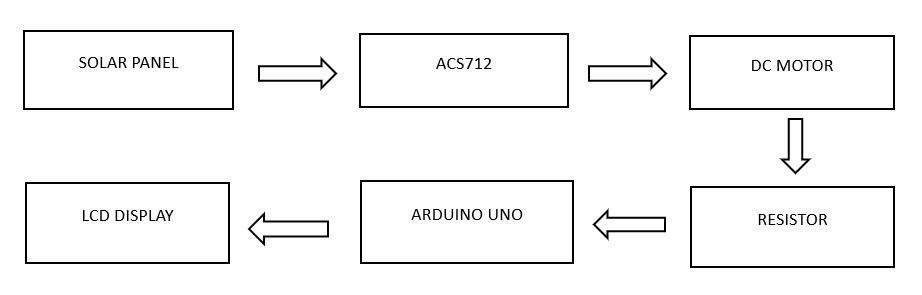
Table -1: Blockdiagram
Tosimulatethissystem,wehaveusedsoftwarelikeProteus. wehavesetupthecomponentsandconnectthemaccording tothecircuitconnectionsmentionedbelow.ByusingArduino code, we run the simulation the simulation, and the LCD displayingthecurrentandthemotorturningon/offbasedon the simulated solar and simulation parameters are listed below:
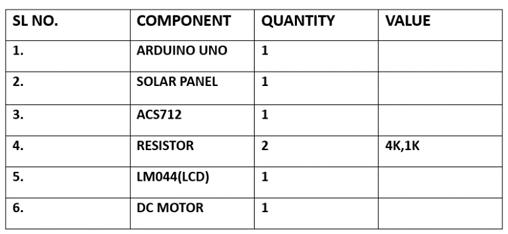
Chart -1: Components Required
International Research Journal of Engineering and Technology (IRJET) e-ISSN: 2395-0056
Volume: 11 Issue: 04 | Apr 2024 www.irjet.net p-ISSN: 2395-0072
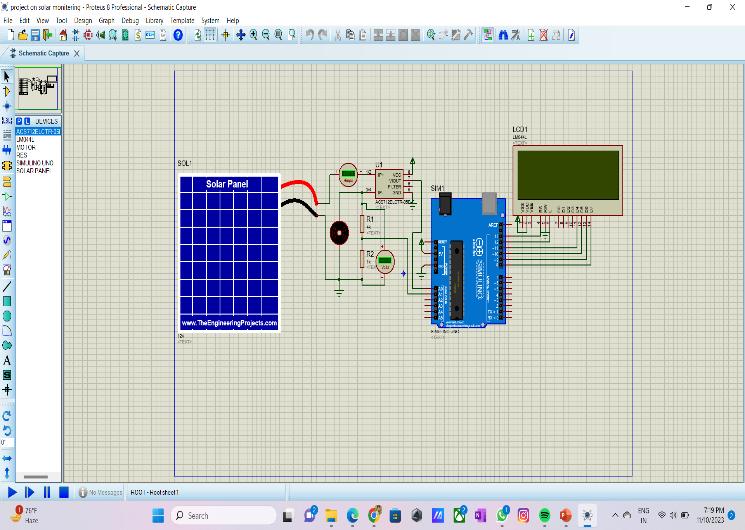
2.1 Code
//includethelibrarycode:
#include<LiquidCrystal.h>//libraryforLCD //initializethelibrarywiththenumbersoftheinterface pins
LiquidCrystallcd(13,12,11,10,9,8);
//MeasuringCurrentUsingACS712 intsenstivity=185;//use100for20AModuleand66for 30AModule
intadcvalue=0; intoffsetvoltage=25000;//sensorcalibration doublevoltage=0;//voltagemeasuring doubleecurrent=0;//currentmeasuring
voidsetup()
{ lcd.begin(20,4);//setuptheLCD'snumberofcolumnsand rows:
lcd.setCusor(0,0); lcd.print("THEBRIGHTLIGHT"); lcd.setCursor(0,1); lcd.print("SOLARMONITORING"); }
voidloop()
//MeasureTheVoltage
//readintheinputonanalogpinA1: intsensorValue=analog(A1); //Converttheanalogreading(whichgoesfrom0-1023) toavoltage(0-5V): floatvol=(senorValue*5.0)/1023.0;
floatvoltage=vol*5; lcd.printCursor(0,2); lcd.print("Voltage="); lcd.print("V");
//MeasureTheCurrent
adcvalue=analogRead(A0);//readingthevaluefromthe analogpinA0
Voltage=(adcvalue/1024.0)*5000;//GetsyoumV ecurrent=((Voltage-offsetvoltage)/senstivity); lcd.setCursor(0.3); lcd.print("current=") lcd.print(ecurrent); lcd.print("A");//unitforthecurrenttobemeasured delay(2000); }
Aswewanttoconcludeherethatourworkingmodelgives usthenearlyaccuratevaluesofcurrentandvoltagewhenwe run the program of Arduino as mentioned below. This programhelpstogiveus theexactvalueofcurrentthatis gainedbythesolarpanel.
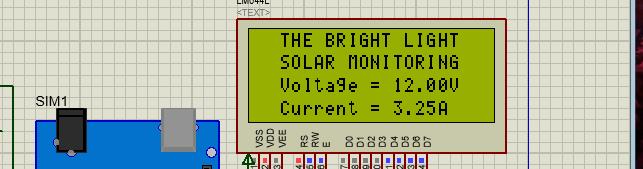
TheadoptionofRenewableEnergytechnologiesservesasa strategy to diminish environmental impact. Through monitoringmethods,userscananalyzeandoptimizetheuse ofrenewableenergy,leadingtoreducedconcernsassociated with electricity consumption. By making future forecasts basedoncurrentprojectmonitoringvaluesasbenchmarks, there is room for development that could enhance this initiative even more. Additionally, an interactive web applicationmaybecreatedforend-users'conveniencewhich will provide predictions about upcoming events readily availableattheirdisposal.Toensuredataaccuracyduring forecast analysis multiple models must be employed; enablingasinglepreciseestimateperdatasetestablishedby eachmodelindividuallyoraltogetherwhenachievable.
International Research Journal of Engineering and Technology (IRJET) e-ISSN: 2395-0056 Volume: 11 Issue: 04 | Apr 2024 www.irjet.net p-ISSN: 2395-0072
[1] Ambuj Gupta, Rishabh Jain, Rakshita Joshi, Dr. Ravi Saxena. Real Time Remote Solar Monitoring System. 97815090-6403-8/17©2017IEEE.
[2] Solar Infrared, Beaverton, Oregon. Aerial Solar Thermography and Condition Monitoring of Photovoltaic Systems.978-1-4673-0066-7/12©2011IEEE.
[3] Manish Katyarmal, Suyash Walkunde, Arvind Sakhare, Mrs.U.S.Rawandale. Solar power monitoring system using IoT. International Research Journal of Engineering and Technology(IRJET)e-ISSN:2395-0056Volume:05Issue:03 |Mar-2018www.irjet.netp-ISSN:2395-0072.
[4] Savitha Krishna, Ullas Ramanathan, Manoj Pokkiyarat, Renjith Mohan. Real Time Monitoring of Solar Micro Grid Installations; Discussion on Three Year Performance Analysis and System Black Out Modelling. 2017 IEEE InternationalConferenceonTechnologicalAdvancementsin PowerandEnergy.
[5]K.G.Srinivasan,Dr.K.Vimaladevi,Dr.S.Chakravarthi.Solar EnergyMonitoringSystembyIOT.SpecialIssuePublishedin Int.Jnl.OfAdvancedNetworking&Applications(IJANA).
[6]A.Gupta,R.Jain,R.JoshiandR.Saxena,"Realtimeremote solar monitoring system," 2017 3rd International Conference on Advances in Computing, Communication & Automation(ICACCA)(Fall),Dehradun,India,2017,pp.1-5, doi:10.1109/ICACCAF.2017.8344723.
[7]H.M.Ahmed,B.A.Elsayed,G.IbrahimandG.C.Talisic, "Solar still with two layouts integrated built-in condenser and real time monitoring system," 2017 4th IEEE InternationalConferenceonEngineeringTechnologiesand AppliedSciences(ICETAS),Salmabad,Bahrain,2017,pp.1-7, doi:10.1109/ICETAS.2017.8277904.
[8]S.M.Patil,M.VijayalashmiandR.Tapaskar,"IoTbased solar energy monitoring system," 2017 International ConferenceonEnergy,Communication,DataAnalyticsand Soft Computing (ICECDS), Chennai, India, 2017, pp. 15741579,doi:10.1109/ICECDS.2017.8389711.
[9]B.ShrihariprasathandV.Rathinasabapathy,"AsmartIoT system for monitoring solar PV power conditioning unit," 2016 World Conference on Futuristic Trends in Research and Innovation for Social Welfare (Startup Conclave), Coimbatore, India, 2016, pp. 1-5, doi: 10.1109/STARTUP.2016.7583930.
[10] S. Singh et al., "Artificial Intelligence and Internet of Things Analysis of Solar-based Internet of Energy Battery ManagementSystemElectricVehicles,"2022International ConferenceonSignalandInformationProcessing(IConSIP),
Pune, India, 2022, pp. 1-4, doi: 10.1109/ICoNSIP49665.2022.10007459.
[11] R. Niranjana, P. V, M. K. R and A. Ravi, "Effectual Sun TrackingSolarPanelSystem,"2023InternationalConference on Circuit Power and Computing Technologies (ICCPCT), Kollam, India, 2023, pp. 858-863, doi: 10.1109/ICCPCT58313.2023.10244975.
[12]E. I.Archibong, S. Ozuomba andE. Ekott,"Internet of Things(IoT)-based,SolarPoweredStreetLightSystemwith Anti-vandalisation Mechanism," 2020 International Conference in Mathematics, Computer Engineering and ComputerScience(ICMCECS),Ayobo,Nigeria,2020,pp.1-6, doi:10.1109/ICMCECS47690.2020.240867.
[13] B. K. S. Vastav, S. Nema, P. Swarnkar and D. Rajesh, "AutomaticsolartrackingsystemusingDELTAPLC,"2016 International Conference on Electrical Power and Energy Systems (ICEPES), Bhopal, India, 2016, pp. 16-21, doi: 10.1109/ICEPES.2016.7915899.
© 2024, IRJET | Impact Factor value: 8.226 | ISO 9001:2008