
International Research Journal of Engineering and Technology (IRJET) e-ISSN: 2395-0056
Volume: 11 Issue: 04 | Apr 2024 www.irjet.net p-ISSN: 2395-0072
International Research Journal of Engineering and Technology (IRJET) e-ISSN: 2395-0056
Volume: 11 Issue: 04 | Apr 2024 www.irjet.net p-ISSN: 2395-0072
Yash Bhagia1, Syed Mohammad Abbas2, Shalendra Kumar3, Shwetank Maheshwari4
Abstract - Chatbots, or virtual assistants that can communicatewithhumansusingnaturallanguageprocessing, have grown in popularity in recent years. These computer programs can be used for a variety of things, including finishing duties and offering amusement and business guidance. We start by performing a bibliometric study to determinethekeypapersandresearchersinthefield.Then,to spotthemesandpatterns,wesummarizevariousstudyarticles and present studies in accordance with predetermined criteria. A chronological, thematic, and methodological summaryoftherelatedstudy isalsoprovided.Researchersare also investigating the creation of chatbots that can produce interestingandcoherenttalks,employing deepreinforcement learning techniques to encourage sequences that exhibit informative, coherent, and simple-to-follow conversational qualities. The way we communicate with machines could be completely changed by these developments in chatbot technology,whichalsohasthepotentialtocompletely impact a variety of sectors. An overview of the state-of-the-art in chatbot technology will be provided in this paper, along with suggestions for prospective future research areas.
Key Words: Natural language processing, deep learning, neural networks, chatbots, Conversational Agent, Artificial intelligence.
AsubfieldofartificialintelligencecalledconversationalAIis concernedwithspeech-basedortext-basedAIsystemsthat canreplicateandautomateverbalinteractionswithpeople. ConversationalAIisanexcitingandrapidlyevolvingfieldof artificialintelligencethatseekstodevelopsystemsthatcan engageinnaturallanguageconversationswithhumans.The technologyleveragesadvancedalgorithmssuchasnatural languageprocessing,machinelearning,anddeeplearningto understandthemeaningofhumanlanguageandrespondin a way that is accurate, contextually relevant, and personalized.
OneofthemostwidelyusedexamplesofconversationalAIis virtual assistantssuchasSiri,Alexa,andGoogleAssistant. These systems enable users to interact with their devices using natural language and voice commands, and the AI technologybehindtheminterpretsandprocessestheuser’s requeststoproviderelevantinformationorcompletetasks asneeded.
AnotherexampleofconversationalAIischatbots,whichare computer programs designed to simulate human
conversation through text-based interfaces. Chatbots are commonlyusedincustomerserviceapplications,wherethey canprovidesupportandassistancetocustomerswithbasic questions or problems without the need for human intervention.
ConversationalAIisalsofindinginnovativeapplicationsin variousdomainssuchashealthcare,education,andfinance. For instance, AI-powered chatbots have been used to provide mental health support to patients, assist with languagelearning,andprovidefinancialadvicetocustomers.
In healthcare, conversational AI can assist with medical diagnosisanddecision-makingbyanalyzingandinterpreting clinicaldataandelectronichealthrecords.Ineducation,AIpowered chatbots can provide personalized learning experiences and instant feedback to students, helping to improve their understanding of complex concepts. In finance,conversationalAIcanassistcustomerswithbanking transactionsandfinancialplanning,providingpersonalized recommendationsbasedontheirfinancialgoalsandneeds.
Overall,conversationalAIhasthepotentialtotransformthe wayweinteractwithtechnologyandmakeourlivesmore convenient, efficient, and personalized. As the technology continuestoevolve,wecanexpecttoseemoreinnovative applicationsinvariousdomains,makingconversationalAI anexcitingareaofresearchanddevelopment.[1]
2. Four Components of Conversational A.I. [2]
Asubsetofartificialintelligenceknownasmachinelearning (ML)usesarangeofstatisticalmodelsandalgorithmstofind patterns and predict future outcomes. Conversational AI needsmachinelearningtofunction.Ithelpsthesystemto improve its understanding of and responses to human languagebyallowingittocontinuouslylearnfromthedatait collects. Among other ML subtypes, conversational AI commonlyusessupervisedlearning,unsupervisedlearning, deeplearning,andneuralnetworks.
Tocreateanacceptableanswer,naturallanguageprocessing (NLP) includes converting unstructured input into a machine-readable format. The algorithms that make up conversationalAIarealwaysbeingimprovedbecausetothe continuousfeedbackloopthattheseNLPtechniquesengage
International Research Journal of Engineering and Technology (IRJET) e-ISSN: 2395-0056
Volume: 11 Issue: 04 | Apr 2024 www.irjet.net p-ISSN: 2395-0072
inwithmachinelearning.NLPiscrucialtoconversationalAI since it gives the system the ability to understand human input and generate pertinent responses. To understand humanlanguage,therearefourfundamentalstepstotake: Input generation: The process of creating new input for a conversational AI system is known as input generation. Throughawebsiteoranapp,userscansubmittext,speech, orbothtypesofinput.
Input analysis: This technique identifies the intent and meaningofuserinput.ConversationalAIwillemploynatural languageunderstanding(NLU)tointerpretthesubstanceof the input and determine its intent if it is text-based. To interpret the message upon receiving voice input, it will combineautomaticspeechrecognition(ASR)withnatural languageunderstanding(NLU).
Dialogue management: Thistechniqueregulatesthepaceof theconversationbydecidingwhentoclarifyorpause.NLG, or natural language generation, creates this function. Conversational AI tracks interactions, determines what information has been acquired, and is still required using dialoguemanagement.
Reinforcement learning: By rewarding or penalizing behaviors,reinforcementlearningteachesasystemtomake decisions on its own. The system is given a goal to accomplishandusesarangeoftacticstodoso.Depending on how successfully a decision helped it fulfil the task, it receivesascoreforthatdecision
Fromvastvolumesofdata,relevantinformationisretrieved through data mining. In conversational AI, data mining is utilizedtoextractpatternsandinsightsfromconversational datathatprogrammerscanusetoimprovetheoperationof the system. Data mining is a technique for discovering undiscovered attributes as opposed to machine learning, whichconcentratesonmakingpredictionsbasedonrecent datadespitesharingmanycharacteristicswithit.
AIforvoice-basedconversationsincludesautomaticspeech recognition. ASR gives the computer the ability to comprehendhumanvoiceinputs,removebackgroundnoise, translate spoken words into text, and replicate human responses. Natural language conversations and directed dialoguearethetwocategoriesofASRsoftware.
ASR'sstreamlineddirecteddialoguefeaturemayrespondto simpleyes/noinquiries.ASRinteractionsthatimitatereal human conversations are better and more complicated versionsofnaturallanguageconversations.
Here’sapossibleparagraphsummarizingthesections:
Thisreviewpaperisorganizedintoninesections.Inthefirst section, the introduction, we provide an overview of the paper and the significance of conversational artificial intelligence systems. Section II discusses the four componentsofconversationalAI,
includingnaturallanguageprocessing,speechrecognition, machine learning, and dialogue management. Section III providesanoverviewofconversationalAIsystems,including their evolution, current applications, and future potential. Section IV focuses on the system architecture of conversationalAIsystems,includingthedifferentlayersand componentsinvolvedintheprocess.InsectionV,weexplore the research techniques used to study conversational AI, including data collection, annotation, and evaluation methods.InsectionVI,weconductabibliographicanalysis oftheliteratureonconversationalAI,identifyingkeytrends and research gaps. Section VII presents the results of our analysisanddiscussion,highlightingthemajorfindingsand implications for future research. Section VIII presents the conclusion,summarizingthemainpointsofthereviewand providingrecommendationsforfutureresearchinthefield ofconversationalAI.
The system architecture of a typical speech-based Conversational AI system as well as a brief history of Conversational AI systems are covered in this section's abridged overview of Conversational AI systems. The introductionofcrucialConversationalAIsystemideasinthis part is crucial. A general comprehension of these ideas is alsonecessarytocomprehendthesectionsthatfollowinthis essay. As a result, later parts would refer to the terminologies,methods,andideaspresentedhere.
Recentyearshaveseenarapidevolutionofconversational AI,givingrisetoavarietyofterminologytodefinedevices like chatbots, personal digital assistants, and voice user interfaces. Communication methods (voice, text, or a combination), goals (task-oriented or non-task- oriented), initiation and turn (who initiates the conversation), strategies(rule-based,statisticaldata-driven,end-to-end,or hybrid),andmodality(text,speech,oracombination)canall beusedtoclassifythesesystems.[6]Deepneuralnetworks, statisticalmethods,andrule-basedapproacheshaveallbeen usedinthedevelopmentofconversationalAIsystems.[5]
Anearlymethodofsystemdesignwheredecision-makingis predefinedandmanuallyprogrammedbydesignersisthe rule-based approach to dialogue management. Although designers may believe they have total control over the system,thisstrategyhasseveraldisadvantages.Itisdifficult toscale,time-consumingtodevelop,expensivetomaintain, anditmightnotalwaysproducethebestresults.Thesystem might also have trouble when users deviate from the plannedpath,orinedgecircumstances.[5] Theadoptionofa statisticaldata-basedstrategyfordialoguemanagementis promptedbytheselimitations.
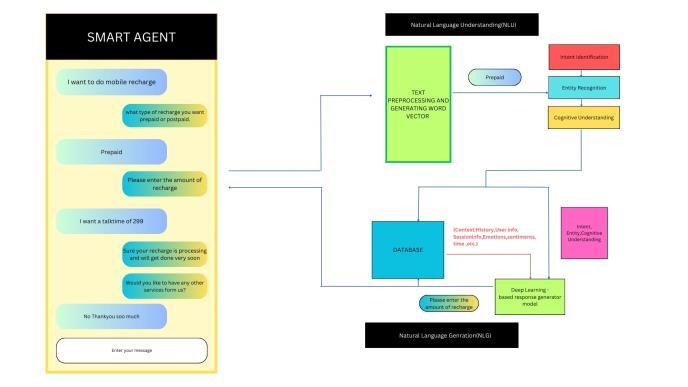
A technique for implementing rule-based AI chatbots was proposed by Nithuna S. and Laseena C.A. The techniques theybrieflydiscussedintheirpaperinclude:
• Creating a set of rules to manage user inquiries and producepertinentresponses
• Using regular expressions to check input from the user againstestablishedpatterns
• Usingdecisiontreestodealwithdifficultdecision-making situations.[8]
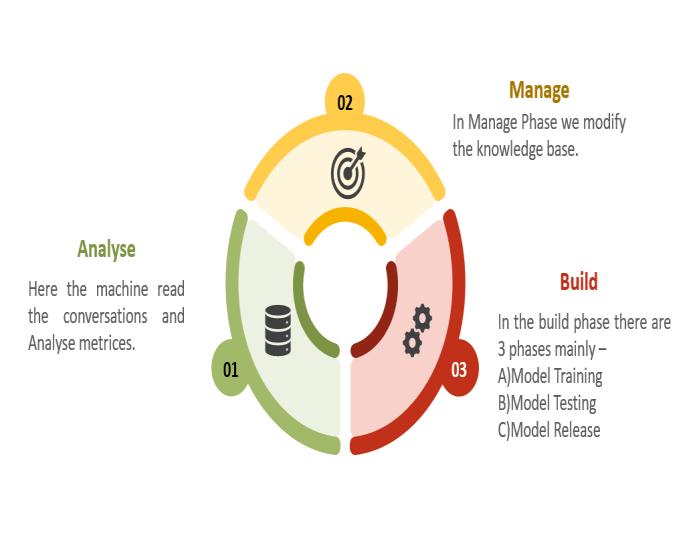
The Chatbot Management Process methodology was presentedbySantosandSilvaasastandardizedanditerative way for managing content that can help rule- based AI chatbotsdevelopandevolve.Forrule-basedAIchatbots,itis essentialtoestablishthechatbot'sgoalsandtargetmarket during the methodology's "manage" phase. The "build" phase,whichincludeshumanoversightandqualitycontrol, focuses on developing and implementing the chatbot is content, including its rules and knowledge base. Through userinteractionsandfeedback,the"analyze"phaseassesses the chatbot's performance, allowing for ongoing rule and knowledge base improvement. For rule-based AI, the technique offers an organized approach to chatbot administration.[9]
MloukandJiangprovidesamethodologyforincorporating knowledge graphs into rule-based chatbots, which can improve their ability to understand user queries and
generateaccurateresponses.Byleveraginglinkeddataand machinelearningtechniques,thisapproachcanhelprulebasedchatbotsbecomemoreeffectiveinhandlingcomplex userqueriesandprovidebetteruserexperiences.[10].
Whencreatingdialoguemanagementsystems,thestatistical data-drivenapproachisemployedasanalternativetothe rule-based approach. It uses a rule- based approach to probabilistically represent the system's constituent parts andincludesaconversationpolicy,dialoguestatetracking, and dialogue control. But this method has significant difficulties,includingasscalability,the"blackbox"issue,and theneedforalotofdatatooptimizeit.
1) 1)SantosandSilvaproposedmethodologycanbeseenasa way to incorporate data-driven insights into the development and management of chatbots. By analyzing userinteractionsandevaluatingthechatbot'sperformance, themethodologyallowsfortheincorporationofstatistical data and machine learning techniques to improve the chatbot'sperformanceovertime.Forexample,theauthors report While maintaining a high level of confidence in its responsesandkeepingtheusersatisfactiondatagathered duringconversationsstable,themethodology'sapplication toEvatalk'schatbotproducedpositiveresults,includinga decrease in the chatbot's human hand-off rate and an increaseinthechatbot'sknowledgebaseexamples[9].
2) 2)YuWu,WeiWu,ZhouJunLi,andMingZhourproposesa methodforimprovingresponseselectioninretrieval-based chatbots using a statistical-based approach. The method uses a weakly supervised learning process that leverages bothlabeledandunlabeleddata.Theauthorsutilizeusing the sequence (Seq2Seq) model as a crude judgement the matching degree of unlabeled pairs. The experimental results on two public datasets show that this approach significantlyimprovestheperformanceofmatchingmodels. [11].
3) 3) Zehao Lin et al. suggest a novel strategy for dialogue systemstodealwiththeconundrumofdecidingwhetherto respond to a user's enquiry right away or wait for more details. In addition to introducing the Wait-or-Answer challenge, they also suggest Predict-then-Decide (PTD), a predictivestrategythatcombinesadecisionmodelwithtwo predictionmodels auserpredictionmodelandanagent prediction model. The trials carried based on three open datasetsandtworeal-worldscenariosdemonstratethatthe PTDtechniquebeatspreviousmodelsinresolvingthisWaitor-Answer challenge. This study offers a cleverer way for dialogue systems to act in circumstances where they are confused whether to wait or respond, which helps to advancestatisticallydrivenconversationalAI.[12]. International Research
International Research Journal of Engineering and Technology (IRJET) e-ISSN: 2395-0056
Volume: 11 Issue: 04 | Apr 2024 www.irjet.net
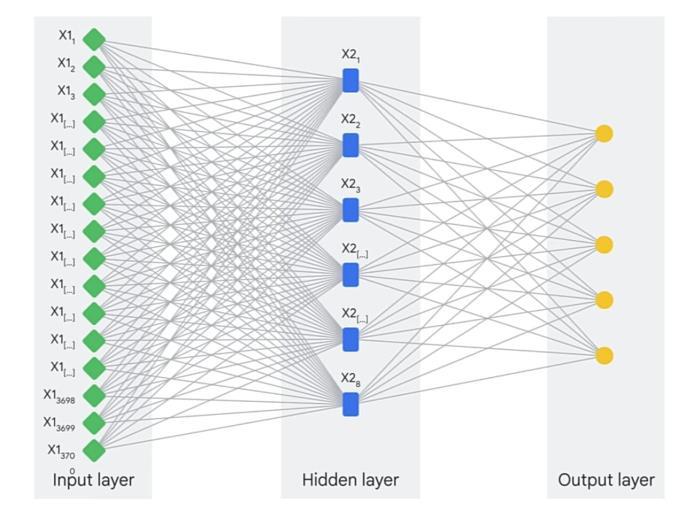
Dialoguemanagementsystemdesignsmodulardesigncan haveknock-onconsequences,whereimprovingonemodule hasanegativeimpactontheothers.Topreventthis,theendto-endneuralapproachusesasequence-to-sequencedesign thatoptimizestheentiresystem;however,thiscomplicates the credit assignment problem, which is the difficulty of identifyingunderperformingcomponentsduringevaluation. [7] In spoken dialogue systems, automatic speech recognitionandtext-to-speechoperateindependentlyfrom the system for input and output, using Deep Neural Networkstomapuserutterancesdirectlytooutput.
Vamsi, Rasool proposed that a new method for creating chatbotsusingadeepneurallearningapproach.Theauthors built a neural network with multiple layers to learn and process conversational data. By using deep learning and natural language processing techniques, the proposed approach can improve the accuracy and flexibility of chatbots,allowingthemtohandlemorecomplexandnatural conversations.Thisresearchcontributestotheadvancement ofconversationalAIbyprovidinganewend-to-endneural approach that can be used to develop more sophisticated andintelligentchatbotsforvariousapplications.[13].
Anki, Alhadi asa high accuracy conversational AI chatbot, proposesabidirectionallongshort-termmemory(BiLSTM) modelbasedonrecurrentneuralnetworks(RNN).Thepreprocessingmodule,word-embeddinglayer,BiLSTMlayer, attention layer, and output layer are all included in the authors'descriptionofthemodel'sarchitecture.Theyalso talk about the dataset, which consists of conversational exchanges from a customer service platform, that was utilizedtotrainandtesttheirmodel.Thesuggestedmodel outperformed various other baseline models and demonstrated great accuracy in predicting user input replies.Theauthorscontendthatmoresuccessfulchatbots can be created for a range of applications using their BiLSTM-basedmethodology.[14]
SHEETAL KUSAL1, SHRUTI PATIL, JYOTI CHOUDRIE mentionsthatneuralnetworks,particularlydeeplearning models, have been increasingly used for building conversational agents due to their capacity to learn from vast amounts of data and provide more believable and human-like responses. They provide an overview of numerous deep learning architectures, including transformer models, convolutional neural networks, and recurrentneuralnetworks,andhowtheyhavebeenusedin conversational agents.[15].
The technique known as Automatic Speech Recognition (ASR)transformsaudioinputfromspeechtotextforfurther processing. It includes signal and feature extraction, linguisticandauditorymodels,andhypothesissearch.ASR has historically employed N- gram language models, Melfrequency Cepstral Coefficients (MFCCs), Hidden Markov Models (HMMs), Gaussian Mixture Models (GMMs), and HMMs. Deep neural networks (DNNs), recurrent neural networks (RNNs), and convolutional neural networks (CNNs),amongothermorerecentmethods,arebeingused with better outcomes. A few businesses and institutions, including Google, IBM Watson, and Microsoft Speech API, havedevelopedASRsystems.Worderrorrate(WER),match errorrate(MER),andpositionindependentworderrorrate (PER) are a few measures that are used to assess ASR performance.
SADEENALHARBI,MUNAALRAZGANpaperbrieflyexplains the working of automatic speech recognition in conversational A.I. system as a user's spoken input is transcribed using ASR and then processed using NLP algorithmstounderstandtheuser'sintentandgeneratean appropriate response. Similarly, in a voice assistant application, ASR is used to transcribe the user's spoken
International Research Journal of Engineering and Technology (IRJET) e-ISSN: 2395-0056
Volume: 11 Issue: 04 | Apr 2024 www.irjet.net p-ISSN: 2395-0072
commands, which are then used to control the device or performotheractions.[16]
ShinnosukeIsobe,SatoshiTamura,andYuutoGotohdiscuss the use of Audio-Visual Speech Recognition (AVSR) in conversational AI in the work. AVSR combines ASR and Visual Speech Recognition (VSR) to increase recognition accuracy in noisy circumstances. In order to determine whether voice data was captured in quiet or noisy environments,thesuggestedmethodmakesuseofascene classifierbasedonParallel-WaveGAN.OnlyASRisusedin clean surroundings to reduce processing time, whereas multi-angle AVSR is used in noisy conditions to improve recognition accuracy. Using two multi-angle audio-visual databasestotesttheframework,thestudyshowsthatmultiangle AVSR improves recognition accuracy over ASR alone.[17]
Inthepresentinvestigation,HabibIbrahimandAsafVarol explainhowautomatedspeechrecognition(ASR)identifies anddecodesspeechsignalsusinganacousticandmodelling technique. An audio signal is transformed into a digital signal,whichisthenexaminedtoextractpropertiessuchthe frequencyandamplitudeof thesignal.Thespeechsounds arethenrecognizedusingthesetraits,andatranscriptionof theutteredwordsisproduced.
A language model is often used by the ASR system to interpretthewordsandproducetext.Thelanguagemodel uses machine learning and statistical analysis to identify patternsandforecastthelikelihoodthatspecific wordsor phraseswillemergeinaparticularsituation.[18].
Understanding human language is the primary goal of the NaturalLanguageUnderstanding(NLU)subfieldofNatural Language Processing(NLP).Entity extraction and purpose classificationareinvolved.Thetechniqueofdeterminingthe user'smoodandgoalisknownasintentcategorization.Deep learning techniques like LSTM, CNNs, RNNs, biLSTM, and shallow feedforward networks are increasingly more frequently utilized in place of more conventional methods like Hidden Markov Models (HMMs) and Decision Trees (DTs). The process of identifying entities and categorizing them into predetermined classes is called named entity recognition (NER), sometimes known as entity extraction. While Conditional Random Fields (CRFs) and other conventional methods have been employed, CNNs and biLSTMarecurrentlymorefrequentlyused[5].
Athoroughassessmentandsynthesisofthecurrentstate of Natural Language Processing (NLP) research in InformationSystems(IS)isprovidedbyDapengLiuandYan Li,whoprovidearoadmapforfurtherNLPresearchinIS.The authorsinclude12commonlystudiedarchetypalNLPtasks, including text classification, information extraction, and sentimentanalysis.
The conclusions drawn from this study may be helpful in directing the creation of conversational AI systems. NLP approaches play a significant role in conversational AI systems'abilitytocomprehendandrespondtohumaninput and questions in natural language. Conversational AI developers can take advantage of current research to enhancetheperformanceoftheirsystemsbycomprehending the status of NLP research and recognizing the archetypal NLPtasks.
The dialogue management system is the key element of a dialoguesystemthatincorporatesinputfromtheASRand NLUandcommunicateswiththeknowledgesourcetodecide howthedialoguewillgoandwhatstepswillbetakenafter that.Itcomprisesofadecisionmodelorpolicymodelanda context model for discussion state tracking. The context model stores all the dialogue-related data, including any knowledgesources,whilethedecisionmodeldeterminesthe dialogue'sprogressiondependingonthedatainthecontext model. The dialogue system's methodology can be rulebased,statisticallydriven,orneural.
HayetBrabraandMarcosBaezconcentrateontask-oriented conversational systems, which enable users to carry out tasks using the information they disclose during talks. By keepingtrackofinformation,comprehendingconversation context, resolving ambiguity, managing the conversation flow, interacting with external services/databases, and identifying system actions to achieve the user's ultimate goal,thedialogue management component plays a crucial roleinthedevelopmentofconversationalsystems.[20]
TakuyaHiraokaandYukiYamauchisuggestatechniquefor creatingpersuadingdialoguesystemsthatengageusersin ordertoaccomplishaparticulargoalwhilealsoconsidering theuser’ssatisfaction.Theygiveanexampleofasystemthat guides graduate students in choosing which laboratory to joinwhilealsotryingtokeepthenumberofstudentsineach laboratoryatasteadylevel.Inordertodirectuserstowards issuespertinenttothesystempurpose,thearticlesuggests techniques for creating knowledge bases and a dialogue management system. The Bayesian network paradigm, on whichthepersuasivedialoguemanagerisbuilt,canbeused in conversational AI to guide users towards particular activitieswhilestilltakingtheiraimsandpreferencesinto account.
A dialogue system's NLG component deals with providing theuserwiththesystemanswerbasedontheoutputofthe NLUandconversationmanagementsystem.Itismadeupof modules for document planning, microplanning, and realization. Responses can be produced using templatebased, statistical, neural network, or hybrid methods. The effectiveness of NLG can be assessed using a variety of
International Research Journal of Engineering and Technology (IRJET) e-ISSN: 2395-0056
Volume: 11 Issue: 04 | Apr 2024 www.irjet.net
metrics,includingtask-basedevaluation,gradingandhuman responses are evaluated, and the output is compared to humanreplies[4].
A conversation system's text-to-speech (TTS) component turnsthewrittenoutputfromtheNLGintospokenwords. Thetextisanalyzed,brokendownintophonemes,andthen transformedintowaveformsaspartofthisprocess.Modern TTSmethodsuseneuralnetworkstoimproveperformance over traditional methods that used text and waveform analysis. TTS is assessed using objective, subjective, and behavioral metrics. Theseincluderatingsyntheticspeech, evaluatingtheeffectivenessofuserengagement,andgauging theoutput'sintelligibilityandcomprehensibility.
TheusageofauniqueText-to-Speech(TTS)algorithmbased on Deep Voice, an attention-based, fully convolutional mechanism, is explored by Pabasara Jayawardhana and AmilaRathnayake.Serenityandfluidityarethemostcrucial characteristicsrequiredfromaTTS,withtheobjectivebeing toprovidespeechsynthesisthatisaccurateandauthentic. The suggested TTS is designed to be used in multilingual synthesizers and performs phonetic-to-acoustic mapping using a neural network-based technique. They also emphasize the value of TTS technology in enhancing web accessibilityanduser-computerinteractions,particularlyfor peoplewhoarevisuallyandaudiblyhandicapped.Giventhat themajorityoflistenersareintolerantofunnaturalness,the quality of TTS is essential in keeping a voice that is comparabletothatofahuman.[22].
Concatenative, formant, articulatory, and hidden Markov model (HMM) synthesis are a few of the text to speech synthesizertechniquescoveredbySnehaLukoseandSavitha S.Upadhyay.Thesetechniquesareusedinmanyapplications inthemedicalandtelecommunicationsdomainstoproduce appropriatesoundoutputswhentextisinputted.
Thesource-filterparadigmservesasthefoundationforthe formant synthesis technique, which employs parallel and cascadestructures.Ingeneral,uptothreetofiveformants areneededtogenerateunderstandablespeech.
Each formant is represented by a two-pole bandpass resonator with its appropriate formant frequency and bandwidth. While the two-pole resonators in the cascade structure are connected in series, those in the parallel structureareconnectedinparallel.[23].
In order to make the English grapheme to phoneme dictionaryacceptableforIndianEnglishtext-to-speech(TTS) systems,DeepshikhaMahantaandBidishaSharmasuggesta method. A kind of Indian English called Assamese English wasgivenitsownsetofrulesbytheauthors.Bydiscovering anddetectingimprobablegrapheme-phonemecombinations andcorrectingthem bysubstitutingthemostlikelyvowel
phoneme,theyimprovedIndianEnglish'svowelgrapheme to vowel phoneme mapping. Both the word level and the sub-wordlevelarerefinedinthismanner.
They implemented the suggested method of dictionary updateatthefrontendofthestatisticalparametricspeech synthesisandunitselectionsynthesis-basedIndianEnglish TTS. After adding the variety-specific information, the subjectiveassessmentrevealedasignificantimprovementin bothframeworks.[24].
With an emphasis on the fields of "Engineering" and "Computer science," the generated search query was employed in Scopus without year limitation, and only documents available in the language is English. The same searchquerywasappliedintheIEEXploredatabasewithout limitations (year and publishing themes), and the outputs weresortedusingthe'Searchinsideresults'option.
Additionally, the query was limited to the categories "EngineeringCivil"and"ConstructionBuildingTechnology" in the Web of Science Core Collection, without regard to publicationyearsordocumenttypes.BecausetheBoolean connectors in the search option are limited, the search in Science Direct was done sequentially; the 'Engineering' subject area and no year restriction were taken into consideration.Finally,thecreatedquerywasusedtosearch theACMdigitallibrary.
Inordertogatherdataforthisstudy,welookedatawide range of publications (such as books and papers). We examined details such as the publication's creation date, author,subjectmatter,style,andfieldofapplication.
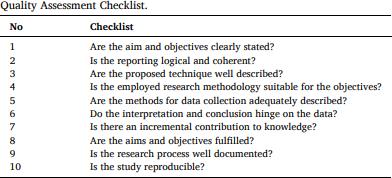
Weevaluatedeacharticleaccordingtoachecklist(similarto a list of criteria) to ensure that they only included highqualitypublications in their study.Anarticle wasdeemed suitableforinclusioninthestudyifitmetatleast70%ofthe criteriaonthechecklist.
Volume: 11 Issue: 04 | Apr 2024 www.irjet.net p-ISSN:
6.1. Publication Trend:
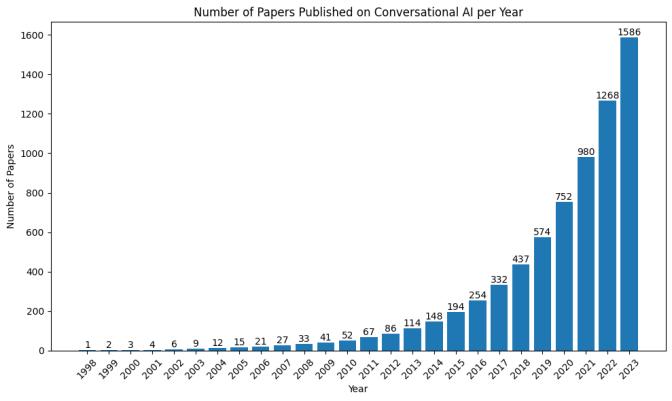
ThepublicationtrendofconversationalA.I.showsasteady increaseoverthelastdecade.Thenumberofpublicationson thistopicincreasedfrom1in1998to1586in2023.Theyear 2023witnessedthehighestnumberofpublications(1586) on this topic. The trend shows thatconversational A.I. isa rapidlygrowingareaofresearch.
6.2. Top Countries:
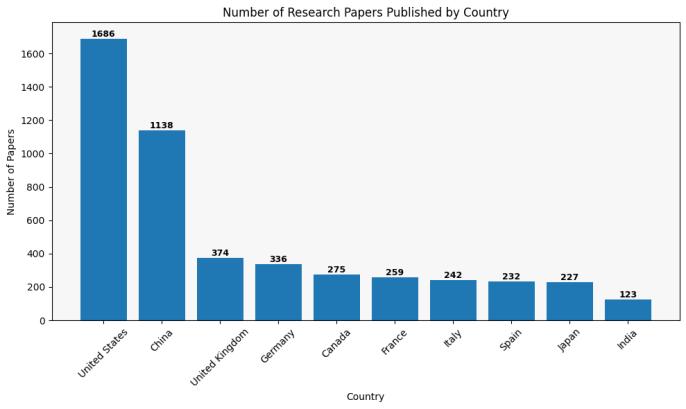
TheUnitedStatesistheleadingcountryinthepublicationof research related to conversational A.I., with 1686 publications. It is followed by China (1338), the United Kingdom(374),Germany(336),Canada(275),France(259), Italy(242),Spain(232),Japan(227),India(123).
6.3. Top Authors:
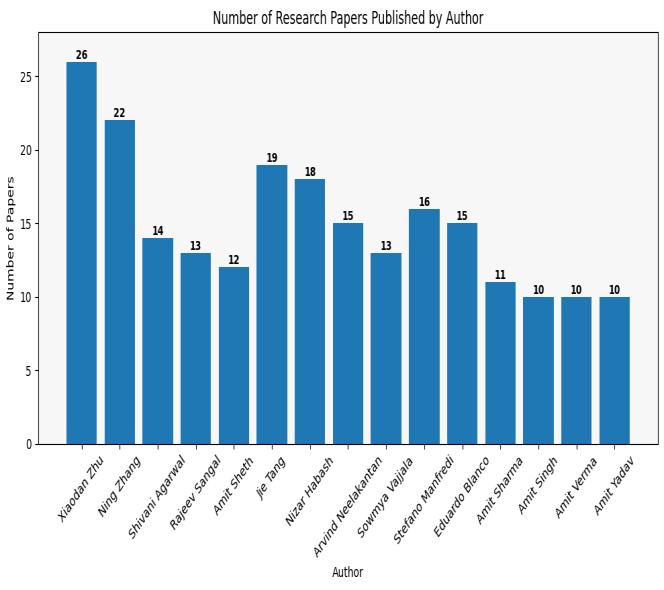
ThetopauthorinthisfieldisXiodanZhufromQueens,with 26 publications. He is followed by Liu, Bing from the UniversityofWindsorinCanada. with23publications,and DrShivaniAgarwalfromIndianInstituteofsciencewith14 publications.
6.4. Top Journals:
With130publications,thetopjournalforconversationalA.I. research is IEEE Transactions on Audio, Speech, and LanguageProcessing.JournalofMachineLearningResearch (36), and ACM Transactions on Interactive Intelligent Systems(57)followit.
6.5. Top Keywords:
The top keywords in this field are "natural language processing" (1,623 publications), "chatbot" (893 publications),"dialoguesystem"(702publications),"machine learning"(658publications),and"speechrecognition"(608 publications)[25].
Documents by Author
DocumentsByYear
DocumentsbyCountries
7. Result
7.1. A critical analysis of developed conversational AI systems: -
ThissectionprovidesanoverviewoftheconversationalAI systems'evolution,aswellasitsevaluationandbreakdown oftheircomponents.Thissectionisessentialasitprovidesa broadoverviewoftheelementsandtechniquesusedtobuild conversationalAIsystems.
AlthoughthecomponentshavebeenbrokendownintoASR, NLU, Knowledge source, Dialogue management, NLG, and TTS,dependingonthestrategyandaimofthesystem,notall Conversational AI systems have employed these in their development. While a modularized system used many componentsforvariouspurposes,theseq-2-seqjustusedone componentformorethanonetask.
TheASR'sabilitytotransformvoiceintotext,fromwhichthe NLUUnitderivestherequestsoftheusers,iscrucial.Both syntacticandsemanticanalysisareusedinthisprocedure. Parsing, also known as syntactic or syntax analysis, is the processofdissectingmaterialtoseewhetheritcomplieswith grammarrules.
On the other side, semantic analysis works with deriving meanings from the words to identify the request from the
International Research Journal of Engineering and Technology (IRJET) e-ISSN: 2395-0056
Volume: 11 Issue: 04 | Apr 2024 www.irjet.net p-ISSN: 2395-0072
users, and it frequently makes use of knowledge bases or domainontologies.Beforegeneratinganyqueries,theNLU uses domain ontology to give the machine a field understanding of the meaning of the word. A domain ontologymustbecreatedandmaintained,whichtakestime.
Additionally, because the majority of the systems under considerationaredesignedtofacilitateinformationretrieval, theDMoverseesandcontrolstheprocedureforobtainingthe appropriate data from the database in response to user requests.
Fortheinstance,somesystemsusedvectorizationandthe mappingofthesearchtermstothedatabase.Theinteraction betweenmorethanonecomponent,suchastheinteraction betweentheBIMmodelanddynamo[49,55,57]usedfordata extraction and manipulation of the BIM model, might be directed on a platform thathas been established basedon pre-codedscripts.Aftertheactivitiesarefinished,theusers receive feedback in the form of textual, visual displays, or speech. The answer frequentlyuseda template to provide consumers’feedback.[27][28][29][30][31].
7.2. System verification and assessment: -
Alloftheresearchthatwasevaluatedwasvalidated,withthe exceptionoftheframeworkproposedbySheldonandDobbs [61]. With the assumption that happy path users will test withanticipatedinputsandanticipateanticipatedoutcomes, thesuggestedConversationalAIsystemsarestillintheearly stagesofresearchandvalidationinacontrolledsetting.The validationprocessmayinvolvetestingusingacasestudy,a task,agroupofqueries,oraseriesofquestions,depending onthesystem'sobjective.nearlyalloftherecommended Systemswereevaluatedbasedonuserreviews,performance tests, or contrasts with other current systems. Users are askedaseriesofquestionsabouthowtheyusethesystemin order to provide feedback (satisfaction, efficiency, and effectiveness) for the user experience evaluation. On the otherside,performanceevaluationcomparestheoutputof thesystemtorecognizedbenchmarksortherealworldusing establishedcriteria.[29][30][31].
7.3.Validation and evaluation of the systems: -
They examined whether each system had been verified (tested to ensure appropriate operation) and evaluated (assessedforperformance).
ExceptfortheSheldon,Dobbsframework,themajorityofthe systemshadtheirvaliditychecked.
The researchers discovered that the majority of ConversationalAIsystemswerestillunderdevelopmentand werebeingevaluatedinacontrolledsetting.Thisindicates thatthesystemsweretestedusingexpectedinputs(suchas
inquiries or commands that the developers were aware wouldlikelybegiven)andrespondedaccordingly.
Theresearcherssearchedforinformationregardinghowthe systemswouldfunctioninedgescenarios,buttheycouldn't uncoverany.Edgecasesarescenariosinwhichthesystem receivesunexpectedinputs
(such as inquiries or orders that the developers weren't expecting).
The majority of the suggested Conversational AI systems were assessed by the researchers in three different ways: userexperience,performance,andcomparisonwithexisting systems.
Userexperienceevaluationreferstotheresearchers'inquiry intothesatisfaction,effectiveness,andefficiencyofsystem fromthosewhoactuallyutilizedit.
Theterm"performanceevaluation"referstotheresearchers' comparison of the system's output to a benchmark or standard. In one study, for instance, the system's performance was assessed based on how well it handled particular tasks (such as calculating writing and reading latency in a blockchain-based network). Other studies assessedthesystem'sperformanceusingmetricslikerecall, accuracy,andprecision.
Theinteractionbetweenpeopleandmachineshasimproved overtimethankstoconversationalAI.Thisstudyconducteda thorough assessment of Conversational AI systems in the construction industry in order to identify the present applicationareas,thedevelopmentofthesystems,prospects, and issues. A thorough search of Scopus, IEEE Xplore (Institute of Electrical and Electronics Engineers), ACM (AssociationofComputingMachinery),WebofScience,and Science Direct turned up numerous publications on Conversation AI systems. In the current work, these were retrievedandrigorouslyexamined.
MostConversationalAIsystemsintheexaminedstudiesused a modularized design. Like this, most ASR systems used Google SpeechRecognitionSystem.Information extraction andretrievalarethemaincurrentusesofconversationalAI systems.CurrentconversationalAIsystemsconcentratedon retrieving or extracting data from websites, project schedules,buildinginformationmodels,andothersources. Allthesesystemsaretask-orientedandintendedforuseby architects,buildingmanagers,buildingoccupants,teachers, andconstructionworkers.ThegoalsoftheseConversational AI systems are to enhance user experience, increase productivitybycuttingdownoncontacttime,andenhance cognitivelearning.
International Research Journal of Engineering and Technology (IRJET) e-ISSN: 2395-0056
Volume: 11 Issue: 04 | Apr 2024 www.irjet.net p-ISSN: 2395-0072
Last but not least, this study has limitations despite its contributions.DatafromScopusandWebSciencewereused in the study, and they were later verified using databases fromIEEEXplore,ACM,andScienceDirect.Thus,thestudy's abilitytocovervariousdatasetsmightbeconstrained.Similar to this, the selection criteria and the search queries could bothactasrestrictions.However,whendoingthesystematic review,bestpracticeguidelineswereused.Tothebestofthe authors' knowledge, this research is significant since it represents the first attempt to provide an overview of conversationalAI.[27][28][29][30][31].
[1].https://www.ibm.com/in-en/topics/conversational-ai
[2].https://yellow.ai/conversational-ai/
[3]. M. Campbell, Beyond Conversational Artificial Intelligence,Computer53(12)(2020)121–125
[4].S.A.Bello,L.O.Oyedele,O.O.Akinade,M.Bilal,J.M.Davila Delgado,L.A.Akanbi,A.O.Ajayi,H.A.(2021)122.
[5]. M. McTeer, Conversational AI: Dialogue Systems, ConversationalAgents,andChatbots,SynthesisLectureson HumanLanguageTechnologies.13(2020)
[6]. Magalhaes,J.,A.G.Hauptmann,R.G.Sousa,and C. Santiago, MuCAI’21: in Proceedings of the 29th ACM InternationalConferenceon.2021.
[7]. A.C. Morris, V. Maier, P. Green, From WER and RIL to MERandWIL:
[8].NithunaSandLaseenaC.A.:Reviewonimplementation TechniquesofChatbot(2020).
[9]. GIOVANNI ALMEIDA SANTOS, GUILHERME GUY DE ANDRADE,GEOVANARAMOSSOUSASILVA1,FRANCISCO CARLOSMOLINADUARTE,JOÃOPAULOJAVIDIDACOSTA
, RAFAEL TIMÓTEO DE SOUSA, A Conversation driven ApproachforChatbotManagement.(2022).
[10] Addi M Mlouk, Lili Jiang: A knowledge-based graph chatbot for Natural language understanding over Linked Data.(2020).
[11]YuWu,WeiWu,ZhoujunLi,andMingZhou.:Learning Matching Models with Weak Supervision for Response SelectioninRetrieval-basedChatbots(2019).
[12]ZehaoLin,ShaoboCui,GuodunLi,XiaomingKang,Feng Ji,FenglinLi,ZhongzhouZhao,HaiqingChen,andYinZhang: Predict-then-Decide: A Predictive Approach for Wait or AnswerTaskinDialogueSystems(2021).
[13]GKrishnaVamsi,AkhtarRasool,GauravHajela:ADeep Neural Network Based Human to Machine Conversation Model.(2020).
[14]PrasnurazakiAnki,AlhadiBustamam,HerleyShaoriAlAsh, Devvi Sarwinda: High Accuracy Conversational AI Chatbot Using Recurrent Neural Networks Based BiLSTM Model.(2020)
[15] SHEETAL KUSAL1, SHRUTI PATIL, JYOTI CHOUDRIE, KETAN KOTECHA, SASHIKALA MISHRA, AND AJITH ABRAHAM: AI-Based Conversational Agents: A Scoping Review from Technologies to Future Directions (2020).
[16] SADEEN ALHARBI, MUNA ALRAZGAN, ALANOUD ALRASHED, TURKIAYH ALNOMASI, RAGHAD ALMOJEL, RIMAH ALHARBI, SAJA ALHARBI, SAHAR ALTURKI, FATIMAH ALSHEHRI, AND MAHA ALMOJIL.: AutomaticSpeechRecognition:SystematicLiteratureReview.
[17] ShinnosukeIsobe,SatoshiTamura,YuutoGotohand Masaki Nose: Efficient Multi-angle Audio-visual Speech RecognitionusingParallelWaveGANbasedSceneClassifier (2022).
[18]HabibIbrahim,AsafVarol:AStudyonAutomaticSpeech RecognitionSystems.
[19] Dapeng Liu and Yan Li: A Roadmap for Natural LanguageProcessingResearchinInformationSystems.
[20]HayetBrabra,MarcosBaez,BoualemBenatallah,Walid Gaaloul, Sara Bouguelia, Shayan Zamanirad: Dialogue Management in Conversational Systems: A Review of Approaches,Challenges,andOpportunities(2021).
[21] Takuya Hiraoka, Yuki Yamauchi, Graham Neubig, SakrianiSakti,TomokiToda,SatoshiNakamura:DIALOGUE MANAGEMENT FOR LEADING THE CONVERSATION IN PERSUASIVEDIALOGUESYSTEMS.
[22] Pabasara Jayawardhana, Amila Rathnayake: An Intelligent Approach of Text-To-Speech Synthesizers for EnglishandSinhalaLanguages(2019).
[23] Sneha Lukose, Savitha S. Upadhya: Text to Speech Synthesizer-FormantSynthesis.
[24] Deepshikha Mahanta, Bidisha Sharma, Priyankoo Sarmah,SRMahadevaPrasanna:TexttoSpeechSynthesis SysteminIndianEnglish.
[25]https://www.scopus.com/home.uri
[26]SHEETALKUSAL1,SHRUTIPATIL,JYOTICHOUDRIE3, KETANKOTECH,SASHIKALAMISHRA,AJITHABRAHAM:AIbased Conversational Agents: A Scoping Review from TechnologiestoFutureDirections.
International Research Journal of Engineering and Technology (IRJET) e-ISSN: 2395-0056
Volume: 11 Issue: 04 | Apr 2024 www.irjet.net p-ISSN: 2395-0072
[27] K. Adel, A. Elhakeem, M. Marzouk, Chatbot for construction firms using scalable blockchain network, Autom.Constr.141(2022).
[28]B.Zhong,W.He,Z.Huang,P.E.D.Love,J.Tang,H.Luo,A building regulation question answering system: A deep learningmethodology,Adv.Eng.Informatics(2020)46.
[29] S. Wu, Q. Shen, Y. Deng, J. Cheng, Natural- languagebasedintelligentretrieval engineforBIM object database, Comput.Ind.108(2019)73–88.
[30] G. Gao, Y.-S. Liu, M. Wang, M. Gu, J.-H. Yong, A query expansionmethodforretrievingonlineBIMresourcesbased onIndustryFoundationClasses,Autom.Constr.56(2015) 14–25.
[31] Zhoui, H., M.O. Wong, H. Ying, and S.H. Lee, A Framework of a Multi-User Voice Driven BIM-Based Navigation System for Fire Emergency Response, in 26th International Workshop on Intelligent Computing in Engineering(EG-ICE2019).2019.