
International Research Journal of Engineering and Technology (IRJET) e-ISSN:2395-0056
Volume: 11 Issue: 04 | Apr 2024 www.irjet.net p-ISSN:2395-0072
International Research Journal of Engineering and Technology (IRJET) e-ISSN:2395-0056
Volume: 11 Issue: 04 | Apr 2024 www.irjet.net p-ISSN:2395-0072
Meryem
Demir1,* and Sezai Elagoz2
1Aselsan Sivas Precision Optics, 58060, Sivas, Turkey Sivas Cumhuriyet University Nanophotonics Research and Application Center, 58140, Sivas, Turkey
Abstract
ThisstudyfocusesonthestructuralcharacterizationofCo/Crsuperlattices.Co/Crsuperlatticeshaveattractedsignificant interest due to their exceptional magnetic and electronic properties, which are highly sought after in technological applications such as high-density data storage, magnetic sensing, and spintronics. The synthesis and comprehensive analysis of these superlattices are critical for unlocking their potential and tailoring their properties for specific applications.MolecularBeamEpitaxy(MBE)isasophisticatedtechniqueforthefabricationofCo/Crsuperlattices,offering unparalleled control over material deposition at the atomic level. This precision facilitates the creation of superlattices withdistinctinterfacesandtailoredthicknesses,crucial formodulatingtheirphysicalproperties.X-RayDiffraction(XRD) servesasacornerstonetechniqueforstructuralcharacterization,providingdetailedinsightsintothecrystallinestructure andorientationofthesuperlattices.ThisstudyconsidersthedetailedcharacterizationthroughXRDofCo/Crsuperlattices grown by using the MBE technique, aiming to highlight the potential of Co/Cr superlattices in future technological applications.
Keywords: Co/Crsuperlattice,magnetoresistance,X-raydiffraction,structuralcharacterization
1. Introduction
The pursuit of materials with novel and enhanced properties for technological applications has been a key driver in the advancementofmaterialscienceandnanotechnology [1,2].Inthiscontext,Co/Crsuperlattices havegarneredsignificant interest due to their exceptional magnetic and electronic properties, which are highly sought after in high-density data storage, magnetic sensing, and spintronics [3, 4]. The fabrication and comprehensive analysis of these superlattices are criticalforunlockingtheirpotentialandtailoringtheirpropertiesforspecificapplications[5-7].
MolecularBeamEpitaxy(MBE)standsoutasasophisticatedtechniqueforthefabricationofCo/Crsuperlattices,offering unparalleled control over material deposition at the atomic level [8, 9]. This precision facilitates the creation of superlattices with distinct interfaces and tailored thicknesses, crucial for modulating their physical properties [10]. The versatility and precision of MBE have been instrumental in exploring the limits of material synthesis, enabling the engineeringofsuperlatticeswithdesiredcharacteristics.Followingthesynthesis,thestructuralcharacterizationofCo/Cr superlattices becomes imperative to understand their properties and performance [11, 12]. X-ray Diffraction (XRD) is a cornerstone technique in this regard, providing detailed insights into the crystalline structure and orientation of the superlattices. Through XRD analysis, researchers can glean information on lattice parameters, strain profiles, and the overallqualityofthesuperlatticestructure(Doeetal.,2019).Thisinformationisvitalforcorrelatingstructuralattributes with the magnetic and electronic behaviors of the superlattices, thereby guiding the optimization process for their applicationinadvanceddevices[13,14]
Current study considers the detailed characterization through XRD synthesis of MBE grown Co/Cr superlattices. By examining the processes involved in their fabrication and the insights gained from XRD analysis, this study aims to shed light on the potential of Co/Cr superlattices in future technological applications. Emphasizing the importance of precise fabrication and characterization techniques, this paper will contribute to the ongoing discourse in the field, highlighting theroleofCo/Crsuperlatticesinadvancingmaterialscienceandnanotechnology.
2. Materials and Method
The molecular beam epitaxy (MBE) technique was employed to grow the sample, a process detailed by the parameters outlined in Table 1. Initially, the substrate temperature was raised to 590 °C within 20-30 minutes, a step essential for removing the oxide layer on the substrate surface and purifying it from oxygen. The intent behind the growth of the superlattice structure was to closely match the lattice constants of the subsequently grown layers with that of the superlattice,therebyinducinggiantmagnetoresistancethroughtheformationofmagneticstructures.Thiswasachievedby
International Research Journal of Engineering and Technology (IRJET) e-ISSN:2395-0056
Volume: 11 Issue: 04 | Apr 2024 www.irjet.net p-ISSN:2395-0072
incorporating a Ge buffer layer and Co and Au bridge layers; the Au layer, in particular, facilitated the nucleation of the subsequentColayerinthehexagonalclose-packed(hcp)phase.
The growth rates for the Co/Cr superlattice were fine-tuned by experimenting with various parameters such as layer thickness,growthrates,and temperature,todetermine theoptimal conditionsforgrowth,asspecifiedinthetable.Upon completionofthesuperlatticegrowth,a 20Athick Aucaplayer wasadded. Thislayerservesa dual purpose:it prevents the oxidation of the superlattice and preserves the integrity of the structure. The architecture of the grown multilayer crystal, as presented schematically in Table 1, reflects the meticulous planning and execution of the growth process, highlightingtheprecisionachievablewithMBEinthedevelopmentofcomplexsuperlatticestructures.
1. Theconditionsforsamplegrowth.
(32A/4A)*27
(hcp)=4.07
= 2.51A
(hcp)=4.57A
(bcc)=2.8A (0001) hexagonal close-packed (hcp)
0.250.35A/s Bridging layer
layer
A 5.66A (110)zinc blende(zb)
Substrate Semiinsulating GaAs >1mm 5.65A (110)zinc blende(zb)
3. Results and Discussion
-beam, 0.3A/s
The X-ray Diffraction (XRD) analysis has been utilized as a critical method for the structural characterization of Co/Cr superlattices. XRD provides valuable information about the crystal structure and phases, determining the quality and arrangement of the material. In this study, the findings from XRD analysis offer significant insights into the crystalline structure, orientation,and phasetransitions of the superlattices. Ourgoal hereis, aftera longtime,hasthehcp Crphase observedforthefirst timeinthisstructureturnedinto thebcc phaseandhasthere beena deterioration inthe structure quality?Possiblepeaks/phasesandXRDresultforsamplearegiveninTable2andFigure1,respectively
The XRD results indicate that the superlattice incorporates both hexagonal close-packed (hcp) and body-centered cubic (bcc)phases.Inparticular,thedifferentcrystalstructuresofCoandCrlayers(Coinbothhcpandbccphases,andCrinhcp
International Research Journal of Engineering and Technology (IRJET) e-ISSN:2395-0056
Volume: 11 Issue: 04 | Apr 2024 www.irjet.net p-ISSN:2395-0072
and bcc phases) highlight the structural complexity of the superlattices. This diversity in phases plays a crucial role in influencingthemagneticandelectronicpropertiesofthesuperlattices.
Another notable point from the XRD analysis is the alignment of measured peaks and calculated 2θ values with the expectedcrystalphases,demonstratingthehighcrystalqualityandorderlystructureof thesynthesizedsuperlattices.For example,theclearobservationoftheAu(111)phaseataspecific2θangleindicatesthesuccessfulgrowthoftheprotective Au layer on top of the superlattice structure, serving to prevent oxidation. In this contex, the XRD analysis has provided critical information on the structural integrity and phase composition of the superlattices, laying the foundation for understanding and optimizing the material's magnetic and electronic properties. The importance of structural characterization in evaluating the potential use of Co/Cr superlattices for specific technological applications is clearly underscoredinthisstudy.
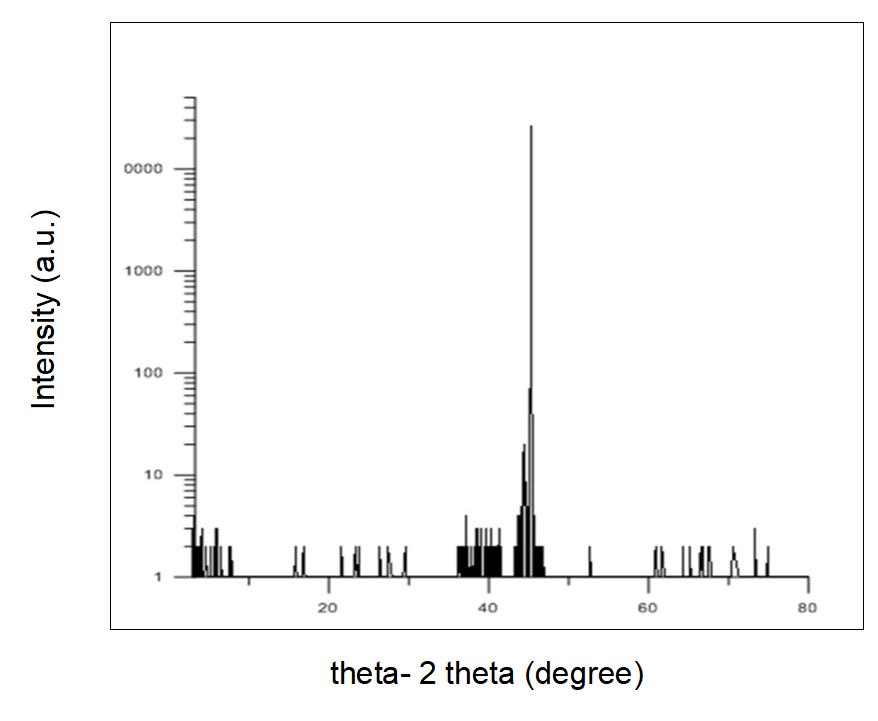
-ray
ofthesamplebetween3o-80o
International Research Journal of Engineering and Technology (IRJET) e-ISSN:2395-0056
Volume: 11 Issue: 04 | Apr 2024 www.irjet.net p-ISSN:2395-0072
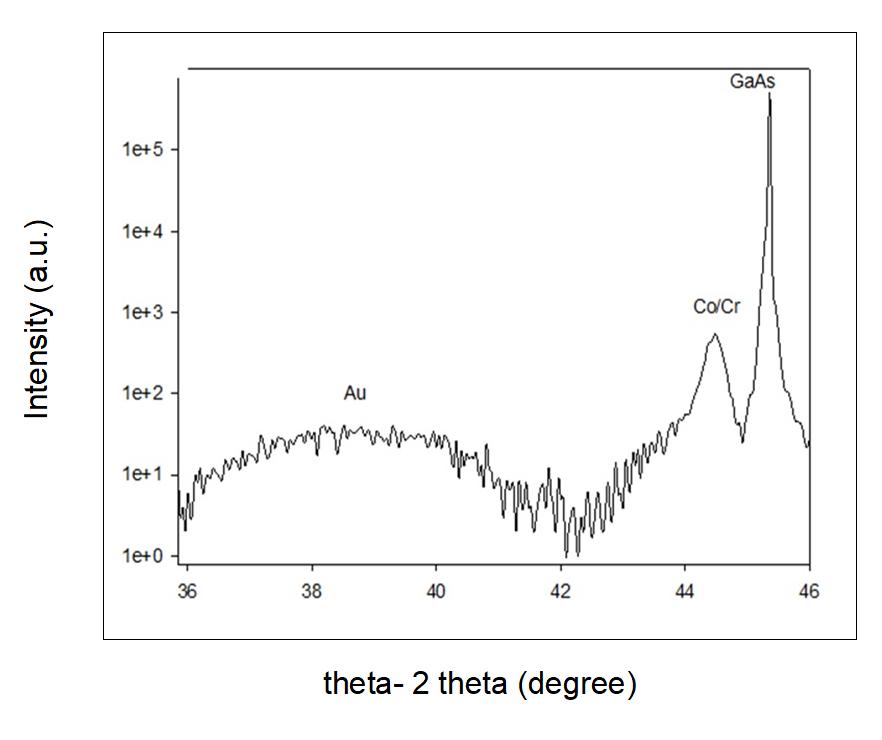
Followingtheinitialanalysis,amoredetailedscanwasconductedwithinthe36° - 46°rangetocloselyexaminethemain peaksofthe structure, asillustrated in Figure 2. Thisscanrevealed the broad Aupeaksandthe more distinctly localized Co/Cr peaks within the structure, providing clearer insights into the material composition and structure. The lattice constantsofGeandGaAscompoundsareverysimilar,leadingtooverlappingpeaksthatmaketheGe(110)peakdifficultto discern clearly. However, the comparison of the calculated lattice constants with their known real values shows minimal deviation, indicating the high quality of the crystal structure. The thickness calculations derived from these angle values, detailedinTable3,demonstrateconsistencyamongthemeasuredvalues,whichcloselyalignwiththeactualthicknesses. Thislevelofprecisioninthethicknessmeasurementsfurtherconfirmstheexceptionalqualityofthecrystalgrown.
Table 3. ThethicknesscalculationsderivedfromXRDresult.
4. Conclusions
Thisstudy on the structural characterization of Co/Cr superlattices presents findingsobtained through X-Ray Diffraction (XRD) analysis. The XRD results indicate that the superlattices incorporate both hexagonal close-packed (hcp) and bodycenteredcubic(bcc)phases.Specifically,thedifferentcrystalstructuresofCoandCrlayers(Coinbothhcpandbccphases, and Cr in hcp and bcc phases) underscore the structural complexity of the superlattices. This diversity in phases plays a crucialroleininfluencingthemagneticandelectronicpropertiesofthesuperlattices.ThedataobtainedfromXRDanalysis demonstrate the high crystal quality and orderly structure of the synthesized superlattices. This study emphasizes the importance of structural characterization in assessing the potential use of Co/Cr superlattices for specific technological applications,underscoringthatprecisefabricationandcharacterizationarekeyfactorsinadvancingmaterialscienceand nanotechnology.
International Research Journal of Engineering and Technology (IRJET) e-ISSN:2395-0056
Volume: 11 Issue: 04 | Apr 2024 www.irjet.net p-ISSN:2395-0072
This study is a part of the Graduate Thesis of Meryem Demir which titled as “XRD investigation of epitaxial Co/Cr single crystal thinfilms”. Thiswork issupported bythe Scientific ResearchProjectFund ofSivasCumhuriyet University,Turkey undertheprojectnumberF-312.
References
1 Singh, H. and K.J.M.T.P. Kaur, Role of nanotechnology in research fields: Medical sciences, military & tribology-A review on recent advancements, grand challenges and perspectives. 2023.
2. Wellmann,P.J.J.D.M., The search for new materials and the role of novel processing routes. 2021. 1(1):p.14.
3. Mukherjee,T.,etal., Magnetocaloric properties of Co/Cr superlattices. 2009. 79(14):p.144406.
4 Şahin,O.andS.J.J.o.t.A.C.S.Horoz, Investigation of the properties of Cr-doped CdZnS nanocrystals with the best IPCE (%) value. 2022. 58(5):p.1709-1714.
5 Ye, S., et al., Centimeter-scale superlattices of three-dimensionally orientated plasmonic dimers with highly tunable collective properties. 2022. 16(3):p.4609-4618.
6. Yue, X., et al., Entropically Driven Fabrication of Binary Superlattices Assembled from Polymer‐Tethered Nanocubes and Nanospheres. 2023. 19(24):p.2207984.
7 Zhang, Z., et al., Heterostructure engineering of 2D superlattice materials for electrocatalysis. 2022. 9(35): p. 2204297.
8. Brahlek,M.,J.Lapano,andJ.S.J.J.o.A.P.Lee, Topological materials by molecular beam epitaxy. 2020. 128(21).
9 Camacho-Reynoso, M., et al., Cubic InxGa1− xN/GaN quantum wells grown by Migration Enhanced Epitaxy (MEE) and conventional Molecular Beam Epitaxy (MBE). 2022. 921:p.165994.
10. Springholz, G., Molecular beam epitaxy of iv-vi heterostructures and superlattices, in Lead Chalcogenides. 2021, Routledge.p.123-207.
11 Chowdhury,T.,E.C.Sadler,andT.J.J.C.R.Kempa, Progress and prospects in transition-metal dichalcogenide research beyond 2D. 2020. 120(22):p.12563-12591.
12 Li, J., et al., Controllable preparation of 2D vertical van der waals heterostructures and superlattices for functional applications. 2022. 18(22):p.2107059.
13 Epp, J., X-ray diffraction (XRD) techniques for materials characterization, in Materials characterization using nondestructive evaluation (NDE) methods.2016,Elsevier.p.81-124.
14. Kahle, M., M. Kleber, and R.J.G. Jahn, Review of XRD-based quantitative analyses of clay minerals in soils: the suitability of mineral intensity factors. 2002. 109(3-4):p.191-205.