
International Research Journal of Engineering and Technology (IRJET) e-ISSN:2395-0056
Volume: 11 Issue: 04 | Apr 2024 www.irjet.net p-ISSN:2395-0072
International Research Journal of Engineering and Technology (IRJET) e-ISSN:2395-0056
Volume: 11 Issue: 04 | Apr 2024 www.irjet.net p-ISSN:2395-0072
Manoj H M1, N Sangeetha2, Nikita Biradar3, K Deevena Kumari4, Jyoti Raju Kamati5
1 Assistant Professor, Dept. of Computer Science Engineering, BMS Institute of Techonology and Management, Bengaluru, India
2345 UG students, Dept. Of Computer Science Engineering, BMS Institute of Techonology and Management, Bengaluru, India
Abstract - Traffic congestion is a major challenge encounteredbyurbanareaspresentlydespiteactionsbeing implementedtoalleviateanddiminishit.Theproblemwith StaticRoadDividersisthefixednumberoflanesoneachside oftheroad.Bothpopulationgrowthandthenumberofcars foreachfamilyareontherise,therebyincreasingthecount of the cars on roads. The circumstance is worse when an emergencyvehiclelikeanambulancehastowaitforother vehiclestogive.Thiscausesadelayintimeandmayaffect the emergency case. All these challenges encountered by facedbyambulancescanbeavertedusingthesmartmovable roaddivider.Itintegratesreal-timetrafficmonitoring,data analysis,andintelligentcontrolmechanismstoautomatically clear a dedicated lane for ambulance passage. Upon detectinganambulanceapproaching,thesystemtriggersthe actuation of the smart road dividers located at key points alongtheroad.Thesedividerscandynamicallyadjusttheir positionstomakeaclearlanefortheambulance,bypassing trafficandreducingresponsetimes.
Keywords TrafficCongestion,MovableRoadDivider,IOT, Ambulance,ObjectDetection.
Over time, a single-lane road was constructed, causing numerous issues for commuters due to severe traffic congestion. This situation lacked efficiency, safety, and flexibility.Subsequently,atwo-laneroadwasbuilt,which, unfortunately,didnotrelievethetrafficproblem.Evenwith the introduction of a four-lane road, the traffic issues persisted,leadingtotheexplorationofinnovativesolutions.
ManyproposedsolutionsalsoemployedIoTandembedded systems,alongwithIRsensors,tomonitortrafficconditions. However,thesesystemsstruggledtoaccuratelydetecttraffic and incurred high costs for maintenance and installation. Despitetheseefforts,theproblempersisted,necessitatinga moreadvancedsolution.
As the count of vehicles continued to rise, the road infrastructure remained largely unchanged, not able to managewithriseintraveldelays,congestion,andaccidents. Traffic congestion has become a big challenge in modern societies,leadstoamyriadofproblems.Emergencyvehicles,
like ambulances, often found themselves stuck in traffic, leading to potentially life-threatening delays. Traffic jams alsocontributetoroadaccidents,environmentalharm,and pollution,adverselyaffectingpeople'swell-being.Inurban areas, commuters frequently endured prolonged waits in standstilltraffic,resultinginwastedtimeandfrustration.
Thisprojectaimstoaddresstheseissuesbyintroducinga movableroaddividerthatadjustsbasedonreal-timetraffic conditions. It relies on IoT technology to implement a connectionbetweentrafficconditionsandthepositioningof the divider, utilizing computer vision. This is divided into two phases, inbound and outbound. At peak times, traffic often significantly imbalances between the inbound and outboundlanes.Insuchscenarios,thedividerautomatically adaptsitspositiontoalleviatetrafficcongestion.Whenthe amount of vehicles comes to a temporary standstill, this situationisclassifiedas trafficjam.Thedividershiftsbased on signals received from a camera vision module, thus mitigatingtrafficjams.Thissystemprioritizesthepassage forambulances.
Theprojectleveragescloudcomputingtomanageadatabase oftrafficdatacapturedbycameravisionmodulespositioned oneithersidesoftheroad.Thesecamerascaptureimagesof the vehicles and employ deep-learning algorithms to calculate traffic density accurately. The above inventive strategy not only improves traffic flow but also enhances roadsafety,reducesenvironmentalimpact,andaddresses thedifficulties encountered byemergencyvehiclesduring emergencies.
Theproblemisthatthestaticroadiswide,thatis,thecount oflanesoftrafficonbothsideofthepathisincreased.Since theresourcesarelimitedandasthepopulationgrows,the countofcarsperfamily,andasignificantriseinthecountof carsontheroad.Thismeansamoreefficientuseofexisting resources,suchasthecountofavailablelanes.
At this time, there emerged a consistent and significant increase in capacity of congestion on road, causing traffic jams,especiallyduringrushhour.
International Research Journal of Engineering and Technology (IRJET) e-ISSN:2395-0056
Volume: 11 Issue: 04 | Apr 2024 www.irjet.net p-ISSN:2395-0072
Passengershavetomeettheextremetrafficatpeaktimes,on a day-to-day basis, consequently, there will be a postponement in reaching their destination. During rush hour, the traffic on one side of road in contrast to the anothersideoftheroad,andthesituationisthesameinthe evening.
EnhanceEmergencyResponseTimes:Theprimaryobjective isto decreaseassistancetimesforemergencyservices,such as ambulances, by swiftly creating a dedicated and clear pathwayforthemthroughtraffic.
Dynamic Positioning of Road Dividers: Create a system of Smart movable road dividers that can dynamically adjust theirpositionsfortheclearenceofambulancepathtopass through.
SafetyandReliability:Ensurethatthesystemiscrafted to operate safely and reliably, with fail-safe mechanisms in placetopreventaccidentsormalfunctions.
IntelligentControlMechanisms:Developintelligentcontrol algorithms and mechanisms that can used to make quick decisionsonwhenandwheretomovethedividers,ensuring asafeandefficientpathfortheambulancewhileminimizing disruptiontootherroadusers.
Real-Time Traffic Monitoring: Implement a system that continuouslymonitorstrafficconditionsinreal-timeusing various sensors and data sources, such as cameras and vehicularmovementdata.
The "Controlling of smart movable Road divider and Clearance Ambulance Path Using IOT Cloud" paper presentedatthe2021internationalconferenceonComputer communication and Informatics in Coimbatore, India, focusesonimplementingaSystemthatdynamicallyadjusts road dividers to manage traffic congestion and prioritize ambulanceclearanceusingIoTtechnology[1].Thissystem aims to optimize traffic flow and enhance emergency responseefficiencybyleveragingcloudcomputingandIoT solutions.
TheresearchbyM.D.Sinhaetal.introducesandemphasize theutilizationofcloudcomputingandIoTforeffectivetraffic monitoringandmanagement.Thistechnologyisessentialin real-timetrafficanalysisanddecision-makingprocessesto improveoveralltrafficcontrolmechanisms[2].
The research by S. Ahn and M. J. Cassidy [3] delves into "Freeway traffic oscillations and vehicle lane change manoeuvres,"highlightingcomplexitiesoftrafficdynamics andtheconsequenceoflanechangesonoveralltrafficflow, as shown at the Transportation and Traffic Theory 2007
conference. This study sheds light on the intricate interactions between vehicle movements and traffic oscillations,usefulperspectivesforcraftingeffectivetraffic managementstrategies.
B.D.Sri,K.Nirosha,andS.Gouse’s[4]workonthe"Design andtheImplementationofSmartMovableroaddividerusing IOT" at the 2017 international conference on Intelligent sustainable systems showcases innovative solution for TrafficmanagementthroughIoTtechnologies.Thisresearch emphasizes the importance of dynamic road dividers in optimizing traffic flow and enhancing emergency vehicle clearance, contributing to more efficient urban mobility solutions.
TheresearchbyZ.Jan,B.Verma,J.Affum,S.Atabak,andL. Moir[5]focusesona"ConvolutionalNeuralnetwork-based Deep Learning techniques for finding road attributes," showcasingtheimplementationofadvancedDeepLearning methods in road attribute recognition. This study emphasizes the potential of Artificial intelligence in extractingvaluableinsightsfromroaddatatoenhancetraffic managementsystems.
Additionally,A.Wujcicki's[6]workon"Automaticdetection oflanecountintowhicharoadisdivided,"asdetailedinthe US Patent 9,355,321, emphasizes innovations in lane detection technologies capable of greatly enhacing lanespecific traffic control measures. This technology offers a promisingsolutionforaccuratelydetectingandcategorizing lanes on roads to optimize traffic flow and enhance road safety.
A.J.Ghandour,H.A.Krayem,andA.A.Jezzini[7]presenteda studyon"Autonomousvehicledetectionandclassificationin high-resolutionsatelliteimagery"atthe2018International Arab Conference on Information Technology (ACIT). This research focuses on utilizing high-resolution satellite imageryforautonomousvehicledetectionandclassification, contributingtoadvancementsinintelligenttransportation systems.
Thepaper"TrafficimageprocessingSystems"bySurgailis, T.; valinevicius, A.; Zilys , M . [8], presented at the Second international conference on Advances in Circuits, Electronics, and Micro-electronics (CENICS '09) in 2009, focuses on the Development and Application of image processingsystemsinTrafficSurveillanceandanalysis.This study contributes to the advancement of intelligent transportation systems by utilizing image processing technologies to monitor traffic dynamics, optimize traffic flow,andenhanceroadsafetythroughreal-timeanalysisand controlmechanisms.
The paper titled "Smart Traffic Optimisation using image processing" by Pranav maheshwari, Deepanshu suneja, Praneet singh, and Yogeshwar Mutneja [9], focuses on
International Research Journal of Engineering and Technology (IRJET) e-ISSN:2395-0056
Volume: 11 Issue: 04 | Apr 2024 www.irjet.net p-ISSN:2395-0072
adopting the image processing techniques of smart traffic optimization. This research emphasizes the advantage of real-time monitoring and study of traffic conditions using camerasatintersectionstodynamicallyoptimizetrafficflow. The proposed system in this paper offers a dynamic and autonomous approach to traffic management, potentially saving critical resources and enhancing overall traffic efficiencyatjunctions.
YasuoKudoet al.[10]presentedastudyon"TrafficFlow Measurement System using image processing" at the VehicularTechnologyConference.Thisresearchfocusesin employing image processing methods for traffic flow measurement, highlighting the adoption of advanced technologies inmonitoringandanalyzingtrafficdynamics forimprovedtrafficmanagementstrategies.
Our project aims to solve the following limitations: The limitationsofthepresent trafficManagementsystemsare apparent in their reliance on outdated methodologies, resultingininadequateresponsivenesstoreal-timetraffic demands. The utilization of conventional IR sensors often leadstoinaccuraciesinassessingtrafficdensityandfailsto providecomprehensiveinsightsintotrafficpatternsduring peakhours.Furthermore,thelackofadedicatedmechanism for ensuring the swift passage of emergency vehicles contributes to potentially life-threatening delays, particularly in critical situations. The elevated upkeep expenses linked to maintaining and revising the current infrastructure present significant financial constraints, impedingthecomprehensiveimplementationofadvanced traffic management solutions. The absence of robust data analysiscapabilitiesfurtherrestrictsthecapabilityofthese systemstoeffectivelypredicttrafficpatternsandimplement proactive traffic flow management strategies. In addition, worriesw.r.tdataconfidentialityandtherelianceonmanual interventionfordecision-makingunderscoretheurgencyfor anupgradedsystemthatprioritizesaccuracy,adaptability, and seamless integration of modern technologies for efficienttrafficmanagement
A. Research gaps
Data Integration with Accuracy: One research gap is the necessityforenhanceddataamalgamationandaccuracyin real-timetrafficmonitoring.Presentsystemsmaydealwith inaccuracies,andalsoiscrucialtoexploreadvancedsensor technologies and data fusion techniques to enhance the dependabilityoftrafficdata.
Algorithm Development: Developing robust and adaptive algorithmsforintelligentcontrolmechanismsisaimportant research gap. The system must accurately predict and
respond to ambulance movements while minimizing disruptiontoregulartrafficflow.
Human Behaviour and Compliance: Understanding and addressing human behavior is a challenge. Study must investigatedrivercompliancewiththesmartdividersystem and develop strategies to encourage proper yielding to emergencyvehicles.
Interoperability: Ensuring interoperability with present trafficregulationsystemsandinfrastructureisanothergap. Researchers need to focus on creating standards and protocols that allow the smart divider system to work seamlesslywithothertrafficcontroldevices.
PrivacyandSecurity:Protectingtheprivacyofindividualsin asystemthatreliesheavilyondatacollectionischallenging. Researchersmustworkonprivacy-preservingdatahandling andsecurecommunicationprotocols.
ReliabilityandRedundancy:Ensuringthereliabilityofthis systemisacriticalchallenge.Developingredundantsystems and fail-safe mechanisms to prevent accidents or system failuresisessential.
Adaptive AI: Building AI algorithms that can adapt to dynamictrafficconditionsandemergenciesischallenging. Thesealgorithms mustconsidervariousfactors,including weather,roadconditions,anddifferenttypesofemergency vehicles.
LegislationandRegulation:Workingwithinexistingtraffic laws and regulations while introducing a new traffic Managementsystemiscomplex.Researchersmustnavigate the legal landscape and work with authorities to ensure compliance.
Public Acceptance: Overcoming public skepticism and gainingacceptanceforthenewsystemisachallenge.Public awarenesscampaignsandeducationeffortsarenecessaryto inform people about the benefits of the system as well as howitworks.
CostManagement:Implementingthesystemcost-effectively is a challenge, especially when retrofitting existing road infrastructure. Balancing the costs of development, installation,andmaintenancewiththebenefitsisessential.
A. Functional Requirements
Ambulance Detection: This system should detect approaching ambulances using a combination of sensors, including visual (flashing lights recognition), and GPS tracking.
Real-time Monitoring: Continuously monitor the road and surroundingareasinreal-timetodetectemergencyvehicles.
International Research Journal of Engineering and Technology (IRJET) e-ISSN:2395-0056
Volume: 11 Issue: 04 | Apr 2024 www.irjet.net p-ISSN:2395-0072
Data Processing: Process IoT device sensor data and edge devicesforaccurateambulancedetection.
AmbulanceVerification:Verifytheidentityandstatusofthe ambulancetopreventmisuseoftheclearancesystem.
EmergencyServicesCommunication:Integratewiththelocal emergency services communication network to facilitate coordinationwithfirstresponders.
Cloud-basedDecisionMaking:Usecloud-basedsoftwareto makedecisionsbasedonincomingdata.Determinewhento movetheroaddividerstocleara pathforanapproaching ambulance.
RoadDividerControl:Activatetheroaddivider'smotorized orhydraulicsystemstocreatealanefor ambulancewhen necessary.
B. Non-Functional Requirements
Performance:
1.ResponseTime:Thesystemshouldrespondtoambulance detection and clearance requests within a defined, lowlatencytimeframetoensurequickemergencyresponse.
2. Scalability: The system should be able to handle an increasing number of road dividers, sensors, and users as neededwithoutsignificantdegradationinperformance.
Reliability:
1. Availability: The system should have a high level of availabilitytoensureitisaccessibleandoperationalwhen needed,24/7.
2. Fault Tolerance: The system should be designed to withstand hardware or software failures and continue to operatewithminimaldisruption.
3. Redundancy: Implement redundant components and failovermechanismstominimizedowntime.
A. Proposed System
ThissuggestedsystememploysIoTtechnologyandcloudbasedalgorithmstoswiftlydetectapproachingambulances and autonomously adjust smart movable road dividers to clear their path. This system features a user-friendly interface, real-time monitoring, robust security, and scalability. It optimizes emergency response times, generates valuable data insights, and ensures regulatory compliance, marking a significant advancement in urban trafficcontrolandemergencyservicescoordination.
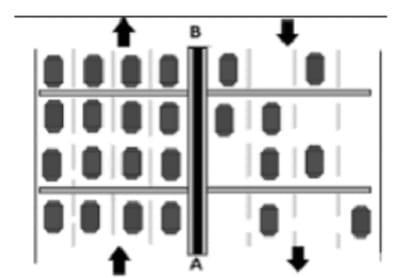
Trafficdetection:Theprimaryobjectiveofthismoduleisto determine the number of vehicles, which influences operationofthedivider.InfraredSensorsarepositionedat thedividersentrypointtoobtainvehiclecounts,reflecting the level of traffic congestion. When the traffic density is high,thedividermovestowardslessless-densityside.Ifthe traffic density remains average, then no action is implemented,andthemedianremainscentrallypositioned.
In this suggested system, a component has been formulatedutilizingamicrocontrollerthatcontainsan ultrasonicsensor,employedforgaugingtraffic.
The infrared sensor can be considered to be a part of vehicletoevaluatethedensityandisonaone-laneroad.
Ambulance Detection:
RGBLEDsstationedoneithersidesofroad.
Wheneverthedividerreceivesasignalfromtheambulance RGBLEDsnetworkedtothesidewilllightup.
Theambulancecanbedetected100mawayinourplanso based on those signals, path will be cleared to the Ambulance.
Onenarrowpathwillbecreatedwhereonlyanambulanceis allowed.
Wheneveranambulanceisdetectedoneitheroftheroads thecolouroftheroadwillchangeanddisplayontheLCD.
Volume: 11 Issue: 04 | Apr 2024 www.irjet.net p-ISSN:2395-0072
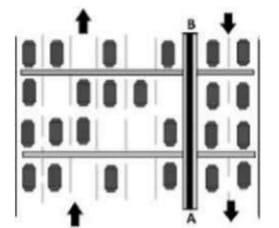
Theoverallmethodologyofthesystemisshowninbelow figure.
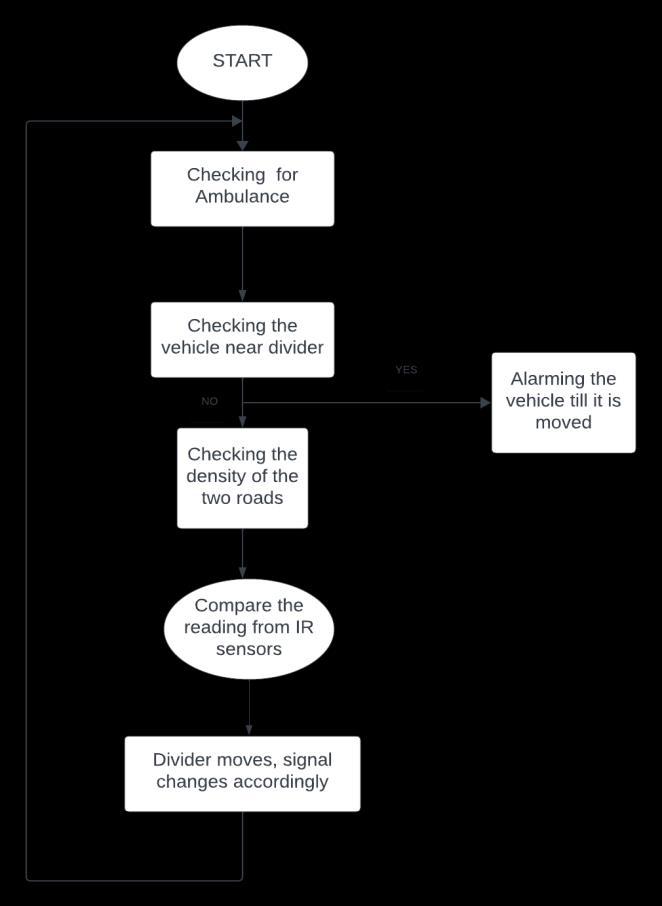
3:Flowchartfordividermovementundertraffic conditions.
ReducedEmergencyResponseTimes:Theprimaryoutcome is a significant reduction in emergency response times, particularlyforambulances.Thismightpotentiallyavertloss
of life by allowing medical professionals to reach patients morequickly.
Improved Traffic Flow: The project aims to alleviate congestionoftrafficandenhanceoveralltrafficflow,leading toshortenedcommutingtimeforeveryroadusers,increased productivity,andreducedfuelconsumption.
Enhanced Safety: The use of smart movable road dividers withadaptivecontrol mechanisms isexpectedtoimprove road safety by minimizing the risk of accidents involving emergencyvehiclesandothervehiclesontheroad.
Public Awareness and Education: An expected outcome is improved public awareness and education regarding the importance of giving way to emergency vehicles and understandinghowthesmartdividersystemworks.
Interoperability: The successful integration of the smart divider system with existing traffic management infrastructure and protocols is expected, contributing to smoothertrafficmanagementoverall.
Smartmovableroaddividersreducecongestionbyproviding additional lanes in peak traffic directions for AM and PM commuters, thereby increasing safety, decreasing travel time,andofferingenvironmentalbenefitssuchasimproved air quality, fuel efficiency, and reduced atmospheric CO2 levels.Bydynamicallyadjustingdividerpositionsbasedon real-timetrafficconditions,thesesystemseffectivelymanage trafficflowandalleviatecongestionhotspots.
Moreover,byoptimizingroadcapacityusage,thesedividers can reduce the necessity for costly infrastructure developmentprojects,suchasconstructingnewbridgesor expanding existing roads. Their ability to be easily reconfigured and relocated makes them adaptable to changing traffic conditions or temporary roadwork. IntegratedwithIoTtechnology,thesystemfurtherenhances its functionality and effectiveness in controlling traffic congestion.
Smart movable road dividers offer numerous advantages, andtheirproperusageisessentialformaximizingbenefits andensuringsafetrafficcontrol.
In conclusion, this project addresses a critical urban challenge of traffic congestion caused by the static road infrastructure'sinabilitytoadapttothegrowingpopulation andincreasedcarownership.
By introducing a smart movable road divider system, we have demonstrated the potential to significantly reduce emergency response times, improve traffic flow, and enhanceroadsafety. International Research Journal of Engineering and Technology (IRJET) e-ISSN:2395-0056
International Research Journal of Engineering and Technology (IRJET) e-ISSN:2395-0056
Volume: 11 Issue: 04 | Apr 2024 www.irjet.net p-ISSN:2395-0072
Theoutcomesofthisprojectunderscoretheimportanceof embracing innovative solutions to meet the evolving transportationneedsofourmetropolitanareas. Aswelooktothefuture,itisimperativetocontinuerefining and expanding such initiatives to create more sustainable andlivablecities.
[1] "Controlling of Smart Movable Road Divider and Clearance Ambulance Path Using IOT Cloud," in 2021 InternationalConferenceonComputerCommunicationand Informatics(ICCCI-2021),Jan.27–29,2021,Coimbatore, INDIA.
[2] M.D.Sinha,D.M.R.Babu,D.R.Patan,D.P.Jiao,M.K. Barri,andD.A.H.Alavi,"InternetofThings-basedFogand CloudComputingTechnologyforSmartTrafficMonitoring," Internet of Things, vol. 100175, 2020, Doi: 10.1016/j.iot.2020.100175.
[3] S.AhnandM.J.Cassidy,"Freewaytrafficoscillationsand vehicle lane change maneuvers," in Transportation and Traffic Theory 2007. Papers Selected for Presentation at ISTTT17,2007.
[4] B. D. Sri, K. Nirosha, and S. Gouse, "Design and implementationofsmartmovableroaddividerusingIOT,"in 2017 International Conference on Intelligent Sustainable Systems(ICISS),2017,doi:10.1109/iss1.2017.8389364.
[5] Z. Jan, B. Verma, J. Affum, S. Atabak, and L. Moir, “A convolutionalneuralnetworkbaseddeeplearningtechnique for identifying road attributes,” in 2018 International Conference on Image and Vision Computing New Zealand (IVCNZ).IEEE,2018,pp.1–6.
[6] A.Wujcicki,“Automaticdetectionofthenumberoflanes into which a road is divided,” May 31, 2016, US Patent 9,355,321.
[7] A. J. Ghandour, H. A. Krayem, and A. A. Jezzini, “Autonomousvehicleddetectionandclassificationinhighresolution satellite imagery,” in 2018 International Arab ConferenceonInformationTechnology(ACIT).IEEE,2018, pp.1–5.
[8] Surgailis, T.; Valinevicius, A.; Zilys, M., "Traffic Image Processing Systems," in Advances in Circuits, Electronicsmand Micro-electronics, 2009. CENICS '09. SecondInternationalConferenceon,vol.,no.,pp.61-66,1116Oct.2009
[9] PranavMaheshwari,DeepanshuSuneja,PraneetSingh, YogeshwarMutneja,“Smarttrafficoptimizationusingimage processing”,2015 IEEE 3rd International conference on MOOC’s, Innovation and Technology in Education (MITE), ISBN:978-1-4673-9/15/$31.00,2015IEEE.
[10] Kudo, Y.; Yamashita, T.; Tsurutani, T.; Naniwada, M., "Trafficflowmeasurementsystemusingimageprocessing," inVehicularTechnologyConference,1983.33rdIEEE,vol.33, no.,pp.28-34,25-27May1983
[11] S. Djahel, Nicolas Smith, John Murphy, “Reducing emergency services response time in smart cities: An advanced adaptive and fuzzy approach” in International SmartCities,28October2015
[12] L. Sumia, V. Ranga “Intelligent Traffic Management SystemforPrioritizingEmergencyVehiclesinaSmartCity” in IJE TRANSACTIONS B: Applications Vol. 31, No. 2, (February2018)278-283
[13] W. Yu, W. Bai, W. Luan and L. Qi, "State-of-the-Art Review on Traffic Control Strategies for Emergency Vehicles,"inIEEEAccess,vol.10,pp.109729-109742,2022, doi:10.1109/ACCESS.2022.3213798