
International Research Journal of Engineering and Technology (IRJET) e-ISSN: 2395-0056
Volume: 11 Issue: 04 | Apr 2024 www.irjet.net p-ISSN: 2395-0072
International Research Journal of Engineering and Technology (IRJET) e-ISSN: 2395-0056
Volume: 11 Issue: 04 | Apr 2024 www.irjet.net p-ISSN: 2395-0072
Mrs. Bhuvaneswari1 , Kiran Kumar2 , Nandhan3 , Adithya4, Aravind Amarnath5
1Professor of Department of Information Technology, Meenakshi College of Engineering, Chennai, Tamil Nadu, India
2,3,4,5 Student of Department of Information Technology, Meenakshi College of Engineering, Chennai, Tamil Nadu, India ***
Abstract - Touchless eye-hand control (TEHC) refers to the use ofeyeandhandmovements tointeractwithdigitaldevices without physically touching them. This technology has the potential to revolutionize the way we interact with devices, especially for people with physical disabilities. Python and OpenCV library are utilized for real-time computer vision implementation, with the camera output displayed on the monitor. Integrating advanced computer vision, it enables precise cursor control without physical contact, through eye tracking and hand gesture recognition. Despite challenges, including accuracy and environmental factors, TEHC holds promise for gaming, communication, and virtual reality applications.
Key Words: TEHC, Eye-hand gesture recognition, Physical disabilities, Cursor control.
Human-computer interaction (HCI) has undergone significant advancements in recent years, particularly in making computers more accessible to individuals with restrictedmotorabilities.Priorresearchhasyieldedvarious devices aimed at assisting disabled individuals using gesturesandothernon-contacttechniques.However,many HCIactivitiesstillrequireuserinteractionwithoutrelyingon anassistantorassistivedevice,whichposeschallengesfor thosewithlimitedmotorskillssuchasspinalcordinjuries and limb paralysis. HCI plays a crucial role in providing opportunities for disabled individuals to engage in computer-basedtasks,includingcursorcontrol.
Thispaperproposesthedevelopmentofa TouchlessEyeHandControl(TEHC)systemdesignedtoenhancecomputer accessibilityforindividualswithdisabilities.TEHCutilizes eye tracking and hand gesture recognition to control the cursoronapersonalcomputer.Byaccuratelyestimatingthe user's eye position and tracking head/face movements, including nodding for vertical movement and rotation for horizontal movement, the system enables precise cursor controlwithoutphysicalcontact.Additionally,mousebutton functions are activated by bending the head left or right, providingfurthercontrolflexibility.
Moreover, the proposed TEHC system aims to deliver an interactive user interface withminimal responselagtime, ensuring a seamless user experience. The system's design prioritizessimplicityandconvenience,makingitaccessible andeasytouseforindividualswithdisabilitiesinoperating computersandinteractingwithdigitalobjects.Throughthe integrationofadvancedHCItechniques,TEHCrepresentsa significantstepforwardinenhancingcomputeraccessibility andempoweringdisabledindividualstoengagemorefullyin computer-basedtasks.
In their innovative system, the researchers employed a Convolutional Neural Network (CNN) for face detection, achieving high accuracy in identifying and localizing faces withinimages.Thisinitialsteplaidarobustfoundationfor subsequent analysis. Building upon this foundation, a YOLOv4-based object detection framework wasintegrated into the system, enabling precise and reliable face recognition. This framework ensured the system's adaptabilitytovariousenvironmentalconditions,enhancing itseffectivenessinreal-worldscenarios.
Oncefacesweredetectedandrecognized,thesystemutilized theestimatedheadposeandcapturedfacialareatofacilitate cursor movement control. By interpreting subtle head movements and facial cues, users could intuitively manipulate the cursor on the screen, providing a natural interactionmethod.Thisseamlessintegrationofheadpose estimationandfacialanalysiscontributedtoauser-friendly experience, particularly beneficial for individuals with restrictedmotorabilities.
Tofurtherenhancecursortrackingprecision,theresearchers incorporated a Kalman filter into the system. This filter refinedthetrajectoryofthecursor,smoothingitsmovements and reducing jitter orinaccuracies.Continuouslyadjusting thecursor'spredictedpositionbasedonincomingdata,the Kalman filter ensured responsive and accurate cursor control,ultimatelyoptimizingtheoveralluserexperience.
International Research Journal of Engineering and Technology (IRJET) e-ISSN: 2395-0056
Volume: 11 Issue: 04 | Apr 2024 www.irjet.net p-ISSN: 2395-0072
TheproposedsystemcombinestheutilizationofanRGB cameraandmediapipetocaptureandestimatefacialangles, facilitatingprecisecursorcontrol.Bytrackingbotheyeand handmovements,themousecursoraccuratelyfollowsthe user'sintendedlocationsonthescreen.Leveraginglefteye blinkingforright-clickoperationsandrighteyeblinkingfor left-click operations introduces a natural and intuitive mechanismforperformingclickingactions,enhancinguser interactionwiththesystem.
Furthermore,thesystemseamlesslyintegratesmediapipe for efficientfacedetectionandincorporatespyautogui for precise cursor control. In addition to eye and facial movements,theinclusionofhandmovementsaddsanextra layer of interaction, expanding the possibilities for cursor manipulation. This comprehensive approach not only enhancestheoveralluserexperiencebutalsodemonstrates the potential of combining multiple input modalities for moreintuitiveandaccessiblehuman-computerinteraction.
The"TouchlessEye-HandControl"algorithmutilizeswebcam inputandlandmarkpointdetectiontoaccuratelytrackeye and hand movements. It simulates mouse cursor actions basedoneyegesturesandprovidesavisualrepresentationof controlledcursormovementsonthescreen.
AlgorithmUsed:TouchlessEye-HandControl
Input:
VideoCapture:Cam
Landmark_points:(x,y)
Frame:(h,w)whereh=height;w=width
Output:
CursorMovementandAccess
Step1:
frame=cam.read()
output=frame
Cameraaccessisready.
Step2:
iflandmarks_points:
x=int(landmarks.x*frame_w) y=int(landmarks.y*frame_h) Landmarksareobtained,andtheeyeisdetected.
Step3:
ifid==1:
screen_x=screen_w*landmark.x screen_y=screen_h*landmark.y Usepyautuguitomove.
Step4: forlandmarkinleft: x=int(landmarks.x*frame_w) y=int(landmarks.y*frame_h) Usepyautoguitoclick.
Step5:
ShowEye-HandControlledMouse
STEP 1: Capture video from the webcam, initializing necessaryvariables.
STEP 2: Process landmark points to determine their pixelpositionsontheframe.
STEP3:Calculatethecursor'spositiononthescreen relativetothelandmarkpoints.
STEP 4: Simulate mouse clicks at the detected eye positionsusingpyautogui.
STEP 5: Display a visual representation of the controlledcursoronthescreen.
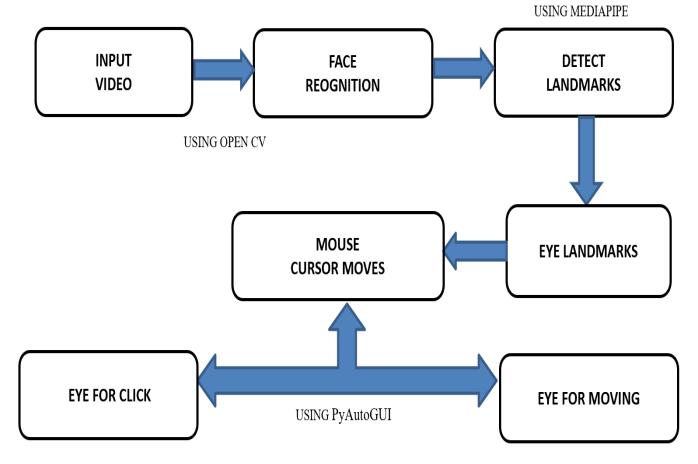
Figure 1 presents the architectural blueprint of the TOUCHLESS EYE HAND CONTROL system, outlining the webcaminput,landmarkpointdetection,andcursorcontrol mechanisms. It provides a visual representation of the system's data flow, illustrating the path from input acquisitiontosimulatedcursormovementsbasedoneyeand handgestures.Thisvisualizationoffersaconciseoverviewof thesystem'sdesignforintuitiveand touchlessinteraction withdigitaldevices.
1:Architectureforproposedsystem
International Research Journal of Engineering and Technology (IRJET) e-ISSN: 2395-0056
Volume: 11 Issue: 04 | Apr 2024 www.irjet.net p-ISSN: 2395-0072
Themethodologyforfacilitatingmousecontrolthrougheye trackingandhandgestureswasdevisedasfollows:
A.FaceDetection:
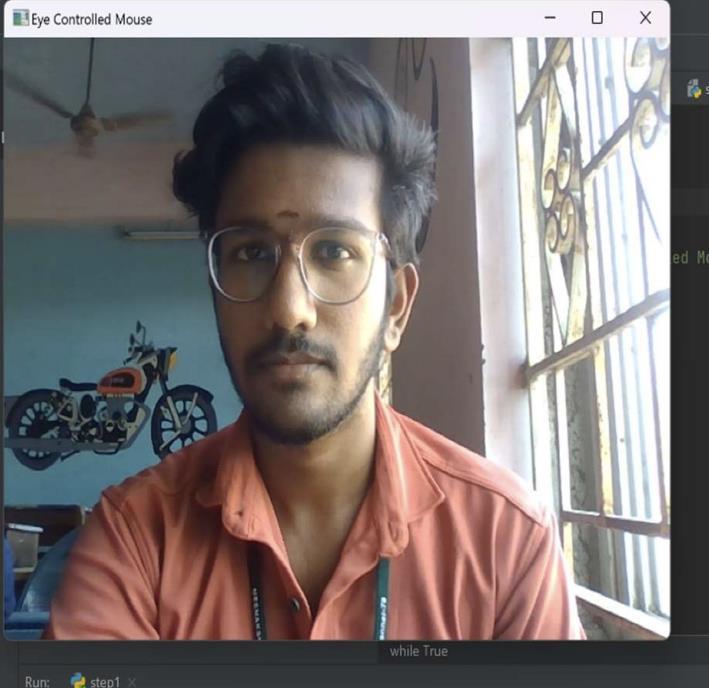
To ensure optimal image clarity and accuracy, it is recommended that the user align their face parallel to the webcam's position, as depicted in Figure 2. The system capturestheuser'simageusingapre-installedwebcamand processesitusingPythonwithOpenCV.Anillustrationofthe capturedimagethroughthewebcamispresentedinFigure3

B.LandmarkDetection:
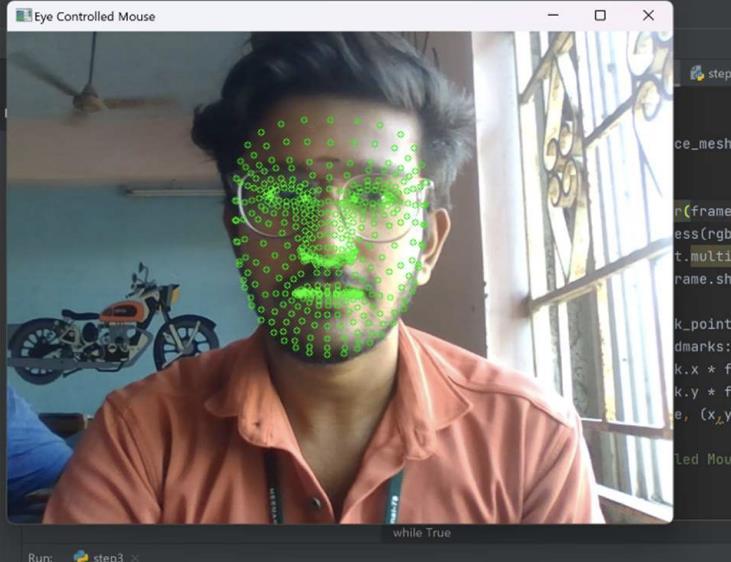
Utilizingthecapabilitiesofmediapipe,thesystemaccurately detectsfaciallandmarks.Oncedetected,theselandmarksare represented visually, akin to the depiction in Figure 4, providing a comprehensive overview of the key facial featuresidentifiedbythealgorithm.
C.EyeDetection:
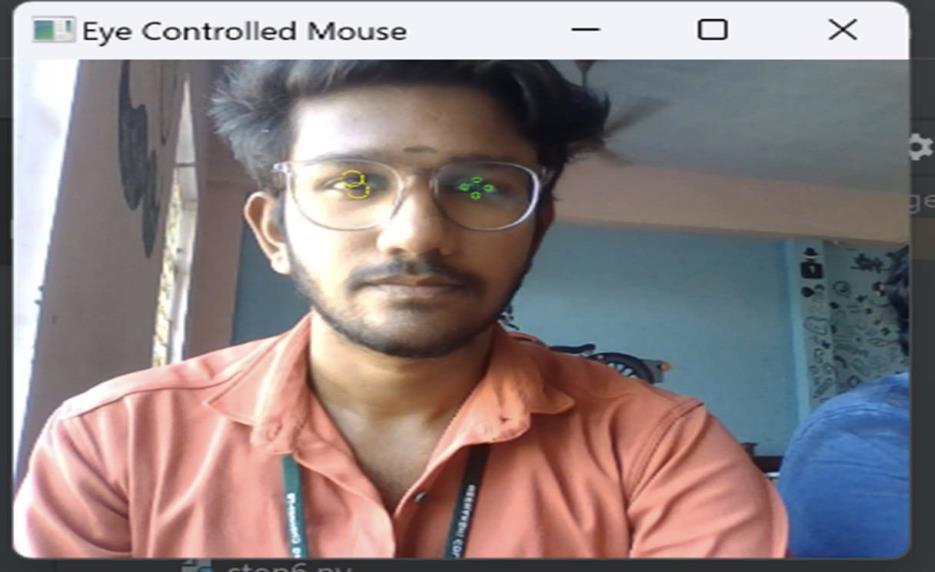
Eyedetectionisaccomplishedthroughadvancedcomputer vision techniques, specifically targeting the identification andtrackingoftheuser'seyeswithinthe capturedimage. This process ensures precise localization of the eyes, facilitating subsequent analysis and interaction with the system'sfunctionalities.Oncethesystemdetectstheeyes,it appearsasdepictedinFigure5
D.HandDetection:
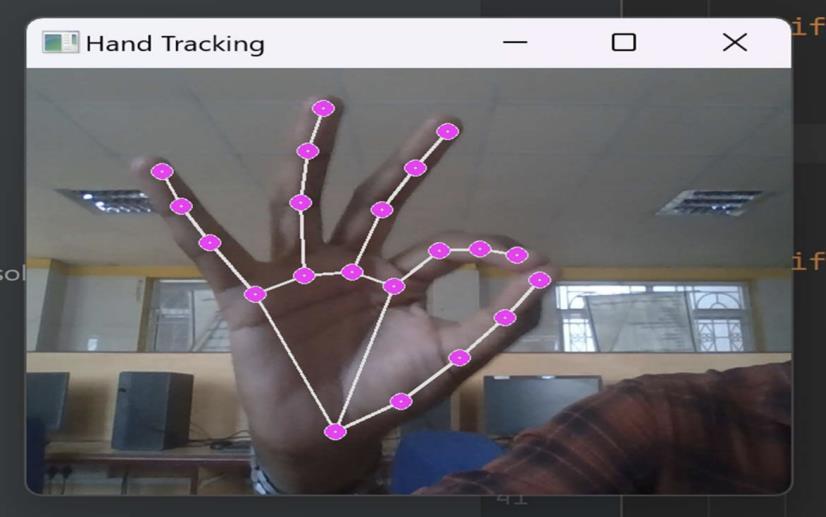
Thesystememploysadvancedtechniquestodetectandtrack the user's hands within the captured image. This process enables the precise identification of hand movements, facilitatinginteractionwiththesystem'sfunctionalities.Once the system detects the hands, the visual representation resemblestheillustrationprovidedinFigure6
International Research Journal of Engineering and Technology (IRJET) e-ISSN: 2395-0056
Volume: 11 Issue: 04 | Apr 2024 www.irjet.net p-ISSN: 2395-0072
Theevaluationofthetouchlesseye-handcontrolsystem revealedpromisingoutcomesintermsofbothperformance and usability. Analysis of system performance indicated a highdegreeofaccuracyincursormovementprecision,with minimalresponsetimeobservedduringinteractionsessions. Users reported positive feedback regarding the system's usability, emphasizing its intuitive nature and ease of navigationthroughdigitalinterfaces.
Comparativeanalysisagainstexistingmethodsshowcased the superiority of the touchless eye-hand control system, particularlyintermsofitsseamlessintegrationofeyeand hand movements for cursor control. This innovative approachofferssignificantadvantagesovertraditionalinput methods, enhancing user interaction experiences across variousapplications.
The potential applications of the touchless eye-hand control system span diverse domains, including assistive technology for individuals with disabilities, immersive gaming experiences, and enhanced virtual reality interactions. Its intuitive interface and precise control mechanisms hold promise for revolutionizing humancomputerinteractionparadigms.
Despiteitspromisingperformance,thetouchlesseye-hand control system faces certain limitations, such as environmental factors affecting accuracy and the need for further optimization in certain scenarios. Future research endeavors aim to address these limitations and explore additionalfunctionalitiestoexpandthesystem'scapabilities, ultimately advancing accessibility and user experience in digitalenvironments.
In conclusion, the touchless eye-hand control system represents a significant advancement in human-computer interaction, offering a seamless and intuitive interface for
userstonavigatedigitalenvironments.Throughourstudy, we have demonstrated the system's high performance in termsofaccuracyandusability,highlightingitspotentialto revolutionize various applications, including assistive technology,gaming,andvirtualreality.Theimplicationsof ourfindingsextendbeyondtechnicaladvancements,asthe systemholdspromiseinenhancingaccessibilityandquality oflifeforindividualswithdisabilities.
Lookingahead,futureresearcheffortswillfocusonrefining the system's capabilities, addressing any identified limitations, and exploring new avenues for innovation. By continuingtoadvancetouchlessinteractiontechnologies,we can further empower individuals to engage with digital interfacesmoreeffortlesslyandefficiently.Ultimately,our workunderscorestheimportanceofongoingcollaboration andinvestmentinthisfieldtocreateinclusiveandaccessible digitalexperiencesforall.
[1] Touchless Head-Control (THC): Head Gesture Recognition for Cursor and Orientation Control, IEEE Transactions On Neural Systems And Rehabilitation Engineering,June30,2022.
[2]M.A.Haq,S.-J.Ruan,M.-E.Shao,Q.M.U.Haq,P.-J.Liang, and D.-Q. Gao, "One stage monocular 3D object detection utilizing discrete depth and orientation representation," IEEETrans.Intell.Transp.Syst.,earlyaccess,May23,2022, doi:10.1109/TITS.2022.3175198.
[3]J.K.Muguroetal.,"DevelopmentofsurfaceEMGgame control interface for persons with upper limb functional impairments,"Signals,vol.2,no.4,pp.834–851,Nov.2021.
[4] J. M. Vojtech, S. Hablani, G. J. Cler, and C. E. Stepp, "Integratedheadtiltandelectromyographiccursorcontrol," IEEE Trans. Neural Syst. Rehabil. Eng., vol. 28, no. 6, pp. 1442–1451,Jun.2020.
[5]W.Rahmaniar,Q.M.U.Haq,andT.-L.Lin,"Widerange head pose estimation using a single RGB camera for intelligentsurveillance,"IEEESensorsJ.,vol.22,no.11,pp. 11112–11121,Jun.2022.
[6]R.H.AbiyevandM.Arslan,"Eyemousecontrolsystem forpeoplewithdisabilities,"ExpertSyst.,vol.37,no.1,Feb. 2020,Art.no.e12398.
[7]H.A.Alhamzawi,"Controlmousecursorbyeyeandhand movement:Developmentandimplementation,"Appl.Med. Informat.,vol.40,nos.3–4,pp.39–44,2018.
[8] D. Sawicki and P. Kowalczyk, "Eye movement based interactioninmobility,"Int.J.Hum.–Comput.Interact.,vol. 34,no.7,pp.653–665,Nov.2017.
International Research Journal of Engineering and Technology (IRJET) e-ISSN: 2395-0056
Volume: 11 Issue: 04 | Apr 2024 www.irjet.net p-ISSN: 2395-0072
[9]N.Rudigkeit,M.Gebhard,andA.Graser,"Ananalytical approachforeyegesturerecognitionwithmotion,"inProc. 9thInt.Conf.Sens.Technol.(ICST),Dec.2015,pp.1–6.
[10] H. Ohtsuka, T. Kato, K. Shibasato, and T. Kashimoto, "Non-contacteyegesturemaneuveringsystemforelectric wheelchairusingadepthsensor,"inProc.9thInt.Conf.Sens. Technol.(ICST),Dec.2015,pp.98–103.
BIOGRAPHIES





Mrs. M Bhuvaneswari, Professor, Dept. of Information Technology, MeenakshiCollegeofEngineering, Chennai,TamilNadu,India
Kiran Kumar A, Student, Dept. of Information Technology, MeenakshiCollegeofEngineering, Chennai,TamilNadu,India
Nandhan K, Student, Dept. of Information Technology, MeenakshiCollegeofEngineering, Chennai,TamilNadu,India
Adithya D, Student, Dept. of Information Technology, MeenakshiCollegeofEngineering, Chennai,TamilNadu,India
Aravind Amarnath S, Student, Dept. of Information Technology, MeenakshiCollegeofEngineering, Chennai,TamilNadu,India