
International Research Journal of Engineering and Technology (IRJET) e-ISSN: 2395-0056
Volume: 11 Issue: 04 | Apr 2024 www.irjet.net p-ISSN: 2395-0072
International Research Journal of Engineering and Technology (IRJET) e-ISSN: 2395-0056
Volume: 11 Issue: 04 | Apr 2024 www.irjet.net p-ISSN: 2395-0072
M.Bindu Sri1 , K.SRIHARI RAO2 , T.Anvitha3 , V.Anusha4 , N.Raj Kamal5 , T.Jayadweep6
1 Associate professor, Department of Electronics and Communication Engineering, Nri institute of technology, Perechala, Andhra Pradesh,India
2 Associate professor, Department of Electronics and Communication Engineering, Nri institute of technology, Perechala, Andhra Pradesh,India
3UGStudents,Department of Electronics and Communication Engineering, Nri institute of technology, Perechala, Andhra Pradesh,India
Abstract - Face recognition systems are essential in practically every industry in our digital age. One biometric that is frequently utilized is face recognition. It has several more benefits in addition to being useful for security, authentication, and identity. Despite being less accurate than fingerprint and iris recognition, it is nonetheless extensively utilized since it is a non-invasive and contactless technique. Additionally, facial recognition systems may be utilized in businesses, universities, schools, and other settings to indicate attendance. The goal of this system is to create a facial recognition-based class attendance system because the current manual approach requires a lot of time and effort to maintain. There's also a risk that proxies will show up. As a result, this mechanism becomes more necessary. The four stages of this system are database building, face detection, face recognition, and attendance updating. Images of pupils in class are used to develop databases. The local binary pattern histogram technique and the Haar-Cascade classifier are used, respectively, for face detection and recognition. From the classroom's live streamed footage, faces are identified and detected. After the session, an attendance report will be forwarded to the relevant faculty members.
Key Words: Face Recognition, Face Detection, HaarCascade classifier, Local Binary Pattern Histogram, attendance system
Themorningrollcall,whenthelecturerswouldpersonally callonournamestoverifyourpresence,isoneofthemost memorable experiences that any college student has. In educational institutions, the routine is drawn out and tiresome. Despite being a crucial aspect of administration, keeping track of attendance can sometimes become a tedious and time-consuming task that is prone to errors. Keeping track of students' attendance during class has growntobea difficulttask.Asmanual calculatingleadsto errors and costs a lot of time, figuring out the attendance proportionbecomesacrucialtask. Thecomputerizationof the traditional attendance-taking method forms the foundation for the development of an automatic attendancemanagementsystem.
With the use of their faces, pupils' attendance will be tracked in this initiative. Typically biometric systems or calling roll numbers are used to record attendance. They are simple to proxy. However, there is a very slim possibility of errors and proxies in our project. The attendance system is entirely automated, and reports are periodicallystored.
1.2 A summary of the document, recommended reading, and intended audience
This text is meant to be distributed widely with its contents. But it's crucial to preserve information like the student's name and roll number. The document since it is their duty to make sure that the instructions inside is followed. All employees that handle student data in the courseoftheiremploymentshouldalsobemadeawareof theserequirements.
TheAnacondadistributioncomeswithadesktopgraphical userinterface(GUI)calledAnacondaNavigator,whichlets you manage conda packages, environments, and channels without the need for command-line interfaces. Navigator has the ability to look for packages in a local Anaconda repositoryoronAnacondaCloud.
Anaconda is a distribution for Python and R data science, an environment manager, a package manager, and a repository of more than 7,500 open-source programs. Anaconda provides free community assistance and is simpletoinstall.AfterobtainingtheAnacondaCheatSheet, launchAnaconda.Doyouwanttoinstallcondaandutilizeit toinstallonlythenecessarypackages?AcquireMiniconda. utilize Navigator if you would rather utilize a desktop graphical user interface (GUI) after installing Anaconda or Miniconda. Use conda and the Anaconda prompt (also known as the terminal on Linux or macOS) if that's how youliketowork.Additionally,youmayflipbetweenthem. After installing Anaconda,launch the command anaconda-
International Research Journal of Engineering and Technology (IRJET) e-ISSN: 2395-0056
Volume: 11 Issue: 04 | Apr 2024 www.irjet.net p-ISSN: 2395-0072
navigatorintheAnacondaprompt(orterminalonLinuxor macOS)totryNavigator.Alternatively,selecttheNavigator icon on the application menu of your operating system.Take the 30-minute conda test drive and obtain a conda cheat sheet to give conda a try after installing Anaconda or Miniconda. Write your first Python project using Anaconda by following the instructions at Getting started with Anaconda if you're new to the program. To read the user guide from beginning to end, utilize the navigation tabs at the bottom of the page.To understand how to utilizeAnaconda'sgraphical user interface,see the Navigatorusermanual.TakealookattheUIandlearnhow to use Navigator at Opening Navigator for the first time.Anaconda and Microconda both come with Conda,an open source package management and environment managementsystem.Findouthowtoinstallanduseconda.
Python, hundreds of scientific programs, Anaconda Navigator, and conda are all included in the Anaconda Distribution. All of these were also installed when you installed Anaconda.Conda may be used using a command lineinterface,suchastheLinuxandmacOSterminalorthe Windows Anaconda Prompt. With Navigator, you can quickly manage conda packages, environments, and channelswithoutneedingtousecommand-linecommands. Navigator is a desktop graphical user interface. To determine which is best for you to manage your packages andenvironments,youmaytestbothNavigatorandconda. Theworkyoucompleteinonemaybeviewedintheother, andyoucanevenflipbetweenthem.
TheAnacondadistributioncomeswithadesktopgraphical userinterface(GUI)calledAnacondaNavigator,whichlets you manage conda packages, environments, and channels without the need for command-line interfaces. It also lets you start programs. Navigator has the ability to look for packages in a local Anaconda repository or on Anaconda Cloud. It may be downloaded for Linux, macOS, and Windows
Face-specific systems and object recognition systems both employed a variety of techniques to address disparities in picturesthatwereaffectedbyvariationsinlight.Gray-level data was utilized to extract a face or an object from the shading strategy as a way to cope with these differences.Because grayscale representations simplify the procedure and minimize computation overhead, they are preferred over directly working with color pictures for extracting descriptors.Color isn't really helpful in this situation, and adding extraneous information might make more training data needed to get decent results. These
suggested answers assumed the object's form and reflectance characteristics or the lighting circumstances since the challenge was ill-posed. It didn't work well for facialrecognitionsincethepresumptionsweretoorigidfor generic object recognition. The second method makes advantageoftheimage'sedgemap,ahelpfulcharacteristic for representing objects that is unaffected by changes in lightingorspecificevents.Imageswithedgesmightbeused torecognizeobjectsandattainaccuracylevelscomparable to those of grayscale images. The edge map information technique has low memory requirements and is featurebased approach's invariance to illumination. It groups the pixels of the face edge map into line segments, so integrating the structural information with the spatial information of a face picture. The edge map of a face is createdbyapplyingapolygonallinefittingprocedureafter the edge map has been thinned. Another method for handling picture discrepancies caused by variations in illumination is to use a model made up of many photos of the same face taken in different lighting scenarios. Here, the photos that were taken can be utilized as separate models or as part of a larger model-based recognition system.
4.1
Themostdifficultaspectofafeasibilitystudyisevaluating technical feasibility. This is because there aren't many indepth system designs at this moment, which makes it challenging to access concerns like performance, pricing, etc. (due to the type of technology that has to be developed). Several factors need to be taken into account whiledoingatechnicalanalysis.
4.1.2
Only when proposed ideas can be developed into an information system that satisfies the operational needs of the company will they be beneficial.In other words, this feasibilitytestquestionsifthesystemwillfunctionwhenit isconstructedandputintoplace.Existsignificantobstacles toimplementation?
4.1.3
The goal of economic feasibility is to balance the advantages of having a new system in place with the expensesofcreatingandexecutingit.Thefeasibilitystudy will providethenewsystem'sseniormanagementwithan economicbasis.
In this instance, a straightforward economic analysis that provides an accurate cost-benefit comparison is far more significant. Additionally, this serves as a helpful point of
International Research Journal of Engineering and Technology (IRJET) e-ISSN: 2395-0056
Volume: 11 Issue: 04 | Apr 2024 www.irjet.net p-ISSN: 2395-0072
reference to compare actual costs as the project moves forward.Theremaybea varietyofintangiblebenefitsdue to automation, such as improved customer satisfaction, higher-quality products, better decision-making, faster information retrieval, expedited activities, improved operational accuracy, better documentation and recordkeeping,andhigheremployeemorale.
Everythingisdoneonpaperunderthecurrentsystem.The attendance record for each session is kept in the register, and reports are created at the conclusion of the semester, which requires additional processing time. Roll numbers will be called in order to manually record attendance in registers at first. A later feature is biometric attendance. The time required for attendance in the old fashion has decreased thanks to biometrics, but there are still some drawbacks, such as proxy and network connection difficulties. The current system has the following drawbacks:
1. Tobuildthereport,weneedtoperformfurther computations.
2. Manuallaborisrequired,andtheprocesstakes time.
3. Reportgenerationrequiresalotofdocumentation.
4. Eventhoughattendancetimemaybereadily altered,ithasbeenloweredthroughtheuseof Bio-Metric.
5. Prospectiveattendancebyproxy.
6. Wesuggestedasolutioninordertogetaroundthe problemswithmanualandbiometric
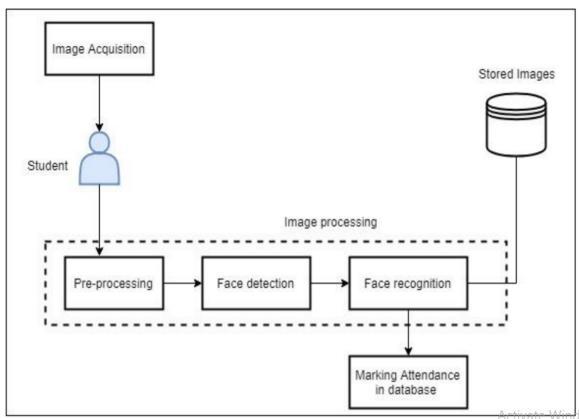
Student photos are gathered in this attendance system so that students' faces may be identified. The student database,whichconsistsofallofthestudents'faces,isused totrainthealgorithmatfirst.Inordertooptimizetheuser experience during training and testing which involve using the system to take attendance and gather student photos the system has an intuitive user interface. Numerous more applications where facial recognition is used for authentication might benefit from this study. At the conclusion of the semester, reports will be generated automatically by the system.The benefits of the suggested system are listed below.Our suggested method will collect attendancebyidentifyingaperson'sface.
6.1 Use case Diagram
Utilization Case Using actors and use cases, the diagram encapsulatesthefunctionalityandneedsofthesystem.Use cases simulate the functions, duties, and services that a system must provide. Use cases show high-level features andthewayauserwillinteractwiththesystem.
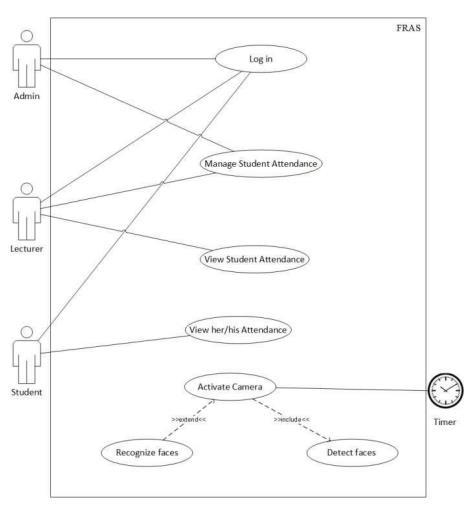
Fig -2: usecaseillustration
UML Sequence Diagrams are interaction diagrams that show the steps involved in performing an operation. They depicthowitemsinteractwithoneanotherwhenworking together.
Volume: 11 Issue: 04 | Apr 2024 www.irjet.net p-ISSN: 2395-0072
Sequence diagrams, which have a time emphasis, use the vertical axis to represent time, the messages transmitted, and the timing of thosemessagesto graphicallydepict the sequenceoftheinteraction.
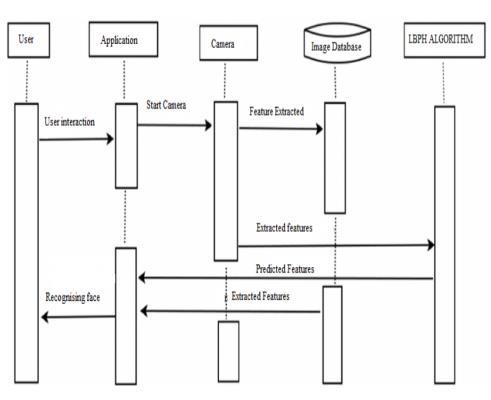
Fig -3: schematicoftheseries
6.3 Activity Diagram
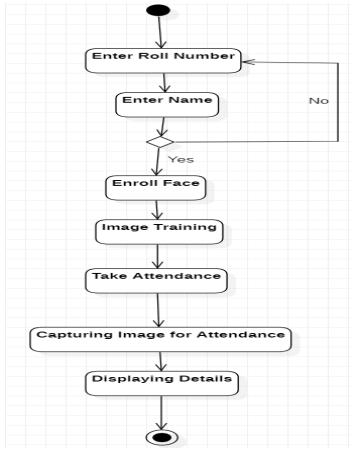
An activity diagram is a type of UML diagram where the execution and flow of a system's behavior are the main emphasisratherthanimplementation.Anothernameforit is an object-oriented flowchart. Activities that are composed of actions that are applicable to behavioral modelingtechnologiesmakeupactivitydiagrams.
Python is a robust and simple-to-learn programming language.Itsobject-orientedprogrammingmethodologyis straightforward but efficient, and its high-level data structures are efficient. Python's interpreted nature, dynamic typing, and beautiful syntax make it a perfect language for scripting and quick application development acrossawiderangeofplatforms.FromthePythonwebsite, https://www.python.org/, the large standard library and thePythoninterpreterarefreelydistributableinsourceor binary form for all major systems. Distributions of and linkstoseveralfreethird-partyPythonmodules,tools,and applications,aswellasmoredocumentation,maybefound onthesamewebsite.Itissimpletoaddnewfunctionsand data typestothePythoninterpreterthatareimplemented inCorC++(orotherlanguagesthatmaybecalledfromC). Pythonmayalsobeusedasanextensionlanguagetocreate programs that can be customized. See The Python StandardLibraryforadescriptionofstandardmodulesand objects.
A more formal definition of the language may be found in the Python Language Reference. Read Extending and Embedding the Python Interpreter and the Python/C API Reference Manual before writing any C or C++ modifications. Python is also thoroughly covered in a numberofbooks.
Gary Bradsky founded OpenCV at Intel in 1999, and the first version was released in 2000. Vadim Pisarevsky took overGaryBradsky'spositionasmanagerofIntel'sOpenCV softwareteamforRussia.Stanley,thevehiclethatwonthe 2005DARPAGrandChallenge,wasequippedwithOpenCV. Later, with Gary Bradsky and Vadim Pisarevsky in charge of the project, Willow Garage supported its ongoingactive development. Currently, OpenCV supports a large number of machine learningand computer vision methods,andits listisgrowingdaily.
In order to retake attendance in this module, we must recognize a student's face in the picture and display a rectangle box around it. We'll utilize the haarcascade file for that once more. The Traineer.yml file contains the characteristics that the LBPH Algorithm extracts from the photos. It will extract the features from the current image at attendance time and compare them with preexisting features; if it discovers a match, attendance will be recordedforthatspecificstudent. International Research Journal of Engineering and Technology (IRJET) e-ISSN: 2395-0056
Fig -4:ActivityDiagram
International Research Journal of Engineering and Technology (IRJET) e-ISSN: 2395-0056
Volume: 11 Issue: 04 | Apr 2024 www.irjet.net p-ISSN: 2395-0072
8. RESULTS
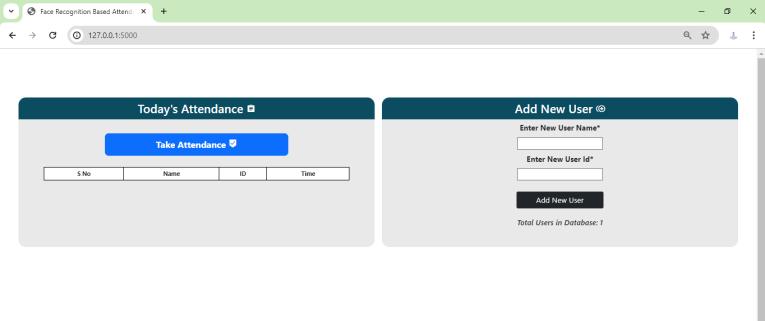
-5:Homepage
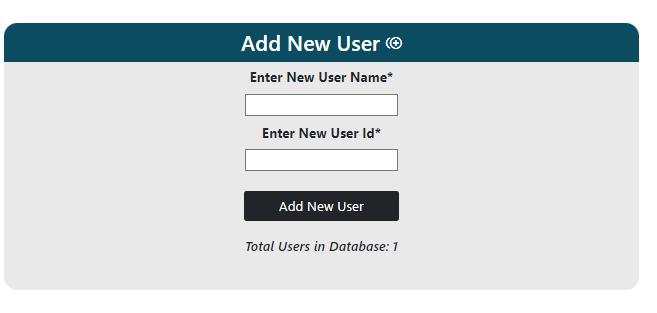
Fig -6:UserRegistration
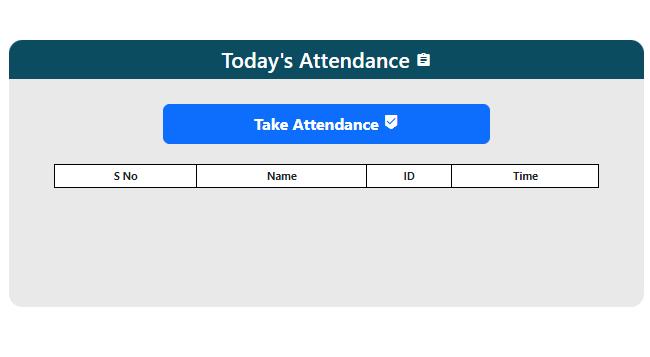
Fig -7:TakeAttendance
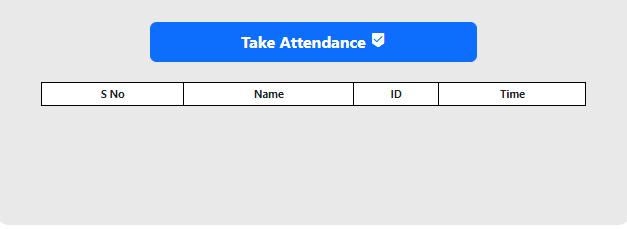
Fig -8:AttendanceData
3. CONCLUSIONS
Thisautomatedattendancesystemhasbeenputintoplace with the aim of lowering the mistakes that arise in the conventional method of taking attendance. This research presents a deep learning-based facial recognition system
that is resilient and accurate, recognizing users with 98.3% accuracy. The outcome demonstrates the system's capacitytoadapttochangesinfaceprojectionandposing. According to research on deep learning face recognition, the lighting issue is resolved during face identification as theoriginal imageisconvertedintoa HOGrepresentation that effectively captures the main characteristics of the image independent of its brightness. Local facial landmarks are taken into consideration for subsequent processing in the face recognition algorithm. Faces are then encoded, producing 128 measures of the photographed face. The best way to recognize a face is to decode the encoding to get the subject's name. An Excel sheetisthencreatedusingtheoutcome.
B.K.P. Horn and M. Brooks, Seeing Shape from Shading. Cambridge,Mass.:MITPress,1989.
A.F.Abate,M.Nappi,D.Riccio,andG.Sabatino,"2Dand3D face recognition: A survey", Pattern Recognition Letters,vol.28,issue15,pp.1885-1906,Oct2007.
Yael Adini, Yael Moses, and Shimon Ullman, “Face Recognition: The Problem of Compensating for ChangesinIlluminationDirection”.
Kanan C, Cottrell GW (2012) Color-to-Grayscale: Does the Method Matter in Image Recognition? https://doi.org/10.1371/journal.pone.0029740
T. Kanade, Computer Recognition of Human Faces. Basel andStuttgart:BirkhauserVerlag1997.
K.SRIHARIRAO DESIGNATION:PROFESSOR QUALIFICATION:pH.D EXPERIENCE:34yrs