
International Research Journal of Engineering and Technology (IRJET) e-ISSN: 2395-0056
Volume: 11 Issue: 04 | Apr 2024 www.irjet.net p-ISSN: 2395-0072
International Research Journal of Engineering and Technology (IRJET) e-ISSN: 2395-0056
Volume: 11 Issue: 04 | Apr 2024 www.irjet.net p-ISSN: 2395-0072
Prof. Heena patil1, prof. Aunrag shekhar2 , Ms. Manita sah3 , Ms. Kajal kongere4 , Ms. Dhanshree malpekar5, Mr. Harsh kewat6
1Head of Department, Dept. of AIML Diploma, ARMIET, Maharashtra, India2Lecturer, Dept. of AIML Diploma ARMIET, Maharashtra, India 3Student, Dept. of AIML Diploma, ARMIET, Maharashtra, India 4Student, Dept. of AIML Diploma, ARMIET, Maharashtra, India 5Student, Dept. of AIML Diploma, ARMIET, Maharashtra, India 6Student, Dept. of AIML Diploma, ARMIET, Maharashtra,
Abstract - The goal of this project is to develop an intelligent assistant that is easy to use and can improve your everyday life. It is simple to ask questions, give commands, or have informal chats with this AI assistant because of its capacity to connect with you in a natural way. Additionally, it may learn from your interactions, whichmeans that over time, it will adjust to your tastes and needs to provide you a tailored experience. The AI assistant is great at organizing your schedule, putting reminders on your behalf, and providing recommendations and useful information. [3]. the project's main goal is to develop a personal assistant, especially in light of Windows-based operating systems. The concept for JARVIS, a personal assistant, was influenced by existential virtual assistants like Cortana.
Key Words: Artificial Intelligence, Machine Learning, Natural Language Processing, Voice detection, Voice recognitionetc.
1. Introduction
Jarvis is all about combining the power of Artificial Intelligence (AI) and the Internet of Things (IoT) to make smartsystemsthatcandocoolstuff.Imagineyourgadgets anddevicesworkingtogethertocollectinformation,think aboutit,andmakedecisions.
Here'swhatwe'redoing:
1. Making Devices Talk: We're connecting devices like sensorsandgadgetssotheycanchatandshareinformation.
2. Personalized Help: It learns from your interactions to provide personalized support. It knows your preferences andtailors’responsestofityourneeds.
3. Works with Your Stuff: It can connect to your devices andonlineservices,makingitsuperhandy.
4. Gathering Data:Wecollectdatafromthesedevices,like temperaturereadingsormovementinfo,andstoreit.
5. Smart Thinking: We teach our system to use AI to analyzethisdata.Itcanlearnandmakesmartchoices.
6. Quick Decisions: Our system can make fast decisions basedonwhatitlearns.Itcancontrolthings,saveenergy, andhelpinvarioussituations.
7. Staying Safe:Wemakesurethatthedataissecureand private,soyoudon'thavetoworryaboutyourinformation gettingintothewronghands.
[2]TheintegrationofAIandIoTpresentssignificantsecurity and privacy challenges. Ensuring the confidentiality, integrity,andauthenticityofIoTdata,deviceauthentication, real-timethreatdetection,anduserprivacyprotectionare paramount.Thecomplexityoflarge-scaleIoTdeployments, resource constraints, and regulatory compliance further compound the problem. To fully leverage AI in IoT applications, robust security measures and privacy safeguards must be developed, encompassing encryption, anomaly detection, access management, and compliance frameworks.
[2] The elderly, the visually and physically handicapped, children, and others benefit from virtual assistants since engagingwithmachinesisnolongerachallenge.Evenblind peoplewhocan'tseethecomputercancommunicatewithit simplybyspeakingtoit.TheintegrationofAIandIoTserves tocreateintelligent,data-drivensystemswithseveral key purposes. It enables real-time data analysis, predictive maintenance, and automation, improving efficiency and personalizing user experiences. Additionally, it enhances security,healthcare,andenvironmental monitoring,while fosteringsmartcitiesandbusinessintelligence.Overall,this integrationseekstorevolutionizeindustriesbyharnessing dataandintelligentalgorithmsforbetterdecision-making, efficiency,anduserbenefits.
The scope of AI assistants is extensive, with applications acrosscustomerservice,healthcare,education,smarthomes, business productivity, e-commerce, automotive, finance, social media, personal health, language translation, accessibility, and more. As AI technologies advance, these assistants are continually evolving, providing users with
International Research Journal of Engineering and Technology (IRJET) e-ISSN: 2395-0056
Volume: 11 Issue: 04 | Apr 2024 www.irjet.net p-ISSN: 2395-0072
enhanced automation, personalized services, and greater convenienceacrossvariousdomainsandindustries.
Table -1: LiteratureSurvey
Name Research Comparison
Falcon– personal assistance.[1]
Vijay Mittal
Siddhant Shukla, Saurabh Shukla, Shivam Sachan Rishabh Kumar Singh B. Tech, ComputerScience and Engineering, IMS Engineering College, Ghaziabad, India. (May2021).
Sara: A voice assistance using python.[2] Ayush Chinchane1, Aryan Bhushan2, Ayush Helonde3, Prof.KiranBidua4 (June2022)
Input in the form ofvoicecommand and system recognize the inputandbyusing different libraries of python it provides the resultintheform ofvoiceaswellas text.
The assistance doesn’t work continues they have to run again and again. But in Jarvis,theyalways running and for closing we have added some commandtoclose it
Table 2: ModulesDescriptionofProposedSystem
User Voice commands Itisaninstructionthatgiven bytheUsertotheJarvisto performtaskrespectively.
Thesystemconvertsspeech input to text using Google's online speech recognition system. The voice input Userscanobtaintexts from the special corpora organized on the computer network server at the information centre, which aretemporarilystoredinthe systembeforebeingsentto Google cloud for speech recognition
Overall Smart AI Assistance performs every task.
3. Proposed System
3.1 Proposed System
Basically,Sarahas done every task thatcannormalAI cando.Itisalsoa voicebasedai.But the only difference Jarvis and sara that IOT Jarvis can accept IOT but Sara doesn’t have IOT inthat
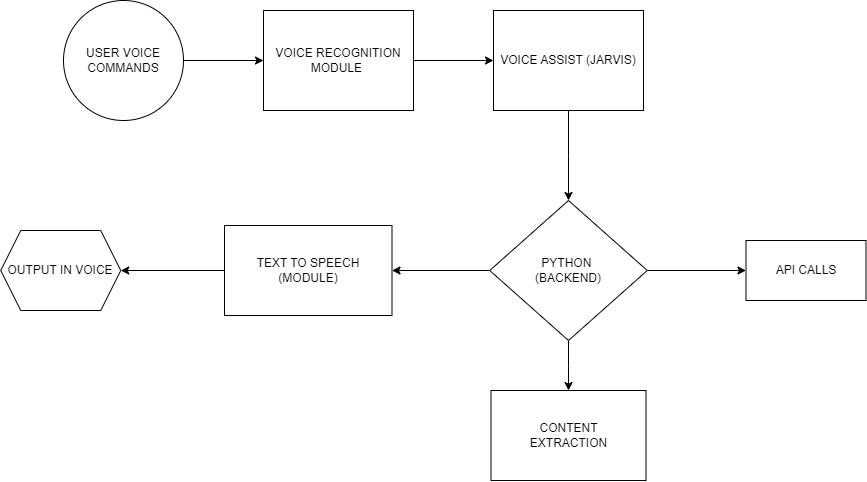
API is an abbreviation for Application Programming Interface. An application programming interface (API)isasoftwareinterface that enables two applicationstocommunicate withoneanother.
Context extraction (CE) is the process of extracting structuredinformationfrom unstructured and/or semistructured machinereadable documents automatically.
The python backend reads the voice recognition module's output and determines whether the command or speech output is an API Call, Context Extraction, or System Call. The output is then transmitted back to the python backend to provide the user with the desired results.
System calls
A system call is a programmatic method by which a computerprogram requests a service from the kerneloftheoperatingsystem onwhichitisrunning.
International Research Journal of Engineering and Technology (IRJET) e-ISSN: 2395-0056
Volume: 11 Issue: 04 | Apr 2024 www.irjet.net p-ISSN: 2395-0072
Text-to speech
3.3 Methodology
Thecapacityofcomputersto readtextaloudisreferredto as text to- speech (TTS). Third-partypublishersoffer TTS engines in a variety of languages, dialects, and specializedvocabularies.
pyttsx3:Pytt3x is a cross-platform text to speech library whichisplatform independent. The major advantage of using this library for text-to-speech conversion is that it works offline. To install this module,typethebelowcommandintheterminal:
Speech Recognition: This allows us to convert audiointotextforfurtherprocessing.Toinstallthis module,typethebelowcommandintheterminal:
pywhatkit: Thisisaneasy-to-uselibrarythatwill help us interact with the browser very easily. To install the module,run the following commandin theterminal:
Wikipedia: We'll use this to fetch a variety of informationfromtheWikipediawebsite.Toinstall this module, type the below command in the terminal:
Requests: This is an elegant and simple HTTP libraryforPythonthatallowsyoutosendHTTP/1.1 requestsextremelyeasily.Toinstallthemodule,run thefollowingcommandintheterminal:
4. System Requirement
4.1 Software Requirement
1. OperatingSystem:Windows10
2. ProgrammingLanguage:PythonLatestVersion
3. IDE:VScode(visualstudio)
4. Tools:PythonsLibraries
4.2 Hardware Requirement
1. Processor:Inteli5orgreater
2. Harddisk:Morethan100GB
3. RAM:Morethan4GB
4. Monitor
5. Keyboard
6. Mouse
7. WebcamorIn-builtcamera
5. System Flow
6. Result / Conclusion
6.1
Thissectionofthestudypaperprovidesabriefsummaryof the project's results. For our project, we selected the recommended programming language is Python. Our main areas of focus were Internet of Things and AI. We concentrated on the duties carried out by the personal assistantandvoiceassistant.isthat,incomparisontoother installationengines,PyCharmwassimpletosetupanduse. TheprimaryjustificationforutilizingPython Itwasalsoa comfortableandstraightforwardprocesstoacquireallthe modulesneededforourproject.TheintelligentAIJarvishas followed instructions from humans to complete tasks and connectswithInternetofThingsdevices.
6.2 Conclusion
The virtual assistant we have created is able to do almost everythingthat the user commands ittodo fromopening a particularfileonthesystemtowebsurfingtogatherorcollect informationontherequiredtopicandalsoIOTcommands.We kepta simpleapproachtoourproblemusing python.Some mainPythonpackagesusedinourproductarethisisspeech
International Research Journal of Engineering and Technology (IRJET) e-ISSN: 2395-0056
Volume: 11 Issue: 04 | Apr 2024 www.irjet.net p-ISSN: 2395-0072
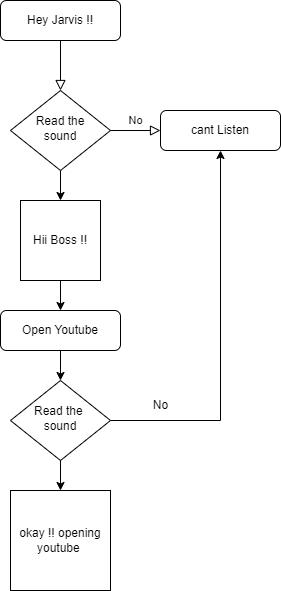
Recognition,PythonPyttx3,and more.Wehavesuccessfully madeaworkingvirtualassistantwhichcanbeactivatedbythe userusingthewakekeyword“Jarvis”,andcanmanipulatethe systemusingverbalcommands.Iteasesmostofthetasksof the user like searching the web, accessing YouTube videos, sendingmailthroughvoice,etc.
SomekeyareasoffuturescopeforAIcombinedwithIoT:
1. Wearable Technology: The integration of AI and IoT in wearabledeviceswillcontinuetoevolve,supportinghealth monitoring,personalassistants,andmore
2.HomeAutomation:Thesmarthomeindustryisgrowing rapidly,withAIassistantsandIoTdevicesplayingacentral role.
3.Agriculture:IoTandAIcanenhanceprecisionagriculture, optimizing crop management, irrigation, and livestock monitoring.
4. Healthcare: AI-driven IoT devices can revolutionize healthcare by enabling remote patient monitoring, predictingdiseaseoutbreaks,andpersonalizingtreatment plans
5.SmartCities:AIandIoTcantransformurbanareasinto smart cities by optimizing traffic management, waste collection,energyusage,andpublicsafety.
8. Reference
[1] Vijay Mittal Siddhant Shukla Saurabh Shukla Shivam Sachan Rishabh Kumar Singh B. Tech” Falcon – Personal Assistance”- IMS Engineering College, Ghaziabad, India –Volume8IssueVIJune2020June.
[2] Ayush Chinchane1, Aryan Bhushan2, Ayush Helonde3, Prof.KiranBiduaty-“Sara:AVoiceAssistantUsingPython”International Journal for Research in Applied Science & Engineering Technology (IJRASET) ISSN: 2321-9653; IC Value: 45.98; SJ Impact Factor: 7.538 Volume 10 Issue VI June2022(June2022).
[3] Sai Madhavi D1, Sudarshan Reddy R2, Shivakumar Meda3, Siddesh Godinal4, Harshit B5 - “Jarvis Voice Assistance”- 1Professor & Head of the Department of cse (Ai&Ml),RaoBahadurY.MahabaleshwarappaEngineering College, Bellary, Karnataka, India 2,3,4,5 Department of computer science and engineering, Rao Bahadur Y. Mahabaleshwarappa Engineering College, Bellary, Karnataka,India-ISSN:2349-6002-Volume9Issue1-June 2022
[4] Dias,PubuduM.,andKithsiriJayakody."VirtualAssistant inNativeLanguage."In2020IEEEAsia-PacificConference
onGeoscience,ElectronicsandRemoteSensingTechnology (AGERS),pp.16-18.IEEE,2020.
[5] John, Linda, Nilesh Vishwakarma, and Rajat Sharma. "Voice Control Human Assistance Robot." In National Conference on Technical Advancements for Social Upliftment,Proceedingsofthe2ndVNC.2020.
[6] Cambre,Julia,AlexC.Williams,AfsanehRazi,IanBicking, AbrahamWallin,JaniceTsai,ChinmayKulkarni,andJofish Kaye."FirefoxVoice:AnOpenandExtensibleVoiceAssistant Built Upon the Web." In Proceedings of the 2021 CHI ConferenceonHumanFactorsinComputingSystems,pp.118.2021.
[7] International Journal of Research in Engineering and Science (IJRES) ISSN (Online): 2320-9364, ISSN (Print): 2320-9356www.ijres.orgVolume10Issue2ǁ2022ǁPP.1520"ResearchPaperonDesktopVoiceAssistant."\
[8] Patil, Akshay, Suyash Samant, Mohit Ramtekkar, ShubhamRagaji,andJayashreeKhanapuri."IntelligentVoice Assistant." In Proceedings of the 3rd International ConferenceonAdvancesinScience&Technology(ICAST). 2020.
[9]July2021|IJIRT|Volume8Issue2|ISSN:2349-6002 "VoiceAssistantUsingPython."NiveditaSingh,Dr.Diwakar Yagyasen,Mr.SuryaVikramSingh,GauravKumar,Harshit Agrawal
[10] Jaydeep, Dr, P. A. Shewale, E. Bhushan, A. Fernandes, and R. Khartadkar. "A Voice Based Assistant Using Google DialogFlowandMachineLearning."nternationalJournalof Scientific Research in Science and Technology 8, no. 3 (2021):06-17.