
International Research Journal of Engineering and Technology (IRJET) e-ISSN:2395-0056
Volume: 11 Issue: 04 | Apr 2024 www.irjet.net p-ISSN:2395-0072
International Research Journal of Engineering and Technology (IRJET) e-ISSN:2395-0056
Volume: 11 Issue: 04 | Apr 2024 www.irjet.net p-ISSN:2395-0072
Ayush Patel1, Sahil Thakur2, Ayush Singh3, Shankendu Kunti4, Prof. Atul Shintre5
1. Student, Dept. of COMP Engineering, VPPCOE & VA, Maharashtra, India
2. Student, Dept. of COMP Engineering, VPPCOE & VA, Maharashtra, India
3. Student, Dept. of COMP Engineering, VPPCOE & VA, Maharashtra, India
4. Student, Dept. of COMP Engineering, VPPCOE & VA, Maharashtra, India
5. Associate Professor, Dept. of COMP Engineering, VPPCOE & VA, Maharashtra, India
Abstract - Web3, which promises a decentralized, usercentric digital ecosystem, has arisen as a revolutionary notion in the quickly changing internet world. Web3 aggregators,a newclassofservices,are atthecenter ofthis transformation and are essential in helping consumers connect to the decentralized web. Web3 aggregators are distinct from standard web aggregators in that they utilize decentralized protocols, smart contracts, and blockchain technology to collect and display data from several decentralized sources. This article highlights the transformational potential of Web3 aggregators through a thoroughanalysisofreal-worldapplications,includingtheir impactonindustrieslikefinance,gaming,anddecentralized financing (DeFi). This potential is not without obstacles, though. Web3 aggregators address several major challenges, including scalability, interoperability, and data accuracy. The Web3 Aggregator project seeks to provide a comprehensive platform that combines decentralized information and services delivery with the capability of Web3 technology. A single point of entry to these services is becoming more and more necessary in an era where blockchainnetworks,decentralizedapps(dApps),andsmart contracts are growing at a rapid pace. With the goal of bridging the gap between consumers and the decentralized web, Web3 Aggregator offers an intuitive interface for managing, accessing, and interacting with a range of Web3 services, applications, and data sources. This project aspires to facilitate the adoption and integration of Web3 technologies into daily activities while enabling consumers and enterprises to fully realize the promise of these technologiesthroughthecreationof Web3Aggregator.
Key Words: Web3, Web3 aggregator, decentralization, blockchain, smart contracts, data aggregation, decentralizedfinance(DeFi),digitalecosystem
A new era of decentralization has begun with the rise of Web3 technologies, in which trust is ingrained in the internet's design rather than being bestowed upon its centralized administrators. A plethora of decentralized applications (dApps), blockchain networks, and smart contracts have emerged as a result of this paradigm change, all of which contribute to a worldwide ecosystem
that allows people and businesses to connect securely, peer-to-peer, and without the need for middlemen. The demand for an easily navigable entry point to this decentralized world has grown as the Web3 ecosystem keepsgrowing.Ourattempttocreateasolutionthatcloses the gap between the quickly developing Web3 world and regular users is embodied in the "Web3 Aggregator" project. A Web3 Aggregator is a technology that merges decentralized exchanges (DEXs) and NFT marketplaces into an all-encompassing ecosystem. As such, users can trade, purchase, and sell NFTs across numerous sites withouthavingtoregisterformultipleaccounts.
A Web3 aggregator's architecture is distinguished by its decentralized design and use of multiple components to accomplish its capabilities. Typically, a Web3 aggregator consistsofthefollowingessentialelements:
2.1. Sources of Data
Web3 aggregators collect information from off-chain data sources, decentralized apps (dApps), and blockchain networks, among other decentralized sources. The raw data used by the aggregator to compile and display the informationtouserscomesfromthesedatasources.
To communicate with blockchain networks and obtain pertinentdata,blockchaininterfacesareutilized.Through theseinterfaces,theaggregatorcanretrievedata,whichis processed and shown to users, including balances for tokens,smartcontractdata,andtransactiondata.
This layer handles the processing and combining of data fromvarioussources.Ithasprotocolsandtechniquesthat guarantee the dependability and correctness of the combined data. Additionally, data standardization and validation are handled by this layer to assure consistency acrossvariousdatasources.
International Research Journal of Engineering and Technology (IRJET) e-ISSN:2395-0056
Volume: 11 Issue: 04 | Apr 2024 www.irjet.net p-ISSN:2395-0072
To store aggregated data, Web3 aggregators may make use of decentralized storage systems like IPFS (InterPlanetary File System). Data availability and integrity are guaranteed by decentralized storage, along withdefenseagainstcensorshipanddatamanipulation.
The Web3 aggregator's frontend part that communicates with users is called the user interface. Users can access and engage with the combined data and services via its graphical user interface. A seamless user experience is ensured bytheuserinterface'suser-friendlyand intuitive design.
User identities and access restrictions within the Web3 aggregator may be managed using decentralized identity solutions, such as decentralized identifiers (DIDs) and verified credentials. These solutions protect user security andprivacywhentheycommunicatewiththeaggregator.
Smart contracts are dynamically performing agreements thatare encoded intocomputer code. Smart contractsare usedintheframeworkofWeb3aggregatorstoautomatea number of tasks, including transaction execution, validation,anddatagathering.
In a nutshell a Web3 aggregator's architecture is distinguished by its decentralized design and the utilization of several components for the collection, processing, and presentation of data from decentralized sources. By utilizing this design, Web3 aggregators may provide consumers with a cohesive and smooth experience, surpassing the constraints of conventional onlineaggregationtechniques.
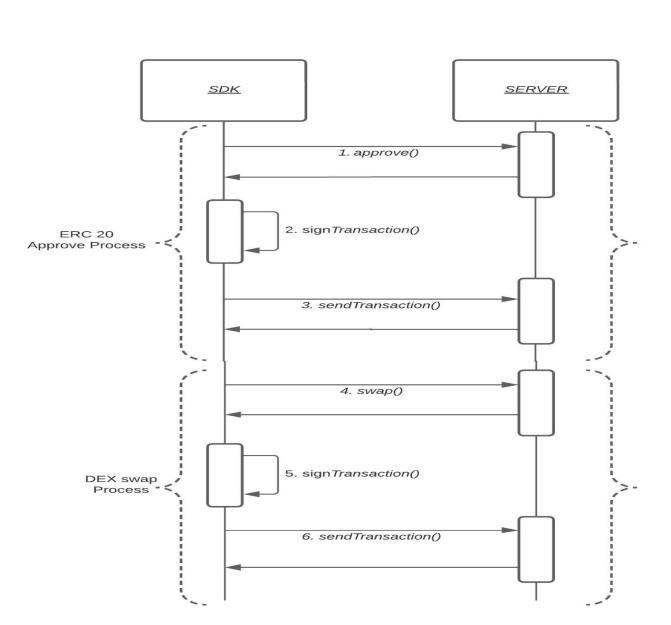
A user interface that lets you engage with the platform is shown to you when you visit a Web3 aggregator website. The first step is to decide the assets you want to buy or sell. These assets could be tokens, coins, NFTs (nonfungible tokens), or other kinds of decentralized assets (VDAs). The aggregator then queries its data sources to retrievethemostrecentpricesofthechosenassetsacross various platforms, which could include decentralized exchanges(DEXs)andothermarketplaces.Youmaymake an informed choice by viewing a comparison of costs across these platforms, which is displayed by the aggregatorbasedonthedatathatwasreceived.Afterthat, you can decide which market to buy the assets you're interestedinatalowerprice.Followingyourdecision,the aggregatorcreatesatransactionthatincludesthespecifics
of the trade, such as the assets to be traded, the quantity, and the marketplace of choice. After that, the blockchain receives this transaction to be processed. The transaction is validated by the blockchain network to make sure it satisfies the necessary requirements and that the assets are exchangeable. The transaction is entered into the blockchain'sledger and added to a block once ithas been verified. Consensus is the procedure that guarantees the transaction's security and irreversibility. The assets are traded on the chosen marketplace when the transaction has been completed. The ownership of the assets is updatedwhenatransactionisrecordedontheblockchain. Upon that, the aggregator's interface allows you to see your assets' updated status, indicating that the deal was successfully completed. In a nutshell a Web3 aggregator offers an easy-to-use interface for communicating with marketplaces and decentralized assets. It lets customers choosethebestalternativebycomparingpricesonseveral platforms and executing trades on the blockchain with ease.
Becauseofits capacityto compile and organize data from decentralized sources, Web3 aggregators are used in a broadvarietyofsectorsandfields.Web3aggregatorshave severalimportantapplicationsandusecases,suchas:
BypoolingliquidityfromseveralDecentralizedExchanges (DEXs) and other DeFi protocols, Web3 aggregators are essential to the DeFi ecosystem. They give consumers the
Volume: 11 Issue: 04 | Apr 2024 www.irjet.net
ability to compare loan terms, interest rates, and other financial goods between several platforms, enabling them tomakewell-informedfinancialdecisions.
4.2 Token Swapping and Trading
By integrating prices from several DEXs, Web3 aggregators make token swapping and trading easier. Without the need for a centralized exchange, they allow consumers to locate the best rates for their deals and executethemsmoothlyontheblockchain.
4.3 NFT Marketplaces
Web3 aggregators can compile NFT listings from many marketplaces, enabling consumers to find and buy NFTs across multiple platforms. The non-fungible token (NFT) market is expanding. By doing this, NFTs become more visibleandauthorsareabletoreachalargeraudience.
4.4 Data Aggregation and Analysis
Web3aggregatorsarecapableofgatheringandexamining data from off-chain sources as well as other blockchain networks. Users and companies can gain important insights from this data by using it for trend analysis, marketresearch,andotheruses.
4.5 Decentralized Applications (dApps)
Usersmayfindandaccessdecentralizedapplicationsfrom a single, central location thanks to Web3 aggregators, which can gather dApps from multiple sources. This promotes the uptake of dApps by improving their discoverability.
4.6 Identity and Access Management
Users can manage their online identities and access controls across many platforms by using Web3 aggregators to offer decentralized authentication and authorization solutions. When using decentralized services,thisimprovesconfidentialityandsafety.
Thesearebutahandfulofthemanyusesandapplications forWeb3aggregators.Wecananticipateseeingevenmore cutting-edgefeaturesandappscreatedontheseplatforms astheWeb3ecosystemdevelopsmore.
The ability to manage a high volume of data and transactions from decentralized sources is essential for Web3 aggregators. Keeping decentralization while ensuringscalabilityisamajorissuethatmustberesolved. Web3 aggregators must be able to communicate with differentblockchainnetworksandprotocolsinaseamless manner. For many systems and protocols to be effective, interoperability is essential.Web3aggregators depend on
p-ISSN:2395-0072
decentralized sources of data, which might not always be reliable or recent. Keeping data accurate and dependable isamajorissuethatrequiresattention.Web3aggregators mustabide bylegal standards,particularlywhen itcomes to data protection and money. The difficulty of sustaining decentralization while ensuring regulatory compliance must be faced. The safety of user information and transactions must be guaranteed by Web3 aggregators. Both authentication and encryption are two strong security methods that must be used in order to secure userassetsanddata.
By bringing layer 2 scaling techniques like state channels and sidechains into practice, Web3 aggregators can become more scalable while experiencing lower latency andtransactioncosts.Improvingcross-chaincompatibility will let various blockchain networks communicate better, giving Web3 aggregators access to more decentralized sources. Oracles and data feeds are examples of data verification techniques that can be used to verify the integrity and dependability of data coming from decentralized sources. Web3 aggregators can adhere to regulatory standards by developing security solutions, suchasidentityverificationanddataprotectionmeasures. Web3 aggregator safety and user asset protection can be achievedthroughfrequentsecurityassessments.
By combining data from multiple sources, Web3 aggregators provide users with a cohesive experience by utilizing decentralized technology. They make decentralized information and services more accessible, stimulate innovation, and give people more authority. Nevertheless, before they are widely used, issues like scalabilityanddataaccuracymustberesolved.
7.
Web3 aggregators can spur innovation and empower people,therebyrevolutionizingthedecentralizedonline.It is imperative to tackle issues such as data accuracy and scalabilityinordertofullyfulfillthispotential.Inorderto guarantee the security and dependability of Web3 aggregators and to improve user experience, future directions include enhancing cross-chain interoperability anddevelopingscalingsolutions.
8. CONCLUSION
To sum all this up, Web3 aggregators are an important breakthroughinthefieldof decentralizedtechnologythat havethepotentialtocompletelychangehowusersengage withdAppsandservices.Byactingaslinksbetweenusers and the decentralized web, these aggregators provide a cohesive and smooth experience that cuts through the complexity of decentralized networks. Web3 aggregators enable users to securely and transparently access,
International Research Journal of Engineering and Technology (IRJET) e-ISSN:2395-0056
Volume: 11 Issue: 04 | Apr 2024 www.irjet.net p-ISSN:2395-0072
evaluate, and interact with decentralized content and services by utilizing decentralized technologies like blockchain and smart contracts. The capacity of Web3 aggregators to empower consumers is one of its main advantages. These aggregators democratize access to the decentralized web by offering a centralized point for accessing decentralized content and services, allowing users to discover new possibilities. This empowerment, which reduces entry barriers and promotes a more inclusivedigitalecosystem,isessentialforacceleratingthe mainstream adoption of decentralized technology. Additionally, Web3 aggregators stimulate innovation by giving programmers fresh chances to create and implement decentralized apps. These platforms allow developers to design novel solutions that cater to the unique demands and issues of consumers inside the decentralizedecosystembygatheringandorganizingdata from several decentralized sources. The development of the decentralized web and the expansion of decentralized technology depend on this breakthrough. Web3 aggregators offer a doorway to a more user-centric, safe, and inclusive internet, which has the potential to completely transform the decentralized online. Web3 aggregators can pioneer a more decentralized and democratized digital future by tackling obstacles and embracingnewpaths.
We would like to sincerely thank Prof. Atul Shintre, our project guide, and the rest of the computer office's teaching team for their significant suggestions, encouragement, and support during this research. Their knowledge and perceptions have been crucial in determiningthecourseandextentofthisundertaking.We alsoacknowledgetheDepartmentHead,Dr.RaisMulla,for his unwavering encouragement and assistance. His leadershiphasservedasaninspirationtous.Wealsolike to thank our peers and colleagues for their contributions, as they have offered insightful criticism and recommendations. Their advice has substantially improvedourjob.
[1] J. Sun, A. E. Saddik and W. Cai, "Smart Contract as a Service: A Paradigm of Reusing Smart Contract in Web3 Ecosystem," in IEEE Consumer Electronics Magazine,doi:10.1109/MCE.2024.3353178.
[2] M. Swan, "Blockchain Thinking: The Brain as a Decentralized Autonomous Corporation," in IEEE Technology and Society Magazine, vol. 34, no. 2, pp. 41-52,Summer2015.
[3] P. De Filippi and A. Wright, "Decentralized Blockchain TechnologyandtheRiseofLexCryptographia,"inIEEE Access,vol.6,pp.3389-3401,2018.
[4]M.Crossetti,D.Godoy,G.Oliveira,L.Oliveira,G.Pujolle and T. Peixoto, "Blockchain-Based Decentralized Management of Demand Response Programs in Smart Energy Grids," in IEEE Transactions on Industrial Informatics,vol.15,no.6,pp.3511-3519,June2019.
[5] A. Dorri, S. S. Kanhere, R. Jurdak and P. Gauravaram, "Blockchain for IoT Security and Privacy: The Case Study of a Smart Home," in IEEE PerCom Workshops, 2017.
[6] S. Nakamoto, "Bitcoin: A Peer-to-Peer Electronic Cash System,"inIEEETransactionsonNetworkandService Management,vol.5,no.4,pp.1-14,Oct.2008.
[7] M. J. Escalona, L. C. Garcia-Banuelos, and J. A. GarciaMacias, "A Systematic Mapping Study on Blockchain and Smart Contracts: A Software Engineering Perspective," in IEEE Access, vol. 8, pp. 167693167709,2020.
[8] D. A. Kardas, M. L. Hsieh, and K. E. Atinc, "Blockchain, Smart Contracts, and IoT: A Review, Challenges, and Solutions," in IEEE Access, vol. 8, pp. 197136-197157, 2020.
[9] A. Huckle, O. White, and D. Lee, "Trust in digital life: Encoding, storing, and exchanging digital assets on a distributed, decentralized blockchain," in IEEE Consumer Electronics Magazine, vol. 7, no. 2, pp. 96102,March2018.
[10] V. Buterin, "Ethereum: A Next-Generation Smart ContractandDecentralizedApplicationPlatform,"in IEEE Security & Privacy, vol. 12, no. 3, pp. 40-49, May-June2014.
[11]P.DeFilippiandA. Wright,"BlockchainandtheLaw: The Rule of Code," in IEEE Internet Computing, vol. 21,no.6,pp.50-56,Nov.-Dec.2017.
[12] G. Wood, "Ethereum: A Secure Decentralised Generalised Transaction Ledger," in IEEE Internet Computing,vol.22,no.1,pp.40-49,Jan.-Feb.2018.