
International Research Journal of Engineering and Technology (IRJET) e-ISSN:2395-0056
Volume: 11 Issue: 04 | Apr 2024 www.irjet.net p-ISSN:2395-0072
International Research Journal of Engineering and Technology (IRJET) e-ISSN:2395-0056
Volume: 11 Issue: 04 | Apr 2024 www.irjet.net p-ISSN:2395-0072
1G K Karthik, 2S Sahishnu Nag, 3K Jwalitha
1,2,3 Student, GITAM (Deemed to be University), Visakhapatnam, Andhra Pradesh, India. ***
1. Abstract ‐
Progress in machine learning in the biomedical and healthcare domains has made accurate analysis of medical data better for early sickness detection, patient treatment, andcommunityservices.Insufficientqualityofmedicaldata results in a decline in the study's accuracy. Furthermore, distinct geographical areas display distinct manifestations of certain localised illnesses, thus undermining the forecasting of disease epidemics. The suggested approach offersmachinelearningalgorithmsforaccurate forecasting of different illness incidences in communities where diseasesarecommon.Itteststhemodifiedestimatemodels using actual hospital datathathas been gathered. It uses a latentfactormodeltoreconstructthemissingdatainorder to get over the challenge of incomplete data. It tests a localisedchronicformofcerebralinfarction.Itmakesuseof both structured and unstructured hospital data. By mining data sets for conditions like diabetes, breast cancer, and heartdisease,itmakespredictionsaboutlikelyailments.To thebestofourknowledge, noprevious effortinthefieldof medical big data analytics has taken into account both forms of data. Our suggested technique outperforms numerous common estimate algorithms in terms of calculationaccuracy,reaching94.8%,andhasafasterrateof convergence than the machine learning disease risk predictionalgorithm.
Key Words: Heart Disease prediction, Diabetes, Breast Cancer
2. Introduction
In today's digital age, data has become a valuable asset, with vast amounts being generated across various industries. The healthcare sector, in particular, relies on patient-related information, collectively referred to as healthcare data. In this context, we propose a general architecture for predicting illnesses in the healthcare sector.Manyexistingmodelstendtofocusonanalyzingone disease at a time, such as diabetes, cancer, or skin conditions. However, there is a noticeable absence of a comprehensive system that can simultaneously assess multiple diseases. Our primary objective is to provide
customers with accurate and real-time disease predictions, alongwith corresponding informationabout the associated symptoms.
To address this challenge, we are introducing a Djangobased system designed for predicting specific medical conditions. In our initial implementation, we will focus on analyzingmalaria,heartdisease,anddiabetes.However,it's importanttonotethatwehavetheflexibilitytoexpandthe range of diseases in the future. Our approach combines Django, a robust web framework, with machine learning techniquestodevelopmultiplediseasepredictionmodels.
One notable advantage of our system is its comprehensive consideration of all relevant factors contributing to each diseaseduringtheanalysis,whichenablesmorepreciseand effective disease identification. To ensure the preservation ofthemodel'sbehavior,weutilizePythonpickling,allowing us to save and load the trained model as a pickle file in Python. This approach ensures that our system maintains itspredictiveaccuracyandfunctionality.
Many existing healthcare systems have been primarily designed to assess individual diseases separately. For instance, one system might be dedicated to diabetes, another to diabetic retinopathy, and yet another to heart disease prediction. This fragmented approach often requires organizations to deploy a variety of models to evaluate patient health information. These systems are tailoredforanalyzingspecificailmentsinisolation.
In contrast, our proposed system offers a more versatile approach.Usersofourmulti-diseasepredictionsystem can conveniently assess several diseases on a single webpage. They no longer need to navigate multiple platforms to determine whether they might be affected by a particular illness. To utilize this comprehensive disease prediction system,userssimplyneedtoselectthenameofthedisease of interest, input the relevant parameters, and click the "submit" button. The system will then invoke the appropriate machine learning model to forecast the outcome and display the results on the screen. This integrated approach streamlines the process for users, providingamoreuser-friendlyandefficientexperience.
International Research Journal of Engineering and Technology (IRJET) e-ISSN:2395-0056
Volume: 11 Issue: 04 | Apr 2024 www.irjet.net
The need for accuracy and intelligence is rising behind the purplish patch of technology that the Earth is currently experiencing. The folks of today probably have an internet addiction, but they don't give a damn about their physical well-being.Individualsneglectminorissuesandavoidgoing to the hospital, which over time can develop into more seriousillnesses.Ourprimarygoalistocreateasystemthat, by using the rapidly advancing technology, can diagnose variousillnessesbasedonthesymptomsstatedbypatients, savingthemtripstothedoctororhospital.
3.1. The study emphasizes the significant impact of diabetes as one of the most perilous diseases worldwide.With the potential to lead to various health complications, including vision impairment. Given the ease and adaptability of machine learning techniques in predicting a patient's health status, these methods were employedintheresearchtodetectthepresenceofdiabetes accurately. The primary objective of this investigation was to create a diagnostic system that enables patients to preciselyidentifydiabetes.
The research assessed the performance of four key algorithms:DecisionTree,NaïveBayes,andSupportVector Machine (SVM), with accuracy rates of 85%, 77%, and 77.3%, respectively. In addition to the training phase, the researchersalsoimplementedan Artificial Neural Network (ANN) algorithm to observe the network's responses, determiningwhetherthediseasewascorrectlyidentifiedor not. The study further compared each model's accuracy, precision,recall,andF1scoresupport.
3.2. Illustrating the heart's vital importance to all living things is the paper's principal goal.
The Identification and prediction of heart-related illnesses is critical due to their potential for fatality. In this way, artificial intelligence and machine learning aid in the prediction of many natural disasters. To calculate the accuracy of machine learning for heart disease prediction, the authors of this work use k-nearest neighbor, decision tree,linearregression,andSVM,trainingandtestingonthe UCI repositor dataset. They also evaluated the algorithm's accuracy against that of the K-Nearest Neighbor (87%), Support Vector Machine (83%), Decision Tree (79%), and LinearRegression(78%).
p-ISSN:2395-0072
3.3. A personalised and economical approach to the identification of Alzheimer's disease using machine learning:-
In early stages of Alzheimer's disease, cognitive impairment maybeminimal,makingadiagnosis challenging.However, streamlining the diagnosing process would be extremely beneficial, as this is the window of time when treatment is most likely to be successful. A machine learning method for an affordable, individualized AD diagnosis is described and evaluated. It computes the sequence of biomarkers that is mostusefuloreconomicaltoidentifypatientsbyusinglocally weighted learning to create a classifier model for each patient. By comparing patients with AD to controls and patients with MCI who developed AD within a year to those whodidnot,wewereabletoclassifyADpatientsusingADNI data.Althoughthemethod's performance wasequivalentto that of analyzing all the data at once, it greatly decreased thequantity(andexpense)ofbiomarkersrequiredtoverify a patient's diagnosis. As a result, it might be helpful in therapeutic settings and aid in the precise and tailored detectionofAD.
3.4. Quantized Analysis Using Cardiac Sound Characteristic Waveform Method for Heart Valve Disease:-
A novel quantization diagnosis approach, known as the cardiacsoundcharacteristicwaveform, was presented to analysefourclinicalheartvalvesoundsinordertoprecisely andefficientlyanalyseheartvalveillness.Togathersignal,a BIOPACacquisitionsystemwasemployed.ThroughEthernet, the data from the user is sent for use on PC real-time display, evaluation, and storage. A one degree of independence analytical model is created to takeout the distinctive phase diagram. Additionally, parameters for diagnostics were computed and distinguished between normal Heart valve illness and cardiac sound using an understandable diagrammatic depiction, making it simple for even a novice user to track the progression of their pathology. Lastly, a case study showing the patient's condition before and after surgery is presented to confirm theeffectivenessandutilityofthesuggestedapproach.
Nowadays, a lot of machine learning models used in health careanalysisfocusononeillnessatatime.Forinstance,the firstisforstudyoftheliver,whiletheothersareforanalysis of lung issues and cancer. To forecast more than one ailment, one must consult various websites. Under any common paradigm, more than one disease cannot be predicted by a single analysis. There could be a significant effect on patient treatment if certain models have lower
accuracy than others. An organisation must install many models in order to assess patient health records, which adds to the expense and effort involved. Very few parameters are taken into account by some of the current systems,whichcanleadtoinaccuratefindings.
When the quality of the medical data is inadequate, the analysis'saccuracyisdecreased.
Furthermore, distinct locations display distinct features of specificlocalizedillnesses,thusimpairingtheforecastingof disease outbreaks. Nonetheless, the majority of the previousresearchfocusedonstructureddata.
There are no suitable approaches for managing semistructuredandunstructureddata.
Both structured and unstructured data will be taken into accountbythesuggestedsystem.
The application of machine learning algorithms increases theaccuracyoftheanalysis.
6.1
A machinecan identifydiseases, but it is unable toidentify thesubtypes ofdiseases that result from theincidenceofa singledisease.Itisunabletoforeseeeveryscenarioinwhich peoplemightbehave.Onlystructureddataishandledbythe current system. The prediction mechanism is unclear and has a wide scope. Numerous illness estimate classes have been developed and implemented in the recent past. The established organizations set up a combination of machine learningalgorithmsthatarecarefullyaccurateinpredicting illnesses.Still,therearedisparitiesintherestraintwiththe current systems. First of all, the current systems are more expensive, only accessible to the wealthy. Additionally, it increasesevenmorewhenitcomestopeople.Secondly,the current guess systems lack heseveral subtypes ofdiseases or disorders brought on by a single bug. For example, if a groupofpeopleispredictedtohavediabetes,itislikelythat some of them would have a complicated risk for heart viruses as a result of their diabetes. The remaining plans are unable to predict every scenario in which the tolerant couldbefound
The planned machine learning-based multiple disease prediction system compares a patient's symptoms to a previouslyavailabledatasetinordertopredictthepatient's disease.Thisisaccomplishedthroughtheuseofalgorithms the system, where the data is pre-processed for future references. Next, machine learning algorithms like logistic regression are used to classify such data. The data is then fedintotherecommendationmodel,whichdisplaystherisk analysis that is part of the system and offers the system's probability estimation so that it can show different probabilities, such as how the system behaves when n number of predictions are made. It also generates recommendations for patients based on and other diverse tools.Wecanaccuratelyforecastthepatient's%diseaseby comparing those datasets with the patient's condition. The user chooses the features by entering or selecting the different symptoms. The dataset and symptoms are sent to the prediction model of their symptoms and final results, indicating which treatments to take and which ones to avoid based on the provided datasets and results. By analysing data sets related to diabetes, breast cancer, and heartdisease,itmakespredictionsaboutprobableillnesses. Tothebestofourknowledge,nopreviouseffortinthefield of medical big data analytics has taken into account both formsofdata.
In order to create the necessary and appropriate machine learning models, we must first comprehend the problem statement of our project. Next, we gathered data from a number of publicly available sources, including Kaggle and theUCIMachineLearningRepository.Boththequantityand quality of the data are crucial since they influence our model. Following that, we preprocessed the data to make suretheinformationwasgatheredinthecorrectformat.As soonaspossible,weexaminetheavailabledatatoeliminate duplicatesandaddressanymissingvalues.Wealsolookfor anomalies.Todeterminethelinkbetweenthevariables,we visualise the data. Here, we address the skewness and derive some insightful conclusions. Examine data that has been separated into training and testing sets. Of our data, 80%areusedfortrainingand20%areusedfortesting.The most crucial stage in creating a reliable and accurate machine learning model is this one. To obtain the best results, we have experimented with a number of machine learningalgorithms.
Volume: 11 Issue: 04 | Apr 2024 www.irjet.net p-ISSN:2395-0072
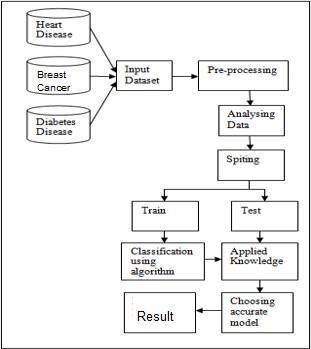
Fig1: Blockdiagram
B. Using Django to implement ML models:
The Django framework for Python is utilized to implement themachinelearningmodelsforvariousailments.Djangois apopularhigh-levellanguage,open-sourcewebframework for Python that is used to create websites and online applications. By offering an organized, reusable, and maintainablecodebase,itwascreatedwiththeintentionof streamlining and expediting the webdevelopment process. Often referred to as Model-View-Template (MVT) in the Django context, the Model-View-Controller(MVC) architecturalparadigmisfollowedbyDjango.
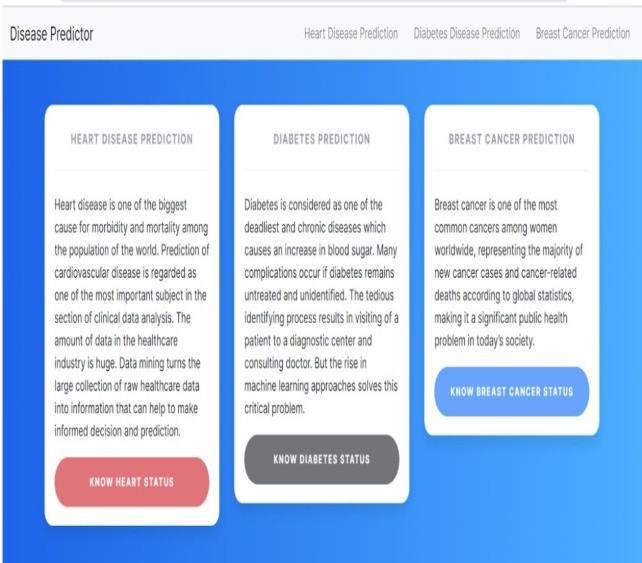
Fig2:GraphicalUserInterface
Overview of technologies
A well-liked open-source Python library for mathematical and numerical operations is called NumPy (Numerical Python). With the help of a number of mathematical functions, one can effectively work with sizable, multidimensionalarraysandmatrices.SciPy,pandas,scikit-learn, and many other libraries are built on top of NumPy, which is a core library in the Python data science and scientific computingecosystem.
Pandas
Python programmers can use the Pandas library, which is an open-source data manipulation and analysis tool. Data science, machine learning, financial analysis, and other domains require it as a vital tool for data analysis, data transformation, and data cleaning since it offers userfriendly data structures and functions for handling structureddata.
A machine learning library for the Python programming language, Scikit-learn, is sometimes shortened to sklearn. Many tools are available to carry out different machine learningtasks,suchasdimensionalityreduction,clustering, regression,andclassification.NumPyandSciPyarejusttwo ofthewell-known Pythonlibrariesupon whichScikit-learn isbuilt.Itisintendedtobeanintuitive,effectivetoolthatis utilized extensively in both academic and commercial settings.
The testing of a Multi-Disease Prognostication system involved the application of various Machine Learning and Data Science methodologies. These approaches were instrumentalinanalyzingandpredictingtheprogressionof multiple diseases. The research focused on developing a thorough system capable of correct forecasting the progressionofdifferentillnessessimultaneously.
A variety of Data Science methods and Machine Learning algorithmswereusedinthetestingstage.KNNandRandom Forest were two of these. Through the application of these various approaches, the research team aimed to evaluate the prognostication system's efficacy and efficiency. To allow for a comprehensive assessment of the models' predictive skills, the study also assessed each model's accuracy,precision,recall,andF1scores.
International Research Journal of Engineering and Technology (IRJET) e-ISSN:2395-0056
Volume: 11 Issue: 04 | Apr 2024 www.irjet.net p-ISSN:2395-0072
8.1 Unit
Unit testing, which entails testing individual programme units or components, is a crucial practise in software development. Unit testing is essential for guaranteeing the correctness and dependability of the produced models in the context of machine learning and data science approaches for multi-disease prognostication. In order to determine whether a function or method generates the desiredresultforagiveninput,itmustbetested.Unittests areusuallycreatedtoevaluateanumberoffactors,suchas model interpretability, prediction accuracy, data preprocessing,andtraining.
In order to evaluate the code's resilience, developers design test cases that cover a variety of situations and edge cases during unit testing. This procedure enhances the overall quality of the programmer by assisting in the early detection and correction of any possible problems during the development cycle. Maintaining the codebase and promoting teamwork among members also depend on comprehensive documentationofthetestsandtheiroutcomes.
8.2 Integration
During the crucial integration testing stage of the software testing process, separate software modules or components areputtogetherandtestedcollectively.Assuringthatthese interconnected components function flawlessly together with detecting and resolving any possible problems that can result from their interactions is the main objective of integration testing. In the software testing life cycle, integrationtestingusuallycomesbeforesystem testingand afterunittesting.
8.3 System
An essential step in the software testing process is system testing,whichassessestheprogramasawhole.Thiskindof testing evaluates whether the software's modules and integrated components meet the required standards and function as a cohesive unit. The software development lifecycle includes system testing, which is usually carried outafterunitandintegrationtesting.
8.4
White box testing is a type of software testing where the tester is privy to the program's inner workings, structure, and language or at the very least, what it is meant to do. That is its goal. It is employed for testing regions that are inaccessiblefromablackboxlevel.
9. Results
Project Interface
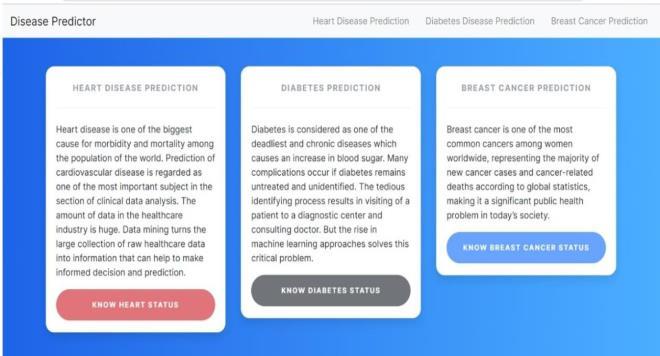
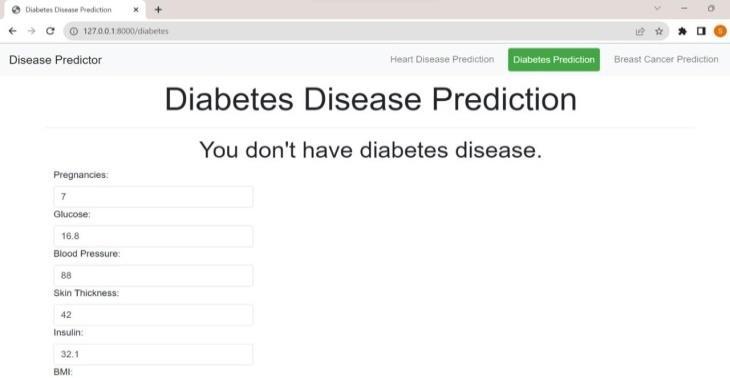
Fig4:Diabetesdiseasereport
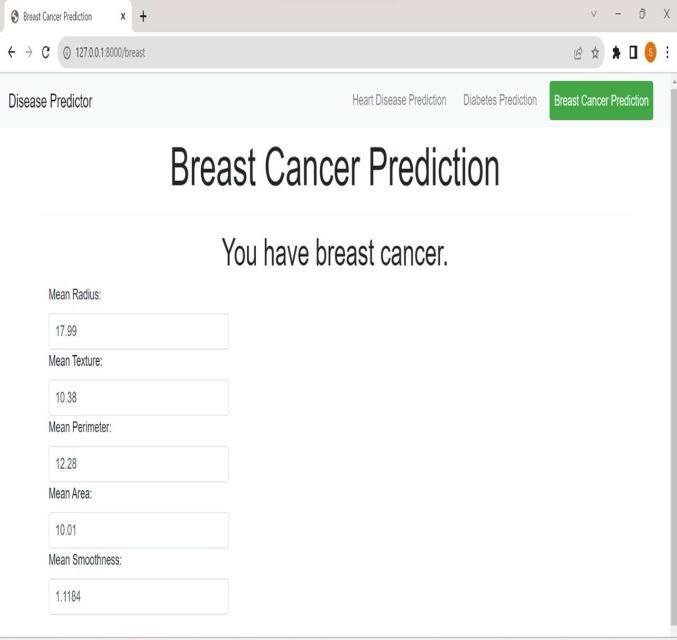
Fig5:Breastcancerdiseasereport
International Research Journal of Engineering and Technology (IRJET) e-ISSN:2395-0056
Volume: 11 Issue: 04 | Apr 2024 www.irjet.net p-ISSN:2395-0072
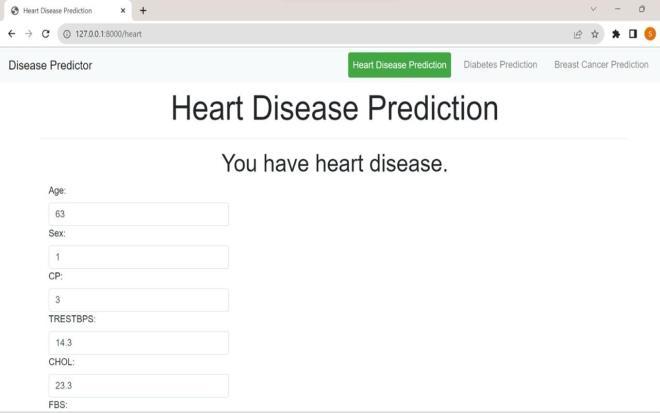
Fig6:Heartdiseasereport
10. Conclusion
The main goal of the project is to develop a system that can accurately predict various disorders. Thanks to technology, users can save time by avoiding having to switchbetweenmultiplewebsites.
A disease's life expectancy can be increased and financial hardship can be avoided with early diagnosis. We have utilized various machine learning techniques, including RandomForest,toachievethehighestlevelofaccuracy.
The ability to detect diseases early on will be tremendously helpful to the healthcare sector, especiallyhospitals.
We can expand the current system to include more disordersinfurther.
Todecreasethedeathtempo,we’reabletoattemptto gouppredictionpreciseness.
Putforthanefforttoimprovethatsystem'susability.
11. References
Priyanka Sonar, Prof. K. JayaMalini,” DIABETES PREDICTION USING DIFFERENT MACHINE LEARNING APPROACHES”, 2019 IEEE ,3rd International Conference on Computing Methodologies and Communication(ICCMC)
Archana Singh ,Rakesh Kumar, “Heart Disease Prediction Using Machine Learning Algorithms”, 2020 IEEE, International Conference on Electrical and ElectronicsEngineering(ICE3)
A. Sivasangari, Baddigam Jaya Krishna Reddy, Annamareddy Kiran, P. vAjitha,” Diagnosis of Liver Disease using Machine Learning Models” 2020 Fourth International Conference on I-SMAC (IoT in Social, Mobile,AnalyticsandCloud)(I-SMAC).
Rajesh. Ranjan, "Predictions for COVID-19 outbreak in IndiausingEpidemiologicalmodels",2020.
Mohan Senthilkumar, Chandrasegar Thirumalai and Gautam Srivastava, "Effective heart disease prediction using hybrid machine learning techniques", IEEE Access,vol.7,pp.81542-81554,2019.
Mohan Senthilkumar, Chandrasegar Thirumalai and GautamSrivastava,"Effectiveheartdisease prediction using hybrid machine learning techniques", IEEE Access,vol.7,pp.81542-81554,2019.
M. Bayati, S. Bhaskar and A. Montanari, "Statistical analysis of a low cost method for multiple disease prediction",StatisticalMethodsMed.Res.,vol.27,no.8, pp.2312-2328,2018.