
International Research Journal of Engineering and Technology (IRJET) e-ISSN: 2395-0056
Volume: 11 Issue: 04 | Apr 2024 www.irjet.net p-ISSN: 2395-0072
International Research Journal of Engineering and Technology (IRJET) e-ISSN: 2395-0056
Volume: 11 Issue: 04 | Apr 2024 www.irjet.net p-ISSN: 2395-0072
1Asst. Professor, Department of civil engineering, NHITM, Maharashtra, India
2B.E student, Department of Civil Engineering, NHITM, Maharashtra, India
3B.E student, Department of Civil Engineering, NHITM, Maharashtra, India
4B.E student, Department of Civil Engineering, NHITM, Maharashtra, India
5B.E student, Department of Civil Engineering, NHITM, Maharashtra, India ***
Abstract - The primary aim of this project is to make use of waste foundry sand (WFS) from the foundry industry in the production of bricks. The entire process, from mixing clay to forming bricks, drying, and firing, was carried out under local conditions. By incorporating up to 30% WFS in clay compositions, it was feasible to create bricks with desired characteristics using minimal processing. Bricks containing 30% WFS exhibited a minimum average wet compression resistance of 5.54Mpa and a maximum average water absorption of 20.76% when fired at 900°C. When comparedto commercial bricks, there was little difference in apparent porosity, water absorption, and specific gravity of WFScontaining bricks. The inclusion of WFSledtoadecreaseinthe bulk density of the bricks, resulting in a reduction in compressive strength. AccordingtotherecommendationsofIS 1077 standard specification, WFS brickscanbecategorizedas class II bricks. These bricks are suitable for use in single-story load-bearing structures as well as in the construction of infill walls in multi-story framed structures.
Since 80% of India is still undeveloped in 2030, it was projectedthatthecountry'sbuildingconstructionindustry willexpandata6.6%annualpacethroughthattime.Bricks andotherbuildingmaterialswillbecomemoreandmorein demandastheconstructionindustrycontinuestoexpand.
Theusageofagriculturalclaytomakebricks,whichiscrucial for farmers, is a significant issue that India is currently facing.TheIndiangovernmentforbidstheuseofagricultural landforbrick production,promotingtheuse ofsubstitute materialsinordertopreservetheland.Withalongandrich historyofmanufacturedatingbackto,clayburnedbricksare oneofthemostpopularwallingmaterialsinIndia.
1.1 Methodology used
This study was carried out for the purpose of having a detailed understanding of the effect and uses of waste foundry sand in bricks and to determine its compressive
strength.Toachievetheobjectivesstatedpreviously,several laboratory tests were conducted. By using appropriate apparatus and methods, testing was conducted on the required materials, standard bricks and the bricks with wastefoundrysand.Thefollowingstepswerefollowed in thisprojectstudy.
1.2 Grading of Bricks and Its parameters As per IS: 1077-1957 and 1970 code specifications.
a) Bricks with compressive strength not less than 110kg/cm2–Firstclassbricks-GradeA-A.
b) Bricks with compressive strength not less than 75kg/cm2–Secondclassbricks-GradeA.
c) Bricks with compressive strength not less than 50kg/cm2–Thirdclassbricks-GradeB.
D) Bricks with compressive strength not less than 30kg/cm2–Fourthclassbricks-GradeC
Wewillfollowdifferenttestsonsoilasmentionedbelow
1.Plasticlimit
2.Liquidlimit
3.Waterabsorption
4.Soundnesstest
5.Colourtest
Usingdifferentproportion,wewouldfollowdifferenttests asmentionedbelow
1.Absorptiontest
2.Crushingstrengthtest
3.ShapeandSizetest
4.Soundnesstest
5.Colourtest
International Research Journal of Engineering and Technology (IRJET) e-ISSN: 2395-0056
Volume: 11 Issue: 04 | Apr 2024 www.irjet.net p-ISSN:
Table -1: COMPRESSIVESTRENGTHTEST
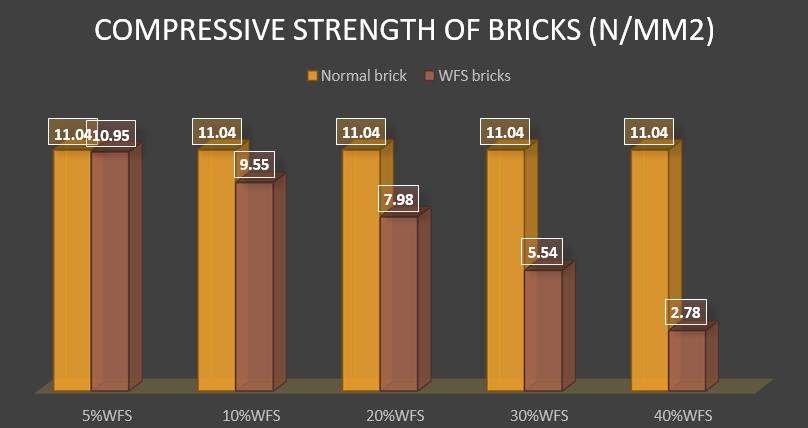
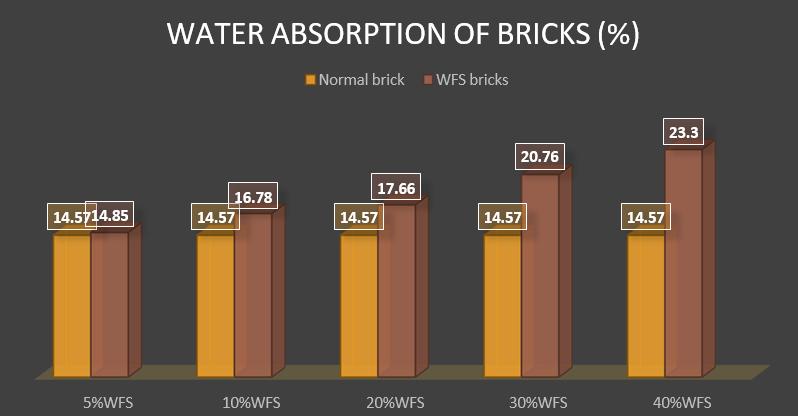
Chart-2:WaterAbsorptionTest
In our project study, we made statistical analysis betweennormalbricksandbricksWithwastefoundrysand. Thereismajordifferencebetweenstandardbricks&bricks Withwastefoundrysandlikecompressivestrengthvalue, waterabsorptionandamountofsaltspresentsinbricksetc.
International Research Journal of Engineering and Technology (IRJET) e-ISSN: 2395-0056
Volume: 11 Issue: 04 | Apr 2024 www.irjet.net p-ISSN: 2395-0072
1. Withminimummaterialprocessingandadoptinglocal conditions, it was possible to introduce WFS as a raw materialinproductionofbricks.
2. The maximum desirable replacement proportion of WFSis30%.
3. TheadditionofWFSreducedthebulkdensityofthe bricks, which has also caused reduction in compressive strength.Thereductioninbulkdensitycanbeattributedto thepoorpackingabilityofbrickscontaininghighercontent ofWFS.
4. The average compressive strength of 30%WFS replacement is 5.54N/mm^2 and water absorption is 20.75%ofdryweight,whenfiredat900°c.thisbrickcanbe classifiedasaclasslllbrick,basedonrecommendationofis 1077-1957standardspecification.Thesebrickscanbeused in single storied load bearing structures, and also in the construction of infill walls in multi- storied framed structures.
[1] S Maithel,EvaluatingEnergyConservationPotential ofBrickProductioninIndia,FinalReportforSAARCEnergy Centre,Islamabad,2013.
[2] Faster, Sustainable And More Inclusive Growth- An ApproachToThe12thFiveYearPlan(2012–2013to2016–17),Plan.Comm.India,2011.
[3] Environmental and Energy Sustainability, An ApproachforIndia,McKinseyandCompany,2009.
[4] Y.Chen,Y.Zhang,T.Chen,Y.Zhao,S.Bao,Preparation of eco-friendly construction bricks from hematite tailings, Constr.Build.Mater.25(4)(2011)2107–2111.
[5] X.Lingling,G.Wei,W.Tao, Y.Nanru,Studyon fired bricks with replacing clay byflyash in high volume ratio, Constr.Build.Mater.19(3)(2005)243–247.
[6] R.Menezes,H.Ferreira,G.Neves,H.Lira,H.C.Ferreira, Useofgranitesawingwastesintheproductionofceramic bricksandtiles,J.Eur.Ceram.Soc.25(7)(2005)1149–1158.
[7] S.Roy,G.Adhikari,R.Gupta,useofgoldmilltailingsin makingbricks:afeasibilitystudy,WasteManage.Res.25(5) (2007)475–482
[8] M.El-Mahllawy,Characteristicsofacidresistingbricks made from quarry residues and waste steel slag, Constr. Build.Mater.22(8)(2008)1887–1896.
[9] M. Sutcu, S. Akkurt, The use of recycled paper processingresiduesinmakingporousbrickwithreduced thermal conductivity, Ceram. Int. 35 (7) (2009)2625–2631
[10] A. Abdul Kadir, A. Mohajerani, F. Roddick, J. Buck ridge, Density, strength, thermal conductivity and leachatecharacteristicsoflight-weightfired claybricks incorporatingcigarette butts,ProceedingsoftheWorld Academy of Science, Engineering and Technology 53 (2009)1035–1040.
[11] M. Rahman, Properties of clay-sand-rice husk ash mixedbricks,Int.J.Cem.Compos. LightweightConcr.9 (2)(1987)105–108.
[12]D. Eliche-Quesada, F. Corpas-Iglesias, L. PérezVillarejo,F.Iglesias-Godino,Recyclingofsawdust.