
International Research Journal of Engineering and Technology (IRJET) e-ISSN: 2395-0056
Volume: 11 Issue: 04 | Apr 2024 www.irjet.net p-ISSN: 2395-0072
International Research Journal of Engineering and Technology (IRJET) e-ISSN: 2395-0056
Volume: 11 Issue: 04 | Apr 2024 www.irjet.net p-ISSN: 2395-0072
Dr. Anita Dixit1 , Aarti Hiremath2 , Sahana Talvar3, Varshini Handral4, Netravati Jogin5
1Dr. Anita Dixit, Professor, Department of Information Science and Engineering, SDMCET Dharwad, Karnataka, India
2 Aarti Hiremath, Student, Department of Information Science and Engineering, SDMCET Dharwad, Karnataka, India
3Sahana Talvar, Student, Department of Information Science and Engineering, SDMCET Dharwad, Karnataka, India
4Varshini Handral, Student, Department of Information Science and Engineering, SDMCET Dharwad, Karnataka, India
5Netravati Jogin, Student, Department of Information Science and Engineering, SDMCET Dharwad, Karnataka, India
Abstract - TheSmartCard-Basedisthemethodused to monitor student attendance is a comprehensive project aimed at improving the efficiency and accuracy of tracks studentattendanceineducationalinstitutions.Thisproject utilizes smart card technology to automate attendance recording and provides a reliable solution for attendance management. Among the uses of radio frequency identification (RFID) are campuses access and public transportationtickets.ItenablesustoauthenticateanRFID ownerquicklyandlegally.
Smart Card-Based Student Attendance System is a novel solutiondesignedtostreamlineandenhancetheprocessof recording student attendance in educational institutions. This system leverages smart card technology to automate attendancetracking,ensuringaccuracyandefficiencywhile reducingtheadministrativeburdenoneducators.Thecore functionalityofthesysteminvolvesstudentssimplytapping theirsmartcardsondesignatedreadersuponenteringthe classroom.Thisactioninstantlyrecordstheirattendanceina centralized database. Educators can access real-time attendance data, track absenteeism, and generate reports effortlesslythroughauser-friendlyinterface.
Key Words: Smart attendance card, IoT, RFID, Arduino, data management.
This system leverages smart card technology to automate attendancetracking,ensuringaccuracyandefficiencywhile reducing the administrative burden on educators. Traditional attendance systems often rely on manual methodssuchaspaperregistersormanualdataentry,which are prone to errors and time-consuming. In contrast, the SmartCard-BasedStudentAttendanceSystemutilizesEach pupilreceivedacontactlesssmartcard.Thesecardscontain uniqueidentificationinformationandmakeseasescanning usingRFIDorNFCtechnology.Studentscaneasilyidentify themwiththehelpofRFIDtags.RFIDscannerspossessthe abilitytoreadthedatastoredthereinsafelyandreadily.The
datawillbetransmittedtoadistantcloudserverforstorage. After being evaluated, this saved data will yield real-time analysisandfindingsregardingstudentspecifics.TheRFID systemconsistsofRFIDtag(orcard)andRFIDreader.The tag(orcard)possessesadistinctIDthatisfirststoredwithin thedatabasepriortobeingassignedtotheuser.Torecord the attendance, the user must position the tag a certain distance from the RFID reader. The tag is made up of a microchip that stores a special sequence number that are abletoidentifyobjects.Themostessentialcomponentofthe RFID system is the RFID reader. The RFID reader used in detection has a maximum range of around 5cm above the readerandoperatesatfrequencyof125kHzand12Vpower supply.RFIDtag(orcard)isusedtoexchangedatawiththe RFIDreaderusingtheradiowaveswherethetagismadeup oftheantennawhichreceivestheradiowavesandtheother component is an integrated circuit which is mainly to processandstorethedata.Itreadstherawdatafromthetag andtransmitsittothemiddle-wareforprocessing.Tagsat varying frequencies are interrogated by the reader. The computerandreaderarefurtherconnectedsothatthedata maybeprocessed.ThiscanbedoneusingaUSBconnector oranywirelessconnection.Managingstudentattendanceis acriticaltaskineducationalinstitutions.Traditionalpaperbasedmethodsaretime-consumingandpronetoerrors.The SmartCard-BasedStudentAttendanceSystemisdesignedto addresstheseissuesbyimplementingasmartcardsystem that simplifies attendance recording and enhances data accuracy.ASmartCard-BasedStudentAttendanceSystemis a cutting-edge solution that revolutionizes traditional attendance tracking in educational institutions. By leveragingadvancedtechnology,thissystemstreamlinesthe process of monitoring student attendance, ensuring accuracy, security, and efficiency. In this era of digital transformation, such a system not only simplifies administrative tasks but also enhances the overall Educational experience by promoting transparency and accountability.Inthisdiscussion,wewilldelvedeeperinto the key components, benefits and implementation of this innovative system. Furthermore, this system promotes
International Research Journal of Engineering and Technology (IRJET) e-ISSN: 2395-0056
Volume: 11 Issue: 04 | Apr 2024 www.irjet.net p-ISSN: 2395-0072
securityandtybyensuringthatonlyauthorizedindividuals canrecordattendance.Thedatacollectedisencryptedand storedsecurely,protectingstudents'privacy.
[1] Smart Attendance Management is a solution to one the most challenging and long-standing problems in managementofemployeeorstudent’sattendance.Thiswork introducesanewparadigmofmonitoringstudentattendance utilizing Internet of Things-based Radio Frequency Identification(RFID)(IoT).Institutionsofhigherlearningare worried about sporadic student attendance. A student's overallacademicperformancemaybeimpactedbytruancy.It takesalongtimeandisineffectivetotakeattendancetheoldfashioned way, which involves slurs or having individuals sign papers. One way to solve the issue is to use an IoT systemwithanRFID-basedattendancesystem.IoTandRFID, thetwomostprevalenttrendsintechnologicalresearch,are includedinthesuggestedstudy.
[2]ThisworkispredicatedoncombinationofRFIDtagsand facialrecognitionformonitoringsystems.Theauthorshave contributed topresenta solution basedoncombinationof facialrecognitionandRFID(radiofrequencyidentification) tags for the office’s surveillance monitoring system (SMS). TheSMSisbuiltbasedontwomaintechniquestobuilding smartsystemswhichconsistoffacerecognitiontechnology and RFID tag recognition which will enable the admin to monitor student attendance when they are entering or leaving.Theauthorshaveusedthedeepneuralnetworkfor employing the face recognition module. The system is connectedtotheSQLServerdatabaseatthebackendtostore andretrievestudentinformationthatwillhelpinmonitoring angmanagingtheattendance.TheyhaveusedMFRC522as theRFIDcardreader.
[3]ThispaperdiscussestheusageofanRFIDtagtouniquely identify a person and produce a key to access the RFID's contentusingtheuser'sfingerprinttemplate.Viaaninventive Wi-Fi system, this data is transmitted to a cloud server. Additionally,thissystemencouragestheuseoftheInternet, where data is processed,stored, and made available.RFID technologyofferauniqueblendofconvenience,security,and functionalitycomparedtotraditionalmethods.Ditchingpen and paper, simply tap the card for touchless, speedy attendancemarking,savingtimeandreducingadministrative burden.Plus,theembeddedchipmakesforgingorcopying difficult,boostingreliabilityandsecurity.Real-timetracking andpotentialconnectiontoaccesscontrolsystemsfurther strengthenitseffectiveness.
[4] This work presents a facial recognition utilizing convolutional neural networks for deep learning in an attendance system. This transfers learning by using three pre-trainedconvolutionneuralnetworksandtrainedthem onourdata.Thenetworksshowhighperformanceinterms of high prediction accuracy and reasonable training time. Facialrecognitionsystemsseamlesslyidentifyindividualsas
they walk through designated points, offering a truly touchless and effortless experience. This improves convenience while also encouraging hygiene in sensitive environments.Facialrecognitiontechnologyoffersaunique and powerful approach to attendance management, providingunparalleledconvenience,enhancedsecurity,and efficientscalability.However,addressingprivacyconcerns, ensuringtechnologicalreliability.
[5] The design and development of smart attendance card using NFC simplifies smart attendance card development. Choose dedicated cards or leverage smartphones' built-in NFC for portability. Selecting an appropriate chip, encode data securely, and design a user-friendly interface. Developing a mobile app or reader software for data transmission.Buildacentralplatformforsecuredatastorage andmanagement.Prioritizerobustsecuritythroughoutthe process.NFCshineswithitstap-to-markconvenience,realtime data access, and potential for additional features like locationtrackingoraccesscontrolintegration.Bemindfulof smartphonecompatibility,potentialsecurityvulnerabilities, andtheneedfortechnicalexpertise.
[6]ThissystemalsorecordsattendanceusingBluetoothlow energy(BLE)wirelesstechnologybasedonlow-costdevices call beacons. A number of studies have proposed the integration of BLE beacons with RFID technology, placing BLEstickersonIDcardsorenablingthescanningofanID card after receiving identifiers from nearby beacons. But thesemethodssufferfromthesameproblem,whilstbeing morecomplexandcostly.Itaddressesbothofthosefeatures, whilst opening the possibility for future advanced data analysis. The design relies on three main components: (1) BLE beacons, (2) a customweb service, and (3) a custombuiltmobileapplication.Beaconsassumetheresponsibilityof the location providers. Given their little stature and are programmableinthesensethattheycanemitcustomdata tags up to a specified range (determined by the signal strength).Thus,theyserveaslandmarksforthelectures.The mobileapplicationfunctionsastheuserinterfaceproviding thestudentswithadditionalinformation.
RFID Cards or Tags: These are physical cards or tags embeddedwithRFID(RadioFrequencyIdentification).Each cardisuniqueandisassociatedwithanindividual'sidentity inthesystem.
RFID Readers: These are devices capable of reading the information stored on RFID cards/tags. They are usually placed at entry points or designated locations where individualsneedtoregistertheirattendance.
Microcontroller or Single Board Computer (SBC): A microcontroller(suchasArduino)isoftenusedtointerface with the RFID reader and manage the attendance data. It
International Research Journal of Engineering and Technology (IRJET) e-ISSN: 2395-0056
Volume: 11 Issue: 04 | Apr 2024 www.irjet.net p-ISSN: 2395-0072
processes details from the readers and send it to the database.
Database: A database is accustomed to store information about individuals, their attendance records, and other relevantdata.ThiscouldbearelationaldatabaselikeMySQL.
Communication Module: This module facilitates communication between the microcontroller/SBC and the database server. It could be Ethernet, Wi-Fi, GSM, or any other communication protocol depending on the network infrastructureavailable.
Attendance Management Software: This is the software interface that allows administrators to view, manage, and analyseattendancedata.Itprovidesfunctionalitiessuchas registering new users, generating reports, and setting up attendancerules.
Power Supply: Depending on the setup, a power supply modulemightbeneededtoensurecontinuousoperationof thesystem.Thiscouldbeasimplepoweradapteroramore sophisticatedpowermanagementsystem.
SecurityFeatures:Toguaranteethesecurityandintegrityof attendancedata,encryptionandauthenticationmechanisms maybeimplemented.Thiscouldinvolveencryptionofdata transmittedbetweenthebothArduinoandthereaderuser authentication mechanisms for accessing the attendance records.
TheFig.1representstheflowchartofsmartattendance card.
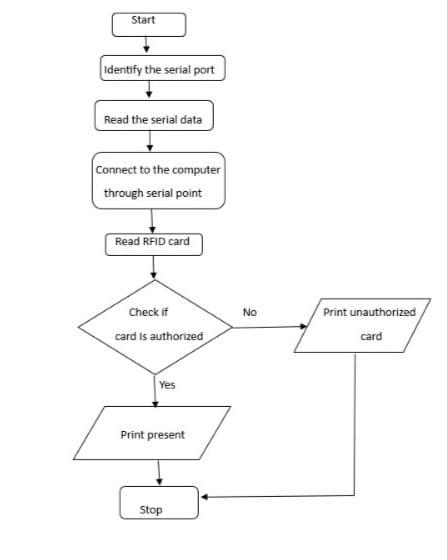
Start:Theprocessbeginswiththeuserscanningthecard.
Identifytheserial port: The initial actionistoidentify the serial port on the RFID reader. This is usually done by looking at the reader's documentation or by using a trialand-errormethod.
Readtheserial data:Once theserial portis identified,the nextstepistoreadtheserialdatafromthereader.
ThisdatawillcontaintheIDquantityoftheRFIDtagthathas beenscanned.
Connecttothecomputerthroughserialpoint:Thenextstep istoconnecttheRFIDreadertothecomputerthroughthe serialport.ThisisusuallydoneusingaUSBcable.
Read RFID card: Once the reader is connected to the computerthefollowingactionistoreadtheRFIDcard.This isdonebyplacingthecardnearthereader'santenna.
Checkifcardisauthorized:Thesystemwillthencheckifthe ID number of the RFID card is authorized. If the card is authorized,thefollowingstepwillbeinitiatedbythesystem. If the card is not authorized, the system will print an unauthorizedmessageandstoptheprocess.
Print for authorized card: If the card is authorized, the systemwillprintthename ofthecardholderandthedate andtimethecardwasscanned.Stop:Theprocesswillthen stop.
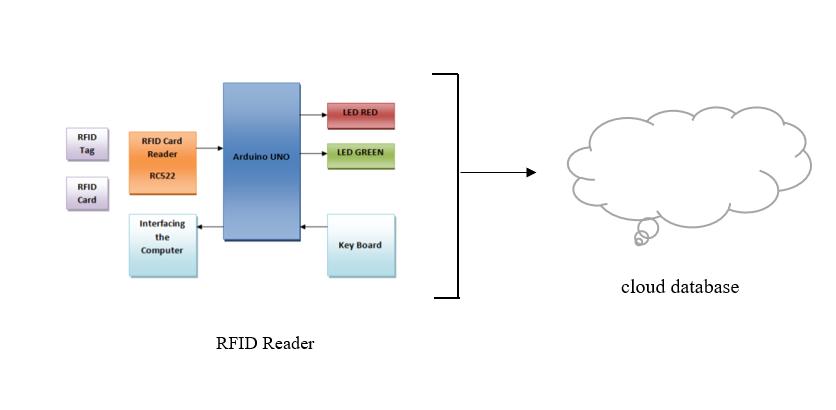
TheabovediagramdisplaysablockschematicofanRFIDbased attendance monitoring system. The system uses an RFID reader to read the ID of an RFID tag attached to an student’s ID card. The reader then sends the ID to an ArduinoUnomicrocontroller,whichcommunicateswitha computer.ThecomputerstorestheIDinaclouddatabase.A keyboardisfurthermorelinkedtothecomputer,whichcan be used to add or remove employee IDs from the system. Thistypeofsystemcanbeusedtotrackstudentattendance, aswellastocontrolaccesstorestrictedareas.Herearesome
International Research Journal of Engineering and Technology (IRJET) e-ISSN: 2395-0056
Volume: 11 Issue: 04 | Apr 2024 www.irjet.net p-ISSN: 2395-0072
of the benefits of using an RFID-based attendance monitoringsystem.
Improved accuracy: RFID Systems have far higher accuracythantraditionaltimekeepingmethods,suchas punchcardsortimeclocks.
Reducedcosts:RFIDsystemscanhelptoreducelabour costsbyautomatingtheattendancetrackingprocess.
Increasedsecurity:RFIDsystemscanassistinimprove security by making it more difficult for unauthorized employeestogainaccesstorestrictedareas.
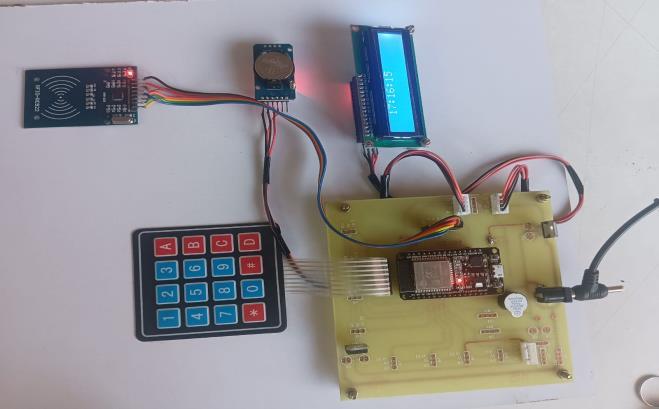
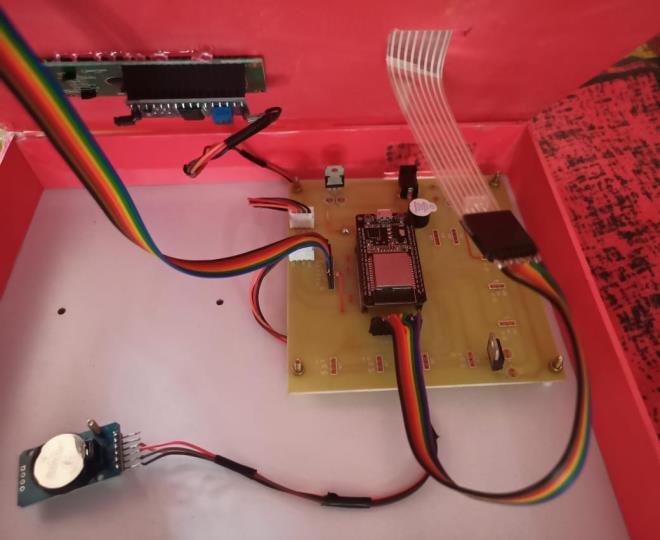
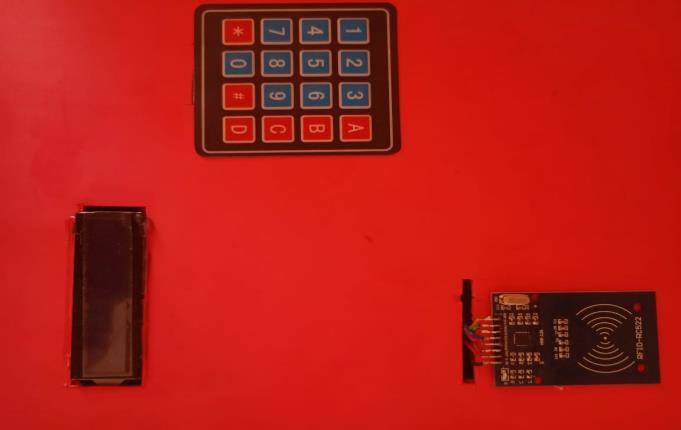
Asmartattendancecardsystemoperatesbyutilizingsmart cards and card readers to track and manage student or employee attendance. The methodology of a smart attendancecardsystemisdividedintothefollowingsteps: Cardregistration:Theadministrationregisterseachstudent or employee with a unique smart card containing their information. Card reader integration: Card readers are strategically placed at entry points, classrooms, or workstations. These Readers interact with the main attendance system. Attendance marking: When a student swipes their card on a card reader, their attendance is automatically recorded in real-time. Data processing: The attendancedataisprocessedandstoredinadatabase,which canbeaccessedbyauthorizedpersonnel.Datavisualization: Thesystemmaydisplayattendancedatainvariousformats, suchasregisters,graphs,orreports.Integrationwithother systems:Itispossibletointegratetheattendanceinformation with othersystems, including HR,accesscontrol,and time and attendance software. Security: Smart cards can be designed with strong security features to prevent unauthorizedaccessandduplication.Themodulesusedina smart attendance card system using RFID technology typicallyinclude:RFIDReaderModule:Thismoduleisused toreadtheinformationstoredontheRFIDcardsandrecord attendance.Itcanbeawirelessorwiredmodule,depending on the system design. RFIDCards: These are special cards issued to students or employees, containing unique identificationinformationandaccesscodes.Theyareused with the RFID reader module to register Attendance ManagementSoftware:Thissoftwareisusedtoprocessand managetheattendancedatacollectedfromtheRFIDreader module.Itcanbeintegratedwithotherapplications,suchas studentinformationmanagementsystemsoraccesscontrol systems. Central Section: All of the system's electrical components,includingtheRFIDreadermodule,arekeptin thispart.,database,andcommunicationprotocols.
International Research Journal of Engineering and Technology (IRJET) e-ISSN: 2395-0056
Volume: 11 Issue: 04 | Apr 2024 www.irjet.net p-ISSN: 2395-0072
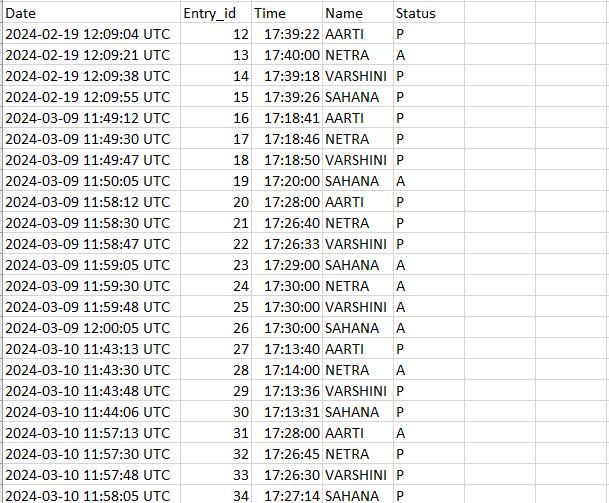
A low-cost prototype RFID-based attendance system was successfullydeveloped.Comparingthesystemprototypeto the traditional classroom approach reveals a number of benefits.Inthisprototypefortheprojectislightweightand compact.Itcanalsobepoweredbyanadaptororabattery. Due to the 26-bit Wiegand standard used for Tag ID encoding, the attendance is accurate and secure. With switches and communication connectors that are conveniently located, the prototype is simple to use. Participation is simply recoverable and kept. One further benefitof thesystemisitsfastspeed ofidentificationand verification.Thismethodhasthepotentialtobeutilizedin bothsmallandmajorcompaniesgoingforward.
Theauthorsofthispaper,areverygratefulandwouldliketo express the support and facilities provided by SDMCET, Dharwad.Wewouldalsothankourguide,Dr.AnitaDixitfor thesupportandguidancetocarryoutthisimplementation successfully.WewouldalsoliketothankourCo-Ordinator Prof.VarshaJadhavforthesupport. Wewouldalsoliketo thankourfriendstokeepusmotivatedduringtheperiodof thisproject
[1]AttendanceManagementSystem(AMS):Comparisonof Two Different Approaches, M.Amir Abas (IEEE), Auji, M. Dahlui,Proc.oftheInternationalConferenceonEngineering TechnologiesandTechnopreneurship(ICE2T2017)
[2]P.Kovelan,N.Thisenthira,T.Kartheeswaran“Automated Attendance Monitoring System Using IoT” International Conference on Advancements in Computing (ICAC) December5-6,2019.Malabe,SriLanka
[3] Khawla Alhanaeea , Mitha Alhammadia , Nahla Almenhalia , Maad Shatnawi, “Face Recognition Smart AttendanceSystemusingDeepTransferLearning”2020
[4] "International Symposium on Electronics and Smart Device2019,"RFIDAttendanceSystemwithFaceDetection utilizing Validation Viola-Jones and Local Binary Pattern Histogram Method Faisal Rohman Basthomi, Khoirun Nasikhin, Roudhotul Auliya Sa'adah, Dendy Dwi Prasetyo, MatSyai'in
[5] Global Conference on Information Technology Advancements 2019; Unnati Koppikar, Shobha Hiremath, AkshataRajoor,Akshata66Shiralkar,V.P.Baligar"Internet ofThingsbasedSmartAttendanceMonitoringSystemusing RFID"
[6] Ms. G.T. Bharatithy, Ms. S. Bhavanisankari, and T. Tamilselvi,"SmartAttendanceMonitoringSystemusingIoT andRFID,"InternationalJournalofAdvancesinEngineering andManagement(IJAEM2021).
[7]Van-DungHoang,Van-DatDang,Tien-ThanhNguyenand Diem-PhucTran,"AsolutionbasedonCombinationofRFID tags and facial recognition for monitoring systems", 5th NAFOSTED Conference on Information and Computer Science(NICS),2018.
BIOGRAPHIES



Dr. Anita Dixit, Professor, Dept of Information Science and Engineering SDMCET, Dharwad, Karnataka,India.
Aarti Hiremath, Student, Dept of Information Science and Engineering SDMCET, Dharwad, Karnataka,India Sahana Talvar, Student, Dept of Information Science and Engineering SDMCET, Dharwad, Karnataka,India
International Research Journal of Engineering and Technology (IRJET) e-ISSN: 2395-0056
Volume: 11 Issue: 04 | Apr 2024 www.irjet.net p-ISSN: 2395-0072


VarshiniHandral,Student,Deptof Information Science and Engineering SDMCET, Dharwad, Karnataka,India
Netravati Jogin, Student, Dept of Information Science and Engineering SDMCET, Dharwad, Karnataka,India
© 2024, IRJET | Impact Factor value: 8.226 | ISO 9001:2008 Certified Journal | Page72