
International Research Journal of Engineering and Technology (IRJET) e-ISSN: 2395-0056
Volume: 11 Issue: 04 | Apr 2024 www.irjet.net p-ISSN: 2395-0072
International Research Journal of Engineering and Technology (IRJET) e-ISSN: 2395-0056
Volume: 11 Issue: 04 | Apr 2024 www.irjet.net p-ISSN: 2395-0072
B. Jagadeesh1 , A. Umesh Chandra2 , G. Uday Sankar Reddy3, G. Satish4, Md. Shakeel Ahmed5
1,2,3,4Department of Information Technology, VVIT, AP, India 5Associate Professor, Dept. of Information Technology, VVIT, AP, India
Abstract-
Rice, a vital staple crop globally, confronts significant threats from various leaf diseases, adversely impacting yield and agricultural sustainability. In response, our projectendeavors to develop an efficient rice leaf disease detection system using deep learning models. The study utilizes a comprehensive dataset encompassing images of rice leaves afflicted withfour prevalent diseases: bacterial blight, blast, tungro, and brown spot. Leveragingdiversedeep learningarchitectures,including Simple CNN, ResNet, Inception, and LeNet, we train and evaluate models to accurately classify these diseases.Through meticulous experimentation, we identify the model exhibiting the highest accuracy on the validation dataset. Deploying the selected model with the Streamlit library, we constructauserfriendly frontend interface facilitating seamless interaction. This interface empowers users to upload rice leaf images, enabling real-time disease prediction and identification. By integrating advanceddeeplearningtechniques withaccessible user interaction, our project offers a practical solution for farmers and agricultural experts to swiftly diagnose and address rice leaf diseases. This initiative holds promise for enhancing crop management practices and bolstering agricultural productivity.
Key Words: Deep Learning, Image classification, Simple CNN, LeNet, ResNet, Inception, Bacterial Blight, Blast, Tungro,Brownspot
Rice leaf diseases pose significant threats to crop yields worldwide,necessitatingfasterandmorereliabledetection methods.Currentapproachesrelyingontextualdatasetsand traditional algorithms like SVM/KNN face challenges with image complexity, potentially leading to suboptimal classification.Recenttechnologicaladvancementsinimage processing have opened avenues for automated disease detection. Our project aims to enhance the accuracy and efficiencyofriceleafdiseasepredictionbyintegratingdeep learning techniques, particularly Convolutional Neural Networks(CNNs).Bydirectlytacklingthepressingissueof rice leaf diseases, our system offers a practical tool for farmerstoimprovediseasemanagementandminimizecrop losses. Designed to be user-friendly, our system provides farmers with a convenient means of predicting and managingriceleafdiseases.TheintegrationofCNNmodels notonlyaddressesriceleaf diseasesbutalsounderscores
the potential of deep learning in resolving complex agriculturalchallenges.
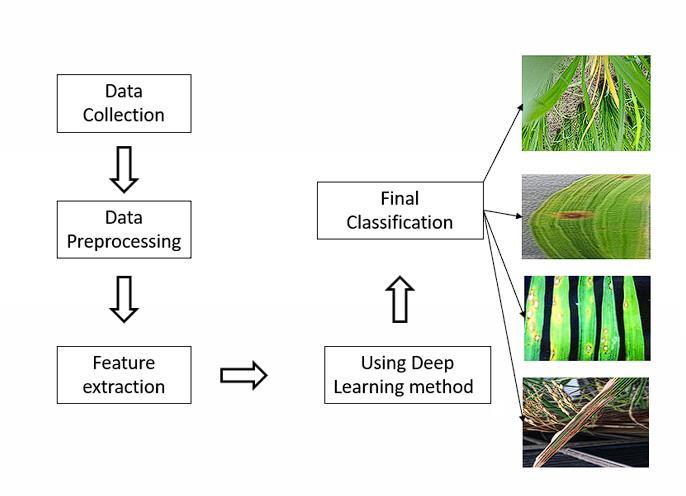
Existingsystemsforriceleafdiseasedetectionoftenrelyon text datasets and machine learning algorithms, such as Support Vector Machine (SVM) or K-Nearest Neighbors (KNN). These systems typically suffer from limitations in handlingimagecomplexity,potentiallyleadingtosuboptimal classificationresults.Someexistingsystemsmayutilizeonly one algorithm, which can further limit their accuracy and robustness.Despitetheircontributionstodiseasedetection, thesesystemsareoftenslowerandlessefficientcomparedto moreadvancedtechniqueslikedeeplearning.Hence,thereis apressingneedtoexploreandimplementmoresophisticated approachestoenhancetheeffectivenessofriceleafdisease detectionsystems.
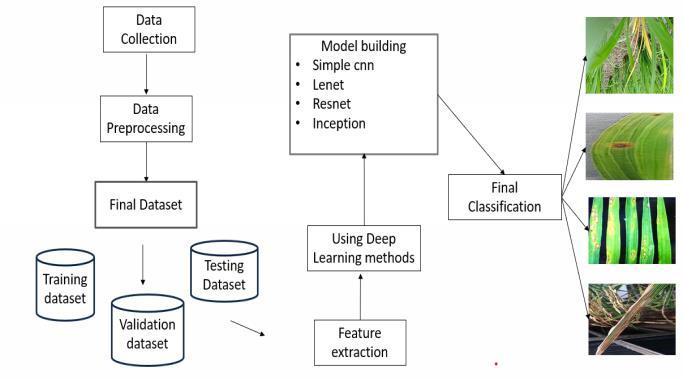
The proposed system for rice leaf disease detection leverages the power of deep learning models, including Simple CNN, ResNet, LeNet, and Inception, to enhance classificationaccuracy.Unlikeexistingsystems,whichoften rely on text datasets and traditional machine learning algorithms,ourapproachutilizesimagedatasets,enabling more effective analysis of the complex visual features present in rice leaf images. Through rigorous experimentation and comparison of model accuracies, we
International Research Journal of Engineering and Technology (IRJET) e-ISSN: 2395-0056
Volume: 11 Issue: 04 | Apr 2024 www.irjet.net p-ISSN: 2395-0072
identify the most optimal deep learning architecture for disease classification. This approach not only improves accuracy but also demonstrates the versatility and effectiveness of deep learning in tackling agricultural challenges. By harnessing the capabilities of various deep learningmodels,ourproposedsystemoffersa robustand efficientsolutionforriceleafdiseasedetection.
4.
1) Early Detection with CNN Integration: Utilizing ConvolutionalNeuralNetworks(CNN)toenableearly andaccuratedetectionofriceleafdiseases,enhancing agriculturaldiseasepredictionefficiency.
2) Efficiency Enhancement: Moving away from timeconsumingvisualinspectionmethodstoachievequicker andmoreefficientdiseasedetection.
3) Precision Improvement through Deep Learning: Utilizing advanced deep learning techniques, particularlyCNNmodels,toenhancediseaseprediction precisioncomparedtotraditionalmethods.
4) Enhanced Disease Management Strategies: Developing a predictive model capable of capturing detailed visual information for precise and reliable diseaseclassification,contributingtoimproveddisease managementstrategiesinricecultivation.
5) Empowering System Use with Visual Information: Integrating CNN models to effectively utilize visual information for disease prediction, showcasing significant advancements in precision agriculture and the potential of deep learning in agricultural applications.
5.1 Dataset Collection and Preparation:
The project began with collecting a dataset containing images of rice leaves affected by four common diseases: bacterialblight,blast,brownspot,andtungro.
The dataset was organized into appropriate directories, ensuring compatibility with TensorFlow's image dataset loadingutilities.
Preprocessingstepsincludedresizingimagestoauniform sizeandrescalingpixelvaluestotherange[0,1].
5.2.Data Augmentation:
Toaugmentthedatasetandenhancemodelgeneralization, data augmentation techniques were applied using TensorFlow's Sequential API. These techniques included randomhorizontalandverticalflipping,aswellasrandom rotation.
5.3.Model Selection and Architecture:
Four deep learning models were selected for experimentation: Simple CNN, LeNet, ResNet, and InceptionV3.
Eachmodel'sarchitecturewasdefinedusingTensorFlow's KerasAPI,tailoredtosuitthecharacteristicsofthedataset andthecomplexityofthetask.
Themodelswerecompiledwithappropriatelossfunctions (sparsecategoricalcross-entropy)andoptimizers(Adam), andaccuracywaschosenastheevaluationmetric.
5.4.Model Training and Evaluation:
Thedatasetwassplitintotraining,validation,andtestsets, with80%,10%,and10%ofthedataallocatedtoeachset, respectively.
Training wasperformed on eachmodel using the training set, with validation performed on the validation set to monitorperformanceandpreventoverfitting.
Trainingprogress,includinglossandaccuracymetrics,was trackedovermultipleepochs.
Aftertraining,themodelswereevaluatedusingthetestset toassesstheirperformanceonunseendata.
5.6.Model Comparison and Selection:
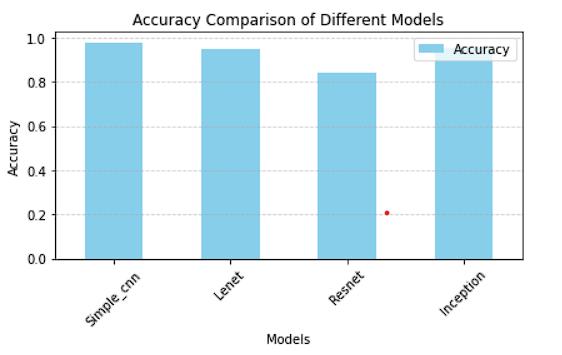
Performancemetricssuchasaccuracy,precision,recall,and F1-scorewerecomputedforeachmodelusingthetestset.
Confusionmatricesweregeneratedtovisualizethemodels' classificationperformanceacrossdifferentdiseaseclasses.
Basedontheevaluationresults,themodelwiththehighest accuracyandmostrobustperformancewasselectedasthe optimalmodelforriceleafdiseasedetection.
International Research Journal of Engineering and Technology (IRJET) e-ISSN: 2395-0056
Volume: 11 Issue: 04 | Apr 2024 www.irjet.net p-ISSN: 2395-0072
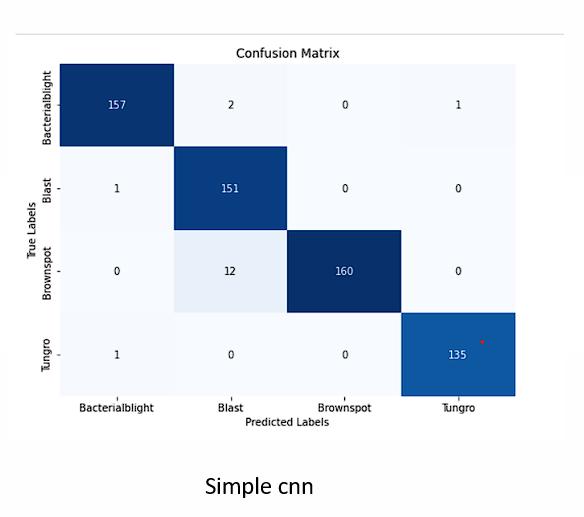
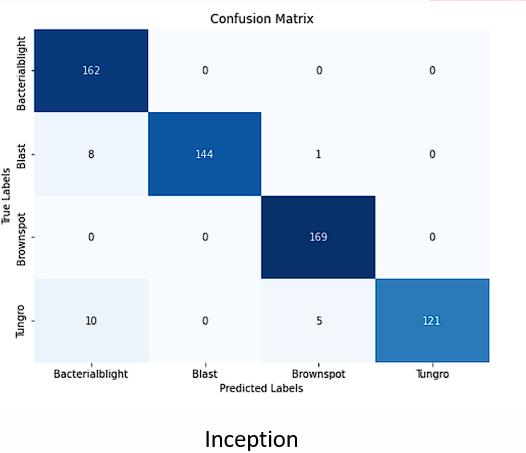
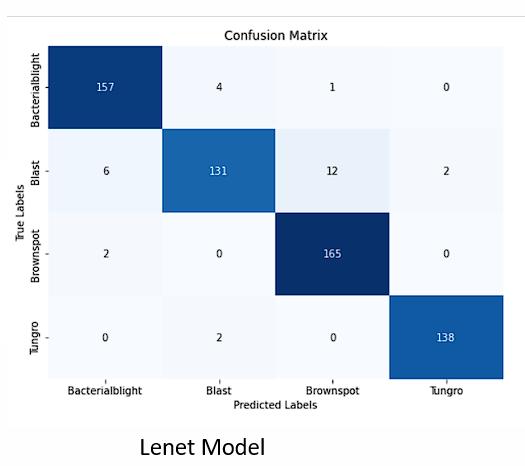
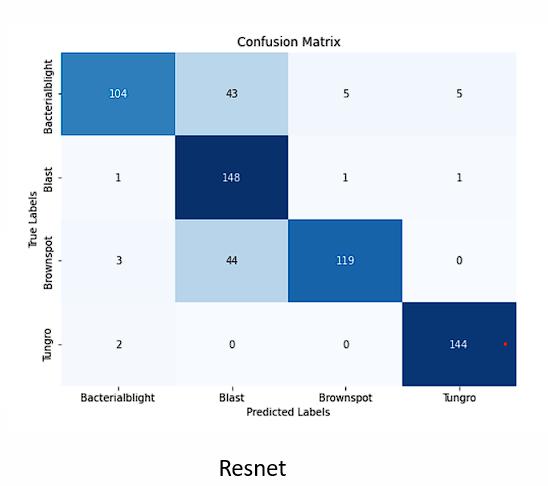
Table: Statisticalanalysisfordifferentmodels
5.7.Model Deployment and Visualization:
DeployedtheselectedmodelusingtheStreamlitlibraryto createauser-friendlyfrontendinterfaceforriceleafdisease classification. Integrated image uploading functionality to allowuserstouploadimagesforclassification.Preprocessed theuploadedimagesforpredictionbyresizingthemtothe appropriate dimensions and normalizing them. Made predictions using the deployed model and displayed the predicteddiseaseclassonthefrontendinterface.
International Research Journal of Engineering and Technology (IRJET) e-ISSN: 2395-0056
Volume: 11 Issue: 04 | Apr 2024 www.irjet.net p-ISSN: 2395-0072
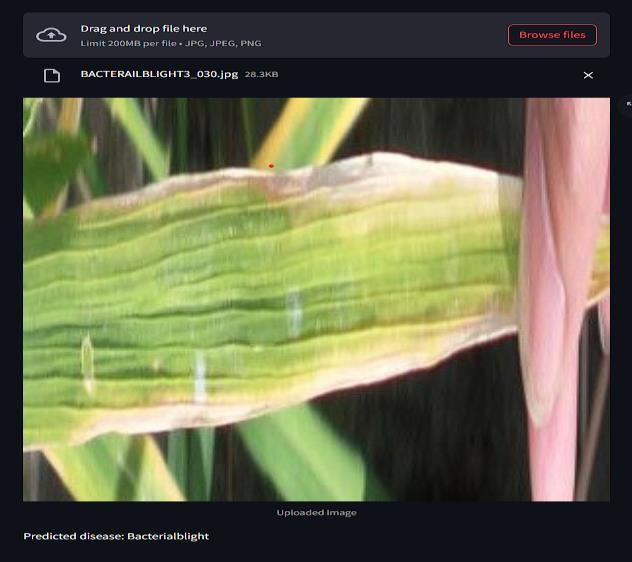
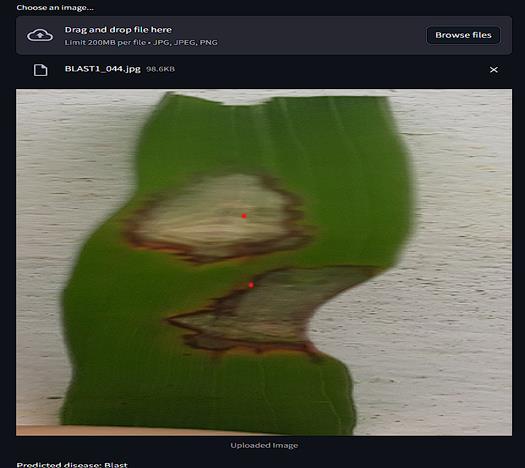
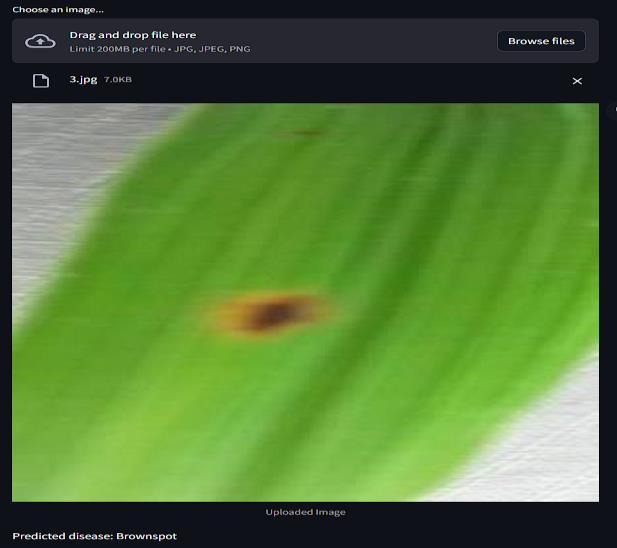
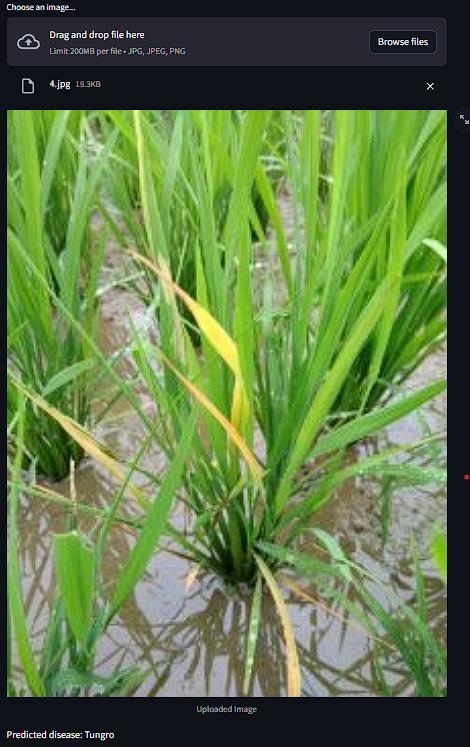
In conclusion, the integration of Convolutional Neural Networks(CNNs)inriceleafdiseasedetectionrepresentsa significantadvancementinagriculturaltechnology.Through rigorous experimentation and evaluation, our study demonstrates the superiority of deep learning techniques over traditional methods, achieving early and accurate disease detection. The deployment of a user-friendly frontend interface further enhances accessibility and usability for farmers, empowering them to manage rice diseases more effectively. Our project underscores the potentialofdeeplearninginprecisionagricultureandoffers apracticalsolutiontomitigatecroplosses.Movingforward, continued research in this field holds promise for further improvingcrophealthandagriculturalproductivity.
1) Expansion of Disease Categories: Expandthedisease classificationmodeltoincludeawiderrangeofriceleaf diseasesbeyondthecurrentcategories,enhancingthe system's capability for comprehensive diagnosis and management.
2) Multimodal Data Integration: Incorporateadditional datasourcessuchasweatherpatterns,soilconditions, and crop health metrics into the disease detection system, enabling a more holistic understanding of diseasedynamicsandfacilitatingtargetedinterventions.
3) IntegrationwithPrecisionAgricultureTechnologies: Integrate the disease detection system with precision agriculture technologies such as drones, satellite imagery,andIoTsensors,enablingpreciseandefficient diseasemonitoringandmanagementatscale.
International Research Journal of Engineering and Technology (IRJET) e-ISSN: 2395-0056
Volume: 11 Issue: 04 | Apr 2024 www.irjet.net p-ISSN: 2395-0072
4) Real-Time Monitoring and Alerts: Implement realtimemonitoringcapabilitiesinthesystem,coupledwith automated alert mechanisms to notify farmers of disease outbreaks or anomalies, enabling timely responsesandinterventionstomitigatecroplosses.
[1]Trébuil,G.,2011.RiceproductionsystemsinAsia:The constant presence of an essential cereal on a continent in mutation.
[2]Papademetriou,M.K.,2000.RiceproductionintheAsiaPacific region: issues and perspectives. Bridging the rice yieldgapintheAsia-Pacificregion,220.
[3] Bangladesh Rice Knowledge Bank, available at <>, last accessedon25-11-2020,08.40am.
[4]Wikipedia,listofriceleafdiseases,availableat<>,last accessedon28-11-2020,05.10am.
[5] Mondal, M. H. (2010). Crop agriculture of Bangladesh: Challenges and opportunities. Bangladesh Journal of AgriculturalResearch,35(2),235-245.
[6] AlamsyahD,FachrurroziM.2019.Faster R-CNN with inception v2 for fingertip detection in homogenous background image. Journal of Physics: Conference Series 1196(1):12017'
[7] Arnal BarbedoJG.2013.Digital image processing techniques for detecting, quantifying and classifying plant diseases. SpringerPlus 2(1):1-12
[8] AsfarianA,HerdiyeniY,RaufA,MutaqinKH.2014.A computer vision for rice disease identification to support IntegratedPestManagement. Crop Protection 61:103-104