
International Research Journal of Engineering and Technology (IRJET) e-ISSN: 2395-0056
Volume: 11 Issue: 04 | Apr 2024 www.irjet.net p-ISSN: 2395-0072

International Research Journal of Engineering and Technology (IRJET) e-ISSN: 2395-0056
Volume: 11 Issue: 04 | Apr 2024 www.irjet.net p-ISSN: 2395-0072
Dr. Anoop C K1 , Soumya Rani P Thomas2 , Brinta K Jose3, George K Alosius4
Lakshmi J Nair5 , Soya Joshy6
1Professor, Dept. of Civil Engineering, Viswajyothi College of Engineering and Technology, Vazhakulam, Kerala, India
2Assistant Professor, Dept. of Civil Engineering, Viswajyothi College of Engineering and Technology, Vazhakulam, Kerala, India
3,4,5,6Student, Dept. of Civil Engineering, Viswajyothi College of Engineering and Technology, Vazhakulam, Kerala, India ***
Abstract - Proper municipal solid waste management has become a challenge, not only due to environmental and aesthetic consideration, but also due to the massive amounts of municipal solid waste (MSW) generated every day. This paper deals with the detailed study of dump site at Parakadavu, which is locatedat Thodupuzha municipality, in Idukki district, Kerala. This paper involves the determination ofcompositionofMSWindumpyard,itseffectonsurrounding water sources, and the method to dispose the legacy waste from the dumping yard. Several water quality tests were conducted by collecting samples from nearby wells. Parameters such as pH, acidity, alkalinity, chloride, iron, conductivity,turbidity,totaldissolvedsolidswereexaminedto assesswaterquality.Thetotalquantityof wasteindumpyard is determined using total station. Based on the study conductedapropersegregationtechniqueisformulatedwhich involves the usage of trommel, and magnetic separator to segregate the waste and to make the dump site cleared
Key Words: dump site, composition, water quality tests, segregationtechniques,RefuseDerivedFuel(RDF)
Effectivewastemanagementatdumpingsites,suchasthe onelocatedinParakadavuwithinThodupuzhamunicipality, is essential to mitigate environmental degradation and safeguardpublichealth.Accumulatedsolidwasteovertime posessignificantrisksofcontaminationandhealthhazards. Conductingwastecharacterizationstudiesisimperativeto understand the composition of waste and its potential impact.Throughmethodslikehandsegregation,samplesare analysed to determine the percentage of each waste componentforfurtherassessment.Additionally,assessing the water quality of nearby water resources is crucial to evaluatepollutionlevelsandpotentialhazards.Varioustests and evaluations are conducted to ascertain the extent of contamination and its effects on human health. Proposed segregation techniques aim to prevent further contamination of water resources. By implementing
comprehensivesegregationstrategiesintegratedintowaste management systems, communities can achieve more sustainablepractices,therebycontributingtoahealthierand moreenvironmentallyfriendlyfuture.
1.1
To study the characteristics and to determine the compositionofwasteindumpsite
Tostudytheeffectofdumpsiteonlocalsurrounding watersources
Todeterminethequantityofwasteandtoformulate asegregationtechniquefordumpsite
2. METHODOLOGY
StudyofDumpSite
DeterminationofComposition
WaterSampleTesting
Calculationofquantityofwasteandformulationof segregationtechniques
The dump site is located at Parakadavu, in Thodupuzha municipality, Idukki district, Kerala. This region has a climaticprofilethatincludesheavyrainfall,highhumidity andarelativelyconstanttemperature(23-32degreeCelsius) throughouttheyear.Thedumpsiteoccupiesatotalareaof 1.26acres,with80centsofthisspacefilledwithdumps. Forthelast40yearsThodupuzhamunicipality'ssolidwaste hasbeendepositedinthedumpingyardatParakadavu.The wasteisdumpedfromgroundleveltomaximumheightof 15.28m.
International Research
Volume: 11 Issue: 04 | Apr 2024 www.irjet.net
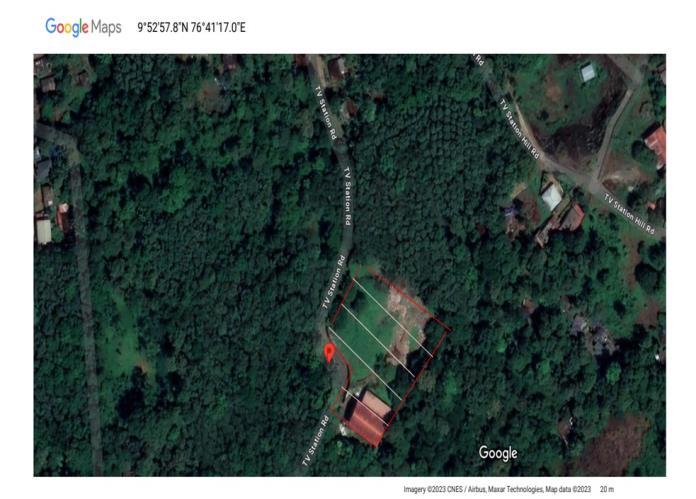
In order to gather comprehensive information about the dumpsite,we embarked on a processofcollectingdetails from both local inhabitants and government bodies. Engaging with the local community provided valuable insightsintothehistoryandcharacteristicsofthedumpsite, including patterns of waste disposal and community concerns.Concurrently,liaisingwithgovernmentagencies and relevant authorities allowed us to obtain official data regardingthedumpsite'sstatus,regulatoryoversight,and anyongoingmanagementinitiatives.Bysynthesizingthese diversesourcesofinformation,wewereabletogeneratea general understanding of the dump site's location, size, composition,andpotentialenvironmentalimpact.
With a solid foundation of off-field data, we proceeded to planandexecutethesamplingprocess.Thisinvolvedcareful consideration of several factors, including the weight and number of samples to be collected and the selection of suitable locations for sampling. After deliberation, we determinedthatasampleweightof5kgandfiveiterations would be appropriate to capture the variability of waste compositionacrossthedumpsite.Utilizingourknowledge fromoff-fielddatacollection,weidentifiedidealspotswithin thedumpsiteforsamplecollection,ensuringrepresentative sampleswereobtained.
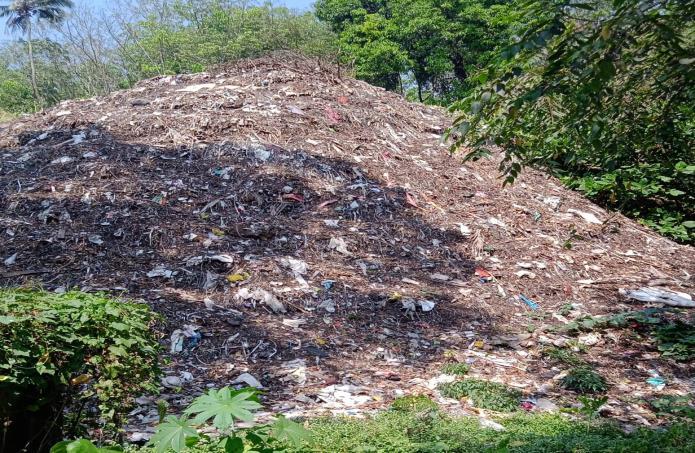
Upon successful collection of samples, our analysis phase commenced.Thesamples(S1,S2,S3,S4,S5)weresubjected to hand segregation to separate them into different components, facilitating a detailed examination of their composition.Subsequently,eachcomponentwasweighedto quantify its proportion within the sample. Finally, we formulated results for analysis, synthesizing the data obtainedfromsamplecollectionandsegregationtoderive insights into the waste composition and characteristics of thedumpsite.Thisanalyticalprocedurewasapivotalstage in comprehending waste disposal dynamics and devising efficientmanagementapproaches. Othersincludesanitary waste,wood,andaggregatematerials.Theobtaineddataare givenbelow
Table- 1: Composition
Throughtheanalysisofcomposition,ithasbeenfoundthat about80%ofthedumpconstituteorganicmatter.Similarly, about 10% constitute plastic. Glass, metal, paper, electronics,etc.constitutetheremaining10percentage.The presenceofelectronicsislessidentifiedduringsegregation
International Research Journal of Engineering and Technology (IRJET) e-ISSN: 2395-0056
Volume: 11 Issue: 04 | Apr 2024 www.irjet.net p-ISSN: 2395-0072
Thedeteriorationinthequalityofwaterduetothepresence ofdumpsiteshouldbeverifiedusingthevarioustestingof parameters of water. To assess water quality, five water samplesweregatheredfromfivedistinctwellssurrounding thedumpsitetoidentifyanyfluctuationsinwaterquality. Forcollectingsamples,one-literhigh-densitypolyethylene bottleswereutilized,andprecautionswere weretaken to preventcontamination.Inlaboratory,testssuchasacidity alkalinity, pH, chloride, electrical conductivity, iron, total dissolved solids, turbidity were conducted for all five samples.Thesamples(S1,S2,S3,S4,S5) weregatheredand analyzed three times, with each testing session spaced 15 daysapart.Threetofouriterationswerecarriedoutforeach ofthesamplesforaccuracy. Thetest resultsare shown in Table2.Thetestresultsclearlyshowthecontaminationof water sources due to the dump site. The presence of contaminationisbecauseoftheinfiltrationofcontaminants fromdumpingsitetogroundwaterwhichaffectthequality of wells, further it may lead to significant health risk for individualsandalsodestroythesurroundingecosystem.
effects aquatic life, and results in soil degradation also. Everything strongly shows that there has been a contaminationduetothedumpsite.So,itisveryneededto replaceallthewastefromthedumpsiteinaneffectiveway.
Prior to devising a segregation strategy, we ascertain the quantityofwasteatthedumpsiteusingtotalstation.The quantity of solid waste in dump site is measured using reducedlevelobtainedfromtotalstation.Attheinitialphase inthedumpyard,theentireplotwasdividedintodifferent part using a 2-meter grid. Point of intersection on grid is plotted and marked on ground. A combination of total station and levelling staff is used for finding the reduced levelofsurfaceofdumpsiteatdifferentmarkedpoints,all necessaryreadingslikeforesite,backsiteandreducedlevel are recorded. This recorded value is used to find area of sections on the grid. The area calculated is used to find quantityoftotalsolidwasteindumpyard.Thequantityof wastewasfoundtobe26640m^3.Asthequantityofsolid wastehavebeendeterminedusingsurveyingtechniqueand its composition using hand segregation. General physical characteristics of the dump site is identified. This characteristiccanbeusedtoidentifyotherdumpyardwith similarpropertiesandeffectivetechniquesusedtosegregate solidwaste.Duringthestudywefoundtwodumpsiteswith similarwastecharacteristicinKottayam-vadavathurandin kollam.Segregationtechniquesemployedinthistwo-waste disposal site is studied for formulating an effective technique.
Firstprocedureispredictingthequalityofrecycledwasteto formulate an economical segregation technique. During determinationofcomposition,itwasfoundthatrecyclable plasticandpaperobtainedwillbemixedandoflowquality duetocontaminationbydecomposedorganicwastehence theyhaveveryloweconomicvalueandcanonlybeusedas refusederivedfuel(RDF).Metalsobtainedarerecyclable andcanberecycledthroughvenders.Glassmaterialsdon’t getdegradedbyotherwasteshencecanberecycled,inert materials like large boulders and concrete block obtained (C&D)aftersegregationdoesnotloseitsstrengthandhence berecycled.
TheresultsarecomparedwithIS10500:2012standards.It is found that the results obtained from the study area are somewithinthelimitsandsomearenot.Itismainlydueto thepollutionfromdumpsite.Theprofileofthedumpsiteis insuchawaythatthereisahigherpossibilityforleachateto enterintothegroundwaterandcontaminatingthem.Allthe watersamplesareacidicinnature.Thatis theirpHisless than 7. It its self-shows that the water is not suitable for drinking.Mostofthesampleshowsironcontentmorethan itslimitsandthepresenceofchlorideisalsoidentified.All the samples exhibited mineral acidity, rendering them unsuitablefordrinking.Consumptionofwaterwithmineral aciditycancausehigherhealthissuesaswellasitinversely
International Research Journal of Engineering and Technology (IRJET) e-ISSN: 2395-0056
Volume: 11 Issue: 04 | Apr 2024 www.irjet.net p-ISSN: 2395-0072
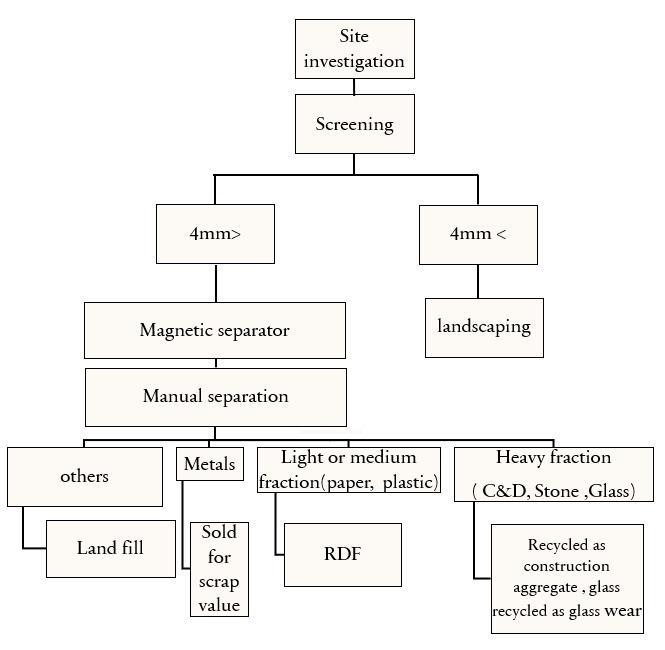
BasedonthestudyconductedondumpsiteinThodupuzha and other dump site, we have formulated a segregation techniqueasfollowed.Initialphaseofalldumpsitesinthe worldisdecompositionoforganicsolidwastewhichreduces thequantityoforganiccomponent.InParakadavudumpsite duringthedeterminationofcompositionwehavefoundthat theorganiccontentshavebeencompletelydecomposedthus thebioremediationandactivateddecomposingprocedures can be eliminated. Further studies showed the site was inactiveforlongsixmonths,whichconfirmsthepreceding conclusions accuracy, keeping all economic and environmentalfactorsthedesignedsegregationtechniqueis asfollowed.Firstphaseistheseparationoforganiccontent from solid waste, accomplished by using a trommel with rotating4mmbarscreen.Thiseffectivelyseparatesorganic contentfromthesolidwaste.Largeandinertmaterialsare separatedbyhandpickingthenthesolidwasteloadedinto rotating trommel using backhoe loaders. Decomposed organic content get separated. Around eighty percent of waste is decomposed organic materials, thus large part of thewasteissegregatedinthefirststageitself.
Secondphaseistheseparationofvaluablemetalsfromsolid wasteusingmagneticseparator.Withthecompletionoffirst twostepsquantityofwastegetreducedto15percentofits initial quantity. Third phase is the manual separation of remaining waste. To separate it into glass, inert large particles, plastic and paper. Expensive machines can separate between different grades of plastic but hand segregation is preferred at Parakadavu due to low or no economic value for contaminated plastic and has a very smallquantityofsolidwasteremainingafterfirsttwostages ofsegregation,thatisaround4000-metercube.Paperand plasticisbailedusingbailingmachine,whichcanbesoldto manufacturingplantsusingRDFasfuel.
Theinvestigationintothegroundwaterqualitysurrounding the Parakadavu dumpsite has revealed indications of contamination,primarilyduetowastewaterseepage.This contaminationposesa threattothenearby ecosystem.To counteracttheseadverseeffects,asegregationmethodhas beendevised,consideringfactorssuchaslandavailability, technological feasibility, and economic viability. The optimization process commenced with determining the compositionofsolidwastethroughmanualsegregationover fiverepresentativesamplingiterations.Subsequently,atotal station survey was conducted to quantify the solid waste. Usingthegathereddata,anefficientsegregationmethodwas formulated, incorporating a combination of trommel, magnetic separator, and manual segregation techniques, supportedbyheavyearth-movingequipmentandpersonnel. This holistic strategy seeks to oversee and reduce the environmental footprint of the Parakadavu dumpsite, protecting the nearby ecosystem and advocating for sustainablewastemanagementmethods
[1] S Ringle Raja, Balamurali Kanagaraj, S Eunice: “Evaluating groundwater contamination: An examination of a municipal solid waste dump yard in southern India’s Manchester City”, Resources, Conservation & Recycling Advances, Volume 20, December2023,200196
[2] M.D. Meena, M.L. Dotaniya, B.L. Meena, P.K. Rai, R.S. Antil,H.S.Meena,L.K.Meena,C.K.Dotaniya,VijaySingh Meena, Avijit Ghosh, K.N. Meena, Amit K Singh, V.D. Meena, P.C. Moharana, Sunita Kumari Meena, Ch. Srinivasarao, A.L. Meena, Sumanta Chatterjee, D.K. Meena,M.Prajapat,R.B.Meena:“Municipalsolidwaste: Opportunities,challengesandmanagementpoliciesin India:Areview”, WasteManagementBulletin,Volume 1,Issue1,June2023,Ppg.4-18
[3] Workineh Mengesha Fereja, Dereje Diriba Chemeda: “Status,characterization,andquantificationofmunicipal solidwasteasameasuretowardseffectivesolidwaste management: The case of Dilla Town, Southern Ethiopia”, Journal of the air &waste management association,Volume72,Issue2,2022,Ppg.187-201
[4] Sowmya Munagala, Durga Chaitanya Kumar Jagarapu, RatnamalaReddyB.S.S:“Determinationofwaterquality index for ground water near municipal dump site in Guntur”,Materialstoday:proceedings,Volume33,Part 1,July2020,Ppg724-727
[5] Collins O. Ugwu, Chigbogu G. Ozoegwu, Paul A. Ozor: “Solid waste quantification and characterization in
International Research Journal of Engineering and Technology (IRJET) e-ISSN: 2395-0056
Volume: 11 Issue: 04 | Apr 2024 www.irjet.net p-ISSN: 2395-0072
university of Nigeria, Nsukka campus, and recommendations for sustainable management”, Heliyon,Volume6,Issue6,June2020,e04255
BIOGRAPHIES






Dr. Anoop CK Professor ViswajyothiCollegeofEngineering andTechnologyVazhakulam
Soumya Rani P Thomas
AssistantProfessor ViswajyothiCollegeofEngineering andTechnology,Vazhakulam
Brinta K Jose
4thyearstudent,Civilengineering
ViswajyothiCollegeofEngineering andTechnology,Vazhakulam
George K Alosius
4thyearstudent,Civilengineering
ViswajyothiCollegeofEngineering andTechnology,Vazhakulam
Lakshmi J Nair
4thyearstudent,Civilengineering
ViswajyothiCollegeofEngineering andTechnology,Vazhakulam
Soya Joshy
4thyearstudent,Civilengineering ViswajyothiCollegeofEngineering andTechnologyVazhakulam
© 2024, IRJET | Impact Factor value: 8.226 | ISO 9001:2008