
International Research Journal of Engineering and Technology (IRJET) e-ISSN:2395-0056
Volume:11 Issue:04 | Apr 2024 www.irjet.net p-ISSN:2395-0072
International Research Journal of Engineering and Technology (IRJET) e-ISSN:2395-0056
Volume:11 Issue:04 | Apr 2024 www.irjet.net p-ISSN:2395-0072
Melkamu Debelo Geleta*, Assale Malka Kussia, Tsehaye Adamu Andualem
aTongji University, College of Environmental Science and Engineering, Shanghai, 200092, P. R. China; a*Tongji University, Shanghai 200092, China
Abstract
Rain-fed crop production is inherently susceptible to climate variations, making it a vulnerable sector in all nations. However, the impact of climate change is disproportionately felt by the poorest nations and their citizens due to their limited coping mechanisms.Therefore,theobjectiveofthisresearchistogainacomprehensiveunderstandingofthelocalclimatetrendsinthe westshoazoneoftheOromiaregion.Specifically,thestudyaimstoinvestigatehowthesetrendsaffectrain-fedcropproduction in differentagro-ecologiesandhow smallholderfarmers areadapting their farming practicestocope with the currentclimate variabilityandchange.
Additionally, the study examines the typical weather patterns in the area, the significance of indigenous knowledge, and the institutional coping strategies that are currently being employed. To achieve these objectives, two research techniques were employed. Firstly, monthly time series data on temperature and precipitation from three stations (Bako, Ambo, and Holeta) within the zone were analyzed using the Mann Kendall trend test at a 95% significance level to assess temporal monotonic trends.Secondly,semi-structuredquestionnaire-basedinterviewsandgroupdiscussionswereconducted.
Thetrendevaluationatthethreestationsrevealedrelativelystableprecipitationtrends,withsampleZ-valuesof0.29,-0.27,and -0.97 for Bako, Ambo, and Holeta, respectively. In contrast, the analysis showed a significant increase in temperature, with Z-values of 3.54, 1.84, and 2.78 for the respective stations. Furthermore, the socio-economic data analysis indicated that the occurrence and frequency of weather events varied across different locations within the research area. The most prevalent events were prolonged drought, including late onset or early offset (71.2%), flood or excessive moisture (53.8%), heavy rain (32.6%), frost (20.5%), and strong winds (4.5%). These events hinder agricultural operations and have diverse impacts on rain-fed crop production, which relies on normal distribution and the timely onset and offset of the rainy season. The issue becomes more severe in areas with mid-altitude and lowland terrain. According to the survey, the main consequences include completecroploss,reducedyield,decreasedseedingarea,delayedseedingandmaturity,aswellasanincreaseincroppests.In ordertoadapt,smallholderfarmersemployvariousstrategiessuchasacceptingtheloss,replacingcrops, diversifyingtheircrop selection, practicing late seeding, cultivating early maturing crops, implementing zero or minimum tillage techniques, and growingtolerantcrops.Additionally,thesefarmersrelyonlocalknowledge,suchastraditionalearlywarningsystemsandtillage practices, to cope with adverse weather events. Despite their efforts, smallholder farmers face challenges due to limited resourcesincludingefficienttechnologies,land,labor,savings,credits,andcropinsurance.Althoughthelong-termmeanvalues of precipitation remain stable, there is significant seasonal and inter-annual variability. Moreover, the small fluctuations in precipitation and temperature have a substantial impact on rain-fed crop production, compounded by other biophysical and socio-economic factors. Therefore, this study highlights that even minor weather shocks can have significant consequences, emphasizingtheneedtoenhanceadaptationoptions,allocateresourcesappropriately,andprovidetimelyinformationonfuture climatechangetoenablefarmerstotakenecessarypreventiveactions.
Key words:Climatechange,climatetrend,adaptation,mitigation,rainfall,impact,copingmechanisms
Climatechangeiscurrentlyapressingissuethatis beingaddressedatvariouslevels,includinglocal,national,regional,and global.Althoughthereisongoingdiscussionregardingtheextenttowhichhumanactivitieshavecontributedtoclimatechange, thereisageneralconsensusthatitsimpactsareevidentthroughchangesinweatherpatterns,anincreaseinextremeweather
International Research Journal of Engineering and Technology (IRJET) e-ISSN:2395-0056
Volume:11 Issue:04 | Apr 2024 www.irjet.net p-ISSN:2395-0072
events, and a decrease in predictability [1-3];. This increased weather variability as a result of climate change results in potentially sudden and irreversible disruptions to life and livelihood-sustaining natural systems, and the resulting economic, socialandenvironmentaldislocations[4] Evidentpatternsofcontinuousclimatechangeandfutureforecastssuggestthatmost countries will face more severe adverse effects, particularly impacting the poorest populations who have limited resilience to climate challenges. Moreover, climate change is having a disproportionate impact on the impoverished and marginalized communities within nations. The anticipated consequences present a significant risk to the progress and durability of the MillenniumDevelopmentGoalsindevelopingnations,aswellastheeffectiverealizationofhumanrightsinbothdevelopedand developing countries [4]. Despite global coverage of climate change, there is global variation in climate change manifestations based on geographiclocationand environmental factors.For instance,in Europe retreating glaciers, flashfloods, wild firesand rising sea levels are some of the manifestations whereas, in Africa, climate change is manifested as drought and floods [5]. Accordingly, the climate change impacts global variation based on adaptive capacity, socioeconomic, technological and environmental factors. In developing countries like Africa will face increasing water scarcity and stress with a subsequent potentialincreaseofwaterconflictsasalmostallofthe50riverbasinsinAfricaaretrans-boundary[6].Agriculturalproduction reliesmainlyonrainfallforirrigationandwillbeseverelycompromisedinmanyAfricancountries,particularlyforsubsistence farmersandinsub-SaharanAfrica.Ontheotherhand,inEuropeagriculturalsectorisbelievedtobenefitfromgradualclimate changeduetothecarboneffectandthewarmingclimate[7,8];
Numerous scholars have conducted research to ascertain the influence of climate on agriculture, proposing various adaptation measures. Despite the abundance of evidence regarding the impact of climate change, smallholder farmers have struggled to effectively address and cope with climate-related hazards. Top-down approaches, such as modeling and scenario analysis,havebeenemployedtoprovidevaluableinsightsfordecision-making,particularlyintermsofthebiophysicalaspectsof impacts. However, these models have limitations in representing human interactions and local capacities for adaptation. Additionally, the resolution of models utilized to assess climate change in developing nations is often inadequate and relies heavilyondatafromexternalsources.Alongwiththedisparityinoutputsfromdifferentmodels,thismakestheuseofresultsas abasisforadaptationactionverydifficult[9].Hence,asacomplementtotop-downapproach,bottomupwhichrecognizesand builds upon local coping strategies and indigenous knowledge and technologies, and the capacity and coping range of communities,andlocalinstitutionsisusefulindevelopingspecificstrategies.
In Ethiopia, more than 85% of the people depend mainly on agriculture for their livelihoods, rendering them very vulnerable toclimatevariabilityandchange.Accordingly, inrecenttimes,a significantnumberof peopleinEthiopiaare being affectedchronicallybydroughtand/orflooding,leadingtodeathsandlossof assetsandtoanappealforinternationalsupport [10].Theabilityofsmallholderfarmersisofparamountimportance todealwithadverseeffect ofclimaterelatedshockswith successfuladaptationstrategies.Accordingto [10],Ethiopiahasbeenmarkedbyfluctuationsinclimateconditions,leadingthe localpopulationtodevisevariousmethodsofadaptation.Theseencompassearlywarningsystems,traditionalapproachestosoil and water conservation, the cultivation of diverse crops and livestock, mobility, reciprocity, customary conflict resolution, and more.Althoughnotanovelidea,thepotentialofthesestrategiesinaddressingagriculturalclimatechangeremainsunexplored.
Small-holderfarmersinthewesternShoaregionhavealsobeenmodifyingtheirpracticesinresponsetochangingclimate patterns and advancements in technology. These adjustments serve as coping mechanisms to deal with the variability in weatherconditions,eventhoughthefarmersthemselvesmaynotexplicitlylabeltheiractionsasresilience-building.Integrating resilience-building measures into existing agricultural operations could greatly enhance the farmers' capacity to adapt to the unpredictableweatherpatternsassociatedwithclimate change [11].Hence,thisresearchaimstoknowtheclimatetrendand weatherevents,impactson rainfedcropproduction,andcopingmechanisms whichcanbeusedtoupgradethe perceptionof farmersaboutclimatechangeandimproverainfedcropproductionsinWestshoaZone
International Research Journal of Engineering and Technology (IRJET) e-ISSN:2395-0056
Volume:11 Issue:04 | Apr 2024 www.irjet.net p-ISSN:2395-0072
2.1 Research area description
2.1.1 Location
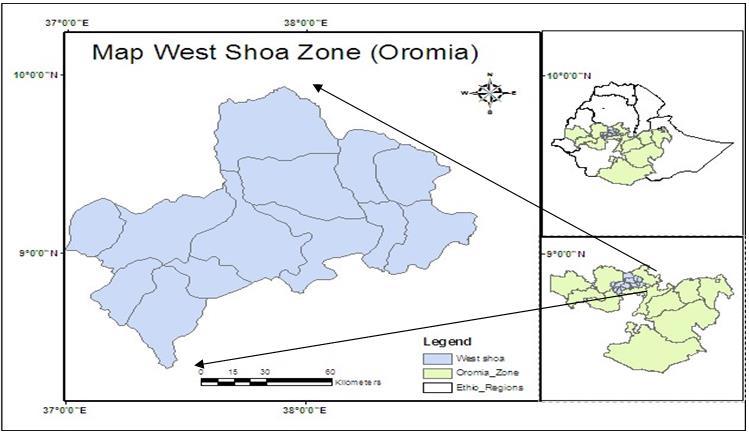
WestShoa,situatedintheOromiaregionalstate,isoneofthe18administrativezoneswithcoordinatesbetween8o17’and 9o56’Nand37o17’and38o45’E.Thezonespans174kminitsNorth-Southextensionand183kminitsEast-Westextension. ItsharesborderswithAmharaRegionalstateandNorthShewatothenorth,AddisAbabaregiontotheeast,EastWollegatothe west,andsouthwestShoaandJimmaZonetothesouthwest.Coveringatotalareaof15086.15km2,WestShoaisdividedinto 18woredasand two independent urbanadministrative zones, namely Amboand Holeta.Ambo, the largesturbancenterinthe zone, serves as the capital and is located 114 km west of Addis Ababa. The map of the research area is depicted in Figure-1 below.
2.1.2Population
According to [12] the total population estimated 2,080,698 out of which 1,021,484 (49.1%) are male and 1,059,214 (50.9%) are female. The zone is predominantly settled by Oromo ethnic groups, out of total population 1,845,162.9 (88.68%) arelivinginruralareaswhiletherest235,535(11.32%)areurbandwellers.Activeandproductivelaborforceisestimatedtobe at 52% while economically dependent population constitute about 48 % [12]. The population density varies from 84p/km2 to 218p/km2.
2.1.3 Topography
Topographically, West Shoa is characterized by diversified land forms consisting of mountain peaks, plateaus, plains, valleys,spursandlowlands.Elevationvariesfrom900mto3500masl
International Research Journal of Engineering and Technology (IRJET) e-ISSN:2395-0056
Volume:11 Issue:04 | Apr 2024 www.irjet.net p-ISSN:2395-0072
The climate in this region is predominantly influenced by altitude and latitude compared to other factors. According to the simplified agro-climatic classification of Ethiopia, it falls under three agro-climatic zones: Highland (27%), mid-altitude (56%), and lowlands (17%) (ZARDO). This zone experiences a bimodal rainfall pattern, with the main rainy season occurring in the summermonths,peakinginJuly(fromJunetoAugust),andashorterrainyseasonfromFebruarytoApril.Rainfalllevelsrange from813.2 mm to1669.1 mm.Themaximum temperatureinthearea fluctuates between 24°Cand29°C, while theminimum temperaturerangesfrom11°Cto13°C.
2.1.5
Sixpercentofwestshoa’sareaiscoveredwithprotectedanddensenaturalforests.TheseincludeMenageshasubaforest, Jibatforest,ChilimoforestandGuraforest.
2.1.6
Mixedagricultureistheoccupationofover90%ofthepopulation.Theareaissuitablefortheproductionofmajorcereal cropssuchasTeff,Wheat,Barley,Maize,sorghum,andalsooilseedssuchasNoug,Flaxandlinseeds.Theareaisalsorichinits livestock population and hence animal husbandry is practiced as supplementary to rain fed crop production. As to the land use, according to [12] out of total parcels estimated to 787,522 ha, 596325 ha (75%) covered by temporary crops (cereals, pulses, oil crops and others),16054 ha permanent crops (Such as Coffee and fruit trees), 104,863ha grazing land,46428ha fallowland,5687hawoodlandand18165haotherssuchasswampyandrockyareas.Theaveragelandholdingperhousehold isestimatedto1.51ha[12].
As to the soil conditions the chromic and pellic vertisols, chromic and orthic Luvisols, Rendzinas, Halphic and luvic phaezems and distic Nitosols are the major soil types. There are three agricultural research institutions namely Ambo plant protectionResearch,HoletaagriculralResearchcenterandBakoagriculturalresearchcenters,currentlyundertakingdifferent agriculturalresearchactivities.
Theresearchwasaimedtoseethetrendofmajorclimaticvariablesinordertoinvestigatetheextenttowhichchangein physicalfactorsandsocioeconomicimpactfacedagreewithoneanotherasaresultofclimatechangeandvariability.Ascase study research, an exploratory question, ‘’what’’ and ‘’how’’ and also both qualitative and quantitative approach, is used to undertake this research. According to [13], methodological triangulation; obtaining data from different sources, such as observations, documentations and interviews, helps to harnesses diverse ideas about the same issue and assist in cross-checkingthe results,andconsequentlyhelps to increase the validity, reliabilityof thefindingsand eases data analysis. Impact assessment alone is subtle and may not be sufficient enough to show consequences of climate impact on different memberofcommunity[13];hencevulnerablePAsselectedfromdifferentAgro-ecologiesbasedonpastexposuretoweather variability. Moreover, to assess vulnerability of rural livelihood strategy in context of shocks and other stressors used as indicators such as (Landholding, water availability, biological resources, social interconnectedness, labor availability, saving andcreditavailability)andassetaccessmodificationsbysocialrelations,institutionsandorganizations [14].Thisinturnalso usedtoidentifytheresourcesrequiredtocopeupwiththeprevailingextremeweatherevents.Thesiteselectedbasedonpast exposuretodifferentclimaticshocksandduetotheincreaseinfrequencyunusualweathereventsintheareaespeciallyinmid altitude and lowland PA with Zonal Agriculture and Rural Development Office (ARDO) and Disaster Prevention and Preparedness Office (DPPO) experts. The occurrences of unusual weather events were common in mid altitude and lowland PAs ofalmostall Woredas within theZone.Besidethisthe numberofpeopleunder food aidintheaffectedareasand those areasfacingfrequentweathereventsisalsousedasselectioncriteria.
2.3 Methods of Data Collection
Both primary and secondary data were used to undertake this research. The data were obtained from primary sources (field observation, household, government officials, Development agents) and secondary data (government documents, meteorologicaldata,andcropproductiondata).
International Research Journal of Engineering and Technology (IRJET) e-ISSN:2395-0056
Volume:11 Issue:04 | Apr 2024 www.irjet.net p-ISSN:2395-0072
ThestudyfocusedonthewestShoazone,whichconsistsof18woredas(Ambo,Bako,Toke-kutaye,Ejere,Ginchi,Holeta, Ada Berga, Meta Robi, Jeldu, Gindeberet, Ilfata, Cheliya, Mida-kegn, Ilu-Gelan, Tikur-inchini, Jibat, Nono, and Dano). These woredas were classified into different categories based on factors such as crop diversity, altitude, rainfall, and temperature, according to the traditional classification by the Zonal Agriculture and Rural Development Office (ZARDO). The highland category includes Holeta, Jeldu, Cheliya, Mida-kegn, and Tikur Inchini, while the mid-altitude category includes Ambo, Toke-kutaye,Ejere,Ginchi,AdaBerga,MetaRobi,Gindeberet,Ilfata,Jibat,andNono.Theremainingworedas,IluGelan,Dano, andBako,areclassifiedaslowlands.Duetothe vastnessofthearea andthe needfora comprehensivestudy, representative samplingwasemployedfortheresearch.Threerepresentativeworedas,namelyHoleta,Ambo,andBako,wereselectedbased ontheavailabilityofmeteorological stations,agro-ecology,andaccessibility.Thisselectionaimedtoexaminethedifferences andcommonalitiesintermsofclimate-relatedhazardsandthecopingmechanismsemployed.
TwoFarmersAssociationswerechosenfromeachworeda,specificallyTalachoandDufafromHoleta,SenkelleandKisose fromAmbo,andAmarti-GibeandDembi-GobufromBako.Theselectionwasbasedontheirpreviousexposuretoprecipitation variability, involvement in food aid programs, and weather-related hazards, as indicated by Agricultural Census data. The samplefarmerswererandomlyselectedfromeachvillage,witharequirementthattheyhavelivedintheareaformorethan tenyears.ThesurveydesignisillustratedinFigure-3below.
The first approach used was to conduct household interviews using semi-structured questionnaire in selected PAs and Primary data on impact, adaptation measures and coping mechanism employed were collected from April to May 2010. The interview was conducted on 60 lowlanders, 60 households from mid-altitude, and 32 from highlands based on proportion weatherrelatedincidentsinthearea;andatotalof152keyinformantsfromthreerepresentativeWoredasofthestudyArea. The summary of questionnaires on major findings was presented to the farmers through focal group discussions so that they canmakecomments,suggestionsandapprovals.
The second approach was review of E-books, Journals and Published local researches on response to extreme weather eventsandexistinglocalinnovation/indigenousknowledgetoadapttoweathershocksinstudyareas.Moreover,unpublished reportsofsomeNGOsworkingatthegrassrootslevelandrespectivegovernmentofficesalsoreviewedtosharetheirfindings. In addition, a literature review was conducted on some global and regional issues related to climate change and local adaptation to relate and comparewiththelocal context. Interviewsanddiscussions alsoheldwith relevant government and NGOstaffworkingatvillage,district,andzonallevel(DistrictandZonalARDOandDPPO) Fieldobservationwasconducted intheBako,AdaBerga,Ambo,TikurInchiniandMetaRobi,regardingtheexistingsituationsoftheresearcharea.
International Research Journal of Engineering and Technology (IRJET) e-ISSN:2395-0056
Volume:11 Issue:04 | Apr 2024 www.irjet.net p-ISSN:2395-0072
Published and unpublished literatures were collected from different government offices. Data on crop production were collectedfromDistrictandZonalAgricultureandruraldevelopmentofficewhereasdataonclimateshocksandvictimpeople wereobtainedfromDistrictandZonalDPPO. PrecipitationandtemperaturevalueswerecollectedfromNMSA(threesample meteorological stations namely, Holeta, Ambo, and Bako) which are found at different locations and altitudes with in the research area. Contemporary climate change was studied by records of values which have been obtained by standard equipment.MonthlytotalprecipitationandTemperaturevaluesof41years,41years,and15yearswereusedatHoleta,Bako, and Ambo respectively for the trend analysis. Only 15 years’ values were used at Ambo due to the poor organization and qualityofthedata.Table-2GeographicallocationofMeteorologicalStations
1 Holeta
Before the analysis, some pre-analysis activities such as filling of the missing years from Archives of the stations, adjustmentofincompletedataandadjustmentofoutlierswereemployedforqualitydata.
The result of the research in this paper presented by categorizing in to four parts based on the objectives set at the beginning. The first part includes the trend of climatic variables; rainfall and temperature. The second part comprises occurrenceofusualweathereventsexperiencedbythearea.Thethirdpartisaboutimpactofweathereventsonrainfedcrop production and the perception of farmers. The final part is the existing coping mechanisms, the resource required by small holderfarmersandlocalindigenoustechnicalknowledgeofthefarmersthatcontributetocopewithclimatechange.
According to the Mann Kendall monotonic trend analysis the results indicate there is increasing trend at Bako whereas decreasing trend at Holeta and Ambo stations; however, the trend analysis indicates only weather the trend is increasing or decreasingovercertainperiodoftime.Hencesignificancetestforthetrendisofparamountimportanceinordertopredictthe occurrence of extreme weather events and their likely impacts. Accordingly, the trend significance tests show there is no statistically significant trend. Hencethetrendevaluationindicatesthereisstabletrendatthethreesites(Table-3).Accordingto Mankendallsignificancetestatlevelofsignificance0.05,thetesthypothesisis
H0=µ=µ0(thereisnosignificanttrend/stabletrendinthedata
HA=µ≠µ0(thereissignificanttrend/unstabletrendinthedata.
HenceZα/2=±1.96
If-1.96≤Z≤1.96acceptthehypothesisorelseRejectH0
Volume:11 Issue:04 | Apr 2024 www.irjet.net
Table-3ValuesofPrecipitationTrendanalysis(Source:NMSA)
Eventhoughthereisnosignificanttrendatthethreestationsthevaluesshowthereisvariabilitywithintheresearcharea. The result of Annual total rainfall and monthly rainfall analysis at the three selected stations namely Holeta, Ambo and Bako showsyeartoyearvariations.RainfalldataanalyzedforHoletaandBakoisfromtheyear1979to2019(41years)whilethatof Ambo is from 1997 to 2019 (23 years). The average annual rainfall analysis in Table-4 below shows the total annual rainfall showsvariabilityatthethreesamplemeteorologicalsitesandthevariabilityisrelativelyhighatBako.Asonegoes fromhigher altitudetothemidaltitudeandlowaltitudeareasthevariabilityoftheRainfallalsoincreasesaccordinglywhichalsoconsistent withprimarydataobtainedbysurvey.
Table-4AnnualtotalRainfallVariability(Source:NMSA)
Accordingly, the results indicate that trends are not uniform with in the research area. The trend analysis of total annual rainfallshowsthatrainfalltrendshowsdecreasingtrendforHoletaandAmbostationwhilethatofBakoshowsincreasingtrend with variability (fluctuations from the base line values). The temporal variation of the total annual rainfall is displayed in the figuresbelow.
International Research Journal of Engineering and Technology (IRJET) e-ISSN:2395-0056
Volume:11 Issue:04 | Apr 2024 www.irjet.net p-ISSN:2395-0072
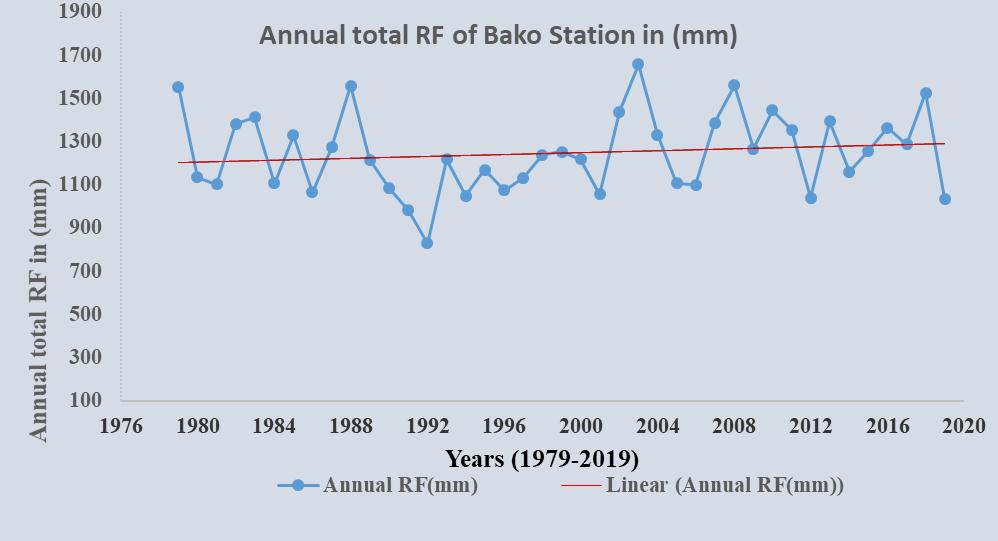
Figure-4 Trends and variability of annual total rainfall at Bako station (Source: NMSA)
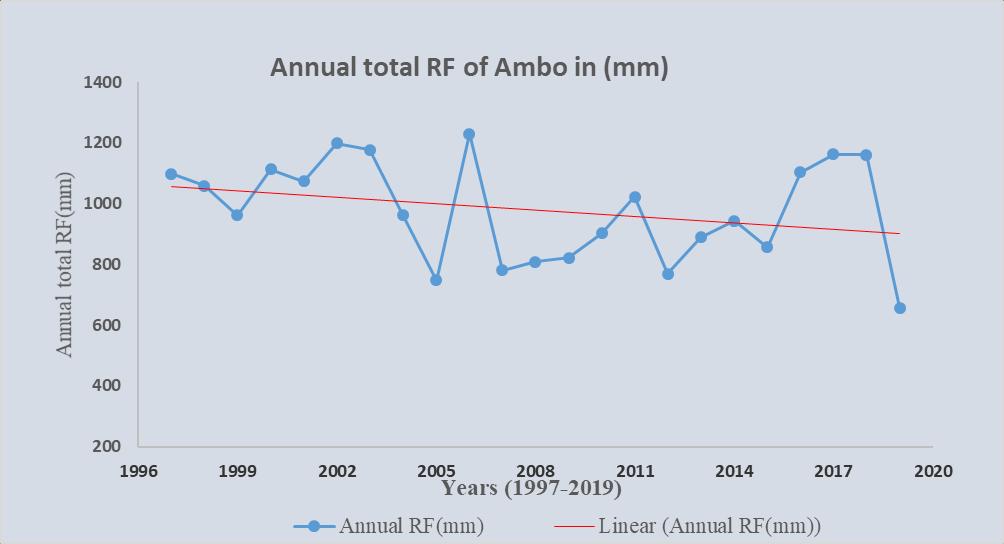
Figure-5 Trends and variability of annual total rainfall at Ambo Station (Source: NMSA)
International Research Journal of Engineering and Technology (IRJET) e-ISSN:2395-0056
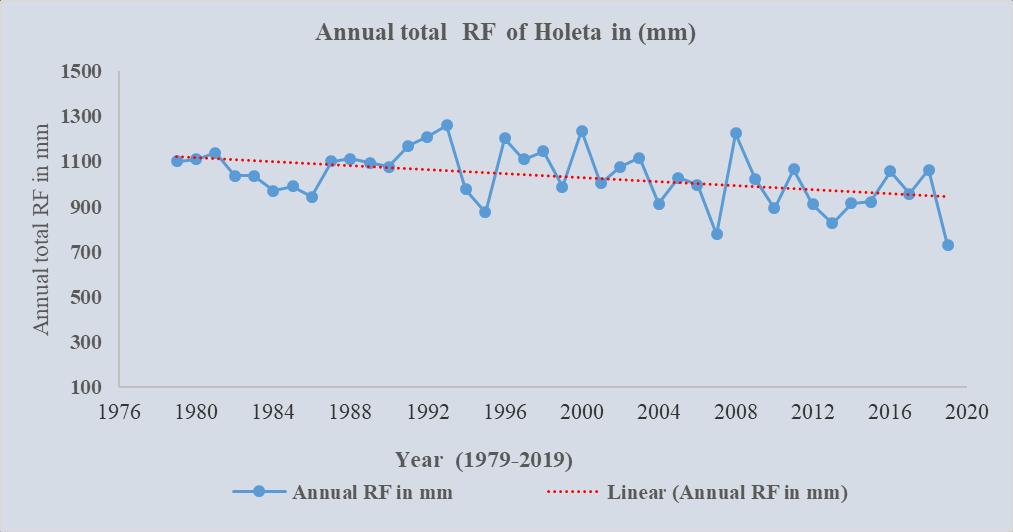
Figure-6 Trend and variability of average annual total Rainfall at Holeta Station (Source: NMSA)
Thereisalsospatialvariabilityintotalannualamountwithinthezone.Woredasfoundattheboundariesofsouthwestern partofthecountryhaverelativelyhightotalannualrainfall.Thealtitudedifferenceis2400maslatHoleta,1977masland 1650 maslforAmboandBakorespectively. Figure-belowshowsspatialvariabilityofrainfallwithintheresearcharea.
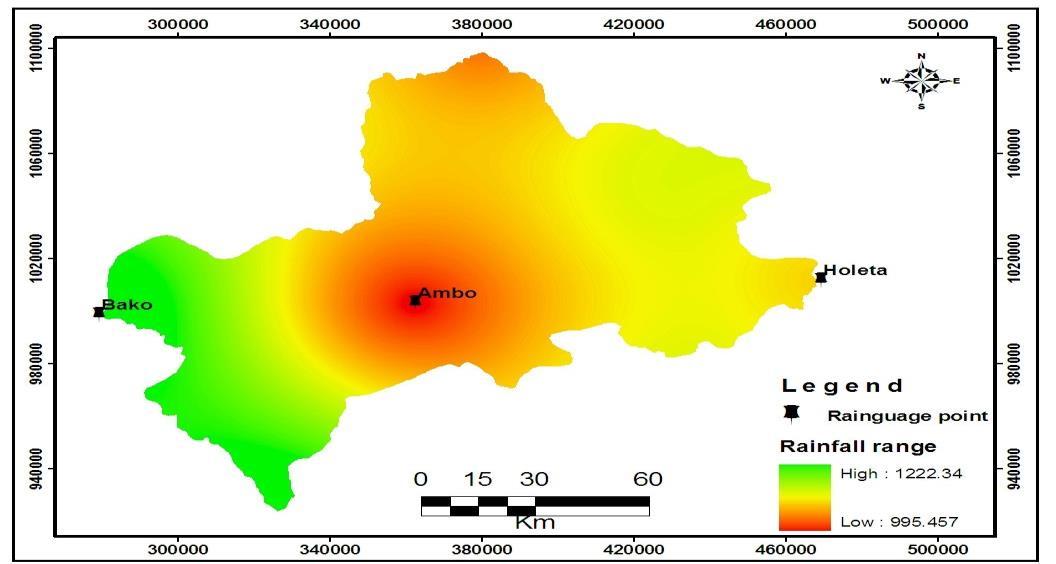
Figure-7SpatialVariabilityofrainfallofwestShoaZone(Source:NMSA)
MeasurementstakenfromEthiopianmeteorologicalstationsshowthattheannualvolumeofrainfalloverthepastfifty-five yearshasremainedmoreorlessconstantwhenlookingattheaverageforthewholecountryacrosstheperiod1961-2016[15]. However,ifonelooksathowrainfallisdistributedacrossthecountry,thereisamarkeddifference:thereisatendencyforless raintofallin the northernpartofthecountry wherethereisalreadymassiveenvironmental degradation. Onthecontrarythe
Volume:11 Issue:04 | Apr 2024 www.irjet.net p-ISSN:2395-0072 © 2024, IRJET | Impact Factor value: 8.226 | ISO 9001:2008 Certified Journal | Page9
International Research Journal of Engineering and Technology (IRJET) e-ISSN:2395-0056
Volume:11 Issue:04 | Apr 2024 www.irjet.net p-ISSN:2395-0072
centralhighlandscharacterizedbyincreasingtrend;However,decreasingtrendatHoletaandAmbowhereasincreasingtrendis observed at Bako. Hence, the frequent occurrence of flush flood, heavy rain, could be associated with its variability in distributionandthedegradationofthelandwhichlacksitscapacitytostorerainwaterasaresultofexcessiveexploitation.
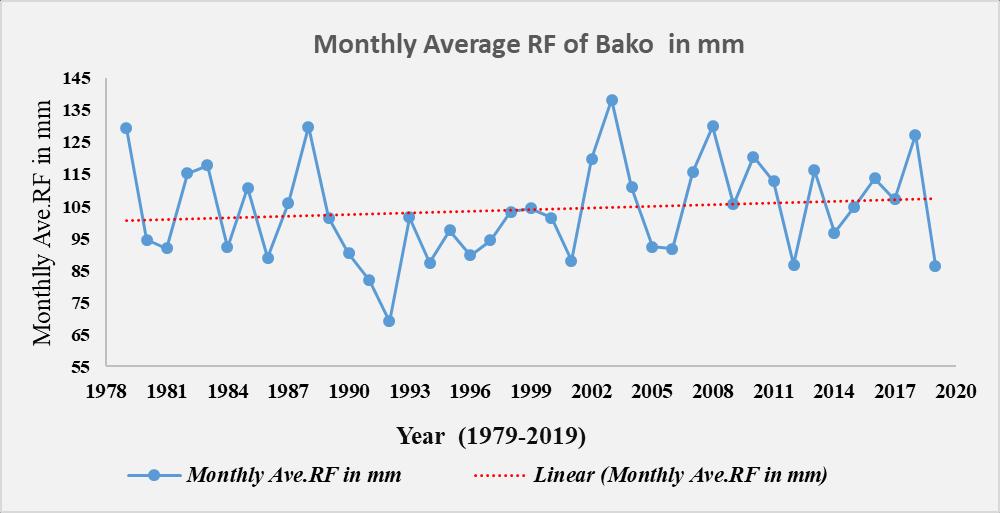
Seasonality effects also analyzed to know whether the seasonal component has a trend or not. Seasonality analysis indicateswhathashappenedwithintheyear;likefluctuationsinthepeakrainfalltime.Thepeakrainfalltimedoesnotoccurat thesamedateeachyearthepatternofthevariationisalteringfromyeartoyearwhichalsoaffectcropproduction.Accordingly, monthly values for 491 months at Holeta and Bako and 276 months at Ambo. Hence, monthly average rainfall values were usedtoanalyzetheseasonalityoftherainfallandtheresultindicatesthatthepatternofthepeaktimeshowsvariationwhere asthe12monthseasonalcomponenthasnotrendexceptforHoletastation.
International Research Journal of Engineering and Technology (IRJET) e-ISSN:2395-0056
Volume:11 Issue:04 | Apr 2024 www.irjet.net p-ISSN:2395-0072
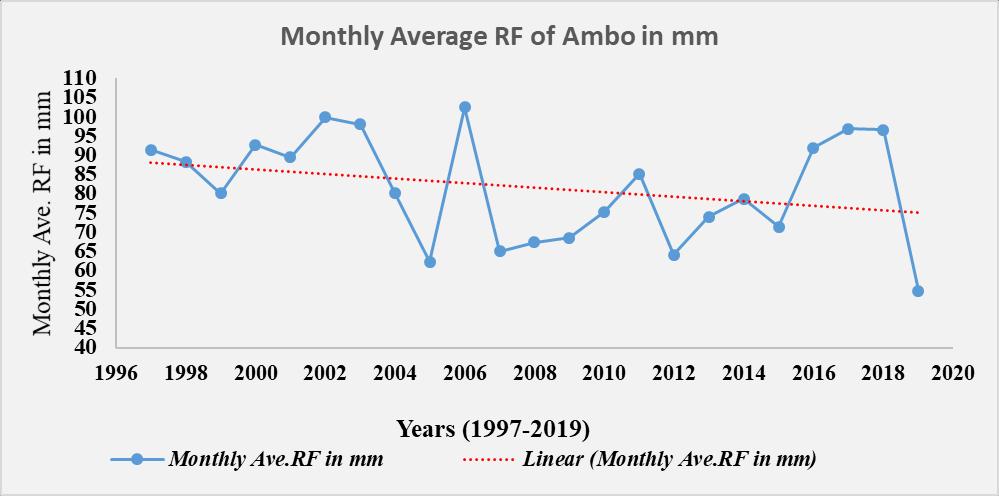
9.TrendandvariabilityofMonthlyRainfallatAmboStation(Source:NMSA)
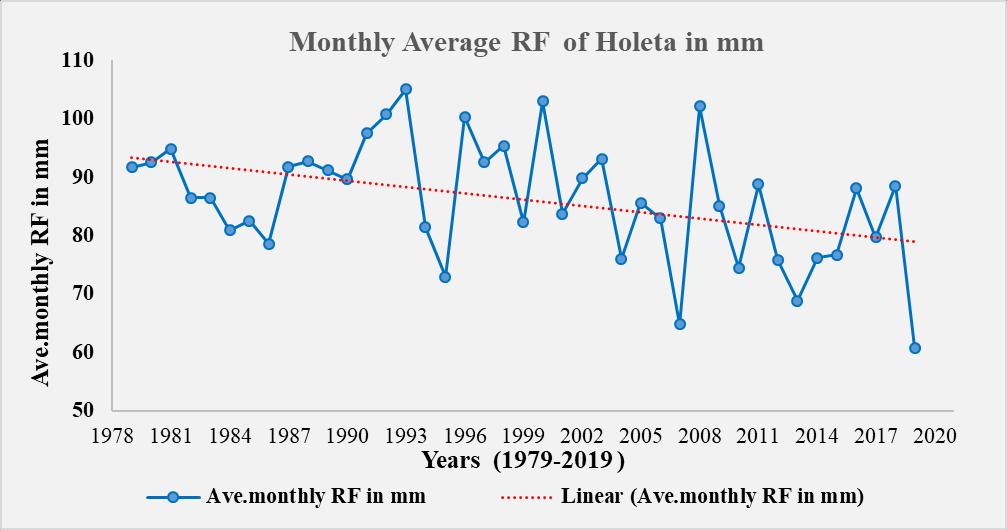
10.TrendandvariabilityofMonthlyRainfallatHoletaStation(Source:NMSA)
Theimpactofrainfalloncropproductioncanberelatedtoitstotalseasonalamountoritsintrapersonaldistribution.Inthe extreme case of droughts, with very low total seasonal amounts, crop production suffers the most. But subtler intra-seasonal variations in rainfall distribution during crop growing periods, without a change in total seasonal amount, can also cause substantialreductionsinyields.Thismeansthatthenumberofrainydaysduringthegrowingperiodisasimportant,ifnotmore, as that of the seasonal total [16]. According to the rainfall trend analysis the change in annual total is insignificant while the
© 2024, IRJET | Impact Factor value: 8.226 | ISO 9001:2008 Certified Journal | Page11
International Research Journal of Engineering and Technology (IRJET) e-ISSN:2395-0056
Volume:11 Issue:04 | Apr 2024 www.irjet.net p-ISSN:2395-0072
impact on crop production and variation in total production is still increasing which indicates that the annual total alone is inadequatetodetermineimpactoncropproduction.Hence,forbetterinsightofimpactsoncropproductionanalysisofseasonal variationisverydecisivesincevariationinallseasonsoftheyeararenotequallyimportantfromcropproductionpointofview. Thefollowingtablesshowseasonaltotalrainfallandcoefficientofvariationof kiremt and Belg season.
Table-5Kiremt(June-September)Rainfallandcoefficientofvariation
Table-6Belg(March-May)rainfallandcoefficientofvariation
The seasonal rainfall shows variability as indicated by their coefficient of variation in the tables above. The Belg rainfall (MarchtoMay)ismorevariablethanthe kiremt (JunetoSeptember).Thisisalsoconsistentwiththeconclusionmadeby [17] which reveals that Belg rainfall is more variable than kiremt rainfall. As Belg rainfall is more favorable for crops and its variability also affect production by hindering agricultural activities (such as land preparation and sowing time) and crop physiology such as germination and growth of seedlings. The Belg the rainfall is favorable as there is no aeration problem, no cloudcoverandthecropsarealsophotosyntheticallyactive.Moreover,theseasonal variabilityofrainfallalsoassociated with late on set and early offset of the rainy season. The correlation analysis of kiremt and Belg season also shows inverse relationship at Holeta and Bako station while it is positively correlated at Ambo. The positive correlation at Ambo may be associatedwithshortlengthperiodofrainfalldata.Thesurveyalsosupportsthatwhenthereisgooddistributionin Belg rainfall; the kiremt rainfallbecomelessinamountandmorevariableandviceversa.However,therelationshipsofseasonalrainfallare foundtobestatisticalinsignificanthoweversmallvariationinrainfallhassignificantimpactonproductionduehighdependency onrain-fedagricultureandothercompoundingfactors.
Table-7correlationof Belg and Kiremt rainfallatthreestations
Pearson's Correlation of Belg and Kiremt Rainfall Stations
International
Volume:11 Issue:04 | Apr 2024 www.irjet.net
UnlikethatofrainfallMannKendalltrendanalysisforaveragemonthlytemperatureshowsstatisticallysignificantincrease exceptAmbostations.AccordingtothesurveytherespondentsofAmboareaindicatethatthetemperaturehasbeenincreasing intheareainthepasttwodecades;however,thestatisticalanalysisshowsnon-significant.HencethestabletrendatAmbomay be due to the short length the data as Mann Kendall trend analysis become stronger depending on the length of the data. The seasonal Mankendall test for temperature also shows that there is significant trend (Annex-2). Table- below show values for temperaturetrendanalysis.
Table-8ValuesofAverageTemperatureTrendAnalysis(Source:NMSA)
S.N
1
3
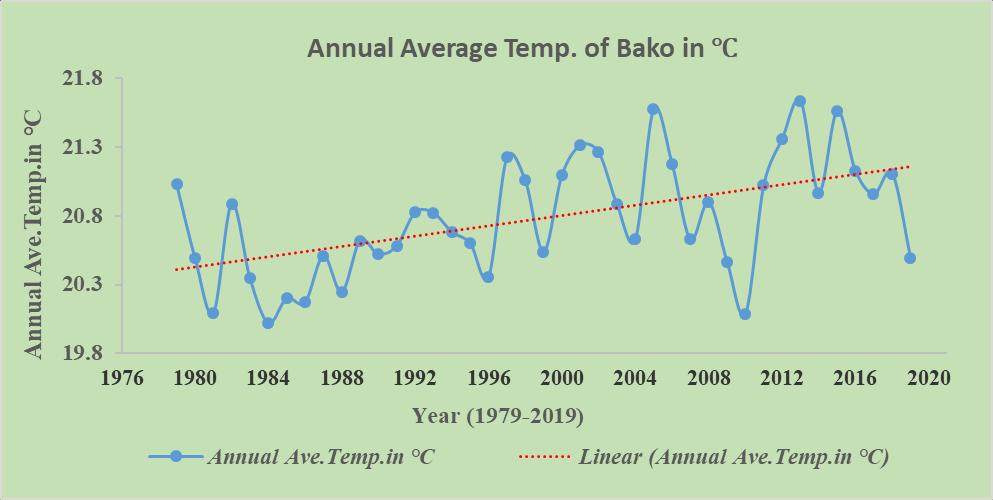
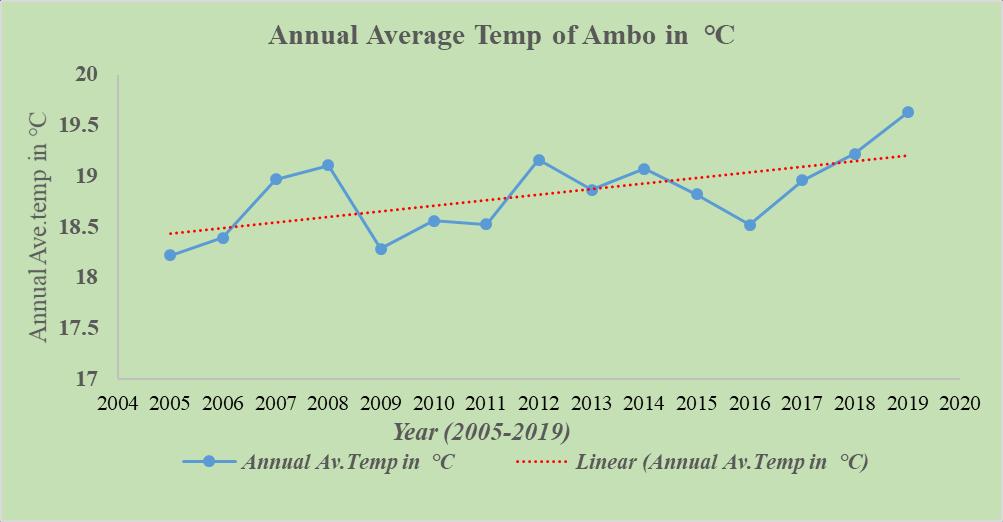
Theresultsofaverageannualtemperaturetrendanalysisindicatethattrendsshowthereisvariabilityatthethreesampled stations(Bako,AmboandHoleta).Table–9belowshowsdescriptivestatisticsofaverageannualtemperature.
Table-9ValuesofAverageAnnualTemperatureandcoefficientofvariation(Source:NMSA)
International Research Journal of Engineering and Technology (IRJET) e-ISSN:2395-0056
Volume:11 Issue:04 | Apr 2024 www.irjet.net p-ISSN:2395-0072 © 2024, IRJET | Impact Factor value: 8.226 | ISO 9001:2008 Certified Journal | Page14
ThetemporalvariationaverageannualTemperaturetrendisdisplayedinthefiguresbelow.
International Research Journal of Engineering and Technology (IRJET) e-ISSN:2395-0056
Volume:11 Issue:04 | Apr 2024 www.irjet.net p-ISSN:2395-0072
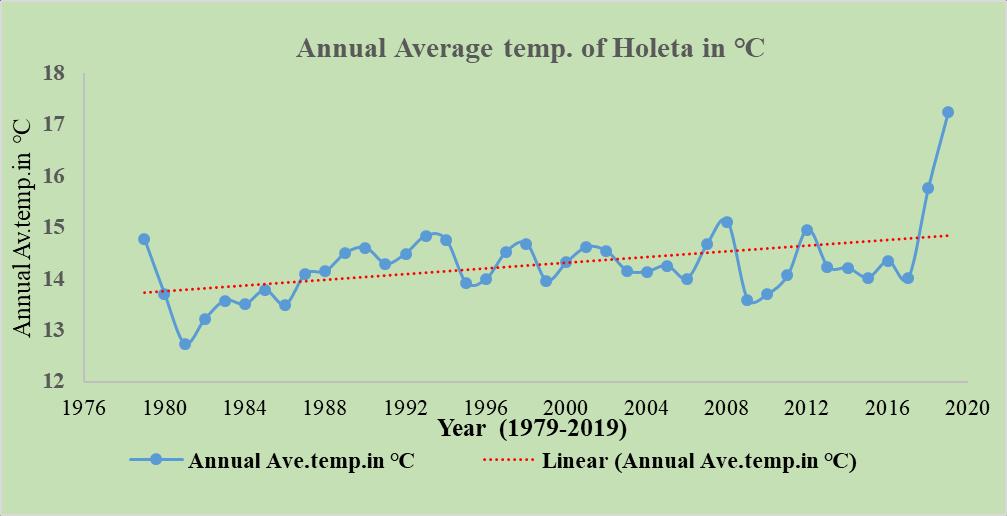
According to [18] there has been a general trend of atmospheric warming in Ethiopia. Average annual minimum and maximumtemperaturehavebeenincreasingby0.25and0.1 oCperdecaderespectively.Theaveragetemperatureincreaseper decadeforHoletaandBakoiso.25and0.2oCrespectively.Accordingtothesurvey,inBakoandAmboWoredas,therespondents also indicate there is frequent soil moisture stress due to the increased temperature and farmers compelled to grow maize varietiesofshortgrowingperiod.Moreover,inareasaroundHoletawhichisrelativelyhigheraltitude,thefarmershavestarted to grow maize which was formerly limited to low altitude areas. This indicates that the soil moisture stress is not only due to meteorological drought but due to increased evaporate-transpiration due to the overlap of time of maximum temperature period(MarchtoMay)and Belg rainvariabilityduringthegrowingperiods.ThisresultwouldhavebeensounderifAridityindex oftheareasiscalculatedbutorganizeddataonevaporate-transpirationwaslacking.
4. Conclusions and Recommendations
4.1 Conclusion
Theinvestigationintotheconsequencesofclimatechangeonrain-fedcropproductionforsmallholderfarmershasyielded several significant findings. By actively involving smallholder farmers in the research and data collection processes, participatory approaches have empowered them to contribute their knowledge and concerns, ensuring that assessments accurately reflect their lived experiences. The collection of localized data in the west Shoa Zone has shed light on the distinct challenges faced by farmers in different agro-ecological zones. By providing communities with access to climate information through diverse channels, informed decision-making regarding crop selection and resource management becomes possible. Capacity building programs that focus on climate-resilient farming techniques and crop diversification play a crucial role in helpingfarmerseffectivelyadapttochangingclimateconditions.Theimplementationofsocialprotectionmechanisms,suchas weather-indexed insurance and safety nets, assists farmers in coping with climate-related shocks. Additionally, factors such as age, education, access to resources, and market dynamics influence the ability to adapt to the impacts of climate change. Communities residing in the woredas of Ambo, Bako, and Holeta experience various climate variability impacts, which disproportionatelyaffectvulnerablegroupssuchasthepoor,landlessindividuals,disabledindividuals,women,children,andthe elderly.
International Research Journal of Engineering and Technology (IRJET) e-ISSN:2395-0056
Volume:11 Issue:04 | Apr 2024 www.irjet.net p-ISSN:2395-0072
Basedontheoutcomesofthestudy,thefollowingrecommendationsareforwardedtolocalcommunitiesandgovernment representatives.
The local government ought to implement policies that provide support and improve market access for smallholder farmersintheresearchareas.Furthermore,theyshouldpromotepoliciesthatgiveimportancetotherequirements and concerns of smallholder farmers, such as investing in rural infrastructure, establishing connections to markets, implementingmechanismsforpricestabilization,ensuringlandtenuresecurity,andcreatingregulatoryframeworks that encourage sustainable agriculture and climate adaptation. Agricultural stakeholders have the ability to design specificinterventionsandsupportsystemstostrengthenresilience,improvelivelihoods,andguaranteefoodsecurity amidstthechallengesposedbyclimatechange.
Thegovernmentoughttoenhancetheadaptationstrategiesoflocalresidentstoclimatechangebyprovidingvarious trainingsessionsatFarmersTrainingCenters(FTCs)inWoredas,kebeles,anddemonstrationsites.Toenhancetheir productivityandresilience,thegovernmenthasintroducedandmandatedthecommunitytoutilizenewagricultural technologies, inputs, fertilizer supplies, and various media. Furthermore, to assist smallholder farmers, the government should bolster the integration among different institutions, non-governmental organizations, and communities.
The government should enhance the number of meteorological stations and improve infrastructures to ensure the availabilityofweatherandclimateinformationforthelocalcommunity.Additionally,itiscrucialforthegovernment to assert the community's ownership over natural resources in order to conserve and restore them, as well as protect the environment. Furthermore, there is a need to enhance the accessibility and services of institutions to effectivelyaddresstheproblemsfacedbyfarmers.
In conclusion, it is suggested that further research be undertaken to thoroughly investigate the vulnerability to climatechange.Additionally,itisimportanttoassesstheeffectivenessofvariousadaptationoptionsinordertoinform policy decisions related to climate change adaptation. Developing a tailored adaptation menu specific to each locality will help account for the impacts of climate change and variability, ultimately leading to more effective adaptation strategies.
5. References
1. Abate Senbeta 2009. Climate Change Impact on Livelihood,Vulnerability and Coping Mechanisms: A Case Study of West-ArsiZone,Ethiopia.Mendeley.
2. Abebe, T. 2007. Assessment of Climate Change Impacts on the Water Resources of Megech River Catchment, Abbay Basin,Ethiopia.OpenJournalofModernHydrology.
3. Berkes and Jolly., F.a.D. 2001. Adapting to Climate Change: Social-Ecological Resilience in a Canadian Western Arctic CommunityConservationEcology.
4. Bernstein,L.,Bosch,P.,Canziani,O.,Chen,Z.,Christ,R.andRiahi,K.2008IPCC,2007:climatechange2007:synthesis report,IPCC.
5. Bewket,W.2006.RainfallvariabilityandcropproductioninEthiopiaCasestudyintheAmhararegion.Pr0ceedingsof the16thInternationalConferenceofEthiopianStudies.
6. Biazen, M. 2014.The Effect of Climate Change and Variability on the Livelihoods of Local Communities: In the Case of CentralRiftValleyRegionofEthiopia.OpenAccessLibraryJournal,1
7. Conference,G.F.(2008)ClimateChange:ABurningIssueforEthiopia:Proceedingsofthe2ndGreenForumConference HeldinAddisAbaba,31October-2November2007,GreenForum.
International Research Journal of Engineering and Technology (IRJET) e-ISSN:2395-0056
Volume:11 Issue:04 | Apr 2024 www.irjet.net p-ISSN:2395-0072
8. CSA-Ethiopia 2007 Population and Housing Census Central Statistical Agency, Minnesota Population Center Addis Ababa.
9. FAO2008aCLIMATECHANGEANDFOODSECURITY:,Rome.
10. FDRE Ministry of Environment and Forest 2015 Ethiopia's second National Communication to the United Nations FrameworkConventiononClimateChange(UNFCCC),AddisAbaba.
11. Fischer, G., Shah, M., Tubiello, F.N. and van Velhuizen, H. 2005. Socio-economic and climate change impacts on agriculture:anintegratedassessment,1990-2080.PhilosTransRSocLondBBiolSci360(1463),2067-2083.
12. FitsumBekele,D.K.,LisaneworkNegatu2017.DemonstratingEffectofRainfallCharacteristicson Wheat Yield: Caseof SinanaDistrict,SouthEasternEthiopia.AgriculturalSciences8.
13. FrankEllis2000.RuralLivelihoodsandDiversityinDevelopingCountries.OxfordUniversityPress.
14. Gebeyehu, B.Z.a.G. 2016. Climate Change in Ethiopia Variability, Impact, Mitigation, and Adaptation. International JournalofResearchandDevelopmentOrganisation2.
15. Getachew, B. 2009. Impacts of Climate Change on Crop Yields in South Gonder Zone, Ethiopia. World Journal of AgriculturalResearch.
16. Hundera,M.(2018)<MegereseHunderaMScThesis.pdf>.MSCThesis,JimmaUniversity,Jimma.
17. Iyalomhe,F.2011.Understandingdevelopingcountriesvulnerabilityandadaptationtoclimatechangeusingtheoretical changevulnerabilityframework.AfricanJournalofComputingandICT4(3),33-40.
18. McCarthy,J.J. 2001.Climatechange2001:impacts,adaptation,andvulnerability:contributionofWorkingGroupIIto thethirdassessmentreportoftheIntergovernmentalPanelonClimateChange,CambridgeUniversityPress.Cambridge UniversityPress.
19. MershaEngida1999.AnnualRainfallandpotentialevapotranspirationinEthiopia.JournalofNaturalResources.
20. Reduction,U.O.o.D.R.2008.Climatechangeanddisasterriskreduction.UnitedNationsDigitalLibrary.
21. Smith,J.B.,Klein,R.J.T.andHuq,S.2003Climatechange,adaptivecapacityanddevelopment.
22. Solomon,S.2008.ClimateChange2007:ThePhysicalScienceBasis.Report.
23. Temesgen Deressa 2008 Analyzing the Determinants of Farmers’ Choice of Adaptation Methods and Perceptions of ClimateChangeintheNileBasinofEthiopi,UniversityofPretoria,SouthAfrica,SouthAfrica.
24. Tol,R.S.J.F.,S.;Richels,R.G.etal.2000.Howmuchdamagewillclimatechangedo?Recentestimates.WorldEconomics.
25. UNSystemCEB2008 ActingonClimateChange:TheUNDeliveraingasone.
26. YohannesGebremichael and Mebratu Kifle 2009. Participatoryclimate-changeadaptation building onlocal innovation. CELEP.
27. Yue, X.-L. and Gao, Q.-X. 2018. Contributions of natural systems and human activity to greenhouse gas emissions. AdvancesinClimateChangeResearch9(4),243-252.
International Research Journal of Engineering and Technology (IRJET) e-ISSN:2395-0056
Volume:11 Issue:04 | Apr 2024 www.irjet.net p-ISSN:2395-0072
Firstofall,IwouldliketothanktheAlmightyGodforgivingmetheopportunityandguidancetoachievemygoalandto besuccessful in thispartof lifejourneysofar. ThenIwouldlike tothank my wifeandfamilyfortheirupbringingofmeand theirtirelesseffortsandsupportineverypath.
Iwanttogivemydeepestappreciation,deepgratitude,andrespectformyresearchadvisor, professorBinXu.Hehasdevoted his time tofollowupinpersonand via different ways ofcommunication,valuable guidance,andintellectual encouragement, critical comments from the early design of the proposal to the final write up of the study. He has inspired me to become an independent researcher and helped me realize the power of critical reasoning. He also demonstrated what a brilliant and hard-workingscientistcanaccomplish.Inaddition,Iwouldliketoexpressmygratitude,appreciation,anddeepestrespectfor myfriendsDiluDessalegn,AssaleMelkaandYonasKebede,forgivingmetheirunwaveringpersonalandprofessionalsupport. IwouldalsoliketoextendmythankstoBako,AmboandHoletaworeda’sEnvironmentalProtectionAuthorityOfficesfortheir support in providing necessary information, different resources, and relevant data collected from the study site with their valuableadviceandassistance.
Finally,butmostimportantly,IwouldliketothankmyspouseGenetBeyene,DaughterKenbonMelkamumybrotherDumessa Debelo. it would be an understatement to say that, as a family, we have experienced some ups and downs in the in my life. Every time I was ready to quit, you did not let me and I am forever grateful. This research stands as a testament to your unconditional loveandencouragement.Thank youall forsupportingandguiding metowhereIamtoday.MaytheAlmighty Godcontinuetoblessyouall!
1. BerkesandF.a.D.Jolly.,AdaptingtoClimateChange:Social-EcologicalResilienceina CanadianWesternArcticCommunityConservationEcology,2001.
2. Smith,J.B.,R.J.T.Klein,andS.Huq.Climatechange,adaptivecapacityanddevelopment.2003.
3. Fischer, G., et al., Socio-economic and climate change impacts on agriculture: an integrated assessment, 1990-2080. PhilosTransRSocLondBBiolSci,2005. 360(1463):p.2067-83.
4. UNSystemCEB,ActingonClimateChange:TheUNDeliveraingasone.2008.
5. Bernstein,L.,etal.,IPCC,2007:climatechange2007:synthesisreport.2008,IPCC.
6. FAO,CLIMATECHANGE ANDFOODSECURITY:,inReliefweb.2008:Rome.
7. Tol,R.S.J.F.,S.;Richels,R.G.etal.,Howmuchdamagewillclimatechangedo?Recentestimates.WorldEconomics,2000.
8. McCarthy,J.J.,Climatechange2001:impacts,adaptation,andvulnerability:contributionofWorkingGroupIItothethird assessment report of the Intergovernmental Panel on Climate Change, Cambridge University Press. Cambridge UniversityPress,2001.
9. Iyalomhe, F., Understanding developing countries vulnerability and adaptation to climate change using theoretical changevulnerabilityframework.AfricanJournalofComputingandICT,2011. 4(3):p.33-40.
10. Hundera,M.,<MegereseHunderaMScThesis.pdf>.2018,JimmaUniversity:Jimma.
11. Getachew, B., Impacts of Climate Change on Crop Yields in South Gonder Zone, Ethiopia. World Journal of Agricultural Research,2009.
International Research Journal of Engineering and Technology (IRJET) e-ISSN:2395-0056
Volume:11 Issue:04 | Apr 2024 www.irjet.net p-ISSN:2395-0072
12. CSA-Ethiopia, Population and Housing Census 2007, Central Statistical Agency, Minnesota Population Center Addis Ababa.
13. AbateSenbeta,ClimateChangeImpactonLivelihood,VulnerabilityandCopingMechanisms:ACaseStudyofWest-Arsi Zone,Ethiopia.Mendeley,2009.
14. FrankEllis,RuralLivelihoodsandDiversityinDevelopingCountries.OxfordUniversityPress,2000.
15. Ethiopia Ministry of Environment and Forest, Ethiopia's Second National Communication to the United Nations FrameworkConventiononClimateChange-UNFCCC.2015:AddisAbaba,Ethiopia.
16. Bewket, W., Rainfall variability and crop production in Ethiopia Case study in the Amhara region. Pr0ceedings of the 16thInternationalConferenceofEthiopianStudies,2006.
17. MershaEngida,AnnualRainfallandpotentialevapotranspirationinEthiopia.JournalofNaturalResources,1999.
18. FDRE Ministry of Environment and Forest, Ethiopia's second National Communication to the United Nations FrameworkConventiononClimateChange(UNFCCC).2015:AddisAbaba.