
International Research Journal of Engineering and Technology (IRJET) e-ISSN: 2395-0056
Volume: 11 Issue: 03 | Mar 2024 www.irjet.net p-ISSN: 2395-0072
International Research Journal of Engineering and Technology (IRJET) e-ISSN: 2395-0056
Volume: 11 Issue: 03 | Mar 2024 www.irjet.net p-ISSN: 2395-0072
Dr.M V S S Nagendranath1 , Kanuri Yamuna2 , Yajjavarapu Sai Sravani3 , Palasetti
Sri
Mounika
4
, Dintakurthi Priyanka5
1Professor, Dept. of Computer Science and Engineering, Sasi Institute of Technology & Engineering, Tadepalligudem, A.P, India.
2,3,4,5 Students of Computer Science and Engineering, Sasi Institute of Technology & Engineering, Tadepalligudem, A.P, India
Abstract - Mobileadhocduetoautonomousnodedirection, networks are selfconfiguring, structure-less systems for sendingdatafromoneconnectiontoanother.Oneofthekey difficulties in a network during information transmission is maintaining intermediate node information for efficient transmission. Additionally, the intermediary party can be hacking the data using wormhole and black hole assaults. As a result, this research suggests an efficient clustering methodology based on neighboring relationships. The transmitted node information protocols' surrounding relationships are analyzed by the protocol. Information from each similar node is gathered into a cluster. The configuration of the cl-head and nearby nodes is now being modified regularly to prevent middleman operation like wormhole and black hole. Additionally, the Fireflies algorithm-based Energy efficient routing protocol is used to efficiently regulate the energy consumption. The observational data,suchasthepacket delivery ratio,energy usage factor, and proportion of attack-free routing efficiency,arethenusedtoexaminethesystem'sefficiency.
Key Words: obility, throughput, loadbalance, scalability, fireflies, cluster head (cl-head).
Mobile ad hoc networks have experienced a fundamental increaseindemand.Infact,thiskindofnetworkhasbeen used in a variety of utilizes, including those in the industrial,economic,cultural,andenvironmentalfields,as well as in help desks, sensor networks, and communicative cars. Ad hoc networks' volatile communication is expected given how frequently the topology changes in these networks. Additionally, the mobility and energy limitations of mobile devices are a majorsourceofissues.Asaresult,amulti-clusternetwork design for wireless systems needs to be able to adapt to changingnetworkconfigurationsonthego[1].
Ad hoc network partitioning, or clustering, is used to address the inefficient use of power and bandwidth for direct communication between each node. In clustered communication, network nodes can be divided into
compact groups known as clusters, via which information transfer can be carried out. Each cluster often has a clhead who coordinates the gathering and aggregation of data inside that cluster[2]. Any node of the particular cluster typically transfers the data packets to the cl-head. Clusteringin WSNensuresthatfundamental performance goals are met with a greater number of sensor nodes. Because clustering raises the requirement for central structure and encourages local decisions, it also increases thescalabilityofWSN.
It is possible to separate the MANET structure into distributedandclusternetworks.Inadistributednetwork structure, all nodes play an equal role, and mesh topographicanatomycanbefreelychangedinresponseto node quality. The selection of the cluster head node is a crucial issue in clustering networks [3]. The performance of cluster-head nodes is superior to that of regular nodes, necessitatingmorepowerfulprocessingandmoreenergy. So choosing the cluster-head nodes is crucial in a clustering network. Clustering can solve issues with routing protocols, enhance the calibre of data transmission,andincreasenetworkscalability.InMANET, clusters offer a reliable means of tying together mobile nodes and efficiently allocating resources. They also offer a network layered environment through cluster to assure the stability of MANET structure. Clustering involves the cl-head, cluster members, and gateway, with the cl-head and gateway acting as the backbone nodes in a hierarchical ad hoc network. Cluster- Member (CM) is a regular node, and Cluster-Head (CH) is a cluster's local coordinator. The node in question is not a CH or a gateway
International Research Journal of Engineering and Technology (IRJET) e-ISSN: 2395-0056
Volume: 11 Issue: 03 | Mar 2024 www.irjet.net p-ISSN: 2395-0072
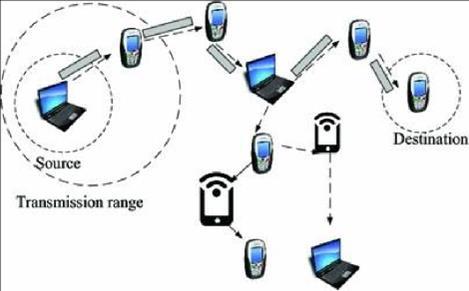
Clustering involves the cl-head, cluster members, and gateway, with the cl-head and gateway acting as the backbonenodesina hierarchicaladhocnetwork.ClusterMember(CM)isaregularnode,andCluster-Head(CH)isa cluster's local coordinator. The node in question is not a CHoragateway.
A cluster gateway is a shared node that connects two or more clusters and offers nodes to transmit information between clusters. The cl-head set is referred to as the dominant set [5].All services are provided by the cl-head totheothernodes.Ordinarynodesorclustermembersare terms for other nodes. Ordinary nodes cannot directly connect with other cluster members, but every member node has direct access to the cl-head.During communication, the CH frequently experiences load balancing problems, which causes the MANET nodes to loseenergymorequickly.Thisistheprimarycauseoflink failure .The unique clustering and optimised approaches based routing protocol is then used to address the problems with the network protocols. The approach uses the adjacent relationship idea to analyse the network's nodes, and related nodes are grouped together to form clusters.Sinceitisimpossibleforattackerstopredictboth the data flow and content, the created cl-head has been updated continuously to stop attacks.The Energy efficient routingprotocol,whichisbasedontheFirefliesalgorithm, is used to reduce energy consumption during transmission.
1. GENERAL ARCHITECTURE OF cl-head SELECTION FOR MANETS USING WEIGHTED CLUSTERING ALGORITHM
In this section fig 1 shows the general architecture of clhead selection for manets using weighted clustering algorithm. There are five phases in this architecture. The belowparagraphtellsbrieflyaboutthosefivephases.
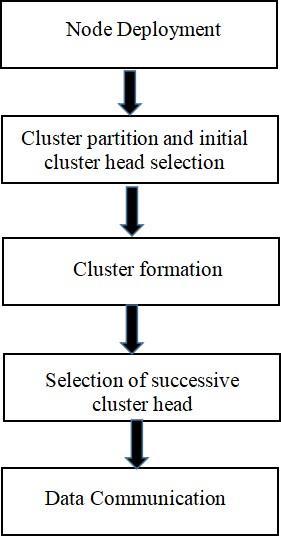
Fig.2: GeneralArchitectureofcl-headselectionformanets usingweightedclusteringalgorithm.
Here, first phase node deployment, after this phase initialization of cl-head takes place and it is the intermediate phase. And the one-third phase is cluster formation. In the forth phase selection of successive clhead takes place and finally in the fifth phase data communicationtakesanddatatransmitted.
2. Literature Survey
In this section, many writers discuss the approaches used invarioustypesofrouting algorithms.
cl-head Selection Methods
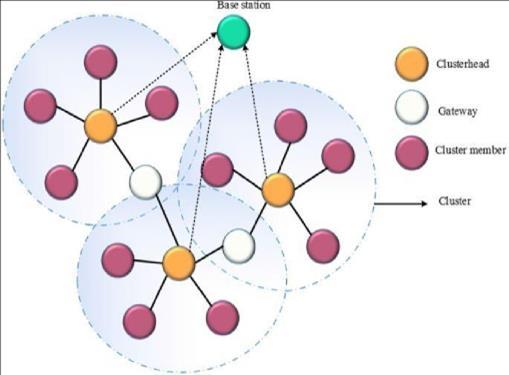
Fig.3-ClusteringFormation(Courtesy:D.PramodhKrishna etal…)
International Research Journal of Engineering and Technology (IRJET) e-ISSN: 2395-0056
Volume: 11 Issue: 03 | Mar 2024 www.irjet.net p-ISSN: 2395-0072
Kulkarnietal.(2017)[6]developedahighnodemobility in WCA causes frequent re-affiliations, which raises network overhead. Higher re-affiliation frequency causes thecluster assignmentto berecalculatedmore frequently, increasing communication overhead. Entropy-based clustering,whichproducesamorestablenetwork,fixesthe flaw in WCA. It uses an entropy-based methodology to evaluate the route stability in ad hoc networks and select the cluster leader. Entropy is a gauge of how chaotic and uncertain a system is Asa result, it givesa more accurate signalofthemobilityandstabilityoftheadhocnetwork.
Chia-Cheng Hu et al. (2012) [7] proposed a load balancingalgorithmoffertheelectedcl-headswithacloseby load balance. Once a node has been chosen as the clhead,itispreferredforittoremaininthatpositionforthe designated maximum period of time or program. The algorithm'sbudgetisauser-definedrestrictionthatcanbe adjustedtotakeintoaccounttheparticularsofthesystem, such as the battery life of one-on-one nodes. Each mobile nodeinthismethodhasavariablecalledavirtualID(VID), andthevalueofthisvariableisinitiallysetasthenode'sID number. The cl-head job is initiallyawarded to the mobile nodes with the highest IDs in their immediate vicinity. When a cl-head node uses up all of its duration budget, it resetsitsVIDto0andceasestobeacl-headnodebecause LBC placesa cap on thelongest continuous period of time that a nodecanserve as a cl-head. When two cl-heads are withinreachofoneanother,theonewiththegreatestVID becomes the new cl-head. The non-cl-head in the neighbourhoodwiththegreatestVIDscoremaysucceeda departingcl-head.Thenewlyselectedmobilenodehasthe shortest overall cl-headservice timein its neighbourhood, which should ensure a great force for the new clhead position. The disadvantage is that a mobile node's energy consumption may not always be accurately predicted by thecl-headservingtimealone.
A. H. Hussein et al. (2008) [8] suggested an algorithm's core concept centred on rapid topology changes adaption and minimized cl-head re-election. To choose the most advantageous combination of criteria for choosing a clhead, on the other hand. With this approach, we favour gatheringmetricsthatinfluencethecluster'sstability.Two stepsmakeupthesuggestedalgorithm.Theelectionofthe cl-head takes place in the first step, and the cluster's members are formed in the second. Each node must broadcast its ID to all of its other nodes within the same transmission range in order to determine the position of thenodesatthisfirststage.Eachneighbourwhoheardthe radiomessagecandeterminehowfarawayitis.Fromthe signal's strength that was received. Another option is the
Global Positioning System (GPS), however it has the drawback of using more energy. In the second phase constructionofcl-headmemberstakesplace.
X. Yang et al. (2013) [9] developed a 3-hop between adjacent cl-heads (3hBAC) technique produces a 1-hop non-overlapping clusters structure with three hops betweenneighbouringcl-headsandintroducesanewnode status called cluster guest. A mobile node known as a cluster guest node can connect to some clusters via a clustermemberbutisunabletoconnecttoanyCHdirectly. Themobilenodeswiththehighestnodedegreearechosen as the initial CH. If a mobile node has the highest node degreeinitsneighbourhoodandisnotdisqualifiedasaCH, it declares as a new CH. A mobile node enters the appropriateclusterasaclusterguestwhenitlearnsthatit cannotactasaCHorjoinaclusterasaclmemberbutthat oneofitsindividualisaclustermemberofanothercluster. For node maintenance, this method keeps the neighbouring CHs at least two hops away. Using this algorithm, fewer small unnecessary clusters and CHs are created.
Keerthipriya N et al. (2015) [10] proposes a system in order due to the multihop scenario and impulsive topographic anatomy changes via a wireless medium, mobile ad hoc networks struggle with network mobility andsafetysolutions.Someoftheseissuesareaddressedby the cluster-based approach. To enhance the operation of the mobile ad hoc network, the projected protocol employing fuzzy logic for cl-head selection under competence level, Goodness Function, and Mobility is employed. To execute routing and authentication over a network and ease network congestion, MANET is separated into clusters. This logic creates a cl-head that is completely secure, reliable, and has minimal network overhead. The cl-head is more effective thanks to the competencelevel, and thecluster is more stable thanksto themobilityfactor.
Reddy A. P et al. (2017) [11] proposed a system to maintain stable clustering construction, A DWCA is projected, which picks locally optimum cl-heads and incorporates power establishment at the cl-heads, to lengthen the life of the system's mobile nodes, reduce the burdenassociatedwithclustersetupandmaintenance,and achieve good end-to-end performance. A weighted clusteringapproachbasedonnodedegree,receivedpower level, stationary factor, and left over time batteries is proposed for MANETS in order to create stable cluster architecture and maintain the topology of the MANET as
International Research Journal of Engineering and Technology (IRJET) e-ISSN: 2395-0056
Volume: 11 Issue: 03 | Mar 2024 www.irjet.net p-ISSN: 2395-0072
stableasfeasible.Thechunkwiththefull fitnessischosen as the clhead after the performance is evaluated through simulation.
S. Muruganandam et al. (2021) [12] used four clustering techniquestoknowthe secureandtimereliablecl-headin thenetwork.
3.1.1
The suggested method groups network nodes based on their locations and power characteristics. The procedure begins by reading the network exposure and locating a group of mobile nodes that are instant in the network. Next, the network is divided into chunks. A set of nodes located are recognized for each region, and more nodes found are detected from neighbouring regions or a snapshot. The approach calculates the average distance between each of them. The nodes in the region are clusteredintoaclusteriftheavgdistinctbetweenthemare smaller than a certain threshold. Every region node is recognizedandgroupedsimilarly.
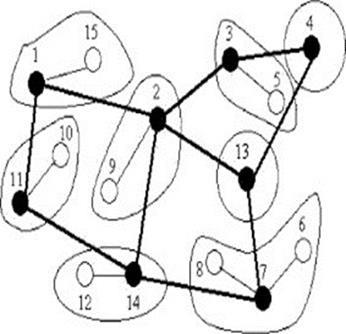
Fig-4: Optimalpathselection(Courtesy:MainakChatterjee)
3.1.2 Power centric reliable CH selection
When choosing a cl-head, the power-centric CH selection strategy takes into account various factors, including the quality available, the no.of transmissions made, the numberofretransmissionsmade,andtheno.ofneighbors. The projected a single node uses to find out the value of reliabledeliveryischosenasthecl-head,usingallofthese variables. 3.1.3 Dependable transmission support estimate using many factors
Any cluster's nodes use a variety of paths to get to the clhead and destination node. However, there are a no.of chunks in the network which has a unique security problem. Any malicious nodes on the route would disrupt
thetransmissionbyengaginginvariousimproperactionsif they were there. To achieve transmission efficiency, a secure route must be used. In order to achieve this, the approach calculates dependable transmission support estimate using many factors based on various variables, including force, quality, position, the no.of transmissions, success rate, and re-transmission values. The procedure calculates the value of MFRTS based on each of these variables. Based on the time value of MFRTS, the path is chosen.
The suggested approach uses a variety of security techniques to carry out data transmission in an encrypted manner. The approach determines the list of path in accordancewiththetopographicanatomyofclusterstodo this. The approach calculates multi-factor dependable transmission support for each of the accessible routes. According to the parameters of mobility, transmission volume,re-transmissionfrequency,andsuccessrateofthe route's point, the value of dependable transmission supportiscomputed. Theapproachcalculates the valueof MFRTS based on the measurements taken for each hop along the path. The technique chooses the route with the highest value based on MFRTS value. Data transmission hasbeendoneusingthechosenroute.
For the cluster formation procedure, P. Basu et al. (2001) [13] introduced a local mobility metric such that moving nodes with slower speeds than their neighbours have a chance to become cl-heads.The aggregate local speed of a mobile chunk is calculated by computing the moment of the link speed in relation to all of its neighbours. If this mobile node's variance value is low, it might not be as mobileasnodescloseby.Therefore,mobilenodeswithlow values for neighbour variation are selected as the cl-head. By limiting re-clustering for accidental interactions betweentwopassingclheads,timerisemployedforcluster maintenancetolowertherateofcl-headchange.
A cl-head is not always bonded to have a low movement features in comparison to its associates during the supporting phase because the quality behaviour of mobile chunks is not always taken into account in cluster maintenance. The mobility criterion is becoming less and less important over time. This method works well for MANETs with group mobility behaviour, in which a collectionofmobilenodestravelsinacoordinatedmanner, muchlikehighwaytraffic.Asaresult,achosencl-headmay often guarantee low mobility in relation to its member connections. Therefore, performance may suffer if mobile nodesmoveerratically.
Volume: 11 Issue: 03 | Mar 2024 www.irjet.net p-ISSN: 2395-0072
A. Johnson Santhosh et al. (2022) [14] proposed an algorithm to calculate the reliability factor. This method involves computing the dependability pair factor and the node's maximum energy toproduce the cl-head.A nodeis recognized as the cl-head when it has the most energy, with the nodes below it serving as the alternate cl-head. The alternative cl-heads are used in two situations. When the cl-head's energy level drops, the backup cl-head takes overautomatically.Theroutebetweenthesourcesandthe destination is discovered using the optimal way selection technique. This algorithm provides a strategy based on a node's highest energy and a minimum number of hops between nodes. This algorithm may allow us to find multiple paths with the same high energy. The alternate route must be picked if there are any crashes along the route.Thus,computationtimecanbeshortened.
D.Singhetal.(2018)[15]proposedanapproachtoadjust the AODV routing algorithm's route retention mechanism andpayspecialattentiontochooseanidealpaththatonly has the nodes that are the most appropriate between the source and the destination at any given time. The method changedtheoriginatornode'spacketheaderbyinsertinga newfieldwiththedefaultvalueof0calledHC(HopCount) (zero). A packet's hop count to the finish chunk is often reserve in HC. The value of HC has raised by 1 with each hop that has passed. The suggested method is to evaluate the packet HC value at the destination node to determine orupdatetheactivepath.
3.5 Location based routing Algorithm
S. Hadjiefthymiades et al. (2019) [16] developed an algorithm to perform clustering on basics of location information. The suggested method divided into four action stages, including cluster creation, data packet routing, location information, and location recovery maintenance, to carry out routing. The first is Cluster Formation. To avoid early establishment overheads associated with cluster organization, CLBR chooses and maintainthecl-headusing"regionalminimum"ratherthan "global minimum, "it determines the smallest heavy quantity for each node in the network. The second is LocationRecovery Processing, where the source node of a data collection keeps the data message in the frame and broadcasts an LREQ packet if it wants to transfer the packet which contains the data to the destination without usingtheroutingtable.Thethirdisdatapacketrouting,in which the source node, destination node, and neighbour node are used to determine the actual routing of data packets. The position of packets that do not use source routing, determines where they go from source to destination. Location Information is the final. The
established route continues to change as a result of the characteristicsofwirelesssensornetworks.
3.6 Real-Time traffic multicasting in Manets using Routing Algorithms.
Sapna B Kulkarni et al. (2015) [17] proposed a link for designnodes.Thecl-headnodesarethosewiththehighest levels of connectivity, bandwidth availability, and residual energy. A shortest path multicast tree is created using members as leaf nodes and the cl-head as group leaders. This facilitates the transmission of multimedia data to various recipients. The Top-N rule selection method algorithm is used after the cl-head has been chosen to partition multimedia traffic quickly and effectively. The data is divided in this method based on the hit rate. To distribute multimedia data to various recipients, the shortestpathmulticasttreeiscreatedusingtheTop-Nrule selectionmethodtechnique.TheNodeconnectivity,Energy and Bandwidth Aware Clustering Routing Algorithm for Mobile Ad Hoc Network is used to route data. After the shortestpathmulticasttreehasbeenconstructed.Foreach receiver, several distinct pathways are constructed when multicastingmultimediapackets.
K. Sindhanaiselvan et al. (2019) [18] developed a hybrid dynamic topology to choose the cl-head based on energy measurements. They conducted the experiment apply two variables power usage and the choice of cl-heads. Every clusterneedsaleader,orclhead(CH),whoactsasbridgeto faster communication between and within clusters by considering elements like node weightiness, level, compactness,quality,separatelyorincollection.Themain aimistosendthecontenttoeveryregioninthecluster,but it should also make itsimpler to communicate with nodes inotherclustersviathecl-headorintermediarynodes.
Tarek et al.(2015)[19] proposed the transparency based mobility communication networks. One of the most significant attacks that tracks all the data during information transit is the black hole attack. In order to preventintermediaryaccesstotheinformation,theauthor uses the networks is based on vector protocol in conjunction withan intrusion avoidancesystem.This plan of action is constructed using the NS2 machine tools, and its effectiveness is assessed by comparing it to the conventional ad hoc demand distance vector in terms of throughput, packet arrival ratio, and normalize routing load.
Black-Hole Assault Mohammad et al.(2020) [20] minimizing black hole attacks on the MANET
International Research Journal of Engineering and Technology (IRJET) e-ISSN: 2395-0056
Volume: 11 Issue: 03 | Mar 2024 www.irjet.net p-ISSN: 2395-0072
communication network in order to establish an effective communication system. The author analyses the answers in two different approaches. First, ad-hoc networks must beusedtochooseanefficientsourceanddestination.After determining the most efficient path, it is necessary to choose the packet header and sequence in an efficient manner. The implemented method is compared to the traditional and existing systems, and the publisher proposedastructurewhichisvalidabove75%andbelow 98%, ensuring the best and safest path with the least amountoftimeandmoneyspent.
Dharman, et al.(2016) [21] using the privacy network for the digit message approach with ad hoc networks to prevent the network's existing gray hole attack. The technique scans the end-to-end nodes in the network as well as the network topology in different directions. By carryingouttheintermediaryactivity,thegrayholeattack affected the network and dropped the packet. In order to make it harder to guess the real connection path, the root and end are identified and encrypted using the message digit approach. An ad hoc routing protocol effectively transmits the information from the estimated path. The group of effectiveness is then evaluated in terms of the messagetransmissionscaleusingtheNS2simulationtool.
In their comprehensive study [40], Sri Lakshmi et al. conductedadetailedstudyofthisalgorithmsinthistypeof networks, focusing on their impact on performance. They compared two existing methods, EA-DRP and EE-OHRA, and their results led them to recommend the Secure Optimization Routing (SOR) technique. SOR, a secure optimization algorithm for Mobile Ad Hoc Networks , was proposedinthepaper.Initially,SORidentifiestheshortest path between source and destination nodes. It then optimizesthispathusingageneticalgorithmtoenhanceits security features. The authors evaluated SOR's performance through simulation studies. Their experimentsdemonstratedthatSORsignificantlyimproves MANETsecurity by reducing some parameters. Thisstudy contributes to the understanding of MANET routing security in several ways. Firstly, it introduces a novel, dynamically adaptable secure optimization routing technique. Secondly, it provides a comprehensive performance analysis of the proposed method using simulation studies, enriching the existing knowledge on MANETroutingsecurity.
Duc M. Hoang et al.[41] introduced a novel algorithm named the AODV for Mobile Communication. They introducedthealgorithmthatselectsoptimalroutesbased on higher energy and performance compared to existing techniques like FF-AOMDV and EE-LB-AOMDV. Through simulated studies, the authors evaluated FT-AORP's performance, demonstrating its ability to enhance MANETs' fault tolerance in some parameters. This study's
aboutFault-TolerantutilizesMANETnodes'characteristics to identify reliable pathways for data transmission. Similarly,researchbyNishitShahetal.[42]introducedthe Genetic Algorithm-based Adaptable Routing Protocol (GARP) in Mobile Networks. GARP selects optimal routes basedon thehighestfitness value,considering factorslike thenumberofhops,linkreliability,andtrafficloadoneach link.Throughsimulatedstudies,theauthorsdemonstrated GARP's ability to enhance MANET performance, particularly in some parameters. This adaptive protocol tailors its routing paths to meet the network's requirements,ensuringefficient.
In their paper [43], Sabri et al. introduced two critical processesforenhancingEfficientRouteDiscoveryandLink Failure Detection in Source Routing Protocols for Mobile Ad-HocNetworks.Inthistypeofnetworkstheyimproving theefficiencyofroutediscoveryiscrucial,andonemethod involves reducing the number of nodes handling RREQ packets. In this source protocols, the Link Failure Prediction Mechanism (LFPM) plays a vital role in enhancing link failure detection effectiveness. LFPM predictstheprobabilityofalinkfailurebetweentwonodes based on their mobility and position data. When a link failure occurs, this information is utilized to determine whether to transmit a Route Error (RERR) packet. This approach can significantly reduce the volume of RERR packetssent,therebyimprovingtheoveralleffectivenessof linkfailuredetection.
In a study by Pattnaik et al. [44], a distinctive mobility and obstacle-aware algorithm for MANETs is introduced. Theauthorscriticallyassesspreviouseffortsandproposea strategythatconsidersbothmobilityinreal environments and obstacles. They develop a method employing Bezier curves and unique node lists to navigate around obstacles and select optimal paths based on mobility indicators and link reliability. This methodology resultsin thecreationof the"MobilityandObstacle-AwareRoutingAlgorithm.
"Additionally, another literature review in paper [45] provides an overview of existing routing techniques and their limitations. It discusses the shortcomings of the simplefloodingmechanism,particularlytheadverseeffects of excessive duplicated traffic. Fatemeh Safari et al. specificallyhighlighttheOn-demandprotocolasansample ofstraightforwardflooding,aprocessnotoriousforcausing broadcaststormsandweakintheperformanceofnetwork. To overcome this problem, their proposed approach employsaFuzzyInferenceSystem(FIS)tomakebroadcast decisions. This algorithm utilizes the Mamdani fuzzy inference system, known for its simplicity and low computational demands, and consists of a monitoring and fuzzy analysis module, along with a broadcast decisionmakermodule.
Saleh Ahmed Alghamdi et al.,well-versed in business process modeling, information systems, and smart city
International Research Journal of Engineering and Technology (IRJET) e-ISSN: 2395-0056
Volume: 11 Issue: 03 | Mar 2024 www.irjet.net p-ISSN: 2395-0072
development, constitute a significant research group [46]. Another notable researcher, Neenavath Veeraiah, specializes in SE.Additionally, Uppalapati Srilakshmi has contributed several articles on her research in secure multipath routing methods for Manets. The literature underscores the challenges faced by MANETs, including dynamic topology, wireless technology, and bandwidth limitations, rendering them vulnerable to hostile attacks. Consequently, finding secure protocols has become a research priority. To address this, hybrid optimization algorithms have been developed, combining techniques like the Genetic Algorithm (GA) and the Hill Climbing Algorithm (HCA). Moreover, hybrid routing protocols, integrating static and dynamic routing strategies, have been formulated. One such protocol is the Secure Optimization Routing (SOR) protocol, which combines (AODV) and Secure Routing Protocol (SRP) into an innovativehybridprotocol.
In their work, Neenavath et al. [47] delve into the challengesofmobileadhocnetworks,particularlyfocusing on limited energy resources and the necessity for energy efficient protocols. They highlight the crucial need for information pledge technology to secure MANETs and mitigate their security risks. The researchers propose a hybrid algorithm called the cat slap single-player method for MANETs, which ensures both trust-based security and energyefficiency.
This protocol employs multi-hop routing based on a hybrid approach to select optimal routes considering factors like delay, throughput, and connectivity. Fuzzy clusteringisutilizedtodesignateclusterheads(CHs)based on trust levels. The novel technology is rigorously evaluated and compared with existing methods, showcasingitspotentialforsignificantenergysavings.The utilization of the existing Minimum Cost Spanning Tree (MCST) posed challenges in terms of data transmission efficiency, particularly in providing an all-nodes-to-all shortestrouteinbroadcastnetworks,asdiscussedinpaper [48].
Collaborating with other researchers, Milan Kumar Dholey et al. developed a broadcast network based on Kruskal’s MCST broadcast network, serving as a foundational solution to enhance control message broadcastanddatatransmissionefficiency.DitipriyaSinha andAyanKumarDasproposedaugmentinghigh-frequency linkstothebasenetworkusingtheDijkstraalgorithm.The resulting High Frequency link-based broadcast network, analyzed through Omnet++, displayed a minor increase in control overhead compared to current methods. Despite the less-than-ideal routes, this approach significantly enhanced data efficiency while reducing link costs, especially as broadcast volume increased. Meanwhile, according to Hang Zhan et al. [49], Swarm Intelligencebased algorithms show promise in finding optimal
solutions for complex challenges. These algorithms, groundedinSwarmIntelligence(SI),offernotablebenefits such as high robustness and low cost. Xi Wang and Dieter Hogrefe highlighted Ant Colony Optimization (ACO) as an effective illustration of Swarm Intelligence. The proposed meta-heuristic Ant Colony Optimization technique successfully balanced the routing requirements of Mobile Adhocnetworks,addressingaspectslikePacketDelayand PacketDeliveryRate.
IntheresearchconductedbyJinbinTuetal.intheirpaper "An Active-Routing Authentication Scheme in MANET" [50],theauthorshighlightpotentialsecurityissuesarising from open channels and rapidly changing network topologies as solution tailored to active routing protocol characteristics. Their suggested Active Authentication Scheme(AAS)provesresilientagainstselectiveforwarding attacks and route spoofing attacks, making it compatible with numerous active routing protocols. This Active Authentication Scheme, as deduced from their study, is expectedtoenhancepacketdelivery,reducecollisionrates, and maintain network performance. Additionally, in the paper titled "An Adaptive On-Demand Multipath Routing Protocol with QoS Support for High-Speed MANET," authors Wenli Zhou et al. [51] argue that the impact of node mobility on link stability poses a challenge in developsaprotocolwhichprovidesquality.Inthiscontext of Mobile Ad-Hoc Networks, Zheng Chen emphasizes this necessityforadaptabilityinnetworkarchitecturetoensure QualityofService(QoS).Toaddresstheproblemsposedby high-speed node movement, the research proposes the utilization of the Topological change Adaptive Ad hoc Ondemand Multipath Distance Vector Protocol. Through its implementation, the study concludes that this protocol significantly improves QoS metrics, some parameters. Additionally, it demonstrates strong potential in supportingQoSrequirementsforhigh-speedMANETs.
In the research conducted by Kamlesh et al. [52], the effectiveness of the MMEE routing protocol introduces an innovative approach that has the potential to significantly enhance MANET performance. Unlike its counterparts, MMEE considers nodes' energy levels, bandwidth, and queue length when selecting routes. Additionally, it incorporatesamultipathmultichannelstrategytoimprove routing accuracy and efficiency. In comparison to EA-DRP and EE-OHRA, as outlined in [1], the MMEE routing protocol outperforms both in terms of packet delivery (99.9%), delay (0.36 MS), and throughput (0.85 Mbps). This highlights the MMEE protocol's superior reliability, efficiency, and capability in contrast to EA-DRP and EEOHRA.
Study [53] delves and focusing on the Branch and Bound algorithm.Addressingcomplexare essential insolving the energy efficiency optimization problem in MANETs. Researchers led by Wen kuang kuo proposed a tailored
Volume: 11 Issue: 03 | Mar 2024 www.irjet.net p-ISSN: 2395-0072
branch and bound (BB) method, leveraging the unique model structure.Thisapproachprovedhighlyeffectivefor globally optimizing energy efficiency issues in MANETs. The Energy Efficiency(EE)over One-HopRouting (OHRA) percentage, denoted as EE-OHRA, demonstrated a remarkable increase, up to 7.87 times when compared to one-hop routing protocols. This implies the suggested algorithm significantly enhances MANETs' energy efficiency. The final results affirm the algorithm's efficacy in finding effective solutions for the EE Optimization problem in MANETs, all while ensuring computational efficiencyandguaranteeingoptimalsolutions.
In their study, Shahenda et al. utilized the Elephant Herding Optimization (EHO) method and conducted tests usinganNS-3simulator toevaluate its effectiveness. They introduced a promising energy-efficient MANET routing protocol known as EHAODMV. According to [54], the EHO algorithm categorizes nodes into fit and unfit clans based ontheirenergylevels,wherenodeswithampleenergyare consideredfitwhilethoselackingenergyaredeemedunfit. This approach led to the development of the EHO-AOMDV routing protocol, employing the EHO algorithm to select optimalpathswithsuitablenodesbeforeusingthesepaths to transmit packets. Notably, this protocol offers more energy-efficient routing for MANETs compared to current routingprotocols.
A ground-breaking contribution from Aqeel Taha et al. [55] introduced the Fitness Function-based Ad hoc OnDemandMultipathDistanceVectorAlgorithm,delvinginto the challenges of developing energy-efficient routing protocols in Mobile Ad-Hoc Networks (MANETs) [4]. Described as a novel, energy-efficient multipath routing algorithm, FF-AOMDV selects routes based on fitness criteria. Notably, it surpasses the existing AOMR-LM and AOMDVprotocolsintermsofsomeparameters.
The FF-AOMDV outperforms AOMR-LM and AOMDV with an impressive EEOHRA percentage of 75%, surpassing AOMR-LM's 65% and AOMDV's 55%. Additionally, FF-AOMDV exhibits superior performance metrics, including some parameters ,outclassing both AOMR-LM and AOMDV. This study meticulously considers energy consumption, distance, and bandwidth of the links whenselectingroutes.
Intheirpaper[56],Y.HaroldRobinsonetal.introducea novel approach for managing network traffic overload in thistypeofNetworks(MANETs)througha freshlink-joint multipath routing strategy. This proposed method guarantees both reliability and load balancing, streamlining the selection of optimal paths for individual datapackets.TheLDMalgorithm,detailedin[1],calculates the path cost using a specific factor. When compared to other alternatives, the LDM algorithm outperforms in terms of some parameters. Through simulations, the LDM Algorithm was rigorously tested, revealing remarkable
results: achieving up to 99% packet delivery, a mere 100ms endto-end delay, and a substantial network throughputof200ms.Itstandsoutforitsabilitytoenhance network performance in crucial aspects ensuring both reliability and the load balancing. Tong Guang et al. introduced three innovative algorithms outlined in their paper [57]: "Multi-path Routing and MPTCP-Based Data Delivery Over MANETs." These algorithms include the QOE-Driven Packet Scheduling Algorithm, and the ImprovedMulti-Hop Algorithm.
Their emphasis lies to improves the Quality of Service (QoS) for phone devices within Mobile Ad Hoc Networks , all without relying on a fixed infrastructure. As stated in reference[2],theresearchdemonstratesthattheproposed algorithms and techniques significantly enhance the efficiency of utilizing multiple routing, Multi-Path TCP (MPTCP), and Quality of Experience (QOE). The study underscores the practicality and effectiveness of their proposed model while acknowledging the necessity for additionaldevelopmentandreal-worldtesting.
The AOMDV-GA protocol uses a genetic algorithm to create new routes that are more likely to be efficient, accordingtoacheckdonebyAntraetal.[58].Thedistance to the destination, the level of congestion on the routes, andtheenergylevelofthenodesalongtheroutearejusta few of the variables that affect how suitable a route is. In [3], the output is taken on the basis of delay, energy. The AOMDV-GAprotocolusesacongestioncontroltechniqueto avoid congested paths and maintains pathways to destinations, making it more resilient to connection failures and congestion. Though it is still in development, the AOMDV protocol has the capacity to be a useful tool. Evaluating a route's efficiency through a fitness function proves to be a promising strategy. In their paper titled "Neighbor-Based Dynamic Connectivity Factor Routing ProtocolforthistypeofNetworks"[59],ALIM.Ejmaaetal. highlighted the drawbacks of routing protocols relying solely on predetermined variables. The latter approach increases undesirable routing overhead and compromises system performance. To mitigate these issues, a novel routingprotocolwasintroducedbyShamalaSubramaniam et al. This protocol employs a unique connectivity factor, aiming to reduce RREQ overhead while enabling dynamic probing of the network's status. Their innovative solution was designed to enhance various aspects of performance, including some parameters. In their paper titled "Trust Routing Protocol Based on Cloud-Based Fuzzy Petri Net and Trust Entropy for this type of Network" [60], Xiao Liangetal.tackledthechallengedealingwithperformance metrics that are inherently fuzzy and difficult to quantify. Theseambiguitiesoftenleadtoerrorsinestimatingnodes' trustvalues.
Toaddressthisissue,theresearchersemployedanissueof trust approach depending on the cloud model and Fuzzy Petri Net (FPN). Their research focused on overcoming
International Research Journal of Engineering and Technology (IRJET) e-ISSN: 2395-0056
Volume: 11 Issue: 03 | Mar 2024 www.irjet.net p-ISSN: 2395-0072
these challenges using innovative methods. In a bid to provide the best quality in this type of Networks and surpass existing trust-based Optimized Link State Routing (OLSR) protocols, PENG ZHANG and Mei Qi proposed a novel routing algorithm. This algorithm, named Trust Entropy Routing Algorithm and Optimized Link State Routing , was designed to optimize link state routing and leveragetrustentropy.Theirapproachaimedtoelevatethe performance of MANETs in terms of trust-based routing protocols
TABLE-1: SUMMARY OF ROUTING ALGORITHM
BFOA:BacteriaforAgingOptimization
AODV:AdHocOn-DemandDistanceVector
GA:GeneticAlgorithm
HA:HybridAlgorithm
FPAODV:FixedProbabilityAdHocOn-DemandDistance VectorAlgorithm
4. Result analysis
We learned that various algorithms were proposed with various parameters after reviewing a number of papers. According to our expertise, we compared many parameters.
TABLE-2: PERFORMANCE EVALUATION WITH DIFFERENTPARAMETERS
The proportion of data packets effectively transmitted from the start terminal to the end terminal within the network is determined as the packet delivery ratio (PDR). This can be represented bythefollowingformula: (
PDR= *100 (1) (������������������������������)
The duration it takes for a data packet to traverse multiple routers and network segments from the beginning terminal to the ending terminal is known as delay.Thiscanbemathematicallyexpressedas:
Delay (2)

Where (2) denotes the total discrepancies between the transmission time (Si) & reception time (Ri) of n packets.
When discussing routing, the term "energy consumption" refers to the amount of electricity required by network equipment, such as switches, routers, and other networking devices, during the transmission and reception of data packets inside a computernetwork.
Energy= �� (3)
In equation (3), the dissimilarity between the starting energy (ini(i)) and the left energy (ene(i)) of ith component or device within the network is expressed as thesummationofthenthpowerofthesevariances.
International Research Journal of Engineering and Technology (IRJET) e-ISSN: 2395-0056
Volume: 11 Issue: 03 | Mar 2024 www.irjet.net p-ISSN: 2395-0072
TABLE-3: COMPARISON TABLE FOR VARIOUS PROTOCOLS
Protocols Accuracy Delay Through put Energy
AODV [19,21] Intermediate Low Intermediate Intermediate
PSOGA [1] Intermediate Low Intermediate Intermediate
P2P [12] Variable Change Variable Variable
GKCA Variable Change Variable Variable
CHSA [2,18,31]
Low Intermediate Intermediate
AODV [19,21] Variable Change Variable Variable
5.Challenges and gaps:
5.1 Adaptive Topology
Routingprotocolsmustadjusttothesemodificationsand createeffectiveroutesinreal-time
5.2 Threats to Security
Various security risks, such as rogue nodes, eavesdropping, and denial-of-service attacks, can affect MANETs. Security safeguards must be built into routing protocolstocounterthesedangers.
5.3Requirements for service quality
From straightforward data interchange to real-time multimedia streaming, MANETs are utilized for a variety ofapplicationswithdifferentqualityofserviceneeds.QoSsensitive traffic should be given priority via routing protocols.
6.Future research direction
6.1 Privacy-Preserving Routing:
PossibilityAddressuserdataprivacyissuesinMANETsbybuildingroutingprotocols
6.2 Energy-Efficient Protocols:
Research on energy-efficient routing protocols should be continuedinordertomeettherisingdemandforMANETs withlimitedenergyresources.
6.3 Security and Trust Mechanisms:
To combat growing threats, there is a chance to improve security and trust mechanisms in MANET routing protocols.
The literature review in my research sheds light on the authors' background and interests, focusing on the challenges related to energy conservation and security. It emphasizes the secure protocols based on trust. Several studies conducted by scientists have consistently shown that AODV outperforms other algorithms. AODV is highly regarded in mobile due to its on-demand routing approach, proactive route management, and effective adaptation to changing network conditions. AODV, emerging prominently from academic research, has demonstrated superior performance in comparison to alternative routing algorithms in various studies. Its key strength lies in its on-demand routing strategy, ensuring efficientresource utilization.Additionally,proactive route management techniques contribute to network stability even in dynamic scenarios, making it a reliable choice for addressing the unique challenges of mobile ad hoc networks. In summary, AODV's attributes make it a preferred choice in MANETs, where energy efficiency and securityarecriticalconcerns.
[1] T. Rahman, I. Ullah, A. U. Rehman and R. A. Naqvi, "Notice of Violation of IEEE Publication Principles: Clustering Schemes in MANETs: Performance Evaluation, OpenChallenges,andProposedSolutions,"inIEEEAccess, vol.8,pp.25135-25158,2020.
[2] P.Yuan,"AnOptimizedClusterAlgorithmforMANET," 2009, pp. 2555-2558,Datuk prof IrIshakIsmail , Mohd HairilFitriJaafar,“Mobile Ad Hoc Network Overview”, 2007ASIA-PACIFIC CONFERENCE ON APPLIED ELECTROMAGNETICSPROCEEDINGS,1-4244-1435-0/07, 2007IEEE.
[3] M.Saxena,N.Phate,K. J. Mathai and M. A. Rizvi, "Clustering Based Energy Efficient Algo-rithm Using MaxHeap Tree for MANET," 2014 Fourth International Conference on Com-munication Systems and Network Technologies,2014,pp.123-127.
[4] S. Aggarwal, D. Singh and Y. M. Sharma, "Refined Steering Procedure for MANETs," 2018 3rd International Conference on Communication and Electronics Systems (ICCES),2018,pp.350-354.
[5] M.Chatzidakis and S. Hadjiefthymiades, "Location Aware Clustering and Epidemic Trust Management in Mobile Ad Hoc Network," 2019 28th International
International Research Journal of Engineering and Technology (IRJET) e-ISSN: 2395-0056
Volume: 11 Issue: 03 | Mar 2024 www.irjet.net p-ISSN: 2395-0072
Conference on Com-puter Communication and Networks (ICCCN),2019,pp.1-7.
[6] S. B. Kulkarni and Yuvaraju B N, "Node connectivity, Energy and Bandwidth Aware18 Clustering Routing Algorithm for real-time traffic multicasting in MANET," 2015 IEEE International Advance Computing Conference (IACC),2015,pp.760-763.
[7] C. -C. Hu, "P2P Data Dissemination for Real-Time StreamingUsingLoad-BalancedCluster-ingInfrastructure in MANETs With Large-Scale Stable Hosts," in IEEE SystemsJournal,vol.15,no.2,pp.2492-2503,June2021
[8]A.H.Hussein,A.O.AbuSalemandS.Yousef,"Aflexible weightedclusteringalgorithmbasedonbatterypowerfor Mobile Ad hoc Networks," 2008 IEEE International Symposium on Industrial Electronics, 2008, pp. 21022107
[9] P. Zhao, X. Yang, W. Yu and X. Fu, "A Loose-VirtualClustering-Based Routing for Power Heterogeneous MANETs," in IEEE Transactions on Vehicular Technology, vol.62,no.5,pp.2290-2302,Jun2013.
[10] Keerthipriya N and R. S. Latha, "Adaptive cluster formation in MANET using particle swarm optimization," 2015 3rd International Conference on Signal Processing, Communication and Networking (ICSCN), Chennai, India, 2015.
[11] Reddy A.P,S. Jabbehdari, A. Rezaee and S. Adabi, "Distributed Fuzzy Score-Based Cluster-ing Algorithm for MobileAdHocNetworks,"2008IEEEAsia-PacificServices ComputingConference,Yilan,Taiwan,2008,pp.193-198.
[12] Muruganandam, S., Renjit, J.A. Real-time reliable clustering and secure transmission scheme for QoS development in MANET. Peer-to-Peer Netw Appl. 14, 3502–3517(2021).
[13]P. Basu,N.Khanand T. D.C.Little,"A mobility based metric for clustering in mobile ad hoc networks," Proceedings 21st International Conference on Distributed ComputingSystemsWorkshops,2001,pp.413-418.
[14] P. Yuan, "An Optimized Cluster Algorithm for MANET," 2009 First International Conference on Information Science and Engineering, 2009, pp. 25552558,Datuk prof IrIshakIsmail , Mohd Hairil FitriJaafar,“MobileAdHocNetworkOverview”,2007ASIAPACIFICCONFERENCEONAPPLIEDELECTROMAGNETICS PROCEEDINGS,1-4244-1435-0/07,2007IEEE
[15] D. Singh and Y. M. Sharma, "Refined Steering Procedure for MANETs," 2018 3rd International Conference on Communication and Electronics Systems (ICCES),2018,pp.350-354.
[16] S. Hadjiefthymiades, "Location Aware Clustering and EpidemicTrustManagementinMo-bileAdHocNetwork," 2019 28th International Conference on Computer CommunicationandNetworks(ICCCN),2019,pp.1-7.
[17] S. B. Kulkarni and Yuvaraju B N, "Node connectivity, Energy and Bandwidth Aware Cluster-ing Routing Algorithm for real-time traffic multicasting in MANET," 2015 IEEE International Advance Computing Conference (IACC),2015,pp.760-763.
[18] Sindhanaiselvan, K., Mannan, J.M. & Aruna, S.K. Designing a Dynamic Topology (DHT) for Cluster Head SelectioninMobileAdhoc Network.MobileNetwAppl25, 576–584(2020).
[19 ]Tarek M. Mahmoud, Abdelmgeid A. Aly, Omar Makram,“A Modified AODV Routing Proto-col to Avoid Black Hole Attack in MANETs”, International Journal of Computer Applications (0975 – 8887), Volume 109 – No. 6,2015..
[20] Mohammad Al-Shurman, Seong-Moo Yoo, Seungjin Park,“BlackholeattackinmobileAdHocnetworks”,ACMSE 42 Proceedings of the 42nd annual Southeast regional conference2020.
[21]Dharman, G. Venkatachalam, “Detection of Gray Hole Attack in AODV for MANETs by using Secure Message Digest”, South Asian Journal of Engineering and TechnologyVol.2,No.17(2016)321–329.
[22] Y. -X. Wang and F. S. Bao, "An Entropy-Based WeightedClusteringAlgorithmandItsOptimizationforAd Hoc Networks," Third IEEE International Conference on Wireless and Mo-bile Computing, Networking and Communications(WiMob2007),2007,pp.56-56.
[23] S.Rohini and K. Indumathi, "Consistent cluster maintenance using Probability Based Adaptive Invoked Weighted Clustering Algorithm in MANETs," 2011 National Conference on In-novations in Emerging Technology,2011,pp.37-42.
[24] A. Katal, M. Wazid, R. S. Sachan, D. P. Singh and R. H. Goudar, "Effective Clustering Technique for Selecting Cluster Heads and Super Cluster Head in MANET," 2013 International Conference on Machine Intelligence and ResearchAdvancement,2013,pp.1-6.
[25] S. -J. Yang and H. -C. Chou, "Design Issues and Performance Analysis of Location-Aided Hierarchical Cluster Routing on the MANET," 2009 WRI International Conference on Communications and Mobile Computing, 2009,pp.26-31.
© 2024, IRJET | Impact Factor value: 8.226 | ISO 9001:2008
|
International Research Journal of Engineering and Technology (IRJET) e-ISSN: 2395-0056
Volume: 11 Issue: 03 | Mar 2024 www.irjet.net p-ISSN: 2395-0072
[26] Wang, X. Content-Centric Networking for Mobile Networks.WirelessPersCommun109,89–110(2019).
[27] M. Ahmad, A. Hameed, A. A. Ikram and I. Wahid, "State-of-the-Art Clustering Schemes in Mobile Ad Hoc Networks: Objectives, Challenges, and Future Directions," inIEEEAccess,vol.7,pp.17067-17081,2019.
[28] F. Aftab, Z. Zhang and A. Ahmad, "Self-Organization Based Clustering in MANETs Using Zone Based Group Mobility," in IEEE Access, vol. 5, pp. 27464-27476, 2017, doi:10.1109/ACCESS.2017.2778019.
[29] P. Zhao, X. Yang, W. Yu and X. Fu, "A Loose-VirtualClustering-Based Routing for Power Heterogeneous MANETs," in IEEE Transactions on Vehicular Technology, vol.62,no.5,pp.2290-2302,Jun2013.
[30]SabbarInsaifJassim“PerformanceStudyofAODV,GRP and OSPFv3 MANET Routing Proto-cols Using OPNET Modeler”inNumber8Volume19August2013Journal of Engineering,pp.1039-1055.
[31] Pathak, S., Jain, S. An optimized stable clustering algorithm for mobile ad hocnetworks. J Wireless Com Network2017,51(2017).
[32] F. D. Tolba, D. Magoni and P. Lorenz, "A Stable ClusteringAlgorithmforHighlyMobileAdHocNetworks," 2007 Second International Conference on Systems and Networks Communications (ICSNC 2007), 2007, pp. 1111. Y. Song, H. Luo, S. Pi, C. Gui and B. Sun, "Graph Kernel Based Clustering Algorithm in MANETs," in IEEE Access, vol.8,pp.107650-107660,2020.
[33]Y.Song,H.Luo,S.Pi,C.GuiandB.Sun,"GraphKernel Based Clustering Algorithm in MA-NETs," in IEEE Access, vol.8,pp.107650-107660,2020.
[34] Taneja S. and Kush A., (2010): A Survey of Routing Protocols in Mobile Ad Hoc Networks”, International Journal of Innovation, Management and Technology , Vol. 1,No.3,pp.279-285.
[35] Goyal M., Soperi M., Baccelli E., Choudhury G., Shaikh A.,HosseiniH.,TrivediK.,(2008):ImprovingConvergence Speed and Scalability in OSPF: ASurvey., IEEE Communications Surveys & Tutorials, 99, DOI : 10.1109/ SURV.2011.011411.00065,pp.1–21.
[36] Pei G., Spagnolo P. A. and Templin F. L., (2008): EnablingOSPFv3MANETExtensionsoverIPv4Encryptors, 978-1-4244-2677-5/08/IEEE.
[37] Ning Du, Huijing Yang, Chunying Wang, (2012): An Optimized OSPF Routing Protocol for Mobile Ad-hoc Networks", JOURNAL OF NETWORKS, VOL. 7, NO. 9, pp.1456-1463.
[38] T. R. Andel and A. Yasinsa c, "On the credibility of MANETsimulations,"Computer,vol.39,pp.48-54,2006.
[39]D.Cavin,Y.SassonandA.Schiper,"Ontheaccuracyof MANET simulators," in Proceed-ings of the Second International Workshop on Principles of Mobile CommercePOMC’2002,2002,pp.38-43.
[40] Srilakshmi, U. S. (2022). A Secure Optimization Routing Algorithm for Mobile Ad Hoc Networks. IEEE, 14260-14269.20
[41] Hoang, D. N. (2022). Fault- Tolerant Ad Hoc OnDemand Routing Protocol for Mobile Ad Hoc Networks. IEEE,111337-111350.
[42] Shah, N. H.-O. (2022). Adaptive Routing Protocol in Mobile Ad-Hoc Networks Using Genetic Algorithm. IEEE, 132949-132964.
[43] Khudayer, B. H. (2020). Efficient route discovery and link failure detection mechanisms for source routing protocolinmobilead-hocnetworks.IEEE,24019-24032.
[44] Pattnaik, P. K. (2021). Design of novel mobility and obstacle-aware algorithm for optimal Manet Routing. IEEE,110648-110657.
[45] Safari, F. H. (2023). A Novel Cross-layer Adaptive Fuzzy-based Ad hoc On-Demand Distance Vector Routing ProtocolforMANETs.IEEE.
[46]Srilakshmi, U. N. (2021). An improved hybrid secure multipath routing protocol for MANET. IEEE, 163043163053.
[47] Veeraiah, N. O. (2021). Trust aware secure energy efficienthybridprotocolforManet.IEEE,120996-121005.
[48] Dholey, M. K. (2020). A novel broadcast network design for routing in mobile ad-hoc network. IEEE, 188269-188283.
[49] Zhang, H. X. (2017). A survey of ant colony optimization based routing protocols for mobile ad hoc networks.IEEE,24139-24161.
[50] Tu, J. D. (2021). An active-routing authentication schemeinMANET.IEEE,34276-34286.
[51] Chen, Z. W. (2020). An adaptive on- demand multipath routing protocol with QoS support for highspeedMANET.IEEE,44760-44773.
[52] Chandravanshi, K. G. (2022). Design and Analysis of anEnergy-EfficientLoad BalancingandBandwidthAware Adaptive Multipath N-Channel Routing Approach in MANET.IEEE,110003-110025.
International Research Journal of Engineering and Technology (IRJET) e-ISSN: 2395-0056
Volume: 11 Issue: 03 | Mar 2024 www.irjet.net p-ISSN: 2395-0072
[53] Kuo, W.-K. a.-H. (2016). Energy efficiency optimizationformobileadhocnetworks.IEEE,928-940.
[54] Sarhan, S. a. (2021). Elephant herding optimization Ad Hoc on-demand multipath distance vector routing protocolforMANET.IEEE,39489-39499.
[55]Taha,A.R.(2017).Energyefficientmultipathrouting protocol for mobile ad-hoc network using the fitness function.IEEE,10369-10381.
[56] Robinson, Y. H.-B. (2019). "Link-disjoint multipath routingfornetworktrafficoverloadhandlinginmobileadhocnetworks.IEEE,143312-143323..
[57] Zhang, T. S. (2020). Multipath routing and MPTCPbaseddatadeliveryovermanet.IEEE,32652-32673.
[58] Bhardwaj, A. a.-O. (2020). Multipath routing protocol using genetic algorithm in mobile ad hoc networks. IEEE, 177534-177548.
[59] Ejmaa, A. M. (2016). Neighbor-based dynamic connectivity factor routing protocol for mobile ad hoc network.IEEE,8053-8064.
[60] Wang, X. P. (2020). Trust routing protocol based on cloud-based fuzzy petri net and trust entropy for mobile adhocnetwork.IEEE,47675-47693.