
International Research Journal of Engineering and Technology (IRJET) e-ISSN: 2395-0056
Volume: 11 Issue: 03 | Mar 2024 www.irjet.net p-ISSN: 2395-0072
International Research Journal of Engineering and Technology (IRJET) e-ISSN: 2395-0056
Volume: 11 Issue: 03 | Mar 2024 www.irjet.net p-ISSN: 2395-0072
B Rajesh1 , K Nimai Chaitanya2 , P Tejesh Govardhan3, K Krishna Mahesh4 , B Sudarshan5
1Assistant Professor, Dept. of CSE GITAM(Deemed to be University), Visakhapatnam, Andhra Pradesh, India 2,3,4,5 Student, GITAM(Deemed to be University), Visakhapatnam, Andhra Pradesh, India
Abstract - There is a lot of information available on the internet today, but it can be difficult to obtain it quickly and efficiently. It can be difficult to find exactly the information you need to understand a particular topic. The context of the text is useful for extracting the most important information from the various contents of the text. In the age of information overload on the Internet, automatic document summarization is especially important for retrieving important information from many electronic documents. Text summarization that uses natural language processing to summarize text. There are many ways to describe different methods of explanation: extraction and abstraction from single or mixed data; the purpose of content reduction; features of the manuscript; process from shallow to deep; and the content of the article. With the increase in internet and smartphone usage, online shopping has also increased. Everyone wants their belongings to be delivered to their home in good condition. But reading these long reviews is not easy for everyone. Therefore, brevity should be able to reduce long words into short sentences with shorter words describing the same subject.
Keywords - Text summarization, information retrieval, electronic text, extraction, abstraction, online shopping.
Inaneracharacterizedbytheexponentialgrowthofdigital information, the ability to distil large volumes of text into conciseyetinformativesummarieshavebecomeanessential task.NaturalLanguageProcessing(NLP)revolutionizeshow we interact with and make sense of textual data. Text summarization,aprominentapplicationofNLP,addresses thechallengeofcondensinglengthydocuments,articles,or passagesintoshorterversionswhileretainingthecoreideas andcriticalinformation.
Theartofsummarizationdatesbackcenturies,fromearly human-curatedabstractstomodern-dayalgorithmsdriven bycomputationallinguistics.However,thesurgeinonline content creation and the demand for quick access to information has prompted the need for automated and efficient text summarization techniques. NLP techniques have truly shined, enabling machines to comprehend, analyze,andgeneratehuman-likesummaries.
There are two primaryapproaches totext summarization: extractiveandabstractivesummarization.
***
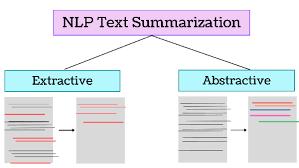
Fig-1: ExtractiveandAbstractive
1.1
Itinvolvesselectingandrearrangingsentencesdirectly from the source text and extracting the most informative sentencestoformacoherentsummary.Themethodologyof the extractive text summarization includes reading the document, it will then clean the text and then weighs the sentence scores by the nlargest() function in the Heapq model.
The process of Extractive text summarization includes the following:
I. TextPre-Processing
II. SentenceScoring
III. SentenceSelection
IV. Post-processing
Abstractive summarization goes a step further by generatingnewsentencesthathasthesamemeaningofthe original content. This approach requires a deeper understanding of language and context, often involving techniquessuchaslanguagegenerationmodels.
The challenges in text summarization are multifaceted. NLPmodelsmustdiscerntheimportanceofsentences,grasp contextualnuances,andensuregrammaticalaccuracywhile craftingsummaries.Additionally,theymusthandlevarious text types, such as news articles, research papers, social mediaposts,andmore.TheapplicationsofNLP-basedtext summarizationarediverseandimpactful.Newsagenciescan automatetheprocessofgeneratingnewsdigests,enabling readerstograsptheday'seventsquickly.Researcherscan sift through numerous academic papers to find relevant studiesefficiently.Itisusedforsummarizingthereviewsof
International Research Journal of Engineering and Technology (IRJET) e-ISSN: 2395-0056
Volume: 11 Issue: 03 | Mar 2024 www.irjet.net p-ISSN: 2395-0072
online products. Content creators can repurpose their articlesintoshorterformatsfordifferentplatforms.
[1] Shetty, K. et al. Text summarization through clustering and token extraction is a technique that involves breaking down a text into clusters of related content, often using clustering algorithms. Within these clusters, the text is tokenized, resulting in individual words or phrases. Each tokenisthenassignedarelevancescoreusingmethodslike TF-IDForText-Rank.Thehighest-scoringtokenswithineach cluster are chosen as representative keywords or phrases. These selected tokens from all clusters are combined to createa summary,offeringa conciserepresentationofthe primarythemesandinformationfoundintheoriginaltext. Thismethodisvaluableforcondensinglargevolumesoftext andhighlightingkeydetails.
[2]Haque,M.Metal.Theincreasingvolumeofinternetdata hasmadeefficientinformationretrievalcrucial.Usersoften need help to extract essential information from search results.Automatictextsummarizationsystemsoffervarious benefits, including enhanced research efficiency by eliminatingredundantinformation,improvedpresentation on small devices, and reduced machine translation time. Theseadvantagesmaketextsummarizationavaluabletool formanagingvastonlineinformation.
[3]Booruguetal.Therehasbeenacontinuousincreasein internet users every year. With increased Internet users comes a great deal of information stored online every second. There is a need to summarize this data while retainingtheoriginalmeaningofthedata.Thus,theprocess of Text Summarization comes into the picture with its benefits spread over different fields such as Machine Learning,NaturalLanguageProcessing,ArtificialLearning, andSemantics.
[4]Adhikari,S.etal.Intoday'sdata-centricworld,wherewe produce and consume vast amounts of information, text summarization plays a crucial role. It condenses textual content, making it easier to extract essential insights. Various techniques, including machine learning, neural networks,andNLPlibrarieslikescikit-learnandNLTK,are employedtoachievethis.
[5] JUGRAN, S. et al. Extractive text summarization is a powerful tool for rapidly extractingthe gist of elaborated text. It is particularly useful for scanning large reports and identifyingthe mostimportantdata. Thisprojectaimsto developatextsummarizationmodelbasedontheextractive approach,whichusesthesamesetofimportantwordsfrom the original text to generate a shorter, more concise summary. We will evaluate the effectiveness of different methods for distinguishing between different summaries basedonsizeandaccuracy.
[6]Christian,H.etal.Itdiscussesthegrowingneedfortext summarization due to the rapid increase in textual data, particularlyontheinternetandsocialmedia.Ithighlightsthe role of Natural Language Processing (NLP) in text summarization, explaining two methods: extractive and abstractive summarization, with a focus on the Term Frequency-InverseDocumentFrequency(TF-IDF)method.It also outlines the four main steps in building an extractive summarization program, from preprocessing to summary generation.
[7]Theextractivetextsummarizationinvolvesthestepsof text-cleaning, formatting and tokenization. It will collect words that are frequently repeated and collects into word frequencytablesothatitcanknowaboutthemeaningand importanceoftheword.
[8] Awasthi, et al. Text summarization is a NLP challenge where software shortens texts to highlight key points. It's categorized by input type (single/multi-document, generic/domain- specific, query-based) and output type (extractive/abstractive). Applications include media monitoringandmore.
[9]Prakash,N.C.etal.Automatictextsummarizationusing spaCyisaprocessthatemploysthespaCylibraryfornatural languageprocessing.Itbeginsbyparsingandtokenizingthe inputtextandthenscoresindividualsentencesbasedontheir relevance. This is typically accomplished using the Term Frequency-InverseDocumentFrequency(TF-IDF)algorithm. Thesentenceswiththehighestscoresareselectedtoforma concisesummary,effectivelycondensinglengthydocuments orarticlesintoshorter,coherentversions.
[10] Khan, R. et al. Text summarization is a technique to extractthemostessentialinformationfromatextdocument. The experimental results show that this method is used to achievegoodresultsforextractivetextsummarization.
Textsummarizationistheprocessofgeneratingashorter version of a text document without removing the most essentialinformation.Thisisbecausedifferent people may have different opinions on what is important, and the importanceofinformationmayalsodepend onthecontext. Problem with text summarization is that it is difficult to generate a summary that isboth fluent and informative Summariesoftenneedtobeconcise,buttheyshouldalsobe easytoreadandunderstand.
The main objective is to develop algorithms that can automatically generate accurate, fluent, and concise summariesoftextdocuments.
International Research Journal of Engineering and Technology (IRJET) e-ISSN: 2395-0056
Volume: 11 Issue: 03 | Mar 2024 www.irjet.net p-ISSN: 2395-0072
Specifically,NLP-basedtextsummarizationsystemsshould beableto:
Generateasummarythatisfluentandeasytoread.
Generate a summary that is concise, but still containsthesameinformationfromthetext.
Be able to summarize a variety of text types, includingnewsarticles,scientificpapers,andemail messages.
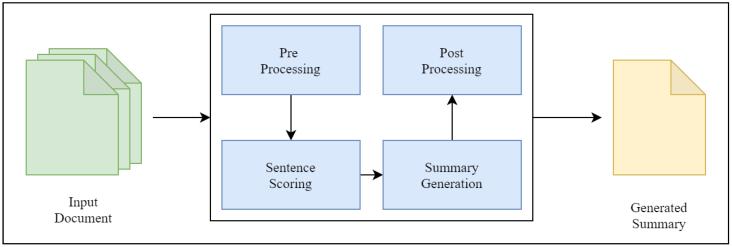
TheprocessofExtractivetextsummarizationincludesthe following:
I. TextPre-Processing
II. SentenceScoring
III. SentenceSelection
IV. Post-processing
I. TextPre-Processing:Thisstepinvolvestakingthe input text from the user, and then it starts cleaning the text by removing stop words, punctuation,andotherirrelevantcharacters.
Thepre-processinginvolvesthreestepsoftheprocess:
a) Textformattingistheprocessofformattingthetext intolowercaseletters.Itwilleditallthelettersof the text into lowercase. It will be easy to summarizetheessentialpoints.
b) Text-Cleaning:Itistheprocessofremovingspelling mistakes, punctuation, and special characters presentinthetext.
c) Tokenization: It is the process of breaking the words into single tokens. It will divide both the wordsandsentences.
(1) Sentence Tokenization: The sentence tokenization will break a paragraph into sentences.
(2) WordTokenization:Thewordtokenization willoccurafterthesentencetokenization, andthenthewordinthesentencewillbe divided.
II. SentenceScoring:Itistheprocessofmeasuringthe importanceofthesentence.
III. SentenceSelection:Thesentencesthatgetthetop priority will be selected. The length of the sentencewillalsobereduced.
IV. Post-Processing: This step involves merging the sentences with the same meaning and correctingthetext'sgrammaticalerrors.
Spacy library:
ItisalibraryinpythonusedinNaturalLanguageProcessing (NLP). We have chosen this library because it helps in buildingapplicationsthatprocesslargevolumesoftext.
Heapq:
“heapq”isaPythonmodulethatprovidesanimplementation oftheheapqueuealgorithm. It is part of Python's standard library and is used for efficientlymaintainingapriorityqueuedatastructure.
NLP:
NLP is a computer program, that has the ability to understandhumanlanguage.Itisacomponentofartificial intelligence(AI).WehavechosenNLP becauseitcontains thetwomainphases.
NLTK:
ItisalibraryinpythonusedinNaturalLanguageProcessing (NLP).WehavechosenNLTKbecauseithasthelibrariesof textprocessingtoperformtheoperationsliketokenization, parsing,andclassification.
Flask:
Itisalightweightandwebframework forPython,usedto make web applications quick and easy. It was created by ArminRonacherin2010andhassincebecomeone ofthe mostpopularframeworksforwebdevelopmentinPython.
1.Installthelibraries i.SetupTools ii. Spacy iii.“en_core_web_sm”libraries.
International Research Journal of Engineering and Technology (IRJET) e-ISSN: 2395-0056
Volume: 11 Issue: 03 | Mar 2024 www.irjet.net p-ISSN: 2395-0072
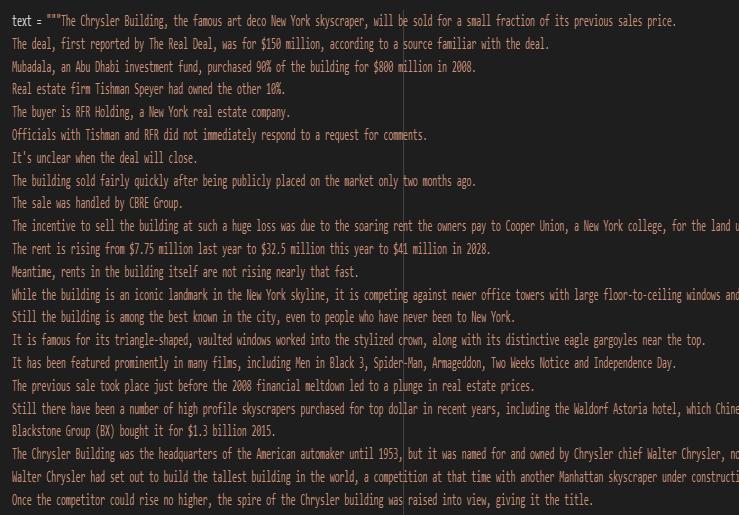
2.LoadstheEnglishlanguagemodelprovidedbyspaCy.
3. Processes the input text using spaCy to tokenize it into wordsandsentences.
4.Loadtheinputinto“doc”
5. Counts the frequency of each word in the text after filteringout“stopwords”and“punctuation”marks.
6.Normalizesthewordfrequenciesbydividingthembythe maximumfrequency.
7.Tokenizesthetextintosentences.
8.Calculatesascoreforeachsentencebasedonthesumof normalizedfrequenciesofthewordsitcontains.
9. Selects a subset of sentences with the highest scores to formthesummary.
10. Joins the selected sentences into a single string to generatethefinalsummary.
11.Printsboththeoriginaltextandthegeneratedsummary, alongwiththeirrespectivelengthsintermsofthenumberof words.
Rouge:
ROUGE(Recall-OrientedUnderstudyforGistingEvaluation) stands as a comprehensive suite of metrics designed to assesstheefficacyofautomaticsummarizationalgorithmsin producingtextsummaries.Thisevaluationmethodgauges the degree of overlap between summaries generated by systems and predetermined reference summaries. By analyzingthisoverlap,ROUGEoffersvaluableinsightsinto the effectiveness of a summary in encapsulating essential informationfromthesourcetext.
1.
A recall of 0.5795 indicates that 57.95% of the unigrams presentinthereferencesummarywerealsocapturedinthe generated summary. Similarly, a precision of 0.3835 suggests that 38.35% of the unigrams in the generated summary are relevant to the reference summary. The F1scoreof0.4615providesabalancedevaluationofrecalland precision(harmonicmean)providingabalancedmeasureof thesummarization'saccuracy.
2. ROUGE-2 Score (Bigram Overlap):
A recall of 0.4167 indicates that 41.67% in the reference summarywerematchedinthegeneratedsummary,whilea precisionof0.2674suggeststhat26.74%inthegenerated summaryarerelevant.TheF1-scoreof0.3257reflectsthe balancebetweenrecallandprecisionforbigramoverlap.
3.
A recall of 0.5682 suggests that 56.82% of the LCS in the referencesummarywascapturedinthegeneratedsummary, whileaprecisionof0.3759indicatesthat37.59%oftheLCS in the generated summary is relevant. The F1-score of 0.4525 provides a balanced evaluation of recall and precisionforLCSoverlap.
The ROUGE scores provide valuable insights into the accuracy of the text summarization algorithm. Higher the scores,particularlyfor“ROUGE-1”and“ROUGE-L”,indicatea strongeralignmentbetweenthegeneratedsummaryandthe reference summary, suggesting a more accurate summarizationprocess.
PyTorchisapowerfulandversatilemachinelearninglibrary in Python, offering dynamic computation graphs, tensor operations,automaticdifferentiation,andahigh-levelneural network module. Its flexibility, ease of use, and growing ecosystemmakeitapreferredchoiceforbothresearchand production-leveldeeplearningprojects.
Inconclusion,theprovidedROUGEscoresofferquantitative measures of the summarization algorithm's performance, indicating its ability to capture key information from the originaltexteffectively.
International Research Journal of Engineering and Technology (IRJET) e-ISSN: 2395-0056
Volume: 11 Issue: 03 | Mar 2024 www.irjet.net p-ISSN: 2395-0072
Table-1:Scores
GRAPHICAL INTERPRETATION:
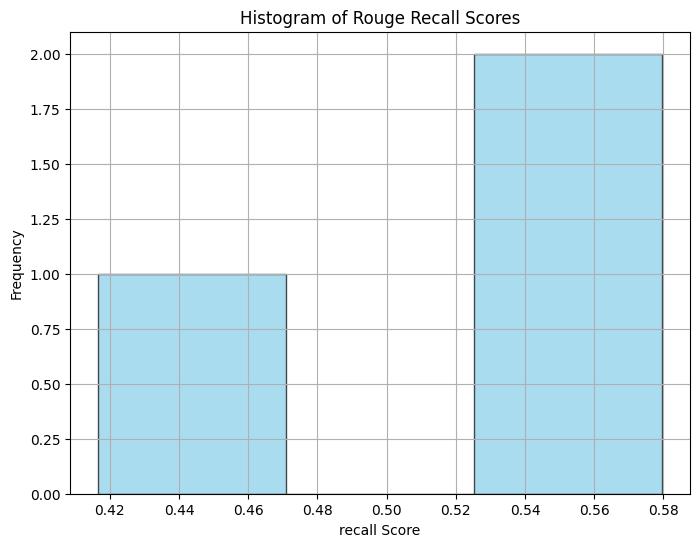
Fig-4: Recallscores
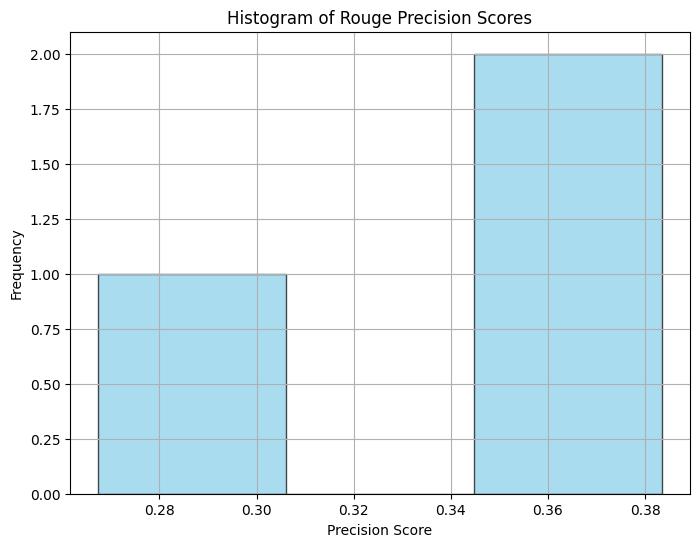
Fig-5: Precisionscores
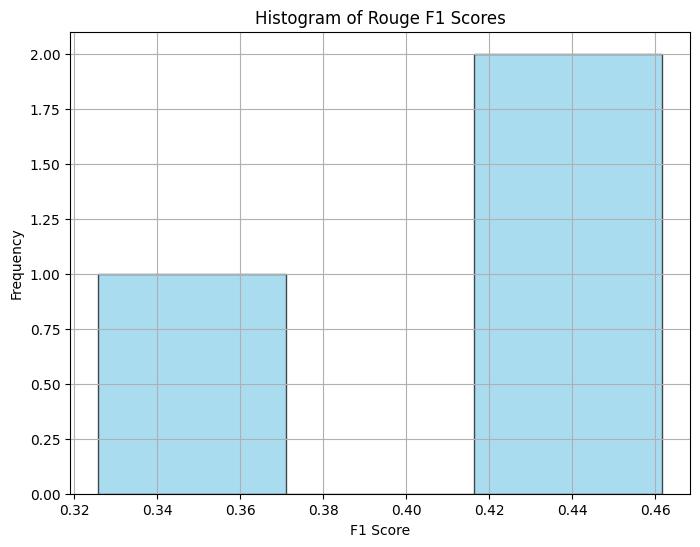
Fig-7: F1scores
The text summarization website developed using Flask providesuserswithaconvenientplatformtosummarizetext inputsandviewboththesummarizedandoriginaltexts.The website consists of two pages: the first page features a textbox where users can input text, and upon submitting, they are redirected to the second page where the summarizedandoriginaltextsaredisplayedalongwiththe respectivewordcounts.
Keyfeaturesandfunctionalities:
i.InputInterface
ii.TextSummarization
iii.WordCountDisplay
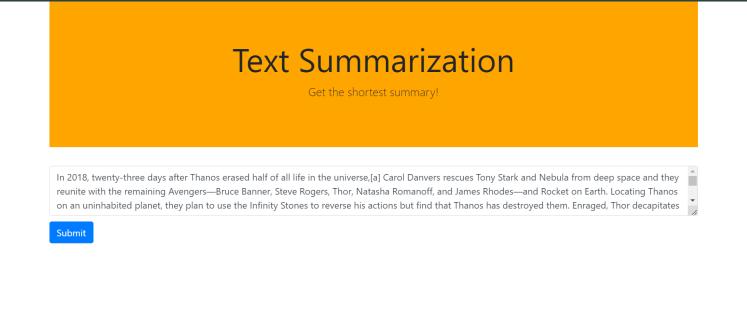
Fig-8: InputPage
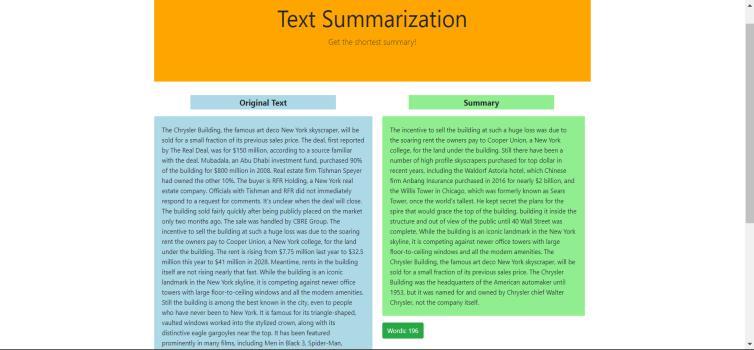
Fig-9: OutputPage
International Research Journal of Engineering and Technology (IRJET) e-ISSN: 2395-0056
Volume: 11 Issue: 03 | Mar 2024 www.irjet.net p-ISSN: 2395-0072
Thedevelopmentanddeploymentofthetextsummarization websiteusingFlaskmarkasignificantmilestoneinproviding userswithapracticaltoolforsummarizingtextualcontent. The integration of Flask, a lightweight and flexible web framework,enablesefficienthandlingofuserrequestsand responses,contributingtothewebsite'sresponsivenessand performance.

Wordsdisplayed
Inconclusion,theprojectaimstoprovideasummarization ofthearticlesthatcontainsignificantorlargetextcontent. Somearticlesprovideunnecessarycontentthatchangesthe meaningofthearticle.So,theusermayneedhelptogetthe exactinformationauserwants.Here,TextSummarization using NLP plays a crucial role by summarizing the text withoutchangingtheexactmeaningofthetext.Italsohelps toremoveunnecessarysentencesandparagraphsfromvast textcontent.
This project will be helpful for students, researchers, and news reporters. They can use this tool to summarize the topicofaresearchpaperoranynewsreporttounderstand and present it.Students can use this tool to read and understandanytopicmorethoroughly.Researcherscanuse this tool to study any research work they are doing. Text summarization can be done extractively and abstractly. Extractivesummarizationinvolvestheextractionofthetext fromtheenormoustextarticlesuchthatthemeaningofthe article does not change. In contrast, abstractive summarizationwillwriteasummaryofthearticle.
Here, we use extractive summarization because it tries to keep the article's sentences and the meaning the same. It also maintains the exact meaning of the article. It will not change the essential meaning of the text content. The extractive text summarization will involve the process tokenization,sentencescoringandselection.Tokenization dividesthesentencesandwordstotokenssothatitcanfind the word that has been repeatedly frequently so that it placesthewordincorrectplace.
Thetextsummarizingusing NLPhasmuchscopeinmany industries.Newsreporterscanuseittowritethelatestnews headlineswithconciseoverviews.Itwillbemainlyusedin the research industry to study and understand complex scientificpapersbyresearchers.Chatbotscanalsousethis text summarization to provide users with precise information. Text summarization is going to be used in
marketing. Also, if a person wants to buy a product, the description and review of the product should be precise enoughsothatproductinformationwill beprecise.Social media marketing is also increasing nowadays, to provide precise information about a brand and its product, text summarizationisuseful.
Insummary,thetextsummarizerwillprovidethesummary bykeepingthemeaningofthevasttextcontentthesame.It will be more helpful for students, researchers, news reporters, and general users. People will widely use text summarization because articles nowadays contain unnecessary content. Text summarizer plays a significant roleinmakingitshorter,simpler,andmoreunderstandable.
[1] Shetty,K.andKallimani,J.S.,2017,December.Automatic extractivetextsummarizationusingK-meansclustering. In 2017 international conference on electrical, electronics,communication,computer,andoptimization techniques (iceeccot) (pp. 1-9). IEEE.M. Young, The TechnicalWriter’sHandbook.MillValley,CA:University Science,1989.
[2] Haque,M.M.,Pervin,S.andBegum,Z.,2013.Literature review of automatic single document text summarization using NLP. International Journal of InnovationandAppliedStudies,3(3),pp.857-865.
[3] Boorugu,R.andRamesh,G.,2020,July.AsurveyonNLP based text summarization for summarizing product reviews. In 2020 Second International Conference on InventiveResearchinComputingApplications(ICIRCA) (pp.352-356).IEEE.
[4] Adhikari,S.,2020,March.Nlpbasedmachinelearning approaches for textsummarization. In 2020 Fourth International Conference on Computing MethodologiesandCommunication(ICCMC)(pp.535538).IEEE.
[5] JUGRAN,S.,KUMAR,A.,TYAGI,B.S.andANAND,V.,2021, March.Extractiveautomatictextsummarizationusing SpaCy in Python & NLP. In 2021 International conference on advance computing and innovative technologies in engineering (ICACITE) (pp. 582-585). IEEE.
[6] Christian,H.,Agus,M.P.andSuhartono,D.,2016.Single document automatic text summarization using term frequency-inverse document frequency (TF-IDF). ComTech: Computer, Mathematics and Engineering Applications,7(4),pp.285-294.
[7] NLPTutorial12-TextSummarizationusingNLP
International Research Journal of Engineering and Technology (IRJET) e-ISSN: 2395-0056
Volume: 11 Issue: 03 | Mar 2024 www.irjet.net p-ISSN: 2395-0072
[8] Awasthi,I.,Gupta,K.,Bhogal,P.S.,Anand,S.S.andSoni, P.K.,2021, January.Naturallanguageprocessing(NLP) based text summarization-a survey. In 2021 6th International Conference on Inventive Computation Technologies(ICICT)(pp.1310-1317).IEEE
[9] Prakash,N.C.,Narasimhaiah,A.P.,Nagaraj,J.B.,Pareek, P.K., Maruthikumar, N.B. and Manjunath, R.I., 2022. Implementation of NLP based automatic text summarization using spacy. International Journal of HealthSciences,6,pp.7508-7521
[10] Khan,R.,Qian,Y.andNaeem,S.,2019.Extractivebased text summarization using k- means and tf-idf. International Journal of Information Engineering and ElectronicBusiness,10(3),p.33.