
International Research Journal of Engineering and Technology (IRJET) e-ISSN:2395-0056
Volume: 11 Issue: 03 | Mar 2024 www.irjet.net p-ISSN:2395-0072
International Research Journal of Engineering and Technology (IRJET) e-ISSN:2395-0056
Volume: 11 Issue: 03 | Mar 2024 www.irjet.net p-ISSN:2395-0072
1Research Scholar, Department Of Computer Science And Engineering
RSR Rungta College Of Engineering And Technology, Bhilai, Chhattisgarh, India
2,3Assistant Professor, Department Of Computer Science And Engineering
RSR Rungta College Of Engineering And Technology, Bhilai, Chhattisgarh, India
Abstract
Presenting YOLO, a fresh take on object detection, is something we're very excited about. In the past, object detection made use of repurposed classifiers to actually detect objects. We approach object detection differently by viewing it as a regression problem. This makes use of geographically separated bounding boxes and associated categorization probabilities. A single neural network can instantly evaluate complete images and provide predictions about bounding boxes and class probabilities within the context of a single evaluation. All of the detection steps may be fine-tuned in real time based on detection performance becausetheentirepipelineisasinglenetwork.
Our unified infrastructure delivers lightning-fast performance. Our YOLO model revolves upon the continuous processingofimagesatarateof45 framespersecondinreal time. A smaller variant of the network, the Fast YOLO network, achieves twice the maximum average processing speed (mAP) of competing real-time detectors while processing an incredible 155 frames per second. Everything about this is remarkable. While YOLO is less likely to predict falsepositivesonbackground,itis morepronetolocalization errors as compared to other state-of-the-art detection methods. To sum up, YOLO can create rather generalized representations of the objects it encounters. Its ability to generalize from natural images to other domains, such artwork, is superior to that of other detection approaches, likeDPMandR-CNN.
Keywords- Object Detection, Real time video, YOLO coco dataset,PyCharm,OpenCV.
1. INTRODUCTION
Whenpeoplelookata picture,theyimmediatelyrecognize theitemsthatare shownin it, wheretheyarelocated, and howtheyinteractwithoneanother Duetothefactthatthe humanvisualsystemisbothswiftandprecise,weare able to engage in physically demanding tasks such as driving with a relatively low amount of conscious thought. The development of object identification algorithms that are both speedy and precise would make it possible for computers to drive automobiles without the need for specialized sensors. It would also make it possible for assistive devices to provide real-time scene information to
human users. Finally, it would open the door to the possibility of general-purpose robotic systems that are responsive.
Within the most recent generation of detection systems, classifiers are repurposed to perform the function of detection. These systems begin with a classifier that correspondsto theobjectin question,and then proceed to evaluate the object at a variety of various sizes and locations within a test picture. This allows the system to ultimately identify the item. Examples of such systems are deformable parts models (DPM), which make use of a sliding window methodology. In this method, the classifier isperformedatpointsthatareconsistentlyspacedoverthe wholepicture[10].
The utilization of region suggestion is a feature that is utilizedbymorecontemporarymethodslikeasR-CNN.
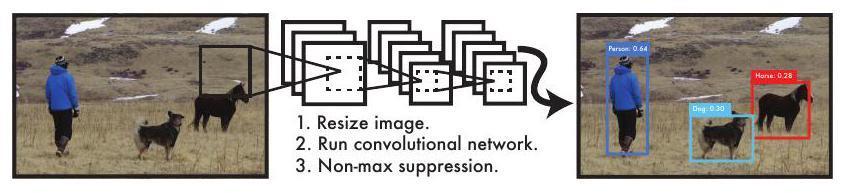
Thesystemconsistsofresizingtheinputimageto448x448, running a single convolutional network, and throttling detections based on model confidence techniques to construct picture bounding boxes and then classify them. The post-processing step, which follows classification, involves improving the bounding boxes, removing duplicates,andrescoringthemaccordingtotheitemsinthe scene [13]. Due to the need to teach each component separately,thesecomplexpipelinesareslowanddifficultto optimize.
We transform the object recognition issue into a singular regression problem by transferring the class probabilities and bounding box coordinates from the picture pixels to theboundingboxcoordinates.Ourmethodreliesontaking a cursory look at an image (YOLO) to deduce what objects arethereandwheretheyarepositioned.
International Research Journal of Engineering and Technology (IRJET) e-ISSN:2395-0056
Volume: 11 Issue: 03 | Mar 2024 www.irjet.net p-ISSN:2395-0072
See Figure 1 for an illustration of how deliciously straightforward YOLO is. Different bounding boxes and class probabilities can be predicted by the same convolutional network across many classes. Complete image Through YOLO training, detection performance may beimproved.Whencomparedtomoretraditionalmethods, a unified paradigm for object detection offers a number of positiveadvantages.
The first thing is that YOLO is incredibly quick. A state-ofthe-art method is unnecessary as we reframe detection as regression. In order to generate predictions regarding the detections, we train our neural network on a fresh image right before the test. On a Titan X GPU, our baseline networkrunsat45fpswithoutbatchprocessing,butafast variant can reach over 150 fps. Thanks to this feature, streaming video can be processed in real time with a latencyofunder25milliseconds.Furthermore,amongrealtimesystemsthatareequivalent,YOLOhasameanaverage accuracythatistwiceasexcellent.Onthehomepageofour project, which can be found at http://pjreddie.com/yolo/, oursystemisdisplayedliveonawebcam.
The second thing that YOLO does is think about the image in a broad sense before making predictions. Because it observes the whole image during training and testing, YOLOautomaticallyencodesclasscontextand appearance. This is in contrast to approaches that are based on sliding windows and region proposals. A technique for detecting the top The Fast R-CNN [14] algorithm is unable to comprehend the larger context, which causes it to incorrectly identify background patches as objects. YOLO hasabackgrounderrorratethatisfiftypercentlowerthan thatofFastR-CNN.
Finally, YOLO can learn to represent objects in a generalized way, which is a huge plus. You Only Live Once far outpaces DPM and R-CNN in terms of teaching on natural images and judging on artwork. The generalizability of YOLO makes it highly unlikely that it would fail when applied to new domains or given unexpected inputs. When compared to more sophisticated detection methods, YOLO's accuracy is lower. Although it struggles with smaller items, it can swiftly recognize objects in photos. We have investigated these tradeoffs in ourexperiments.Thepublichasaccesstoallofthecodewe use for testing and training. You can download any of the pre-trainedmodels.
Combining all of the parts into one neural network allows us to detect objects. Our network predicts the contents of eachboundingboxbasedonthepicture'sattributes.Every class using the same image makes a prediction about its bounding boxes at the same time. Therefore, our network considersthefullimageandallofitsparts.Byutilizingthe
YOLO design, which permits end-to-end training and realtimespeeds,ahighlevelofaverageaccuracyisattained.
Todividetheinput picture, weemploya square-by-square grid. Objects whose centers are falling into grid cells are detected by grid cells. Predictions about the B bounding boxes and confidence ratings are made in each grid cell. Themodel'sconfidenceratingsshowhowsureitisthatthe box contains an item and how accurate it is at predicting. WiththeproductofPr(Object)andIOU_"pred"and"truth," wegettheconceptofconfidence.Toindicatethatthecellis empty,settheconfidenceratingsto0.Thatbeingsaid,we'd like it if the confidence score matched the anticipated intersection of box-ground truth over union (IOU), should thecontrarybetrue.X,y,w,andharethefiveforecastsand confidence levels for each bounding box. The center of the box with respect to the grid cell is indicated by the coordinates (x, y). Anticipation affects the entire image's width and height. When we speak about confidence prediction, we're referring to the IOU between the predictedboxandanygroundtruthbox.
The conditional class probabilities, denoted as Pr(☤ Class _i∣ Object), are also predicted by each grid cell independently. These probabilities are dependent on the grid cell that contains an item in order to be calculated. Thereisjustonesetofclassprobabilitiesthatweanticipate foreachgridcell,andthisistrueregardlessofthenumber ofspacesB.
Each participant's confidence prediction for their own box is multiplied by the conditional class probabilities when testingisunderway,
so that we can get confidence scores for each class individually for each box. These scores represent the object's anticipated box fit as well as the class's likelihood ofappearinginthebox.
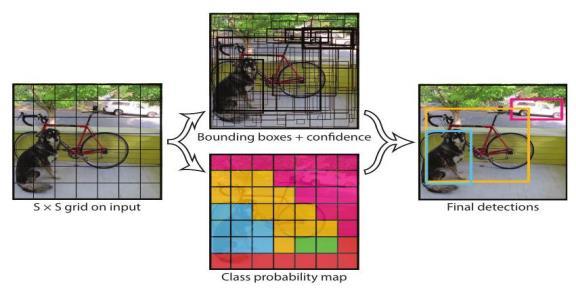
Figure 2: The Prototype. In our system, detection is modeled as a regression problem. A S×S grid is used to segment the image. The model makes predictions about C class probabilities, B bounding boxes, and confidence scores for each grid cell. The tensor S×S×(B*5+C) encodes thesepredictions.
International Research Journal of Engineering and Technology (IRJET) e-ISSN:2395-0056
Volume: 11 Issue: 03 | Mar 2024 www.irjet.net p-ISSN:2395-0072
ForevaluatingYOLOonPASCALVOC,weuse , . PASCAL VOC has 20 labelled classes so . Our final predictionisa tensor.
2.1.
We tested this convolutional neural network model using the PASCAL VOC identification dataset [9]. Predicting output probabilities and coordinates is the job of fully connected layers, while earlier convolutional layers are in chargeofvisualpropertyextraction
Our network was built using the principles of Google's neuralnetwork[33]forthegoalofimageclassification.We use a network architecture consisting of twenty-four convolutional layers and two fully linked layers. We apply 3x3 convolutional layers and 1x1 reduction layers to GoogleNet's inception modules to align with the results reportedinLinetal.[22].Youcanseethewholenetworkin Figure3.
WealsotrainafastYOLOtoimproveitsobjectrecognition speed. A neural network with fewer than twenty-four filters and nine convolutional layers is utilized by the Fast YOLO method. In terms of testing and training conditions, the sole difference between YOLO and Fast YOLO is the networksize
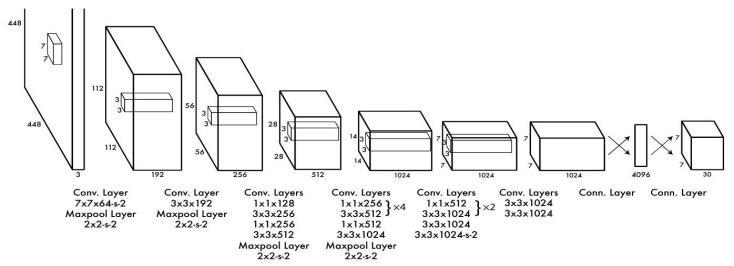
Figure 3:Architecture.Weuse24convolutionallayersand 2 fully linked layers in our detecting network. Alternating 1x1 convolutional layers reduce feature space from previouslayers.WetrainconvolutionallayersonImageNet at half resolution (224x224 input picture) and then do detectionatdoubleresolution.
The final outputofournetwork is the tensorof predictions.
We use the ImageNet 1000-class competition dataset [29] topretrainourconvolutionallayers.AsillustratedinFigure 3, after the first twenty convolutional layers, we use a completely connected and an average-pooling layer for pretraining. Following just one week of training on the ImageNet2012validationset,thisnetworkachievesatop5accuracyof88%forsinglecrops.TheGoogLeNetmodels createdbyCaffe'sModelZoo[24]achieveanaccuracylevel similartothisone.
We change the model so it can detect. When it comes to enhancingtheperformance ofpretrainednetworks,Ren et al. show that convolutional and linked layers function better [28]. In keeping with their model, we use two fully connectedlayersandfourconvolutionallayers,allofwhich weightsarerandomlyassigned.Ournetwork'sfine-grained visual identification capabilities have been improved by increasingtheinputresolutionfrom224×224to448×448.
In the last layer, we use the class statistics and bounding box coordinates to create predictions. When the bounding box's width and height are normalized by the picture's width and height, they fall inside the range of 0 to 1. To make the x and y coordinates of the enclosing box range from0to1,weoffsetthemfromthepositionofagridcell.
All of the layers up to our last one used leaky rectified linear activation, whereas our final layer uses a linear activationfunction.
When it comes to sum-squared error, we maximize the model output. Although improving the sum-squared error is an easy process, it does not adequately achieve our objective ofoptimizingthe averageaccuracy.The mistakes in localization and classification are given equal weight, which is not the best possible situation. Most of the grid cells in each and every photo are vacant. The "confidence" values of those cells tend to decrease toward zero, frequently overcoming the gradient that is produced by cells that contain objects. Instability in the model might leadtodivergencebeforetrainingiscomplete.
We have resolved this issue by raising the loss from predictions of bounding boxes' coordinates and lowering the loss from predictions of confidence for empty boxes. We use two parameters, oor and noo to accomplish this.Weset oor and noo
The sum-squared error method gives equal weight to both large and tiny box errors. When it comes to our error measure, Smaller discrepancies in bigger boxes should be given less weight than smaller ones in smaller boxes. Predicting the square root of the width and height of the bounding box instead of both at once can help with the problemtoacertaindegree.
ItisanticipatedbyYOLOthateachgridcellwillhavemany bounding boxes. During training, we wish for each item to have a single bounding box predictor. A prediction is considered "responsible" if it comes from the predictor with the highest current IOU with the ground truth. This leadstothespecializationofboundingboxpredictors.Size, aspect ratio, and item type predictions are all enhanced witheachpredictor,leadingtohigherrecall.
International Research Journal of Engineering and Technology (IRJET) e-ISSN:2395-0056
Volume: 11 Issue: 03 | Mar 2024 www.irjet.net p-ISSN:2395-0072
Intraining,weoptimizeamulti-partlossfunction.:
where o denotes if object appears in cell and o denotes that the th bounding box predictor in cell is "responsible"forthatprediction.
Thelossfunctiononlypenalizesclassificationmistakesifan objectisinthatgridcell,whichiswhytheclassprobability is conditional. The only predictor that is penalized for inaccurate bounding box coordinates is the one that is "responsible" for the ground truth box, meaning the one withthegreatestIOUinthatgridcell
Thenetworkundergoesa135-epochtrainingprocessusing validation and training data from PASCAL VOC 2007 and 2012.Fortrainingpurposes,weusedVOC2007testdatain our 2012 testing. We use 64 batches, 0.9 momentum, and 0.0005 decay for training Our learning rate schedule: In the initial epochs, we gradually increase the learning rate from 〖10〗^(-3)to 〖10〗^(-2).Unstablegradientscause model divergence at high learning rates. We train with 〖 10〗^(-2) for 75 epochs, then 〖10〗^(-3) for 30 epochs, andlastly 〖10〗^(-4)for30epochs
To prevent overfitting, we use dropout and enhance the data significantly. Layer co-adaptation cannot occur in a dropoutlayerfollowingthe firstlinkedlayerwith a rate of 0.5 [18]. When augmenting data, we randomly scale and translate images by up to 20% of their original size. Using HSV color space, we arbitrarily change the saturation and exposureoftheimagebyamaximumof1.5.
Predicting test image detections takes one network assessment, like training. The network predicts 98 bounding boxes per image and class probabilities using PASCALVOC.TesttimeisfastwithYOLOsinceitonlyneeds one network assessment, unlike classifier-based approaches.
The grid design ensures that the bounding box forecasts contain a diverse range of spatial elements. Most of the time, it is obvious which grid cell each object belongs to,
and the network only predicts one box for each object. Numerous cells, on the other hand, are able to accurately pinpoint certain huge objects or items that are located on the boundary of numerous cells. Fixing these numerous detections can be accomplished through the use of nonmaximal suppression. In mAP, non-maximal suppression contributes 23% to performance, despite the fact that it is notasimportanttoperformanceasitisforR-CNNorDPM.
There are strict geographical constraints on YOLO's boundingboxpredictionsduetothefactthat eachgridcell can only foresee two boxes and one class. Because of this geographical restriction, our model is unable to predict as manynearbythings.Crowdsofsmallobjects,suchasbirds, aredifficultforourmodeltohandle.
Since our method relies on data to anticipate bounding boxes, it is unable to generalize to objects with unusual aspect ratios or configurations. Our strategy uses coarse characteristics in our bounding box prediction model becausewedownsampletheinputpicturemultipletimes
Finally, we train on a loss function that approximates detection performance that handles mistakes equally in small and big bounding boxes. minor errors in large boxes are usually harmless, whereas minor errors in small boxes affectIOUmore.Ourbiggesterrorismislocalization.
Object detection is a key problem in computer vision. Detection pipelinesoften begin withthe extraction ofa set of robust characteristics from the input photos. A few examples of these features are convolutional features [6], Haar[25],SIFT[23],and HOG[4].Classifiers[35,21,13,10] andlocalizers[1,31]canthenbeusedtoidentifyobjectsin the feature space. These classifiers or localizers can be appliedinaslidingwindowfashiontoeitherasubsetorthe full image [34, 15, 38]. In this article, we compare and contrasttheYOLOdetectionapproachwithmanyindustryleading detection systems, highlighting both their similaritiesanddifferences
Models of pliable components. Models for deformable components (DPM) use sliding window object detection [10].TheDPMutilizesanindependentpipelinetocarryout operations including feature extraction, region classification, bounding box prediction for high-scoring regions, etc. All of these parts are substituted by a single convolutional neural network in our system. The network simultaneously does bounding box prediction, feature extraction, contextual reasoning, and no maximal suppression. In order to optimize them for the detection task, the network trains its features in-line instead of employing static features. When compared to DPM, our simplifieddesignisfarfasterandmoreaccurate.
International Research Journal of Engineering and Technology (IRJET) e-ISSN:2395-0056
Volume: 11 Issue: 03 | Mar 2024 www.irjet.net p-ISSN:2395-0072
ImplementingR-CNN...Whenitcomestoobjectdetectionin images, R-CNN and related algorithms use region suggestions instead of sliding windows. A linear model adjusts the bounding boxes, a neural network extracts features,asupportvectormachine(SVM)scorestheboxes, a linear model uses Prospective Bounding Boxes [34] to remove duplicate detections, and finally, non-max suppression is used to eliminate duplicates. The system's tremendous slowness, brought on by the necessity to finetune each stage of the complex pipeline independently, resulted in each picture taking about 40 seconds during testtime[14].
There are several similarities between YOLO and R-CNN. Everycell inthegridmakes a score-basedsuggestionfora potential bounding box using convolutional features. However, our method restricts the grid cell suggestions spatially to lessen the occurrence of identical item detections. To add insult to injury, our method only proposes 98 bounding boxes per image, whereas Selective Search provides almost 2,000. Afterwards, we utilize our technology to combine all of these components into a single,optimalmodel.
VariousRapidIdentifiersQuitea bit quickerInaneffortto speeduptheR-CNNarchitecture,R-CNNintendstoreplace Selective Search with neural networks for region proposal [14, 27]. You can't compare their speed and precision to that of R-CNN, but they're still no match for real-time performance.
ResearchonhowtospeeduptheDPMpipelineisprevalent [30,37,5].TheymaximizeHOGcomputingthroughtheuse of cascades and the acceleration of calculation on GPUs. Notethatonly30" "HzDPM [30]iscapableofoperating in real-time.
The YOLO algorithm eliminates the need to optimize individual components of a large detection pipeline and is quickbydesign.
Because they don't have to cope with as much fluctuation, detectorsforsingleclasses,suchasfacesorpersons,canbe significantly optimized [36]. With its ability to learn and detectmanyitemsatonce,YOLOisaversatiledetector.
The multi-box is advanced. When predicting ROIs, Szegedy et al.[8] train a convolutional neural network rather than using Selective Search, as opposed to R-CNN. Single object detection is also possible with MultiBox by replacing the confidence prediction with a single class prediction. Nevertheless, MultiBox is still limited to being a part of a largerdetectionpipelineandcannotperformgeneralobject identification, therefore further picture patch classification is required. While both YOLO and MultiBox use neural networks to predict the borders of images, YOLO's detectioncapabilitiesaresuperior.
TheDefeat.Byfirsttrainingaconvolutionalneuralnetwork to do localization, Sermanet et al. [31] modify the network suchthatitcanalsodetectobjects.Eventhoughit'sstillnot acohesivesystem,OverFeatdoesslidingwindowdetection efficiently. Instead of focusing on detection performance, OverFeat optimizes for localization. When creating a prediction, the localizer, similar to DPM, only considers local information. OverFeat necessitates substantial postprocessingtogetconsistent detectionssinceitisunableto reasonregardingglobalcontext.
Grabmultipleobjectsatonce.Redmonetal.'s[26]workon grasp detection is conceptually comparable to ours. The MultiGraspmethodforregressiontograspsformsthebasis of our grid approach to bounding box prediction. But comparedtoobjectdetection,gripdetectionischild'splay. InorderforMultiGrasptofunction,eachobjectinanimage onlyhastohaveitsgraspableregionpredictedonce.Itjust needstolocateanappropriateareatograb;itdoesn'tneed to guess the object's class or even its size, position, or limits. For various objects in an image belonging to different classes, YOLO can forecast both their bounding boxesandthelikelihoodofeachclass.
To start, on PASCAL VOC 2007, we evaluate YOLO in comparison to various real-time detection methods. We compare the mistakes made by YOLO and Fast R-CNN, a top-performing R-CNN variant, on VOC 2007 [14] to learn about the distinctions between the two R-CNN variants. RescoringFastR-CNN detectionsusing YOLOandreducing background false positive errors significantly improves performance,asdemonstratedbyvariouserrorprofiles.In addition, we compare mAP to the state-of-the-art methodologiescurrentlyavailableand offer thefindingsof VOC2012.Weconcludebydemonstrating,ontwoartwork datasets, that YOLO outperforms other detectors in terms ofgeneralizingtonewdomains
Standard detection pipeline speed optimization is a major areaofattentioninobjectdetectionresearch.Citations:[5] [37][30][14][17][27].Ontheotherhand,onlySadeghiet al. develop a real-time detection system (30 fps or higher) [30]. We evaluate YOLO in comparison to their 30Hz or 100Hz GPU implementation of DPM. To investigate the accuracy-performance tradeoffs in object identification systems, we evaluate their relative mAP and speed, even while previous efforts fail to achieve the real-time milestone.
From what we can tell, Fast YOLO is the quickest object detector currently available, and it's also the quickest way on PASCAL. Compared to previous work on real-time detection, its accuracy of 52.7%mAP is more than double.
International Research Journal of Engineering and Technology (IRJET) e-ISSN:2395-0056
Volume: 11 Issue: 03 | Mar 2024 www.irjet.net p-ISSN:2395-0072
YOLO pushes mAP to while still maintaining realtimeperformance.
Using VGG-16, we also train YOLO. While this model outperformsYOLOintermsofaccuracy,itisalsonoticeably slower. While it can be used to compare VGG-16-based detectionsystems,thepaper'sremainingsectionscenteron our quicker models due to their superior performance in real-time
Fastest DPM effectively speeds up DPM without sacrificing much mAP but it still misses real-time performance by a factor of 2 [37]. It also is limited by DPM's relatively low accuracy on detection compared to neural network approaches.
R-CNN minus R replaces Selective Search with static boundingboxproposals[20].Whileitismuchfasterthan
Detectors Train
Table 1: Systems Operating in Real-Time on PASCAL VOC 2007.Thereisacomparisonofthespeedandperformance offastdetectors.Not onlyis FastYOLO thefastestPASCAL VOCdetectoreverrecorded,butitisalsotwiceasaccurate as any other real-time detector. Compared to the fast version, the YOLO algorithm is 10mAP more exact; nonetheless, it is still far quicker than real-time. R-CNN, it notonlydoes notmeetthe requirementsfor real-time, but italsosuffersalargelossinaccuracyduetotheabsenceof suitableideas.
Fast R-CNN uses selective search to speed up the classification stage of R-CNN, although it still takes about
two seconds each image to provide bounding box proposals. Despite its high mAP, its frame rate of 0.5 fps is farlowerthanreal-time.
By replacing selective search with a neural network, the newly created Faster R-CNN suggests bounding boxes in a way similar to Szegedy et al. on page 8: Our study shows that their most accurate model functions at 7 frames per second, whereas a smaller model with less precision performs at 18 frames per second. quicker R-CNN with VGG-16 architecture is 10mAP quicker than YOLO, but it's sixtimesslower.TheZeilerFergusFasterR-CNNhasworse accuracydespitebeingonly2.5timesslowerthanYOLO.
Looking at a deep breakdown of VOC 2007 data, we will compare YOLO against the most advanced detectors and find out where it falls short. Given that Fast R-CNN is a publicly available, top-performing detector on PASCAL, we arecomparingittoYOLO.
WeutilizethetechniqueandtoolsdevelopedbyHoiemand colleagues. [19] We examine the top N guesses for each category during testing. Each forecast is either accurate or categorizedaccordingtothesortofmistakemade.
Correct:correctclassandIOU
Localization:correctclass, IOU
Similar:classissimilar,IOU>.1
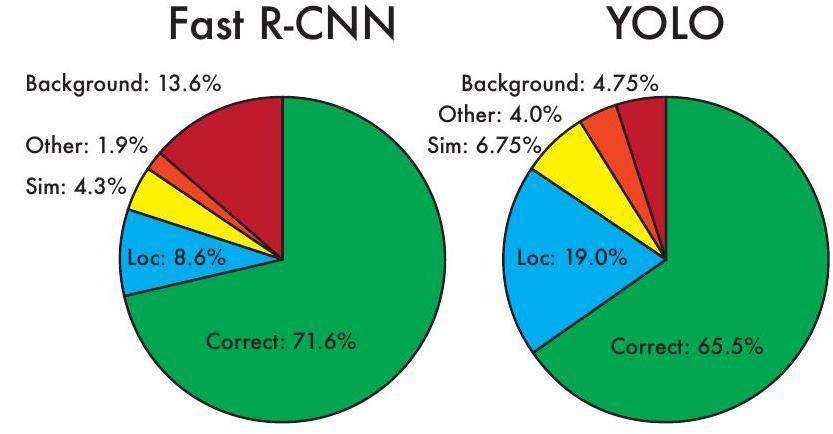
Figure 4: Analyzing Errors: Quick R-CNN vs. YOLO The charts display the percentage of top N detections for each category,whereNisthenumberofobjectsinthatcategory, and background and localization mistakes are shown as a percentage.
Other:classiswrong,IOU>.1
Background:IOU foranyobject
As a whole, all 20 classes contributed to the breakdown of mistake types, as shown in Figure 4.Things can be difficult for YOLO to pinpoint precisely. When it comes to YOLO, localization issues are far and away the most common cause of mistakes. While Fast R-CNN does increase its background mistake rate, it has drastically cut down on localization errors. Since 13.6% of its main detections are empty, they are not accurate.Fast R-CNN has a higher
International Research Journal of Engineering and Technology (IRJET) e-ISSN:2395-0056
Volume: 11 Issue: 03 | Mar 2024 www.irjet.net p-ISSN:2395-0072
probability of predicting background detections compared toYOLO,almostthreetimesmorelikely.
The YOLO model outperforms Fast R-CNN in terms of background error rate. We achieve a significant speed boost by using YOLO to eliminate background detections from Fast R-CNN. We will compare YOLO's predicted boundingboxestoallofR-CNN'spredictedboundingboxes toseeiftheyarecomparable.Ifithappens,weimprovethat prediction by factoring in the YOLO-predicted likelihood andtheoverlapbetweenthetwoboxes.
A mean absolute performance (mAP) of 71.8% is achieved bythetopFastR-CNNmodelontheVOC2007testset.Ina way,it'sbothYOLOanditself.
detection approaches, we display the mean and per-class average precision. So far, YOLO is the sole real-time detector.
Fast R-CNN + YOLO comes in at number four, with a score thatis2.3%higherthanFastR-CNN.
A 3.2% gain brings the mAP up to 75.0%. Additionally, we attempted to combine the most successful Fast R-CNN model with a number of different variants of Fast R-CNN. For more information, please refer to Table 2; these ensembles resulted in mAP gains that were between 0.3 and0.6percent.
Becausethereisnotmuchofanadvantagetobegainedby mergingdifferentversionsofFastR-CNN,theincreasethat comes from YOLO is not merely a result of the process of model assembly. It is more accurate to say that the reason YOLO is so successful in improving Fast R-CNN's performanceisexactlybecauseitcreatesavarietyoferrors throughoutthetestingprocess.
You won't get the speed boost from YOLO with this combination because we run each model separately and then combine the results. Thanks to its incredibly quick speed, YOLO, on the other hand, does not significantly increase the amount of computation time required comparedtoquickR-CNN..
Table 2: VOC 2007 model combination experiments. Combining different models with the best Fast R-CNN is examined. Other Fast R-CNN versions offer only a minor performanceimprovement,whileYOLOdoes.
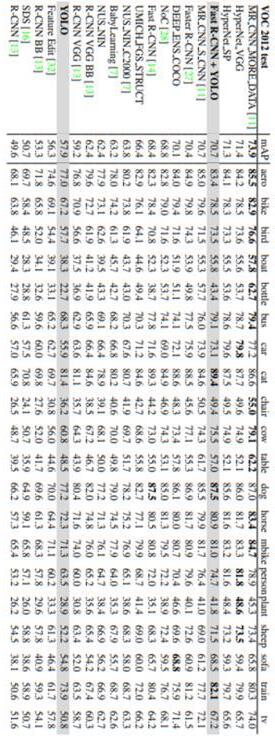
Table 3: 2012 PASCAL VOC status quo. The YOLO public leaderboardwascomparedtothefullcomp4(outsidedata allowed) as of November 6, 2015. For a number of
In 2012, YOLO achieved 57.9% mAP on the VOC test set. Table 3 shows that this is lower than the state-of-the-art andmoreinlinewiththeR-CNNoriginallybuiltwithVGG16.When itcomesto handlingrelativelysmall objects, our system struggles, especially when compared to its main competitors. In domains including bottle, sheep, and television/monitor models, YOLO performs 8-10% worse than R-CNN or Feature Edit. But in other areas, like their train and cat divisions, YOLO has better success. One detection strategy that can reach maximum performance is the combination of our Fast R-CNN and YOLO model. Fast R-CNN jumps to number five on the public leaderboard after combining with YOLO, which increasesitsperformanceby2.3%.
According to the VOC 2012 test results, YOLO gets 57.9% mAP. This is lower than the state-of-the-art and more in line with the R-CNN that was initially constructed using VGG-16, as shown in Table 3. Our technology struggles to handle relatively small objects as compared to its main competitors. The bottle, sheep, and television/monitor modelsget8-10%poorerresultsforYOLOcomparedto RCNN or Feature Edit. However, YOLO has more success in other areas, including their train and cat divisions. For optimal performance, one detection strategy is to
International Research Journal of Engineering and Technology (IRJET) e-ISSN:2395-0056
Volume: 11 Issue: 03 | Mar 2024 www.irjet.net p-ISSN:2395-0072
combine our Fast R-CNN with the YOLO model. When combined with YOLO, Fast R-CNN achieves a 2.3% boost, puttingitinfifthplaceinthepublicleaderboard.
ComputervisionapplicationsbenefitgreatlyfromtheYOLO objectdetector'sspeedand accuracy.Wehook upYOLO to a webcam and watch to see if it keeps running in the background.
(a)PicassoDatasetprecision-recallcurves.
(b) Quantitative results on the VOC 2007, Picasso, and People-Art Datasets. Both AP and the best F_1 score are usedforevaluationinthePicassodataset.
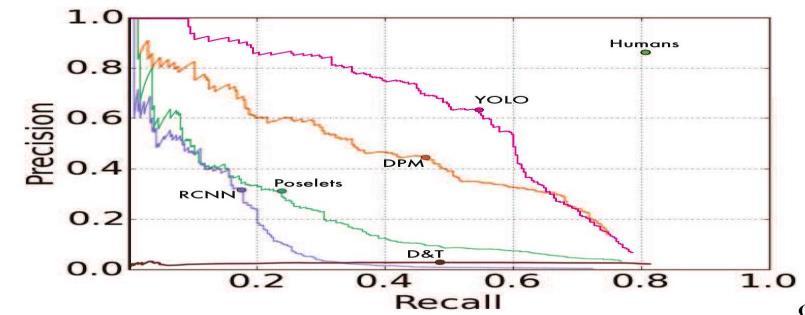
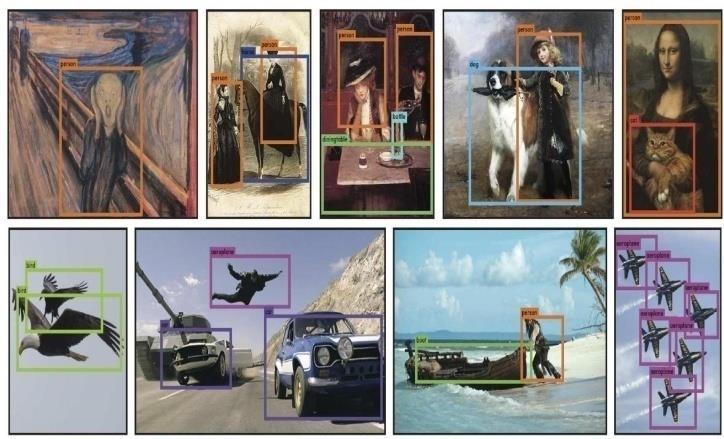
Figure 6:QualitativeResults.Internet-basedYOLOusing sampleartandnaturalphotos.Itgenerallyworks,butit thinksonepersonisanairplane.
for example, the amount of time required to get photos fromthecameraanddisplaythedetections.
The resultant system is engaging and full of interactive features. When connected to a camera, YOLO examines each photo independently, but it also acts as a tracking system, detecting things as they move or change their appearance. Detailed instructions and a live demo of the system are available on our project website (http://pjreddie.com/yolo/).
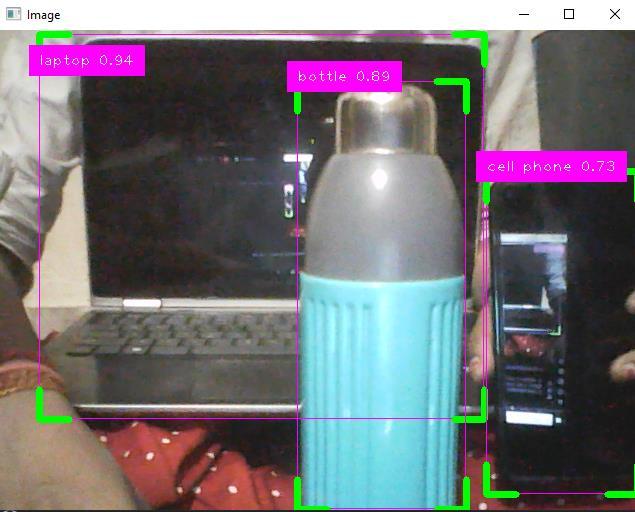
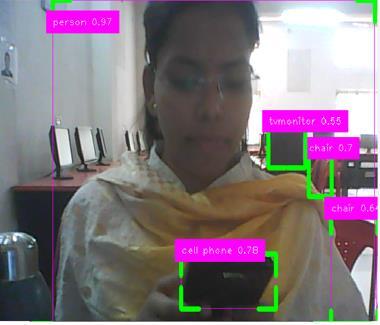
8 :Multi-ObjectDetectionusingYOLO
International Research Journal of Engineering and Technology (IRJET) e-ISSN:2395-0056
Volume: 11 Issue: 03 | Mar 2024 www.irjet.net p-ISSN:2395-0072
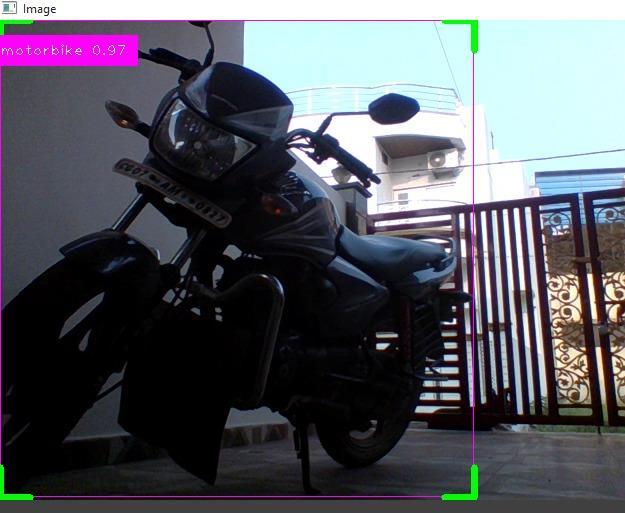
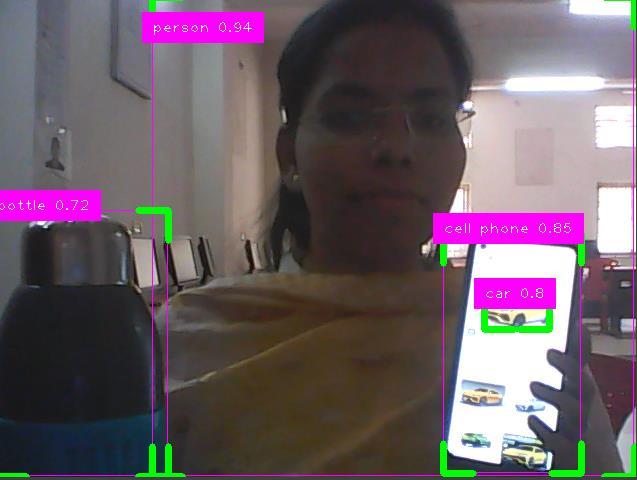
In order to differentiate between various objects, we introduced the YOLOapproachinthisstudywiththegoal of using a single neural network. After being extended from natural photos to other domains, this expanded technique outperforms existing algorithms. It is possible to train the algorithm on a complete image, and its construction is simple.Usingregionproposaltechniqueslimitstheclassifier to a certain region. In order to do border prediction, YOLO canseethewholepicture.Moreover,itanticipatesareduced amount of false positives in background regions. When applied in real time, this method outperforms all others in terms of effectiveness and speed of movement among classifieralgorithms.
[1] M. B. Blaschko and C. H.Lambert. Learning to localize objects with structured output regression. In Computer VisionECCV2008,pages2-15.Springer,2008.4
[2] L. Bourdev and J. Malik. Poselets: Body part detectors trainedusing humanposeannotations.InInternational ConferenceonComputerVision(ICCV),2009.8
[3] H. Cai, Q. Wu, T. Corradi, and P. Hall. The crossdepiction problem: Computer vision algorithms for recognising objects in artwork and in photographs. arXiv preprintarXiv:1505.00110,2015.7
[4] N. Dalal and B. Triggs. Histograms of oriented gradients for human detection. In Computer Vision and Pattern Recognition, 2005. CVPR 2005. IEEE Computer Society Conference on, volume 1, pages 886-893. IEEE, 2005.4,8
[5] T. Dean, M. Ruzon, M. Segal, J. Shlens, S. Vijayanarasimhan,J.Yagnik,etal.Fast,accuratedetection of 100,000 object classes on a single machine. In Computer Vision and Pattern Recognition (CVPR), 2013 IEEEConferenceon,pages1814-1821.IEEE,2013.5
[6] J. Donahue, Y. Jia, O. Vinyals, J. Hoffman, N. Zhang, E. Tzeng, and T. Darrell. Decaf: A deep convolutional activation feature for generic visual recognition. arXiv preprintarXiv:1310.1531,2013.4
[7]J.Dong,Q.Chen,S.Yan,andA.Yuille.Towardsunified objectdetectionandsemanticsegmentation.InComputer Vision-ECCV2014,pages299-314.Springer,2014.7
[8] D. Erhan, C. Szegedy, A. Toshev, and D. Anguelov. Scalable object detection using deep neural networks. In Computer Vision and Pattern Recognition (CVPR), 2014 IEEEConferenceon,pages2155-2162.IEEE,2014.5,6
[9] M. Everingham, S. M. A. Eslami, L. Van Gool, C. K. I. Williams, J. Winn, and A. Zisserman. The pascal visual object classes challenge: A retrospective. International JournalofComputerVision,111(1):98-136,Jan.2015.2
[10] P. F. Felzenszwalb, R. B. Girshick, D. McAllester, and D. Ramanan. Object detection with discriminatively trained part based models. IEEE Transactions on Pattern Analysis and Machine Intelligence, 32(9):1627-1645, 2010.1,4
[11] S. Gidaris and N. Komodakis. Object detection via a multiregion& semantic segmentation-aware CNN model. CoRR,abs/1505.01749,2015.7
[12] S. Ginosar, D. Haas, T. Brown, and J. Malik. Detecting people in cubist art. In Computer Vision-ECCV 2014 Workshops,pages101-116.Springer,2014.7
International Research Journal of Engineering and Technology (IRJET) e-ISSN:2395-0056
Volume: 11 Issue: 03 | Mar 2024 www.irjet.net p-ISSN:2395-0072
[13] R. Girshick, J. Donahue, T. Darrell, and J. Malik. Rich feature hierarchies for accurate object detection and semantic segmentation. In Computer Vision and Pattern Recognition(CVPR),2014IEEEConferenceon,pages580587.IEEE,2014.1,4,7
[14] R. B. Girshick. Fast R-CNN. CoRR, abs/1504.08083, 2015.2,5,6,7
[15] S. Gould, T. Gao, and D. Koller. Region-based segmentation and object detection. In Advances in neural informationprocessingsystems,pages .4
[16] B. Hariharan, P. Arbeláez, R. Girshick, and J. Malik. Simultaneous detection and segmentation. In Computer VisionECCV2014,pages297-312.Springer,2014.7
[17] K. He, X. Zhang, S. Ren, and J. Sun. Spatial pyramid pooling in deep convolutional networks for visual recognition.arXivpreprintarXiv:1406.4729,2014.5
[18]G.E.Hinton,N.Srivastava,A.Krizhevsky,I.Sutskever, and R. R. Salakhutdinov. Improving neural networks by preventing co-adaptation of feature detectors. arXiv preprintarXiv:1207.0580,2012.4
[19]D.Hoiem,Y.Chodpathumwan,andQ.Dai.Diagnosing error in object detectors. In Computer Vision-ECCV 2012, pages340-353.Springer,2012.6
[20]K.LencandA.Vedaldi.R-cnnminusr.arXivpreprint arXiv:1506.06981,2015.5,6
[21]R.LienhartandJ.Maydt.Anextendedsetofhaar-like features for rapid object detection. In Image Processing. 2002. Proceedings. 2002 International Conference on, volume1,pagesI-900.IEEE,2002.4
[22] M. Lin, Q. Chen, and S. Yan. Network in network. CoRR,abs/1312.4400,2013.2
[23] D. G. Lowe. Object recognition from local scaleinvariant features. In Computer vision, 1999. The proceedings of the seventh IEEE international conference on,volume2,pages1150-1157.Ieee,1999.4
[24]D. Mishkin. Models accuracy on imagenet 2012 val. https://github.com/BVLC/caffe/wiki/ Models-accuracyon-ImageNet-2012-val.Accessed:2015-10-2.3
[25]C.P.Papageorgiou,M. Oren,andT.Poggio.Ageneral frameworkforobjectdetection.InComputervision,1998. sixth international conference on, pages 555-562. IEEE, 1998.4
[26]J.RedmonandA.Angelova.Real-timegraspdetection using convolutional neural networks. CoRR, abs/1412.3128,2014.5
[27] S. Ren, K. He, R. Girshick, and J. Sun. Faster r-cnn: Towards real-time object detection with region proposal networks.arXivpreprintarXiv:1506.01497,2015.5,6,7
[28] S. Ren, K. He, R. B. Girshick, X. Zhang, and J. Sun. Objectdetectionnetworksonconvolutionalfeaturemaps. CoRR,abs/1504.06066,2015.3,7
[29] O. Russakovsky, J. Deng, H. Su, J. Krause, S. Satheesh, S.Ma,Z.Huang,A.Karpathy,A.Khosla,M.Bernstein,A.C. Berg, and L. Fei-Fei. Image Net Large Scale Visual Recognition Challenge. International Journal of Computer Vision(IJCV),2015.3
[30] M. A. Sadeghi and D. Forsyth. 30hz object detection with dpm v5. In Computer Vision-ECCV 2014, pages 6579.Springer,2014.5,6
[31]P.Sermanet,D.Eigen,X.Zhang,M.Mathieu,R.Fergus, and Y. LeCun. Overfeat: Integrated recognition, localization and detection using convolutional networks. CoRR,abs/1312.6229,2013.4,5
[32] Z. Shen and X. Xue. Do more dropouts in pool5 feature maps for better object detection. arXiv preprint arXiv:1409.6911,2014.7
[33]C. Szegedy, W. Liu, Y. Jia, P. Sermanet, S. Reed, D. Anguelov, D. Erhan, V. Vanhoucke, and A. Rabinovich. Going deeper with convolutions. CoRR, abs/1409.4842, 2014.2
[34]J. R. Uijlings, K. E. van de Sande, T. Gevers, and A. W. Smeulders. Selective search for object recognition. Internationaljournalofcomputervision,104(2):154-171, 2013.4,5
[35]P. Viola and M. Jones. Robust real-time object detection.International Journal ofComputerVision,4:3447,2001.4
[36]P. Viola and M. J. Jones. Robust real-time face detection. International journal of computer vision, 57(2):137-154,2004.5
[37]J. Yan, Z. Lei, L. Wen, and S. Z. Li. The fastest deformable part model for object detection. In Computer Vision and Pattern Recognition (CVPR), 2014 IEEE Conferenceon,pages2497-2504.IEEE,2014.5,6
[38]C.L.ZitnickandP.Dollár.Edgeboxes:Locatingobject proposals from edges. In Computer Vision-ECCV 2014, pages391-405.Springer,2014.4
[39]AbdulMuhsinM,FarahF.Alkhalid,BashraKadhimOleiwi, “Onl n Bln Assstv Syst musngO tR ognton”,Int rnationalResearchJournalofInnovationsinEngineeringand Technology(IRJIET),Volume3,Issue12, pp 47-51, December–2019.
International Research Journal of Engineering and Technology (IRJET) e-ISSN:2395-0056
Volume: 11 Issue: 03 | Mar 2024 www.irjet.net p-ISSN:2395-0072
[40]AishwaryaSarkale,KaiwantShah,AnandjiChaudhary, Tatwa ars P.N., “A Lt ratur Surv y: N ural N tworks orO tD t ton”,VIVA T Int rnatonal Journal or Researchand Innovation Volume1,Issue1(2018)ISSN(Online):25817280ArticleNo.9 .
[41]BhumikaGupta,AshishChaube,AshishNegi,Umang Go l,“Stu yonO tD t tonus ngOp nCVPyt on”, InternationalJournalofComputerApplications FoundationofComputerScience(FCS),NY,USA,Volume 162,Number8,2017.
[42]Geethapriya.S,N.Duraimurugan,S.P.C okkalngam,“R alTm O tD t tonwt Yolo”,Int rnatonalJournal of Engineering and Advanced Technology (IJEAT) ISSN: 2249–8958,Volume-8,Issue-3S,February2019.
[43]Karan r C a al1 an Kuntal D y,“ A Surv y of Mo rnO tD t tonLt ratur usngD pL arnng”, International Research Journal of Engineering and Technology(IRJET),Volume8,Issue9,2018.
[44]Kartk Um s S arma an Nl s sng T akur, “A Review and an Approach for Object Detection in Imag s”,Int rnatonalJournalo ComputatonalVsonan Robotics,Volume7,Number1/2,2017.
[45]Muk s Twar, Dr. Rak s Sng a,“A R v w o Detection and Tracking of Object from Image and Video S qu n s”,Int rnatonalJournalofComputationalIntellige nceResearch,Volume13,Number5(2017).
[46]R.Su t a,Va avMs ra,“O tD t tonan Tra k ngusngT nsorFlow”,Int rnatonalJournalo R ntT no logyandEngineering(IJRTE)ISSN:2277-3878,Volume8,Issue-1,May2020.
[47]RichardSocher,BrodyHuval,BharathBhat,Christopher D.Mannng,An r wY.Ng,“ConvolutonalR ursv D pL a rningfor3DO tClassfi aton”,Int rnatonalCon r n o nComputationalIntelligenceandCommunicationNetworks, 2018.
[48]RichardSocher,BrodyHuval,BharathBhat,Christopher D.Mannng,An r wY.Ng,“ConvolutonalR ursv D pL a rnng or3DO tClassfi aton”,Int rnatonalCon r n o nComputationalIntelligenceandCommunicationNetworks, 2018.
[49]Yor ankaKarayan vaan DanaHnt a,“O jectRecogni tioninPythonandMNISTDatasetModificationandRecognitio nwt Fv Ma n L arnngClass rs”,Journalo Imag an Graphics,Volume6,Number1,June2018.
[50]MaheshPawaskar,SahilTalathi,Shraddha
S n ,Dgv ay Sng D ora “YoloV4 Bas O t Detection for Bln St k”Int rnatonal Journal o
2024, IRJET | Impact Factor value: 8.226 |
Innovative Science and Research TechnologyVolume 8, Issue5,May–2023.
[51] Mas R. Ka m, Bus ra K. Ol w “Bln Assstv System Based on Real Time Object Recognition using Ma n L arnng”Engn rngan T nologyJournal40 (01)(2022)159-165.
[52]J. Liang, D. DeMenthon and D. Doermann Geometric Rectification of Camera-captured Document Images IEEE TransactionsonPAMI,Vol.30,No.4,pp.591-605,2008.
[53] Aditya Raj, Manish Kannaujiya, Ajeet Bharti, Rahul Prasa ,NamrataSng ,Is anB ar wa “Mo l orO t Detection using Computer Vision and Machine Learning or D son Makng ” Int rnatonal Journal o Comput r Applications (0975 – 8887) Volume 181 – No. 43, March 2019.
[54] Selman TOSUN, Ens KARAARSLAN “R al-Time ObjectDetectionApplicationforVisuallyImpairedPeople: T r Ey ”. IEEECon r n s2018.
[55] ”Jays r R Pansar , A t Gakwa , Vas nav Ankam, Pryanka Karn an S k a S arma “R al - Time T xt R a r” Int rnatonal Journal of Computer Applications182(34):42-45,December2018.
[56] Xinyu Zhou, Cong Yao, He Wen, Yuzhi Wang, S u ang Z ou, W ran H , Jaun Lang “EAST: An E nt an A urat S n T xt D t tor”. Corn ll University,Jul2017.
[57] T. Guo, J. Dong, H. Li, and Y. Gao, Simple convolution neural network on image classification, 2017 IEEE 2nd Int. Conf. Big Data Anal. ICBDA 2017, pp. 721 724, 2017, doi:10.1109/ICBDA.2017.8078730.
[58]Wei Xiang Dong-Qing Zhang Heather Yu Vassilis Athitsos, Context-AwareSingle-ShotDetector, 2018 IEEE Winter Conference on Applications of Computer Vision, pp.1784-1793,2018.
[59] R. L. Galvez, A. A. Bandala, E. P. Dadios, R. R. P. Vicerra, J. M. Z. Maningo, "Object Detection Using Convolutional Neural Networks", TENCON 2018-2018 IEEERegion10Conference,2018.
[60] A. Huete, J. Victores, S. Martinez, A. Gimenez, and C. Balaguer Personal autonomy rehabilitation in home environment by a portable assistive robot IEEE Trans. Syst.,Man,Cybern.C,Appl.Rev.,no.99,pp.1–10,2011.
[61] A. Beck and M. Teboulle Fast gradient-based algorithmsforconstrainedtotalvariationimagedenoising and deblurring problems IEEE Trans. Image Process., vol. 18,no.11,pp.2419–2434,Nov.2009.
International Research Journal of Engineering and Technology (IRJET) e-ISSN:2395-0056
Volume: 11 Issue: 03 | Mar 2024 www.irjet.net p-ISSN:2395-0072
[62]Hashino,S.,Ghurchian,RAblindguidancesystemfor street crossings based on ultrasonic sensors Information and Automation (ICIA), 2010 IEEE International Conferenceon,2010,pp.476–481.
[63] Mauricio Menegaz, Understanding YOLO Hacker Noon,Hackernoon.2018
[64]D.DakopoulosandN.G.BourbakisWearableobstacle avoidance electronic travel aids for blind: A survey IEEE Trans. Syst., Man, Cybern.,vol. 40, no. 1, pp. 25–35, Jan. 2010.
[65] Hesch A. J., and Roumeliotis, S.I An Indoor Localization Aid for the Visually Impaired IEEE Internet Conf. on Robotics and Automation, Roma, Italy, 2007, pp. 3545–3551.
[66]C.YiandY.Tian Assistivetextreadingfromcomplex background for blind persons Proc. Int. Workshop Camera-BasedDocumentAnal.Recognit.,2011,vol.LNCS7139,pp.15-28
[67] Joseph Redmon, Santosh Divvala, Ross Girshick, Ali Far a “You Only Look On : Un , R al-Time Object D t ton”.Corn llUnv rsty,Jun2015
[68] J. Du, Understanding of Object Detection Based on CNN FamilyandYOLO,J.Phys.Conf.Ser.,vol.1004, no. 1, 2018,doi:10.1088/1742-6596/1004/1/012029
[69]P.Poirson,P.Ammirato,C.-Y.Fu,J.Liu,WeiKoeck,A. C. Berg, "Fast single shot detection and pose estimation", InternationalConferenceon3DVision(3DV),2016.

Anita is Currently Research Scholar of MTechinCSEdepartment,RSRRungta CollegeofEngineeringandTechnology, Bhilai, Chhattisgarh, India. She has earned under Graduation Degree from Chhattisgarh Swami Vivekanand Technical University Bhilai, Chhattisgarh, India. She has regular reviewer of many publications (like International Journal of Science and Engineering Technology She has one design patents and has published She has good rate of citation in Googlescholar: (https://scholar.google.com/citations? user=Om6qkq4AAAAJ&hl=en) Her area of interested is Artificial Intelligence, Image Processing, Deep Learning,NaturalLanguageProcessing, MachineLearningandmanymore

RupaliChandrakar is currently servingasanAssistantProfessorin the faculty of Engineering at RSR Rungta College of Engineering & Technology, under the aegis of Sanjay Rungta Group of Institutions, Bhilai, Chhattisgarh, having a teaching experience of sevenyearsinreputedengineering organizations.Shehasreceivedher postgraduate degree from MATS University, Aarang, Chhattisgarh. She haspublished severalresearch papers in various UGC-CARE journals,nationalandinternational conferencesandhastwodesignson her name, with an expertise and researchinterestinDeepLearning.

Dr.ShikhaPandey is currently working as Assistant Professor in CSE department, RSR Rungta College of Engineering and Technology, Bhilai, Chhattisgarh, India and taking responsibilities of overallPGandPHDcoursesasaPG co-coordinator.She hasearned her Under Graduation Degree from Central University Bilaspur, Chhattisgarh. She earned Post Graduate degree, Master of Computer Technology (MTech) fromNIT Raipur.She hasdone her PhD from Chhattisgarh Swami Vivekanand University Bhilai. She has13+yearsofoverallexperience in Post Graduate Teaching and Research area. She has one design patents and has published many research papers in Scopus, UGC Care – National and International Journals. She hasregular reviewer of many publications (like Indian Journal of Science and Technology andPremierPublishershouses.She has good rate of citation in Googlescholar(https://scholar.go ogle.com/citations?hl=en&user= vCMmBscAAAAJ)and Scopus indexed journal (https://www.scopus.com/authi d/detail.uri?authorId=57193486 232). Her area of interested is Natural Language Processing, Machine Learning, Plagiarism Detection, DataMiningandmanymore.