
International Research Journal of Engineering and Technology (IRJET) e-ISSN: 2395-0056
Volume: 11 Issue: 03 | Mar 2024 www.irjet.net p-ISSN: 2395-0072
International Research Journal of Engineering and Technology (IRJET) e-ISSN: 2395-0056
Volume: 11 Issue: 03 | Mar 2024 www.irjet.net p-ISSN: 2395-0072
Smita Wagh1 , Diksha Jaiswal2 , Snehal Thalkar3, Ekata More4, Resha Deshmukh5
1Guide and Professor, Department of Computer Engineering 2,3,4,5 Students, Department of Computer Engineering
Jayawantrao Sawant College of Engineering, Pune, India
Abstract - Sign languages serve as vital tools for facilitating communication within the deaf and hard-ofhearing community, enabling them to interact effectively withhearingindividuals.Whileextensiveresearchhasbeen conducted in American Sign Language (ASL), Indian Sign Language (ISL) has received comparatively less attention fromresearchersworldwide.Oneoftheprimarychallenges facedintheadvancementofISLrecognitionsystemsisthe lack ofstandardized datasetsandthe significantlinguistic variation across different regions. To address these challenges, we present a novel approach for Indian Sign Language(ISL)gesturerecognition,focusingonbothsinglehandedandtwo-handedgestures.Unlikeexistingsystems that often require signers to wear gloves or use marker devices for hand segmentation, our proposed method eliminates such requirements, thus simplifying the recognitionprocess.OurapproachleveragesConvolutional Neural Networks (CNNs) for image classification, offering improved accuracy and robustness in ISL gesture recognition.Byutilizingacustom-builtdatasetcomprising continuousISLgesturescapturedusingalaptopwebcamin homeenvironments,weaimtoenhancetheaccessibilityand usabilityofISLrecognitiontechnology.
Key Words: SignLanguage,ISL,CNN,DeepLearning,Deaf andDumb.
Humansemploydiversemeansofcommunication, includingverbal speechinvariousregional languagesand non-verbalexpressions.SignLanguage,specificallytailored for the Deaf and Hard of Hearing, serves as their primary mode of communication, utilizing gestures to convey messages without relying on speech. Unlike spoken languages, Sign Languages cannot be transcribed into written form. However, the challenge arises when attemptingtobridgethecommunicationgapbetweenthose proficientinSignLanguageandthoseunfamiliarwithit.To addressthisissue,weproposeaSignLanguagerecognition system.
Our system aims to mitigate the communication barrier by facilitating communication between hearingimpaired individuals and the general population. Sign Languageexhibitsvariationsacrossdifferentcountries,each with its own vocabulary and grammar, such as American
Sign Language (ASL), French Sign Language (FSL), and Indian Sign Language (ISL), the latter being our primary focus. India hosts a significant population of hearingimpairedindividuals,withISLbeingthepreferredmodeof communication for over a million deaf adults and approximately half a million deaf children. Despite its prevalence, research onISL lagsbehindthat ofASL. Thus, our research endeavors to bridge this gap and facilitate effective communication between hearing and speechimpairedindividualsandthebroadercommunity.
In addition to overcoming linguistic barriers, our Sign Language recognition system also addresses the technological challenges associated with such implementations.Weemployadvancedcomputervisionand machinelearningtechniquestorecognizeandinterpretSign Language gestures accurately. By leveraging modern technologies, our system aims to achieve real-time recognition, enhancing the efficiency and accessibility of communicationforhearing-impairedindividuals.
Furthermore, our research extends beyond mere recognitiontoincludethedevelopmentofeducationaltools and resources for learning Sign Language. By creating interactivetutorialsandapplications,weseektoempower bothhearing-impairedindividualsandthegeneralpublicto engage with Sign Language more effectively, thereby fosteringinclusivityandunderstandingwithinsociety.
Deafpeople,wholiveinvillagesusually,donothave access to sign language. However, in all large towns and citiesacrosstheIndiansubcontinent,deafpeopleusesign language which is not standard sign language. Extensive work and awareness program are being done for implementationofISLineducationsystems.
ZawHeinandThetPaingHtoo[1]workedonskin color-based enhancement method and color-based segmentationmethodfordetectingskincolorofhands,and manualsignsofMyanmarSignLanguageRecognitionSystem based on machine learning. They proposed, sign classification following horizontal and vertical projection employsSupportVectorMachine(SVM),utilizingGaussian radial basicfunctionforaccurateclassification,leveraging SVM's capabilities in supervised machine learning for
International Research Journal of Engineering and Technology (IRJET) e-ISSN: 2395-0056
Volume: 11 Issue: 03 | Mar 2024 www.irjet.net p-ISSN: 2395-0072
classificationtasks.AlthoughViolaJonesfacedetectioncan detect frontal view of face, it is difficult to detect unconstraintfaceinsometimes.Forthefurtherextension, they developed face and hand detection of Myanmar Sign LanguagebyusingYOLOCNNandrecognitionprocesswill bebasedondeeplearning.
AccordingtoSandrineTornayandMarziehRazavi [4], they devised an evaluation system for languageindependentKL-HMMs,initiallyfocusingonhandmovement subunitsandsubsequentlyintegratinghandmovementand shapesubunits.Theyvalidatedtheirmethodbyextracting handmovementsubunitsfromthreedistinctsignlanguages: Swiss German Sign Language (DSGS) from the SMILE database,TurkishSignLanguage(TSL)fromtheHospiSign database, and German Sign Language (DGS) from the DGS database. Testing involved cross-lingual and multi-lingual systems,modelingbothhandmovementandshapesubunits, withintheframework.
ArjunKrishnanandBalajiM[7]workedonthesign languagerecognitionwhichinvolvesaglovewithasensor andvaluesfromthesesensorsareusedtoclassifyagesture or alphabet using Machine Learning, specifically, Logistic Regression. A speaker and LCD display can be used to communicate the message. A collection of sets of feature valuesandtheirlabelledclassiscalledaDataset.Tocreate such a data set the readings of each sensor for each particular output class that stands for a word/Letter are noted.Inthisresearchwork,8features(5flexsensorvalues for each finger and 3 coordinate readings from the accelerometer) are used. When a sample dataset correspondingtodifferentalphabetsaregiventothemodel, anaccuracyof72%isobserved.
AsperD.P.BhavinkumarandB.P.Harshit[11],they proposedaninteractivesystemforhearingimpairedpeople forimpactfulcommunication.IttransformsEnglishspeech into a 3D avatar animation that portrays signs of Hindi (Indian)language ratherthanGIFs,pictures,orvideosfor handlingthememoryeffectively.Itgeneratesarealisticand vibrant appeal of animations. The authors of the paper utilized the Google Cloud Speech API to transcribe audio signals into text, noting that only Chrome and Firefox browsers support the speech-to-text API. They suggest futureworkshouldfocusonenhancingtheexistingmodelby integratingabespokespeechrecognitionsysteminsteadof relyingonGoogle'sAPI.Itgivesanaverageaccuracyof77% concerningvoicerecognition,grammarpars ing,andavatar action. Moreover, the system is capable of generating the output within 1s per conversion by minimizing the operationalprocessingtime.
DeepKothadiyaandChintanBhatt[13]introduceda novelapproachforIndianSignLanguage(ISL)recognition utilizing Long Short-Term Memory (LSTM) and Gated RecurrentUnit(GRU)architecturesontheIISL2020dataset.
Theirmodel exhibitedsuperior performancecompared to existingmethods,particularlyforcommonlyusedISLwords like'hello'and 'good morning'.By increasing the depth of LSTM and GRU layers and employing a sequential combination of these models, they achieved enhanced accuracy in ISL recognition. Their methodology involves processingvideoinputcontainingISLgesturestogenerate corresponding English words, aiming to facilitate real-life communication for the hearing impaired. This research underscores the potential of deep learning techniques in improvingISLrecognitionsystems.
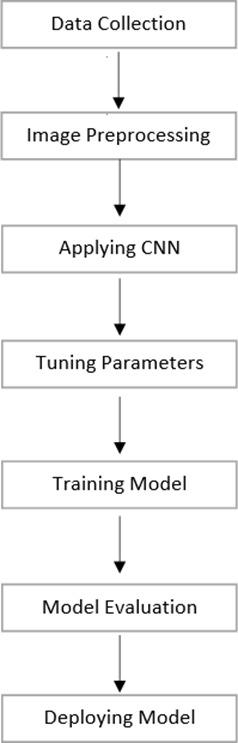
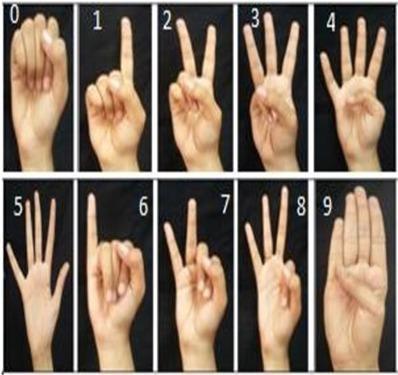
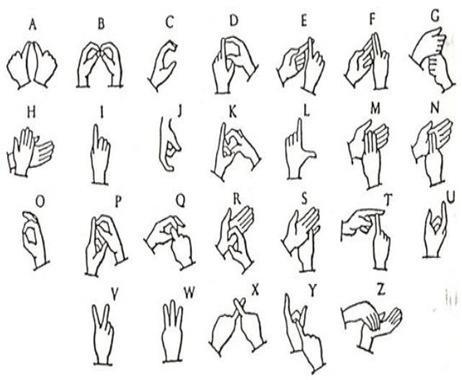
Firststepwastofindagooddataset.Butinmarket therewasnosuchstandard/reliabledatasetsofIndianSign Languagegestures.Sowedecidedtomakecustomdataset. With the help of OpenCV library and laptop webcam we collectedtrainandtestseparatedatasetoftotal36classes i.e. 26 Alphabets + 10 Digits. Our custom dataset contains approx.3000images.
Thetraintestratiois70:30.Afterthedatacollection the next step was to apply filters on the images i.e. image processing.
Toincreasethesizeofdatasetartificiallywehave used data augmentation method. Through data augmentation we can artificially increase number of train datasetimagesbyapplyingrandomtransformationfiltersto the images. The filters may be like randomly cropping images,flippingthem verticallyorhorizontally,andmany more.Becauseofdataaugmentationwecanmakeourmodel robustinsuchawaythattheobjectsintheimageshouldbe recognizedregardlessoftheorientation.Italsomakesthe model invariant to transformation of the provided input data. Then Convolutional Neural Network is applied for trainingandforclassifyingtheimages.Thelaststepwasto evaluatefromtherealtimevideo.
International Research Journal of Engineering and Technology (IRJET) e-ISSN: 2395-0056
Volume: 11 Issue: 03 | Mar 2024 www.irjet.net p-ISSN: 2395-0072
Gestures
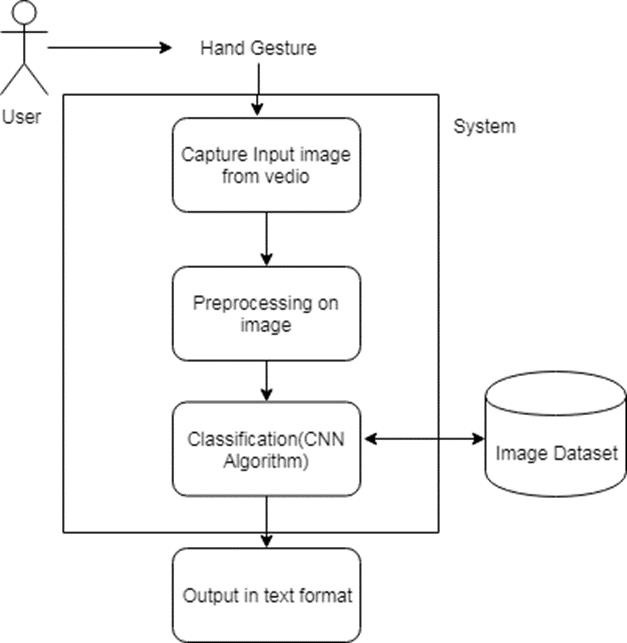
Our system consists of a CNN model. It is used to capture features from the frames and to predict hand gestures. A CNN model consists of four main operations: Convolution, Relu (Non-Linearity) Activation Function, PoolingandClassification(Fully-connectedlayer)
Convolution: Convolutionisamatrixoperationusetoapply filter on the input image. Its purpose is for extracting features from the provided input image. It preserves the spatialrelationshipbetweenthepixelsbylearningextracted features.Itisusuallyfollowedbyactivationfunction(here Relu).
Pooling: InConvNet,it’sacommonpracticetoaddpooling layerafterconvolutionlayer.Theinputimageresolutionis loweredtosuchalimitthatonlyrequireddetailsarekept.
Fully-connected layer: Fully connected layer is a multilayer perceptron that makes use of softmax activation function in the output layer. Its main purpose is to use featuresfrompreviouslayersforclassificationofimagesinto differentclassesbasedontherequirement.Theselayersare combined to create a CNN model. The last layer is a fully connectedlayer.
Number of Epochs: Itbasicallyisthenumberoftimesthe dataset is passed to the neural network for training the model. There is no such formula or ideal number for the epochs. It depends on the dataset. Higher the number of epochshigherwillbethetrainingtime.Also,highernumber ofepochsmayleadtobetteraccuracy.
Activation Function: Itspurposeistodecidewhetherthe neuronisactivatedornot.Itisappliedtothevalueofsumof
International Research Journal of Engineering and Technology (IRJET) e-ISSN: 2395-0056
Volume: 11 Issue: 03 | Mar 2024 www.irjet.net p-ISSN: 2395-0072
weights and bias. Here ReLU activation function is used whichismostcommonlyusedactivationfunctionbecauseof itscomputationaladvantages.Thisfunctionworksinsucha waythatitreturnszeroforinputsthatarenegativeandfor thepositiveinputsitreturnsthevalueitself.Therearemany other activations function like Sigmoid, Tanh, etc. but for mostofthemodernneuralnetwork,Reluisused.
Softmax: Thislayerisusedinmulti-classclassificationright beforetheoutputlayer.Theparameterpassedtosoftmaxis thenumberofclassesinclassification.Itgivesthelikelihood oftheprovidedinputimagewhichisbelongingtoparticular class/category.
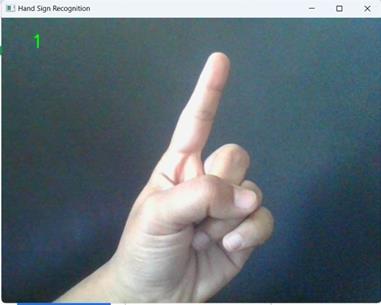
Our Proposed system is capable enough of recognizinggesturesfromrealtimevideo.OpenCVlibraryis used to access the laptop webcam and process the video frame by frame and after extracting the feature the image/gestureisrecognized.Currently,theROImustcontain agestureofhandwithaproperblank/clearbackground. Beforeusingtheactualsystemasmentionedabove, wefirstneedtotrainthedatasettomakemodelwithCNN.
4.
AND DISCUSSION
We achieved a commendable accuracy of approximately 90% in recognizing Indian Sign Language (ISL) gestures. Our system demonstrated robustness in handling variations in hand gestures and backgrounds. However,challengessuchasmisinterpretations ofsimilar symbols were encountered. Comparing our system with existing approaches revealed promising advancements.
Despite limitations, our work marks a significant step towards bridging the communication gap for individuals withhearingimpairments.
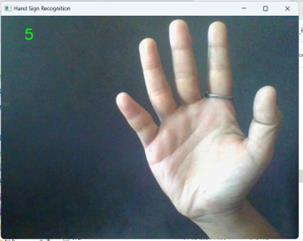
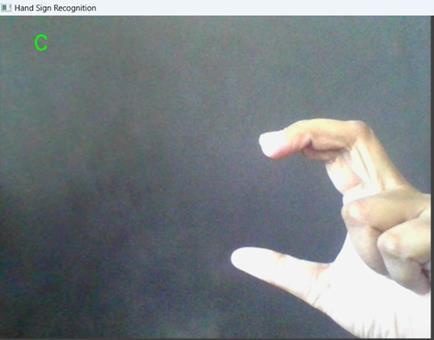
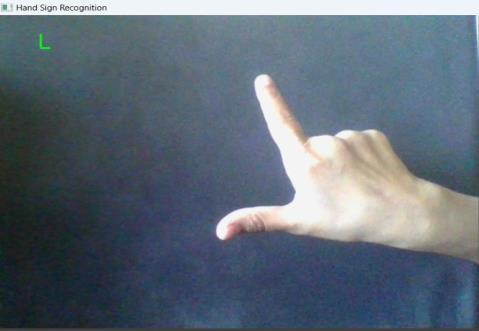
We can conclude that Convolutional Neural Networks(CNN)canbeusedasclassificationalgorithmsfor sign language recognition systems as it provides better accuracy.However,pre-traininghastobeperformedwitha
International Research Journal of Engineering and Technology (IRJET) e-ISSN: 2395-0056
Volume: 11 Issue: 03 | Mar 2024 www.irjet.net p-ISSN: 2395-0072
larger dataset in order to show increase in accuracy. We were able to achieve approximate accuracy of 90%. The systemrequiressomeconstraints,likeaclearbackground andtheorientationofthehandtofacethecamera.Further, similar symbols were sometimes misinterpreted for one another.Thiscouldbeduetothelimitedtrainingprovidedto thesystem.Thesystemmightovercometheselimitationsifa moredetaileddatasetindifferentenvironmentalconditions isprovidedfortraining.Alsolettersthatneededmovement ofthehandscouldnotbeproperlyidentified.
Inourfuturework,wewillalsotrainmodelonsome short videos of some commonly used phrases like I am coming,howareyou,IamHardik(nameoftheperson),This ismyhouseetc.Asthisdatasetiscustommade,thenumber ofimagesarenotenoughtogainmoreaccuracysowewill try to increase number of images as well as accuracy at different angles. The system can undergo training using a comprehensivedatasetthatincludesthousandsofsamples for each letter of the alphabet. This dataset encompasses variousenvironmentalconditions,lightingscenarios,hand positions,andskintonestoenhanceoptimization.
We express our gratitude to the divine for bestowing us with blessings and guiding our efforts to a successfulconclusion.Wedeeplyappreciatetheinvaluable guidanceandadviceprovidedbyouresteemedmentor,Prof. S.G.Malas,duringcriticalmoments,steeringusintheright direction. Additionally, we extend our thanks to Dr. P.D. Lambhate, the Head of the Department, for granting us accesstonecessaryfacilities.Oursincereappreciationalso goestoallthefacultymembersfortheirsupport.Finally,we aregratefultoourfriendsandfamilyfortheirunwavering encouragementthroughoutthisendeavor.
[1] U. Patel and A. G. Ambekar, "Moment Based Sign Language Recognition for Indian Languages," 2017 International Conference on Computing, Communication, ControlandAutomation(ICCUBEA),Pune,2017,pp.1-6.
[2] Y. Xue, S. Gao, H. Sun and W. Qin, "A Chinese Sign Language Recognition System Using Leap Motion," 2017 InternationalConferenceonVirtualRealityandVisualization (ICVRV),Zhengzhou,China,2017,pp.180-185.
[3] P. Viola and M. Jones, "Rapid object detection using a boostedcascadeofsimplefeatures,"Proceedingsofthe2001 IEEEComputerSocietyConferenceonComputerVisionand PatternRecognition.CVPR2001,Kauai,HI,USA,2001,pp.I-I.
[4]RachelSutton-SpenceandBencieWoll,TheLinguisticsof British Sign Language: An Introduction, Cambridge UniversityPress,1999.
[5 H. Cooper, B. Holt, and R. Bowden, “Sign language recognition,”inVisualAnalysisofHumans,2011.
[6] T. Starner, J. Weaver, and A. Pentland, “Real-time Americansignlanguagerecognitionusingdeskandwearable computer-based video,” IEEE Transactions on Pattern Analysis and Ma chine Intelligence, vol. 20, no. 12, pp. 1371–1375,1998.
[7]M.B. H.Flores,C.M.B. Siloy,C. Oppus,andL.Agustin, "User oriented finger-gesture glove controller with hand movement virtualization using flex sensors and a digital accelerometer," 2014 International Conference on Humanoid, Nanotechnology, Information Technology, CommunicationandControl,EnvironmentandManagement (HNICEM), Palawan, 2014, pp. 1-4, DOI: 10.1109/HNICEM.2014.7016195J.
[8] R. Mardiyanto, M. F. R. Utomo, D. Purwanto and H. Suryoatmojo, "Development of hand gesture recognition sensorbasedonaccelerometerandgyroscopeforcontrolling arm of underwater remotely operated robot," 2017 International Seminar on Intelligent Technology and Its Applications (ISITIA), Surabaya, 2017, pp. 329- 333, doi: 10.1109/ISITIA.2017.8124104.
[9] P. Telluri, S. Manam, S. Somarouthu, J. M. Oli and C. Ramesh,"Lowcostflexpoweredgesturedetectionsystem anditsapplications,"2020SecondInternationalConference onInventiveResearchinComputingApplications(ICIRCA), Coimbatore, India, 2020, pp. 1128-1131, doi: 10.1109/ICIRCA48905.2020.9182833.
S.Davey,C.Maheshwari,S.K.Raghav,N.Singh,K.Muzammil, andP.Pandey,“Impactofindianpublichealthstandardsfor ruralhealthcarefacilitiesonnationalprogrammeforcontrol ofdeafnessinindia:Theresultsofacohortstudy,”Journalof familymedicineandprimarycare,vol.7,no.4,p.780,2018.
[11]O.M.Foong,T.J.Low,andW.W.La,“V2s:Voicetosign languagetranslationsystemformalaysiandeafpeople,”in InternationalVisualInformaticsConference.Springer,2009, pp.868–876.
[12]R.San-Segundo,R.Barra,R.Cordoba,L.D’Haro,F.Fern´ andez, ´ J. Ferreiros, J. M. Lucas, J. Mac´ıas-Guarasa, J. M. Montero, and J. M. Pardo, “Speech to sign language translationsystemforspanish,”SpeechCommunication,vol. 50,no.11-12,pp.1009–1020,2008.
[13]Manware,A.;Raj,R.;Kumar,A.;Pawar,T.SmartGloves as a Communication Tool for the Speech Impaired and HearingImpaired.Int.J.Emerg.Technol.Innov.Res.2017,4, 78–82.
International Research Journal of Engineering and Technology (IRJET) e-ISSN: 2395-0056
Volume: 11 Issue: 03 | Mar 2024 www.irjet.net p-ISSN: 2395-0072
[14] Wadhawan, A.; Kumar, P. Sign language recognition systems: A decade systematic literature review. Arch. Comput.MethodsEng.2021,28,785–813.
[15]Papastratis,I.;Chatzikonstantinou,C.;Konstantinidis, D.; Dimitropoulos, K.; Daras, P. Artificial Intelligence TechnologiesforSignLanguage.Sensors2021,21,5843.
BIOGRAPHIES





SmitaWagh
JSPM’sJSCOE ComputerDept. SPPUUniversity
Ms.DikshaJaiswal
JSPM’sJSCOE ComputerDept. SPPUUniversity
Ms.SnehalThalkar
JSPM’sJSCOE ComputerDept. SPPUUniversity
Ms.EkataMore
JSPM’sJSCOE ComputerDept. SPPUUniversity
Ms.ReshaDeshmukh
JSPM’sJSCOE ComputerDept. SPPUUniversity
|