
International Research Journal of Engineering and Technology (IRJET) e-ISSN: 2395-0056
Volume: 11 Issue: 03 | Mar 2024 www.irjet.net p-ISSN: 2395-0072
International Research Journal of Engineering and Technology (IRJET) e-ISSN: 2395-0056
Volume: 11 Issue: 03 | Mar 2024 www.irjet.net p-ISSN: 2395-0072
S. Raghuram*1, K. Abinaya2, V.Gayathri3 , V. Dhanasekar4
1* Assistant Professor, Department of Civil Engineering, Karpaga Vinayaga College of Engineering and Technology, Chennai, Tamil Nadu, India. 2, 3, 4 Student, Department of Civil Engineering, Karpaga Vinayaga College of Engineering and Technology, Chennai, Tamil Nadu, India.
Abstract - The innovative usage of recycle products has increased in this present scenario. Manufacturing of new product with the utilization of waste product is a challenging job. The necessity of the waste products increases with the decrease in the availability of Natural Resource over a short period. The main objective of this project is to encourage the use of Plastic waste (PW) and Brick Waste (BW) products as constitution of Interlocking Blocks. In this project Interlocking block was made with OPC 53 Grade and by replacing Coarse aggregate and Fine aggregate with Plastic waste of about 5%, 10%, 15% while the Brick Waste (BW) of about 2%, 4%, 6%, 8% respectively. Initially the Plastic waste (PW) was only replaced for the coarse aggregate and the optimum percentage was calculated which is 10% Plastic waste. Next the Plastic waste (PW) was standardized and the Brick Waste (BW) was replaced for fine aggregate. From the experiment conducted 10% Plastic waste (PW) and 4% of Brick Waste (BW) was obtained as the optimum percentage replacement. With this percentage replacement the Interlocking Blocks are casted and compressive tests were conducted.
Key Words: Interlocking Block, Plastic Waste, Brick Waste, Replacement, Compressive Strength
The conventional brick masonry is a most renowned building material in the construction industry which has extreme properties like durability, cost etc. [7]. The traditionalbricksaremadewithclayandtheyaretreated with high temperature kiln firing [6]. These bricks are produced either by machine or by manually. The conventional bricks can be used for the construction of singlestorybuildingandnotformulti-storybuildingasthey arelargeinsizeandhavelessresistancetoearthquake[7]. Toovercomefewoftheaboveandtocompeteinthisrapidly growingconstructionindustryengineersareinsearchofthe new technique and that should be an alternate for conventionalburntclaybricks[6].
The Interlocking concrete block are different from the normal bricks. These blocks interlock with each other by meansofpositiveandnegativefrogontopandbottomofthe block[4].Thisfrogconnectiondoesnotallowthestructure
forhorizontalcompressivestressandlateralmovementof block[4].Theinterlockingblocksareofdifferentshapesand themostcommonshapeisregularorfullblock(300mmX 150mmX100mm),halfsized(150mmX150mmX100mm) andU-Shaped[7,4].
Theconstructionwiththeinterlockingblocksaredoesnot requiredalargeamountofcementmortarasofconventional bricks masonry. The cement mortars are used only for plastering the wall to resist the structure from the penetrationofwindandrain[7].
There is little heterogeneity between normal brick and interlockingblocksandtheyare:[7].
InterlockingBricksarenotbacked;it’sjustmudinhigh densitypressureusingapressingmachineandallowed todrynaturally.Whereasnormalbricksareburnedclay materials.
Thesizesoftheinterlockingblocksareapproximately 2.5timesthesizeofthenormalbricks.
Theweightoftheinterlockingblockisgreaterthanthe equivalentvolumeofthebakedbricks.
The dry assembly of interlocking blocks saves large amountoftimeandreducesthebuildingcost.
Theycanbeshippedeasilyfromonelocationtoanother.
The manufacturingofthese blocksissimpleand does not required skilled labors and the production can be doneatanygeographicallocations.
Grout hole and channel block are provided to insert steelreinforcementinanypointofthebuildingtoresist thestructurefromwindandearthquake.
1.2 Disadvantages: [7]
As it is the new technique so there lack of proper awarenesstowardthepeoples.
Asthejointsarenotentirelyresistancetowindandrain, soplasteringisrequired.
International Research Journal of Engineering and Technology (IRJET) e-ISSN: 2395-0056
Volume: 11 Issue: 03 | Mar 2024 www.irjet.net p-ISSN: 2395-0072
TheOPC53gradeCementisusedastheBindermaterial.The properties of the cement are tested and the results are Specific Gravity of the cement is 3.23 and Normal Consistentlyis32%.TheInitialSettingTimeofcementis47 minandtheFinalSettingTimeofcementis610min.
The granite materials are crushed and the materials retaining 20 mm sieve and 12.5 mm sieve was used. The SpecificGravityofcoarseaggregateis2.54andtheFineness modulusis7.03andtheWaterabsorptionis0.62%.
ThereisahugedemandfortheriversandtheM-Sandisused asthealternativeovertheconstructionindustryandsodo we. The Specific Gravity of the M-Sand is 2.33 and the Finenessmodulusis2.68andtheWaterabsorptionis1.01%
Portablefreshwater,whichisfreefromorganicsubstance andconcentrationsofacid,wasusedformixingofconcrete.
ThePlasticarenon-biodegradablewastematerialwhichhas few intelligent features also they are extremely versatile, light weight, high lesser, production cost and ability to combinewithothermaterials[2,5].Sothelocallyavailable plasticswasteswerecollectedandtheyarehandcrushed. Theplasticwhichareretainedin20mmsieveand12.5mm sieveareused.ThepropertiesofthePlasticaredetermined andtheyareSpecificgravityofPlasticis2.06andtheWater absorptionis1.07%.
Thereisneedinthefurther improvementofrecyclingthe brickwasteproducedduringtheconstructionofbuildings. Construction practices still create too much waste during boththedesignandbuildphases.Thiswastecanberecused inaneffectiveastheyarealowercostoptionandismore resourceefficient[1,3].TheBrickWasteproducedfromthe construction sites were collected and they are tested to determine their properties and are the Specific gravity of Brickwasteis2.44andtheWaterabsorptionis2.71%.
AspertheIndianStandardMethodofTestsforStrengthof Concrete(IS516:1959),theCubecompressiontestandthe compressiontestforinterlockingBlocksareevaluated.
3.
TheDesignmixforM20gradeofconcrete isdone with IS 10262:2019.TheMixratiowas1:1.61:2.86withthewater cement ratio of 0.5 (9). Then the cube samples are casted onlywiththepartialreplacementofCoarseaggregatewith thePlasticwastewasdoneandtheoptimumpercentagewas derived.Thenwiththeoptimumpercentagereplacementof Plasticwaste,theBrickwasteisreplacedforFineaggregate and the compressive strength was calculated and the optimumpercentagereplacementisdetermined.Finallythe InterlockingBlocksarecastedwiththeoptimumpercentage replacement obtained with the replacement of both the plastic waste and the brick waste, and the compressive strengthwasdeterminedfortheInterlockingBlock.
TheConcreteCubeMoldofsize150×150×150mmwasused forcastingthespecimens.Totally54cubesamplesand12 Interlocking Block samples were casted and tested. The Sampledetailsareasfollows:
TABLE -1: DetailsofSpecimens.
The Concrete cube with the Partial replacement of plastic waste(PW)forcoarseaggregatewasdoneat5%,10%and 15%.Thentheyareplacedforcuringfor7and28days.
International Research Journal of Engineering and Technology (IRJET) e-ISSN: 2395-0056
Volume: 11 Issue: 03 | Mar 2024 www.irjet.net p-ISSN: 2395-0072
Fromthetable2thecompressivestrengthofconcretecube withvaryingproportionsofplasticwastewastestedandthe test results are compared with the conventional concrete. Accordingtowhichtherewasariseincompressivestrength inPW2(10%ofplasticwastereplacement)inboth7days and28days compressivestrength.Thus thePW2sample wasconsideredastheoptimumpercentageforplasticwaste replacement.
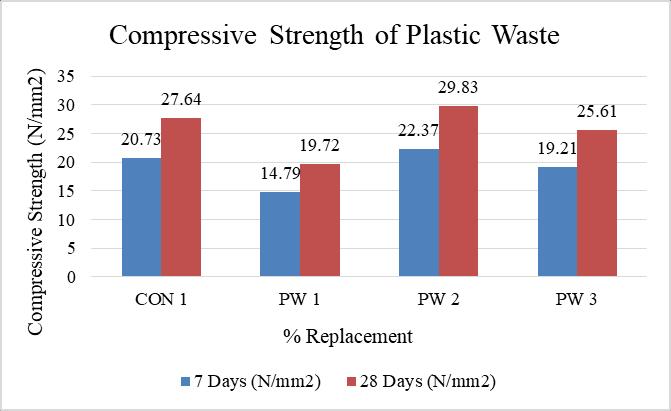
FromtheChart-1wecanalsoconcludethattherewasarise inthecompressivestrengthwhichwas7.81%in7daysand 7.92%in28days.
The Concrete cube with the Partial replacement of plastic wasteforcoarseaggregatewasdoneat5%,10%and15% and the optimum percentage was determined i.e., 10% replacement. With that optimum percentage additional partialreplacementofBrickwastewasdoneat2%,4%,6%, and8%.Thentheyareplacedforcuringfor7and28days. Then they are tested and from the test results optimum percentageforthecastingofInterlockingConcreteBlocks wasdetermined.
Fromthetable2thecompressivestrengthofconcretecube with varying replacement of Brick Waste with optimum percentage of plastic waste which was determined from table1wascastedandtheyweretested.Inthatresultthe plasticwasteandBrickWastereplacedcubestestresultsare compared with the conventional concrete. According to which there was a rise in compressive strength in PCW 2 (10%ofplasticwastereplacementand4%replacementof Brick Waste) in both 7days and 28 days compressive strengthascomparedtoCON2.ThusthePCW2samplewas consideredastheoptimumpercentageforplasticwasteand BrickWastereplacedcubes.
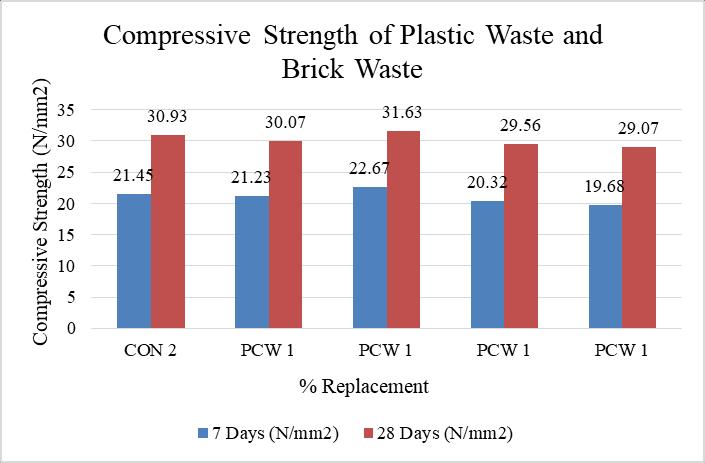
Chart -2:7Daysand28DaysCompressivestrengthof PlasticWasteandBrickwaste
From the Chart-2 we can also conclude that there was an upsurgeinthecompressivestrengthwhichwas5.69%in7 daysand2.26%in28days.
InthisprojecttheInterlockingconcreteblocksofdimension of 400mm X 200mm X 200mm was casted and the compressive strength was calculated. The interlocking blocksaremadewiththefinaloptimumpercentageobtained from the compressive strength of Plastic Waste and Brick Wastei.e.10%PlasticWasteand4%BrickWaste.
International Research Journal of Engineering and Technology (IRJET) e-ISSN: 2395-0056
Volume: 11 Issue: 03 | Mar 2024 www.irjet.net p-ISSN: 2395-0072
TABLE - 4: CompressiveStrengthtestofInterlocking ConcreteBlock Specimen Details
Fromthetable4thecompressivestrengthofInterlocking concreteblockwithoptimumpercentageofBrickWasteand optimumpercentageofplasticwastewhichwasdetermined from table 3 was casted and they were tested. In that the results of plastic waste and Brick Waste replaced interlockingconcreteblocksarecomparedalongside with thetestresultofconventionalconcrete.Accordingtowhich thereisaclearupsurgeinthecompressivestrengthinILB (10%ofplasticwastereplacementand4%replacementof Brick Waste) in both 7 days and 28 days compressive strengthascomparedwithConventionalConcrete(CON).
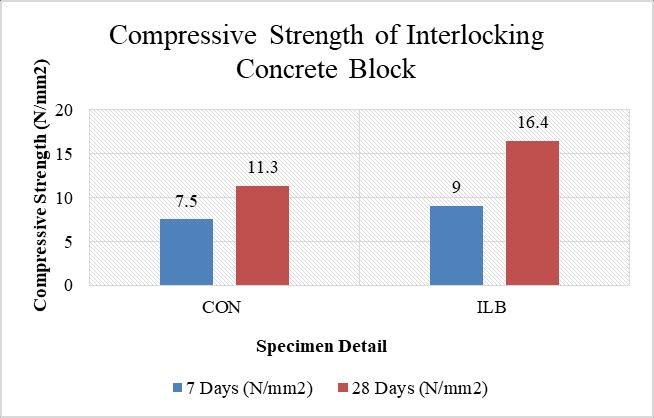
Chart -3:7Daysand28DaysCompressivestrengthof InterlockingConcreteBlock
From the Chart-3 we can also conclude that there was an increaseinthecompressivestrengthwhichwas50.67%in7 daysand82.22%in28days.
5. Conclusion
Thisexperimentalinvestigationwasdoneaccordingtothe material properties based on IS specifications and its physical which are obtained through various tests conducted.ThedesignmixforM20gradeofconcretewas done and verified with the reference of IS code. The compressive strength of Plastic Waste replaced concrete with10%replacement;itgivesacceptablestrengthof29.83 N/mm2. Also the compressive strength of Plastic Waste replacedconcretewith10%replacementandBrickWaste replaced concrete with 4% gives an optimum result for casting interlocking Block; it gives acceptable strength of 31.63N/mm2.
Fromthetestresultstheinterlockingblocksarecastedand the Compressive Strength was evaluated and thus we are concluding that the Interlocking concrete block with 10% replacementofPlasticwastewith4%replacementofBrick Wasteshowsanevidentresult.
The Authors, Mr. S. Raghuram, Ms. K. Abinaya, Ms. V. GayathriandMr.V.Dhanasekar thankstheManagementand Principal of Karpaga Vinayaga College of Engineering and Technology for providing the facilities to conduct experiment on Interlocking Concrete Block by Partial ReplacementofBrickWasteandPlasticWaste.
[1] D.Konakova,E.Vejmelkova,M.Cachova,P.Reiterman, M.Keppert&R.Cerny(2015),“Characterizationofthe effect of brick-powder application in lime-based plasters” WIT Transactions on Modelling and Simulation,Vol59,pp291-301.
[2] KarmaTempa,NimeshChettri,GautamThapa,Phurba, ChekiGyeltshen,DawaNorbu,DikshikaGurung,Ugyen Wangchuk, (2022), “An experimental study and sustainabilityassessmentofplasticwasteasabinding material for producing economical cement-less paver blocks”, Engineering Science and Technology, an InternationalJournal,Elsevier,pp1-14.
[3] Li’anZhou,YangLiu,JiachengLu,WenjuanZhouandHui Wang.(2021) “InfluenceofRecycledConcretePowder (RCP) and Recycled Brick Powder (RBP) on the Physical/MechanicalPropertiesandDurabilityofRaw Soil”,coatings,11,1475,pp1-12.
[4] Malavika. P, Nipuna. M, Raina T.R, Sreelakshmi A.V, Kirpa K.M, (2017) “Design of Interlocking Block and ReplacementofM-SandbyConcreteRoofTileWaste”, International Research Journal of Engineering and Technology(IRJET),pp1224-1229,Vol-4,Issue-5.
[5] PoojaLamba,DilrajPreetKaur,SeemaRaj,JyotiSorout, (2021), “Recycling/reuse of plastic waste as construction material for sustainable development: a review”EnvironmentalScienceandPollutionResearch, Springer.
[6] Prasanna Jenifer Golda. J, Anitha. P, (2021) “Experimental investigation onInterlockingBlocksby Partial Replacement of Cement with Silica Fume”, International Journal of Creative Research Thoughts (IJCRT),pp338-342.Vol-9Issue-6.
[7] PraveenKumar.T,Vigneshvar.R,(2014),“Development of Innovative Interlocking Blocks”, Journal of Civil
International Research Journal of Engineering and Technology (IRJET) e-ISSN: 2395-0056
EngineeringandEnvironmentalTechnology,Research Gate,pp.114-118,Vol-1Num-5.
[8] IS 10262: 2019 – Indian Standard Concrete Mix Proportioning–Guideline.
[9] IS 456: 2000 – Indian Standard Plain and Reinforced Concrete–CodeofPractice
[10] IS 516: 1959 – Indian Standard Method of Tests for StrengthofConcrete
Volume: 11 Issue: 03 | Mar 2024 www.irjet.net p-ISSN: 2395-0072 © 2024, IRJET | Impact Factor value: 8.226 | ISO 9001:2008