
International Research Journal of Engineering and Technology (IRJET) e-ISSN: 2395-0056
Volume: 11 Issue: 03 | Mar 2024 www.irjet.net p-ISSN: 2395-0072
International Research Journal of Engineering and Technology (IRJET) e-ISSN: 2395-0056
Volume: 11 Issue: 03 | Mar 2024 www.irjet.net p-ISSN: 2395-0072
Abstract:
This paper examines the potential health risks associated with well water use in Cotonou, Benin. Drawing on existing research, environmental data, and community surveys, it analyzes the quality of well water, identifies potential contaminants, and explores their possible health effects on residents. The paper concludes by highlighting the need for improvedwaterinfrastructureandsanitationpracticestomitigatetheserisksandpromotepublichealth.
Every individual should have the fundamental right to have uncontaminated and secure water, along with sufficient sanitary amenities. However, the provision of water and sanitation services continues to be a significant obstacle in numerous undeveloped nations. Water is vital for the survival of every plant and animal species, especially for humans. Thehumanbodyisprimarilycomposedofwater.Waterisessentialforthefunctioningoflivingbeingssinceitfacilitates important exchanges necessary for the sustenance of life[1]. The freshwater resource comprises groundwater, surface water, and rainwater. Ensuring abundant and top-notch availability of potable water is crucial for all facets of existence and the progress of sustainable development. Groundwater is the favored source for piped water supplies in numerous metropolitan regions in Sub-Saharan Africa, and its expansion is projected to significantly rise in order to enhance the extentof urban water distribution[2]. Groundwater qualityisaffected by both natural occurrences and human activities. WaterisafundamentalnecessityforHomosapiens.Regrettably,asstatedinthe2019WorldBankreportpresentedatthe United Nations, the global community is currently confronting an overlooked water quality problem[3]. This issue substantially diminishes the economic growth prospects of highly polluted regions by 33% and raises concerns for both humanandenvironmental well-being.Everyorganism needaccesstopotablewater.Inorderforhumanstoensuretheir continued existence, they need an abundant supply of clean and potable water. The prevalence of waterborne diseases, such as cholera, typhoid, diarrhea, and dysentery, is greatly increased due to the poor quality of drinking water and inadequate sanitation facilities. The inadequate condition of water and sanitation in Africa can be attributed to various issues,suchasinadequatestrategicplanning,a fast-expanding population,lack ofaccountability, political instability,and insufficient financial resources[4]. The water and sanitation issues in developing countries are more noticeable in rural regions,mostlybecauseofadevelopmentplanningapproachthatgiveshigherimportancetourbandistricts.Thisstrategy can be attributed to the colonial era and regrettably continues to exist throughout Africa after gaining freedom. Impoverished nations encounter substantial limitations in acquiring access to potable water. In Benin, potable water is sourcedfromseveraloutlets,suchastapwaterandexposedsurfacewater.TheSONEB,agovernment-ownedcorporation, providespotablewatertourbanareasthroughoutBenin[5].Inareaslackingacentralizedwatersupply,theresponsibility for managing water is entrusted to the DGO (Direction Générale de l'Eau), which is a separate governmental entity. The water resources in Benin are characterized by restricted access to potable water and variations in availability based on geography The Ministry of Economic and Financial Development has estimated that an annual budget of US$80 million and US$22 million, respectively, is required from 2006 to 2015 to achieve the Millennium Development Goals (MDGs) relatedtowaterandsanitation[6].By2015,thenumberofindividualswithoutaccesstoimprovedwatersourcesexceeded 2million.Interms ofsanitation,20%of the population hadaccesstoupgradedsanitationfacilities,with36%and7%in urbanandruralregions,respectively.Thisstudyaimstoinvestigatethehealthimplicationsassociatedwiththeutilisation of well water in the city of Cotonou. Approximately 65% of Benin's population has abstained from registering with the National Water Company of Benin (SONEB) due to financial limitations[7]. The population ingests untreated freshwater and is susceptible to a range of diseases. Yetongnon et al.[8] conducted a comprehensive analysis of the physical and chemical properties of well water in the sixth neighborhood of Cotonou, South Benin, along with the detection of metal contaminants. The researchers performed in-situ measurements of various physico-chemical parameters, such as pH, temperature,conductivity,totaldissolvedsalts(TDS),andsalinity.Elevatedconcentrationsofammoniumandnitriteions wereidentifiedinthegroundwater,indicatingpotentialcontamination.Thewatersamplesincludedexcessiveamountsof aluminum and iron, beyond the guidelines established by the World Health Organization[9]. While the majority of the trace elements fulfilled the toxicity standards, certain atypical levels were detected, suggesting potential sources of contamination. The analysis revealed significant correlations among various chemical elements, indicating a common originforpositivelycorrelatedmetalsanduniqueoriginsfornegativelycorrelatedmetals.In2022,Avocefohounetal.[10] conducted a study to examine the physical and chemical properties of well water in the sixth neighborhood of Cotonou, locatedinSouthBenin.Furthermore,thestudyinvestigatedthepresenceofmetalliccontaminantsinthewater.Thewell
International Research Journal of Engineering and Technology (IRJET) e-ISSN: 2395-0056
Volume: 11 Issue: 03 | Mar 2024 www.irjet.net p-ISSN: 2395-0072
water samples undergo analysis to detect the existence of twenty-six metallic elements utilizing the inductively coupled plasma source mass spectrometer (ICP-MS). The study emphasizes the deterioration of the physical and chemical propertiesofgroundwaterinthesixthneighborhood,whichischaracterizedbyexcessivemineralcontentasindicatedby conductivityvaluesthatsurpassthestandardsetbytheWorldHealthOrganization.Thegroundwaterhasbeendiscovered to possess elevated levels of ammonium and nitrite ions, beyond the predetermined thresholds. Reports show that the waterincludessmallamountsofaluminiumandiron,whichincertaincasessurpassthestandardssetbytheWorldHealth Organisation[9]. The analysis uncovers substantial relationships among different chemical elements, suggesting both shared and distinct origins for metals that have positive and negative connections. Urban areas, such as Cotonou, may undergo deterioration of shallow underground water sources, such the Quaternary aquifer, as a result of contaminants seepingin,suchasseawater,septictankwaste,andsewage.ResearchconductedinDakar,Senegal;Douala,Cameroon;and other regions of Ghana has shown that nitrate contamination is a widespread issue in urban shallow groundwater resources[1, 11, 12]. The indiscriminate disposal of waste and insufficient sanitation infrastructure contributes to the contamination of groundwater, leading to the presence of various pollutants. Seasonal variations in aquifers and fluctuationsingroundwaterqualitycanimpacttheamountofpollutioninwellwater.Theuseofunregulatedgroundwater for residential purposes, such as drinking water supplies, poses substantial health risks due to water quality issues in manyurbanareas[13]
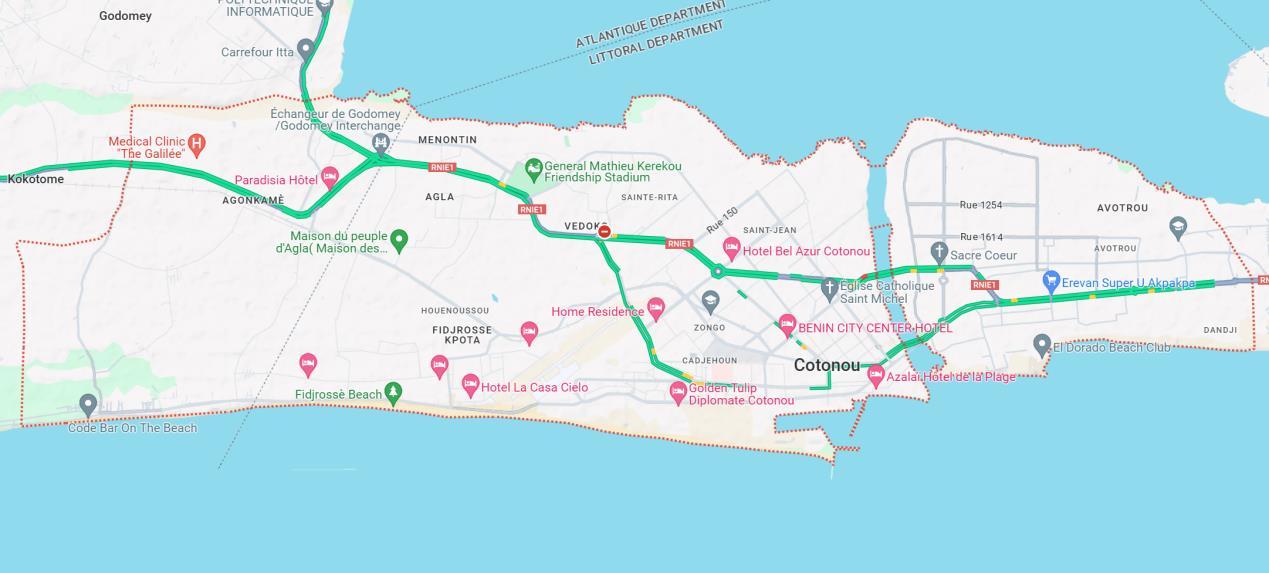
Cotonou is chosen as the optimal location for this study due to its status as the most densely populated city in Benin. Cotonou is located between the geographical coordinates of 6°20' to 6°23' north latitude and 2°22' to 2°30' east longitude[14]. The municipalityis the onlyadministrative subdivision within the Littoral Department. It sharesa border withthemunicipalityofSô-AvaandLakeNokouétothenorth,theAtlanticOceantothesouth,themunicipalityofSèmèKpodjitotheeast,andthemunicipalityofAbomey-Calavitothewest.Cotonouiscomposedof13districts,eachofwhichis dividedinto143citydistricts[15].Theregionhastwoseparateperiodsofrainfall,whichtakeplacefromApriltoJulyand from September to October. The overall amount of rainfall received year ranges from 800 to 1,200 mm (31 to 47 in). Moreover,Cotonouexperiencestwoperiodsoflowprecipitationknownasdryseasons.Thecityisaffectedbyharmattan winds from December to January. The temperatures exhibit a similar stability throughout the year, with the average highesttemperaturesconsistentlystayingaround30°C,andtheaveragelowesttemperaturesremainingaround25°C[16]
2.2.
In Benin, the southern region possesses abundant surface water resources in perennial rivers, while groundwater is extensively utilised throughout the country, both in rural and urban areas, for residential water supply. Cotonou, the capital, relies heavily on groundwater resources. The limited productivity of subterranean aquifers, which are prevalent acrossBenin,resultsinchallengeswiththeaccessibilityofpotablewaterinurbanareasofmoderatetosignificantsize.In certain areas of the coastal basin, there is a problem with providing an adequate supply of drinkable water due to the limited thickness of the shallow aquifers. When the shallow deposits are incapable of producing enough resources,
International Research Journal of Engineering and Technology (IRJET) e-ISSN: 2395-0056
Volume: 11 Issue: 03 | Mar 2024 www.irjet.net p-ISSN: 2395-0072
boreholes are dug to greater depths into the worn basement below. The quality of groundwater in shallow aquifers is frequently compromised as a result of contamination. Coastal aquifers are particularly affected by the issue of saline intrusion.InCotonou,thecapitalcity,thereisasignificantextractionofgroundwater.However,researchhasrevealedthat the groundwater in the urban region above the recommended levels of several pollutants according to the recommendations set by the World Health Organisation. These contaminants include lead, chromium, cadmium, zinc, coliforms,andE.coli[17]
2.3. Sewerage and waste
The study conducted by Totin et al.[17] in Cotonou found that the alteration of groundwater's chemical composition in different climatic conditions is associated with processes such as ion exchange, rock disintegration or weathering, intrusionofseawater,andcontaminationcausedbyhumanpollution.
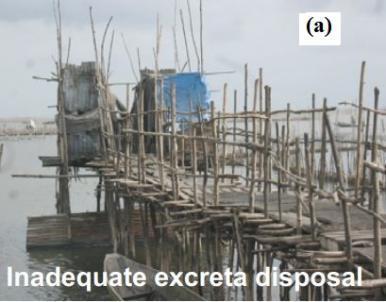
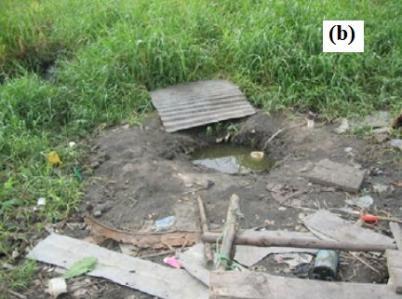
andtheirenvironmentalimplicationsin
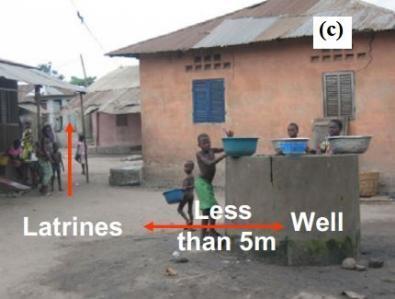
(a)InsufficientwastedisposalonLake Nokoue;
Watersupplysourcepollution;and(c)Inadequateseparationbetweenpitlatrineandwell,asperthecurrent WHOguidelines(15m). Source: Totinetal.[17]
Humanactivities,suchasindiscriminatedisposalofrubbishandwaste,theuseofseptictanks,soak-awaypits,andsimilar practices, can produce leachates that pollute the groundwater. The dumping of sanitary wastewater and solid waste in urban areas presents a substantial threat to the quality of shallow groundwater. Wastewater treatment is not regularly conducted in Benin[10]. Usually, wastewater is not properly disposed of. Within Cotonou, 64.9% of families employ latrines that are documented to be impermeable, whereas 13.5% partake in hazardous and unclean behaviours such as utilising stilt latrines or engaging in open defecation. Based on the 2013 data from INSAE, just 20.8% of the population make use of septic tanks, which are commonly emptied through drainage systems[10]. Usually, wastewater is inadequately disposed of. Impoverished persons residing in disadvantaged communities experience more pronounced consequences from the ingestion of contaminated water. Although these water sources are renewable, various global studieshavedemonstratedthattheyarecontaminatedtovaryingdegreesandserveasafertileenvironmentfornumerous diseases. Sanitary facilities and access to clean water significantly influence the health of households. The absence of adequatesanitaryinfrastructure, leading to water contamination, isa significant issuedue to itsassociation withhuman morbidityandmortality.
The presence of contaminantssuchasbacteria,viruses, heavymetals,andchemicalsin well waterinCotonou isa major concern due to its impact on water quality. However, it remains an essential water source for many people in the area. Everylivingentitynecessitatesaccesstodrinkablewaterinordertosurvive.Forhumanstomaintaintheirsurvival,they require a plentiful provision of uncontaminated and drinkable water. Impoverished communities in disadvantaged neighborhoods of Cotonou are disproportionately affected by the consumption of contaminated water from water wells[12,14,17].Thesewatersourcescanberefreshed,howevermultipleglobalstudieshaveshownthatthesefluidsare contaminatedtodifferentextentsandactasabreedinggroundforvariousdiseases.Thesepollutantshavethepotentialto induce waterborne illnesses, infections of the skin and eyes, as well as long-term health conditions such as cancer and neurological abnormalities[18, 19] Groundwater harbours microbiological pollutants, including bacteria, viruses, and parasites,thatcanconstituteasubstantialhealthhazard ifconsumed[20,21].Thesepollutantsarefrequentlyintroduced by human faeces, animal dung, and soil. In order to maintain the microbiological purity and safeguard against these contaminants,itisessentialtoregularlycarryoutexamination,assessment,andresolution
TheWaterQualityIndex(WQI)isanumericalvaluethatrepresentstheoverallwaterqualityataspecificlocationandtime, taking into account various criteria that measure water quality[22, 23]. The aim of the Water Quality Index (WQI) is to
International Research Journal of Engineering and Technology (IRJET) e-ISSN: 2395-0056
Volume: 11 Issue: 03 | Mar 2024 www.irjet.net p-ISSN: 2395-0072
transform intricate water quality data into comprehensible and practical information for public consumption. Several indices have been created to condense water quality data into a manner that is both simply communicable and easily comprehensible.TheWater QualityIndex(WQI),initiallydevised byHortonintheearly1970s,isessentiallya statistical methodfordeterminingasinglenumericalvaluebasedonseveraltestoutcomes[24].Theindexresultindicatesthedegree of water quality in a certain water basin, such as a lake, river, or stream. Following Horton's work, numerous workers worldwide have developed Water Quality Index (WQI) are systems that assess water quality based on the evaluation of various parameters. This work aims to evaluate the Water Quality Index (WQI) using data from a study conducted by Vodounonetal.[18](REF)onanumberofsampledwellsinCotonou.TheWaterQualityIndex(WQI)is usuallycalculated inaccordance with the parameters pH,TDS,TH,Ca2+, Mg2+,Na+,K+,Cl−,2 SO4− ,HCO3−andNO3−, whicharederived from the studies conducted by Alastal et al.[18] and El Baba et al.[25], as well as the drinking water quality guidelines establishedbytheWorldHealthOrganisation(WHO)[9].Thisindexisusedtoevaluatetheseasonalqualitystatusofwater. Thecorrelationsamongthosemeasuresarecrucialindeterminingonlythephysicochemicalqualitystatusofwellwater.
TheequationsusedtoestimateWQIare:
Where, Wi = unit weight for nth parameter, Si= standard permissible value for nth parameter, and K = proportionality constant.
qi isaqualityratingfor nth waterqualityparameterisgivenbytheequation:
ThefollowingtabledisplaystheappropriatenessofWQIvaluesforhumaneating.TheWQIisdividedinto fivecategories torepresentdifferentwaterqualitystatuses[12,24]:Thequalityiscategorisedasfollows:excellent(0-25),good(26-50), bad(51-75),verypoor(76-100),andinappropriatefordrinking(>100).
Table1.Waterqualityindexandwaterqualitystatus
International Research Journal of Engineering and Technology (IRJET) e-ISSN: 2395-0056
Volume: 11 Issue: 03 | Mar 2024 www.irjet.net p-ISSN: 2395-0072
VariousdistrictswithinthecityofCotonouarechosenatrandomforthepurposeofsampling.Thestudyemployedseveral data collection techniques, including document analysis for existing reports and surveys, in-depth interviews, and group discussions.Surveyshavealsobeenconductedtocollectquantitativedataonhealthimpactsandwaterusagetrendsinthe district. The researchers initiated their investigation by doing a comprehensive analysis of the existing data on water quality in Cotonou, Benin, as well as pertinent articles on health. The reviewed reports contain information about the analysed chemical and microbiological constituents of the well water in the study area. Health surveys can provide insights into the prevalence of waterborne diseases and other issues related to the use of well water. Furthermore, the researchers conducted interviews with the locals who rely on well water in the study area to get comprehensive information about the environment under investigation. In addition, interviews were conducted with both community members and the individuals in question to gather information regarding the community's perspectives, including their worries and previous experiences related to the utilisation of well water and any associated health effects. Group talks likelyservedtopromoteinteractiveandcollaborativeexplorationofperspectivesandexperiencesabouttheutilisationof well water. The group members expressed their viewpoints regarding the flavour, aroma, visual characteristics, and potential health concerns associated with well water. These talks enhanced the research by incorporating a qualitative dimensionthatencompassesawiderangeofperspectivesfromtheentirespectrumofhumanexperiences.Theinterviews andfocusgroupslikelyunderwentqualitativedataanalysis,suchasthemeanalysisoranothermethodofqualitativedata analysis. The researchers likely employed coding techniques to discern reoccurring themes and patterns about the utilisationofwellwaterandits effectsonhumanhealth.Statisticalanalysismayhavebeenusedtoestablishcorrelations betweenthewaterqualitycharacteristicsandhealthoutcomesinthequantitativedata.Tosummarise,thisstudyemploys a non-experimental design, utilising secondary data analysis along with interviews and focus group discussions to thoroughlyinvestigatethecorrelationbetweentheuseofwellwaterandthewell-beingofindividualsinCotonou,Benin.
3.1. Sources and uses of water in Cotonou
The primary sources of water provision in Cotonou consist of privately-owned home wells and the urban infrastructure operated by the SONEB national water corporation. A significant portion of the population utilises well water for the purposesoflaundering,dishwashing,bathing,andcleaning.Occasionally,thiswatersourceisalsousedfordrinkingdueto the insufficient presence of reliable water networks, unfavourable socioeconomic circumstances, and the limited availability of shallow groundwater (0.5 to 2m). There are various sources of water supply in Cotonou. Based on the study’sfindingsthesourcesofwaterfortheinhabitantsaredepictedinFigure3
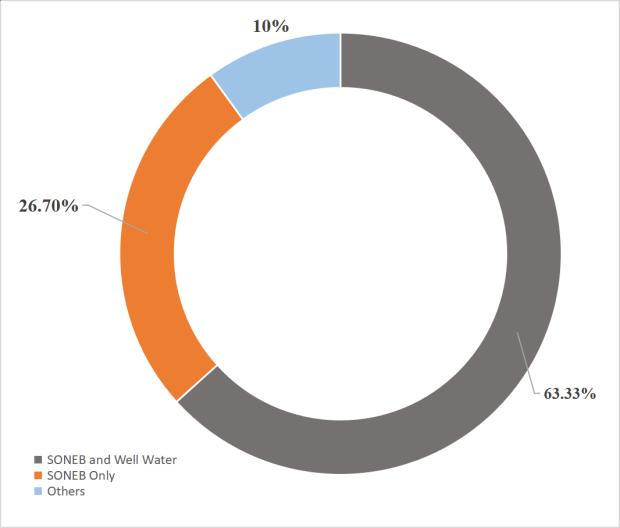
Figure 3. AccesstodrinkingwaterinCotonouadaptedfromsurveyresults(Source:Authors) Cotonouhasmultiplewatersupplysources.Figure3illustratesthewatersourcesavailabletotheresidents.Thepopulace utilizes multiple water sources. Therefore, a total of 19.9% or 95 individuals out of the examined population of 150 exclusivelyrelyonSONEBwaterforalltheirhouseholdneeds.Outofthetotalpopulation,amere26.7%,equivalentto40 individuals, rely on well water to meet their additional water requirements. Additionally, 10%, or 15 individuals, utilize
International Research Journal of Engineering and Technology (IRJET) e-ISSN: 2395-0056
Volume: 11 Issue: 03 | Mar 2024 www.irjet.net p-ISSN: 2395-0072
alternative sources such as bottled water and rainfall, following the usage of SONEB and well water. The insufficient availability of safe water has caused many residents to rely on wells as a supplement to the SONEB water. However, a significant proportion of the population uses this method, which may result in health problems due to the use of well waterinresponsetotheexistingwaterscarcity,leadingtoahigherprevalenceofdiseases.Thisscenariocanheightenthe susceptibility to waterborne illnesses, particularly when the well water is not subjected to treatment before to its consumption, bathing, and culinary purposes[26]. Water treatment is crucial in mitigating the health hazards associated withitsdomesticusage,asitisavitalcomponentoflife.ThestudyconductedbyHounkpeetal.[27]collectedthefollowing dataontheutilizationofwellwater,aspresentedbelow:
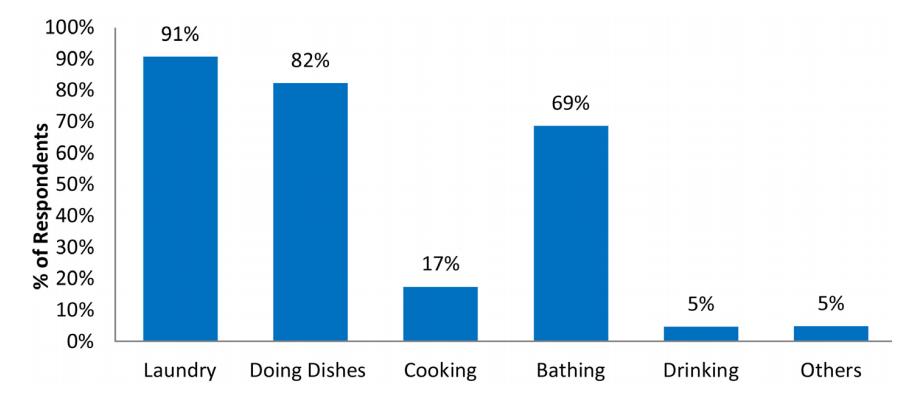
Figure 4. Usesofwaterfromwells(Source:Surveydata,Hounkpeet.al[27])
The findings revealed that well water is the predominant supply for non-potable purposes in Cotonou, with a majority utilising it for laundry (91%), dishes (82%), and bathing (69%). Cooking is dependent on well water to a lesser extent, accountingforonly17%ofitsusage.Thisindicatesthe needtoexploreothersourcesforthisessentialactivity.Merelya minor fraction (5%) of individuals utilise well water for consumption, emphasising the inherent health hazards and the imperativeforsecuresubstitutes.Drinkingwellwatercarriesasubstantialhealthhazardasitmaybecontaminatedwith faecalbacteria,pesticides,andvariouscontaminants.
Thecontamination ofwell waterby bacteria incoastal citiesof WestAfrica hasbeenstudiedby Yapo etal.[28],Soncy et al.[29], and Totin Vodounon[17]. The lack of adequate sanitation facilities in vulnerable communities, including faulty septictanks,improperwastedisposal,andthecloseproximityoftoiletsandpitlatrines(within5to10metres)towater wells,isacontributingfactor.
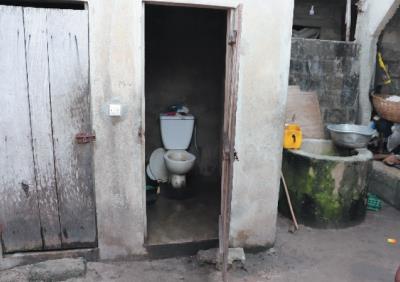
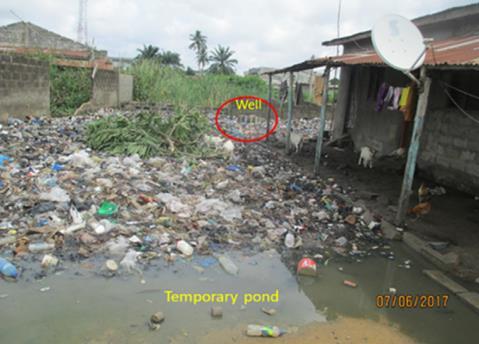
5 ToiletsandtemporarypondsclosetothewellsinCotonou(Source:Totinetal.[17],Houéménou,etal.[21])
International Research Journal of Engineering and Technology (IRJET) e-ISSN: 2395-0056
Volume: 11 Issue: 03 | Mar 2024 www.irjet.net p-ISSN: 2395-0072
The close proximity of urban homes hinders adherence to the standard 15m distance requirement between wells and latrines, which is necessary to prevent contamination of the aquifer[30]. Furthermore, a prominent feature of sanitation facilities in residences in both cities is the absence of septic tanks, which, if they do exist, are predominantly nonwaterproof. During such occurrences, microbial pollutants originating from inadequate sanitation and hygiene practices can easily contaminate groundwater through the development of internal fissures in wells over a period of time. The present urban growth in cities like Cotonou is accompanied by inadequate infrastructure, neglect of gutter maintenance, poor hygiene and sanitation practices, construction of faulty septic tanks within households, and disregard for the recommended distance between wellsand latrines[31].Asa result, neighbourhoodssituated near lagoons, lakesand the ocean face a dire situation. The correlation between water system contamination and the high level of environmental degradationhighlightstheimproperallocationanduse ofurbanlandbyindividualsinWestAfricantowns.Stakeholders assertthaturbanpollutionincomplexcoastaltownswithwetsandysoilsiscausedbysolidandliquidwaste,excreta,and floods[32]. Our analysis reveals that approximately 65.7% of the urban population have an unfavourable connection to poor sanitation practices (55.5%), home solid waste (45.5%), and wastewater management (33%). The strategies employed for solid waste treatment include burial, discharge into gutters, bridging the swamp, and burning[18]. These methods have adverse effects on both the environment and human health. Wastewater is primarily released into sumps and dumped onto the streets, gutters, and courtyards of residences, while pit latrines and septic tanks are the predominant methods of disposing of excreta.The irregularcollection of municipal waste in coastal areasof West Africa poses a significant difficulty, resulting in unpleasant odours, environmental damage (such as water contamination), and potentialhealthissues[28] Sanitationandhygienesystems,forwhichindividualsareresponsible,arefrequentlyobsolete, inadequately built, unsuitable, or not maintained. Plumbing systems are generally subpar. The absence of latrines and properupkeepofgarbage receptacles,coupledwiththeindiscriminatedisposalof wasteinswamps,streets,gutters,and lagoonswithoutprevioustreatment,servesasanindicationoftheinadequateunderstandingofhygieneandsanitationin coastalcities,particularlyintheimpoverishedareas.AccordingtoBanerjeeandMorella[33]a significantnumberofsubSaharanAfricancountrieshaveasewerinfrastructurethatservesjustapproximately10%oftheirpeople.Approximately 85%to90%ofwastewaterworldwideisreleasedintometropolitanareaswithoutundergoinganyformoftreatment[33] The riseofinformal settlements (slums)in developing nations suchasBenin and Togo,along with their respectivelarge towns, presents a significant challenge in terms of wastewater generation[12]. West African coastal cities have the challenge of insufficient and flexible infrastructure that promotes sustainable sanitation and hygiene. Another factor contributing to poor sanitation practices is poverty and a lack of awareness regarding the consequences of inadequate sanitation on the quality of water sourced from wells. Insufficient or unsuitable water supply, sanitation, and hygiene in complex metropolitan settings such as coastal cities can have negative impacts on human health, mostly through the spreadofwater-borneinfections,andontheenvironment,particularlythroughthereleaseofuntreatedwastewater[31]
The authors' examination of the literature on water quality found the presence of both physicochemical and bacteriological contaminants in home wells that are frequently neglected and lacking protection. The analysis of physicochemicalcharacteristicsprimarilyconsidersfactorsthatallowforthe evaluationofwaterqualityorthe extentof organicpollution.
The fluctuating chemical composition of groundwater in various climatic situations is attributed to alterations in ion exchange,weatheringorrockdisintegration,seawaterintrusion,human-inducedpollution,andothercontributingfactors. The main factors contributing to the presence of nitrate in the local drinking water were determined to be agricultural pollution during the wet season, which was subsequently carried by wastewater during the dry season[17]. The study conducted by Sintondji et al.[14] examined the physicochemical condition of well water in six districts of Cotonou. The resultsoftheiranalysisareoutlinedbelow.
International Research Journal of Engineering and Technology (IRJET) e-ISSN: 2395-0056
Volume: 11 Issue: 03 | Mar 2024 www.irjet.net p-ISSN: 2395-0072
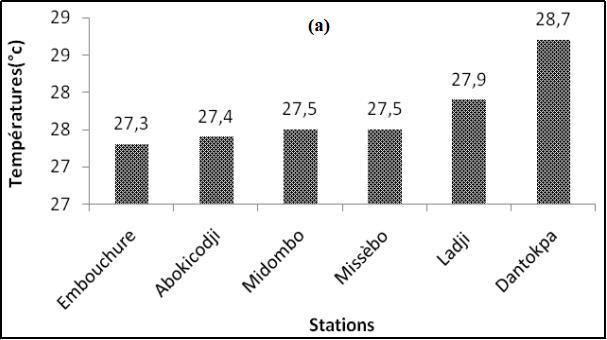
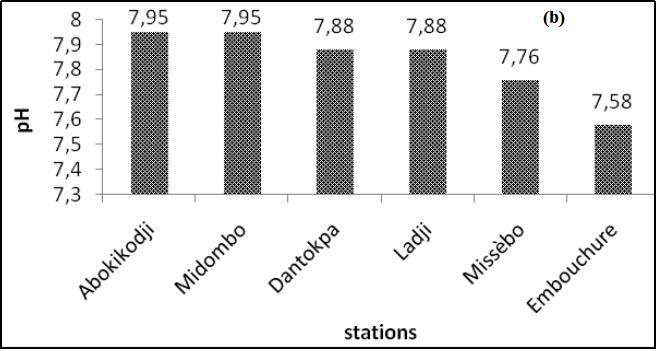
Figure 5. Variationsin(a)watertemperature(b)hydrogenpotential(pH)atthedifferentstations.Modifiedfrom Sintondjietal.[14]
Alllocationshaverecordedtemperaturesbetween27.3and28.7°C,whichiswithintherecommendedrangeof25to30°C for hot water-dwelling aquatic creatures. Specifically, the temperature of the channel's waters is conducive to the existenceofmanyspecies,notablytilapiaguineensis,whichthriveswithinatemperaturerangeof14to33°C[34].ThepH scale, which spans from 0 to 14, is used to measure the acidity or alkalinity of water. It offers a measure of the H+ ion concentrationin water.Figure5illustratesthepHfluctuationsinthewateratseveralsites.TheobtainedpHvaluesvary from7.58to7.95,withameanof7.83.TheoptimalpHrangeforpromotingthegrowthofaquaticspeciesisbetween6.5to 8.5,whichisconsideredtheacceptednormforwaterquality.
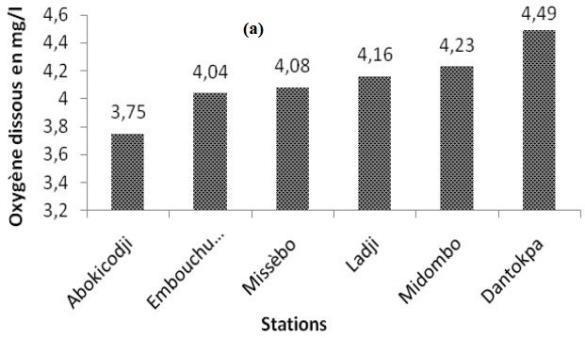
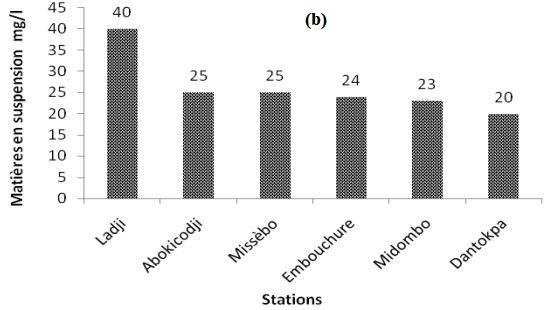
6. (a)DissolvedOxygenConcentrations(b)Suspendedmatterinwellwatersamples.ModifiedfromSintondjiet al.[14]
Adequate levels of dissolved oxygen are crucial for the survival of aquatic organisms. The process of self-purification of watercourses is enhanced through the utilisation of micro-organisms[35]. In their study, Sintondji et al. reported that dissolvedoxygenreadingsrecordedatalllocationsareconsistentlybelowtheacceptablequalitylimitof7mg/L,ranging from3.75to4.49mg/L.Thiscanbeattributedtoasignificantabundanceoforganicmatterinthisparticularenvironment. Aerobic bacteria, often known as oxygen-consuming bacteria, utilise the oxygen present in water to break down organic substances[36]. The water appears hazy due to the significant concentration of suspended particles. Turbidity fluctuates basedonthepresenceofsuspendedparticles,whichcanbeattributedtotheinflowofrun-offandthemovementofplant waste, animals, and other similar substances. The measured amounts of suspended solids range from 20 to 40 mg / l. Amongallthestations,theLadjistationhasthehighestlevelofstrength,surpassingtheacceptablequalityrequirementof 30mg/L.Thisdemonstratesthecontaminationofthelagoonatthislocationduetoanthropogenicactivity.Thepresenceof suspended solids at all stations indicates the substandard quality of the channel water, as high-quality water should be devoidofsuspendedsolids.Biodegradablesuspendedparticleshaveasubstantialimpactonoxygendemandandleadtoa reductionintheconcentrationofdissolvedoxygenintheaquaticenvironment[37]
3.3.2.
The estimated Water Quality Index (WQI) and the current status of water quality reported by Vodounon et al.[18] are displayedinTable2.TheWaterQualityIndex(WQI)forwellwaterinCotonouvariesbetween37.3and144.3duringthe greatrainyseason(GRS),between35.9and169.6duringthesmalldryseason(SDS),andbetween47.6and161.0between the small rainy season (SRS) and the great dry season (GDS). The WQI values also suggest that, on average, 91% of well water samples in Cotonou fall into the categories of poor to unsuitable for drinking, particularly during the dry seasons. Therepresentationofgood waterqualityinCotonouisratherlow,with21%duringthegreatdryseason,7% duringthe littledryseason,andinthesmallwetseason.
International Research Journal of Engineering and Technology (IRJET) e-ISSN: 2395-0056
Volume: 11 Issue: 03 | Mar 2024 www.irjet.net p-ISSN: 2395-0072
Table 2. TheWaterQualityIndex(WQI)assessestheconditionofwaterqualityandthedistributionofseasonalwellwater samplesinCotonou.
Sadhanaetal.[38]haveshownthatthemicrobiologicalqualityofshallowgroundwaterdecreasesdramaticallyduringthe wet season compared to the dry season, based on statistical analysis. This pertains to a significant volume of water movement and the spread of contamination resulting from the disposal of waste. The bacterial concentration above the drinking water criteria set by the World Health Organisation (WHO)[9], indicating a significant level of faecal contaminationinthegroundwater.Thecontaminationofwellwaterbybacteriaislinkedtothepresenceofwastedeposits, toilets, and pit latrineslocated within a distance of5 - 10metres fromthe well.It isalsorelated with faultyseptictanks andtheinfiltrationofwastewaterintoshallowaquifersatdepthsrangingfrom0.5to2metres.Azzellinoetal.[39]verified that the quality of groundwater in heavily urbanised regions is significantly impacted by human activities, specifically throughthespreadofpollutionfromvarioussources.TheanthropogenicsourcesofwasteinCotonouincluderesidences, agriculture processing facilities, industries, and construction companies[40]. These sources contribute chemical and bacteriological pollutants to the groundwater system. Therefore, within the framework of climate change, the yearly floodinginCotonouworsensthedeclineofurbangroundwaterqualityduetothespreadofpollutionfromimproperand unofficial methods of disposing of waste, including as pit latrines, sumps, gutters, residential sewage, and landfills. Sadhana et al.[38] hypothesised that the seasonal variation may be attributed to two hydrological phenomena: the intrusion of pollutants and fluctuations in the water table. The prevailing sandy soils in Cotonou, together with the relativelylowamountofgroundwater,appeartocorroboratethetheorythatenvironmentalvariablesarecontributingto thedeteriorationofgroundwaterquality.
3.3.3. Bacteriological state of well water
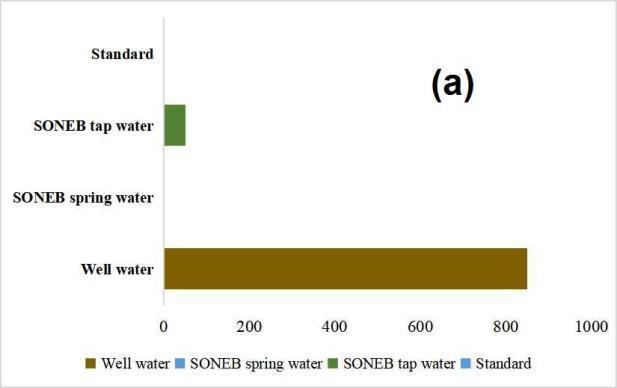
The quality of well water in Cotonou is a significant concern due to variables such as ion exchange, rock disintegration, seawater intrusion, and human pollution. The primary contributors to nitrate levels in the local drinking water are agriculturalpollutionduringtherainyseasonandthesubsequenttransferofthispollutionthroughthereplenishmentof groundwater by wastewater during the dry period[41]. Anthropogenic activities, such as the application of inorganic fertilisers and animal manure, as well as the installation of pit latrines, are responsible for the deterioration of groundwaterquality.Bacterialanalysishasrepeatedlydetectedbacterialcontaminantssuchastotalcoliforms,Escherichia coli,andfaecalstreptococcusthatarebeyondthedrinkingwatercriteriasetbytheWorldHealthOrganisation(WHO)[9] The degradation of groundwater quality in Cotonou is exacerbated by inadequate sanitation and unsanitary behaviours[42]. The shallow nature of the quaternary sandy aquifer enhances susceptibility to contamination and infiltrationofmicro-pollutants.Azzellinoetal.[39]substantiatedthehuman-inducedimpactofdispersedpollutiononthe qualityofgroundwaterindenselyurbanisedregions.Inadequatesanitationandhygienefacilitiessignificantlycontribute tothedegradationofthebacteriologicalqualityofwellwater.Thepresenceofpathogensinwellwater maybeattributed to the infiltration of sewage. Nevertheless, the presence of these substances in surface water is linked to the faeces depositedbyhumansandanimals[42].Adandé,2021 reportsthedetectionoffaecal coliformsinthecollectedwater.The presence of E. Coli in food and drink not only indicates recent faecal contamination, but also indicates the probable presenceofpathogenicbacteriaandprotozoa.Therefore,thisis areliableindicatoroffaecalcontamination.Figurebelow depictstheconcentrationofE.Coliinthesampledwaters.
International Research Journal of Engineering and Technology (IRJET) e-ISSN: 2395-0056
Volume: 11 Issue: 03 | Mar 2024 www.irjet.net
p-ISSN: 2395-0072
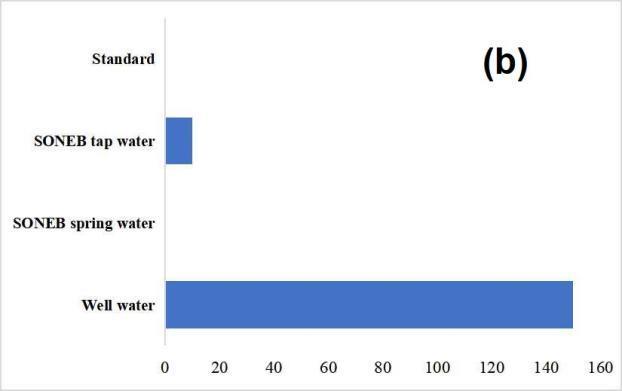
Figure 5 (a)Quantificationoffaecalcoliformlevelsinthewatersamples;(Source:Fielddata,Cotonou,Adandé,2021)(b) WaterandvegetableinE.Colisamples;(Source:Fielddata,Cotonou,Adandé,2021)
According to the bacteriological requirements of the Beninese standard, which states that there should be no E. Coli bacteriapresentin1millilitreofwater,thewellwaterandSONEBwateratthehouseholdlevelhaveasignificantlyhigher quantity of E. Coli bacteria than the norm allows[43]. The studies conducted by Totin et al.[17] and Soncy et al. in 2015 revealedthattherearesignificantlevelsofEscherichiacoliinthewellsofCotonou[44].Thisisattributedtothetransferof organic pollutants during the period when groundwater is being replenished. The temperature rise causes a significant growth of bacteria, resulting in the excessive generation of carbon dioxide[45]. Unsecured wells frequently experience flooding during the rainy season, leading to the contamination of water with waste and excrement from insufficient latrines. In order to address the susceptibility of groundwater in Cotonou's dynamic environment, it is necessary to develop policies that ensure the provision of clean water in the face of population expansion. In addition, a study conducted by Y. Georges[31] offered significant findings to demonstrate the abundance of bacteria in well water. Laboratory examination was conducted on water samples from five wells in different areas of a district in Cotonou to assessthebacteriologicalqualityofthewellwater.TheresultsoftheanalysisareshowninTable1.
Table 1:BacteriologicalresultsofCotonouwellwatersamples(Georges,2022)
Hindé1:Thesignificantprevalenceoftotal,faecalcoliforms,andcommonpathogensindicatesthatthewellwaterhaslow hygienestandards,makingitunsuitablefordirectuseasabeverage.Furthermore,itiscontaminatedwithanimalfaeces. Djidjè 1: The elevated prevalence of typical pathogens, such as faecal streptococci and total coliforms, indicates that this well also exhibits substandard hygiene conditions. The water from this well contains human faeces and is unfit for consumption. Ahouansori: The concentration of total coliforms exceeds that of other microorganisms. The significant quantity of total coliforms indicates that the water is not suitable for consumption, so the absence of faecal streptococci doesnotindicateacceptablewaterquality.ThewaterinLadjihontoisofpoorqualityandisnotsuitableforconsumption due to its high concentration of total coliforms and common pathogens. Test 1 revealsa significant presence of common germs and total coliforms, rendering this water of low quality and unsuitable for consumption. The bacteriological investigations reveal that all the wells examined contain organic contamination. Indeed, the levels of common bacteria, total coliforms, faecal coliforms, Escherichia coli, and faecal streptococci in them exceed the acceptable threshold for drinkingwaterbytentotenthousandtimes.TheAhouansoriwellistheonlywellthatisfreeoffaecalstreptococci.These resultsareconsistentwiththedataobtainedfromhealthcentres.Healthexpertscandetectthepresenceofbacteriasuch asfaecal streptococci,Escherichia coli, total coliforms, and faecal coliforms by conducting bacteriological studieson well water. Based on the aforementioned findings, the majority of individuals who rely on well water for their household requirementsaresubjecttoasignificanthazardbyutilisingthiswatersource.Thedangeriselevatedduetotheutilisation ofuntreatedwellwaterandthelackofadherencetopropersanitationpractices,resultinginarangeofhealthailments,as indicatedbythestudy.
International Research Journal of Engineering and Technology (IRJET) e-ISSN: 2395-0056
Volume: 11 Issue: 03 | Mar 2024 www.irjet.net p-ISSN: 2395-0072
SeveralstudieshaveestablishedacorrelationbetweentheconsumptionofwellwaterinCotonou,Benin,andaheightened susceptibility to diarrheal illnesses such as typhoid fever, hepatitis A, amoebiasis, and diarrhoea[46]. These studies indicate that the occurrence of faecal coliforms, E. coli, total coliforms, Giardia lamblia, and Cryptosporidium parvum in wellwaterheightensthelikelihoodofspecifichealthissues.Severalnaturalandhumanfactors,suchasdifferencesinland elevation, changes in water and climate patterns, and geological influences, affect both water supply systems and environmental well-being[47]. These factors encompass population density and uncontrolled land utilisation. As to the research conducted by the World Bank and submitted to the United Nations in 2019, there is a hidden issue concerning waterqualityworldwide[48].Thisproblemhastheabilitytodecreasetheeconomicgrowthofconsistentlycontaminated areasbyone-thirdandputhumanandenvironmentalhealthatrisk.Thesubstandardhygieneandsanitationconditionsin Benin have a detrimental impact on the quality of the country's potable water. Unsanitary living conditions contaminate sources of drinking water, facilitate the transmission of diseases associated with the oral-fecal route, and enable the transferofthesepathogensbetweenindividuals.Diarrhoeaandstomachinfectionsposesignificantriskstoone'shealth.In a study conducted in 2015 by Yongabi et al.[46], it was discovered that children who consumed water from wells containingelevatedlevelsoffaecal coliformwerefivetimesmore prone toexperiencingdiarrhoea comparedtochildren who used water from wells with lower levels. Consuming well water in the 6th district of Cotonou has been linked to severalhealthissues,suchascholera,diarrhoea,vaginalinfections,skindisorders,andgastroenteritis[31].Ananalysisof the well water samples in the district indicated elevated levels of coliforms, faecal coliforms, Escherichia coli, and faecal streptococci, beyond the permissible limits set by the United Nations for drinking water. Individuals are compelled to utilise well water of dubious quality as a result of harsh local circumstances and a scarcity of hydraulic equipment, so endangeringtheirwell-being.Althoughcertainhouseholdsintheareaemployboilingorchlorinationmethodstoeliminate germs and other pathogens from their well water, these approaches may prove ineffectual if not executed correctly. Bacterial analysis revealed elevated concentrations of common germs, total coliforms, faecal coliforms, Escherichia coli, and faecal streptococci in well water samples, surpassing the permissible limits set by the UN for drinking water. The district's well water is of substandard quality due to poverty and inadequate hydraulic equipment, posing a threat to human health. The well water supply in Cotonou is a cause for worry due to its inadequate physicochemical and bacteriologicalquality,aswellasthehighincidenceofwaterbornediseasessuchasmalaria,gastroenteritis,anddiarrheal disorders. The well water in Cotonou has been discovered to contain significantly elevated levels of total coliforms, Escherichia coli, and faecal enterococci/streptococcus[18]. These findings indicate that the water is of extremely low quality and should not be consumed. The health problems are linked to the district's use of well water for drinking purposes,underscoringthenecessityforadditionalinitiativestoraiseawarenessaboutcleanlinessandhygiene,aswellas improve the availability of potable water. In order to safeguard the health of the population, it is imperative for the governmenttoendorseadequatesanitationpracticesandenhancetheaffordabilityofpotablewater.Thefindingsindicate asignificantthreattopublichealthduetothepresenceofcontaminatedwellwaterinCotonou.Inordertoenhanceaccess to piped water and raise public knowledge regarding the significance of safe drinking water, it is imperative for the government and public health agencies to implement measures aimed at enhancing the quality of Cotonou's drinking water. A significant obstacle for the movement to ensure access to and sustain the availability of these resources is the absence of definitive proof about the consequences of system failure on the advantages of enhanced drinking water supplies for public health[49]. It is crucial to examine the reliability of these systems and evaluate their effect on public health goals regarding the potential enhancements in public health that can be attained through interventions aimed at providing safe drinking water to communities[50]. Reports indicate that choleraic vibrios and typhoid bacteria have the potentialtopollutewellwater,henceendangeringtheripariancommunity[18,28,46].Inaddition,thesignificantmineral content, abnormal levels of ammonium and nitrite ions, and the existence of trace elements such as iron and aluminium suggestadeteriorationinthephysicochemicalcharacteristicsofthegroundwaterin Cotonou. Theneedof enhancingthe quality of well-water and sanitation systems in Cotonou is underscored by these health concerns, since it is crucial for protectingthehealthofallpeople.
Sanitationandtheavailabilityofpotablewaterarecrucialforpreservinghumanhealthandoverallwelfare.Nevertheless, encountering these essential requirements poses significant challenges in Cotonou. Yetongnon et al.[31] found a correlationbetweenthedistrict'sutilisationofwellwaterandanincreasedsusceptibilitytowaterbornediseasessuchas amoebiasis, typhoid fever, diarrhoea, and hepatitis A. This study presents a range of recommendations to improve sanitation and water quality in Cotonou, aiming to address these problems effectively. Sanitation and the availability of potable water are essential for human well-being and prosperity. However, some developing nations, such as Cotonou, continue to have challenges in ensuring that their populations have access to uncontaminated water and adequate sanitation facilities[27]. Multiple factors, including urbanisation, exponential population growth, and insufficient infrastructure, contribute to this issue. Poor sanitation and water quality in Cotonou exert a significant impact on the
International Research Journal of Engineering and Technology (IRJET) e-ISSN: 2395-0056
Volume: 11 Issue: 03 | Mar 2024 www.irjet.net p-ISSN: 2395-0072
health of its residents. These difficulties can lead to a variety of waterborne diseases, including cholera, typhoid fever, hepatitis A, and diarrhoea. These diseases have the capacity to be life-threatening or cause significant impairment in children. Currently, there is an insufficient supply of potable water in Cotonou to meet the demands of the entire population[51]. Expanding the number of households connected to piped water systems is crucial for enhancing the availability of potable water. Furthermore, it is imperative to educate well operators and owners on appropriate well maintenanceanddisinfectionmethods.Thiswillreducethelikelihoodofcontaminationfromalternativesources,suchas fecal matter. The growing population of Cotonou is putting strain on the city's water resources. In order to ensure an adequatewatersupplyforallindividuals,itisimperativetopromoteresponsiblewaterconsumption.Onewaytoachieve this is by implementing water conservation measures, such as leak detection and repair programs, and by educating the publicabouttheimportanceofwaterconservation.Cotonoulacksenoughinfrastructureforthetreatmentanddisposalof wastewater. Consequently, both groundwater and surface water are being polluted. In order to mitigate the risk of waterborne diseases, it is imperative to allocate resources towards the development of wastewater treatment infrastructure. It is crucial to educate the public about the need of proper wastewater disposal. In Cotonou, the existing rules and processes for ensuring cleanliness and water quality are now inadequate. This leads to a violation of water quality rules. In order to ensure that water providers are meeting the necessary standards for providing safe drinking water,itisimperativetostrengthentheregulationandenforcementmeasures.Theissuesofsanitationandwaterquality in Cotonou necessitate a solution that involves multiple stakeholders. For the development and implementation of solutions, it is essential to involve the government, water providers, community organizations, and the business sector. Enhancing the waterandsanitationqualityinCotonouisa challengingyetcrucial undertaking for the overall healthand well-being of the community.Cotonou should take action by implementing the recommendations outlined in this report. Improving the water quality and sanitation in Cotonou is essential for promoting the city's economy and safeguarding publichealth.
4. Conclusion
The findings underscore the presence of organic, chemical, and microbial contamination in the tap water commonly utilisedinhousesinCotonou.Thisservesasa cautionarymessage tothelocal community. Disposing ofgarbageinto the environmentcausesharmtobothsoilandwaterresources.Thestudy'sstrategycentresontheoriginsofwatersupply,the wellwater'squality,anditsdetrimentalimpactonhumanhealthinthespecifieddistrict.Accordingtothesurveyresults, the population's drinking water supply is distributed among three sources: SONEB (26.7%), SONEB and wells (63.33%), andothersources(10%).Nevertheless,thelimited percentageof individualsexclusivelyutilising SONEB waterindicates that various factors impact the exclusive use of drinking water in households. These factors include the socioeconomic status ofthe populations,thegeographical positioningofthesecommunities,inadequatemanagement ofsolidandliquid waste, and prevalent poor hygiene in these areas. These factors are all contributing factors that rationalize the use of dubioussources,suchasgroundwater.Althoughthestudyhasprovidedinformationaboutthecurrentconditionofwells invariousareasofCotonou,thechallengeofpromotingknowledgeaboutthedangersofusinguntreatedwellwater,which mightresultinthediseasesmentionedinthisstudy,stillpersists.Inordertomitigatethesehealthhazards,thepopulace resortstotherapeutictechniquessuchasboilingandemployinglemonjuiceduetothe absenceofaffordablemeasuresto effectively address this issue. The health consequences of utilising well water are expected to escalate in the future, particularly in peri-urban regions like those examined in this study. This is due to the observed lack of adherence to hygiene and sanitation regulations, rapid population expansion, and challenges associated with providing clean water in these settings. The enhancement of well water quality in Cotonou will be achieved through the establishment of flexible socio-ecological systems for sanitation and the promotion of healthy hygiene practices. In addition, implementing strategies such as deepening well drilling, relocating landfills away from wells, and installing protective fences around wellscancontributetothemaintenanceofasecureandreliablewellwatersupply.
5. References
1. Strang,V., Water: Nature and culture.2015:ReaktionBooks.
2. McDonald, R.I., et al., Global urban growth and the geography of water availability, quality, and delivery. Ambio, 2011. 40:p.437-446.
3. Economic,U.N.D.o., World social report 2021: reconsidering rural development.2021:UnitedNations.
4. Ivanova, M., UNEP in global environmental governance: design, leadership, location. Global Environmental Politics, 2010. 10(1):p.30-59.
5. Babadjide,S.P., Aid Effectiveness in The Water Sector: A multi-site study in Benin.2020,CarletonUniversity.
International Research Journal of Engineering and Technology (IRJET) e-ISSN: 2395-0056
Volume: 11 Issue: 03 | Mar 2024 www.irjet.net p-ISSN: 2395-0072
6. Baker, B.K., The Long and Tortured Road to Adequate, Sustained, and Spendable Domestic and Donor Financing for Health.2009.
7. ENGLEBERT,P., RJ HARRISON CHURCH. AfricaSouthoftheSahara,1999,1998. 28:p.388.
8. AZIAN,D.D.,etal., Physico-Chemical and Microbiological Qualities of Porto-Novo Lagoon Water.
9. Organization,W.H., Guidelines for drinking-water quality.Vol.1.2004:WorldHealthOrganization.
10. Hounsou,F.T.M.,etal., Journal of Chemical, Biological and Physical Sciences.
11. Emvoutou, H.C., et al., Hydrochemical and isotopic studies providing a new functional model for the coastal aquifers in Douala Coastal Sedimentary Basin (DCSB)/Cameroon. ScienceofTheTotalEnvironment,2024. 912:p.169412.
12. Lapworth, D., et al., Urban groundwater quality in sub-Saharan Africa: current status and implications for water security and public health. HydrogeologyJournal,2017. 25(4):p.1093.
13. Schmoll,O., Protecting groundwater for health: managing the quality of drinking-water sources.2006:WorldHealth Organization.
14. SINTONDJI, L.O., A.J. VODOUNNON, and A. JS, Quality of water and sources of pollution of chenal cotonou. 2017, IJAEMR.
15. Soury,A.,etal., Sacred forests: a sustainable conservation strategy. ThecaseofsacredforestsintheOuéméValley, Benin.Netherland:WageningenUniversity,2007:p.1-109.
16. Data,C., Spore climate: Average temperature, weather by month, spore weather averages-Climate-Data. org.2021.
17. Totin, H.S., et al., Groundwater pollution and the safe water supply challenge in Cotonou town, Benin (West Africa). ProceedingsofH,2013. 4:p.191-196.
18. Vodounon, H.S.T., etal., Effects of Urban Metabolism on the Well Water Quality in Cotonou (Benin) and Lomé (Togo). JournalofWaterResourceandProtection,2021. 13(8):p.539-562.
19. Roark, P., D. LaPin, and E. Kleemeier, Sustainability Assessment for the Benin Rural Water Supply and Sanitation Project.1992:WaterandSanitationforHealthProject.
20. Majuru, B., et al., Health impact of small-community water supply reliability. International journal of hygiene and environmentalhealth,2011. 214(2):p.162-166.
21. Houéménou, H., et al., Pathogenic Leptospira and water quality in African cities: A case study of Cotonou, Benin. ScienceoftheTotalEnvironment,2021. 774:p.145541.
22. Houssou, A., et al., Spatial and seasonal characterization of water quality in the Ouémé River Basin (Republic of Benin, West Africa). EgyptianJournalofChemistry,2017. 60(6):p.1077-1090.
23. Akharame,M.O.andM.A.Ajayi, Assessment of Groundwater Quality using the National Sanitation Foundation Water Quality Index within Benin City, Nigeria.
24. Rana, R. and R. Ganguly, Water quality indices: challenges and applications an overview. Arabian Journal of Geosciences,2020. 13(22):p.1190.
25. El Baba, M., et al., Evaluation of the groundwater quality using the water quality index and geostatistical analysis in the Dier al-Balah Governorate, Gaza Strip, Palestine. Water,2020. 12(1):p.262.
26. Nichols, G., I. Lake, and C. Heaviside, Climate change and water-related infectious diseases. Atmosphere, 2018. 9(10):p.385.
27. Hounkpe, S., et al., Wastewater management in third world cities: case study of Cotonou, Benin. Journal of EnvironmentalProtection,2014. 5(05):p.387-399.
International Research Journal of Engineering and Technology (IRJET) e-ISSN: 2395-0056 Volume: 11 Issue: 03 | Mar 2024 www.irjet.net p-ISSN: 2395-0072
28. Yapo, T.W., et al., Physico-chemical and bacteriological characterization of surface waters for domestic use: Case of river waters in M'pody village (Anyama, Ivory Coast). International Journal of Biological and Chemical Sciences, 2023. 17(2):p.735-742.
29. Kambire, O., et al., Microbiological and physico-chemical characterisation of well water in the town of Korhogo, Côte d’Ivoire. InternationalJournalofBiologicalandChemicalSciences,2021. 15(3):p.1264-1275.
30. Lapworth,D.,etal., A review of urban groundwater use and water quality challenges in Sub-Saharan Africa. 2017.
31 Georges, Y.J.E., Effects of the use of well water on human health in the 6th district of Cotonou (Benin). Journal InternationalSciencesetTechniquedel’Eauetdel’Environnement,2022. 7(2):p.66-74.
32. Jiang, S.C., etal., Human and environmental health risks and benefits associated with use of urban stormwater. Wiley InterdisciplinaryReviews:Water,2015. 2(6):p.683-699.
33. Banerjee, S.G. and E. Morella, Africa's water and sanitation infrastructure: access, affordability, and alternatives 2011:WorldBankPublications.
34. De Silva, S.S. and D. Soto, Climate change and aquaculture: potential impacts, adaptation and mitigation. Climate change implications for fisheries and aquaculture: overview of current scientific knowledge. FAO Fisheries and AquacultureTechnicalPaper,2009. 530:p.151-212.
35. El Monayeri, O., S. Bayoumi, and A. Khalifa. Enhancement of self-purification of streams using stepped aeration. in Tenth International Water Technology Conference, IWTC10. Alexandria, Egypt.2006.Citeseer.
36. EGWARI,L.O., MICROBIAL LIFE IN THE PRESENCE OF CARBON AND OXYGEN.
37. Chen, J. and D.K. Uan, Low dissolved oxygen membrane bioreactor processes (LDO-MBRs): a review. International JournalofEnvironmentalEngineering,2013. 5(2):p.129-149.
38. Shrestha, S., et al., Seasonal variation in the microbial quality of shallow groundwater in the Kathmandu Valley, Nepal. WaterScienceandTechnology:WaterSupply,2014. 14(3):p.390-397.
39. Azzellino,A.,etal., Groundwater diffuse pollution in functional urban areas: The need to define anthropogenic diffuse pollution background levels. ScienceoftheTotalEnvironment,2019. 656:p.1207-1222.
40. Nlend, B., et al., The impact of urban development on aquifers in large coastal cities of West Africa: Present status and future challenges. LandUsePolicy,2018. 75:p.352-363.
41. Ayobahan, S., et al., Assessment of anthropogenic activities on water quality of Benin River. Journal of Applied SciencesandEnvironmentalManagement,2014. 18(4):p.629-636.
42. Vodounon, H.S.T., et al., Alternative sanitation and strategic directives for the well water security in cotonou (Benin) and lomé (Togo). JournalofWaterResourceandProtection,2021. 13(9):p.675-698.
43. Adande, H.U.M., et al., Physico-chemical and microbiological characteristics of water for domestic use in Cotonou in the republic of Benin. InternationalJournalofScienceandResearchArchive,2021. 4(1):p.188-197.
44. Djeri,B.,etal., Socio-sanitary Aspects and Microbiological Quality of Drinking Water in the Prefecture of Golfe (Togo).
45. Daniels, J.A., R. Krishnamurthi, and S.S. Rizvi, A review of effects of carbon dioxide on microbial growth and food quality. Journaloffoodprotection,1985. 48(6):p.532-537.
46. Yongabi, K.A., Considering a public health model for control and prevention of emerging infectious diseases in SubSaharan Africa. AmericanJournalofClinicalandExperimentalMedicine,2015. 3(1-1):p.7-13.
47. Islam, M.N., et al., Climate Change Impacts and Mitigation Approach: Coastal Landscape, Transport, and Health Aspects. BangladeshII:ClimateChangeImpacts,MitigationandAdaptation in Developing Countries,2021: p.41101.
International Research Journal of Engineering and Technology (IRJET) e-ISSN: 2395-0056
48. Van Vliet, M.T., et al., Global water scarcity including surface water quality and expansions of clean water technologies. EnvironmentalResearchLetters,2021. 16(2):p.024020.
49. Osafo, R., et al., Microbial and parasitic contamination of vegetables in developing countries and their food safety guidelines. JournalofFoodQuality,2022. 2022
50. Petersen, P.E.andS.Kwan, Evaluation of community-based oral health promotion and oral disease prevention-WHO recommendations for improved evidence in public health practice. Community dental health, 2004. 21(4): p. 319329.
51. Pare, S. and L.Y. Bonzi-Coulibaly, Water quality issues in West and Central Africa: present status and future challenges. IAHSPubl,2013. 361:p.87-95.
Volume: 11 Issue: 03 | Mar 2024 www.irjet.net p-ISSN: 2395-0072 © 2024, IRJET | Impact Factor value: 8.226 | ISO 9001:2008 Certified