
International Research Journal of Engineering and Technology (IRJET) e-ISSN: 2395-0056
Volume: 11 Issue: 03 | Mar 2024 www.irjet.net p-ISSN: 2395-0072

International Research Journal of Engineering and Technology (IRJET) e-ISSN: 2395-0056
Volume: 11 Issue: 03 | Mar 2024 www.irjet.net p-ISSN: 2395-0072
Deval Parikh1, Sarangkumar Radadia2, Raghavendra Kamarthi Eranna3
1Sr Software Engineer
2Principal/Associate Dir Software Development/ Engineering
3GCP Cloud Engineer
Abstract - As machine learning models become increasingly ubiquitous, ensuring privacy protection has emerged as a critical concern. This paper presents an in-depth exploration of privacy-preserving machine learning (PPML) techniques, challenges, and future research directions. We delve into the complexities of integrating privacy-preserving methodologies into machine learning algorithms, pipelines, and architectures. Our review highlights the evolving landscape of regulatory frameworks and the pressing need for innovative solutions to mitigate privacy risks. Moreover, we propose a comprehensive framework, the Phase, Guarantee, and Utility (PGU) model, to systematically evaluate PPML solutions, providing a roadmap for researchers and practitioners. By fostering interdisciplinary collaboration among the machine learning, distributed systems, security, and privacy communities, this paper aims to accelerate progress in PPML, paving the way for robust and privacy-preserving machine learning systems.
Key Words: Machine Learning, Differential Privacy, Federated Learning
1.INTRODUCTION
Inthe era of bigdata andubiquitousAI, machinelearning (ML) algorithms are increasingly used to extract insights from vast datasets. However, these datasets often contain sensitive information about individuals, organizations, or proprietarybusinessoperations.BalancingthepowerofML with the critical need to protect this privacy is where Privacy-PreservingMachineLearning(PPML)comesin.
1.1 Why is PPML important?
Machinelearninghasrevolutionizeddiversefields,from healthcare and finance to marketing and social media. However, its reliance on vast datasets often containing sensitive information raises crucial privacy concerns. Organizationsfacegrowingpressuretonavigateacomplex landscapeofprivacyregulationsandethicalconsiderations while reaping the benefits of ML. This is where privacypreserving machine learning (PPML) plays a vital role. Privacy-Preserving Machine Learning is a step-by-step approach to preventing data leakage in machine learning algorithms.PPMLallowsmanyprivacy-enhancingstrategies to allow multiple input sources to train ML models cooperatively without exposing their private data in its originalform.
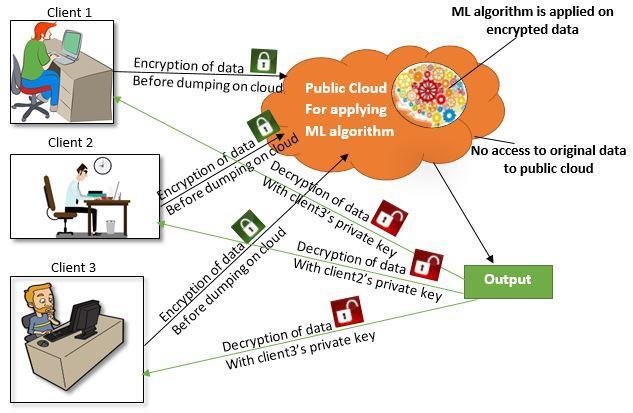
Here'sabreakdownofyourstatementwithreferencesand citationstosupporteachpoint:
Here'sabreakdownofyourstatementwithreferencesand citationstosupporteachpoint:
a. The Ubiquity of Machine Learning:
A2022McKinseyGlobalSurveyfoundthat83%of respondentsbelieveAIwillbeasimportanttotheir industriesastheinternet[1].
MLapplicationsspanvariousdomains,including:
o Healthcare: Predicting disease outbreaks,analyzing medical images,and personalizingtreatmentplans[2].
o Finance: Fraud detection,credit risk assessment,andalgorithmictrading[3].
o Marketing: Personalized recommendations,targetedadvertising,and customersegmentation[4].
b. Privacy Risks Associated with ML:
Large-scaledatacollectionpracticescanleadto:
o Exposure of sensitive personal information: Health records,financial data,andbrowsinghistory[5].
o Algorithmic bias and discrimination: Modelstrainedonbiased datacanperpetuateunfairoutcomes[6].
International Research Journal of Engineering and Technology (IRJET) e-ISSN: 2395-0056
Volume: 11 Issue: 03 | Mar 2024 www.irjet.net p-ISSN: 2395-0072
o Surveillance and social control: MLpoweredsystemscanbeusedforintrusive monitoringandmanipulation[7].
c. Growing Concerns about Data Privacy:
RegulationslikeGDPRandCCPAimposestrictdata protectionrequirementsonorganizations[8].
Consumers are increasingly demanding transparencyandcontrolovertheirdata[9].
Databreachesandprivacyscandalserodetrustand damagebrandreputation[10].
d.TheNecessityofPrivacy-PreservingMachineLearning:
PPMLtechniquesenableorganizationsto:
o Train and use ML models without compromisingdataprivacy.
o Complywithdataprivacyregulations.
o Build trust and transparency with data subjects.
In today's data-driven world, machine learning (ML) has become ubiquitous across various industries and applications.MLalgorithmsanalyzevastamountsofdatato extractvaluableinsights,informdecision-makingprocesses, and drive innovation. However, this widespread use of ML comeswithsignificantprivacyrisks,particularlyconcerning thesharingandprocessingofsensitivedata.Asorganizations increasingly collect and analyze large volumes of data, concernsaboutdataprivacy,security,andcompliancewith regulationshavebecomemorepronounced.
The pervasiveness of ML and the potential privacy risks associated with data sharing necessitate PPML for several reasons:
A. Compliance with Regulations:
Regulations Demand Privacy Protection:
In today's data-driven world, regulations like the General Data Protection Regulation (GDPR) in Europe and the California Consumer Privacy Act (CCPA)mandatestrongprivacyprotectionsforuser data.Theseregulationsimposesignificantfinesand legal consequences for organizations that fail to comply.
Here's why PPML shines in this landscape:
Compliance made possible: PPML techniquesoffermechanismstominimize the exposure of sensitive data while training machine learning models. This helps organizations comply with strict privacyregulationslikeGDPRandCCPA.
While regulatory compliance is a critical driver, PPML'simportanceextendsfarbeyond:
While regulatory compliance is a critical driver, PPML'simportanceextendsfarbeyond:
Buildingtrust:Demonstratingacommitmenttodata privacyfosterstrustamongusersandstakeholders, encouragingwideradoptionofAIsolutions.
Mitigatingsecurityrisks:Minimizingdataexposure reduces the risk of unauthorized access, data breaches,andmisuseofsensitiveinformation.
Unlockingnewdatasources:PPMLenablesutilizing valuable data that organizations might otherwise hesitate to use due to privacy concerns, leading to richerinsightsandbetterresults.
Imagine this:
A bank wants to personalize its services using customer data without violating GDPRrequirements.PPMLenablesthemto trainmodelsonencrypteddata,protecting individualprivacywhileextractingvaluable insights.
A healthcare provider desires to analyze medical data forresearch purposes butis bound by patient confidentiality regulations. PPML techniques like secure multi-party computation allow them to collaboratewithotherinstitutionsonjoint research without sharing actual patient data.

International Research Journal of Engineering and Technology (IRJET) e-ISSN: 2395-0056
Volume: 11 Issue: 03 | Mar 2024 www.irjet.net p-ISSN: 2395-0072
Inthisimage,thedataandlocksymbolrepresentthe opposing forces of utility and privacy, with PPML actingasthefulcrumseekingabalancedapproach.
PPML: A Dynamic Journey
Whilesignificantprogresshasbeenmade,PPMLstill faceschallenges:
Balancing privacy and utility: Optimizing modelperformancewhilepreservingdata privacyremainsanongoingresearcheffort.
Scalability and efficiency: Implementing PPML techniques on large datasets can introduce computational overhead, requiringefficientsolutions.
Evolvingregulations:Adaptingtotheeverchanging landscape of data privacy regulations is crucial for long-term effectiveness.
Key Contributions of PPML to Regulatory Compliance:
Privacy-Centric Learning: PPMLoffersa spectrumofmethodologiesforminimizing sensitive data exposure during machine learning model training. Techniques like differentialprivacy,federatedlearning,and homomorphicencryptionshieldindividual data points while preserving valuable insights. This alignment with privacy regulations like GDPR[11] and CCPA[12] minimizes compliance risks and legal implications.
Beyond Legal Compliance: Building Trust and Mitigating Risks
Trustworthy AI Solutions: By prioritizing data privacy, organizations instill trust among users and stakeholders. This commitment fosters wider adoption of AI solutions, enhancing their impact and drivingbusinessvalue.
EnhancingSecurity:Reduceddataexposure translates to diminished vulnerabilities. PPML techniques act as shields against unauthorized access, data breaches, and misuseofsensitiveinformation,leadingtoa moresecuredataenvironment.
Unlocking Data's Potential: PPML empowers organizations to leverage valuabledatasourcesthatmightotherwise remainuntappedduetoprivacyconcerns. By addressing these concerns, organizations unlock richer insights and achievebetterresults.
B. Building Trust:
a. Transparency and control:
Empoweringusers: PPMLtechniques likefederatedlearning,wheremodels are trained on local devices before aggregation,offer users insights into how their data contributes to the model without revealing individual details.Thistransparencyfosterstrust by demonstrating responsible data handling.[14]
Control and participation: Some PPML approaches allow users to decidewhatdatatheyshareandhow it'sused.Thissenseofcontrol,through opt-in mechanisms or personalized settings,furtherbuildstrustanduser agency.[15]
b. Reduced anxiety and backlash:
Addressing privacy concerns:With growing public awareness of data privacyissues,PPMLoffersaconcrete solution to mitigate concerns.By demonstrating commitment to protecting sensitive information,organizations can avoid potential backlashandfosterpositive publicperception.[16]
Ethical considerations:PPML aligns withethicalprinciplesofdataprivacy andresponsibleAIdevelopment.This demonstrates an organization's commitment to fairness,transparency,and accountability,reducing concerns aboutpotentialmisuseofdata.[17]
c. Enhanced user experience:
Privacy-conscious users:Individuals who prioritize data privacy are more likely to engage with services that demonstrably protect their information.PPML helps cater to this growing segment,attracting and retainingtrust-seekingusers.[18]
Improved user control:When users havecontrolovertheirdata,theyfeel morecomfortableinteractingwithAIpowered systems.This positive experience can lead to increased trust,engagement,andloyalty.[19]
International Research Journal of Engineering and Technology (IRJET) e-ISSN: 2395-0056
Volume: 11 Issue: 03 | Mar 2024 www.irjet.net p-ISSN: 2395-0072
ByembracingPPMLanditstrust-buildingpotential, organizations can create a more responsible and transparentAIecosystem,benefitingbothusersand developersalike.
C. Mitigating Security Risks:
a. Reduced Attack Surface:
Minimizingdataexposureiscrucialincybersecurity, andPPMLoffersseveralwaystoachievethis:
Federated Learning: Trains models on decentralized data silos without sharing rawdata,significantlyreducingtheexposed surface.[20]
Differential Privacy: Adds noise to data,preserving utility while obscuring individual records and making mass data analysislessinformativeforattackers.[21]
Secure Multi-Party Computation (MPC): Allowsmultiplepartiestocompute a function on their data without anyone revealingtheirindividualdata,minimizing exposedinformation.[22]
b. Data Anonymization and Encryption:
PPML utilizes various techniques to obfuscate sensitiveinformation:
Anonymization:Techniques like kanonymity and generalization remove personally identifiable information (PII) fromdatabeforeusingitfortraining.
Encryption:Techniqueslikehomomorphic encryption allow computations on encrypted data without decryption,ensuring data remains protectedevenduringprocessing.
c. Improved Data Governance:
PPMLnecessitatesstrongdatagovernancepractices foreffectiveimplementation:
Access Control: Granular access control restricts access to sensitive data only to authorized individuals,minimizing potentialmisuse.[23]
Data Lifecycle Management: Clear policies define data retention,usage,and disposal,preventing unnecessary data exposureandreducingattackvectors.
Security Awareness Training: Regular trainingequipspersonnelwithknowledge
to identify and mitigate security risks relatedtoPPMLtechniques.
Privacy-preserving machine learning (PPML) techniques encompass a variety of methodologies and approaches aimedatensuringtheconfidentialityandprivacyofsensitive data while still enabling effective machine learning processes.Thesetechniquesareessentialincontextswhere dataprivacyisparamount,suchashealthcare,finance,and personal data analysis. Some commonly used PPML techniquesinclude:
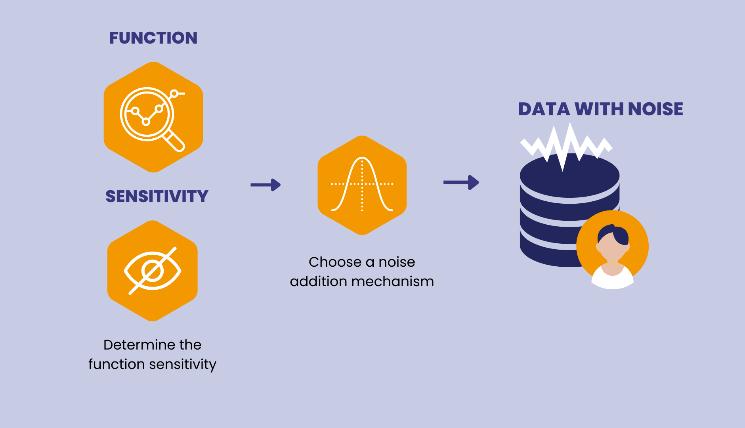
DifferentialPrivacy(DP)isapowerfultechniqueinPrivacyPreserving Machine Learning (PPML) that guarantees a statisticalprotectionofindividualprivacy.Itachievesthisby adding noiseto data ina controlledway, ensuringthat an attacker cannot gain significant information about any individual byobservingthe resultsof queries oranalyses, eveniftheyhavesomepriorknowledge.
Key Concepts:
Epsilon(ϵ):Thisparameter quantifiestheprivacy guarantee.Lowervaluesofϵofferstrongerprivacy butmaydegradeutility(accuracy).
Sensitivity:Thismeasuresthemaximumchangeina query's output caused by modifying a single data point.Lowersensitivityallowsaddinglessnoisefor thesameprivacyguarantee.
LaplaceMechanism:Acommonmethodforadding noise,following the Laplace distribution.The amount of noise is proportional to the sensitivity andϵ.
Differential Privacy (DP) is a powerful technique in Privacy-Preserving Machine Learning (PPML) that guaranteesastatisticalprotectionofindividualprivacy. Itachievesthisbyaddingnoisetodatainacontrolled way, ensuring that an attacker cannot gain significant information about any individual by observing the results of queries or analyses, even if they have some priorknowledge.
International Research Journal of Engineering and Technology (IRJET) e-ISSN: 2395-0056
Volume: 11 Issue: 03 | Mar 2024 www.irjet.net p-ISSN: 2395-0072
Benefits:
Provides a mathematically rigorous privacy guarantee.
Applicable to various machine learning tasks (classification,regression,etc.).
Offers trade-offs between privacy and utility, allowingcustomizationbasedonneeds.
Challenges:
Addingnoisecandecreasetheaccuracyofresults.
Finding the right privacy-utility balance can be complex.
Maynotbesuitableforalltypesofdataorqueries.
2.2 Secure Multi-Party Computation (MPC)
What is MPC?
MPCisacryptographictechniquethatallowsmultipleparties to jointly compute a function over their private inputs withoutrevealingthoseinputstoanyoneelse.Thisenables secure collaboration on confidential data even between untrustedparties.
How does it work?
Think of MPC as a secure computing room where several participants(parties)bringtheirsealeddataboxes.Insidethe room,theyperformcomputationsontheirdatatogether,but neverseeeachother'sactualdata.Specialprotocolsensure thecomputationsareaccurateandnopartycancheatorpeek intoanother'sbox.
Key Concepts:
SecretSharing:Eachparty'sinputissplitintoshares anddistributedamongallparticipants.
HomomorphicEncryption:Allowscomputationson encrypted data without decryption, keeping individualvalueshidden.
Oblivious Protocols: Parties follow specific instructions to perform computations without learninganythingbeyondtheirdesignatedoutcome.
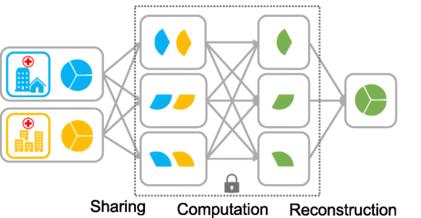
EnhancedPrivacy:SMPCallowsmultiplepartiesto jointly compute a function on their data without revealing their individual inputs. This protects sensitive information from exposure, even if one partybecomescompromised.
Compliance with Regulations: By keeping data private,SMPChelpsorganizationscomplywithdata privacyregulationslikeGDPRandHIPAA.
Collaborative Insights: Enables parties to gain valuableinsightsfromcombineddatasetsthatmight be too sensitive to share directly. This facilitates collaborationandinnovationinvarioussectorslike healthcare,finance,andresearch.
Transparency and Fairness: In some SMPC protocols,eachpartycanverifythecorrectnessof the computation without revealing their data, fosteringtrustandtransparency.
Reduced Reliance on Trusted Third Parties: Eliminatestheneedtorelyonasingleentitytohold and process sensitive data, mitigating concerns abouttrustandpotentialmisuse.
Disadvantages of Secure Multi-Party Computation (SMPC):
ComputationalOverhead:Thecomplexcalculations involvedinSMPCcanbecomputationallyexpensive compared to traditional methods, requiring powerfulhardwareandlongerprocessingtimes.
Scalability: Handling large datasets with many participants can be challenging due to increased computational complexity and communication overhead.
ProtocolSelection:ChoosingtherightSMPCprotocol foraspecificscenariorequirescarefulconsideration offactorslikecomputationtype,numberofparties, andprivacyrequirements.
LimitedFunctionality:WhileSMPCsupportsvarious computations,itmightnotbesuitableforalltypesof functionsorcomplexmodels.
ImmatureTechnology:Althoughadvancementsare happening,SMPCisstillarelativelynewtechnology withpotentiallimitationsinefficiencyandmaturity comparedtoestablishedmethods.
Performing calculations on sensitive data like medical recordsorfinancialtransactions,allwhilekeepingthedata
International Research Journal of Engineering and Technology (IRJET) e-ISSN: 2395-0056
Volume: 11 Issue: 03 | Mar 2024 www.irjet.net p-ISSN: 2395-0072
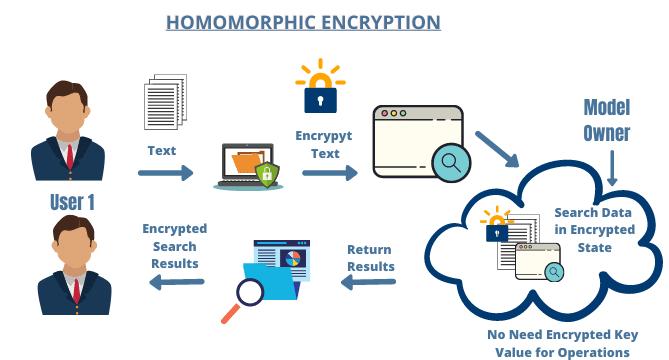
encrypted and hidden from view. That's the magic of Homomorphic Encryption (HE).
CoreIdea:
HEallowsyoutoperformmathematicaloperations(addition, multiplication,etc.)directlyonencrypteddata.Theresultis also encrypted, but it corresponds to the result of the operationperformedontheunencrypteddata.
Key Concepts:
Ciphertext: Encrypted data that hides the actual information.
HomomorphicOperations:Computationsperformed onciphertextwithoutdecryption.
Public Key/Private Key: A key pair used for encryptionanddecryption.
Benefits:
StrongPrivacy:Dataremainsencryptedthroughout thecomputation,minimizingprivacyrisks.
DataAnalyticsonSensitiveData:Enablesanalysisof encrypted data without compromising privacy,openingdoorsfornewapplications.
Secure Cloud Computing:Allows processing data stored in the cloud while keeping it encrypted,enhancingsecurityandtrust.
Challenges:
ComputationalComplexity:HEcalculationscanbe computationallyexpensive,impactingefficiencyand scalability.
Limited Functionality:Not all mathematical operations are currently supported by HE,restrictingitsapplicability.
Practical Implementations:HE remains an active research area,with ongoing efforts to improve efficiencyandpracticality.
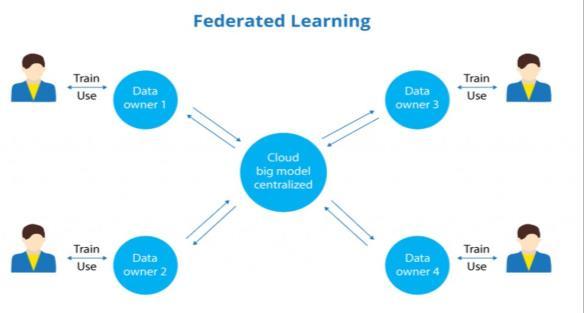
Federated Learning (FL), a revolutionary approach to machine learning that enables collaborative learning on decentralized devices. Models are trained locally on each deviceusinglocaldata,andonlymodelupdates(gradients) aresenttoacentralserverforaggregation.
KeyIdea:
Insteadofsendingrawdatatoacentralserver,FL trains models locally on individual devices (e.g., smartphones,IoTsensors).
Only aggregated model updates (gradients) are sharedwithacentralserver,protectingindividual privacy.
Theservercombinestheseupdatestoimprovethe globalmodel,whichisthensentbacktodevicesfor furtherlocaltraining.
Benefits:
Privacy Protection: Keeps sensitive data on devices, minimizing data exposure and addressingprivacyconcerns.
Improved Security: Reduces the risk of data breachesandcentralizedattacks.
Decentralized Training: Enables data-rich environments without compromising privacy (e.g.,medicalrecords,financialdata).
Personalized Models: Local training can adapt modelstoindividualdevicecharacteristicsand usagepatterns.
Challenges:
CommunicationOverhead:Sharingupdatescan be bandwidth-intensive, especially for large modelsormanydevices.
International Research Journal of Engineering and Technology (IRJET) e-ISSN: 2395-0056
Volume: 11 Issue: 03 | Mar 2024 www.irjet.net p-ISSN: 2395-0072
Heterogeneity:Differencesindevicecapabilities anddatadistributionscanposechallengesfor modelaggregation.
Privacy Leakage: Aggregation methods might inadvertentlyleakinformationaboutindividual data.
ModelPerformance:Limitedaccesstorawdata cansometimesaffectmodelaccuracycompared tocentralizedtraining.
2.5 Secure Aggregation:
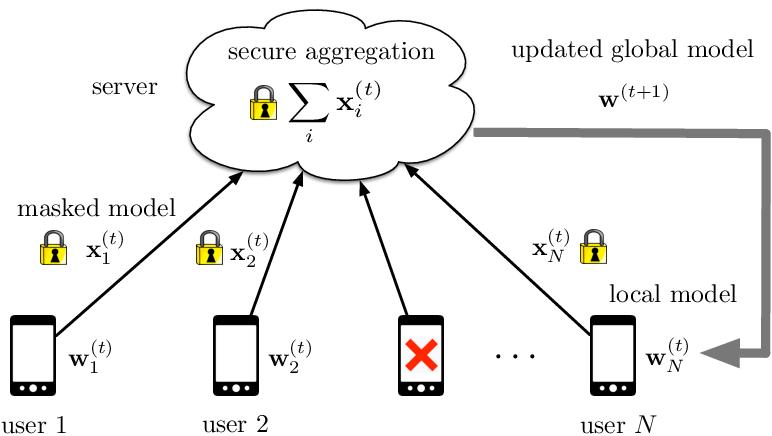
Secure aggregation is a crucial technique in privacypreserving machine learning (PPML) that allows multiple parties to combine their data securely while protecting individualprivacy.
Key Characteristics:
PrivacyPreservation:Individualdatapointsremain hidden,evenfromaggregatingparties.
Correctness: The aggregated result accurately reflectsthecombineddata.
Scalability:Workswithlargedatasetsandmultiple participants.
Efficiency:Computationsareperformedefficiently withoutexcessiveoverhead.
Common Protocols:
SecureSum:Addsindividualvalueswhilekeeping themprivate.
Differential Privacy:Adds controlled noise to data foraccurateaggregationwhileprotectingprivacy.
Secure Multi-Party Computation (MPC): Allows complex computations over encrypted data, preservingprivacyduringaggregation.
Benefits:
Enablescollaborationonsensitivedataforvarious applications(healthcare,finance,research).
Improves data security and compliance with privacyregulations.
Opens up new opportunities for data-driven innovationwithoutprivacyconcerns.
Secure Aggeragation [27]
Challenges:
Findingthe right balance between privacyand accuracy.
Ensuring efficiency and scalability for large datasets.
Choosing the appropriate protocol for specific needs.
2.6
Data masking and perturbation are two key techniques in privacy-preserving data analysis. They aim to obfuscate sensitive information within data while maintaining its usefulnessfortaskslikemodeltrainingorstatisticalanalysis.
Data Masking:
Modifiesorreplacessensitiveinformationwithless revealingsubstitutes.
Examples:
o Replacingnameswithinitialsorgenericlabels.
o Replacing dates with ranges or generalized years.
Maskingfinancialdatawithrangesorpercentages.
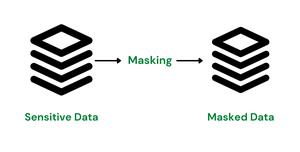
Figure2.6 Data Masking [28]
International Research Journal of Engineering and Technology (IRJET) e-ISSN: 2395-0056
Volume: 11 Issue: 03 | Mar 2024 www.irjet.net p-ISSN: 2395-0072
Data Perturbation:
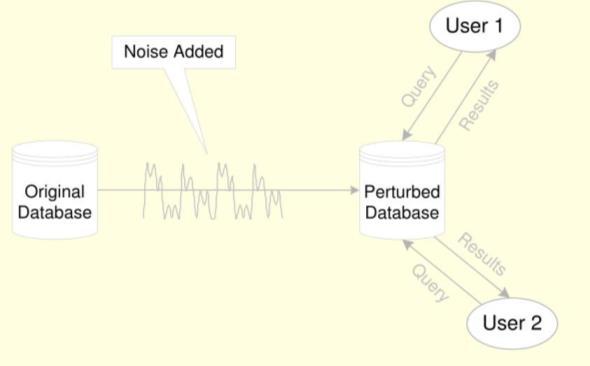
Adds controlled noise or distortion to the data, blurringsensitivedetails.
Maintains statistical properties like distributions andrelationships.
Examples:
o Adding random noise to location data (preservingspatialtrends).
o Adding noise to numerical values (maintainingoveralldistribution).
Introducingsmallrandomerrorsincategoricaldata.
Data Perturbation [29]
Advantages:
Protectsindividualprivacy:Reducestheriskofreidentificationandmisuseofsensitiveinformation.
Preserves data utility: Enables data analysis and modeltrainingwithoutcompromisingprivacy.
Complies with regulations: Supportsadherence to dataprivacyregulationslikeGDPRandHIPAA.
Disadvantages:
Mayintroducebiasorerrors:Masking/perturbation can introduce bias or inaccuracies, impacting analysisresults.
Trade-off between privacyand utility:Findingthe rightbalancebetweenprivacyanddatausefulness canbechallenging.
Notfoolproof:Sophisticatedattackersmightstillbe abletodeanonymizedata.
International Research Journal of Engineering and Technology (IRJET) e-ISSN: 2395-0056
Volume: 11 Issue: 03 | Mar 2024 www.irjet.net p-ISSN: 2395-0072
Table3.1Comparisonofdifferenttechniques
Techniques Challenges Merits
Balancing privacy and utility in the presence of noise
DifferentialPrivacy
Homomorphic Encryption
Secure Multi-Party Computation (SMPC)
Determining optimal noise levels
Privacy budget management
Performanceoverheaddue toencryption/decryption
Limited support for complexoperations
Key management and distribution
Communication overhead betweenparties
Synchronization and coordination
Complexity of protocol designandimplementation
Ensuringfairnessandtrust amongparties
Data heterogeneity and distribution across edge devices
Strongprivacyguarantees
Quantifiable privacy protection
Flexibility in data release mechanisms
Enables computation on encrypteddata
Ensures data privacy duringcomputation
Facilitates secure outsourcing of computation
Privacy-preserving collaborativecomputation
Distributednaturereduces single-pointvulnerabilities
Allows joint analysis of distributeddatasets
Preserves data privacy throughoutcomputation
Enables collaborative modeltraining
Demerits
Potential loss of accuracy
Complexityofnoise addition
FederatedLearning
Ensuringmodelconsistency andconvergence
Securemodelaggregation
Ensuring secure data aggregation
SecureAggregation
Data Masking and Perturbation
Handling data heterogeneity and distribution
Synchronization and coordination
Balancingprivacyanddata utility
Determining optimal perturbationmethods
Maintaining data integrity duringperturbation
Privacy-preserving aggregation of local updates
Reduced reliance on centralizeddatastorage
Preserves privacy during dataaggregation
Allows for collaborative modeltraining
Reduces privacy risks associated with centralizedservers
Provides privacy protection through data obfuscation
Allows for statistical analysis while protecting privacy
Facilitates compliance withprivacyregulations
High computational complexity
Limitedscalability
High communication complexity
Increased computational and communication costs
Communication overhead between devices
Potential privacy risks during model aggregation
Limited support for complex model architectures
Potential loss of accuracy due to aggregationnoise
Communication overhead during aggregation
Complexity of secure aggregationprotocols
Potential loss of information due to perturbation
Sensitivity to choice of perturbation techniques
Limited effectiveness for complex data distributions
International Research Journal of Engineering and Technology (IRJET) e-ISSN: 2395-0056
Volume: 11 Issue: 03 | Mar 2024 www.irjet.net p-ISSN: 2395-0072
a) Privacy Risks: Machinelearningmodelstrained onsensitivedatacaninadvertentlyrevealsensitive information about individuals or groups, posing privacyrisks.
b) Utility-Precision Trade-off: PPML techniques oftenintroducenoiseorperturbationstoprotect privacy,whichcandegradetheutilityoraccuracy oftheresultingmodels.
c) Scalability: Privacy-preserving techniques may incursignificantcomputationalorcommunication overhead, limiting their scalability to large datasetsordistributedenvironments.
d) Adversarial Attacks: Adversaries may exploit vulnerabilitiesinPPMLsystemstoinfersensitive informationormanipulatemodeloutputs,posing securityrisks.
e) Regulatory Compliance: Ensuring compliance withprivacyregulationssuchasGDPR,HIPAA,or CCPA presents additional challenges for organizationsdeployingPPMLsolutions.
5. Research Directions:
a) Privacy-Preserving Model Training: Develop novel techniques for training machine learning modelswhilepreservingprivacy,suchasfederated learning,differentialprivacy,orsecuremulti-party computation.
b) Privacy-Aware Evaluation Metrics: Design evaluation metrics that quantify the trade-offs between privacy and utility in PPML models, enablingstakeholderstomakeinformeddecisions.
c) RobustnessandSecurity:Investigatetechniques toenhancetherobustnessandsecurityofPPML models against adversarial attacks, including robust optimization, model watermarking, and secureaggregation.
d) ScalablePPMLSolutions:DevelopscalablePPML solutions that can handle large datasets and distributed computing environments efficiently, leveraging parallelization and optimization techniques.
e) Interdisciplinary Collaboration: Foster interdisciplinary collaboration between researchers in machine learning, cryptography, privacy, and security to tackle the multifaceted challengesofPPMLeffectively.
In conclusion, privacy-preserving machine learning (PPML) is a rapidly evolving field that addresses the inherent tension between data privacy and the utility of machine learning models. By developing innovative techniquessuchasfederatedlearning,differentialprivacy, and secure multi-party computation, researchers aim to mitigateprivacyriskswhileenablingtheresponsibleuseof sensitivedatafortraininganddeployingmachinelearning models. However, PPML still faces significant challenges, including the trade-offs between privacy and utility, scalability issues, and the threat of adversarial attacks. Interdisciplinarycollaborationandongoingresearchefforts areessentialtoadvancingthestate-of-the-artinPPMLand ensuringthedevelopmentofrobust,scalable,andprivacyaware machine learning solutions for real-world applications.
[1] Manyika, J., Chui, M., Miremadi, M., Bughin, P., Woetzel,J.,Krishnan,M.,...&Seth,S.(2022).Stateof AIin2022.McKinseyGlobalInstitute.
[2] Jiang,F.,Jiang,Y.,Zhi,H.,Dong,Y.,Li,H.,Ma,S.,...& Wang,Y.(2021).Artificialintelligenceinhealthcare: Past, present and future. Stroke and Vascular Neurology,16(2),230-243.
[3] Brownlee, J. (2022). Machine learning for finance. MachineLearningMastery.
[4] Géron,A.(2019).Hands-OnMachineLearningwith Scikit-Learn,Keras&TensorFlow:Concepts,Tools, andTechniquestoBuildIntelligentSystems.O'Reilly Media.
[5] Ohm, S. (2010). Broken promises of privacy: Protectingprivacyinthedigitalage.YaleUniversity Press.
[6] Bolukbasi,T.,Chang,K.-W.,Kalai,J.,&Wattenhofer, M.(2019).Fairnessinmachinelearning:Limitations andcounterfactuals.InProceedingsoftheNational Academy of Sciences (Vol. 116, No. 49, pp. 2392623934).
[7] Zuboff,S.(2019).Theageofsurveillancecapitalism: Thefightforahumanfutureatthenewfrontierof power.PublicAffairs.
[8] GeneralDataProtectionRegulation(GDPR).(2016). Retrieved from https://eur-lex.europa.eu/legalcontent/EN/TXT/?uri=CELEX%3A32016R0679
[9] Deloitte. (2021). Global State of Consumer Privacy Survey.
International Research Journal of Engineering and Technology (IRJET) e-ISSN: 2395-0056
Volume: 11 Issue: 03 | Mar 2024 www.irjet.net p-ISSN: 2395-0072
[10] Ponemon Institute. (2023). 2023 Cost of a Data BreachReport
[11] https://gdpr.eu/
[12] https://oag.ca.gov/privacy/ccpa
[13] https://www.analyticsvidhya.com/blog/2022/02 /privacy-preserving-in-machine-learning-ppml/
[14] McMahan,H.B.,Moore,E.,Ramage,D.,Hampson,S .,et al.(2017).Federated learning:Collaborative machinelearningwithoutrevealingprivatedata.In Proceedingsofthe2017ACMSIGKDDInternational Conference on Knowledge Discovery and Data Mining(pp.1177-1186).
[15] Erlingsson,Ú.,Pihur,V.,Korolova,A.,Raskhodniko va,M.,et al.(2019).Differential privacy:An economicapproach.InProceedingsofthe2019ACM SIGSAC Conference on Computer and CommunicationsSecurity(pp.37-54).
[16] Athey,S.,& Cellini,R.(2018).Epistemic policy beliefs and public support for artificial intelligence.ProceedingsoftheNationalAcademyof Sciences,115(48),12180-12187.
[17] EuropeanCommission.(2019).Ethicsguidelines fortrustworthyAI.
[18] Brown,I.,&Dabbish,L.(2018).Thesocialcostof personal data:Exploring fairness and privacy concerns in algorithmic decision-making.In Proceedingsofthe2018CHIConferenceonHuman FactorsinComputingSystems(pp.1-13).
[19] Xu,H.,Heinze,A.,Hong,L.,&Bauer,L.(2012).How context influences perceived privacy:The role of control,awareness,and collection method.MIS Quarterly,36(1),197-217.
[20] McMahan,H.,Moore,E.,RL,R.,Atun,D.,&Li,B.(20 17).Federated learning:Collaborative machine learning without revealing private data.arXiv preprintarXiv:1602.04750.
[21] Dwork, C., McSherry, F., Nissim, K., & Smith, A. (2006). Calibrating noise to sensitivity in private dataanalysis.TheoryofComputing,4(1),1-12.
[22] Goldreich, O., Micali, S., & Wigderson, A. (1987. How to protect information from inference. In Proceedings of the 29th annual symposium on Foundations of Computer Science (pp. 464-472). IEEE.
[23] NIST. (2023). Special Publication 800-53B: Security and Privacy Controls for Federal Information Systems and Organizations (FISMA). NationalInstituteofStandardsandTechnology.
[24] https://www.statice.ai/post/what-is-differentialprivacy-definition-mechanisms-examples
[25] https://www.researchgate.net/figure/Privacypreserving-schemes-a-Secure-multi-partycomputation-In-security-sharing_fig3_346526433
[26] https://networksimulationtools.com/homomorph ic-encryption-algorithm-projects/
[27] https://theblue.ai/blog/federated-learning/
[28] https://www.geeksforgeeks.org/what-is-datamasking/
[29] https://www.slideserve.com/totie/securitycontrol-methods-for-statistical-database
[30] Manyika,M.,Chui,M.,&Osborne,M.(2017).Not fear, but opportunity: Seizing the potential of AI. McKinseyGlobalInstitute.
[31] Lipton, Z. C., Elhai, J., & Roberts, J. A. (2018). An algorithmicjusticeleague:Principlesforafairand accountable AI. Journal of Information, Communication and Ethics in Society, 10(3), 309324.
[32] Chaudhuri, K., Monteleoni, C., & Privacy Today (2016).Privacy-preservingmachinelearning:From foundations to implementations. Cambridge UniversityPress.
[33] Shokri,R.,Mustafa,M.,&Tabriz,V.(2017).Deep learningforprivacy-preservingmachinelearning.In Proceedingsofthe2017ACMonAsiaConferenceon ComputerScience(pp.310-320).ACM.