
International Research Journal of Engineering and Technology (IRJET) e-ISSN:2395-0056
Volume: 11 Issue: 03 | Mar 2024 www.irjet.net p-ISSN:2395-0072

International Research Journal of Engineering and Technology (IRJET) e-ISSN:2395-0056
Volume: 11 Issue: 03 | Mar 2024 www.irjet.net p-ISSN:2395-0072
Mrs.I.Suganya,M.E.,MBA., K.Sai krishna
Assistant professor
Student
Department of Artificial Department of Artificial
D. Sai ramesh Yenamala vamsi
Student
Student
Department of Artificial Department of Artificial Intelligence and data science intelligence and data science intelligence and data science intelligence and data science
Muthayammal engineering college. Muthayammal engineering college
Muthayammal engineering college
Muthayammal engineering college Rasipuram. Rasipuram. Rasipuram. Rasipuram.
Abstract: Many different security programs use biometric technology. These systems try to identify people based on physical or behavioral characteristics. In the first case, identification is based on the measurement of biological features such as fingerprints, faces, and irises. The second scenario includes behavioral features such as speech and handwriting. Authentication and identification are two basic applications of biometric technology. In the first scenario, a system user provides a biometric sample while claiming who he is. The function of an authentication systemistodeterminewhethertheuserreallyiswhothey saytheyare.Whena userprovidesa biometricsample, the goal of the identification scenario is to find that user's biometric sample among other users registered in the system. This project introduces an innovative approach for duplicate signature verification using Convolutional Neural Networks (CNN). Signature verification is an important aspect of document authentication and fraud prevention. The proposed system uses CNN, a powerful class of deep learning algorithms suitable for image-based tasks, to analyze and distinguish between real and duplicate signatures. The system starts by capturing high-resolution images of signatures that incorporate different writing stylesandconditions.TheseimagesserveasinputtoaCNN architecture,whichistrainedtolearncomplexfeaturesand patternsthatrepresentvalidsignatures.Thetrained model is used for real-time verification to effectively distinguish between genuine and duplicate signatures. Extensive experiments and validation demonstrate the robustness and accuracy of the CNN-based approach in detecting duplicate signatures. Keywords: convolutional neural network;
Introduction : For legal transactions, authorization is by signature.Thisincreasestheneedforsignatureverification. Handwritten signatures are unique to each person and impossible to duplicate. This technology is easy to explain and reliable. Identifying and verifying handwritten signatures from images is a big problem. This is very difficult because even the human eye does not have the visual ability to detect all internal details. handwritten. Since the signature changes every time, it is difficult for humans to distinguish between genuine and fake products. Deep learning using a highly digital replica of the human braincanbeusedtoidentifyfakesignatures.
Higher accuracy. The main advantage of signature verification systems over other types of technology is that signatures are already accepted as a common method of identity verification. There are two types of handwritten signature verification: online and offline. Online methods use electronic techniques and computers to extract signature information and obtain dynamic information such as pressure, speed, and writing speed for verification purposes. Offline signature verification uses fewer electronic controls and a signature image captured with a scanner or camera. Offline signature verification systems usefeaturesextractedfromscannedsignatureimages.The function used for offline signature verification is very simple. Here only pixel images should be evaluated. However, offline systems are difficult to design because manydesirablefeaturessuchasstrokeorder,velocity,and other dynamic information are not available offline. The verification process should be based entirely on the features that can be extracted from the static signature trace.
Problem Statement : Handwritten signatures are unique to each person and impossible to duplicate. This technology is easy to explain and reliable. Identifying and verifying handwritten signatures from images is a big problem.Thisisverydifficultbecausethehumaneyedoes not have the visual ability to recognize all the details of handwriting. It is difficult for humans to sign because the signature changes every time Verification of handwritten signatures There are two types: online and offline. Online methodsuseelectronicdevices.Technologyandcomputers to extract information about signatures and photographs Dynamic information such as pressure, speed and writing speed for targets Offline signature verification requires fewerelectroniccontrols
Use a signature image taken with a scanner or camera. Offline signature The verification system uses features extracted from the scanned signature image. From The function used for offline signature verification is very simple.onlythis,Ineedtoevaluatepixelimages.However, offline systems are difficult to design Provide as many desirablefeaturesaspossible,suchasstrokeorder,speed, andimpact.Inofflinemode,nootherdynamicinformation is available. Confirmation This process should be based entirely on features that can be extracted from the trace. Staticsignatureimage
International Research Journal of Engineering and Technology (IRJET) e-ISSN:2395-0056
Volume: 11 Issue: 03 | Mar 2024 www.irjet.net
Working :
Ourprojectpreparesthemostimportantstepsinverifying and identifying signatures that exist for image manipulation and modification. Successful implementation of this will lead to better results and higher accuracy. Threshold method is used to extract signature from signature background. All the pixels of the signature are convertedto "1" andthe remainingpixelsbelongingto the background of the signature are converted to "0". To do this, a noise reduction filter is applied to the binary signature. Remove a black pixel on a white background. Eliminatedefects,improveimagesandimprovequality.
Convolution neural network Traceability :
CNN(ConvolutionalNeuralNetwork)algorithmsareatype of deep learning algorithm commonly used in image classification tasks, such as identifying plants from images of leaves. This algorithm is designed to learn and automatically extract features from input images without theneedformanualfeatureextraction.TheCNNalgorithm consists of multiple neural layers organized into three types of layers: convolutional layers, combinational layers, and fully connected layers. Convolutional layers perform feature extraction by applying a set of filters to the input image. Each filter detects specific features such as edges, linesandtextures.Theoutputofeachconvolutionlayerisa set of feature maps that show the presence of detected features in different spatial locations in the image. Fusion layers are used to reduce the dimensionality of feature maps by downsampling them. The most common type of integration is maximum integration, which takes the maximumvalueofthelocalregionofthefeaturemap.This helps to extract the most salient features and reduce the computational complexity. The fully connected layer uses the extracted features to perform the final classification task and predict the class labels of the input image. The outputofthefinalfullyconnectedlayerispassedthrougha softmax function that transforms the output into a probability distribution over possible class labels. CNN algorithms are trained using large datasets of labeled images. During training, the algorithm adjusts the neuron weights to minimize the difference between the predicted class label and the actual class label. This is done using a loss function such as stratified cross-entropy. CNN algorithms have been shown to be very effective in image classification tasks such as plant identification from leaf images. By automatically extracting relevant features from inputimages,thisalgorithmcanachievehighaccuracyand robustnessinidentifyingdifferentplantspecies.Connected device technologies include radio frequency identification (RFID) and blockchain. Specifically, RFID is a technology that helps collect data on connected devices, and blockchain is a decentralized technology that can provide secureandreliabledatastorage.
p-ISSN:2395-0072
TheCNNalgorithmhasbeenshowntobehighlyeffectivein imageclassificationtasks,includingplantidentificationfrom leaf images. By automatically extracting relevant features from input images, the algorithm can achieve high accuracy and robustness in identifying different plant species. The CNN algorithm for identifying plants from leaf images involves a series of mathematical operations that learn and classify the images. The algorithm can be divided into the following steps: • Convolutional layers: The input sheet image passes through a series of convolutional layers. Each layer consists of a set of filters that interpolate with the input image and extract features. Filters detect edges, lines and patterns in an image. • Activation function: The output of each convolutional layer is passed through an activation function such as ReLU (Rectified Linear Unit) to introduce non-linearity into the model. 42 • Pooling layers: When the functionisactivated,theoutputispassedthroughapooling layer that reduces the dimensionality of feature maps by taking the maximum or average value in each window. • Fullyconnectedlayers:Theoutputofthelastpoolinglayeris combined and passed through a series of fully connected layers. These layers perform the classification task by learningtherelationshipbetweentheextractedfeaturesand the corresponding class labels. • Softmax function: The last layeroftheCNNalgorithmappliesasoftmaxfunctiontothe output of fully connected layers.This function converts the output to a probability distribution over possible class labels. • Loss function: The loss function measures the difference between the predicted class label and the actual classlabel.The goal istominimizeperformanceloss during training. Optimization: CNN algorithms use optimization techniques such as stochastic gradient descent (SGD) to update model parameters and improve accuracy during training. Handwritten signatures are a proven means of obtainingapersonalsignature.
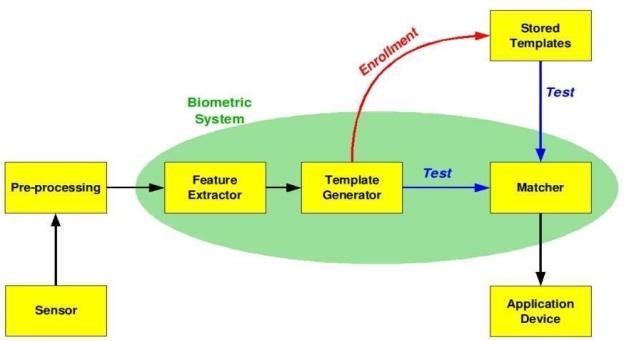
Identificationinformationwhoseuseisstrictlypermittedfor administrative and financial purposes. institution Currently, digital signature devices are specifically designed for the following purposes:For this purpose, it is increasingly used in the commercial and banking sectors.It facilitates payments and transactions in many other sectors including government, healthcare, education and courier services. Acquisition device produces an electronic signal called raw data that represents the signature, Recorded during the writingprocess.Inthepreprocessingstage,Improvinginput data usually involves filtering, noise reduction, Signature smoothing and normalization. Function function or parameter function Because it is extracted in the feature extractionphase,Youcanwriteyoursignature.Validationis usedtoevaluatetheauthenticityofafile.
Test signature attributes against attributes stored in your knowledge base.and was developed in the training phase. Allin-one standard program includes the following:These three phases run on a single device, resulting in a self-
International Research Journal of Engineering and Technology (IRJET) e-ISSN:2395-0056
Volume: 11 Issue: 03 | Mar 2024 www.irjet.net p-ISSN:2395-0072
consistent system. Cloud scenarios require three basic steps to take further. It is decomposed and placed on adistributed architecture. To verify the signature, It has attracted a lot of attention in the last 40 years. Currentindustrial scenario It mainly includes banking andbusiness transactions. Of course these Transactions are performedin a distributed cloud scenario. Interoperability. In addition, each of usowns a mobile device and the number is increasing. We often use mobile devicestoconducttransactions.
System implementation is a critical stage in the developmentlifecyclethatrepresentsthetransitionfrom designanddevelopmenttocommercializationofanewor upgraded information system. This process includes physically installing hardware and software components, configuring network settings, and adjusting system parameterstoensureseamlessoperation.Datamigration (if applicable) is an important step in transferring data from existing systems to new systems using a thorough validation process to ensure accuracy and completeness. Detailed tests including unit testing, integration testing, system testing, and user acceptance testing are performed to identify and fix any issues before full implementation. User training is an essential part of implementation and ensures that end users and support staff are familiar with the new system. It is also supplemented with comprehensive documentation and supporting materials. Finally, parallel execution can be done to allow the new system to work temporarily alongsidetheoldsystemandprovideasafetynetagainst unforeseen problems before the migration is complete. Thiscomprehensiveapproachtosystemsimplementation isintendedtoensureasmoothandeffectivetransitionto neworupgradedinformationsystems.Pythonisawidely used high-level, interpreted programming language. It is usedinvariousfieldssuchaswebdevelopment,scientific computing and data. The first publication on analytics, artificial intelligence, machine learning and more It was introduced in 1991 by Guido Van Rossum and has since becomeoneofthemostpopular.Itssimplicity,readability and versatility make it a popular programming language. oneofThemainfeatureofPythonisthatitssyntaxiseasy to learn and accessible. For beginners and experienced programmersalike.Hasa largestandardlibrary, Itoffers a wide range of modules for tasks such as file I/O, network and general tasks. Python also has a large and active community. Developers who help develop open source libraries and packages Python works as an interpreted language, that is, a language that is executed. line by line to the translator, Libraries like NumPy and Pandas, machine learning libraries, etc. TensorFlow and PyTorch. It is also commonly used for scripting and automation Its ease of use and readability make it ideal for this task. Overall, Python is powerful and A versatile programming language that is widely used in various fields We appreciate its simplicity, ease of use and active community.
Life cycle. It represents the transition from design and development to commercialization of new or upgraded information systems. This process includes physically installing hardware and software components, configuring network settings, and adjusting system parameters to ensure seamless operation. Data migration (if applicable) is animportantstepintransferringdatafromexistingsystems to new systems using a thorough validation process to ensure accuracy and completeness. Detailed tests including unit testing, integration testing, system testing, and user acceptance testing are performed to identify and fix any issues before full implementation. User training is an essentialpartofimplementationandensuresthatendusers and support staff are proficient in implementing the new system. Comprehensive documentation and support materials. Finally, By Parallel execution allows the new system to temporarily run alongside the old system, providing a safety net against unexpected events. Different aspects of human physiology, chemistry and behavior Used forbiometricauthentication.Selectthespecific biometric to use Certain programs require weighting of several factors. and was identified Seven factors used in evaluating the suitability of some traits for an application biometric. Universalitymeansthateveryonewhousesthesystemmust havethisfeature.Uniquenessmeansthatthecharacteristics must be sufficiently different from one person to another. Allows related groups to be distinguished from each other. Continuityreferstohowapropertychangesovertime.More In particular, properties with "good" durability are reasonably stable over long periods of time. Time for a specific matching algorithm. Measurable (collectibility) referstotheeaseofacquisitionormeasurement.Inaddition, thecharacteristicsoftheobtaineddata
Subsequent processing and extraction of relevant feature sets. Performance is related to the accuracy, speed and robustnessofthetechnologyused.Acceptabilityisrelatedto the degree of acceptance of the individual in the relevant group. Technology they wish to capture their biological characteristics and was evaluated. The correct use of biometrics is very application dependent. Some are biometricsSomearebetterthanothersbasedonthelevelof convenience and security you need. No A single biometric meetsalltherequirementsforeveryimaginableapplication.
International Research Journal of Engineering and Technology (IRJET) e-ISSN:2395-0056
Volume: 11 Issue: 03 | Mar 2024 www.irjet.net p-ISSN:2395-0072
Existing Model :
Oneofthemainchallengesofsignatureverificationtasksis the high intra-class variability. Compared to physical biometric features such as fingerprints or irises, a user's handwritten signatures often show large variations between samples. Signature identification is the problem of identifying the author or creator of the desired document according to his writing style and has been studied for different characters. Although scale-invariant features are likely to be required for signature detection, scale-dependent features may also be appropriate. Gaussian models and hidden Markov models (HMM) are widelyusedinvariousfieldsduetotheirversatilefeatures. In image processing, Gaussian models, often implemented through Gaussian filters, play a vital role in tasks such as noise reduction and blurring, and help improve image quality by smoothing pixel-level noise. In the field of machine learning, Gaussian mixture models (GMMs), a typeofGaussianmodel,areusedforclusteringanddensity estimation and have been effective in capturing complex data distributions. On the other hand, HMMs are widely used in speech recognition systems to model the continuous nature of speech signals. HMMs are good at capturing temporal dependencies, making them suitable for applications where sequential analysis of data is important, such as gesture recognition, handwriting recognition, and bioinformatics. Its probabilistic framework allows it to represent systems with hidden states and observe sequences, which makes it especially valuableindynamicandevolvingscenarios.Theseexisting systemsdemonstratetheversatilityofGaussianandHMM modelsinmultipledomains,pavingthewayforcontinued advancements and applications in areas such as signal processing,machinelearning,andmore.
Disadvantages :
Irrelevantandredundantfeaturesare extracted fromalargenumberoflow classification accuracycomputations
Proposed Model :
As signatures are the primary mechanism for authentication and authorization in legal transactions,
there is a growing need for efficient automated signature verification solutions. In thisproject,a signatureverification system based on deep learning is proposed. First, the local features of the image are calculated and with the help of a predefined codebook, an event histogram is created. Compare this histogram to determine author identity or similarity to other handwritten documents. Currently, signature detection methods can be divided into two approaches. The first approach analyzes the letters themselvesandthesecondmethodusesthetexturalfeatures of the handwriting. Forensic science identifies authors by analyzing their writing style. This analysis requires separatingtheforegroundoftheimagefromthebackground, so the author identification result depends on the binarization algorithm. CNN counts the occurrence of gradient orientations in local parts of the image. The main idea behind CNN descriptors is that the appearance and shape of local objects in an image can be described by the intensity gradient distribution or edge direction. This technique divides the image into small square cells and calculates a gradient-oriented or edge-oriented histogram based on the central difference. CNN features are calculated by obtaining histograms of edge intensity direction and shapefeaturesoflocalregions.
Advantages :
o Ofhighaccuracyofdivisionandclassification
o Thesystemisuserfriendly.
o We providecustomers with peaceofmind by providingthemwithfactualinformation
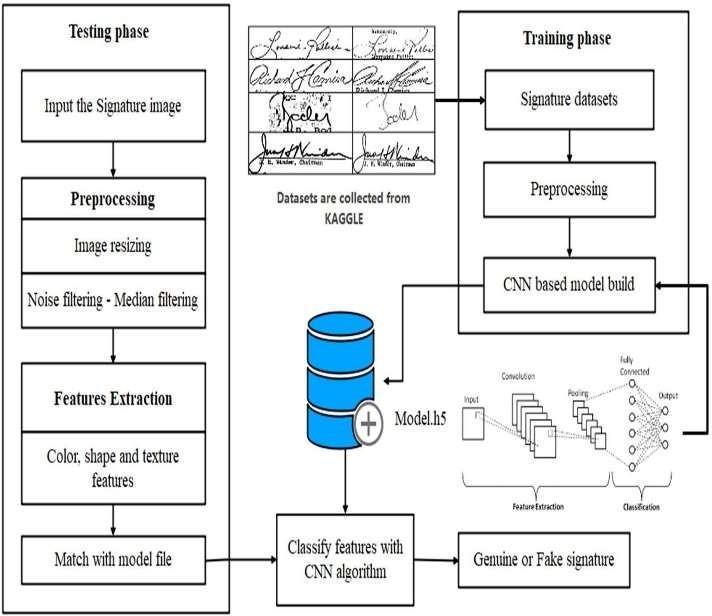
System Architecture:
Application:
Thepurposeofthissystemistoidentifyduplicatesignatures usingconvolutionalneuralnetworks.
Software components:
OperatingSystem:WindowsOS Frontend:Python
International Research Journal of Engineering and Technology (IRJET) e-ISSN:2395-0056
Volume: 11 Issue: 03 | Mar 2024 www.irjet.net p-ISSN:2395-0072
Backend:mySQL
Application:webapplication Tool:PYCHARM.
Hardware components:
Processor:Intel2.60GHzprocessor
RAM:1GB
Harddisk:160GB
Compactdisk:650MB
Keyboard:Standardkeyboard
Monitor:15inchcolormonitor
CONCLUSION:
Biometric technology is used in a variety of security applications. The purpose of such systems is to identify individuals on a physiological or physiological basis. Behavioralcharacteristicsinthefirstcase,thediagnosisis based on the following measurements: Biological features such as fingerprint, face and iris. The second case is related. It has behavioral features such as voice and handwritten signatures. Biometric authentication This system is primarily used in two scenarios: authentication and identification. Handwritten signature is one of the mostimportanttypesofbiometricfeatures.
Mainly because it is widely used to verify a person's identity for legal and financial purposes. And in administrative areas,handwrittensignatureverificationis the easiest way. The most non-invasive biometric authentication method. Signatures can be identified by their content. Geometric shapes. Modeled verification systems are tolerant of intra-individual signature variation, but insensitive to inter-individual signature variation. One,itisacounterfeitproduct.TheCNNfeature enhances signature verification itself for the following reasons: Fixed scaling and rotation properties. This function describes the shape In combination with geometric features such as circle and aspect ratio, Better Accuracy A project that introduces handwritten signature techniques Validation using the neural network approach of this method uses the extracted features from the preprocessed signature image. The extracted features are used for training. Neural network using back propagation trainingalgorithm
Reference:
[1] Al-Ajarami, Iman, et al. "Handwritten signature verificationusingdeeplearning"(2020).
[2] Al-Shemat, Fadi Mohammad and Fatima Susilavati Mohammad. "Convolutional Neural Networks for Offline Signature Verification with MultipleClassifiers",CSand IT Conference Proceedings. Volume 11. Number 20. ProceedingsofCS&ITConference,2021.
[3]Bardamova,MarinaBorisovna,etal."Attractionsearch for designing fuzzy rule-based classifiers for handwritten signatures" confirmation Journal of Software and CommunicationSystems15.3(2019):254-261.
[4] Diaz, Moises et al. "Signature of co-authored research using automatic offline signature verification without reference". signature" IEEE Transactions on Information ForensicsandSecurity15(2019):487-499.
International Research Journal of Engineering and Technology (IRJET) e-ISSN:2395-0056
Volume: 11 Issue: 03 | Mar 2024 www.irjet.net p-ISSN:2395-0072
[5] Diaz, Moises et al. "Dynamic signature verification systembasedonarealsignature".IEEETransactionson Cybernetics 48.1 (2016): 228-239.International Conference on Communication Systems and Networks (COMSNETS).IEEE,2020.
[6] Impedo, Donato, and Giuseppe Pirlo. "Automatic Signature Verification in Mobile Cloud Scenarios: A Review and Future Developments" IEEE Transactions onEmergingTopicsinComputing9.1(2018):554-568.
[7] M. Adham, A. Azodi, Y. Desmedt, and I. Karaolis, "How to Attack Two-Factor Authentication Internet Banking," in Proceedings of the 17th International Conference on Financial cryptography, 2012, pp. 322328. 0 10 20 30 40 50 60 70 80 90 LBP pig offer Accuracy(%)technique7
[8] Malik, Jameel et al. "DeepAirSig: Air Signature Verification Based on Deep Learning" IEEE Access 8 (2020):195832-195843.
[9] Manabu Okawa. "Online signature verification using single local format matching" and global-weighted dynamic time warping. IEEE Information and Systems Transactions103.12(2020):2701-2708.
[10] Volgunti, Chandra Sekhar, Prana Mukherjee and VishwanathPrabaigali."OnlineSignatureProfilingUsing GenerativeAdversarialNetworks."2020