
International Research Journal of Engineering and Technology (IRJET) e-ISSN:2395-0056
Volume: 11 Issue: 03 | Mar 2024 www.irjet.net p-ISSN:2395-0072
International Research Journal of Engineering and Technology (IRJET) e-ISSN:2395-0056
Volume: 11 Issue: 03 | Mar 2024 www.irjet.net p-ISSN:2395-0072
Prasenjit Banerjee
Technical Architect Director at Salesforce, USA
Abstract - The term Open Banking as we know it today originated from the regulations put by the UK and EU to securelyallowbanksandfinancialinstitutionstoexchange customer data and information. While the EU came up with distinct laws that regulate the practices of open banking with the PSD2 and the GDPR, the US has yet to comeupwithaformalizedsetoflawsonpractices,thereis alotofmomentuminthisspacewiththeCFPBisexpected to propose a set of guidelines on the consumer financial datarights,whichisastepinthatdirection.Themarketin theUShoweverismorethanripetounleashthepowerof Open bankinganditis atthecusp of breaking free with a plethora of fintech startups already established in their space, driving significant volume of financial transactions through their platforms which is nothing but open banking.
The traditional financial services companies are now at a varying level of maturity on how to leverage the transformativepowerofopenbankingtotheiradvantage. Instead of simply competing head-to-head with their fintech counterparts in terms of service offerings Briones et al [1]. This paper explores an approach as to how traditional financial institutions, including banks and insurance companies can leverage a new technological approachtobuildtheiropenbankingcapabilitiesthatwill placetheminthedriver'sseattoreapallthebenefitsthat theneweraoftechnologypoweredserviceshastooffer.
Key Words: Open Banking, open Insurance, Open Finance, APIs, fintech, BAAS, CFPB, GDPR, PSD2
“Openbankingisabanking practice that provides thirdpartyfinancialserviceprovidersopenaccesstoconsumer banking, transaction, and other financial data from banks and non-bank financial institutions through the use of application programming interfaces (APIs)”Investopedia. PSD2 was introduced in 2013. PSD2 is a European regulation for electronic payment services. It seeks to make payments more secure in Europe, boost innovation and help banking services adapt to new technologies.-BBVA2
Soon after the introduction of PSD2, the new set of regulationsprogressivelytookeffectfromthebeginningof Jan2018.Theseregulationscreatedafundamentalshiftas
to how banks and other financial institutions exchange data. The existing technologies of data exchange between banks and financial institutions were minimal. Banks wouldoperateashighlyregulatedclosed-doorinstitutions with minimal access to open payments. wherever they wereopen,theylackedthesafetynetofsecurelyaccessing personal identifying data and transmitting through the network in an encrypted way[2]. The PSD2 was followed bytheintroductionofGDPRbytheEUparliamentin2014.
TheintroductionofGDPRcreatedaparadigmshiftinhow banks and financial institutions would collect personal identifiable data, store them, and share them with other financialinstitutions.Whileitnotonlygaveconsumersthe right to control what data is being collected by the financial institutions, but it also firmly laid out the consequences of the breach of data privacy practices [3]. While it wasa bigchange in all the processes involved by the financial institutions to collect, process and store and share data , it created a foundation for a stable platform which the consumers can trust and laid the groundwork for establishing solid data governance practices to be createdandadoptedbyfinancialinstitutions.
So with the introductions of regulatory forces to govern the use of data, financial institutions has taken myriad different ways to make data available to third party institutions and other providers mostly using outdated approaches that were simply not ready to cope up with the challenges of building capabilities within large organizations that allows to safely and securely expose data to third party services securely and stand the test of scaleandcomplexity[4].
There were common protocols that existed that allowed computer systems to share data securely over internet , but no comprehensive tooling was available to conceptualize these mere protocols into comprehensive frameworks that can enable the building of such webservices as capabilities that banks and financial institutionscanleveragetobuildweb-servicesasbuildingblocks of capabilities that can be built incrementally with fundamental services serving as capabilities that can be usedinternallyandexternally.
International Research Journal of Engineering and Technology (IRJET) e-ISSN:2395-0056
Volume: 11 Issue: 03 | Mar 2024 www.irjet.net
Apart from erstwhile techniques such as mainframe copybooks, File transfer protocol (FTP) and later secure file transfer protocol SFTP dominated the space of data transfer,butsuchtechniqueswerenotcompliantwithreal time data transfer approaches and lacked in security and granularity of data. Later web-services became more of a de-facto standard of communication between distributed commuter systems. While Web Services were relatively easyto construct, every computer programming language came up with its own stack of tools to build and expose web-services. Evidently standardization emerged with programming language agnostic specifications were laid outwiththeintroductionofSimpleObjectaccessprotocol or SOAP and organizations were able to establish communicationsinaRealtimebetweenseveraldistributed systems using the SOAP protocol irrespective of the technologystackusedtobuildthehome-grownormarketbased products [5]. SOAP was the de-facto protocol for decades and Service oriented architecture with a rich catalog of web-services emerged as the best-practice approach for communicating between distributed computersystems.
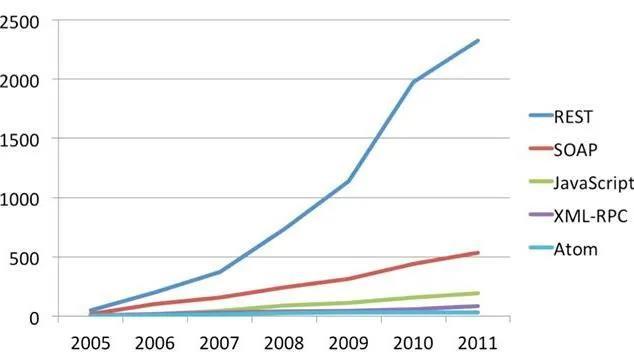
While SOAP is still used across the world simply because so many legacy financial systems have been built on its foundations, another protocol REST (representational state transfer) emerged as a lightweight alternative with HTTP (hypertext transfer protocol) as its root. Over the course of time, REST became more popular than SOAP because of its lightweight, stateless architecture that is able to scale very easily and now since the last couple of decades , it has almost become the standard of communication between computer systems over the Internet[6].
Screen-ScrapingisaprevalenttechnologyintheUSwithin financial organizations to accesscustomer data, but it has significant challenges. Customer Data Privacy is not well protected with Screen scraping technologies. It is difficult
p-ISSN:2395-0072
to build fine-grained access controls around data also policiesaroundratelimitingcanthrottlespeedofaccess.
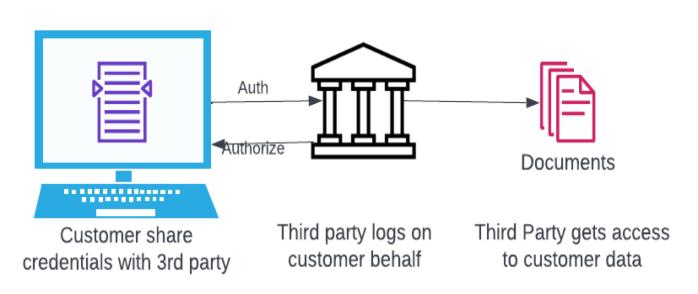
Fig -1:ScreenScrapingtechnology.
Banks understand that there is a better technology available to allow customers to securely provide third parties access to data while retaining the full access to permissions and maintaining full visibility to the request pipeline. This approach is with the use of APIs. APIs exposedbythebankwillallowallthirdpartiestoestablish a certificate of credibility and establish a permission set directly with the Bank. Then banks can provide granular access to third parties while retaining full visibility into theaccesslimits.
3.
Although open banking regulations are still in their final stages and not yet been released by the regulatory agencies. Open Banking Market size was valued at USD 20.2billionin2022andisprojectedtoregisterata CAGR of20.5% between 2023 and 2032.(GM Insights 2023). In the United States, Open Banking is transforming the financial landscape by enabling secure and seamless sharing of financial data between banks, financial institutions, and third-party service providers using application programming interfaces (APIs) [7]. This initiative fosters innovation, competition, and consumer choice in the financial services sector. It empowers consumers with control over their financial data, facilitatingpersonalizedfinancialadvice,improvedmoney managementtools,andaccesstoawiderrangeoffinancial products and services. Although not yet mandated by regulation as in some other regions, Open Banking in the US is driven by market forces and evolving consumer expectations,leadingtoenhancedtransparency,efficiency, andtailoredfinancialexperiencesforconsumers.
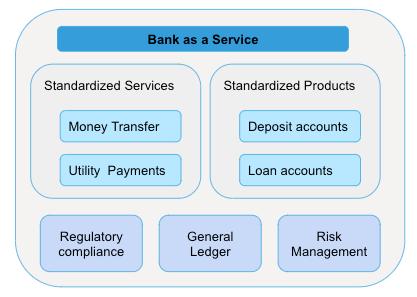
Banking-as a service is a way to capitalize the infrastructure and the knowledge that a bank has already inplace.
International Research Journal of Engineering and Technology (IRJET) e-ISSN:2395-0056
● Banking-as-a-Service (BaaS) describes an ecosystem in whichlicensedfinancial institutions provide accesstotheirservicestonon-bankingbusinesses[8]
● The most ubiquitous technology available to do thisatscaleisusingAPIs.
● APIs create a win-win scenario, where the Banks can capitalize their expertise and Fintechs can provide bundled service offerings without having to re-invent a wholeecosystemofbanking.
Today’s world presents unprecedented economic challenges and opportunities. If a Product or Service is NOT a part of an organization's competitive differentiation,organizationsarenowinclinedtodecrease bottomlineexpendituresbyresponsivelyoutsourcingthat topeerswhoarebetteratit.FinTech’sarelookingtograb this opportunity to build innovative solutions with an expedited go-to-market strategy that can help organizations build competitive differentiation and therebygrowitstoplinerevenue[9]
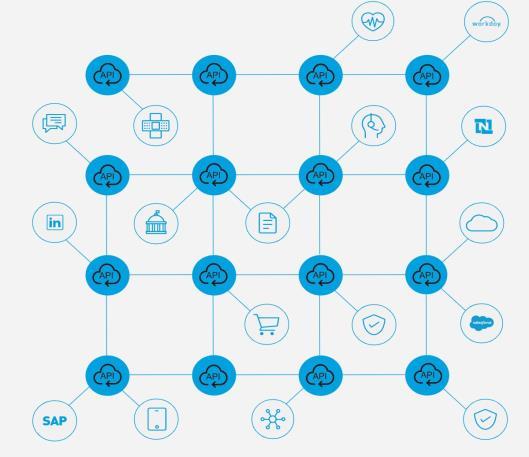
To democratize innovation, banks should be able to exposeinternalservicesinasecureway
● Organizecapabilitiesintoatomicunitsandexpose themasservicea.k.aAPIs.
● Processes should be completely independent of underlyingdataandcustomizableasperbusinessneedsof individualorganizations[10]
● Embrace for elasticity of demand and make provisions of hosting these services in a cloud infrastructurethatisscalableondemand.
● Allow for customization based on internal and regulatoryrequirements.
Volume: 11 Issue: 03 | Mar 2024 www.irjet.net p-ISSN:2395-0072 © 2024, IRJET | Impact Factor value: 8.226 |
● This will help to create a network of APIs which serves a unit of a feature and can be considered as a buildingblockthatprovidesreusability.
5.
BanksshouldbeabletodefinetheLifetimeValue(LTV)of thecustomerandpositiontheofferingaccordingly.
● Service should be decoupled from the core businessmodel.
● Should be able to scale up or down based on demand.
● Should be customizable to a certain extent, based ontheofferingandtypeofservice.
● The service should be differentiated to generate anidentityofitsown[11]
● SecureapositionintheFinTechmarketplace.
Financial Institutions should be able to price out the offeringconsidering.
● The total cost to serve should only consider the variable cost of service and not be an inhibitor that includes the total fixed (establishment cost) . This can initiate a downward spiral of demand with a prohibitive highcostofdoingbusiness
● Pricingthefeaturesbasedontheperceivedvalue, which is the sum of all the value delivered through the service offering based on alternative competitive services availableinthemarket.
API monetization is a strategic approach to generating revenue from an API. It involves defining the value proposition of the API and determining the best way to
Volume: 11 Issue: 03 | Mar 2024 www.irjet.net
charge for its use [12]. The considerations for an API monetization model cover a wide range of factors, from understanding the target market and API capabilities to choosing a pricing model that aligns with customer expectations and business goals. Here are the key considerationsforanAPImonetizationmodel:
● Value Proposition: Understand the unique value your API provides. This involves identifying the problems it solves, the efficiency it offers, and the unique data or services it provides access to. This value proposition shouldbecompellingtoyourtargetcustomers.
● MarketDemand:AssessthedemandfortheAPIin the target market. This includes understanding the needs and pain points of potential customers, as well as the competitivelandscape.Highdemandandlowcompetition canallowforpremiumpricingmodels.
● Customer Segmentation: Identify and segment your potential customers based on their needs, usage patterns, and willingness to pay. Different segments may requiredifferentAPIfeaturesorpricingmodels.
● Pricing Strategy: Choose a pricing strategy that aligns with your API's value proposition, market demand, andcustomersegmentation.Commonstrategiesinclude:
○ Freemium: Offering basic API functionalities for freewhilechargingforpremiumfeatures.
○ Pay-as-you-go: Charging based on the amount of APIcallsordataconsumed.
○ Subscription: Offering access to the API for a recurringfee,whichcouldbetiered basedonusagelimits orfeatureaccess.
○ Tiered Pricing: Providing different levels of API access at different price points, based on features, rate limits,orsupportlevels[13].
● Cost Analysis: Understand the costs involved in providing the API, including development, maintenance, support, and infrastructure costs. Pricing should cover thesecostsandalignwithprofitmargingoals.
● LegalandComplianceConsiderations:Ensurethat your API monetization model complies with all relevant laws and regulations, including data privacy laws and industry-specificregulations.
● Technical Infrastructure: Ensure that your API infrastructure can support the chosen monetization model,includingcapabilitiesfortrackingusage,managing access,andbillingcustomers.
● Integration and Ease of Use: Make it easy for customers to integrate and start using your API. This includes clear documentation, developer support, and flexibleintegrationoptions.
■
Traditional banks in the USA are gradually embracing openbankingthroughpartnershipswithfintechfirmsand bydevelopingtheirAPIstosharedatasecurelywiththirdparty providers. Their methodologies often emphasize security and customer privacy, seeking to maintain customertrustwhileinnovating.Traditionalbanksvaryin theirapproachtoopenbanking,withsomepioneeringthe initiative by creating proprietary API platforms, while others adopt a more cautious stance, slowly integrating third-partyservicesasconsumerdemandgrows.
Fintech companies are at the forefront of driving open banking in the USA. They leverage APIs to create innovative financial services and products that offer enhanced customer experiences, such as personalized financial advice, better loan rates, and more efficient payment systems. Fintech companies tend to be more aggressive and innovative in their approach compared to traditional banks, often pushing the boundaries of what canbeachievedthroughopenbanking.
■ Regulatory Bodies
Fintech companies are at the forefront of driving open banking in the USA. They leverage APIs to create innovative financial services and products that offer enhanced customer experiences, such as personalized financial advice, better loan rates, and more efficient paymentsystems[14].Fintechcompaniestendtobemore aggressive and innovative in their approach compared to traditional banks, often pushing the boundaries of what canbeachievedthroughopenbanking.
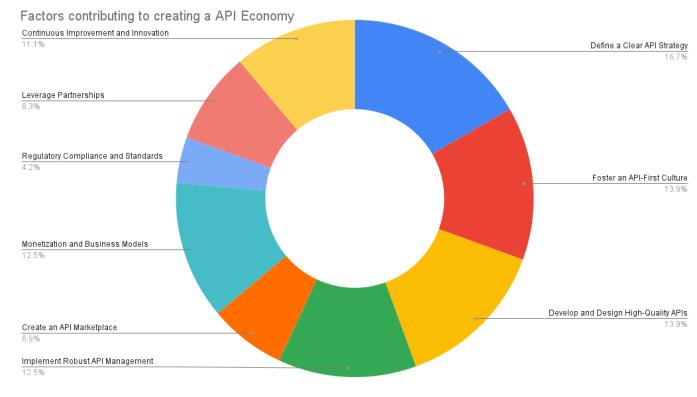
Building an API economy within an organization involves creating a strategic approach to develop, manage, and monetize APIs in a way that promotes innovation, collaboration, and revenue generation. The API economy isdriven by the exchangeof value between API providers and consumers, leveraging digital assets to create new business models and opportunities. Here are key steps organizationscantaketobuildasuccessfulAPIeconomy:
International Research Journal of Engineering and Technology (IRJET) e-ISSN:2395-0056
Volume: 11 Issue: 03 | Mar 2024 www.irjet.net p-ISSN:2395-0072
■ 1. Define a Clear API Strategy
● Identify Objectives: Understand how APIs can support businessgoals,whetherbyenablingnewrevenue streams, improving operational efficiency, or enhancing customerexperiences.
● AssessAssets:Inventorydigitalassetsthatcanbe exposedasAPIstointernalandexternaldevelopers.
■ 2. Foster an API-First Culture
● Encourage Innovation: Promote an API-first approach in product development, encouraging teams to think about how APIs can be used to extend functionality andreach.
● Training and Education: Invest in training developers and business teams on the benefits and best practices of API design, development, and management.[15]
■ 3. Develop and Design High-Quality APIs
● User-Centric Design: Design APIs with the enduser in mind, focusing on simplicity, usability, and documentation.
● Standardization: Adopt industry standards and best practices for API design to ensure interoperability andeaseofintegration.
■ 4. Implement Robust API Management
● Infrastructure:DeployascalableAPImanagement platform to control access, monitor traffic, and analyze usagepatterns.
● Security: Implement strong security measures, includingauthentication,authorization,andencryption,to protectdataandensureprivacy.
■ 5. Create an API Marketplace
● Catalog and Discovery: Provide a centralized catalog where internal and external developers can discoverandaccessAPIs.
● Community Building: Foster a community of developers around your APIs by offering resources, support,andforumsforcollaboration.
■ 6. Monetization and Business Models
● Develop Monetization Models: Identify appropriatemonetizationstrategiesforyourAPIs,suchas subscriptionfees,pay-per-use,orfreemiummodels.
● Value Proposition: Clearly articulate the value proposition of your APIs to potential consumers, focusing onhowtheycandrivebusinessgrowthorefficiency.
■ 7. Regulatory Compliance and Standards
● Compliance: Ensure that your APIs comply with relevant legal and regulatory requirements, especially concerningdataprotectionandprivacy.
● Adopt Open Standards: Whenever possible, use open standards to promote interoperability and ease of integrationacrossdifferentplatformsandsystems.
■ 8. Leverage Partnerships
● Strategic Partnerships: Form partnerships with other organizations to expand your APIs' reach and functionality.
● Ecosystem Development: Encourage third parties to build on your APIs, creating a vibrant ecosystem that addsvaluetoyourdigitalassets.
■ 9. Continuous Improvement and Innovation
● Feedback Loops: Establish mechanisms for collecting and acting on feedback from API users and stakeholders.
● IterativeDevelopment:ContinuouslyimproveAPI offerings based on user feedback, market trends, and technologicaladvancements
8. Conclusion
The role of APIs in shaping the future of open banking in the USA is pivotal, marking a transformative journey towards a more accessible, efficient, and innovative financial ecosystem. As digital conduits that facilitate secure and seamless data sharing between financial institutions, third-party providers, and consumers, APIs stand at the core of open banking's promise to enhance customer experience, drive competition, and foster
© 2024, IRJET | Impact Factor value: 8.226 | ISO 9001:2008 Certified Journal | Page 452
International Research Journal of Engineering and Technology (IRJET) e-ISSN:2395-0056
Volume: 11 Issue: 03 | Mar 2024 www.irjet.net
financial inclusion. With their ability to enable real-time data exchange and support new financial products and services, APIs are instrumental in unlocking the potential ofopen banking. They not onlyempowerconsumers with greater control over their financial data but also catalyze the creation of personalized banking experiences. As the regulatory landscape evolves to support open banking initiatives,thestrategicdeploymentofAPIswillbecritical inensuringtherobustgrowth,security,andsustainability of the open banking ecosystem in the USA. The future of banking, characterized by openness and collaboration, is thus inextricably linked to the advancement and integration of APIs, heralding a new era of financial servicesthataremoreinclusive,innovative,and customer centric.
[1] Briones de Araluze GK, Cassinello Plaza N (2022) Open banking: A bibliometric analysis driven definition. PLoS ONE 17(10): e0275496. https://doi.org/10.1371/journal.pone.0275496
[2] Preziuso,M.,Koefer,F.&Ehrenhard,M.Openbanking andinclusivefinanceintheEuropeanUnion:perspectives from the Dutch stakeholder ecosystem. Financ Innov 9, 111 (2023). https://doi.org/10.1186/s40854-023-005221
[3] Omarini, Anna Eugenia. "Banks and FinTechs: How to develop a digital open banking approach for the bank’s future." International Business Research 11.9 (2018): 2336.
[4] Brodsky,Laura,andLizOakes."Datasharingandopen banking." McKinsey & Company 1097(2017):1105.
[5] Mansfield-Devine,S.,2016.Openbanking:opportunity anddanger. Computer Fraud & Security, 2016(10),pp.8-1
[6] Premchand, Anshu, and Anurag Choudhry. "Open banking & APIs for transformation in banking." In 2018 international conference on communication, computing and internet of things (IC3IoT),pp.25-29.IEEE,2018.
[7] Gozman, Daniel, Jonas Hedman, and Kasper Sylvest. "Open banking: Emergent roles, risks & opportunities." In 26th European Conference on Information Systems, ECIS 2018. Association for Information Systems. AIS Electronic Library(AISeL),2018.
[8] Zachariadis, Markos, and Pinar Ozcan. "The API economy and digital transformation in financial services: Thecaseofopenbanking."(2017).
p-ISSN:2395-0072
[9] Nicholls,ChristopherC."Openbankingandtheriseof FinTech: innovative finance and functional regulation." Banking & finance law review 35,no.1(2019):121-151.
[10] Guibaud, Sophie. "How to develop a profitable, customer-focused digital banking strategy: Open banking services and developer-friendly APIs." Journal of Digital Banking 1,no.1(2016):6-12.
[11] Long, Guodong, Yue Tan, Jing Jiang, and Chengqi Zhang. "Federated learning for open banking." In Federated Learning: Privacy and Incentive, pp. 240-254. Cham:SpringerInternationalPublishing,2020.
[12] Rastogi, Shailesh, Arpita Sharma, and Chetan Panse. "Open banking and inclusive growth in India." Indian Journal of Ecology 47,no.spl(2020):75-79.
[13] Babina, Tania, Saleem A. Bahaj, Greg Buchak, Filippo De Marco, Angus K. Foulis, Will Gornall, Francesco Mazzola, and Tong Yu. Customer data access and fintech entry: Early evidence from open banking. No. w32089. NationalBureauofEconomicResearch,2024.
[14] Laplante, Phil, and Nir Kshetri. "Open banking: definition and description." Computer 54, no. 10 (2021): 122-128.
[15] Dratva,Richard."Isopenbankingdrivingthefinancial industry towards a true electronic market?." Electronic Markets 30,no.1(2020):65-67.