
International Research Journal of Engineering and Technology (IRJET) e-ISSN: 2395-0056
Volume: 11 Issue: 03 | Mar 2024 www.irjet.net p-ISSN: 2395-0072
International Research Journal of Engineering and Technology (IRJET) e-ISSN: 2395-0056
Volume: 11 Issue: 03 | Mar 2024 www.irjet.net p-ISSN: 2395-0072
Abhinav Dwivedi1, Shiv Kumar2
1M.Tech (ME) Scholar, Department of Mechanical Engineering, Goel Institute of Technology & Management Lucknow, Uttar Pradesh, India
2 Assistant Professor, Department of Mechanical Engineering, Goel Institute of Technology & Management Lucknow, Uttar Pradesh, India
Abstract - Inthepresent industrial sectorslikeaircraft, marine, bio-medical, chemical, etc., the usage of titanium has gained lot of interest due to its improved properties like strength, corrosion resistance, etc. Because of the improved properties like, higher hardness, toughness and poor thermal diffusivity make the material to fall under the category of hard-to-machine and this gave rise to the developmentandutilizationofnon-traditionalmachining processes.Machiningofsuchcomponentsata microlevel have gained lot of attraction in the present industrial sector.Therearemanysuchmachiningprocessesusedfor machining micro and mini components. The accuracy and precision of components machined through such conventional processes are the challenging one. This gave risetooneofthenon-traditionalmachiningprocesscalled Wire electrical discharge turning (WEDT) process, which machines any electrically conductive cylindrical components of any shape and dimension. As a present researchwork,theprocessabilityofWEDTprocessduring machiningofTi-6Al-4Valloyusinguncoatedanddiffusion annealed zinc coated brass wire is conducted. To conduct the experiments, a low cost rotary spindle setup is fabricated in-house. In order to predict the crater formation on the work material for the given input machining conditions, the numerical modelling is conductedusingCOMSOLMultiphysics5.2platform.Aset of pilot experiments are conducted to validate the simulatedresultsandfoundresultsareinagreement with each other, thus assuming the model to be correct to proceed further with the main experimentation. The samples machined with uncoated and diffusion annealed zinc coated brass wires are subjected to various mechanical and metallurgical studies to analyze the effect ofWEDTprocess.
Keywords: Turning, Zinc-coated, Optimization, Biocorrosion,Characterization.
Advancement in electronic products keeps going on at a faster pace in every aspect. Remarkable reduction in size of electronic devices is, undoubtedly,one of the outcomes of this progression. But; the increased heat generation
figures a major downside of the incessant innovation. Hence, there arises a pressing need for enhancing the cooling methodology to afford the processor base temperature in a convenient threshold range. It has been reported thatconventional air-cooling techniques remain insufficient to meet such challenges [1]. In recent days, investigation into the concept of heat removal by liquids has attracted heightened interest among researchers in the area of materials science. Liquids function in heat removal process better than air due to their specific thermal characteristics. Research on this subject can be categorized in terms of the methods adopted. One of the methods is modification of the heat sinkgeometry in order to enhance surface area used with conventionalfluid.Anothermethodusedisbyalteringthe thermo physical properties of fluids used with plain geometryformaintaining properfunctioningofelectronic devices[2].
Recently, in an examination on the micro channel heat sinks, it was reported that by reducing the channel’s hydraulic diameter, enhanced heat transfer possibility is attained. Further, a fluid carrying nanoparticles in basefluidhasshownencouragingbettermentforenhanced heat transfer applications. These fluids are known as “Nanofluids”,whicharearelativelyadvancedclassoffluids that consist of a base fluid with nano-sized particles (1–100 nm) suspended within them. These suspended particles are metal or metal oxide, which enhance conduction and convection coefficients, permitting enhancedheat transfer. Some distinctive nanofluids are ethylene glycol-based copper nanofluids and water-based copperoxidenanofluids[3].
Also, the fabrication of micro channel heat sinks for the transfer of heat flux requires considerable expertise. The smaller the electronic components are, the more complex its thermal management becomes. In such cases, surface roughness plays an principal role in pool and flow boiling in micro channels. Itisalsonotedthatanincrease in surface roughness brings about pressure dip and velocity variations in a single-phase flow. Hence, optimization of surface roughness coupled with other characteristics becomes significant. Not just the cooling techniques, and surface area as well as its roughness, but
International Research Journal of Engineering and Technology (IRJET) e-ISSN: 2395-0056
Volume: 11 Issue: 03 | Mar 2024 www.irjet.net p-ISSN: 2395-0072
theconvectiveheattransfercoefficientalsodependsupon thepropertiesofbasematerialofmicrochannelheatsink.
Some common materials used to make heat sinks are Aluminium alloys, Copper and Diamond. Aluminium heat sinks have often been found to be the natural choice to reduce cost, availability and better performance. Composite materials are also used in manufacturing heat sinks.Thesecompositesincludeacopper-tungstenpseudo alloy, Al/SiC (silicon carbide in the aluminium matrix), Dymalloy (Diamond in copper-silver alloy matrix), and EMaterial (beryllium oxide in beryllium matrix). Being their thermal expansion coefficient matchingto ceramics and semiconductors, these materials are often used as substratesforchips[4].
Browers et al examined flow and heat transfer characteristics of aqueous Alumina nanofluid in micro channels.Theyfoundoutan abetmentin frictionfactor at lower Reynolds number and assumed that this might be due to higher particle concentrations. Majority of experiments revealed that larger pumping pressure with an increase in heat transfer. Hosseini et al proposeda research of heat transfer in micro channel heat sink assistedwith magneticfieldAl2O3/Waternanofluid.They analyzed the effects of Hartmann number, nanoparticles volume fraction and Nusselt number. The results have shown that Nusselt number has direct relationship with applied magnetic field. By using Al2O3/H2O nanofluid in wavy micro channels, Rostami et al proved that in three dimensional governing including continuity equations have three times higher heat transfer than conventional waterbasedstraightchannels.
Sohel etalanalysedtheperformanceofminichannelheat sink using Al2O3/H2O nanofluid with volume fraction rangingfrom 0.10 to 0.25%. It wasprovedthat there was an abetment of 0.18% heat transfer successfully. Mohammed et al analysed heat transfer of rectangular micro channel heat sink by varying Reynolds number. Alumina/water nanofluid with varying volume fractions between 1% and 5% used for conducting the experiment. It hasbeen found out that 5% of volume fraction has not any notable effect on heat transfer. Heat transfer could onlybeincreaseduptoaparticularvolumefraction.
Akbari et al examined heat transfer by varying Reynolds number between 10000-60000 and volume fraction of CuO/H2O - based nanofluid with 0%, 2% and 4%. Turbulent flow through three-dimensional rectangular micro channels was scrutinized in this experiment. The resultoftheexperimenthas indicatedthatsemi-attached ribinthemicrochannelincreasesheattransfer.Oliveriaet al considered MWCNT particles dispersed in distilled water as nanofluid in a car radiator with varying
nanoparticles concentration from 0.05% to 0.16%. For circulating air through radiator, a wind tunnel setup was used. Air flow rate was maintained at constant rate with varyinghotfluidtemperature.Thestudyhasputforwarda finding that there occurs only 5% decrease in heat transfer. It also shows that an increase in concentration doesnothaveanyeffectinheattransfer.
Consideringtheliteraturereview,researchgapsidentified havebeendepictedbelow:
Though a good quantum of research has been carried out by researchers on flow and heat transfer in micro channels with restricted working fluids, geometrical patterns of the channels, difference in materials for micro channels, and operational constraints still implicateamajorgaptobebridged.
Machining of micro channels on Aluminium Metal Matrix Compositesforheatsinkapplication usingatypicalmachiningmethodssuchasWEDM, Laser Machining and the influence of operational parameters on the machining characteristics has insufficientliteratures.
Confined literaturehas reportedtheutilization of natural resources as reinforcement in preparation of Particle reinforced Aluminium Metal Matrix Composites (AMCs) as a base material for heat sink/exchangersapplications.
To prepare Aluminium Metal Matrix Composites with Rutile as reinforcement and Aluminium Al6351 as matrix through powder metallurgy technique.
To investigate the addition of Rutile on the physical, mechanical properties such as density, hardness,Compressionstrength.
To machine the micro-channels on the fabricated compositesusingW-EDMmachining.
To optimize the process parameters to get near net shape using a hybrid approach grey-based TaguchicoupledwithPCA.
To investigate, report the flow and heat transfer behaviour of hybridAl2O3/CuO/water nanofluidthroughthemicrochannel.
International Research Journal of Engineering and Technology (IRJET) e-ISSN: 2395-0056
Volume: 11 Issue: 03 | Mar 2024 www.irjet.net p-ISSN: 2395-0072
TheFigure2.1depictstheproposedmethodologytothe researchwork.
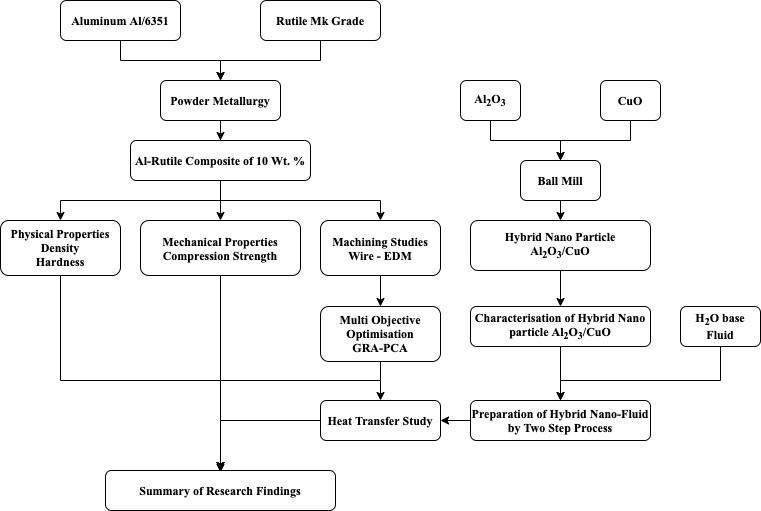
2.1 ProposedMethodology
This chapter elucidates in detail; selection of matrix, reinforcement material, procedure followed to fabricate the composite material, micromachining of micro channel and the steps involved in optimization of machining parameter. Further, it explains the steps involved in the manufacturingofnanofluidsandtheheattransferstudy.
Aluminium Alloy AA 6351powders, Rutile Mk grade mineral of 10 wt. % were weighed in digital balance and wereblendedinanattritionmill.Themillingspeedof200 rpm is maintained and milling time considered is two hours with BCR of 10:1 is maintained to get uniform homogeneous mixture of powders. The die used for compaction is cleaned with acetone. The material is poured in to the die and compacting pressure applied at the rate of 250 MPa for 6minutes under uniaxial load at room temperature. After compaction, the green compacts areejected. Sintering isdoneinanargonatmospherein a tubular type furnace. It is gradually heated up to 600ºC below the melting point of AA6351 for three hours. Then the sintered composite is cooled and cleaned at atmospheretemperature. TheFigure 3.1 depicts thesetup forfabricationofcomposite.Thefabricatedspecimenisof sizeØ30×15mmindiameter.
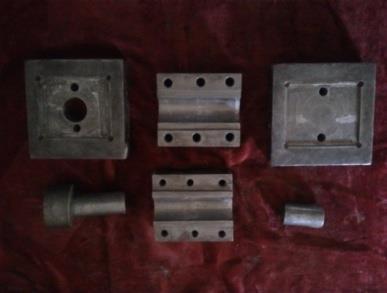
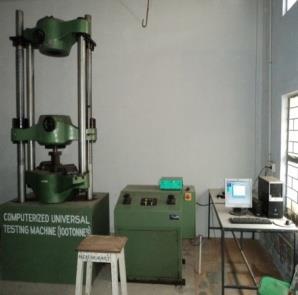
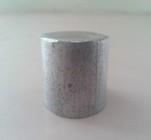
Figure 3.1 PowderMetallurgyfabricationsetupand specimen
AA6351/10%RutileMkgradewassuccessfullyfabricated bypowdermetallurgyroute.Betterqualityofcompositeis ensured by porosity less than 5%. Uniform dispersion of particlesensuredthroughSEMandEDSshowspresenceof titanium.Furthermachining studyandapplicationofheat transferwerediscussedindetail.
Thepreparedcompositemustbesubjectedtoasecondary processingsuchasmachiningtoobtainthenearnetshape of the product. In the current research, Wire Electrical Discharge Machining (WEDM) is employed to producethe micro channels. The machining operation is conducted by varying the electrical, no-electrical parameters. Thus the current, voltage and wire feed rate are considered as machining parameters and the output performance such as surface roughness, kerf width and depth are investigated.
The fabricated AA 6351 – 10 wt. % Rutile composite was successfully machined using WEDM based on L27 array at different Current, Voltage and Wire Feed rate Conditions
4.2.
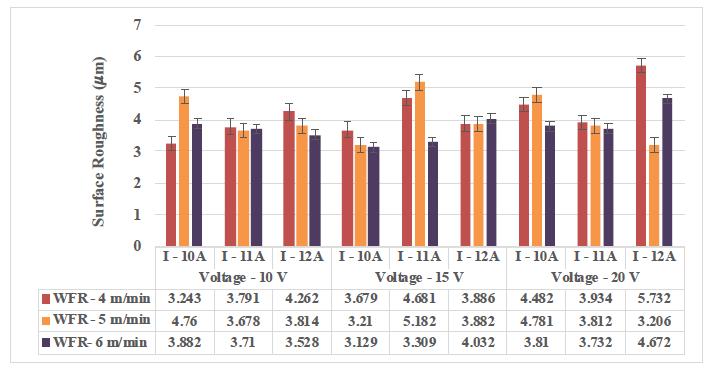
Figure 4.1presentsinfluenceof machiningparameters on the surface roughness of the machined composites.
International Research Journal of Engineering and Technology (IRJET) e-ISSN: 2395-0056
Volume: 11 Issue: 03 | Mar 2024 www.irjet.net p-ISSN: 2395-0072
Since the pulse current and voltage increase, the machining rate increases with reference to wire feed rate and it results to improper finishing and shabby surface finish. Poor surface finish happens because of the presence of hardened reinforcement particles and they arehardtomachine.Whilemachining,theheatdeveloped throughsparkgenerationmeltsthematrixmaterialearlier thanthereinforcementparticlesasithasahighermelting point than the base aluminum matrix; such happenings would possibly result in protrusion of these reinforced particlesoutofthebasematerialandhencewilldefinitely resultinimpropersurface.
4.3. EFFECT OF MACHINING PARAMETERS ON KERF DEPTH ANDKERF WIDTH
The Kerf depth and Kerf width refer to the dimensional accuracy of the fabricated micro channel. Figures 4.2 and 4.3 depict the variations of Kerf depth and Kerf width in terms of machining parameters. When the current increases, the discharge of energy as spark in the wire electrode also increases. Consequently, more metal melting happens on the machined surface. High heat energy generated between wire electrodes and the composites produce a corner wear, which leads to a poor heat dissipation on the surface of the material. Thus, higher dimensional inaccuracy is produced and it results inincreasedKerfdepthandKerfwidth.
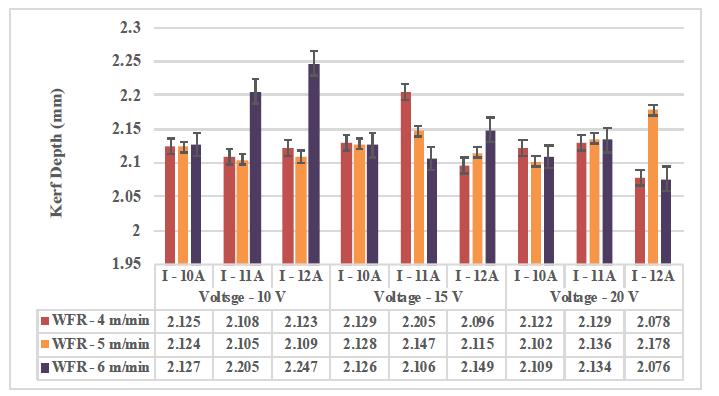
4.2. EffectofmachiningparametersonKerfdepth
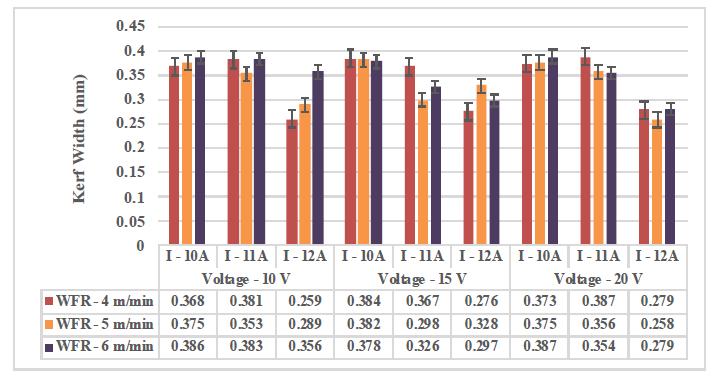
Figure 4.3 EffectofmachiningparametersonKerfwidth
The experimental findings demonstrate that the micro channel in the AA6351 – 10 wt. % Rutile composite may be created utilising Wire Electrical Discharge Machining. Theaddition ofhard reinforcingparticlesRutileenhances machining resistance and increases surface roughness, Kerf Width, and Depth. However, the study's aim is to expand a composite that may be used in micro electrical device.
5.
Rutilereinforcedcompositehasbeensuccessfully fabricatedbypowdermetallurgy methodandthe micro channels are produced by using WEDM. Outcomesoftheresearchworkare:
AA 6351/10 wt. % Rutile Mk grade has higher strengthandexcellentmechanicalpropertiesthan the conventional alloys. The uniform distribution ofreinforcementparticlesisverified.
International Research Journal of Engineering and Technology (IRJET) e-ISSN: 2395-0056
Volume: 11 Issue: 03 | Mar 2024 www.irjet.net p-ISSN: 2395-0072
The formation of micro channel is feasible through WEDM at varying conditions and the surfacemorphologyisexaminedthroughSEMand EDS.
Minimizationofkerfwidth,kerfdepthandsurface roughness has been established to get optimum results.
TheCurrentplaysthemajorinfluenceonaffecting the combined objectives followed by wire feed rateandvoltage.
This hybrid technique has successfully optimized theWEDM processandtheconformitytest,which has been conducted, ensures the increment in GRGby0.0025.
The hybrid Al2O3-CuO/water nanofluid with different weightconcentrations was successfully formulated using two-step process andutilized for the investigation and the following conclusionsweremade:Enhancedheattransferis observedinhybridnanofluid.
The heat transfer rate was increased by 6% followed by the Reynolds Number from 3000 to 5000 and Nusselt number from 60 to 100 for the 0.3%ofthecompositionwhenthemassflowrate increased. The similar pattern was absorbed for the 0.1 and 0.2 % of the composition of the nanofluids.
Pumping power is spiraled with increased flow rate and concentration of nanoparticles but this hindrance can be overcome by the enhancement ofheattransfer.
It is observed that the heat transfer coefficient, mass flow rate and Nusseltnumber increase with theincreaseinReynoldsnumber.
Itis proved that, when the temperature average and pressure difference increase, Reynolds numberincreasesgradually
The prepared composite can be subjected to a non-destructivetest.
Vibration assisted and Cryogenic environment machiningcanbeperformed.
Numerical analysis offluid flowandheattransfer characteristics of MWCNT-water nanofluid in rectangular micro channel heat sink can be performed.
[1] H.S.Wong,K.Akarvardar,D.Antoniadis,J.Bokor, C. Hu, T. J. King-Liu, S. Mitra, J. D. lummer and S. Salahuddin, A Density Metricfor Semiconductor Technology, Proceedings of the IEEE, 108 (4) (2020),478-482.
[2] P. Ye, T. Ernst and M. V. Khare, The last silicon transistor: Nanosheetdevices could be the final evolutionary step for Moore's Law, IEEE Spectrum, 56 (8)(2019),30-35.
[3] Hung, Yan, Wang and Chang, Heat transfer enhancement in micro channel heat sinks using nanofluids, International Journal of Heat andMass Transfer, 55 (9–10)(2012),2559-2570.
[4] G. Prashant Reddy and Navneet Gupta, Material selection for microelectronic heat sinks: An application of the Ashby approach, Materials & Design, 31 (1)(2010),113-117.
[5] M.Pethuraj,M.Uthayakumar,S.Rajakarunakaran, and S. Rajesh, Solid particle erosive behaviour of sillimanite reinforced aluminium metal matrix composites, Materials Research Express, 5 (6) (2018),ArticleNo.066514.
[6] N.Ahmed,M.P.Mughal,W.Shoaib,S.FarhanRaza and A. M. Alahmari, WEDM of copper for the fabrication of large surface-area micro-channels: A prerequisite for the high heat-transfer rate, Micromachines, 11 (2)(2020),173-195.
[7] S. F. Miller, C. C. Kao, A. J. Shih and J. Qu, Investigation of wire electrical discharge machining of thin cross-sections and compliant mechanisms, International Journal of Machine Tools and Manufacture,45 (15) (2005), 17171725.
[8] F. Han, J. Jiang and D. Yu, Influence of machining parameters on surface roughness in finish cut of WEDM, The International Journal of Advanced Manufacturing Technology, 34 (5-6) (2007), 538546.
[9] T. D. Nguyen, P. H. Nguyen and L. T. Banh, Die steel surface layer quality improvement in titanium μ-powder mixed die sinking electrical discharge machining, The International Journal of Advanced Manufacturing Technology, 100 (9) (2019),2637-2651.