
International Research Journal of Engineering and Technology (IRJET) e-ISSN:2395-0056
Volume: 11 Issue: 03 | Mar 2024 www.irjet.net p-ISSN:2395-0072
International Research Journal of Engineering and Technology (IRJET) e-ISSN:2395-0056
Volume: 11 Issue: 03 | Mar 2024 www.irjet.net p-ISSN:2395-0072
Shahin Bano1, J.P Singh2
1 Department of Computer Science and Engineering, CEC Bilaspur
2 Assistant Professor Department of Computer Science and Engineering, CEC Bilaspur
Abstract Vision-based division in forested situations may be a key usefulness for independent ranger service operations such as tree felling and sending. Profound learning calculations illustrate promising comes about to performvisualassignmentssuchasprotestdiscovery.Inany case, the directed learning handle of these calculations requires explanations from a expansive differences of pictures. In this work, we propose to utilize recreated woodland situations to naturally create 43k reasonable engineered pictures with pixel-level comments, and utilizeit toprepare profoundlearningcalculationsfortree discovery. Thispermitsustoaddressthetakingafterquestions:i)what kind of execution ought to we anticipate from profound learning in unforgiving synthetic forest situations, ii) which explanations are the foremost critical for preparing, and iii) what methodology ought to be utilized between RGB and profundity. We moreover report the promising exchange learningcapabilityofhighlightslearnedonourmanufactured dataset by specifically foreseeing bounding box, division covers and keypoints on genuine pictures Code available on GitHub(https://github.com/norlab-ulaval/PercepTreeV1).
Deeplearningpickedupmuchconsiderationwithinthefield of ranger service because it can actualize information into machines to handle issues such as tree discovery or tree health/species classification [1]. In any case, profound learningcouldbeainformationcentricapproachthatneeds a sufficient amount of commented on pictures to memorize unmistakable protest highlights. Making an picture dataset may be a awkward handle requiring a awesome bargain of time and human assets, particularly for pixel-level comments.Inlikemanner,fewdatasetsparticulartoranger service exist,andthislimits profoundlearningapplications, aswellaserrandrobotizationrequiringhigh-levelcognition.
In arrange to maintain a strategic distance from handannotation and incorporate as numerous reasonable conditions as conceivable in pictures, we propose to fill the information hole by making a expansive dataset of manufactured pictures containing over 43k pictures, which we title the SYNTHTREE43K dataset. Based on this dataset, we prepare Veil R-CNN [2], the foremost commonly-used
show for occurrence division [1], and degree its exhibitions for tree location and division. Since our test system permits for speedy explanation, we moreover explore with keypoint locationtosupplydataaroundtreebreadth,slantandfelling cutarea.
Indeed in spite of the fact that the discovery exhibitions gotten on SYN-THTREE43K will not straightforwardly exchangetogenuineworldpicturessinceoftherealityhole,a result investigation can direct us towards building an ideal genuine dataset. Eminently, manufactured datasets can be utilized to assess preparatory models [3], and some of the time they can make strides discovery execution when combined with real-world datasets [3], [4]. In that sense, we shed light on which explanations are the foremost impactful on learning, and on the off chance that including the profundity methodology within the dataset is relevant. Finally, we illustrate the reality hole by subjectively testing the show on genuine pictures, appearing exchange learning potential.
Deep learning for tree location in ranger service has illustrated victory on generally little genuine picture datasets. For occasion, [5] actualize a U-Net engineering to perform tree specie classification, discovery, division and stock volume estimation on trees. When prepared on their (private) dataset of 3k pictures, they accomplish 97.25% exactness and 95.68% review rates. Essentially, [6] employmentsablendofunmistakableandwarmpicturesto form a dataset of 2895 pictures extricated from video groupings, and exclusively incorporate bounding box explanations. They prepared five distinctive one-shot locators on their dataset and accomplished 89.84% exactness,and89.37%F1-score.Weacceptthesepreviously mentioned strategies seem advantage from preparing on manufactured pictures. The Virtual KITTI dataset [3] is one of the primary to investigate this approach to prepare and assess models for independent driving applications. By reproducing real-world recordings with a diversion motor, they create engineered information comparable to genuine information. The models prepared on their virtual dataset appear that the hole between genuine and virtual
International Research Journal of Engineering and Technology (IRJET) e-ISSN:2395-0056
Volume: 11 Issue: 03 | Mar 2024 www.irjet.net p-ISSN:2395-0072
information is little, and it can substitute for information holesinmulti-objectfollowing.Inthemeantime,[7]explore protest discovery employing a engineered dataset for independentdriving,andtheyreportthatpreparingmodels on practically rendered pictures might create great segmentations by themselves on genuine datasets whereas significantly expanding exactness when combined with genuine information. Quantitatively, they made strides perclass exactness by more than 10 focuses (and in a few cases,asdistantas18.3focuses).
Inspiteofthefactthatengineereddatasetscannottotally supplant genuine world information, different works illustrate that it could be a costeffective elective that provides great transferability [3], [4], [7]. In this manner, creating engineered woodland datasets will possibly progress the current state of tree recognition strategies in rangerservice.
Inthisarea,wedetailhowSYNTHTREE43Kwasmade.At that point, we portray the profound learning design and spines,aswellasthepreparingpointsofinterest.
A. Simulator and Dataset
SYNTHTREE43K is produced by utilizing the Solidarity amusement motor to render reasonable virtual woodlands. This virtual world generator can be designed through Gaia to procedurally terra-form the scene, surface the territory and produce objects. In this reenactment, the timberland thicknessiscontrolledthroughdifferentproducerulessuch as height, landscape incline and the number of neighboring objectsinagivenregion.
The woodland is populated with practical tree models from Nature Fabricate . In arrange to expand visual changeability, surface on the six tree models is adjusted to form 17 modern, particular tree models. Other protest models from Nature Fabricate are moreover included in scenessuchasgrass,stumps,scoursandbranches.
For extra authenticity and assortment, meteorological conditions are too reenacted in this virtual world. We recreate snow utilizing snow surface, and damp impact utilizing decals. Molecule frameworks are utilized to reproducesnowflakes,raindropsorhazeimpacts.Tomimic distinctive minutes of the day, we alter brightening to morning, sunshine, evening and sunset. The protest shadowsadjusttolightcastonthescene.
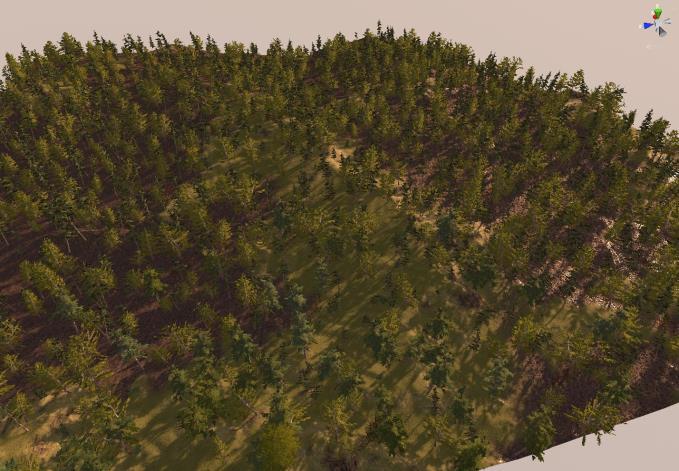
Fig. 3: A general view of a simulated forest environment. In this scene, three terrain textures are used to simulate moss, rootsandmudconditions.Thetreemodelsarefirandbeech, accompanied by scrubs, branches,grassand stompsunder a morninglighteffect.
From each produced scene, we include between 200-1000 pictures to the dataset. Each picture incorporates bounding box, division veil and keypoint comments. The pipeline clarifies trees inside a 10m sweep from the camera, which compares to the reach of a gatherer [8]. Five keypoints are relegated per trees to capture the fundamental data that an independenttreefellingframeworkwouldrequire:thefelling cutarea,breadthandslant.
Collectively, this pipeline can create an boundless sum of manufactured pictures with an explanation speed of roughly 20 frames/minute, for we consider RGB and profundity pictures as one outline. Generally, SYNTHTREE43K contains over 43k RGB and profundity pictures, and over 162k clarifiedtrees.
The Cover R-CNN engineering is composed of i) a convolutional highlight extraction spine, ii) a Locale Proposition Arrange (RPN), and iii) expectation heads. The initial Cover R-CNN arrange is somewhat adjusted for our tree discovery issue, in that, an discretionary keypoint departmentisincludedtotheforecasthead.Inthismanner,it can be utilized for classification, bounding box relapse, division,andkeypointforecast.
Expectationsaremadeviaatwo-stageprepare.Withinthe to begin with arrange, the RPN proposes locales of interface (RoI)fromthehighlightmapsofthespine.Thesecompareto a locale that possibly contains a tree. The era of a RoI takes afteralongthedefaultnineboxgrapples,comparingto three area-scales(8,16and32)andthreeperspectiveproportions
International Research Journal of Engineering and Technology (IRJET) e-ISSN:2395-0056
Volume: 11 Issue: 03 | Mar 2024 www.irjet.net p-ISSN:2395-0072
(0.5,1.0,and2.0).Inourtry,weutilizethreedistinctivespine structures: ResNet-50, ResNet-101 [9], and ResNeXt-101 [10].WeutilizeResNetspineforincludeextractionbecauseit gives amazing picks up in both exactness and speed, which weutilizeasabaselineforourcomesabout.Whencomparing the 50-layer to its 101-layer partner, there's a plausibility that they perform so also when the dataset is little [2], however we anticipate that utilizing SYNTHTREE43K will be sufficienttoillustratethatthe101-layercanoutflank the50layer.InrespectstoResNeXt,itpresentsa cardinalityhyperparameter,whichisthenumberoffreeways,givingawayto alterthedemonstratecapacitywithoutgoing moreprofound or more extensive. More points of interest approximately spineparametersaregiveninTableI
TABLE I: Backbone parameters. The number of learnable parameters(#Params),computationalcomplexity(GFLOPs) and frames per second (FPS) at inference time on 800×800 images.
15
In this way, RoIAlign [2] employments bilinear insertion to outline the highlight maps of the spine into a 7Ã 7 input highlightoutlineinsideeach RoIzone.Highlightsfrom each RoIatthatpointgothroughthearrangeheadtoatthesame time foresee the course, box balanced, double division veil, andandiscretionarytwofoldveilforeachkeypoint.
WeutilizeDetectron2[11]executionsofVeilRCNN.Ithas been appeared that pre-training makes a difference regularizemodels[12],and encourageexchangelearningto atargetspace[13].Hence,theVeilR-CNNmodelsutilizedin our tests are pre-trained on the COCO Individual Keypoint dataset[14],whichcouldbealarge-scaledatasetcontaining more than 200k pictures and 250k individual occasions labeledwith17keypointsperinstance.Beforepreparingor fine-tuning the models, the primary two convolutional layers of the spine are solidified. The equipment for show preparing and testing is an NVIDIA RTX-3090-24GB GPU andanIntelCenteri910900KFCPU.
Topreparethedemonstrate,SYNTHTREE43Kispartinto three subsets: 40k within the prepare set, 1k for the validation set and 2k within the test set. The show learns from the prepare set by utilizing an stochastic slope plunge
(SGD) optimizer with a energy of 0.9, and a weight rot of 0.0005. Amid preparing, we progress show generalization, and diminish dataset overfitting by utilizing information expansion procedures such as picture resizing, flat flipping, sheering, immersion, revolution, and trimming. No information enlargements are utilized at approval and test time. Show overfitting is checked by means of the approval set,whichisadditionallyutilizedforearlyhalting.
Profundity pictures are gray scales of 8-bit 1-channel. At preparetime,theyarechangedoverto8-bit3-channel tofit the RGB arrange from pre-trained models. In our case,asingle picture channel might be conceivable, but it wouldrequire haphazardly started models, which takes an colossal sum of pretraining time for spines such as ResNet andResNeXt.Hyperparameteroptimizationisconductedfor ResNet-50-FPN as it were, and these hyperparameters are utilizedforeachdemonstrate.Weutilizeearlyceasingbased onthemostnoteworthyapprovalsetNormalAccuracy(AP) todecidewhentohaltpreparing.
We base our execution assessment on the standard COCO measurements for each assignment, APbb and APmask, we prepare Cover R-CNN on our engineered woodland pictures and compare location execution between the three spines and RGB/Depth methodology. We moreover conduct an investigation of keypoint expectation by measuring the pixel mistake of each anticipated keypoint. In conclusion, we test discovery on genuine pictures, subjectively illustrating the realitycrevicebetweenmanufacturedandgenuinepictures.
Six models, comparing to all combinations between the threedistinctivespinesandtwomodalities,arepreparedand tried on SYNTHTREE43K. From Table II, we watch that all modelspreparedontheprofunditymethodologybeatmodels prepared on the RGB methodology. In truth, the discovery assignment based on the profundity methodology moves forwardAPbbby9.49%onnormal,indeedinspiteofthefact that all of the models were pre-trained on COCO Individual — an RGB dataset. This proposes two things: 1) that the profundity methodology makes a difference systems dismiss trees found assist than our 10m explanation limit, and 2) profundity pictures are conceivably less demanding to decipher.Inrespecttothedivisionassignment,exceptionally smallpickupisgottenbyutilizingprofunditypicturesrather than RGB, and within the case of ResNeXt-101 it diminishes. Shockingly, the ResNeXt design has more inconvenience exchanging to profundity pictures compared to the ResNet engineering, which make ResNet-101 the leading spine for profundity.
International Research Journal of Engineering and Technology (IRJET) e-ISSN:2395-0056
Volume: 11 Issue: 03 | Mar 2024 www.irjet.net p-ISSN:2395-0072
On RGB pictures, we accomplish the most excellent location comesaboututilizingResNeXt-101.Thiscanbecomparative to past investigate [10], [15], and it may be a result of the cardinality utilized in ResNeXt because it is more successful thangoingmoreprofoundormoreextensivewhentheshow capacity is expanded. The forecasts on manufactured picturescanbewatchedinFigure1.
TABLE II: Results for models trained and tested on SYNTHTREE43K. All models achieved better performances usingthedepthmodality.
TABLE III: Impact of multi-task learning on bounding box, segmentation mask, and keypoints. Results are from ResNeXt-101onrealRGBimages.

B. Keypoint Detection
A keypoint discovery investigation based on mistake in pixelspermitsforimportantanddirectelucidationsoftreefelling errands and their mistake dissemination. In this manner, wecomputethe pixel mistake betweentheground truth and the anticipated keypoint, and report the comes aboutinFigure5.
Table III appears that including the veil department reliably makes strides APbb and APkp. Comparatively, including the keypoint department diminishes APbb and APmask.Thesediscoveriesadjustwith[2],astheyfoundthat the keypoint department benefits from multitask preparing, but it does not offer assistance the other assignments in return. Superior bounding box and keypoint location can happen by learning the highlights particular to division. In reality, a wealthier and point by point understanding of picture substance requires pixel-level division, which can play an imperative part in absolutely delimiting the boundariesofpersontrees[16].
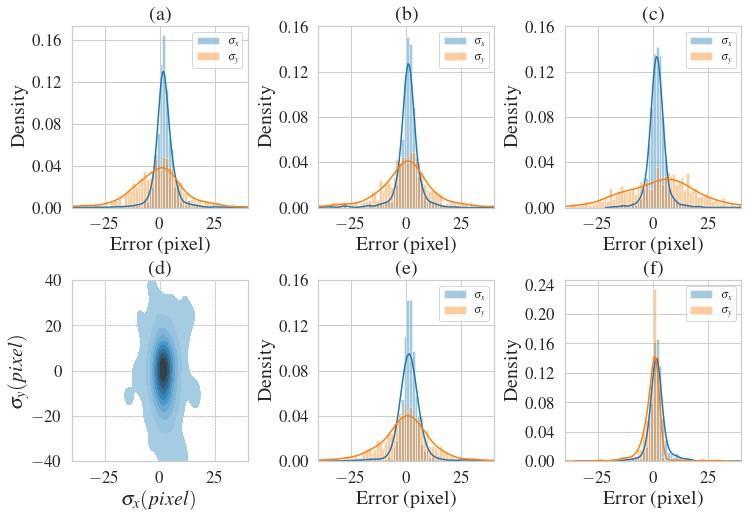
Fig. 5: Keypoint error distributions (in pixels) for our best detection model, ResNet-101 on depth images. Blue is the horizontalerrorandorangeistheverticalerrordistribution forthe(a)fellingcutkeypoint,(b)rightand(e)leftdiameter keypoint; (c) middle keypoint and (f) top keypoint. Density mapofthefellingcutkeypointisshownin(d).
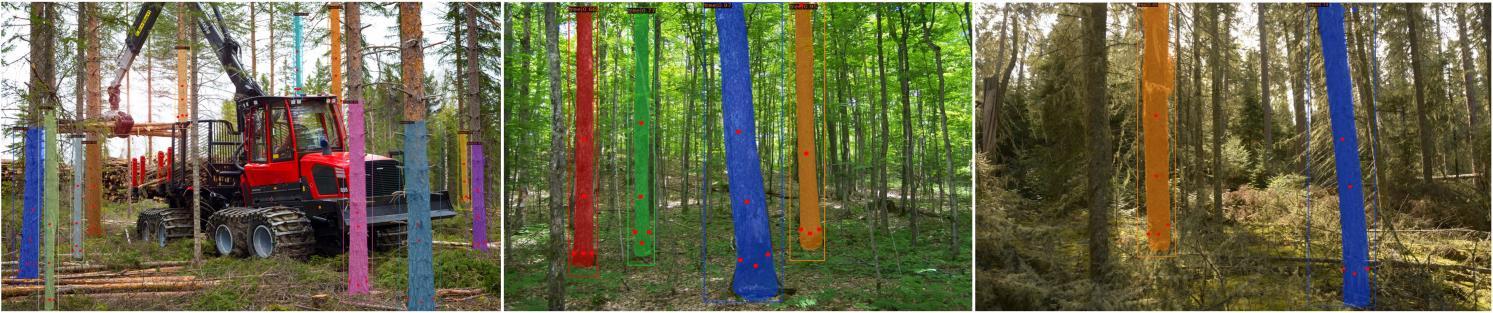
Fig.4:PredictionsonrealimagesfromResNeXt-101trainedonlyonsyntheticimages.Weobservethateven withthereality gap,themodelcanstilldetecttreeswithhighprecision,butsuffersfromlowrecallrates.
International Research Journal of Engineering and Technology (IRJET) e-ISSN:2395-0056
Volume: 11 Issue: 03 | Mar 2024 www.irjet.net p-ISSN:2395-0072
Our tree location demonstrate accomplishes a cruel blunder of 5.2pixels when evaluating tree breadths. This precision is promising for robotization applications, dependingontheseparatebetweenthetreeandthecamera. Since the change from pixel blunder to metric mistake depends on the profundity, the blunder increments when the tree is encourage absent, and in turn diminishes precision. We watch a critical contrast between even and verticalmistake,whereσ yisapproximatelythreetimesthe esteem of σ x, for the felling cut, right and cleared out distance across keypoint, and center keypoint. We anticipated a bigger σ y than σ x, since the level keypoint positioniseitherfoundonthesideorcenterofthetrees.In comparison, the vertical position of each keypoint is subjectivelymoretroublesometoassessduetothefailureof extricating exact vertical data. Consequently, the trouble in assessingtheσ yblundersignificantlyimpactstheassessed fellingcutposition.Intheeventthatitisassessedaswelltall on the stem, felling the tree will take off behind tall stumps that are against current gathering hones [17]. Keypoint expectationswithtallverticalvaluesregularlyhappenwhen athickunderstoreylimitsthelineoflocatetothetree base. This causes flawed forecasts to position over the understorey, which comes about in an improper felling cut stature.Inhone,astraightforwardarrangementtothisissue istoputthefellingheadontheanticipatedpoint,androllit downtothebase[17].
We test the transferability of our demonstrate on genuine pictures.Duetotheneedofgenuinepicturedatasetsfortree discovery and division, the models are not fine-tuned on genuinepictures.Subjectivecomesaboutcanbewatchedin Figure 4. Outwardly, we see that not as it were bounding boxes are well anticipated, but division veils beside keypoint forecasts are moreover exchanged effectively. The demonstrate appears to be more exact than precise, which demonstrates that it is incapable to distinguish trees that are as well diverse from the ones prepared on within the engineereddataset.Includingdistinctivetreemodelsto our reenactmentseemofferassistancegeneralizetothegenuine world. Virtual pre-training may be a promising hone given thecurrent information creviceinrangerservicecompared to other spaces, like independent driving or mechanical robotization.
Inbrief,weinvestigatedtheutilizeofengineeredpictures toprepareprofoundlearningcalculationsfortreediscovery. Weofferquantitativeexploratoryproverecommendingthat the division errand is vital and makes a difference to move forward both bounding box and keypoint expectations.
Subsequently, the creation of a genuine picture dataset in rangerserviceoughttoincorporatethesecomments.Wetoo appear that the profundity methodology altogether outperforms the RGB methodology within the engineered world. At last, we subjectively illustrate that coordinate exchange to genuine world pictures endure from moo exactness, whereas the accuracy is generally great. Models freely accessible. In future works, we plan to evaluate tree detectionperformances on arealimagesdatasetandassess its possible use in forestry related operations. In future works, we arrange to assess tree location exhibitions on a genuinepicturesdatasetandevaluateitsconceivableutilize inrangerservicerelatedoperations
[1] Y. Diez, S. Kentsch, M. Fukuda, M. L. L. Caceres, K. Moritake,andM.Cabezas,“Deeplearninginforestry using uav-acquired rgb data: A practical review,” Remote Sensing,vol.13,no.14,p.2837,2021.
[2] K.He,G.Gkioxari,P.Dollár,andR.Girshick,“MaskRCNN,” in IEEE International Conference on Computer Vision,2017,pp.2961–2969.
[3] A. Gaidon, Q. Wang, Y. Cabon, and E. Vig, “Virtual worlds as proxy for multi-object tracking analysis,” in Proceedings of the IEEE conference on computer vision and pattern recognition,2016,pp.4340–4349.
[4] C. R. de Souza12, A. Gaidon, Y. Cabon, and A. M. López,“Proceduralgenerationofvideostotraindeep actionrecognitionnetworks,”2017.
[5] J. Liu, X. Wang, and T. Wang, “Classification of tree speciesandstockvolumeestimationingroundforest images using deep learning,” Computers and Electronics in Agriculture,vol.166,p.105012,2019.
[6] D. Q. da Silva, F. N. Dos Santos, A. J. Sousa, and V. Filipe, “Visible and thermal image-based trunk detection with deep learning for forestry mobile robotics,” Journal of Imaging, vol. 7, no. 9, p. 176, 2021.
[7] G. Ros, L. Sellart, J. Materzynska, D. Vazquez, and A. M. Lopez, “The synthia dataset: A large collection of syntheticimagesforsemanticsegmentationofurban scenes,” in Proceedings of the IEEE conference on computer vision and pattern recognition, 2016, pp. 3234–3243.
[8] O. Lindroos, O. Ringdahl, P. La Hera, P. Hohnloser, and T. H. Hellström, “Estimating the position of the harvester head–a key step towards the precision
International Research Journal of Engineering and Technology (IRJET) e-ISSN:2395-0056
Volume: 11 Issue: 03 | Mar 2024 www.irjet.net p-ISSN:2395-0072
forestry of the future?” Croatian Journal of Forest Engineering: Journal for Theory and Application of Forestry Engineering, vol. 36, no. 2, pp. 147–164, 2015.
[9] K. He, X. Zhang, S. Ren, and J. Sun, “Deep residual learningforimagerecognition,”in Proceedings of the IEEE conference on computer vision and pattern recognition,2016,pp.770–778.
[10] S. Xie, R. Girshick, P. Dollár, Z. Tu, and K. He, “Aggregated residual transformations for deep neural networks,” in IEEE Conference on Computer Vision and Pattern Recognition (CVPR), 2017, pp. 1492–1500.
[11] Y.Wu,A.Kirillov,F.Massa,W.-Y.Lo,andR.Girshick, Detectron2, https://github.com/ facebookresearch/detectron2,2019.
[12] D.Erhan,A.Courville,Y.Bengio,andP.Vincent,“Why doesunsupervisedpre-traininghelpdeeplearning?” In International conference on artificial intelligence and statistics,JMLRWorkshop,2010,pp.201–208.
[13] D. Mahajan, R. Girshick, V. Ramanathan, K. He, M. Paluri, Y. Li, A. Bharambe, and L. Van Der Maaten, “Exploring the limits of weakly supervised pretraining,” in European Conference on Computer Vision (ECCV),2018,pp.181–196.
[14] T.-Y. Lin, M. Maire, S. Belongie, J. Hays, P. Perona, D. Ramanan, P. Dollár, and C. L. Zitnick, “Microsoft COCO:Commonobjectsincontext,”in IEEE European Conference on Computer Vision (ECCV), Springer, 2014,pp.740–755.
[15] M. Wu, H. Yue, J. Wang, Y. Huang, M. Liu, Y. Jiang, C. Ke,andC.Zeng,“Objectdetectionbasedonrgcmask r-cnn,” IET Image Processing,vol.14,no.8,pp.1502–1508,2020.
[16] L.Liu,W.Ouyang,X.Wang,P.Fieguth,J.Chen,X.Liu, andM.Pietikäinen,“Deeplearningforgenericobject detection: A survey,” International Journal of Computer Vision,vol.128,no.2,pp.261–318,2020.
[17] D. Ireland and G. Kerr, “Ccf harvesting method development:Harvesterheadvisibility,”2008.