
International Research Journal of Engineering and Technology (IRJET) e-ISSN: 2395-0056
Volume: 11 Issue: 03 | Mar 2024 www.irjet.net p-ISSN: 2395-0072
International Research Journal of Engineering and Technology (IRJET) e-ISSN: 2395-0056
Volume: 11 Issue: 03 | Mar 2024 www.irjet.net p-ISSN: 2395-0072
D.
Guna Shekar, K. Siva Likith, G. Lakshmi Priya, Ms. Suvitha S,
Student, Department of AI&DS, Muthayammal Engineering College, Rasipuram, Tamil Nadu, India. Student, Department of AI&DS, Muthayammal Engineering College, Rasipuram, Tamil Nadu, India. Student, Department of AI&DS, Muthayammal Engineering College, Rasipuram, Tamil Nadu, India. Assistant Professor, Department of AI&DS, Muthayammal Engineering College, Rasipuram, Tamil Nadu, India.
Abstract - The rise in e-scams, which can be attributed to approximately 30% of fake social media accounts, has emphasized the pressing need to identify these fraudulent profiles. Due to the limitations of the current model in handling multi-model networks, efforts have been made to addressreal-timeissues.Thisresearchintroducesanadvanced deep-transfer learning model that enhances the detection of fake profiles by conducting a comprehensive analysis of diverse social media data samples. Our model collects a wide range of data from various social media platforms, including posts,likes,comments,multimediacontent,useractivity,login behaviors, and more. Each type of data is individually processedtoidentifysuspiciouspatternsthatareindicativeof fake accounts. For example, discrepancies like male profiles predominantly posting about or using images of females. Similarly, audio signals undergo transformations such as 1D Fourier, Cosine, Convolutional, Gabor, and Wavelet Transforms. On the other hand, image and video data are processed using their 2D counterparts. Text data is transformed using Word2Vec, which assists our binary Convolutional Neural Network (bCNN) in distinguishing between genuine and fake profiles. Feature optimization is carriedout usingthe Grey WolfOptimizer (GWO) for 2D data and the Elephant Herding Optimizer (EHO) for 1D data, ensuring minimal redundancy in features. Subsequently, separate 1D CNN classifiers are employed to classify the refined features and identify fake profiles. The results from theseclassifiersarecombinedthroughaboostingmechanism. Our findings demonstrate an increase in accuracy by 8.3%, precisionby5.9%,andrecallby6.5%comparedtotraditional methods.
Key Words: Social Media, Fake, Profile GWO, EHO, CNN, Multimodal, Cold Start, Issues
Theriseofbigdataplatforms,particularlysocialmedia,has brought about a new set of challenges, including identity theft, due to their widespread popularity. Unfortunately, spammers and con artists have taken advantage of these platforms, leading to an increase in cybercrime activities such as spamming. The impact of these threats on Social MediaPlatforms(SMPs)varies,buttheirexistencecannotbe denied.
Understanding human interpersonal relationships can provide valuable insights into user behavior, preferences, and conversational tendencies. While these insights can enhancethequalityofproductsandservices,theycanalso be used against unsuspecting users. For example, online discoursecanbemanipulatedbyactorswhoareunknownto otherparticipants,alteringtheconversation'sdirection.
Theanonymityprovided by SMPsistheirmainattraction, but it can also be their downfall. Users can create fake profiles,causingdistresstounsuspectingvictims.Activities such as rumor-mongering, cyberbullying, and the dissemination of false information are examples of the negativeuseoftheseplatforms.Thecompetitivenatureof SMPs, as demonstrated by metrics like "likes" or "followings,"exacerbatestheissue,promptinguserstouse bothovertandcoverttacticstogainanadvantage.
The digital revolution has brought about a new era of global connectivity and information sharing. However, alongsidethesepositivedevelopments,thereisadarkerside thatcannotbeignored.Recentestimatesindicatethatnearly one-thirdofallsocialmediaaccountsarefake,highlighting thegrowingthreatofe-scamsandofnews,communication, and business interactions for many individuals. The presenceoffraudulententitiesonsocialmediaundermines trust and sabotages genuine interactions, creating an environmentthatisripeforcybercrimes.
Unfortunately,theexistingmodelsdesignedtoaddress thisissueoftenfallshort.Theyareeitherineffective,unable tohandlemultimodaldata,ortoocomplextobeappliedin real-time situations. As social media continues to play an increasingly significant role in personal, professional, and societal spheres, there is an urgent need for an advanced solution that prioritizes user safety, trust, and platform integrity.
Themodelinthisstudyutilizedvarioustechniquessuchas XG Boost, a random forest method, and a profile-focused multi-layered neural network. These techniques were employed to extract observable features from the data, whichwerethensavedinaCSVfileforeasyreadingbythe
International Research Journal of Engineering and Technology (IRJET) e-ISSN: 2395-0056
Volume: 11 Issue: 03 | Mar 2024 www.irjet.net p-ISSN: 2395-0072
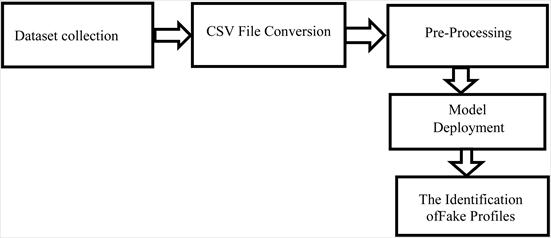
model.Theauthenticityofaprofileisdeterminedthrough thetraining,testing,andanalysisofthemodel.Tobuildthe models,researchersoptedforGoogleColabduetoitsfree GPU utilization. The Google Colab NVIDIA Tesla K80 GPU, withacapacityof12gigabytes(GB),canruncontinuously for 12 hours. This approach has proven effective in identifyingfakeprofiles,potentiallysurpassingtheaccuracy of previous similar studies. Additionally, the design of the modelemphasizesavisuallyappealingframework.Avisual representation of the system architecture can be seen in Figurebelow.
In existing system implement support vector machine, random forest and other machinelearning algorithms are usedtodetectthefakeaccounts.Andalsoimplementingakmean clustering algorithm on vector set to increase efficiency Supervised machine learning models require a labelincludedinthecorpustopredicttheexpectedoutcome. The existing systems use very fewer factors to decide whetheranaccountisfakeornot.
In today’s online social networks there have been a lot of problems like fake profiles, online impersonation, etc. To date,noonehascomeupwithafeasiblesolutionto these problems.Inthisproject,intendtogiveaframeworkwith whichtheautomaticdetectionoffakeprofilescanbedoneso thatthesocial lifeofpeople becomesecuredandbyusing thisautomaticdetectiontechniquewecanmakeiteasierfor thesitestomanagethehugenumberofprofilesusingMultilayer perceptron algorithm. Reduce the time complexity. Improvetheaccuracyinfakeprofiledetection.
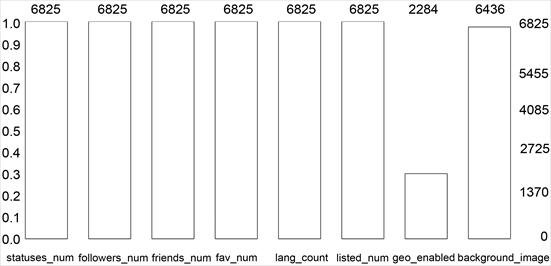
Accordingtotheauthor[20],theMIBdatasetwasemployed, consistingof3474genuineprofilesand3351fakeprofiles. The dataset was composed of E13 and TFP for legitimate accounts,andTWT, INT,andFSFfor fraudulentones. The data wassavedinCSVformatformachineextraction.The characteristicsusedtoidentifyfakeprofilesweredisplayed onthex-axisofFigure,whilethenumberofentriesforeach
featureinthedatasetwasshownonthey-axisafterbeing selectedduringpreprocessing.
Inthissection,theauthorhaspresentedaproposed solutiontoaddressthechallengeofidentifyingfakeaccounts byfocusingonthecharacteristicsofsuchsituations.Initially, acalculationwasperformedtoobtaintheadjacencymatrix of the social network's graph. Subsequently, another calculation was conducted to determine the degree of similarityamongnodes(usersofthesocialnetwork)based on their network connections. Following this, similarity matrices were constructed for each of the mentioned metrics,whichincludedsimilaritybasedoncommonfriends, Jaccard similarity, cosine similarity, and other relevant measures.Atthisstage,multiplematricesweredisplayedto demonstratethelevelofsimilaritybetweennodes.
Allthedatawascategorizedasnormalbecause,in these circumstances, the data is imbalanced, with approximately98-99percentbelongingtothemajorityclass (normal users). This makes it challenging to accurately assess both the minority class (fake subscribers) and the overallclassificationaccuracy.Toaddressthisissue,SMOTE wasutilizedtobalancethestatisticsandtackletheproblem effectively.
Initially, all text posts are transformed into 1D FeatureVectorsusingaWord2Vec-basedmodel.Thismodel helpsinrepresentingindividualwordsasnumericalsets.To accomplishthis,adictionaryofpositiveandnegativewords isutilizedtodeterminethepolarityscoreofeachwordinthe postedtext.Equation1isusedforthispurpose,whereWi, Wn,andWprepresentinput,negative,andpositivewords fromthedictionarydatasamples,andPoutrepresentsthe output polarity levels. The total number of input words is denoted by N. Along with the input corpus, this polarity scoreisthengiventoaWord2VecModel,whichisillustrated in Figure 2. Word2Vec is a technique used for sentiment analysis and can be employed to create tools like a thesaurus, context detector, and continuous bag of words
International Research Journal of Engineering and Technology (IRJET) e-ISSN: 2395-0056
Volume: 11 Issue: 03 | Mar 2024 www.irjet.net p-ISSN: 2395-0072
(CBoW)engine.Thedocumentrevealsvarioussectionsthat explainthisfact.
The program builds a vocabulary by identifying "activewords" ina giventext.Thecontextcreatorutilizes the language and constructs a suitable environment. The contextbuilderblockprovideswordpairstoaidinfinding word choices with related words. With access to these variations through the CBoW engine and skip gramme models, the feature extraction process can be carried out moreeffectively.Thesefeaturesarethenpassedtothefirst stepofatwo-stageneuralnetwork,whichconvertstheinput wordpairsintoemotions.Asaresultoftheoverallsentiment analysis,thiscontext-awaremodelcanbeusedtodetermine thesentimentassociatedwitheachwordcombination.While this engine is accurate in labeling emotions and events, training it for real-time sample sets requires significant effort.
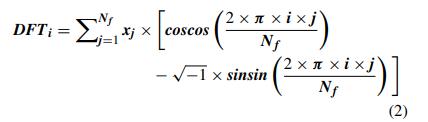
Afterconvertingtextfeaturesintonumericalsets, multidomainfeaturesareextractedfrom1Dfeaturessuchas loginpatterns,postingpatterns,andpageactivitypatterns. This is done to identify patterns in both fake and normal user behaviors. To achieve this, various types of features such as Fourier Features for frequency analysis, Cosine Features for entropy analysis, Gabor Patterns for spatial analysis,WaveletPatternsforenhancedspatialanalysis,and Convolutional Features for window-based analysis are extracted using equations 2 through 8. These equations involve different components such as dimensions for differentwindowandstridecomponents,activationscaling constants, and angular and wavelength components to extract Gabor features. The approximate and detailed waveletcomponentsmightcontainredundancies,whichare reducedthroughanEHOprocessdiscussedinthenextsubsectionofthistext.
The neural networks in deep learning systems exhibit similarbehaviortothosefoundinthehumanbrain,asstated in reference [22]. The model is constructed with an input layer, three hidden layers, and an output layer, each containingnodesorneurons.Keras'sequentialwasutilized by the author in building the model, with activation functionspresentinalllayersexcepttheoutputlayer.The sigmoidfunctionwasusedtoactivatetheoutputlayer.The
modelwasoptimizedusingtheAdamoptimizerandbinary merge loss function. Thisarchitectureisanexample of an ANN.Thesigmoidfunctionoutputsavaluebetween0and1, indicatingwhetheragivenprofileisrealorfakebasedonits prediction.
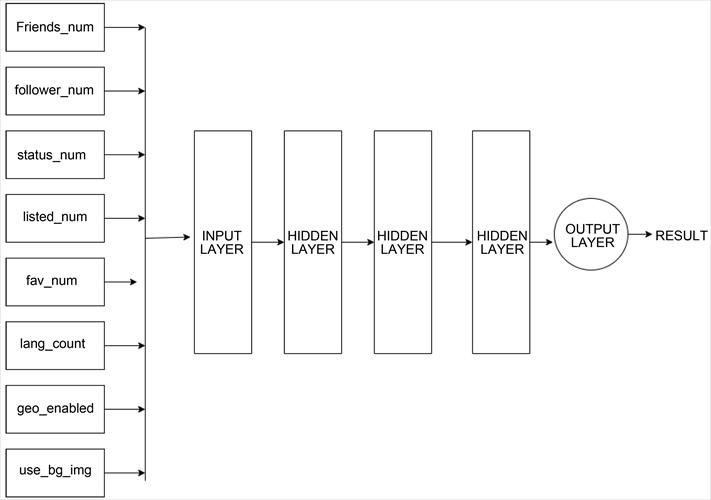
Toestablisharobustframeworkforidentifyingfakeprofiles on social media platforms, a meticulous approach was implementedtoensuretheprecision,accuracy,recall,and delaylevelswererigorouslyevaluatedinatransparentand replicablemanner.
To begin with, the datasets, which were a combination of various platforms, underwent a rigorous preprocessingregimen.Anomalousentriessuchasnullor missingvaluesweresystematicallyeliminated.Additionally, outliersthathadthepotentialtoskewanalyticaloutcomes were identified and appropriately managed. Given the inherent heterogeneity of data collected from different sources,normalizationandstandardizationprotocolswere employed to ensure consistent data scaling. Categorical features were skillfully encoded, and textual data was tokenizedtofacilitatesubsequentcomputationalprocesses.
After refining the data, it was judiciously divided into training and test cohorts, with the former typically comprisingeither70%or80%ofthetotaldatavolume.The cutting-edgedeep-transferlearningmodelproposedinthis researchwasrigorouslytrainedusingthetrainingcorpus. Themodel'spredictivecapabilities werethenassessedon thetestcohortfollowingthisintensivetrainingregimen.
International Research Journal of Engineering and Technology (IRJET) e-ISSN: 2395-0056
Volume: 11 Issue: 03 | Mar 2024 www.irjet.net p-ISSN: 2395-0072
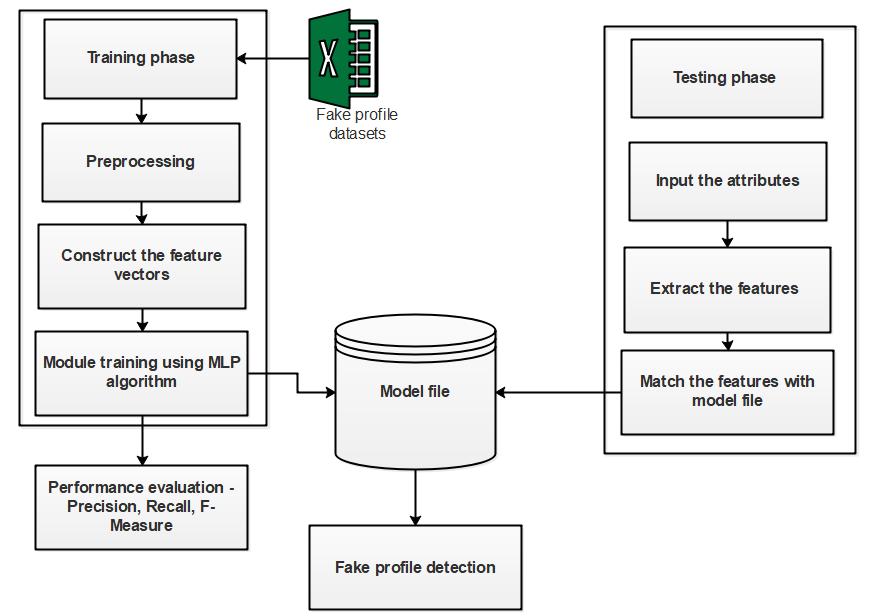
Themainfocusofthismethodologywastocalculate accuracy,precision,andrecall.Accuracy,whichprovidesa comprehensive view, was determined by calculating the ratioofcorrectlypredictedinstancestothetotalpredictions. Precision, which indicates the model's exactness, was derivedfromtheratioofgenuineidentificationstothetotal positivepredictions.Ontheotherhand,recallreflectedthe model'scompletenessbycapturingtheproportionofactual positivesthatwerecorrectlyidentified.
Inaddition to the conventional metrics,thestudy focusedonevaluatingdelaylevels,whicharecrucialforrealtimeapplications.Thisinvolvedmeasuringthetimeinterval betweenthemodelinstanceandthesubsequentgeneration of an assimilated prediction based on an input. These intervals were meticulously captured through systematic timestamping. A comprehensive analysis compared delay levels with parameters such as dataset volume, profile intricacy, and computational load. This provided detailed insights into potential scenarios where the model may experienceincreaseddelays.
After the computation, individual metric values obtainedfromdifferentdatasetswereaggregated,typically using mean or median values, to provide an overall performance view. The methodology culminated in a comparative analysis, where the metric outcomes of the proposedmodelwerecomparedtothoseofexistingmodels. Thishighlightedtherelativeimprovementsoftheproposed modelandidentifiedareasforpotentialrefinements.
Basedonthisapproach,theaccuracyoffakeprofile detection in relation to Total Test Entries (TTE) can be observedinTable2.AccordingtothisevaluationandFigure 4,itisevidentthattheproposedmodelexhibiteda10.5% higher accuracy in fake profile detection compared to GM [6],8.3%betteraccuracythanDCNN[9],and4.5%higher accuracy than PSVM [21]. As a result, it proves to be advantageousforawiderangeofreal-timeusecases.
This improved accuracy is attributed to the utilization of multidomain and multimodal features, their efficientselection,andthebinarycascade1DCNNclassifier, which has been trained to optimize classification performanceacrossvariousdatatypes.
International Research Journal of Engineering and Technology (IRJET) e-ISSN: 2395-0056
Volume: 11 Issue: 03 | Mar 2024 www.irjet.net p-ISSN: 2395-0072
8
Processor :Dualcore processor2.6.0GHZ
RAM :1GB
Harddisk :160GB
CompactDisk :650Mb
Keyboard :Standardkeyboard
Monitor : 15inchcolormonitor
9 SOFTWARE CONFIGURATION
Operatingsystem :WindowsOS
FrontEnd :PYTHON
BackEnd :MYSQL
Application :Webapplication
10 CONCLUSION AND FUTURE SCOPE
In conclusion, the proposed model utilizes various social media inputs to identify behaviors associated with fake profiles. The collected components are represented as multidomainfeaturesetsandprocessedseparatelytodetect patterns. The model uses different transforms for audio, image,andvideosignalsandemploysabinaryConvolutional Neural Network (bCNN) model with Word2Vec to distinguish between genuine and fake profiles. The Grey Wolf Optimizer (GWO) processes 2D features, while the ElephantHerdingOptimizer(EHO)processes1Dfeatures, including Word2Vec, to reduce feature redundancy. The model uses distinct 1D CNN classifiers to classify both featuresets,makingiteasiertodetectfakeprofiles.Inthe future,thismodelcanbefurtherimprovedandexpandedto includemoresocialmediainterfacesandpatterns.
Based on the accuracy evaluation, the proposed model exhibited a 10.5% higher fake profile detection accuracy comparedtoGM[6],an8.3%higheraccuracycomparedto DCNN [9],anda 4.5%higheraccuracycomparedtoPSVM [21].Consequently,itofferssignificantadvantagesforawide rangeofreal-timeusecases.Thisimprovedaccuracycanbe attributed to the incorporation of multidomain and multimodal features, their efficient selection, and the utilization of a binary cascade 1D CNN classifier. The classifier has been specifically trained to optimize classification performance across diverse data types. In terms of precision, the proposed model demonstrated a 10.2%higherfakeprofiledetectionprecisionthanGM[6],a 6.5% higher precision than DCNN [9], and a 3.9% higher precisionthanPSVM[21].Thishighlightsitsutilityacross various real-time use cases. The precision is enhanced by employing different feature representation models for numericaldatasets,audio,image,andvideosamples.These
modelsaretrainedtomaximizeprecisionperformancewhen applied to multiple data types. The combination of these models with the binary cascaded approach contributes to improvedreal-timeclassificationperformance.
The proposed model exhibited a 9.4% higher recall in detecting fake profiles compared to GM [6], a 6.1% better recall thanDCNN [9],anda 4.5%higherrecall thanPSVM [21].Thishigherrecall demonstratesitseffectivenessina widerangeofreal-timeusecases.Theimprovementinrecall isachievedthroughtheutilizationofa1DCNNclassifierin binarycascademodeandmultidomainfeaturesets,which enhance training for optimal recall performance across differentdatatypes.
Whenconsideringclassificationspeed,theproposedmodel showedan18.5%loweridentificationdelayindetectingfake profilescompared toGM [6],a 19.5%loweridentification delay compared to DCNN [9], and a 15.3% lower identificationdelaycomparedtoPSVM[21].Thismakesit highlybeneficialforhigh-speedusecases.Thereductionin identificationdelayisattributedtotheuseofEHOandGWO for feature selection, as well as a highly efficient 1D CNN classifier trained to maximize speed performance across variousdatatypes.
Withtheseperformanceenhancements,theproposedmodel cannowbeeffectivelyutilizedinreal-timesocialmediafake profile detection scenarios. In the future, further improvements can be achieved by combining Generative AdversarialNetworks(GANs),AutoEncoders(AEs),andQLearning, which will continuously enhance accuracy in differentsocialmediascenarios.Additionally,conductingan in-depthuserprofileanalysisandincorporatingexplainable AI interfaces can enhance the analysis of fake-profile signatures,enablingreal-timedetectionoffakeprofilesets.
[1] P.Kantartopoulos,N.Pitropakis,A.Mylonas,andN. Kylilis,‘‘Exploringadversarialattacksanddefences forfakeTwitteraccountdetection,’’Technologies, vol. 8, no. 4, p. 64, Nov. 2020, doi: 10.3390/technologies8040064.
[2] K. Shahzad, S. A. Khan, S. Ahmad, and A. Iqbal, ‘‘A scoping review of the relationship of big data analyticswithcontext-basedfakenewsdetectionon digitalmediaindataage,’’Sustainability,vol.14,no. 21, p. 14365, Nov. 2022, doi: 10.3390/su142114365.
[3] H.Tuncer,‘‘Interaction-basedbehavioralanalysisof Twittersocialnetworkaccounts,’’Appl.Sci.,vol.9, no. 20, p. 4448, Oct. 2019, doi: 10.3390/app9204448.
International Research Journal of Engineering and Technology (IRJET) e-ISSN: 2395-0056
Volume: 11 Issue: 03 | Mar 2024 www.irjet.net p-ISSN: 2395-0072
[4] M. A. Wani, N. Agarwal, and P. Bours, ‘‘Impact of unreliable content on social media users during COVID-19 and stance detection system,’’ Electronics, vol. 10, no. 1, p. 5, Dec. 2020, doi: 10.3390/electronics10010005
[5] K.Machova,M.Mach,andM.Vasilko,‘‘Comparison of machine learning and sentiment analysis in detection of suspicious online reviewers on differenttypeofdata,’’Sensors,vol.22,no.1,p.155, Dec.2021,doi:10.3390/s22010155.
[6] H.Cai,J.Ren,J.Zhao,S.Yuan,andJ.Meng,‘‘KC-GCN: Asemisuperviseddetectionmodelagainstvarious group shilling attacks in recommender systems,’’ WirelessCommun.MobileComput.,vol.2023,pp. 1–15,Feb.2023,doi:10.1155/2023/2854874.
[7] M.Mohammadrezaei,M.E.Shiri,andA.M.Rahmani, ‘‘Identifyingfakeaccountsonsocialnetworksbased on graph analysis and classification algorithms,’’ Secur. Commun. Netw., vol. 2018, pp. 1–8, Aug. 2018,doi:10.1155/2018/5923156.
[8] B. P. Kavin, S. Karki, S. Hemalatha, D. Singh, R. Vijayalakshmi, M. Thangamani, S. L. A. Haleem, D. Jose, V. Tirth, P. R. Kshirsagar, and A. G. Adigo, ‘‘Machinelearning-basedsecuredataacquisitionfor fake accounts detection in future mobile communication networks,’’ Wireless Commun. MobileComput.,vol.2022,pp.1–10,Jan.2022,doi: 10.1155/2022/6356152.
[9] K. L. Arega and E. Shewa, ‘‘Social media fake account detection for Amharic language by using machinelearning,’’GlobalSci.J.,vol.8,no.6,pp.1–11,2020.
[10] P. Wanda and H. J. Jie, ‘‘DeepProfile: Finding fake profile in online social network using dynamic CNN,’’J.Inf.Secur.Appl.,vol.52,Jun.2020,Art.no. 102465,doi:10.1016/j.jisa.2020.102465.
[11] P. Chakraborty, M. M. Shazan, M. Nahid, M. K. Ahmed,andP.C.Talukder,‘‘Fakeprofiledetection using machine learning techniques,’’ J. Comput. Commun., vol. 10, no. 10, pp. 74–87, 2022, doi: 10.4236/jcc.2022.1010006.
[12] J.B.MungaandP.Mohandas,‘‘Feature selectionfor identificationoffakeprofilesonFacebook,’’inProc. 6thKualaLumpurInt.Conf.Biomed.Eng.,vol.86,J. Usman,Y.M.Liew,M.Y.Ahmad,andF.Ibrahim,Eds. Cham,Switzerland:Springer,doi:10.1007/978-3030-90724-2_53.
[13] M. Vyawahare and S. Govilkar, ‘‘Fake profile recognition using profanity and gender identification on online social networks,’’ Social Netw. Anal. Mining, vol. 12, no. 1, Dec. 2022, doi: 10.1007/s13278-022-00997-3.
[14] E. P. Meshram, R. Bhambulkar, P. Pokale, K. Kharbikar,andA.Awachat,‘‘Automaticdetectionof fakeprofileusingmachinelearningonInstagram,’’ Int.J.Sci.Res.Sci.Technol.,pp.117–127,May2021, doi:10.32628/IJSRST218330.
[15] F. Ajesh, S. U. Aswathy, F. M. Philip, and V. Jeyakrishnan, ‘‘A hybrid method for fake profile detection in social networkusing artificial intelligence,’’ in Security Issues and Privacy ConcernsinIndustry4.0Applications.Hoboken,NJ, USA: Wiley, 2021, pp. 89–112, doi: 10.1002/9781119776529.ch5.
[16] K.Kaushik,A.Bhardwaj,M.Kumar,S.K.Gupta,and A. Gupta, ‘‘A novel machine learning-based frameworkfordetectingfakeInstagramprofiles,’’ ConcurrencyComput.,Pract.Exper.,vol.34,no.28, p.e7349,Dec.2022,doi:10.1002/cpe.7349.
[17] S.BanerjeeandA.Y.K.Chua,‘‘Understandingonline fakereviewproductionstrategies,’’J.Bus.Res.,vol. 156, Feb. 2023, Art. no. 113534, doi: 10.1016/j.jbusres.2022.113534.
[18] K. Balogun, A. B. J. Omar, M. Jabar, and M. M. Abdulmajid, ‘‘Spam detection issues and spam identificationoffakeprofilesonsocialnetworks,’’J. Theor.Appl.Inf.Technol.,vol.95,pp.5881–5895, Mar.2017.
[19] P.K.RoyandS.Chahar,‘‘Fakeprofiledetectionon social networking websites: A comprehensive review,’’ IEEE Trans. Artif. Intell., vol. 1, no. 3, pp. 271–285, Dec. 2020, doi: 10.1109/TAI.2021.3064901.
[20] M. Aljabri, R. Zagrouba, A. Shaahid, F. Alnasser, A. Saleh,andD.M.Alomari,‘‘Machinelearning-based social media bot detection: A comprehensive literature review,’’ Social Netw. Anal. Mining, vol. 13, no. 1, p. 20, Jan. 2023, doi: 10.1007/s13278022-01020-5.
[21] S.RazaandC.Ding,‘‘Fakenewsdetectionbasedon news content and social contexts: A transformerbasedapproach,’’Int.J.DataSci.Analytics,vol.13, no.4,pp.335–362,May2022,doi:10.1007/s41060 -021-00302-z
International Research Journal of Engineering and Technology (IRJET) e-ISSN: 2395-0056
Volume: 11 Issue: 03 | Mar 2024 www.irjet.net p-ISSN: 2395-0072
[22] A.Saravanan and V. Venugopal, ‘‘Detection and verification of cloned profiles in online social networks using MapReduce based clustering and classification,’’Int.J.Intell.Syst.Appl.Eng.,vol.11, no.1,pp.195–207,Jan.2023.
[23] Y. Elyusufi, Z. Elyusufi, and M. A. Kbir, ‘‘Social networks fake profiles detection ed on account setting and activity,’’ in Proc. 4th Int. Conf. Smart City Appl. New York, NY, USA: Association for Computing Machinery, Oct. 2019, pp. 1–5, doi: 10.1145/3368756.3369015.
2024, IRJET | Impact Factor value: 8.226 | ISO 9001:2008