
International Research Journal of Engineering and Technology (IRJET) e-ISSN:2395-0056
Volume:11Issue:03|Mar2024 www.irjet.net p-ISSN:2395-0072
International Research Journal of Engineering and Technology (IRJET) e-ISSN:2395-0056
Volume:11Issue:03|Mar2024 www.irjet.net p-ISSN:2395-0072
Ms.AnkaleshaThakare (Mentor)B.EinIT
ComputerEngineering
Mr.YashSoni
ComputerEngineering
Mr.PrateekBaranwal
ComputerEngineering ThakurPolytechnic ThakurPolytechnic ThakurPolytechnic Kandivali,Mumbai,India Kandivali,Mumbai,India Kandivali,Mumbai,India
Mr.ShashankSingh
Mr.Shubham
Vishwakarma ComputerEngineering ComputerEngineering ThakurPolytechnic ThakurPolytechnic Kandivali,Mumbai,India
Abstract - Automatized MEDBOT are conversationally built with technology in mind with having the potential toreduceeffortstohealthcarecostsandimproveaccess to medical services and knowledge. We built a diagnosis bot that engages patients in the conversation for their medical query and problems to provides an individualized diagnosis based on their diagnosed manifestation and profile. Our MedBot system is qualified to identify symptoms from user inputs with a standard precision of 65%. Using these extracted diagnosed symptomscorrectsymptoms were identified witharecallof65%andaprecisionof71%.Finally,the MedBot returned the expected diagnosis for furthermore operations.This determines that a MedBot can provide a somewhat accurate diagnosis to patients with simple symptom analysis and conversational approach, this suggests that an effective spoken language medical bot could be viable. Moreover, the relative effectiveness of this bot indicates that more proceeds automated medical products may flourish to serveabiggerroleinhealthcare.
Keywords – Android application, chatBot Systems, database,androidserver.
Introduction
A MedBot is a software application used to conduct an online chat conversation via text or text-to speech, instead of providing direct contact with a live human agent. Designed toconvincingly simulate the way a human would behaveasaconversationalpartner.Intheproposedsystem, wepresented a MedBot thatgenerates adynamic response foronlineclient'squeries.TheProposedSystemisbasedon Artificial Intelligence-powered Chatbot. This proposed chatbotidentifiestheusercontextwhichtriggerstheintent foraresponse.Sinceitisrespondingdynamicresponse,the desiredanswerwillbegeneratedfortheuser.Theproposed system used machine learning algorithms to learn the MedBot by experiencing various user's responses and requests.NowadaysMedBothasstartedtobecomesorobust
Kandivali,Mumbai,India
because Artificial Intelligence aids the human touch in every conversation, medbot understand the user's query, andtriggeranaccurateresponse.LiteratureReview
The advancement of chatbots has been a interesting travel, traversing a few decades and seeing critical headways in innovation, manufactured insights, and characteristic dialect handling. Here's an outline of the key points of reference within the advancement of chatbots:
1. EarlyBeginnings(1960s-1980s):
- The mostpunctual formof chatbotsrosewithin the 1960s with programs like ELIZA, made by Joseph Weizenbaum at MIT. ELIZArecreated a discussion with a psychotherapist by utilizing design matching and basic dialecthandlingprocedures.
- Within the 1970s and 1980s, chatbots proceeded to advance with programs like Repel, which recreated a individual with jumpy schizophrenia, and Jabberwacky, anearlyendeavoratmakingconversationalAI.
2. Rule-BasedFrameworks(1990s-2000s):
- Amid the 1990s and early 2000s, chatbots essentially depended on rule-based frameworks, where responses were pre-programmed based on watchwords ordesigns.
- AOL's Moment Flag-bearer introduced "SmarterChild" within the early 2000s, which given computerized reactions to client questions and got to be oneoftheprimarywidely-usedchatbots.
3. PresentdayAIandNLP(2010s-present):
- Stages like Apple's Siri (2011), Google Right hand (2016), and Amazon Alexa (2014) presented chatbots with progressed voice acknowledgment and characteristic dialect understanding capacities,
empoweringmoreconsistentintuitive.
International Research Journal of Engineering and Technology (IRJET) e-ISSN:2395-0056
Volume:11Issue:03|Mar2024 www.irjet.net p-ISSN:2395-0072
- Chatbot frameworks and stages such as IBM Watson (2013) and Microsoft Bot System (2016) given engineers with devices to construct modern chatbots capable of understandingsetting,estimation,andaim.
AI-powered chatbots got to be progressively coordinates into different businesses, counting healthcare, back, ecommerce, and instruction, advertising personalized encountersandmechanizingmonotonouserrands.
Overall, the advancement of chatbots reflects the nonstop advance in AI and NLP innovations, driving towards more cleverly, intuitively, and human-like conversational specialists that upgrade different viewpoints of communication,clientbenefit,andclientinvolvement.
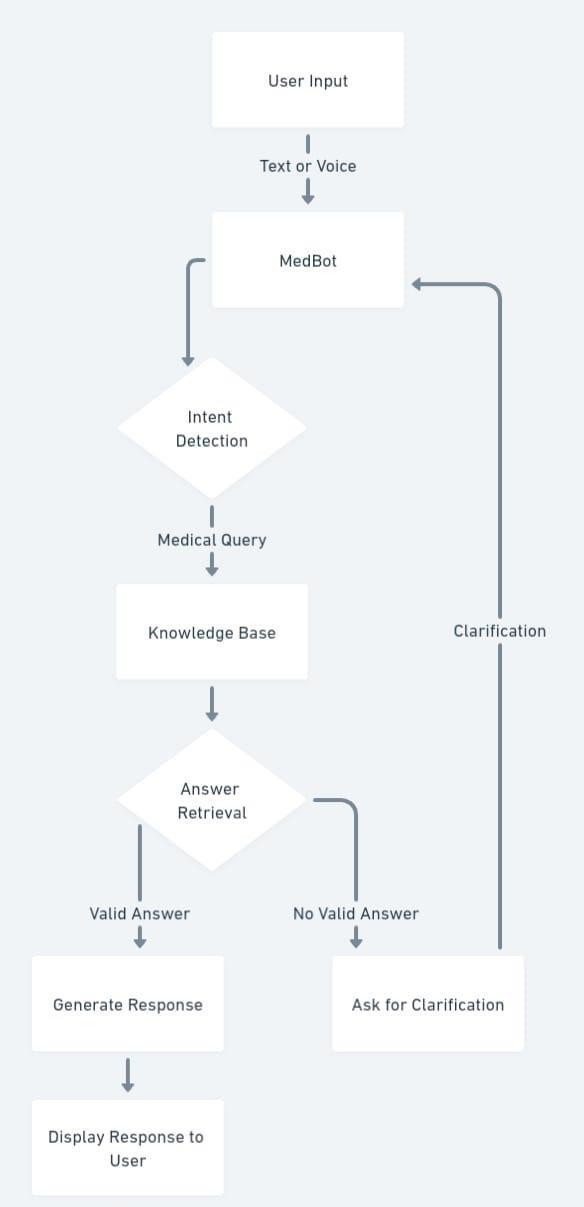
MedBotisa robustAndroidapplicationdesignedforonline chat conversations via voice or text. The system's architectureisdividedintothreeintegratedsections:frontend, back-end and database server. To enable seamless functionality, the system uses the Java- powered interpretive programming interface AndroidStudio and integrates his Firebase database technology on the client side for efficient data exchange with the server. The relational database management system Firebase Database is used for structured data storage. The system is divided intotwomodules,eachtargetedataspecificrolewithinthe auditprocess:
Administrator Module: The Administrator Module serves as the backbone for system administration. Monitors the addition of registered user information to the system databasetoensuredataintegrityandsecurity.
User Module: The User Module provides a streamlined user experience with login options for one-to-one communication.
When you type or speak a prompt or question, the system immediatelygeneratesanddisplaystheresultstotheuser.
Login and Enrollment: To guarantee qualification for examinations, understudiesexperienceaenrollmenthandle where they total a frame. Amid this handle, special login qualifications, counting a username and watchword, are relegated to each understudy. This builds up a secure and personalizedgettopointforexaminationsupport.
Logout: The logout highlight gives a consistent move for understudies back to the login page after completing an examination. This usefulness improves security and permits clients to conclude their examination session productively.
Starting Chat Interface: Users have the ability to start a conversation with the ChatBot and ask several questions regardinganymedicalissues.
Bot Response: After accepting user’s input, the bot will give a personalize response with respect to user’s query andprovideapossiblesolutionforthesame.Theresponse issuperquickandprettyaccurate.
Reference Videos: User can go through a vast collection of videos which might be helpful for them regarding a specificmatterorthebot can suggestsome videos which are related to user’s query for a better understanding of theirissue. Fig.1FunctionalityofSystem
International Research Journal of Engineering and Technology (IRJET) e-ISSN:2395-0056
Volume:11Issue:03|Mar2024 www.irjet.net p-ISSN:2395-0072
This modular approach enhances the efficiency of the Medbot(Chatbot) system by customizing functionalities to cater to the specific requirements of healthcare providers, patients, and administrators. Leveraging advanced technologies and a clearly structured architecture emphasizes the system's dependability and agility in facilitating a seamless and efficient healthcare interaction process
The Firebase Realtime Database is a cloud-hosted NoSQL database that lets you store and sync data between your usersinrealtimeFirebaseisaBackend-as-a-Service(Baas). Itprovidesdeveloperswithavarietyoftoolsandservicesto help them develop quality apps, grow their user base, and earn profit. The Firebase Realtime Database lets you build rich,collaborativeapplications byallowingsecureaccessto thedatabasedirectlyfromclient-sidecode.Dataispersisted locally, and even while offline, Realtime events continue to fire, givingthe enduser a responsive experience. When the device regains connection, the Realtime Database synchronizesthelocaldatachangeswiththeremoteupdates that occurred while the client was offline, merging any conflicts automatically. The Realtime Database provides a flexible, expression- based rules language, called Firebase Realtime Database Security Rules, to define how your data should be structured and when data can be read from or written to. When integrated with Firebase Authentication, developerscandefinewhohasaccesstowhatdata,andhow they can access it. The Realtime Database is a NoSQL database and as such has different optimizations and functionality compared to a relational database. The Realtime Database API is designed to only allowoperations thatcanbeexecutedquickly.Thisenablesyoutobuildagreat Realtimeexperiencethatcanservemillionsofuserswithout compromising on responsiveness. Because of this, it is importanttothinkabouthowusersneedtoaccessyourdata andthenstructureitaccordingly.
In the healthcare sector, communication gaps and administrative inefficiencies pose significant challenges to quality care delivery. Existing methods often result in delays, errors, and a lack of personalized attention for patients, while healthcare providers grapple with overwhelming administrative burdens. To address these issues, there's a pressing need for a MedBot (Chatbot) systemtailoredtothespecificneedsofhealthcareproviders, patients, and administrators. By adopting a modular approach,thissystemaimstoenhanceefficiency,streamline communication, and provide personalized support. Leveraging advanced technologies like artificial intelligence and natural language processing, the MedBot (Chatbot)
system seeks to revolutionize healthcare interactions whileensuringaccuracy,reliability,andcompliancewith healthcareregulations.
The development of the MedBot(Chatbot) system prioritizes user- friendliness, accessibility, and seamless integration with existing healthcare infrastructure. By employing a well-defined architecture, the system aims to improve reliability, responsiveness, and overall effectiveness in healthcare delivery. Ultimately, the implementation of this innovative solution promises to enhance patient outcomes and transform the healthcare experienceforbothprovidersandpatientsalike.
MedBot chatbots offer several advantages in the healthcaredomain.Herearesomekeyadvantages:
24/7 Availability: MedBot chatbots are accessible round-the-clock, providing users with immediate access to medical information and support. This availability is particularly beneficial for individuals with urgent queries or those in remote areas with limited access to healthcareresources.
Timely and Convenient Assistance: MedBot chatbots can quickly analyze symptoms, provide initial assessments,andofferappropriaterecommendationsor next steps. This timely assistance reduces waiting times and allows users to receive guidance without the need for scheduling appointments or visiting healthcare facilities.
Personalized Support: MedBotchatbotscantailortheir responses and recommendations based on user inputs, medical history, and preferences. This personalized support enhances user engagement, ensures relevant information delivery, and promotes a sense of individualizedcare.
Health Education and Empowerment: MedBot chatbots can disseminate accurate and reliable health information to users, empowering them to make informed decisions about their health. By providing educational resourcesandansweringquestions,MedBot chatbots contribute to health literacy and encourage proactivehealthcaremanagement.
Triage and Prioritization: MedBot chatbots can assist in triaging patients based on the severity of their symptoms or medical conditions. By providing initial assessments, they can help healthcare professionals prioritizecases,allocateresourcesefficiently,andensure timelyinterventionforcriticalcases.
International Research Journal of Engineering and Technology (IRJET) e-ISSN:2395-0056
Volume:11Issue:03|Mar2024 www.irjet.net p-ISSN:2395-0072
Reduced Workload for Healthcare Professionals: MedBot chatbotscan handle routineinquiries,appointment scheduling, and basic medical advice, thereby reducing the workload on healthcare professionals. This allows healthcare providers to focus on more complex cases and improvestheirefficiencyandproductivity.
Enhanced Patient Engagement and Satisfaction: MedBot chatbotsprovideaninteractiveandconversationalplatform that engages users in their healthcare journey. By offering personalized recommendations, addressing concerns, and promoting self-care, MedBot chatbots contribute to higher patientsatisfactionandengagement.
Cost Savings: MedBot chatbots can help reduce healthcare costs by minimizing unnecessary visits to healthcare facilities, optimizing resource utilization, and preventing avoidable complications through timely interventions and education.
Scalability and Reach: MedBot chatbots have thepotential to reach a large number of users simultaneously, making themhighlyscalable.Theycancatertodiversepopulations, regardless of geographical location or language, thereby ensuringhealthcareaccessibilityforabroaderdemographic.
WhileMedBot’s chatbots offer many benefits, it's important to note that they shouldn't completely replace medical professionals.
Instead, they should complement existing healthcare systems by providing efficient and accessible support, with seamlesshandovertohumanexpertswhenneeded.
SystemInterface
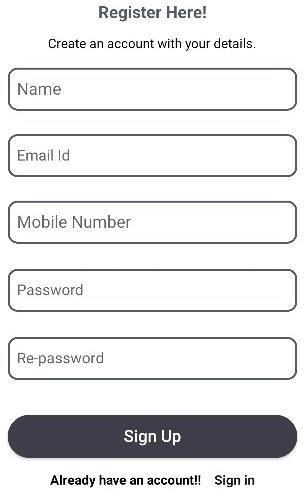
Fig2.SplashScreen Fig3.RegistrationPage
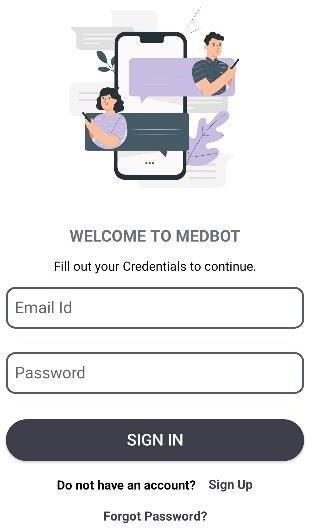
Fig4.LoginPage
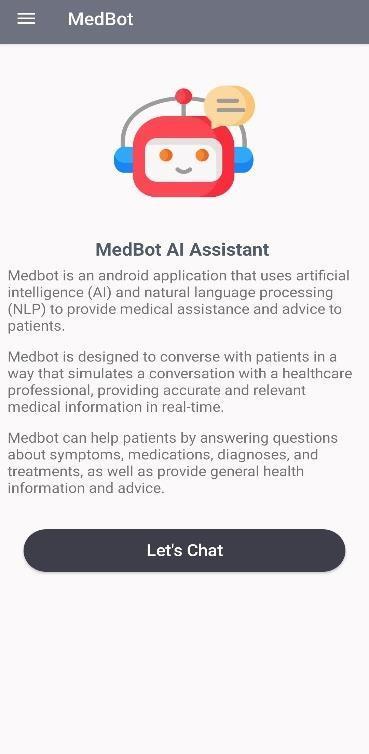
Fig5.HomePage
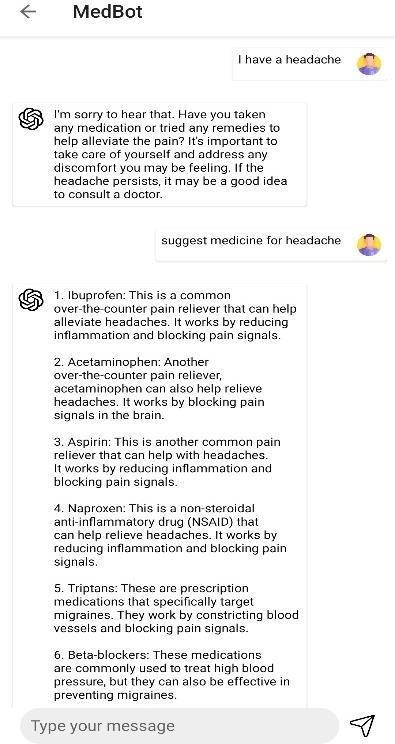
Fig6.ChatInterface
International Research Journal of Engineering and Technology (IRJET) e-ISSN:2395-0056
Volume:11Issue:03|Mar2024 www.irjet.net p-ISSN:2395-0072
Conclusion
AsweknowthatpreventionisbetterthanCure,soitisthe maingoalofMedBot.MedBotareundoubtedlybeneficialfor healthcare industries+ for patients. Healthcare industries can implement MedBot on their sites to get timely advice, senddailyreminders,schedulingappointmentsandtoeven send invoices. And this also cut down the hospital admissions and emergency care and will surely prove as a boon in medical field. MedBot are powerful tools but it's important to first define your expectation before you implementthem.
[1] Benyon, D. and Murray, D. (1993). Applying user modelling to human-computer interactiondesign. Artificial IntelligenceReview.7(3-4):199-225
[2] Sande, B. V. D. (2013). Properties of the Bayesian Knowl-edge Tracing Model. Journal of Educational Data Mining.5(2):1-10.
[3] Nguyen, L. And Do, P. (2009). Combination of Bayesian Network and Overlay Model in UserModelling. International Journal of Emerging Technologies in Learning(iJET),4(4):5-14.
[4] Schilitand Theimer, Miguel A.Muñoz MarcelaRodríguez Jesus Favela Ana 1.MartinezGarciaCenterofScientificResearchandHigherEducationof Ensenada, Mexico Victor M.González University of California, Irvine- Contex-aware mobile communication inhospitals.