
International Research Journal of Engineering and Technology (IRJET) e-ISSN:2395-0056
Volume: 11 Issue: 03 | Mar 2024 www.irjet.net p-ISSN:2395-0072
SOLAR PANEL CLEANING ROBOT
Mr. Rutvik Ravindra Rane1, Mr. Nishant Nandkishor Kaskar2, Mr. Jagnnath Ramchandra Dalvi3, Mr. Samson Sebastian Rodrigues4 , Ms. Mayuri Mangesh Pawar5, Mr. H. A .Pawar6
1,2,3,4,5Students, Yashwantrao bhonsale institute of technology, sawantwadi ,Maharastra, India
6Facuity, Yashwantrao Bhonsale Polytecnic, Sawantwadi, Maharastra, India
Abstract: - As electricity costs rise and environmental concerns over fossil fuels grow, more and more renewable energy sources, including solar power, are being used. Solar panel arrays are the primary means of obtaining solar power. Dust and debris buildup on even one panel significantly lowers the panels' ability to generate electricity, underscoring the importance of maintaining a clean surface for the panels.
The labor-intensive cleaning techniques now used for solar arrays are expensive in terms of time, water, and energy used, and they are not automated. This research presents a revolutionary design for the first-ever human portable robotic cleaning system for solar panels. The system is able to clean and move at several angles, from horizontal to vertical, over the glass surface of a solar panel array. To accomplish this, a microcontroller board is used.
The Arduino Uno, which is employed in this specific model, makes it simple to operate every component. As a result, it aids in our understanding of the necessary parameters to address the efficiency shift caused by cleaning the solar panel arrays.
Key Words: Solar Panel, Cleaning Robot, Sensor based Robot, Automated Cleaning.
1. INTRODUCTION
Aspects pertaining to energy are becoming increasingly significant these days. These include, among other things, the consumption of non-renewable resources, the environmental impact of pollution emissions, and the prudent use of resources. Instead of depending on generators or other regular sources of electricity, the majority of industrial applications employ solar panels as their electrical power source. These factors have led to a global increase in interest in energy conservation and sustainable energy production. Over the past ten years, therehasbeenanotableexpansioninthesolarphotovoltaic (PV) market due to growing interest in renewable energy. Improving solar power generation efficiency is urgently needed.
The surface of the photovoltaic cells must be clear of dust and free of any particles that could impede the flow of photons in order for the cells to perform at maximum efficiencywithzeroenergyloss.
As a result, contamination of solar panels rapidly reduces efficiencysinceanydebrisorimpedimentinthepathofthe sun's rays interferes with their ability to capture solar energy.
Theprimaryissueaffectingaphotovoltaicpanel'sefficiency is dust, which, depending on the location, can reduce the panel's effectiveness by up to 25% to 30%. Dust collection on a photovoltaic (PV) module can range from 80 to 300 mg/sq per day, with an extra 0.4% to 0.7% power loss occurringforevery100mg/sqofdustdeposition.following exposure to the surrounding dust. Even if dirt and bird droppings don't cause much of a problem, solar panel efficiency drops by 15% to 20%. For the solar panel to continueproducingatthesamerateforalongeramountof time,periodiccleaningisthereforerequired.
Compared to hand cleaning and existing mechanical alternatives, a well-designed and efficient robotic equipment can clean expansive parks while using less water. Water is necessary for the cleaning process since it increases efficiency, and most commercial crystalline silicon solar cells are known to exhibit an acceptable currentvoltagecharacteristicatlowertemperatures.
This has to do with how the bot uses water to spray the photovoltaic cells, increasing their effectiveness by almost 15%. Automation is basically necessary for this procedure because it improves utilisation, facilitates better human handling, and minimises manual inspection. As a result, there is a possibility that the system will be cleaned with autoliningfeatures.
An extremely significant benefit of an automated robotized response to the question about solar panel cleaning is the controlled process's superior cleaning speed, robustness, completeness, and test-retest dependability when comparedtoconventionalapproaches.
2. METHODOLOGY
An automated solar panel cleaning bot is a cleaning tool that uses the least amount of water possible to clean solar panels. The cleaning head of the bot is designed to efficiently remove dust and dirt from the solar panel's surface. To lower the possibility of damaging the glass surface of the solar panel, an automated solar panel cleaning bot is moved around the arrays using wheels and
Volume: 11 Issue: 03 |
track belts. It runs on a 12V lead acid battery that may be used for three hours after a full charge. When the robot approachestheedgeofthesolarPVarray,ithastheability to alter its direction of motion. Up to a 40 degree inclination,thebotcanclean.

3.
COMPONENTS
3.1 Microcontroller
The microcontroller used in this project is an ATMEGA328P. Microchip makes this high-performance, low-power controller. It is essentially an Advanced Virtual RISC (AVR) microcontroller, and it is an 8-bit microprocessor. Up to eight (8) bits of data can be supportedbyit.32KBofinternalRAMisintegratedintothe Atmega328P.
Numerous more features are present in this microcontroller, including a 1KB Electrically Erasable Programmable Read-Only Memory (EEPROM). The Static Random-AccessMemory(SRAM)oftheAtmega328Pis2KB. Good performance, low power consumption, a separate oscillator in the real timer counter, six PWM pins, a programmable Serial USART, and a programming lock for software security are some of these advantages. It runs in the3.3Vto5.5Vrange.
3.2 Lead Acid Battery
In this project, a 12V/7Ah lead acid battery is employed. Lead-dioxide cathode, sponge metallic lead anode, and sulfuric acid solution electrolyte make up lead acid batteries. There is a 2V cell voltage. Since the energy that can be drawn from the battery is calculated by multiplying thebatterycapacitybythe depthofdischarge,thedepthof discharge and battery capacity together constitute a fundamentalparameterinthedesignofabatterybankfora photovoltaicsystem
3.3 DC Motor
Themovementofthebotispoweredbya12V,300RPMDC motor. A low-cost, high-quality DC geared motor is the 300RPM Series DC motor. Steel pinions and gears provide superiorwearandtearcharacteristicsandalongerlifespan. (ii) The motor is built with strength. The shaft has longlasting metal bushes. It has high-quality gears included. Additionally, the shaft features a hole for improved connection.
MotorDriver
The motor driver utilised in this project is RKI 1004. The motordriveisaHbridge.AnelectricalcircuitknownasaH bridgeisusedtochangethepolarityofavoltageappliedto aload.Inroboticsandotherapplications,thesecircuitsare frequentlyemployedtoenableDCmotorstomoveforward orbackward.
3.4 Ultra Sonic Sensor
The ultrasonic sensor used in this experiment is the HCSR04. The pin names for the 4-pin HC-SR04 Ultrasonic Sensor module are Vcc, Trigger, Echo, and Ground, in that order.Thissensoriswidelyutilisedinsituationswhereitis necessary to sense objects or measure distance. The ultrasonic transmitter and receiver are formed by the module'stwoeyes-likeprojectionsatthefront.Theformula thatthesensorutilisesis
Distance=Speed×Time
3.5 Water Pump
When cleaning the PV panel, a water pump is employed to spray water through a nozzle. Here, a diaphragm water pumpwitha12VDC100PSIpressureisutilised.
4. DESIGN
4.1 Design of Frame
The bot's frame is made of a 2.44 x 1.22 x 1 mm metallic sheet. Industrial solar panels typically measure 77 by 39 inches (195.58 cm by 99.06 cm). Therefore, in order to balance efficiency and weight, the frame is designed to be 50cmlongand35cmwide.Therefore,theentirepanelcan be cleaned by the bot. Reduced size results in longer cleaning times, and excessive weight reduces the bot's efficiency. Asa result, this isthe bot's ideal size and works withpanelsofanysize.

4.2 3D Model
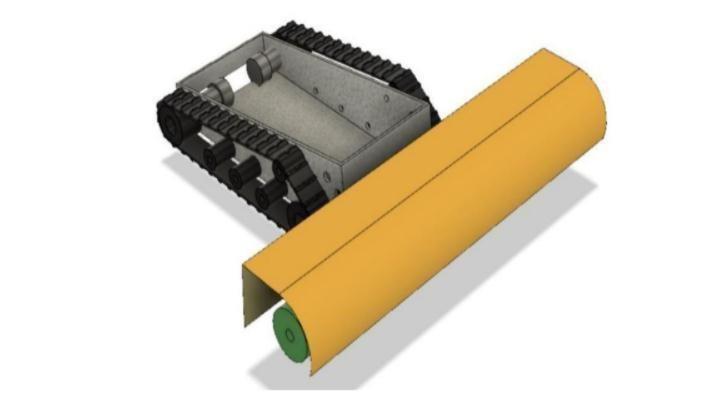
Fusion 360 is used to create the automated solar panel cleaningrobot's3Dmodel.Thecleaningrobotismadeupof aframethatholdsuptheentireapparatus.Theheadofthe frame features a brush that is used to clean the panel's surface.The bot's motorandothercomponentsarehoused insidetheframe'sframework.


4.3 Software Development
To save cleaning time and power consumption, the new software is designed to trace a path from one edge to the other on the surface of PV panels. To increase the robot's stability,averticalpathwasselectedforit.
Aforcefromthesidewillpushtherobotdownifthepathis designed to be horizontal. The robot will reverse its direction of motion when it senses the end of the panel. When it's done, it will either be on the upper right side or thelowerrightsideofthepanel.Afterthat,therobotwaits toresumeitsnextcleaningcycle.
4.3.1 Motor - Arduino Interfacing
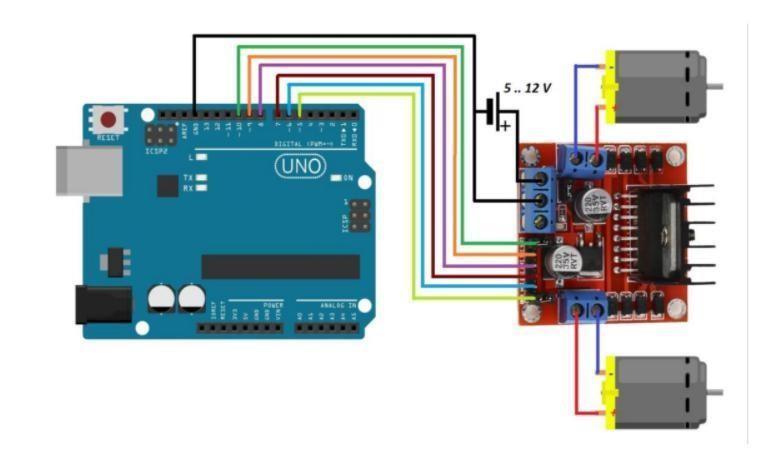
ThemotorandAtmega328Pinterfaceisthefirststepinthe software development process. The motor driver, RK1 1004, assists in this process. While the direction of the motor'sspinningcanbealteredbychangingthedirectionof current flowing through it, the speed of a DC motor can be varied by applying different DC voltages. We can apply different voltages by using the PWM approach. H-bridge circuitsormotordriverICsthatusetheH-bridgeapproach canbeusedtoreversethecurrent.
International Research Journal of Engineering and Technology (IRJET) e-ISSN:2395-0056
Volume: 11 Issue: 03 | Mar 2024 www.irjet.net p-ISSN:2395-0072
5.3.2 Switch Keypad – LCD Display – Arduino
Interfacing
The LCD display and switch keypad interface with the Atmega 328P is the next step in the software development process. This is done so that the length and width of the solar panel that has to be cleaned can be entered. The panel'slengthandwidthareenteredusingaswitchkeypad, and the results are shown on the LCD display. Using C programming, the switch keypad, LCD display, and Atmega328Pareinterfaced.

4.4 Hardware Development
Thepanelcleaningbotdevisedinthisinstanceconsistsofa cleaning head that travelsaround the panelsutilising track belts and a stainless steel rod. This design was chosen due to its resilience, simplicity, and lower cost of ownership. The movement is aided by wheels and manual force to reduce the chance of scratching the glass surface. This design's test-retest capability enables reasonable continuous functionality across a large variety of array dimensions. Despite the fact that no two panels or arrays are the same size, the system's ideal size allows for flexibility. Because the robot can traverse the side borders between the panel frames, the panel columns have continuoustravel.
This robot's chassis is constructed from aluminium. To retain motors in the correct place, it comprises of four Lshaped motor mountings. Additionally, the chassis offers a sturdy framework for the battery and other electronic components.Thenylonbrushesare120ginweight,hollow cylindersmeasuring160mminlengthand75mminouter and 11.8 mm inner diameter. The filaments in these brushes are nylon. There are three held together and used brushes. The brushes are firmly packed to provide an effectivedeburringeffect.
ADCgearedmotorthatproduces10kgcmoftorqueisused toturnthebrushes.A12Vbatteryisrequiredforthemotor to run at its best. Mounting is used to secure the motor. In addition to scouring the unclean surface, we may need to wash it with high-pressure water directed in a specific patternatthesurface.Thisismadepossiblebythenozzle.
4.5 Design Calculation
• Speedofbot=9cm/s
• Lengthofbrush=65cm
• Areacoveredin1sec=0.09x0.65 =0.0585Sqm
• Areacoveredin1hour=0.0585x60x60 =210.6sqm
• Totalworkinghourofbotperfullcharge =3hours
• Areacoveredin3hours=210.6x3 =631.8sqm
5. WORKING
To turn the brushes, a DC geared motor with a torque output of 10 kgcm is employed. To drive the motor as efficientlyaspossible,a12Vbatteryisneeded.Themotoris held in place by mounting. We might also need to apply a high-pressure water wash in a particular pattern to the dirty surface after scrubbing it. The nozzle makes this possible.
The robot advances and wipes the solar panel's surface clean.The motorisstopped bytheultrasonicsensorasthe robotapproachestheendofthepanel,detectingthepanel's edge. Then, using one set of motors at a time, the bot modifies its direction. The bot carries on cleaning once the direction is altered and advances further. The solar panel's whole surface is cleaned as the procedure proceeds. With the aid of a nozzle and water pump, the bot sprays water whilerunningona12Vleadacidbattery.
International Research Journal of Engineering and Technology (IRJET) e-ISSN:2395-0056
Volume: 11 Issue: 03 | Mar 2024 www.irjet.net

Fig -8: Flowchart
The bot's movement pattern is designed to be zigzag. In order to cover the full panel, the bot follows the path. The programmetakesintoaccountthefollowing:
1.The bot proceeds along the path depicted in the picture.
2. To prevent it from falling off, the margins of the PVs are recordedusingultrasonicsensors.
3. After the cleaning procedure is complete, the motor is stopped.

Fig
-9: MovingPathoftherobot
When the ultrasonic sensor detects the edge of the panel, the table shows the robot's direction and movement. The robot's direction can be altered in a few ways.
•Atfirst,therobotwillgostraightaheadwhenthesensoris low.
•Inthesecondmethod,thesensorriseswhenitdetectsan edge. The robot will halt, go a predetermined distance in reverse, turn 180 degrees to the right, and then proceed straight ahead for a predetermined distance.
• After that, the robot will make a 180-degree spin to the right and continue straight ahead until the ultrasonic sensorturnshigh.
• The movement keeps on until the panel's lower edge. Whenthesensorrises,therobotwillhalt,reverse,andturn 180degreestotheleftbeforecontinuingstraightahead for apredetermineddistance.
•The robotwill thenmake another180-degreespin to the left,andtheprocesswillrepeat.
•Theproceduredoesn'tstopuntil therobot completes the designatedpath.
Table -1:MotorMovements

6. RESULT
Thesolarpaneliseffectivelycleanedbythebottogetridof the dust and debris that have accumulated on its surface. When compared to manual cleaning, the cost of cleaning can be reduced by 80% by using bots. The effectiveness of the solar panel is increased by approximately 25% by cleaning it to get rid of dust and debris. It uses 90% less water to remove dust than other methods. It is compatible withnearlyallpanelsizesfoundworldwide.
(i) Manpower reduction: Compared to manual cleaning, robotcleaning of solarpanelstakeslesstime. In the end,it takes less time overall to clean every pane(ii)Effective housekeeping:
According to our research, there are numerous issues with manualcleaning,includingitsinabilitytoremovematerials andstickydustfromsurfaces.Thishooverroboteliminates thosestickyparticlesanddebris.
(iii) Increase in Power Generation: After operation, this robot easily and quickly provides a cleaned surface with less effort. As is well known, sunlight cannot reach the surfacebecauseofdustbuildup.Theimpartationofsunrays increases on a cleansed surface. Thus, panels' efficiency risesbyroughly25%.
International Research Journal of Engineering and Technology (IRJET) e-ISSN:2395-0056
Volume: 11 Issue: 03 | Mar 2024 www.irjet.net p-ISSN:2395-0072
(iv)Water usage reduction: The current cleaning system uses more water to clean. Water consumption in this proposed system can be managed with a valve and nozzle.
(v) Adjust to each panel: This lightweight gadget fits every panel. This robot can clean nearly any size panel. (vi)Diminution of expenses per unit: It saves 80% on cleaning costs because it can cover a vast areaforalowcostwhileusinglesswater.
7. CONCLUSION
Anytypeofbiologicalorchemicaldustthataccumulates on the panel reduces the output power of solar photovoltaic cellsbyinterferingwiththeirperformance.PVperformance can be restored by removing the heavy layer of dust deposition. Therefore, maintaining and cleaning solar panels is a crucial part of their performance. An 8-panel array'sefficiencyhasbeenseentoincreaseby30%to33%; thus, we can observe that it will be more useful in solar parks with significantly bigger cell counts. Thorough cleaning is very beneficial because even a single panel obstructed by dust can reduce the array's overall performance.
Considering that the cells are connected in series, it is crucial that they all function at maximum efficiency. Both thenaturaltechniqueandthemanualwayarenowusedto clean PV panels. Given the benefits and drawbacks of the various solar panel cleaning techniques now in use, it is believedthatanautomaticbrushtypesystemwouldbebest becauseituseseitherverylittleornowatertoremovedust off solar panels. It may be developed domestically and is inexpensive as well. It functions as an auxiliary unit of the currentsolarphotovoltaicsystemandisalsoinoperation.
7.1 Future Scope
Long-term cost reductions that our project asserts. Even if everything about our project went according to plan and operated well, there is still much that could be done to increaseitsefficiencyandmarketability.Thesystemwillbe optimised in the future to be lighter, smaller, easier to ensemble in larger volumes, and more environmentally friendly. More attention will be paid to the auto-lining features, robustness, speed, and general intelligence enhancement of the bot. Installing proximity sensors and a thermal camera module makes it easier to inspect solar panels and enhances interaction with each panel. It would be difficult to clean multiple arrays at once, but design should be more universal to accommodate nearly all panel sizes
REFERENCES
[1] D. J.B Jawale and V.K Karra (2016), “Solar Panel Cleaning Bot for Enhancement of Efficiency”, International conference on Devices, Circuits and Systems,103-108
[2] M. Patil P.A and Bagi J.S (2017), “A Review on Cleaning Mechanism of Solar Panel, Photovoltaic Panel”, InternationalConferenceonEnergy,250-256
[3] Bandham Abhilash and Ashish k Panchal, “Selfcleaningandtrackingsolarphotovoltaicpanelfor improvingefficiency”,2016.
[4] K. A Syafiq and A K Pandey “Photovoltaic glass cleaningmethods:anoverview”,2015