
International Research Journal of Engineering and Technology (IRJET) e-ISSN: 2395-0056
Volume: 11 Issue: 03 | Mar 2024 www.irjet.net p-ISSN: 2395-0072
International Research Journal of Engineering and Technology (IRJET) e-ISSN: 2395-0056
Volume: 11 Issue: 03 | Mar 2024 www.irjet.net p-ISSN: 2395-0072
Nosheen
Mumtaz1 , Tuaha Nasim2 ,
1Nosheen Mumtaz, Dept. of Economics and Management, Anhui University of Science and Technology, Huainan, China
2 Tuaha Nasim, Dept. of Economics and Management, Chang'an University Xi'An, Shaanxi, China.
Abstract - Thisstudyintendstoinvestigatetherelationship betweenoilpricesandtheUSdollarexchangerate,aswell as the impact of inflation and GDP growth rates on global commerce. It uses secondary time series data from 2014 to 2020 and statistical tools to evaluate the variables' significance, non-stationarity, and stationarity. Trade (% of GDP) is the analysis's dependent variable, and the actual exchangerate,growthinGDPrate,alonginflationrate(%of theaverageconsumerpriceindex)areitsindependentfactors. The study emphasizes how minor adjustments to the independent factors have a significant impact on the dependent variable. Numerous economic techniques are includedinthe analysis, including the Granger causality test, OLS, ADF, ARDL, multicollinearity test, correlation test, and descriptive analysis. The research contains important results thatshowalong-termnegativeconnectionbetweentradeand inflation.Itisbelievedthatinflationasavariableisimportant andhasabigeffectontrade.Theanalysisalsoshowsthatthe economy will adjust by 69.36% in the coming years to reach equilibrium,withthevariablesholdingsteadyintheshortand long terms. The comprehension of the complex relationship between inflation, exchange rates, and international trade is aided bythese findings.
Key Words: Oil Prices, US dollar, Exchange rate, Inflation rate, Relationship,GDPgrowth
Inthepast15years,therehavebeensubstantialchangesto global trade, with a noticeable slowdown in growth followingtheglobalfinancialmeltdown.Researchhaslooked attheprimarycausesofthistendencyandwhethertheyare structural or cyclical. The research has focused mostly on two issues: the effects of exchange rates on trade and the efficiency of exchange rate regulations in controlling a nation'sexternalpositionandinternaleconomicstability.
Inthemodernglobaleconomy,traderegulations,tariffs,and government initiatives to encourage domestic investment and trade are just a few of the variables that affect international trade. Economic unions, like the European Union,strivetoimprovetradebetweennationsbylowering barriers and tariffs and allowing capital flows. However, since it is intimately related to the stock market and can
have both favorable and unfavorable consequences, the exchangerateadditionallyservesabigpartininternational trade.Maintaininginternationaltraderequiresfosteringan environmentthatencouragescompetition.Authoritiesmay purposefully keep exchange rates high in order to shield their products for export or domestic industry from competition from overseas markets. Their local currency mightlikewisebeartificiallydevaluedbythem.Asaresult, localgoodsseemcheaperinoverseasmarketswhileforeign goodsgetmoreexpensiveinthehomemarket.Whiletaxing domestic consumers, this helps domestic manufacturers. Long-term sustainability of this approach is challenging, though.Central bankshave totakespecific stepsandmay haveanimpactontradeimbalancesandotherareasofthe economy in order to sustain the elevated exchange rate. Examiningagainhowexchangeratesaffecttradeisauseful exercise for decision-makers. Distinguishing systematic effects based on concept and empirical evidence from perspectivesorbiasesishelpful.Itiscrucialtodifferentiate among whatever "is" and what "ought to occur," as David Hume could have put it. It is also crucial to avoid poorly thought-out policy reactions by irritated nations, like protectionismregardingtrade,whichmaybepredicatedon (atleastpartiallylegitimate)claimsofbeggar-thy-neighbor strategy conduct by nations with whom they trade. A country'sexchangerateaffectsmanyaspectsofitsfinancial system, particularly international trade, and is a good indicatorofthatcountry'sfinancial stability.Duetorising expenses for transactions and possible trade interest reductions brought on by fluctuations in exchange rates, thereisaseriousrisktothemechanicsofglobalcommerce that could lead to De-internationalization. Exchange rate volatilityistheresultofswingsinanation'scurrency'svalue inrelationtoothernations.Theseswingscanbecausedbya varietyofvariables,includinginflation,interestratechanges, politicalunpredictability,economicactivity,andinvestment. Inrecentyears,worldleadershiphasmadetheproblemof restructuringtheglobal economyatoppriorityforpolicy. Since theories anticipates that real exchange rates will change, regardless through nominal rates or prices, real exchangeratemodificationisunquestionablyacomponent of global equilibrium. But there is much more to this argument than just how exchange rates affect commerce. Global imbalances are mostly caused by structural and macroeconomic distortions. Therefore, considering the
International Research Journal of Engineering and Technology (IRJET) e-ISSN: 2395-0056
Volume: 11 Issue: 03 | Mar 2024 www.irjet.net p-ISSN: 2395-0072
intricatenatureoftheunderlyingissues,arestrictedfocus oncommercewouldhavebeenincorrect.
Thecorrelationbetweenexchangeratesandoilpriceshas been a topic of significant discourse among scholars, journalists,andpolicymakersinrecenttimes.Accordingto theopeningstatementoftheconference"OilPriceVolatility, Economic Impacts, and Financial Management: Risk ManagementExperience,BestPractice,andOutlook,"which tookplaceinWashington,D.C.onMarch10–11,2008,"Oil pricesaren'tjustrising;thevolatilityisalsogettingworse fluctuations are more pronounced than they were in the 1990s,creatingunpredictableconsequences." [1]
OnewidelyheldbeliefisthatrisingUSdollarvaluecausesoil pricestofall.Nevertheless,whilethereisindicationfordualdirection causality, empirical study has not been able to establish a definite direction of causation. [2] found that certainstudiesshowthatariseintherealpriceofoilleads to a genuine appreciation of the US dollar, whilst other research shows that a nominal appreciating of the US currencycausesafallinthepriceofoil[3]
When analyzing the association between oil prices and currency rates, it is crucial to distinguish across real and nominal variables. As the local currency per US dollar, the nominalmarketexchangerateatacertainpointintime(St) impliesthatanincreaserepresentsanominalappreciationin theUSdollar.
representexpectations,ratherthanexaminingrecentorspot pricedynamics.
The intricate correlation among energy price disruptions, currency exchange rates, and inflation over a global scale, without regional specificity. Energy price shocks, which includeabruptandnotablechangesinthecostofoilaswell asothersourcesofenergy,canaffectinflationandexchange rates.Sharpfluctuationsinenergypricescanhaveaneffect on firms' production and transportation costs, which can alterconsumerpricingandcauseinflation.Additionally,these variationscanhaveanimpactonexchangerates,asnations thatexportenergymayseeagainintheircurrencieswhile thosethatimportenergymayseeadevaluationduetohigher importcosts.Theintricateinteractionsamongthesevariables can impact both national and international economies, affecting investmentchoices, consumer purchasing power, andgeneraleconomicstability.
Theassortmentoflocalitemsthatcanbeboughtwithone bucketofUSgoodsisreflectedintheactualrateofexchange (qt),whichalsocontainspriceindexesforeachnation.qt=st p��∗/pt,whereptandpt∗standforlocalandforeign(i.e.,US) pricelevels,respectively,whicharetypicallyestimatedusing production or customer prices. Since US goods have more actualbuyingpower,therehasbeenariseintheUSdollar's real appreciation. In external words, this concept is equivalenttotheactualexchangerate.Arealdepreciationis equivalent to a comparable increase in the price of traded products.Thisratio,knownasthetermsoftradeorthereal exchange rate in economic terms, is taken into account in certain studies. The nominal oil price is adjusted for any variationsintheUSpricelevel(whichisusuallybasedonthe USconsumerpriceindex,orCPI)todeterminetheactualoil price.Instead ofonly between two countries, nominal and real exchange rates can be stated as a geometrically or arithmetic trade weighted indicator between numerous nations.Theseeffectiveexchangeratesshowaneconomy's overalllevelofexternalcompetitiveness.Anotheroptionisto concentrate on futures market dynamics, as these also
DEMAND: The invention of the engine's combustion processatthebeginningofthe20thcenturycreatedahuge needforpetroleum-basedgoods,whichhavesincegrownto beessentialtothesector.Scientistshavefoundavastrange ofoil-derivedgoodsandindustrysuppliesoverthecourseof the 20th century. These products and processes have becomeindispensableinavarietyofsectorsandindustries, fromcarsandpowerplantstocommonplaceitemsincluding pens and medication tablets. Oil and its byproducts are currentlyusedbyalmostallmanufacturersandindustries, renderingthecrudeoilmarketplacethebiggestcommodity industry in the world. The need for oil has continuously increased throughout the history of industrialization in manypartsoftheworld,andthistendencydoesnotappear tobeslowingdown.Anearlysignofeconomicexpansionis frequentlyasharpriseinthedemandforoil,whichismostly driven by developed and developing nations like the USA, EU, Japan, China, and India. As these nations develop, industrialization,urbanization,andrisinglivingstandards lead to an increase in energy consumption, and oil is the mainsourceofthisenergy.Theworldoilindustrygrewnine times between 1950 and 1973, averaging ten percent annuallyovertwodecades[4].Inthattime,over2.5billion newmotorvehicleswereproducedworldwide,withhalfof thosebeingintheUSA.Thedemandforoilworldwidewas 11millionbarrelsdailyeverydayinthe1950s,increasedto 57milliontonsadayinthe1970s,andiscurrentlyabove80 millionbarrelseveryday.Withadailyconsumptionof20.7 millionbarrels,theUnitedStatescontinuestobethegreatest user,surpassingthecombinedconsumptionofthenextfive largestnationalconsumers(China,Japan,Germany,Russia, and India) [5] [6]. The world's demand has increased recently at a never-before-seen pace, especially with the 10%annualgrowthratesinboththeeconomiesofChinaand India.China'soilconsumptiondoubledbetween1996and 2006andhasincreasedby8%annuallysince2002.By2020,
International Research Journal of Engineering and Technology (IRJET) e-ISSN: 2395-0056
Volume: 11 Issue: 03 | Mar 2024 www.irjet.net p-ISSN: 2395-0072
however,oilimportsintoIndiaarepredictedtomorethan quadruplefrom2005levels,hitting5millionbarrelsforeach day[7]
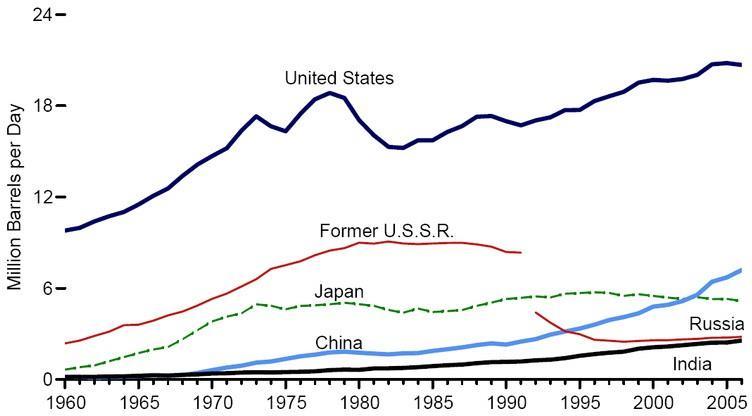

Figure-1.Demandgrowthforthelargestconsumers.
Source: Annual Energy Review 2005, US DOE, Energy InformationAdministration[8]
Animportantfactorindetermininganation'ssusceptibility to fluctuations in oil prices and its capacity to switch to alternate fossil fuels is the composition of its oil consumption. The four primary sectors in the US that consumethemostoilislogistics,manufacturing,electricity production,andresidentialandcommercial.Nearly70%of USoilconsumptioncomesfromtheautomobilesectoralone, withmotorfuelaccountingfortwo-thirdsofthattotal.
SUPPLY: The world's daily operations depend heavily on the availability of oil. The initial oil wells were drilledinEuropeandtheUSA,whichiswherethepetroleum industry got its start. But it wasn’t until the North Sea's hydrocarbon reserves were discovered in the 1970s that Europeannationsstartedtogenerateasizableamountofoil. WhenFordbeganproducingvehiclesinlargequantities,the petroleumindustrywasfirstdrivenbythemanufacturingof kerosene.However,ascarsbecamemorewidelyavailable, consumerdemandforthemincreased.
TheUnitedStatesstartedtobuymoreoilthanitexportedin 1948. The United States' economic expansion, like that of otherdevelopednations,becamehighlydependentonthe supplyofforeignoil.TheUnitedStatesutilizes20.5million barrels of oil per day, with the majority coming from imports, despite having one of the top producers at 8.5 million barrels every day [9]. There may have been three notablesupplyshocksinrecentmemory.
Initially,theYomKippurWarandtheArab-IsraeliConflict led to the 1973 Arab oil embargo, which in turn caused political and economic upheavals. On October 16, 1973, OPEC'sArabmembersimposedanoilembargoontheUnited StatesinretaliationforWesternsupportforIsraelIran'soil production, The 6 million barrels per day had been
overthrownin1979,wasseverelydisruptedandnearlyfell tozeroduringtherevolutionthatsawtheascenttopowerof religiousleaderKhomeini.Whiletheydidnotlastaslongas theprecedingshocks,supplycriseswerealsobroughtonby theGulfWarin1991andthefalloftheSovietUnion[10]
Intheinitial portionofthe20thcentury,theindustryand supply, that identified prices, were ruled by the so-called "Seven Sisters," but the regulation then changed to OPEC. ThefivestrongestAmericancompanies,alongwithatrioof European firms, effectively created an oligopoly. Independentbusinessesenteredthemarketovertime,but theynevermatchedthecontextofthepioneercompanies.All ofthesesupplyshockspromptedsignificantdropsinsupply, which leads to significant disturbances in the market. Eventually,industrializednationsrealizedthatcheapoilwas no longer a factor. Consequently, environmental sustainability and oil supply have grown to be national securityconcerns.
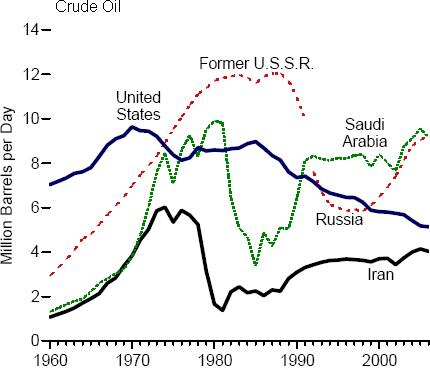
Source: Annual Energy Review 2006, US DOE, Energy InformationAdministration[11]
To extract oil and manage supply, the oligopoly built commercial and legal frameworks. This arrangement, however,wasshort-livedsincethelargerevenuesandthe weakeningofreserve-owningnations'interestsresultedin popular dissatisfaction and the acceleration of nationalization.TheGroupofPetroleumExportingCountries (OPEC) was established as a result of producing nations pushing forth against the oil industry as a reaction to the expandingindustryandrisingprofits[12].OPECsoughtto movethecentersofdecision-makingbeyondtheWesttothe regionscontrolledbytheassetowners.
Nosinglenationorgrouphasthesamesignificantimpactor authorityoversupplynowasthe"SevenSisters"did.Before the 1970s, the supply was largely consistent, but major interruptions started in 1973 and haven't completely stopped subsequently. Although manufacturing is more
© 2024, IRJET | Impact Factor value: 8.226 | ISO 9001:2008 Certified Journal | Page392
International Research Journal of Engineering and Technology (IRJET) e-ISSN: 2395-0056
Volume: 11 Issue: 03 | Mar 2024 www.irjet.net p-ISSN: 2395-0072
reliable than it was previously, price volatility is neverthelesspresentduetotheemergenceofseveralnew hazards.
Many experts think that rising crude oil trades and price volatility could be related to unforeseen economic trends. Recent instances are China's and India's surprisingly substantialenergyneedsandtheUSdollar'sdecliningvalue inothercommodities.Theimagebelowillustrateshowthe first oil shock, which marked the beginning of the price volatilitythathaspersistedtothisday,causedaslowdown intheworld'seconomy.
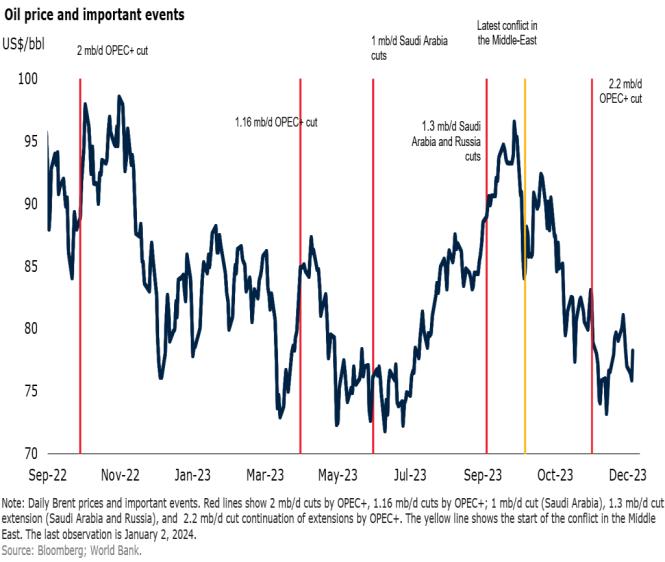
Price volatility has always been caused by a variety of factors,buttheworldhasneverseenthelevelofpersistent fluctuationthathasoccurredlately.Thereasonsbehindthe heightenedvolatilityinoilpricescanbeclassifiedintotwo groups: noneconomic and socioeconomic. The underinvestment in new projects caused by resource nationalism,therecentincreaseinthecostofinvestigative technology,theagingofoldoilwells,andeconomicgrowth combinedwithasignificantincreaseinconsumerappetite foroilinemergingeconomieswasn'toffsetbyanadequate supply, and the depreciation of the dollar relative to alternative currencies constitute a few of the economic factors.
ThefunctioningoftheUSeconomyandinformationonthe availability of petroleum and gasoline have a significant influenceonsudden,significantpricefluctuations.Volatility isinfluencedbybasicsupplyanddemandforecastsaswell aslong-termglobaleconomicperformance.
Political incentives drive most noneconomic factors. For example,countrieswithsignificantoilreservesconcealreal oilinformationfrominvestorssotheycanfeelcertainabout the return on their investments. Countries manipulate oil figures to serve their political agendas and view it as a
national security risk. Because of this uncertainty, most investors are reluctant to become involved in massive amountsofprojectsthatcouldprovideasteadysupply.The nation'sproblem'scausalityisconnectedtotheknown"Peak oil"idea.Thetheoryholdsthatfollowingtheidealamountof globalextractionisreached,productionwillgraduallyslow down.
In addition to other political unpredictability and noneconomic issues leading to a lack of protection for investors'rightsinresource-richnations,resource-related warfarehascausedinstabilityinoil-producingnations.Oil corporations have started to exhibit so-called "spare capacity"asaresultofthepoliticalgamesthathavebeenso heatedoverthepastfewdecadesthattheyhavecompletely ignoredinvestmentsinnewprojectsthatofferaconsistent supply.
The European energy watchdog, the International Energy Agency,wasfoundedtoprotectWesternimporters'interests and accuses OPEC of not producing enough oil to meet demand, which raises prices. However, the main concern raisedbyOPECisthelackofrefinerycapacityintheworld.It assertsthatalthoughitcanincreaseproductionatanytime, itwon'treducemarketvolatility.
Estimates of the state of the global economy have a longterm, more than a year-long influence on prices, although therearemanyreasonswhypricesfluctuate.Recessionsare associated with lower oil prices, and vice versa. Although they are still predicted to be between $90 and $100 per barrel,mostpubliclyavailableoilpriceprojectionsfor2023 thisyearhavebeenrevisedlowerthanpreviousestimates. However,theindustryhasaterribletrackrecordofcorrectly predictingoilprices,soanypredictionisalmostcertaintobe off. This is particularly true at this time due to the great amountofuncertaintysurroundingfundamentalfactorsthat directly affect oil markets by acting in opposition to one another.
China,geopolitics,economicstrife,andtheoutlookforthe globaleconomyarethemainuncontrollablefactorsthatwill impactthisyearandtheyearstocome.
Sincelowpricesmaymakeitunprofitabletoinvestinnew oil projects since they are below the marginal cost of production,thiscreatesadditionalriskierscenarios.There mightonceagainbealackofsupplycomparedtodemand when the world eventually emerges from its crisis, which mightresultinevenmoreextremepricevolatility.
1.4 The GDP and oil correlation
While petroleum has grown to be a vital asset in both the worldwideeconomyanddailylife,oilpricesaretheprimary meansofexaminingtheconnectionthatexistsbetweenoil and macroeconomics. Since Hamilton's (1983) research, which showed that rises in oil prices slowed the
International Research Journal of Engineering and Technology (IRJET) e-ISSN: 2395-0056
Volume: 11 Issue: 03 | Mar 2024 www.irjet.net p-ISSN: 2395-0072
developmentofUSoutputbetween1948and1980[14],the presence of a negative link among macroeconomic conditions and oil prices has come to be widely acknowledged. Numerous additional researchers have verifiedandexpandeduponHamilton'sfindings.([15]The majorityofenergyeconomistsconcludedthatthesignificant rise in oil prices was the primary cause of both the 2001 recession and the bulk of the post-World War II U.S. recessions. The traditional view is that higher production costsduetorisingoilpricesresultinslowerGDPgrowth.On thecontrary,significantfluctuationsinoilprices,whether positiveornegative,canharmoverallproductionastheycan causedelaysinbusinessexpendituresduetoambiguityor expensive reorganization of resources within a sector, especially moving resources from a more negatively impactedsectortoalessnegativelyimpactedone[16]
This demonstrates how rising petroleum prices have a detrimental impact on employment and production since they function as a tax on expenditure. Additionally, businessesthataresufferingrisingcostsraisethepricesof theirgoods,whichcontributestoinflation.Sincejobgrowth istypicallyhighlycontingentonproductionexpansion,price volatility lowers employment growth and raises the unemployment rate. If output growth slows due to incertitude,itputsoffmakinginvestmentsincapitalgoods.
Pricevolatilityhasadirectandindirectimpactonfinancial markets. Currency exchange rates, equities and bond valuations, and actual as well as anticipated changes in corporateprofitability,priceinflation,andmonetarypolicies inthewakeofrisingoilpriceswillallhaveanimpact.
Therefore, understanding and analyzing the interconnectedness of energy prices, exchange rates, and inflation is crucial for policymakers, economists, and businesses to make informed decisions and anticipate potentialeconomicimpacts.
The study's objectives were to examine the intricate relationshipsthatexistamongexchangerates,inflation,and international trade as well as to assess how the exchange rate of the US dollar affects oil prices, how inflation rates affecttrade,andhowGDPgrowthratesaffecttrade.Whilea large amount of research has shown how much currency exchangelevelsandvolatilityaffectcommerce,somestudies have produced contradictory and confusing findings. Exchangeratemovementsmayaffectothermacroeconomic factorsandhencehaveaneffectonhowtradeisaffectedby exchangerates.Accordingtoresearchby[17]whatmatters is not fluctuations in exchange rates in and of itself, but ratherhowitincreasesordecreasesrisksforbusinessesor consumers.Furthermore,researchusingagravityequation modelby[18]andtheIMFsuggeststhatexportvolumesare notimpactedbyexchangeratevolatility.
Against this background, this article investigates the relationship between oil prices and the US currency
exchange rate, as well as the impact of inflation and GDP growth rates on global trade. The article examines the relationshipbetweenthesevariablesandtheirnoteworthy impacts on commerce (% of GDP) using statistical methodologiesandadditionaltimeseriesinformationfrom 2014to2020.Numerouseconomicmethods,includingOLS, ADF, ARDL, convergence test, correlation test, Granger causality test, and descriptive analysis, are covered in the literaturereview.Thestudy'sconclusionsprovideimportant new light on the complex relationships between these economicvariablesandthestateofinternationaltrade.The study also looks at other possible explanations for the decliningcorrelationbetweentradeandcurrencyrates,such asshiftsinthemixandstructureofimportproducts,shortterm external debt exposure of nations, and global and regionalvaluenetworks.
Objectives of study: Thefollowingarethestudy'saims.
tolookintohowchangesintheUSdollar'sexchange rateaffectthepriceofoil.
toinvestigatehowtherateofinflationaffectstrade internationally.
toexaminehowexchangeratesaffectglobaltrade.
toexaminehowtheGDPgrowthrateaffectstrade internationally.
SectionIIexaminestheliteraturereview;SectionIIIpresents the theoretical framework, data, and description of the empiricalmodel;SectionIVprovidesaconclusion.
Contractionarymonetarypolicyshocksleadtosignificant exchangerateappreciationinMalaysia,thePeople’sRepublic of China, and the Republic of Korea. However, in India, Indonesia, the Philippines and Thailand, it is either a significant depreciation or no significant effect [19], investigatestheconnectionbetweenAsiannationsIndonesia, Japan,Malaysia,thePhilippines,Singapore,andThailandand theirtradebalances.Asamethodology,thisstudysuggested an economical and explanatory model. Therefore, the nominal quantity of these countries' trade balance is impacted by actual money. This study's mathematical analysis demonstrates how real money impacts the trade balancesofthePhilippines,Malaysia,Singapore,andThailand withJapan.Toequalizethetradeimbalance,thesecountries needtoconcentrateonusingrealmoney.
Takingintoaccounttheexchangerate,GDP,foreigndirect investment(FDI),realexchangerate,employment,andtrade opennessasindependentvariablesandexportsandfinancial opennessasdependentvariables,[20]confirmedtheimpact ofremittancesandfinancialopennessinPakistan.Theunit root and relationship between the variables have been
International Research Journal of Engineering and Technology (IRJET) e-ISSN: 2395-0056
Volume: 11 Issue: 03 | Mar 2024 www.irjet.net p-ISSN: 2395-0072
determinedusingtheCo-integrationtest,theAuto-regressive Distributed Lag (ARDL), and the Augmented Dickey Fuller test. The findings showed that while foreign direct investment (FDI) has a positive but negligible link with Pakistan'sGDP,remittanceshaveanimpactonhumancapital aswellaseconomicstability.Thecontributionofcompetitive currenciestotheeconomicexpansionofEastandSoutheast Asian economies has been emphasized in a number of studies.[21]discoveredanegativeimpact;inparticular,[21] noteda negativelink amongstexchangeratevolatilityand other economic indices. Both [22] and [23] discovered a detrimentaleffect;Han(2020)pointedoutthatforeigndirect investmentplayedacontributingfactorinexacerbatedthis effect.Barguellil(2018)addedthatfinancialopennessand exchange rate regimes have an impact on how volatile currencyratesaffecteconomicgrowth.Both [24]and[25] stress the value of a competitive real exchange rate in fosteringeconomicgrowth,withDAI(2017)highlightingits particularrelevanceinlessfinanciallylinkednations.Thisis furthersupportedby[26],whoshowshowexportsuccessin these areas is impacted by exchange rate volatility and misalignment.thebilateral exportsbetweenSriLankaand the PRC and come to the conclusion that, although the depreciation has a negative impact on Sri Lanka's imports fromthePRC,ithasamajorpositiveimpactonexportsfrom SriLankatothePRC.AsmajortradingpartnersinthePRC's global supply chains, [27] also use sector-level data to evaluate the effect of the Chinese renminbi on ASEAN exports.Thefindingsindicateasignificantpositiveimpactof real exchange rate depreciation on exports of high- and medium-technologyfinalandintermediategoods.According to[28],thedevaluationoftheUSdollarmaycausedeveloped Asia's exchange rate appreciation to destabilize its complementing trade relationships with developing economies, particularly in the technology-intensive goods sector. [29] and used data from South Asian nations, includingBangladesh,toexaminetheeffectsofexportsand foreign direct investment (FDI) on economic growth. He foundthatcertaincountrieshadmajorrelationshipswhile others had insignificant ones. The analysis found that, althoughitwasnegligibleinIndia,FDIhadafavorableand considerableimpactoneconomicgrowthinBangladeshand Pakistan. However, at the 1% significance level, this associationisnegativeinSriLanka.Numerousstudieshave consistently shown that the ASEAN countries' exports are negatively impacted by inflation and exchange rates. Both [30]and[31]discoveredthattheexchangerateandinflation haveanegativeandconsiderableimpactonexports;(Purusa (2018)alsonotedthatthiseffectisconstantacrossthefive countries.Both[32]and[33]discoveredthatrealexportsare negativelyimpactedbyexchangeratevolatility,withSubanti (2019)speculatingthatincreasedexchangeratestabilitymay improverealexports.[34]discoveredanegativerelationship betweenGDPandinflation.TherewillbeanincreaseinGDP beyond a certain point of inflation. Using the Johansen approach to cointegration, [35] investigated the impact of long-term macroeconomic variables on economic
developmentinGhanafrom1980to2010.Theydiscovereda cointegrationlinkbetweenmacroeconomicparametersand realGDPpercapita(economicgrowth),andtheirresearch suggests that the government should generate more local revenueratherthanrelyingonaidfromabroad.Inastudy, [36]highlightedthatgrossfixedcapitalformation,foreigndirect investment, and total government spending are the main factors determining Nigeria's economic output in the case of a constant inflation rate. Theyalsoproved that there isa relationship, bothshort-andlong-term,betweenmacroeconomicvariables andeconomicgrowth;nevertheless,researchonthistopicis still in its early stages. [37], [38] offers a thorough examination of how the actual exchange rate level affects tradevolumeandpricesoftradedgoods,aswellaswhether ornottherehasbeenasteadylinkbetweenthesevariables. Itsconclusionscorroboratefindingsfrompastresearch.The findingsindicatethatcurrencydepreciationcausesforeigners topaylowerexportpricesandhigherimportprices,whichin turncauseanincreaseinexportsandadecreaseinimports.
After controlling for price volatility, a different line of inquiry examines the connection between the level of the exchange rate and the volume of international trade. Oil pricesaresignificantlyimpactedbytheUSdollarexchange rate, especially over the long run. [39] looked at the US dollar's value and pricing empirically. This study paper's maingoalwastolookathowchangesinUSdollarexchange rates affect the price of oil. This study explored the relationshipbetweentheexchangerateandpriceusingboth theoretical and empirical methods in order to assess this fundamentalgoal.
[40] used a nonlinear smooth-transition approach to study the relationship between the exchange rate of oil exporting nationsand shocks to the world oil price. While [41]observedthatanappreciationoftheUSdollarexchange rateresultedinadecreaseinoildemand,[42]foundthata depreciation of the US currency led to an increase in worldwidecrudeoilprices.[43]providedmoreevidencein favor of this relationship by pointing out the inverse relationship between the price of crude oil and the US dollar/euro exchange rate. Nonetheless, the US dollar exchangeratedoesnotalwayshaveaconsistentimpactonoil prices,[44]notedthatdependingonwhetherchangesinoil priceswerecausedbyaggregatedemandorsupply,different dollar exchange rates reacted differently to shocks in the priceofthecommodity.Thisstudy'smaingoalwastoexplain how six significant oil exporting nations responded to changes in the nominal and real exchange rates. For this reason, the real and nominal exchange rates' symmetric smoothtransitionmovementsandlogisticalasymmetrywere usedinthisanalysis.Dooilshocksaffecttheconfigurationsof global exchange rates examined by [45]. The actual and nominalexchangerates,oilprice,foreignexchangereserves, andgrowthratewerethestudy'svariables.
International Research Journal of Engineering and Technology (IRJET) e-ISSN: 2395-0056
Volume: 11 Issue: 03 | Mar 2024 www.irjet.net p-ISSN: 2395-0072
[46]examinedtheshort-andlong-termcorrelationsbetween USdollarexchangeratesandoilprices.Thisresearchsought toclarifytherelationshipbetweenUSdollarexchangerates andoilpricesinthepost-WorldWarIIera,whenbothwere verychangeable.Theresearchapproachesusedinthisstudy included the OLS, simple regression analysis, Granger causality test, and vector error model applied to daily, monthly, and annual data on oil prices and US dollars exchangerates.
Thisresearchusesathoroughquantitativeanalysistolook attheconnectionsbetweenGDP,trade(asapercentageof GDP), inflation (INF), and exchange rates (EXR). The approachaimstoclarifytheshort-andlong-termdynamics across these variables using methods for data gathering, modelformulation,andstatisticalanalysis.Thedatasources, variabledefinitions,modeldesign,andanalyticaltechniques appliedinthestudyaredescribedinthis part.Thegoalof the research approach is to determine whether the trade balanceisimpactedbyexchangerates.maycontributetothe calculationoftheGDPgrowthrate.
The research is based on secondary time-series data that spans the years 2014 through 2020. The data for trade (percentage of GDP), GDP, inflation (measured by the consumer price index), and exchange rates were sourced from the World Bank's World Development Indicators database. Thisextensivedatasetensuresthattheanalysisis based on internationally recognized and easily accessible dataandoffersa dependablefoundationforanalyzingthe economicvariablesunderinvestigation.
This article solely examines elements that could impact economicgrowth.Everyvariablehasbeenselectedbasedon previousstudiesconductedinthisfield.
Dependent Variable
Theentirevalueofanation'simportsandexportsrelativeto itsGDPisrepresentedbytradeasapercentageofGDP(TB), thedependentvariableinthisstudy.Thismetricisessential for assessing a nation's level of economic integration and opennesstotheworldeconomy.
trade (% of GDP): Trade(%ofGDP)isthetotalamountof goods and services that a nation imports and exports expressed as a percentage of its GDP (gross domestic product).Accordingto[47],[48]andLaneand[49],thereis a considerable correlation between bilateral equity investment and underlying trade trends. Through trade, investorsaremoreeffectivelyabletoobtainaccountingand
regulatory knowledge about overseas markets, enabling them to make investments in foreign assets. Further reductionofdefaultriskcomesfromclosertradeintegration.
Finally,tradetransactionscandirectlyproducecross-border financialflowssuchasexportinsurance,tradecredits,and paymentfacilitation.Thetradeopennessinformationcomes fromtheWorldBank'sWorldDevelopmentIndicators.This can shed light on the advantages and difficulties of global trade,aswell asthepossibleimpactsoftradeagreements andpoliciesonthedevelopmentandexpansionofanation's economy.
Theinfluenceofeconomicexpansionontradeisassessedin this study using the GDP's annual growth rate as an independentvariable.
Gross Domestic Product (GDP): Onemeasureofeconomic growthistheGDP.Anation'smicroeconomicsituationand levelofprogresscanbeinferredfromitsGDP[50].Thereare two ways to look at GDP: the income approach and the expenditure approach. We'll start by talking about the spending strategy. It considers every good and service providedinaspecificamountoftime. However,theincome approach takes into account the amount of worker's pay, rent,interestrates,abusiness'sincome,thetaxonproduced commodities,andthelevelofimports.
Exchange rate: Thisvariableanalyzeshowchangesinthe valueofacurrencyimpacttradedynamicsbycomparingthe valueofthehomecurrencytotheUSdollar.
ShowstheRupee'svalueexpressedinUSDollars.Thevalue ofonecurrencyrelativetoanotherisknownastheexchange rate.Fixedexchangeratesandflexibleexchangeratesarethe twotypesofexchangerates. Inanattempttostabilizethe monetarysystem,thegovernmentsetsfixedexchangerates, whilst the market sets flexible exchange rates with or withoutitsinfluence[51]
DepictstheRupee'svalueexpressedinUSDollars.Thevalue ofonecurrencyrelativetoanotherisknownastheexchange rate.Fixedexchangeratesandflexibleexchangeratesarethe twotypesofexchangerates. Inanattempttostabilizethe monetarysystem,thegovernmentsetsfixedexchangerates, whilst the market sets flexible exchange rates with or withoutitsinfluence.
Inflation (% consumer price index).:Therateatwhichthe average level of prices for goods and services is rising is shown by the yearly percentage change in the consumer priceindex.[52]defineinflationasariseingeneralprices combinedwithadeclineinacurrency'sbuyingpower.There areafewreasonswhypricesforgoodsandservicesrisedue to inflation: when aggregate demand grows more quickly thanaggregatesupply.Theexpansionofbankinterestrates,
International Research Journal of Engineering and Technology (IRJET) e-ISSN: 2395-0056
Volume: 11 Issue: 03 | Mar 2024 www.irjet.net p-ISSN: 2395-0072
thegovernmentdeficit,andtheriseinforeigndemandareall contributing factors to the mismatch between aggregate supply and demand. A few indices of inflation are the ImplicitPriceIndex(deflatorGDP),WholesalePriceIndex (WPI),andConsumerPriceIndex(CPI)[53]
3.3 Model specification
Thelong-termassociationsandshort-termdynamicsamong thevariablesareanalyzedusingtheErrorCorrectionModel (ECM)andAutoregressiveDistributedLag(ARDL)models, respectively.
TB=F(GDP,Exr,Inf,)
TB=α0+β1(GDP)+β2(Exr)+β3(INF)+��
whereGDPistheGrossDomesticProductgrowthrate,INF standsforinflation,EXRforexchangerate,TBisthetrade balance as a percentage of GDP, 0α0 is the intercept, 1β1, 2β2, and 3β3 are the coefficients of the independent variables,andϵtistheerrorterm.
TheECMisincludedintheshort-termdynamicstorecord therateatwhichthesystemreturnstoequilibriumfollowing a shock. To measure the adjustment process, the ARDL model'serrorcorrectiontermisincorporatedintotheECM.
3.4 Nature of the Data
The study will make use of secondary data that is easily accessibleontheofficialwebsites,anditisquantitativein nature.Forthemodel'sdevelopment,I'llusesecondarytime seriesdatafrom2014to2020.
3.5 Nature of the Data Measure
Thetrade(%ofGDP)willbethedependentvariableinthis essay,andtherealeffectiveexchangerate,GDPgrowthrate, andinflationrate(%ofconsumer priceindex) will bethe independent variables. The dependent variable changed greatlyinresponse toanytinychange in theindependent variable.
Table 1: MeasurementScalesandSources
Variables and Sources
Initials
Descriptive statistics that condense the data's central tendenciesanddispersionmeasurementsarethefirststepin themulti-phaseassessmentprocess.TheAugmentedDickeyFuller(ADF)testisthenusedtoverifythetimeseriesdata's stationarity,whichisnecessarybeforeARDLmodelingcan start.Thepresenceoflong-termrelationshipsbetweenthe variablesisthendeterminedusingtheARDLboundstesting approach, and the ECM measures the rate at which the dependent variable returns to equilibrium after a disturbance. P-values are used to determine statistical significance;relationshipsthatarestatisticallysignificantare indicatedbylevelsbelow0.05.
This research framework offers strong insights into the factors influencing trade dynamics in the context of
growth,inflation,andexchangeratevariations,enablinga comprehensive knowledge of the economic relationships underexamination.
WeusedMSWordandEViewsasdataprocessingtoolsin thisarticle
3.8 Descriptive statistics
Table 2: Descriptivestatistics
Thedata'sstandarddeviationis5.317,themaximumvalueis 24.89,theminimumvalueis2.4,andthemeanvalueofinfis 10,2.TheINF'sskewedvalueindicatesapositiveskewinthe data.TheINF'skurtosisvalueis3.6,whichishigherthanthe 3ItindicatesleptokurtosisintheINF.TheINFhasaJBvalue of6.9,whichsuggeststhatitisregularlydistributed.
International Research Journal of Engineering and Technology (IRJET) e-ISSN: 2395-0056
Volume: 11 Issue: 03 | Mar 2024 www.irjet.net
Table-3: CorrelationAnalysis
The correlation between the variables is displayed in the table above. We have already examined the stationary variablesintheADFtest,whicharethecombinationoflevel andfirstdifference.TheGDPandthefirstvariable,TRADE, nowexhibitanegativecorrelationwithavalueof-0.24.The correlation coefficient of 0.66 indicates that there is less correlation between these two variables, whereas TRADE demonstrates the negative correlation between ER. The TRADE and INF connection demonstrates a negative correlationbetweenthevariables;thecorrelationvalueof0.46indicatesalowandnegativecorrelationbetweenthe variables.
Table 4: ResultsofADF’sUnitRootTest
Welearnthatwhereastheothervariables,liketheERand TRADE,arestationaryatthefirstdifference,theGDPandthe INFarestationaryatthelevel.Weverifythestationaryusing the probability value and the t statistics as a basis. The variableisstationaryanditsstationarystateisprovenwhen theprobabilityvalueislessthan0.05%.
WiththeuseoftheErrorCorrectionModel(ECM)andthe AutoregressiveDistributedLag(ARDL)technique,thisstudy carefully examined the correlations between trade (% of GDP), GDP, INF, and exchange rates (EXR). A thorough explanationoftheresultsoftheARDLmodel,ECMfindings, and the statistical significance of the variables is given below.
Thefollowingsignificantfindingswereobtainedbyusingthe ARDL model to investigate the long-term relationships between the variables: The Effect of GDP on Trade: The ARDL model yielded a coefficientof1.048362forGDP,t-statisticof2.378007,and standarderrorof5.840581.Atthe5%level,theGDP'seffect oncommerceisnotstatisticallysignificant,accordingtothe relatedprobabilityvalueof0.1915.Thisshowsthatalthough GDP growth is an important economic indicator, other aspects of the economic climate may have a moderating influenceonitsdirectlong-termimpactoncommerce(asa percentageofGDP).
TheEffectofInflationoncommerce:Thedetrimentaleffect of inflation on commerce was found to be considerably negative, with a coefficient of -0.353796, a t-statistic of2.197954, and a standard error of 3.345746. A strong inverse relationship between trade and inflation is demonstrated by the probability value of 0.0467, which validates the statistical significance at the 5% level. This findingemphasizesthenegativeimpactofpriceincreaseson trade performance in a nation, implying that increased inflationcansignificantlylowertradeasashareofGDP.
EffectsofExchangeRates:Withat-statisticof1.115148and a standard error of 0.333248, the exchange rate variable (ER)showedacoefficientof0.371622.Atthetraditional5% level, the exchange rate's effect on commerce is not statistically significant, as indicated by the associated probability value of 0.2850. These results cast doubt on widely held notions regarding the beneficial impacts of devaluationontradebalanceandraisethepossibilitythat othervariablesmaybemoreimportantindeterminingtrade outcomes.
International Research Journal of Engineering and Technology (IRJET) e-ISSN: 2395-0056
Volume: 11 Issue: 03 | Mar 2024 www.irjet.net
Table-5: ResultsofARDLModel Variable
In a nutshell there is a long-term negative relationship betweenTRADEandinflation.Thesignificanceofinflationis indicatedbythefactthattheprobabilityislessthan0.09and the t-statistics value is more than 2. A one-unit shift in inflationwillresultinathirty-fivepercentchangeintrade. ThesetradeandinflationresultsalignwithQamar's(2014) research. Furthermore, the statistical significance of the constantterm(C)indicatesitssignificanceinthemodel.
4.3. Error correction model
TheECMwasusedtogaugehowquicklyshort-termshocks were adjusted back to long-term equilibrium: Theerrorcorrectionterm'scoefficientwas-0.693529,witha t-statisticof-4.789629andastandarderrorof0.233615.A robustandstatisticallysignificantadjustmentmechanismis shown by the very significant probability value (0.0004), withanannualcorrectionrateofapproximately69.36%of disequilibrium. This emphasizes how the trade balance is dynamicandthat,afterexperiencingshort-termvolatility,it tendstoreverttoitslong-termequilibriumratherrapidly.
Table-6: ResultofECM
Variable
D(GDP)
D(GDP(-1))
D(GDP(-2)) 5.958934 2.072388
D(GDP(-3)) 1.395002 1.983395 0.703340 0.4942
D(GDP(-4)) 0.774362 1.826354
D(GDP(-5)) -2.922831 1.395593 -2.094329 0.0564
D(INF) -0.334897 0.471681 -0.710008 0.4902
D(INF) 0.623586 0.837290 0.744766 0.4697
D(INF) 0.904567
D(INF) 2.438466 0.788526 3.092434 0.0086
D(INF)
D(ER(-1)) -1.260361 1.785472 -0.705898
2395-0072
Eq
Cointegrating=TRADE-(-8.0484*GDP-7.3538*INF+0.3716*ER+ 80.9541)
Table-7: ResultsofBoundTest
NOTE:criticalvalueistakenfromEviews.
Theboundtesttableshowsalong-termconnection,leading ustorejectthenullhypothesisandacceptthealternative.
Thestatisticalanalysesshowthattrade,GDP,inflation,and exchangeratesareintricatelycorrelated.Long-termtrade performance was found to be negatively impacted by inflation, a vital component that was not significantly affectedbyGDPorexchangerates.TheECMalsoemphasized the economy's ability to quicklyadapt to departures from long-term patterns and the trade balances' resilience to transient shifts in the economy. Overall, these findings highlight the complex factors influencingtradedynamicsandindicatethatinflationplaysa majorinfluenceindeterminingtradeoutcomes.
Furthermore,theresultscallforareassessmentofthedirect effects of GDP growth and exchange rate swings on trade, arguing in favor of a more comprehensive viewpoint that takesintoaccounttheinteractionofmanyeconomicfactors indeterminingtradepoliciesandtactics.
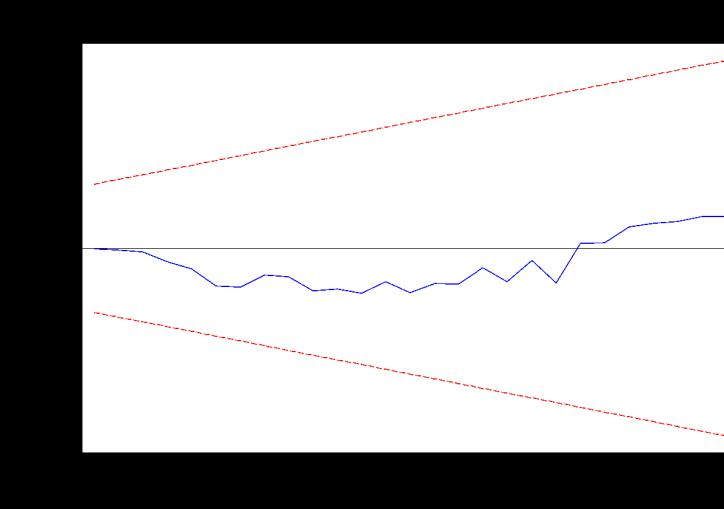
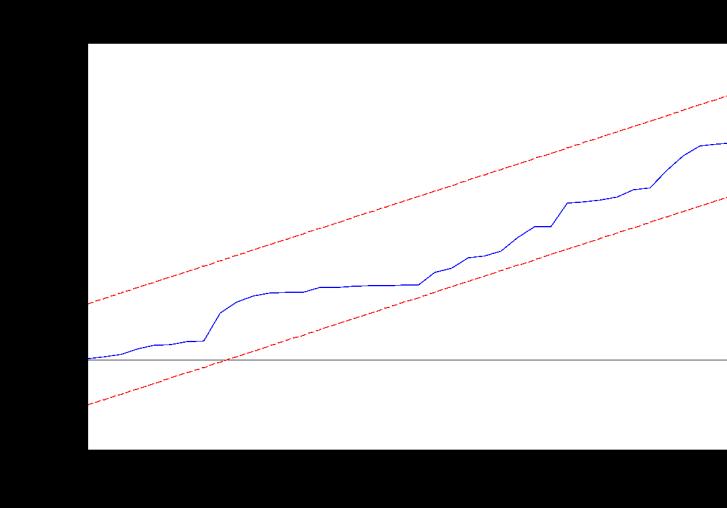
StabilitytestsliketheCUSUMandCUSUMsquaretestsare used to explain the stability of the long run and the short run.TheCUSUMtest'saccuracyandstabilityareindicatedby thebluelines,whichmustappearbetweenthetworedlines. Hencetheresultsofourmodel arestableasthebluelines arebetweenthetworedlines.
International Research Journal of Engineering and Technology (IRJET) e-ISSN: 2395-0056
Volume: 11 Issue: 03 | Mar 2024 www.irjet.net p-ISSN: 2395-0072
5. Discussion
This study adds to the body of empirical research by analyzingthecomplexrelationshipsbetweenGDP,trade(as a percentage of GDP), inflation (INF), and exchange rates (EXR). This work adds to the body of knowledge on economicpolicyandinternational commerce byrevealing subtleinsightsintothelong-terminteractionsbetweenthese variables through the use of an Error Correction Model (ECM)andanAutoregressiveDistributedLag(ARDL)model. DynamicsofTradeandInflation:Ourresultsdemonstrate that inflation has a negative long-term impact on trade, whichisconsistentwithbothclassicalandmoderneconomic theories that view inflation as a negative factor that undermines trade competitiveness. High rates of inflation can raise export prices, which reduces the appeal of a nation's exports abroad and raises the cost of imports, hurtingthetradebalance.Theconclusionsofthisstudyare inlinewiththoseofBahmani-OskooeeandAlse(1993),who discovered that inflation damages the value of native
currencyandhasanegativeimpactontradebalances.But thestudy'sfindings,whichshowthattrade(asapercentage of GDP) changes significantly for every unit increase in inflation, highlight how important it is to keep inflation under control in order to improve both the dynamics of internationalcommerceanddomesticeconomicstability.
GDP'sPlaceinTrade:Thisanalysis'snon-significantfindings about GDP's influence on trade run counter to the more generalbeliefthateconomicgrowthfosterstradeexpansion. This discrepancy raises questions about how much GDP influences trade and raises the possibility that other variables,suchthecompositionoftheeconomy,tradelaws, and external economiccircumstances, mayhave a greater impact. This realization is consistent with the findings of Frankel and Romer (1999), who contended that although trade might boost economic growth, the relationship in reverseislessclear-cut.ThedirecteffectofGDPgrowthon tradeexpansionmaybelessenedbytheintricacyofglobal supply chains and the importance of services in contemporary economies, indicating a more complex relationshipthanpreviouslythought.
ExchangeRates'Influence:Theresultscontradictthewidely held belief that devaluation improves trade balance by resultingincheaper exports andmore expensiveimports. Instead, they show a lack of meaningful long-term link between exchangeratesandtrade.TheJ-curve effect may cause the trade balance to momentarily worsen before improving,whichcouldbeareflectionoftheelasticitiesof demandforimportsandexports.Ontheotherhand,itmight drawattentiontohowcrucialotherelementsare,suchhow competitive products and services are, which can either lessen or magnify the consequences of fluctuations in exchangerates.Thisfindingisintriguing,particularlyinlight of research such as that conducted by Bahmani-Oskooee (1985),whichdiscoveredthatexchangerateshadamajor short-termimpactontradebalances.Ourresultsimplythata widerrangeofeconomicandpolicyfactorsmayhaveamore complexinfluenceonthelong-termeffects.
SynthesiswithPreviousResearch:Thefindingsofthisstudy add to the continuing discussion over the factors that influence trade performance. For example, Rodrik (2008) highlightedthesignificanceoftradepolicyandinstitutional qualityininfluencingtraderesults,implyingthatvariables other than macroeconomic indicators may be crucial. In a similarvein,thestudy'sanalysisofinflationhighlightsthe findings of Aghion et al. (2009), who connected stable inflation rates to higher productivity and, thus, improved tradecompetitiveness.
Economic Policy Implications: In order to improve trade competitiveness,governmentsshouldgivepricestabilitya priority, as this research has shown that inflation plays a substantial influence in determining trade outcomes. This broadensthediscussiontoexaminehowtradepolicygoals
International Research Journal of Engineering and Technology (IRJET) e-ISSN: 2395-0056
Volume: 11 Issue: 03 | Mar 2024 www.irjet.net p-ISSN: 2395-0072
can be in line with inflation targeting, moving beyond traditionalmonetarypolicy.Theintricateknowledgeofhow GDP and exchange rates affect trade also implies that economic policies intended to boost GDP and control currency values should be integrated with more comprehensive plans that take trade laws, the structural makeup of the economy, and international economic conditionsintoaccount.
Tosumup,thisresearchnotonlyprovidesempiricalsupport fortheintricaterelationshipbetweenimportanteconomic indicatorsandtrade,butitalsocastsdoubtonsomewidely held beliefs and emphasizes the complexity of economic processes. The approach provides a comprehensive viewpointthatenhancesthediscourseonglobaleconomic interactions among academics and policymakers. The findingsgleanedfromthisanalysisshedlightonthecomplex balance between domestic economic policies and their effectsonforeigncommerce.
Future Research Directions: This work provides a framework for investigating how trade and other macroeconomic factors interact in various historical and economic circumstances. Deeper understanding might be gained by looking into how trade laws, world economic situations, and sector-specific dynamics affect trade. Furthermore, comparative research among nations with different exchangerateand inflation policiesmayprovide insightful guidance on how to manage commerce and economicexpansion.
Thestudyexploredthecomplexdynamicsofhowoilprices are affected by the US dollar exchange rate, how inflation ratesaffectglobal trade,andhowGDPgrowthratesaffect globalcommerce.Theresearchshowedthelargeimpactof tiny changes in independent factors on the dependent variable,trade(%ofGDP),throughtheuseofstatisticaltools andthorough examinationoftimeseriesdata.Theresults demonstrated a long-term negative association between tradeandinflation,withinflationturningouttobeamajor and significant factor influencing commerce. Additionally, theanalysisshowedthattheeconomywilladjustby69.36% to reach equilibrium in the upcoming years, and that the variables will continue to exhibit consistent long run and short run behavior. These revelations provide significant consequences for economic policy and strategic decisionmaking, and they make significant advances to our understandingoftheintricateinteractionsamongexchange rates,inflation,andinternationaltrade.
Recommendations: Inlightofthestudy'sconclusions,the followingrecommendationscanbemade:
Policy Implications: The long-term negative link between trade and inflation emphasizes how crucial it is to put in placeefficientmonetarypoliciestocontrol inflation rates.
Maintaining stable inflation rates is a priority for policymakers in order to promote global commerce and economicexpansion.
Exchange Rate Management: It is imperative that policymakers actively monitor and control exchange rate variations because of the substantial impact that the US dollarexchangeratehasonoilprices.Itisimportanttothink aboutwaystolessenthenegativeimpactthatexchangerate volatilityhasonoilprices.
EconomicForecasting:Thestudy'sfindingthattheeconomy will adjust by 69.36% over the next few years to reach equilibrium points to the necessity of precise economic forecasting.Businessesandpolicymakerscanusethisdata toplanforfutureeconomicshiftsandmakewell-informed decisions.
TradePolicyConsiderations:Thesignificanceofdeveloping tradepoliciesthattakethesevariablesintoconsiderationis highlighted by the study's insights into the complex relationship between inflation, exchange rates, and internationalcommerce.Thepossibleeffectsofinflationand currencyrateswingsontradedynamicsshouldbetakeninto accountintradeagreementsandnegotiations.
Additional Research: The study lays the groundwork for future research in the areas of macroeconomics and international trade by utilizing a variety of statistical approachesandtimeseriesanalysis.Tofurtherunderstand theseintricateprocesses,futureresearchcouldexaminenew variables and perform comparison analysis across economies.
ACKNOWLEDGEMENT (Optional)
Theauthorscanacknowledgeanyperson/authoritiesinthis section.Thisisnotmandatory.
[1] The World Bank. (2008). Volatile oil Prices Subject of Forum. Newspaper Article. https://www.worldbank.org/en/news/feature/2008/0 3/10/volatile-oil-prices-subject-of-forum
[2] Amano,R.A.,&vanNorden,S.(1998).Oilpricesandthe rise and fall of the US real exchange rate. Journal of International Money and Finance, 17(2), 299–316. https://doi.org/10.1016/S0261-5606(98)00004-7
[3] Akram, Q. F. (2009). Commodity prices, interest rates and the dollar. Energy Economics, 31(6), 838–851. https://doi.org/10.1016/j.eneco.2009.05.016
[4] Library of congress. (2022). Oil and Gass industry a research guide. https://guides.loc.gov/oil-and-gasindustry/history
International Research Journal of Engineering and Technology (IRJET) e-ISSN: 2395-0056
Volume: 11 Issue: 03 | Mar 2024 www.irjet.net p-ISSN: 2395-0072
[5] Robinson,R.W.,Ohrenstein,D.J.,&Michels,K.J.(2000). by the Floyd D. Spence Na-tional Defense Authorization Act for 2001 sec. 1238, Public Law 106-398, 114 STAT. www.uscc.gov.
[6] Karl E, case, R. C. fair, S. M. O. (n.d.). Principles of Macroeconomics (10thed.).RetrievedJanuary23,2024, from https://www.ascdegreecollege.ac.in/wpcontent/uploads/2020/12/Principles-ofMacroeconomics.pdf
[7] DOE/EIA-0384(2006). (n.d.). Annual Energy Review 2006 (OfficeofEnergyMarketsandEndUse,Ed.;2006th ed.).U.S.DepartmentofEnergy.RetrievedJanuary23, 2024, from https://www.osti.gov/servlets/purl/1212315
[8] US Energy information administration. (n.d.). https://www.eia.gov/totalenergy/data/annual/pr. Retrieved January 23, 2024, from https://www.eia.gov/totalenergy/data/annual/pr
[9] IEA report. (2006). World Energy outlook https://www.iea.org/reports/world-energy-outlook2006#overview
[10] ShigetoKondo.(2024). Legal Notice Cover Image
[11] EIA.(n.d.-b). EIA,USEnergyinformationAdministration. Retrieved January 23, 2024, from https://www.eia.gov/totalenergy/data/annual/previou s.php
[12] OPEC. (n.d.). Organization of petroleum exporting countries. Retrieved January 23, 2024, from https://www.opec.org/opec_web/en/about_us/24.htm
[13] EIA.(n.d.-a). Brent crude oil EIA.RetrievedJanuary23, 2024, from https://www.eia.gov/todayinenergy/detail.php?id=611 42#:~:text=In%20the%20second%20half%20of,throug h%20the%20end%20of%202024.
[14] JamesD.Hamilton.(n.d.). Oil and Macroeconomy since World War II. Retrieved January 23, 2024, from https://www.jstor.org/stable/1832055
[15] Awerbuch, S., & Berger, M. (2003). IEA/EET Working Paper Applying Portfolio Theory to EU Electricity Planning andPolicy-Making.www.iea.org
[16] Guo,H.,&Kliesen,K.L.(2005). Oil Price Volatility and U.S. Macroeconomic Activity.
[18] JamesE.AndersonandEricvanWincoop.(n.d.). Gravity withGravitas:ASolutiontotheBorderPuzzle.Retrieved January 23, 2024, from https://www.jstor.org/stable/3132167
[19] JamesE.AndersonandEricvanWincoop.(n.d.). Gravity withGravitas:ASolutiontotheBorderPuzzle.Retrieved January 23, 2024, from https://www.jstor.org/stable/3132167
[20] UlHassan,M.,Hassan,M.S.,&Mahmood,H.(2013).An empiricalinquisitionoftheimpactofexchangerateand economic growth on export performance of Pakistan. Middle East Journal of Scientific Research, 14(2), 288–299.https://doi.org/10.5829/idosi.mejsr.2013.14.2.349
[21] Yensu, J., Nkrumah, S. K., Amankwah, S., & Ledi, K. K. (2022). The effect of exchange rate volatility on economic growth. Risk Governance and Control: Financial Markets and Institutions, 12(4), 33–45. https://doi.org/10.22495/rgcv12i4p2
[22] Han,Y.(2020).TheImpactofExchangeRateFluctuation on Economic Growth – Empirical Studies Based on DifferentCountries. Proceedingsofthe4thInternational SymposiumonBusinessCorporationandDevelopmentin South-East and South Asia under B&R Initiative (ISBCD 2019).https://doi.org/10.2991/aebmr.k.200708.006
[23] Barguellil, A., & Zmami, M. Ben-Salha, O., (2018). EconomicGrowthwithExchangeRateVolatility.1302–1336 in Journal of Economic Integration, 33(2). 10.11130/jei.2018.33.2.1302canbefoundonline.
[24] Gala,P.(2007).Realexchangeratelevelsandeconomic development: theoretical analysis and econometric evidence. Cambridge Journal of Economics, 32(2),273–288.https://doi.org/10.1093/cje/bem042
[25] DAI,P.VAN,DELPACHITRA,S.,&COTTRELL,S.(2017). REAL EXCHANGERATEANDECONOMICGROWTHIN EAST ASIAN COUNTRIES: THE ROLE OF FINANCIAL INTEGRATION. TheSingaporeEconomicReview, 62(01), 163–177. https://doi.org/10.1142/S0217590816500168
[26] Mohamad, S., Nair, M., & Jusoff, K. (2009). Exchange Rates and Export Competitiveness in Selected ASEAN Economies. International Business Research, 2(2). https://doi.org/10.5539/ibr.v2n2p156
[27] Hooy,C.-W.,Siong-Hook,L.,&Tze-Haw,C.(2015).The impact of the Renminbi real exchange rate on ASEAN disaggregatedexportstoChina. EconomicModelling, 47,
[17] PeterClark,N.T.andS.-J.W.withA.S.andL.Z.(n.d.). Exchange Rate Volatility and Trade Flows - Some New Evidence. Retrieved January 23, 2024, from chromeextension://efaidnbmnnnibpcajpcglclefindmkaj/https:/ /www.imf.org/external/np/res/exrate/2004/eng/0519 04.pdf
International Research Journal of Engineering and Technology (IRJET) e-ISSN: 2395-0056
Volume: 11 Issue: 03 | Mar 2024 www.irjet.net p-ISSN: 2395-0072
253–259. https://doi.org/10.1016/j.econmod.2015.02.025
[28] Kang,J. W.,& Dagli,S.(2018).International tradeand exchangerates. JournalofAppliedEconomics, 21(1),84–105.https://doi.org/10.1080/15140326.2018.1526878
[29] ]ManzoorChowdhury,College,W.,Manzoor,S.H.,U.E. (2017). Some Current Trends and Implications RegardingForeignDirectInvestmentsInBangladesh.In the first quarter of Journal of Business & Economics Research (Vol. 15, Issue 1). http://bdlaws.minlaw.gov.bd/print_sections_all.php?id= 597
[30] Purusa,N.A.,&Istiqomah,N.(2018).ImpactofFDI,COP, andInflationtoExportinFiveASEANCountries. Jurnal Ekonomi Pembangunan: Kajian Masalah Ekonomi Dan Pembangunan, 19(1), 94. https://doi.org/10.23917/jep.v19i1.5832
[31] Ilmas,N.,Amelia,M.,&Risandi,R.(2022).ANALYSISOF THEEFFECTOFINFLATIONANDEXCHANGERATEON EXPORTSIN5-YEARASEANCOUNTRIES(YEARS2010–2020). Jurnal Ekonomi Trisakti, 2(1), 121–132. https://doi.org/10.25105/jet.v2i1.13561
[32] Subanti,S.,Hakim,A.R.,Riani,A.L.,Hakim,I.M.,&Nasir, M. S. (2019). Exchange rate volatility and exports: a panel data analysis for 5 ASEAN countries. Journal of Physics: Conference Series, 1217(1), 012089. https://doi.org/10.1088/1742-6596/1217/1/012089
[33] Chit,M.M., Willenbockel,D.,&Rizov,M.(2010).New Empirical Evidence on Exchange Rate Volatility and Exports from Emerging East Asian Economies. 33 (2) World Economy, 239–263. https://doi.org/10.1111/j.1467-9701.2009.01230.x
[34] Gokal, S. H. (n.d.). Relationship between inflation and economic growth. Retrieved January 24, 2024, from https://www.researchgate.net/publication/265023694 _Relationship_between_inflation_and_economic_growth
[35] Semuel, H., & Nurina, S. (n.d.). Analysis of the Effect of Inflation, Interest Rates, and Exchange Rates on Gross Domestic Product (GDP) in Indonesia www.globalbizresearch.org
[36] Mohammed,I.,&Ehikioya,I.L.(2015).Macroeconomic Determinants of Economic Growth in Nigeria: A CointegrationApproach. InternationalJournalofAcademic Research in Economics and Management Sciences, 4(1). https://doi.org/10.6007/IJAREMS/v4-i1/1485
[37] Ahmed, S., Appendino, M., & Ruta, M. (2015). Global Value Chains and the Exchange Rate Elasticity of
Exports. IMF Working Papers, 15(252), 1. https://doi.org/10.5089/9781513531793.001
[38] Ahmed, S., Appendino, M., & Ruta, M. (2017). Global valuechainsandtheexchangerateelasticityofexports. The B.E. Journal of Macroeconomics, 17(1). https://doi.org/10.1515/bejm-2015-0130
[39] Siddiqui, T. A., Ahmed, H., Naushad, M., & Khan, U. (2023). The Relationship between Oil Prices and Exchange Rate: A Systematic Literature Review. International Journal of Energy Economics and Policy, 13(3),566–578.https://doi.org/10.32479/ijeep.13956
[40] Haug,A.A.,&Basher,S.A.(2019).Exchangeratesofoil exporting countries and global oil price shocks: a nonlinear smooth-transition approach. Applied Economics, 51(48), 5282–5296. https://doi.org/10.1080/00036846.2019.1612031
[41] DeSchryder,S.,&Peersman,G.(2015).TheU.S.Dollar Exchange Rate and the Demand for Oil. The Energy Journal, 36(3), 263–286. https://doi.org/10.5547/01956574.36.3.ssch
[42] Zhang, Y.-J., Fan, Y., Tsai, H.-T., & Wei, Y.-M. (2008). SpillovereffectofUSdollarexchangerateonoilprices. Journal of Policy Modeling, 30(6), 973–991. https://doi.org/10.1016/j.jpolmod.2008.02.002
[43] Chen, H., Liu, L., Wang, Y., & Zhu, Y. (2016). Oil price shocks and U.S. dollar exchange rates. Energy, 112, 1036–1048. https://doi.org/10.1016/j.energy.2016.07.012
[44] Cuaresma,C.(n.d.). Crude oil prices and the euro-dollar exchange rate: A forecasting exercise http://hdl.handle.net/10419/71923
[45] Buetzer, S., Habib, M. M., & Stracca, L. (n.d.). GLOBAL EXCHANGE RATE CONFIGURATIONS DO OIL SHOCKS MATTER? http://www.ecb.europa.eu
[46] Hashemi,M.(2017). TheRelationshipbetweenOilPrices and US Dollar Exchange Rates in Short and Long Scales https://researchrepository.wvu.edu/etd/5779
[47] Mishra,A.V.(2007).Internationalinvestmentpatterns: Evidenceusinganewdataset. ResearchinInternational Business and Finance, 21(2), 342–360. https://doi.org/10.1016/j.ribaf.2006.09.002
[48] Alotaibi,A.R.,&Mishra,A.V.(2014).Determinantsof International Financial Integration of GCC Markets. In Emerging Markets and the Global Economy (pp. 749–771). Elsevier. https://doi.org/10.1016/B978-0-12411549-1.00031-4
© 2024, IRJET | Impact Factor value: 8.226 | ISO 9001:2008 Certified
| Page403
International Research Journal of Engineering and Technology (IRJET) e-ISSN: 2395-0056
Volume: 11 Issue: 03 | Mar 2024 www.irjet.net p-ISSN: 2395-0072
[49] Lane,P.R.,&Milesi-Ferretti,G.M.(2004).International Investment Patterns. SSRN Electronic Journal https://doi.org/10.2139/ssrn.735186
[50] Monetary Fund International. (n.d.). Gross Domestic Productisthesumofaneconomy.takenfromJanuary 24, 2024, from https://www.imf.org/en/Publications/fandd/issues/Se ries/Back-to-Basics/gross-domestic-product-GDP
[51] MathiasHoffmann.(n.d.). FixedversusFlexibleExchange Rates: Evidence from Developing Countries. Retrieved January 24, 2024, from https://www.jstor.org/stable/4541545
[52] Semuel, H., & Nurina, S. (n.d.). Analysis of the Effect of Inflation, Interest Rates, and Exchange Rates on Gross Domestic Product (GDP) in Indonesia. www.globalbizresearch.org
[53] Takii,S.,&Ramstetter,E.D.(2007).SURVEYOFRECENT DEVELOPMENTS. Bulletin of Indonesian Economic Studies, 43(3), 295–322. https://doi.org/10.1080/00074910701727571
BIOGRAPHIES (Optional not mandatory)

“Nosheen Mumtaz completed her bachelor's degree at Punjab UniversityinLahore,Pakistan.She went on to pursue her master's degree at the Beijing Institute of Graphic Communication in China. Currently,sheisworkingtowards her Ph.D. at Anhui University of Science and Technology in China. Her research area is Mining Managementdevelopment,Natural resource rents, economy macroeconomics, Management development,Exchange ratesand interest rates, supply chain management, Law and Management, Accountability and Governance, Statistic and econometrics”

“TuahaNasimisaPhDstudentin School of Economics and Management at Chang'an University Xi'An Shaanxi, China. His research direction is Supply Chain Management, Logistics Management,EconomicsandCost Management, Exchange rates and interestrates “