
International Research Journal of Engineering and Technology (IRJET) e-ISSN: 2395-0056
Volume: 11 Issue: 03 | Mar 2024 www.irjet.net p-ISSN: 2395-0072
International Research Journal of Engineering and Technology (IRJET) e-ISSN: 2395-0056
Volume: 11 Issue: 03 | Mar 2024 www.irjet.net p-ISSN: 2395-0072
T. Nishkala1*, K. Sai Sowmya1, C. Gnana Prasad1, K. Jagdeesh1, N. Narasimha Mohith
1Department of Mechanical Engineering, Annamacharya Institute of Technology & Sciences, Tirupati, India
Abstract - Selectionofoptimumprocesscuttingconditions helps to improve the performance of any manufacturing process. In the present work, a study was made to know the impact of cooling method type and process parameters on millingprocessperformanceduringNCmachiningofAl5082 material using Taguchi technique.
Inmillingprocess,cuttingspeed,feedrateanddepth of cut were taken as milling process variables and cutting temperature (CT), surface roughness (Ra) and material removal rate (MRR) were considered as outputs. Taguchi L9 orthogonalarray(OA)experimentaldesignplanwasconsider for carrying out the experiments. From, the obtained results, optimum process variables were selected for all the output characteristics andobserved substantial improvement inthe milling process performance at the Taguchi determined optimum conditions respectively.
Key Words: Al 5082 Material; Milling Process; Taguchi Method;CuttingTemperature;SurfaceRoughness;Material RemovalRate
In today's manufacturing market, quality and productivityarecrucialfactors.Fromtheperspectiveofthe consumer,qualityiscrucialsinceitimpactshowsatisfiedthe consumer will be. In addition to quality, productivity is anothercrucialfactorthatexistsandiscloselylinkedtoboth the growth and profitability of an industry. Every manufacturing company wants to produce more goods within a shorter time. Productivity can be maximized by havingsoundknowledgeofalltheoptimizationtechniques formachining.
Amongvarioustypesofmillingprocesses,endmillingis one of the most important and common metal cutting techniquesusedformachiningpartsbecauseofitscapability to remove materials quickly with a decent good surface quality. Also, it is capable of producing a variety of configurationsusingmillingcutter.Additionally,itmayusea milling cutter to produce a range of designs. Computer numericallycontrolled(CNC)machinetoolshavebeenused recently to automate the milling operation completely. It reducestheneedforoperatorinput,boostsproduction,and improves the quality of machined products. These factors have led to the recent discovery that the CNC end milling techniqueisaveryflexibleandusefulmachiningoperation in the majority of modern manufacturing industries. The
automation of the final milling process is not the only accomplishment.Formachiningtobeeffectiveandtomeet industryneeds,itisalsoessentialtocontinuouslyenhance themachiningprocessandmachiningperformances.
Surface roughness is a key factor in the machining processwhileconsideringmachiningperformanceandthat iswhyinmanycases,industriesarelookingformaintaining the good surface quality of the machined parts. Surface roughness is a major determinant of production cost and qualityanda gauge ofa product'stechnological quality. It explains the geometry of the machined surface and, when paired with surface texture, can significantly impact the operationalcharacteristicsofthepart.
On the other hand, another crucial element that significantly affects production rate and cost is material removal rate (MRR), which shows the work piece's processing time. Therefore, a tool that will enable the assessmentofthematerialremovalrate(MRR)andsurface roughness prior to part machining is required. This tool shouldalsobesimpletouseontheproductionfloor,helping toreducetimeandexpenserequirementswhileproducing thedesiredsurfacequality.Changesinthecuttingprocess parameters result in significant variations in both surface roughness and material removal rate. For this reason, accurateprocessparameterselectionisalsoimportantwith itspredictiontoobtaingoodsurfacefinish(lowerRavalue) andhighermaterialremovalrateinCNCendmillingprocess.
Liaoetal.(2007)foundthatMQListhefeasiblecooling techniquewhilehighspeedmillingofNAK80hardenedsteel overdryandwetcondition.DaSilvaetal.(2011)performed millingexperimentsonAISI1047steelwithcoatedtungsten carbide tools under flood, reduced fluid flow rate (250 ml/min)andMQL.Itwasreportedthatreducedfluidflow ratesignificantlyincreasedthecuttinglengthandMRRdue to the prevention of chipping tool wear mechanism when compared to other conditions respectively. Asiltürk and Akkuş(2011)determinedtheoptimumcuttingconditionfor achieving low Ra and Rz using Taguchi optimization techniqueswhiledryturningofAISI4140.
Zhangetal.(2012)whileendmillingInconel718,used MQCL hybrid cooling approach. MQCL involves a combination of micro droplets of vegetable-based coolant alongwithcryogeniccompressedair.Toollifeandcutting forceweretakenasinvestigativeoutputsunderMQCLand dry cutting conditions. Experimental results showed that
International Research Journal of Engineering and Technology (IRJET) e-ISSN: 2395-0056
Volume: 11 Issue: 03 | Mar 2024 www.irjet.net p-ISSN: 2395-0072
MQCLsignificantlyimprovesthemillingperformanceowing tolowfrictionbetweentool-chipinterfaces.Duchosaletal. (2015)optimizedthecanalizationorientationsofMQL,the inletpressureofMQLsupply,feedrateandcuttingvelocity toachievebestmillingperformanceusingTaguchimethod.
Masmiatietal.(2016)foundthatMQLcoolingnotably controlledtheresidualstressandFcindownmillingmode whereas flood cooling appreciably reduces the Ra under downandupmillingmodesrespectively. Further,predictive mathematical models were developed using RSM. Hassanpouretal.(2016)UsingRSMandendmilling4340 alloysteelunderMQLconditions,mathematicalmodelswere created for micro hardness (Hv), white layer thickness (WLT),andRaasafunctionofcuttingspeed,feedrate,and axialandradialdepthofcut.Additionally,theANOVAresults show that feed rate is the process parameter that has the greatestinfluenceonRaandHv,whereascuttingvelocityhas thegreatestinfluenceonWLT.
Mia et al. (2017) identified the optimum cutting parametersandachievedlowRaandfeedforceusingGray TaguchiapproachoverRSMdesirabilityanalysiswhileend milling of hardened AISI 4140. In the literature, milling experimentswerecarried outwithMQLusing nanofluids and observed improved performance when compared to MQL without nano fluids and flood cooling technique (Najiha,RahmanandKadirgama,2016;Yinetal.,2018).Kurt etal.(2017)employedTaguchimethodsintheoptimisation ofcuttingparametersforsurfacefinish,andhole-diameter accuracyinadrydrillingprocess.Theorthogonalarray(OA), the S/N ratio, the analysis of variance, and regression analyseswereusedtodeterminetheoptimallevelsandthe effectsofthedrillingparametersonsurfaceroughnessand hole diameter. One of the most important machinability metricsismachinedsurfacequalitysinceitinfluenceshow well a product performs functionally (Sivaiah and Chakradhar, 2017). Further, from the customer point of view,themostdemandedrequirementfromthemachined productissurfacequality.Itwasreportedthatconducting experimentsattheoptimumcuttingconditionssignificantly improves any process performance. Optimum cutting conditionscanbedeterminedbyusingmetaandnon-meta heuristictechniques.
Mia(2018)optimizedtheFcandRawhilemillingofAISI 4140materialusingTaguchiandRSMunderMQLcondition. Further, mathematical models have been developed o predicttheoutputs.
OkaforandJasra(2018)duetotheimprovedlubricating effect,lowFcwasfoundinhigh-speedendmillingofInconel718underMQLcuttingconditions compared tocryogenic and cryo+MQL cutting conditions, respectively. Li et al. (2019) optimized the nano fluid diffuse MQL process parameterswhilemillingoftitaniumalloy(TC4)usingPCA andGRA.
The aim of this investigation is to optimize the end millingprocessduringmachiningofAl5082materialusing Taguchioptimizationtechnique.
One of the most essential and abundantly found metalsintheworldisAluminiumthatcomprises8%ofthe total earth crust. Aluminium 5082 Plates exhibit good mechanical properties, great strength, excellent corrosion resistance in marine environments and good weldability. Thealuminium5082platesaremediumstrengthplateswith magnificent corrosion resistance. The other name of it is structural alloy. The grain structure got control due to a specifiedamountofmanganesethatinturnoffersstronger alloymanufacturing.
Table1displaystheprocessparametersthatwere takenintoconsiderationforthiswork.AsseeninFigures1& 2,aCNCmillingmachinewasutilizedtocarryoutthemilling processbothbeforeandduring.Thematerialwasmachined usinganendbittoolmadeoftungstencarbide.Throughout the machining process, Castrol cool edge cutting oil was used.
Table1Millingprocessparametersandtheirlevels
Inanymachiningoperation,materialremovalrateis animportantfactortoenhancetheproductivity.Hencethe characteristics for Material Removal Rate is “larger the better”.Eqn(1)wasusedtocalculatetheMRR.
MRR=(DxWxF/1000)cc/min (1)
Where, D:Depthofcut,mm
W:Widthofcut,mm
F:Feedrate,mm/tooth
SurfaceRoughnesscharacteristicsaremostlyaimed toachievebettersurfacefinish.Thesurfaceroughnesswas measured using SJ 301 model Talysurf tester, where as machining zone temperature was measured by using thermal image camera. Table 2 shows the obtained experimentalresults.
Volume: 11 Issue: 03 | Mar 2024 www.irjet.net
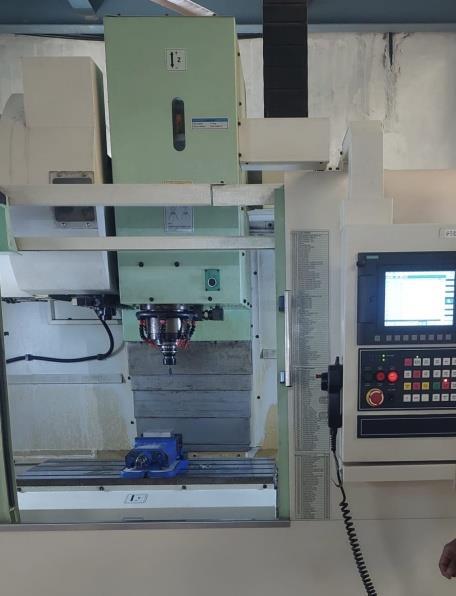
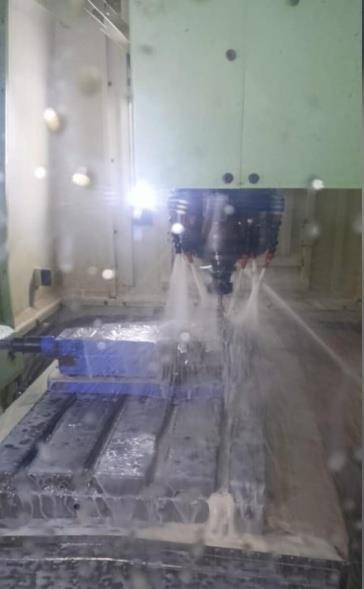
Table2Experimentalresults
(IRJET)
The objective of this work is to understand the creationofaproductorprocessdesignthatisinsensitiveto allpossiblecombinationsofuncontrollablenoisefactorsand isatthesametimeeffectiveandcost-efficientasaresultof setting the key controllable factors at certain levels. The centralpurposeofthisstudyistounderstandandevaluate theimpactofTaguchimethodsin qualityengineeringand management for product or process parameters optimizationbothinthemanufacturingindustryandservice industry.
Any process is the combination of one or more factorsandwillgivethebestpossibleoutputwhenallthese factors operate at the optimum values. If total number of factors and levels involved is more, then the number of experimentswillbecomeverylargebecauseofthisTaguchi designofexperimentsisusedwhichusesOrthogonalArray (OA)whichistheshortestpossiblematrixofcombinations.
Taguchi used the term signal and noise which represents wanted value (mean) for the response and unwanted value (standard deviation) for the response respectively. Based on the requirements of response, Taguchi has divided the S/N ratio into to three categories namelymedium-the-better,higher-the-betterandlower-thebetter.Inthepresentstudy,thequalitycharacteristicslike cutting temperature & Ra are the lower-the-better requirementwhereasMRRishigher-the-bettertoenhance themachinability. So, equation(2)and equation(3)have beenusedtocalculatetheS/Nratioandresultshavebeen showninTable3.TaguchianalysiswasdoneusingMinitab 17.0 software tool, means of S/N ratio plots results were obtainedandpresentedintheupcomingdiscussions.

S/Nratioforsmallerthebetter=-10log 2 (2)

S/Nratioforlargerthebetter=-10 - (3)
Table3Experimentalresultsandrespectivecalculated S/Nratios.
International
Volume: 11 Issue: 03 | Mar 2024 www.irjet.net p-ISSN: 2395-0072
3.1 Determination of optimum cutting conditions for cutting temperature
The obtained S/N ratio response table for the cuttingtemperatureisshowninTable4. Figure3represents themeanS/NratiographobtainedinMinitabsoftwaretool. Higher S/N ratio represents the minimum variation difference between the desirable output and measured output.FromFigure3,itwasnoticedthatthehighestmean S/Nratioobtainedforcuttingtemperaturearecuttingspeed at900RPM,feedrateat100mm/tooth,depthofcut0.6mm mmrespectively. Therefore,thepredictedoptimumprocess parametersforobtainingthelowcuttingtemperatureusing Taguchi method were found as cutting speed at 900RPM, feedrateat100mm/tooth,depthofcut0.6mmrespectively. Figure4showstheimpactofindividualprocessvariableson cuttingtemperature.
Table4MeanS/Nratioresponsetableforcutting temperature
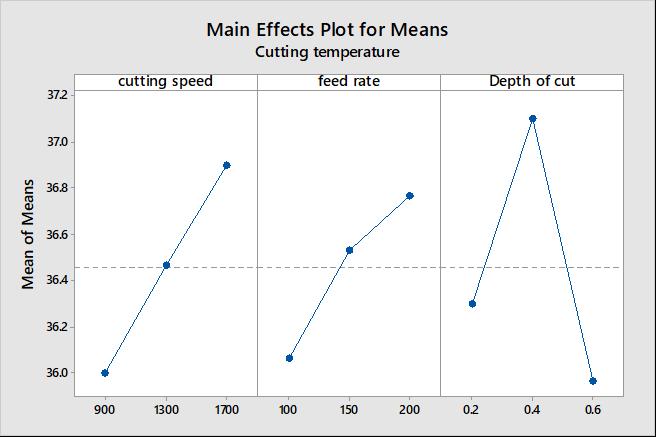
Figure4Effectofindividualprocessvariablesoncutting temperature
3.2 Determination of optimum cutting conditions for surface roughness
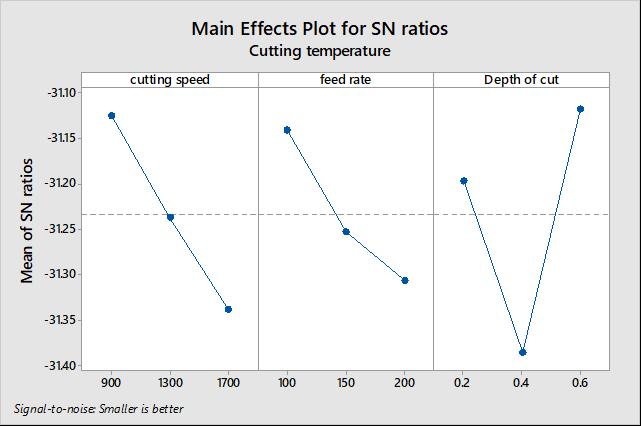
3MeanS/Nratioofcuttingtemperature
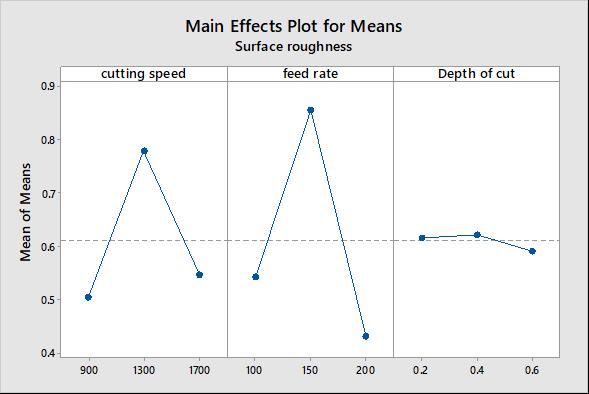
The obtained S/N ratio response table for the surfaceroughnessisshowninTable5. Figure5represents themeanS/NratiographobtainedinMinitabsoftwaretool. Higher S/N ratio represents the minimum variation difference between the desirable output and measured output.FromFigure5,itwasnoticedthatthehighestmean S/Nratioobtainedforsurfaceroughnessarecuttingspeedat 900RPM, feed rate at 200 mm/tooth, depth of cut 0.6mm respectively. Therefore, the predicted optimum process parametersforobtainingthelowsurface roughnessusing Taguchi method were found as cutting speed at 900RPM, feed rate at 200 mm/tooth and depth of cut 0.6mm respectively.Figure6showstheimpactofindividualprocess variablesonsurfaceroughness.
Table5MeanS/Nratioresponsetableforsurface roughness
International Research Journal of Engineering and Technology (IRJET) e-ISSN: 2395-0056
Volume: 11 Issue: 03 | Mar 2024 www.irjet.net p-ISSN: 2395-0072
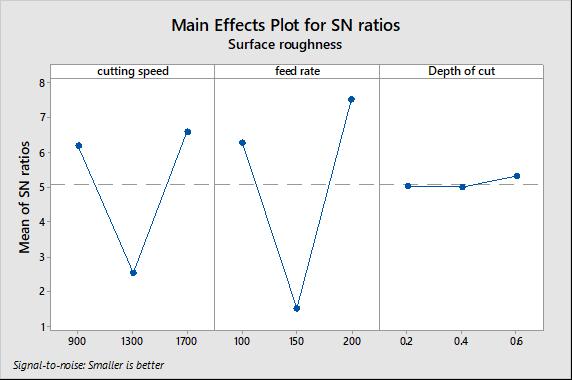
5MeanS/Nratioofsurfaceroughness
3.3 Determination of optimum cutting conditions for MRR:
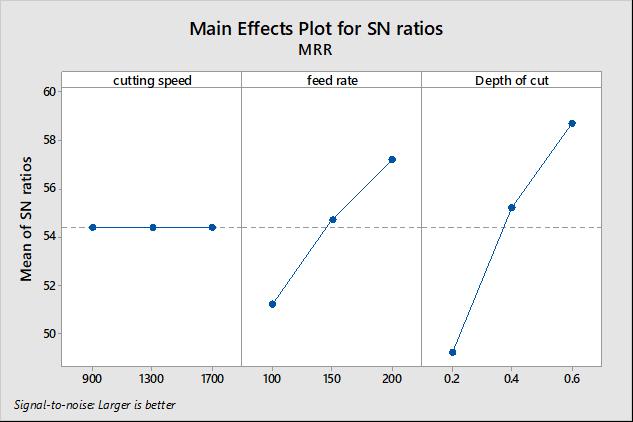
TheobtainedS/NratioresponsetablefortheMRR isshowninTable6. Figure7representsthemeanS/Nratio graphobtainedinMinitabsoftwaretool. HigherS/Nratio representstheminimumvariationdifference betweenthe desirableoutputandmeasuredoutput.FromFigure7,itwas noticedthatthehighestmeanS/Nratioobtainedfor MRR are cutting speed at 900RPM, feed rate at 200 mm/tooth, depthofcut0.6mmrespectively. Therefore,thepredicted optimum process parameters for obtaining the maximum MRRusingTaguchimethodwerefoundascuttingspeedat 900RPM,feed rate at200mm/tooth,depthofcut0.6mm respectively.Figure8showstheimpactofindividualprocess variablesonsurfaceroughness.
Table6MeanS/NratioresponsetableforMRR
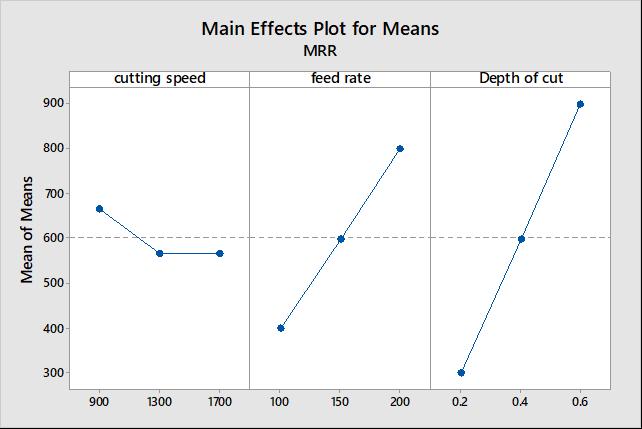
Confirmationtestsmustbeperformedinorderto validate the Taguchi predictedoptimal conditions. The confirmationexperimentswerecarriedoutatthenecessary positions at the Taguchi predicted optimum cutting conditions.ThefindingsweredisplayedinTable7foreach output,accordingly. Theperformancecharacteristicresults show an improvement when predicted optimum cutting conditionsaremetforalloutputs.
The Taguchi projected optimum cutting circumstances yield better outcomes than the initial parameter conditions, according to the confirmation experiments.Asaresult,whenendmillingAl5082material under the specified conditions, the Taguchi predicted optimumcuttingconditionswereconsideredtobethebest cuttingconditions. Basedonthefindings,itwasdetermined that, for the given process parameters, the Taguchi optimization method considerably enhanced the machinabilitypropertiesoftheAl5082material.
International Research Journal of Engineering and Technology (IRJET) e-ISSN: 2395-0056
Volume: 11 Issue: 03 | Mar 2024 www.irjet.net p-ISSN: 2395-0072
Table7ConformationtestresultsforCuttingtemperature, surfaceroughnessandMRR
Initialprocess parameter
Cutting temperature (oC)
Level N=900RPM,f=100 mm/tooth,depthof cut=0.2mm
Surface roughness (µm)
Level N=900RPM,f=100 mm/tooth,depthof cut=0.2mm
Surface roughness(µm)
Predictedoptimal process parameters
N=900RPM,f=100 mm/tooth,depth ofcut=0.6mm
N=900RPM,f=200 mm/tooth, depthofcut= 0.6mm
MRR (cc/min)
Level N=900RPM,f=100 mm/tooth,depthof cut=0.2mm
N=900RPM,f=200 mm/tooth,depth ofcut0.6mm
MRR(mm3/min) 200 1200
Optimum process variables were selected for all the outputsusingTaguchitechniqueandobservedsubstantial improvementintheendmillingprocessperformanceduring machining of Al5082 material at the Taguchi determined optimumconditionsrespectively.
Theoptimumprocessparametersforobtainingthe lowcuttingtemperatureusingTaguchimethodwere foundascuttingspeedat900RPM,feedrateat100 mm/tooth,depthofcut0.6mmrespectively.
Theoptimumprocessparametersforobtainingthe lowsurfaceroughnessusingTaguchimethodwere foundascuttingspeedat900RPM,feedrateat200 mm/tooth,depthofcut0.6mmrespectively.
Theoptimumprocessparametersforobtainingthe high MRR using Taguchi method were found as cutting speed at 900RPM, feed rate at 200 mm/tooth,depthofcut0.6mmrespectively.
[1] Liao, Y. S., Lin, H. M. and Chen, Y. C. (2007) ‘Feasibility studyoftheminimumquantitylubricationinhigh-speed
endmillingofNAK80hardenedsteelbycoatedcarbide tool’, International Journal of Machine Tools and Manufacture, 47(11), pp. 1667–1676. doi: 10. 1016 /j.ijmachtools.2007.01.005.
[2] DaSilva,R.B. etal. (2011)‘Toolwearanalysisinmilling of medium carbon steel with coated cemented carbide inserts using different machining lubrication/cooling systems’, Wear, 271(9–10), pp. 2459–2465. doi: 10.1016/j.wear.2010.12.046.
[3] Asilturk,I.andAkkuş,H.(2011)‘Determiningtheeffect of cutting parameters on surface roughness in hard turningusingtheTaguchimethod’, Measurement:Journal of the International Measurement Confederation, 44(9), pp. 1697–1704. doi: 10.1016/j.measurement.2011.07.003.
[4] Zhang,S.,Li,J.F.andWang, Y.W.(2012)‘Tool lifeand cuttingforcesinendmillingInconel718underdryand minimum quantity cooling lubrication cutting conditions’, JournalofCleanerProduction,32,pp.81–87. doi:10.1016/j.jclepro.2012.03.014.
[5] Duchosal,A. etal. (2015)‘Numericaloptimizationofthe Minimum Quantity Lubrication parameters by inner canalizationsandcuttingconditionsformillingfinishing process with Taguchi method’, Journal of Cleaner Production, 108, pp. 65–71. doi: 10.1016/j.jclepro.2015.07.126.
[6] Masmiati, N. et al. (2016) ‘Optimization of cutting conditionsforminimumresidualstress,cuttingforceand surfaceroughnessinendmillingofS50Cmediumcarbon steel’, Measurement: Journal of the International Measurement Confederation, 86, pp. 253–265. doi: 10.1016/j.measurement.2016.02.049.
[7] Hassanpour, H. et al. (2016) ‘Investigation of surface roughness,microhardnessandwhitelayerthicknessin hard milling of AISI 4340 using minimum quantity lubrication’, JournalofCleanerProduction,120,pp.124–134.doi:10.1016/j.jclepro.2015.12.091.
[8] Najiha, M. S., Rahman, M. M. and Kadirgama, K. (2016) ‘Performanceofwater-basedTiO2nanofluidduringthe minimumquantitylubricationmachiningofaluminium alloy,AA6061-T6’, JournalofCleanerProduction,135,pp. 1623–1636.doi:10.1016/j.jclepro.2015.12.015.
[9] Sivaiah, P. and Chakradhar, D. (2017) ‘Machinability studies on 17-4 PH stainless steel under cryogenic cooling environment’, Materials and Manufacturing Processes,32(15),pp.1775–1788.doi:10.1080/104269 14.2017.1339317.
International Research Journal of Engineering and Technology (IRJET) e-ISSN: 2395-0056
Volume: 11 Issue: 03 | Mar 2024 www.irjet.net p-ISSN: 2395-0072
[10]Mia,M.(2018)‘Mathematicalmodelingandoptimization ofMQLassistedendmillingcharacteristicsbasedonRSM and Taguchi method’, Measurement: Journal of the International Measurement Confederation, 121(February), pp. 249–260. doi: 10.1016/j. measurement.2018.02.017.
[11]ChukwujekwuOkafor,A.andJasra,P.M.(2018)‘Effects ofcoolingstrategiesandtoolcoatingsoncuttingforces and tooth frequency in high-speed down-milling of Inconel-718 using helical bull-nose solid carbide end mills’, International Journal of Advanced Manufacturing Technology, 97(5–8), pp. 2301–2318. doi: 10.1007/s00170-018-2096-5.
[12]Li, M. et al. (2019) ‘Parameter optimization during minimumquantitylubricationmillingofTC4alloywith graphene-dispersed vegetable-oil-based cutting fluid’, Journal of Cleaner Production,209,pp.1508–1522.doi: 10.1016/j.jclepro.2018.11.147.
[13]Mia,M.(2018)‘Mathematicalmodelingandoptimization ofMQLassistedendmillingcharacteristicsbasedonRSM and Taguchi method’, Measurement: Journal of the International Measurement Confederation, 121(February), pp. 249–260. doi: 10.1016/ j. measurement.2018.02.017.