
International Research Journal of Engineering and Technology (IRJET) e-ISSN: 2395-0056
Volume: 11 Issue: 03 | Mar 2024 www.irjet.net p-ISSN: 2395-0072
International Research Journal of Engineering and Technology (IRJET) e-ISSN: 2395-0056
Volume: 11 Issue: 03 | Mar 2024 www.irjet.net p-ISSN: 2395-0072
K.Tharani, R.Karthiga, S.K.Srinisa, Ms.A.Aruna,M.E.,
Student, Dept of AI&DS Muthayammal Engineering College Rasipuram, Tamil Nadu, India. Student, Dept of AI&DS Muthayammal Engineering College Rasipuram, Tamil Nadu, India. Student, Dept of AI&DS Muthayammal Engineering College Rasipuram, Tamil Nadu, India. Assistant Professor, Dept of AI&DS Muthayammal Engineering College Rasipuram, Tamil Nadu, India.
Abstract - Crop prediction is a process that uses deep learning to predict crop yields and other metrics based on a variety of factors such as weather, soil data, and crop history data. The goal of this mission is to provide farmers and other stakeholders with accurate and reliable information about desired crops that can help them make more informed decisions on planting, harvesting and other agricultural management. Crop forecasting problems present many challenges, includingtheneedforaccurateandtimelydata,the selection of features and characteristics for analysis, and the development of machine learning models suitable for forecasting. Additionally, forecast accuracymay beaffectedby factors such as regional differences in climate and soil, the presence of pests, and other environmental factors. To solve these problems, researchers and developers in the field of crop forecastinghavedevelopeddifferent types ofstudies,including the generation of preliminary data, selection of features, selectionofdeep learningmodels,andperformanceevaluation. These techniques will involve the use of different types of data, such as weather data, soil data, and crop data, as well as various deep learning methods such as multilayer perceptron algorithms and convolutional neural networks algorithms. Ultimately, the success of crop forecasting depends on the system's ability to accurately and reliably analyze data from multiplesources andthenpredictcropyieldsandother metrics with accuracy. Bysolvingtheseproblems, cropforecastinghas the potential to increase agricultural productivity and sustainability and support the development of more efficient and effective agriculture.
Key Words: Machine Learning, Deep Learning, Crop prediction.
Inrecentyears,theintegrationoftechnologiessuchasdeep learning and large-scale data analysis has changed many things, including agriculture. Accurate prediction of crop yieldisimportantforoptimizingagriculture,ensuringfood security and reducing financial risk for farmers. Modern methodsoftenrelyonhistoricaldataandsimplemodelsand lacktheabilitytouserichdatafromavarietyofsourcessuch assatelliteimages,weatherdata,soilcompositionandhealth indicators of crops. This article presents a new way to
analyze different types of agricultural data using deep learningforaccurate crop prediction. Our methodaims to capture relationships and patterns in agricultural ecosystemsbyintegratingdatafromdifferentsources,thus predictingcropyieldmoreeasilyandinatimelymanner.We explore the potential of deep learning, including convolutional neural networks (CNN), Multi layer perceptron (MLP), neural networks (RNN), and their variants,toprocessdataindifferentletters.Theintroduction highlightsthechallengesassociatedwiththeintegrationof traditional crop forecasting techniques and highlights the opportunitiesofferedbythecombinationofdeeplearning andmultivariatedataanalysis.Wediscusstheimportanceof each data change in preserving different aspects of crop growthand underscore the need for capable and interpretable models that can unravel the complexities of agriculture. We also present a draft of the paper that includesthemethodology,experimentalsetup,results,and discussiontoprovidereaderswithamethod.Throughthis research, we aim to contribute to the advancement of agricultural technology by publishing a general crop predictionmethodthatusesthepowerofdeeplearningand multiple data fusion. Our method has the potential to improve the decision-making processes of farmers, agriculturalpolicy makersand other stakeholders by increasing the accuracy and efficiency of crop forecasting, ultimately contributing to agricultural sustainability and foodsecurityaroundtheworld.
Crop prediction is a complex task influenced by many factors such as environment, soilqualityand agricultural practices.Modernmethodsoftenrelyonstatisticalmodels orsimplemachine learning methods that are difficult to capturerelationships in multimodal data. Crop forecasting involvesmanychallengesthatareinfluencedbyfactorssuch as environment, soil properties, cropdiversityand agriculturalpractices.Traditionalmachinelearningmodels oftenstruggletocapturecomplexrelationshipsincomplex agricultural systems, resulting in low accuracy. The main purposeofthisresearchistocreateanaccurateandpowerful crop prediction system that uses the power of deep learningtousedifferentdatasets.
International Research Journal of Engineering and Technology (IRJET) e-ISSN: 2395-0056
Volume: 11 Issue: 03 | Mar 2024 www.irjet.net p-ISSN: 2395-0072
Ourprojectpreparesasimple,accurateandlow-cost crop predictionsystem.Weproposeadeeplearningmethodfor croppredictionthatperformsbestincroppredictionusinga large dataset. This method uses deep neural networks to generatecropdatasuchassoildataandtext.Insummary, deeplearningmodelsshowpromiseinpredictingcropyield basedonenvironmentalvariablessuchastemperature,pH, precipitation,andsoilinformation.Usingneuralnetworksto analyze large, complex data, these models can identify patternsandrelationshipsthataredifficultordifficultfor humanstosee.Bytrainingamodelbasedonhistoricaldata and then using it to make predictions on new data,farmersandscientistscangainbetterinsightintothe cropsmostlikelytothriveinspecificenvironments.
The application process is an important stage in the development of life and marks the transition from the creationanddevelopmentofneworupdatedknowledgeto its actual use. This process includes physical installation ofhardwareandsoftware,configuringnetworksettings,and troubleshooting system faults to ensure trouble-free operation.Datamigration(ifnecessary)isanimportantstep in transferring datafrom the existing system to the new system by completing a detailed analysis and processing. Conductrigoroustestingincludingunit,integration,testing, and user acceptanceto identify and fix issues before full deployment. User training is an important part of the implementationandensuresthatendusersandsupportstaff areknowledgeableaboutnewfunctionalityandsupported by documentation, general and supporting information. Finally,integrationcanbedone,allowingthenewsystemto workwiththeoldsystemtemporarily,providingsecurityfor undetected issues before the migration is complete. This complete system is designed to make changes tonew or updatedinformation.
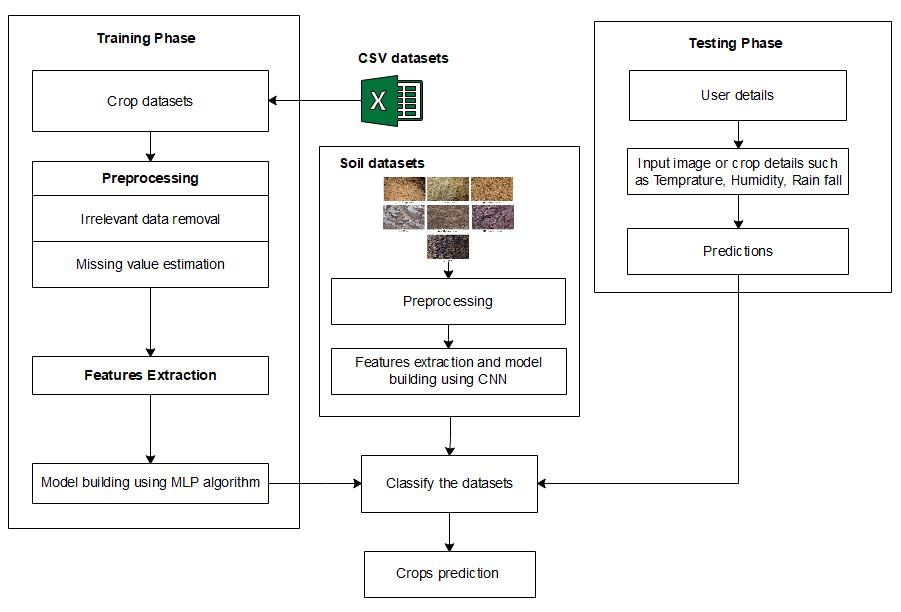
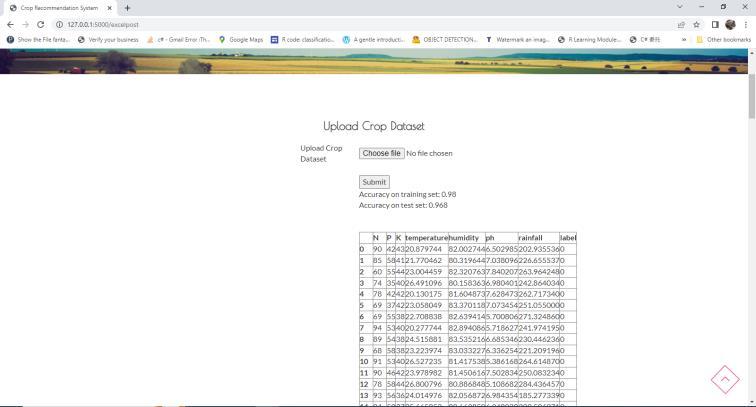
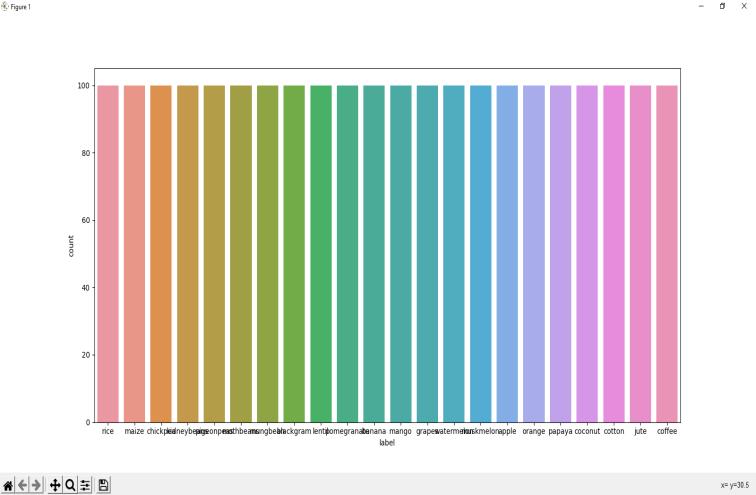
Inthismodel,wecanexportthecropyielddatasetinCSV fileformat.andstoretheinformationinadatabaseforfuture reference.Datasetsincludetemperature,precipitation,pH, nitrogen,phosphorusandpotassiumvalues.Theresultsare retrievedfromtheKagglewebsiteandtheresultsarestored as numerical values.andupload soil data in image format fromKAGGLE
Data pre-processingis an important step in the data mining process. The phrase"garbage in, garbage out"is particularly applicable to data mining andmachine learningprojects. Data preparation and filtering steps can take considerable amount of processing time. In this module, we can eliminate the irrelevant values and also estimate the missing values of data. Finally provide structureddatasets. Theninsoilimage,wecananalyzethe noises and remove the noises using Median filtering algorithm.
Medianfilteringisawidelyusedtechniqueforremoving noise from images, including soil images. It works by replacingeachpixelinanimagewiththemedianvalueofits neighbouring pixels. In the case of salt and pepper noise, which is common in soil images, median filtering can be particularlyeffectiveatremovingthenoisewhilepreserving theedgesanddetailsoftheimage.
Feature selection refers to the process of reducing and evaluating the actions of the material orfinding the most important points. In this module, various features are selectedfromtheloadeddataset.Usemultiplecroprecords
totraindatawithmanyusefulfeatures.Rice,cornetc.We cantraindataforvariouscropssuchasCollectfeaturessuch ascolor,shapeandtexturefromgrounddata.ToDesignthe
CNNarchitecture designed for terrain feature extraction tasks. This will include choosing the number and size of convolution and pooling operations, choosing the optimization function, and deciding on redundancy and optimization.
Inthismodel,wecanusemultilayerperceptronalgorithm toclassifythedataloaded.MLPalgorithmisoneofthemost popular learning algorithms used in classification and regression problems. Crop prediction using the MLP (multilayer perceptron) algorithm is a machine learning technique that involves using radio waves to predict crop yieldsbasedonenvironmentaldata.TheMLPalgorithmis aneural network that can learn the relationship between
International Research Journal of Engineering and Technology (IRJET) e-ISSN: 2395-0056
Volume: 11 Issue: 03 | Mar 2024 www.irjet.net p-ISSN: 2395-0072
inputvariablesandoutputpredictions.Duringtraining,the weightsoftheseconnectionsareadjustedtominimize the errorbetweenthepredictionandtheactualreturn.Oncethe MLPmodelistrainedandvalidated,itcanbeusedtopredict future crop yields based on new inputs. Input data often includesinformationaboutweather,soilquality,croptypes, andotherimportantfactors.TheMLPmodelprocessesthis inputdataandproducesapredictionoftheexpectedreturn. ThenusetheCNNalgorithmtotraintheimage.Thedatais dividedintotrainingset,validationsetandtestingset.The trainingprocessisusedtotraintheCNN,andthevalidation processisusedtotunethehyperparametersofthemodel and prevent over fitting. The testing procedure is used to evaluate the final performance of the model. Designing a CNNarchitecturesuitableforclassificationofgroundimages. This will include choosing the number and size of convolution and pooling operations, choosing the optimization function, and deciding on redundancy and optimization. Train the CNN ontrainingusing backpropagation and gradient descent. Monitor your model's performance through the validation process and adjusthyperparametersasnecessarytoavoidoverfitting.
Effective planning of land use and marketing policiesrequiresareasonableestimateofcropproductivity. Estimatesofcropyieldshaveincreasedinrecentyears.The biggestimpactoncropproductionisweatherconditions.We can use deep learning to evaluate the data in this model. Finally, crop recommendations andinformation are providedtoincreasetheaccuracy.Projectaccuracywasthe
calculatedbasedonprecision,regression,andFtest.Once the model is validated, it can be deployed for use in therealworld.Inthismodel,wepredictthereturnbasedon userinputandusethedataasamodelforclassification.This may involve integrating the model intoexistingcrop management systems or using it to make predictions forspecificareasorregions.
Agriculture is an important part of the Indian economy andthecountry's economy isdependent onagricultureto achieveruraldevelopment.India'sagriculturalstandardsare affected by climate change, unpredictable weather conditions, dwindling water supply, excessive use of pesticides,etc.fallsduetoWeexplainedtheagriculturaldata to understand the production level. The main aim of this research project is to provide a method that effectively describescropyield.Althoughmanystudieshavepresented statisticaldataonIndianagriculture,veryfewstudieshave investigatedcropforecastsbasedonhistoricalclimateand production data. Classification algorithms can be used for many purposes, including classification, clustering,
representativequantification,associationlevel,prediction, prediction, control, and activation. The use of basic regressionincurrentsystemsisatwo-stepapproach.Firstof all,changesinthePCRmethodarestoredandthesizeofthe dataisreducedandstoredinastandardtable.Itextractsthe maximum variation of the material and makes specific selectionsto reducedimensionality.And find thefactor in the direction that maximizes the distribution of observations;theothershouldmaximizethedistributionof thediagonal of the first factor. We can then rotate events verticallyandcontinuetheintegrationforlargerfiles.PCR results represent the difference in low-dimensional data structure.Secondly,wetriedtoattackthestructureofthe componentsrelatedtothesituation.PCReffectivelyresolves multiplesourcesandcollinearityissues.
Labeled databased classification, Provide high number of false positive, Binary classification can be occurred, Computationalcomplexity.
Predictingcropyieldbasedonenvironment,soil,water and product has not been the subject of research. Deep learningmodelsarewidelyusedtoextractimportantcrops forprediction.Althoughthesemethodscansolvetheyield predictionproblem,theyhavethefollowingdisadvantages: Adirectnonlinearorlinearmapofrawdataandcropyield cannotbecreated;Theperformanceofthismodeldepends on the quality of the extract. . Deeplearning provides guidanceandmotivationfortheabovecomplaints.
Deep learning combines reinforcement learning and deeplearning skills to create a complete crop breeding systemthatcanprocessoriginaldataforcropprediction.In thisproject,weuseadeepneuralnetworktopredictingthe yield of maize hybrids based on genotypic and environmental data, analyzing yield and yield differences. Deepneuralnetworksareinthecategoryofrepresentational learning models that can find the basis for the representationofdatawithoutmanuallyinputtingfeatures. Deepneuralnetworksconsistofmanynonlinearlayersthat, transforming the raw data inputinto a higher-level, more abstractmodelateachlayer.Therefore,asthenetworkgets deeper, morefeatures are extracted, which helps improve theaccuracy of the results. Considering informality, deep neuralnetworksareconsidereduniversalpredictors;This meanstheycanpredictalmostanytask,eventhoughitcan beverydifficulttofindflaws.
Accuracyishigh,Parallelprocessing,Reducenumberoffalse positiverate.Timeandthecomputationalcomplexitycanbe reduced.Thissystemisuserfriendly.
International Research Journal of Engineering and Technology (IRJET) e-ISSN: 2395-0056
Volume: 11 Issue: 03 | Mar 2024 www.irjet.net p-ISSN: 2395-0072
Thissystemhas2mainmodulesandtheirsubmodules:

Administrator Login:
The administrator can log in using the username and password.

Manage Items:
Adminis can view the user registration and their information.
User Information:

User Registration:
Users must first register to enter the system using their informations like Name, Gender, Age, Email id, Phone number,Address,UserName,Password.

User Login:

Crop Prediction : Usersneedtouploadsoildataorimages oftheland.

International Research Journal of Engineering and Technology (IRJET) e-ISSN: 2395-0056
Volume: 11 Issue: 03 | Mar 2024 www.irjet.net p-ISSN: 2395-0072
Crop Dataset :
Itanalysedata fromavarietyofsources,andthenpredict cropyieldsandotherrelevantmetricswithahighdegreeof accuracy.
Application
Thissystemaimstodevelopaccuratecroppredictionmodels using deep learning and multimodal data to improve agriculturaldecision-making.
Software Components
peratingSystem : WindowsOS
FrontEnd : Python
IDE : Pycharm
BackEnd : MySQL
Application : WebApplication
Hardware Components
Processor : IntelProcessor2.6.0GHZ
RAM : 4GB
Harddisk : 160GB
CompactDisk : 650GB
Keyboard : StandardKeyboard
Monitor : 15inchcolormonitor
Wedisplayedadeeplearningapproachfortrimexpectation, which illustrated prevalent execution in Trim Challenge utilizing huge datasets of items. The approach utilized profoundneuralsystemstomakecropdatasetssuchassoil and literary datasets. In conclusion, profound learning models offer a promising arrangement for foreseeing edit yields based on natural factors such as temperature, pH, precipitation, and soil information. By utilizing neural systems to dissect expansive and complex datasets, these modelscanrecognizedesignsandconnectionsthatwouldbe troublesome or outlandish for humans to perceive. By training the demonstrate on verifiable information and at that point utilizing it to make expectations on modern information, agriculturists and analysts can pick up profitable experiences into which crops are most likely to flourishbeneathcertainnaturalconditions.Bethatasitmay, there are still a few challenges to overcome, such as the require for high-quality and different information, the trouble of translating complex neural systems, and the potentialforpredispositionandmistakesinthepreparing information. By and large, profound learning holds extraordinaryguaranteeforrevolutionizingthefieldoftrim expectationandmakingadifferencetobolsteradeveloping worldwidepopulace
[1] Abbas, Farhat, et al.: Crop yield prediction through proximal sensing and machine learning algorithms.Agronomy10.7:1046.(2020)
[2] Anantha, K. H., et al.: Impact of best management practices on sustainable crop production and climate resilience in smallholder farming systems of South Asia.AgriculturalSystems194:103276.(2021)
[3] Bian,Chaofa,etal.:PredictionofField-ScaleWheatYield UsingMachineLearningMethodandMulti-SpectralUAV Data.RemoteSensing14.6(2022):1474.(2019)
[4] Gao,H.,Lu,J.,Zhang,Y.,Wang,L.,&Xu,X.(2019).Deep learning for plant disease detection and diagnosis: A review.PlantDisease,103(9),2331-2342.
[5] Jiang, F., Ding, M., & Dai, H. (2021). Spatiotemporal predictionofcropyieldusingdeeplearning:Areview. InformationProcessinginAgriculture,8(2),290-301.
[6] Jin,X.,Kumar,L.,Li,Z.,Feng,H.,&Xu,X.(2018).Deep learning:Individualmaizesegmentationfromterrestrial lidar data using faster R-CNN and regional growth algorithms. Agricultural and Forest Meteorology, 256, 228-239.
[7] Kussul, N., Lavreniuk, M., Skakun, S., & Shelestov, A. (2017). Deep learning classification of land cover and
International Research Journal of Engineering and Technology (IRJET) e-ISSN: 2395-0056
croptypesusingremotesensingdata.IEEEGeoscience andRemoteSensingLetters,14(5),778-782.
[8] Liakos,K.G.,Busato,P.,Moshou,D.,Pearson,S.,Bochtis, D., & Machine, D. L. (2018). Machine learning in agriculture:Areview.Sensors,18(8),2674.
[9] Liu, Y., Jain, A., Hamilton, H., Reinhardt, W., & Du, J. (2020).Cropyieldpredictionusingdeepconvolutional neural networks. Computers and Electronics in Agriculture,176,105674.
[10] Milioto,A.,Lottes,P.,Stachniss,C.,&Behley,J.(2020). Real-timesemanticsegmentationofcropandweedfor precision agriculture robots leveraging background knowledge in CNNs. IEEE Robotics and Automation Letters,5(2),391-398.
[11] Mishra, Subhadra, Debahuti Mishra, and Gour Hari Santra.: Adaptive boosting of weak regressors for forecasting of crop production considering climatic variability: An empirical assessment.Journal of King Saud University-Computer and Information Sciences32.8:949-964.(2020)
[12] Mohanty,S.P.,Hughes,D.P.,&Salathé,M.(2016).Using deeplearningforimage-basedplantdiseasedetection. Frontiersinplantscience,7,1419.
[13] Nishant,PotnuruSai,etal.:Cropyieldpredictionbased on indian agriculture using machine learning.2020 International Conference for Emerging Technology (INCET),IEEE.(2020)
[14] Palanivel,Kodimalar,andChellammalSurianarayanan.: Anapproachforpredictionofcropyieldusingmachine learningandbigdatatechniques.InternationalJournalof ComputerEngineeringandTechnology10.3:110-118. (2019)
[15] Pandith, Vaishali, et al.: Performance evaluation of machine learning techniques for mustard crop yield prediction from soil analysis.Journal of Scientific Research64.2:394-398.(2020)
[16] Paudel, Dilli, et al.: Machine learning for large-scalem crop yield forecasting.Agricultural Systems187:103016.(2021)
[17] Ramcharan,A.,Baranowski,K.,McCloskey,P.,Ahmed,B., Legg,J.,&Hughes,D.P.(2017).Deeplearningforimagebased cassava disease detection. Frontiers in plant science,8,1852.
[18] Roy,D.P.,Wulder,M.A.,Loveland,T.R.,Woodcock,C.E., Allen,R.G.,Anderson,M.C.,...&Zhu,Z.(2014).Landsat8: Science and product vision for terrestrial global changeresearch.RemoteSensingofEnvironment,145, 154-172.
[19] Singh, A., & Ganapathysubramanian, B. (2017). Deep learningforplantstressphenotyping:trendsandfuture perspectives.Trendsinplantscience,22(7),563-575.
[20] Talaviya, Tanha, et al.: Implementation of artificial intelligenceinagricultureforoptimisationofirrigation and application of pesticides and herbicides.Artificial IntelligenceinAgriculture4:58-73.(2020)
[21] Van Klompenburg, Thomas, Ayalew Kassahun, and Cagatay Catal.: Crop yield prediction using machine learning:Asystematicliteraturereview.Computersand ElectronicsinAgriculture177:105709.(2020)
[22] Xiong, Y., Ma, W., Qiu, Y., Ma, X., Jiang, L., & Yang, G. (2020). Deep learning for high-dimensional remote sensing data in precision agriculture: A review. ISPRS Journal ofPhotogrammetry andRemote Sensing,159, 294-308.
[23] Zhang,C.,Zhang,J.,Qi,C.R.,Shi,B.,&Wang,X.(2021). Spatial-temporal dynamic monitoring of crop growth conditionsusingdeeplearning:Areview.ISPRSJournal ofPhotogrammetryandRemoteSensing,171,150-166.
[24] Zhang, Y., & Li, C. (2021). Deep learning based crop classification from high resolution remote sensing images: A review. Computers and Electronics in Agriculture,187,106311.
[25] Zou, Z., Wu, Q., Li, Q., & Cheng, G. (2018). A review of machinelearningmethodsforcropyieldpredictionand Nfertilizeroptimization.Sustainability,10(11),4221.
Volume: 11 Issue: 03 | Mar 2024 www.irjet.net p-ISSN: 2395-0072 © 2024, IRJET | Impact Factor value: 8.226 | ISO 9001:2008