
International Research Journal of Engineering and Technology (IRJET) e-ISSN: 2395-0056
Volume: 11 Issue: 03 | Mar 2024 www.irjet.net p-ISSN: 2395-0072
PROF.
International Research Journal of Engineering and Technology (IRJET) e-ISSN: 2395-0056
Volume: 11 Issue: 03 | Mar 2024 www.irjet.net p-ISSN: 2395-0072
PROF.
HEENA PATIL1, PROF. RENUKA DINGORE2 , HARDIK CHAVAN3 , MOURYA B.N4 , HARSH
MISHRA5 .
1Head of Department, Dept. of AIML Diploma, ARMIET ,Maharashtra, India
2Lecturer, Dept. of AIML Diploma, ARMIET ,Maharashtra, India
3Student, Dept. of AIML Diploma, ARMIET ,Maharashtra, India
4Student, Dept. of AIML Diploma, ARMIET ,Maharashtra, India
5Student, Dept. of AIML Diploma, ARMIET ,Maharashtra, India
Abstract: The agriculture industry is critical to ensuring global food security, hence early diagnosis of plant diseases is critical. Deep Learning (DL) algorithms have emerged as powerful tools for automating the detection of leaf diseases, resulting in better crop management and higher agricultural yields. Deep Learning models, particularly Convolutional Neural Networks (CNNs), have proven to be extremely effective at automating disease detection in plants. DL algorithms can learn complicated patterns and features that distinguish between diseasedandhealthy leaf photos, allowing them to accurately identifynumerous plant illnesses. The study used a dataset full of field images that we pre-trained on deep convolutional neural network called MobilNet and a method known as transfer learning by demonstrating the potential of deep learning approaches in detecting leaf disease. To achieve this goal, the transfer learning model was fine-tuned using a variety of hyperparameters and achieved an 95% accuracy rate
Key Words: Disease detection, Deep learning, MobileNet, Transformer etc
In recent years, the agricultural sector has witnessed a transformativeshiftinthewayplantdiseasesarediagnosed andmanaged.Traditionalmethodsofdiseaseidentification, whichofteninvolvevisualinspectionbyhumanexperts,are labour-intensive and may lead to delayed interventions, potentiallycausingsignificantcroplosses.Toaddressthese challenges,theintegrationofDeepLearning(DL)techniques has emerged as a groundbreaking approach for the automatedandaccuratedetectionofleafdiseasesinplants.
DeepLearningisasubsetofmachinelearningthatfocuses ontrainingartificialneuralnetworkstoautomaticallylearn and extract intricate patterns from data. Specifically, ConvolutionalNeuralNetworks(CNNs)haveproventobe highly effective for image-related tasks, making them particularlysuitedforleafdiseasedetection.TheuseofDL for leaf disease detection offers several advantages, including speed, accuracy, and scalability. It enables early disease identification, allowing for timely interventions, reducing crop losses, and promoting more sustainable
farming practices. Moreover, DL can be applied in remote sensingapplications,wherelargeagriculturalareascanbe monitoredefficiently.[3]
Inthemostofstudies,thePlantVillagedatasetwasutilizedto assess the performance of the DL models. Although this datasetcontainsmanyphotosofmanyplantspeciesandtheir illnesses,theywerecapturedinalaboratory.Asaresult,itis projectedtogenerateasubstantialdatasetofplantdiseases in real-world settings. Although some research uses hyperspectral pictures of ill leaves, and various DL frameworks are used for early identification of plant leaf diseases,issuesthatimpedethebroadapplicationofHSIin plantdiseasedetectionremainunresolved.
Thatis,labeleddatasetsforearlyplantdiseasedetectionare difficulttoget,andevenexperiencedspecialistsareunableto pinpoint where the invisible disease symptoms are and designatetotallyinvisiblediseasepixels,whichiscriticalfor HSItodetectplantdisease.[2]
DL-basedsystemsaredesignedtoidentifyplantdiseases at an early stage. This enables farmers and agricultural experts to take prompt action to mitigate the spread of diseasesandminimizecroplossesTheprimarypurposeisto protect crops from diseases. Timely detection allows for targetedinterventions,suchasapplyingtherightamountof pesticides or adopting disease-resistant crop varieties, to safeguardagriculturalyields.Byidentifyingandmanaging diseases effectively, DL helps increase crop productivity. Healthy plants are more likely to produce higher yields, contributingtofoodsecurityandeconomicsustainability.
Accuratediseasedetectionandmanagementreducethe need for excessive pesticide use, which can have negative environmental consequences.DL helpsinusingpesticides morejudiciously,minimizingecologicalharm.DLprovides valuable data and insights to farmers and agricultural experts, empowering them to make informed decisions aboutdiseasemanagementstrategies,irrigation,andother
International Research Journal of Engineering and Technology (IRJET) e-ISSN: 2395-0056
Volume: 11 Issue: 03 | Mar 2024 www.irjet.net p-ISSN: 2395-0072
agriculturalpractices.DL-baseddiseasedetectionservesasa platformforongoingresearchanddevelopmentinthefield ofagriculturaltechnology.Researcherscontinuouslyrefine models, improve data collection techniques, and explore novelapplications.[1]
CJakulinEtal.,[1]statedthatCNNandotherDLtechniqueof classificationinMLcanbeusedforplantdiseasedetection. Lili Li et al., [2] mentioned that plant village dataset has imagestakeninlab.Itisexpectedtoestablishalargedataset inrealcondition.Torkietal.,[4]thisreviewsummarizesthe progressmadeinDeeplearningtechniquesforplantdisease detectionandprovidesinsightsintothechallengesandfuture directionsofthefield.Ferentinos.,[5]thissurveyprovidesan overviewofvariousdeeplearningtechniquesappliedplant disease detection including CNNs and discusses their advantagesanddisadvantages.
Theproposedsystemaimstoadvancethefieldofleafdisease detectionbyintroducinganovel deeplearningmodelthatis trainedonameticulouslycuratedanddiversedatasetofleaf images. Theprojectisdrivenbytheneedformoreaccurate androbustdiseaseidentificationinplants,with aspecific focusonenhancingtheexistingmethodologiesbyharnessing thepowerofcutting-edge deeplearningtechniques.The proposedsystemusestheplantdiseaseclassificationmerged datasetwith88classeswhichhasabove76000imagesand accuracyasperformancematrix
Thenewdatasetisutilizedtotrainthedeeplearningmodel usingacarefullydevisedtrainingstrategy.Transferlearning frompre-trainedmodelsisexplored,enablingthenetworkto leverageknowledgefromrelatedtaskswhileadaptingtothe specific challenges of leaf disease detection. The training process involves hyperparameter tuning, optimization techniques, and regularization to ensure the model's robustnessandperformance.Thefoundationoftheproposed system is the development of a new dataset that covers a wide range of plant species, diseases, and environmental conditions. This dataset is compiled from various sources, including field images, controlled environment data, and remote sensing imagery, to ensure diversity and representativeness.Rigorousdatacurationandannotation arecarriedouttoprovideaccuratelabelsforeachimage,and data augmentation techniques are applied to increase the dataset'ssizeanddiversity
Plant Disease Classification Merged Dataset., [6] This dataset is compiled from various sources, including field images, controlled environment data, and remote sensing imagery, to ensure diversity and representativeness. Rigorous data curation and annotation are carried out to
provide accurate labels for each image, and data augmentationtechniquesareappliedtoincreasethedataset's sizeanddiversity.Whatcannotbeavoidedingeneralisabias among the classes, since in some cases different shooting conditionswereusedfortheimages(e.g.classeswithmainly laboratoryimagesordifferentsoilinthebackground)
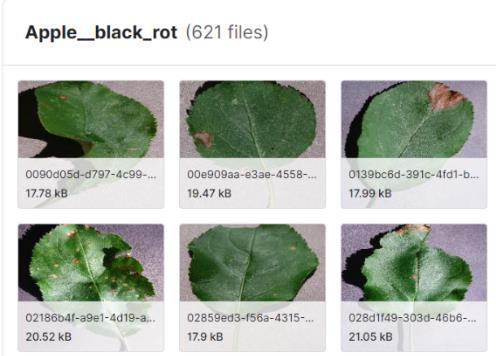
Thesamplesofleafimagesinthedatabaseareshownin
Fig1.PlantDiseaseClassificationMergedDataset
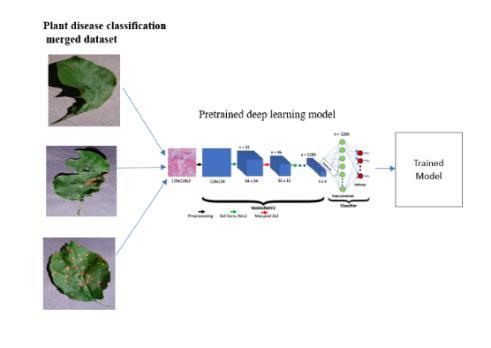
Wehavetrainedthedatasetonpretrainedmodelknown asMobileNetV2.Mobilenetsarelowpoweredmodelsthatwe canuseeffectivelyforclassificationofleafimagesandalso usedtoextractfeatures.
Fig2.ModelArchitecture
TrainingtheModel- The next stepis tocompile the model and then train it on a training dataset. The following parametersneedtobespecifiedforcompilingthemodel: WehaveusedtheAdamoptimizationtechniquebecauseit always leads to a smoother way than other optimization techniques. Adam is an optimization algorithm that uses adaptive moment estimation to generate more efficient
International Research Journal of Engineering and Technology (IRJET) e-ISSN: 2395-0056
Volume: 11 Issue: 03 | Mar 2024 www.irjet.net p-ISSN: 2395-0072
neural network weights [7]. We have used the optimizer: Adam with betas= (0.9,0.999) and epsilon=1e-08 ,learning_rate:5e-5.loss→Inourcasewehaveused“sparse categorical_crossentropy”.Sparsecategoricalcrossentropy canbeusedforintegertargetsinsteadofcategoricalvectors [8]. In order to fit the model we have used the batch size 256epochs→Anepochisameasureofhowmanytimesthe wholetrainingsetofimagesisusedonce.
Theconfusionmatrix[9,10]ofprojectisshowninFig.3
Fig.3ConfusionMatrix
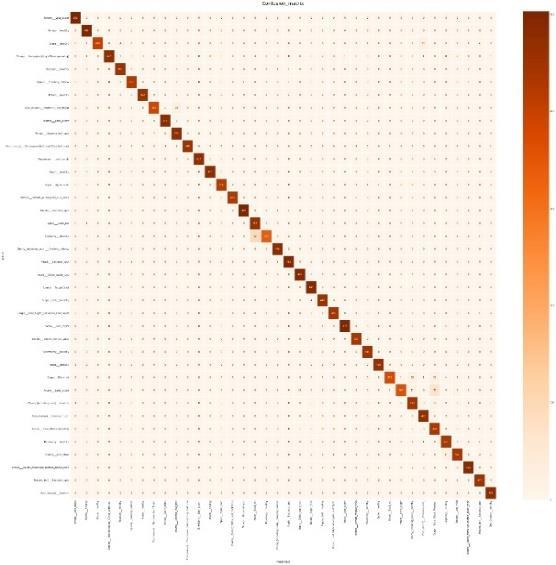
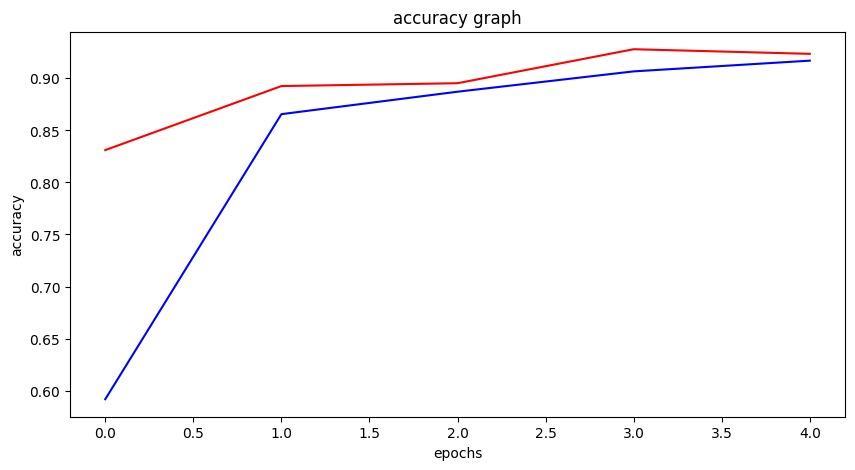
Themodelisvalidatedwithtrainingandtestingdataset. Themodelresultsin95%accuracyfor80%oftrainingset and 93% accuracy for testing set. The model is fine tuned withGeminiAPItoimprovevisiontechniques
FIg4.PredictedDisease
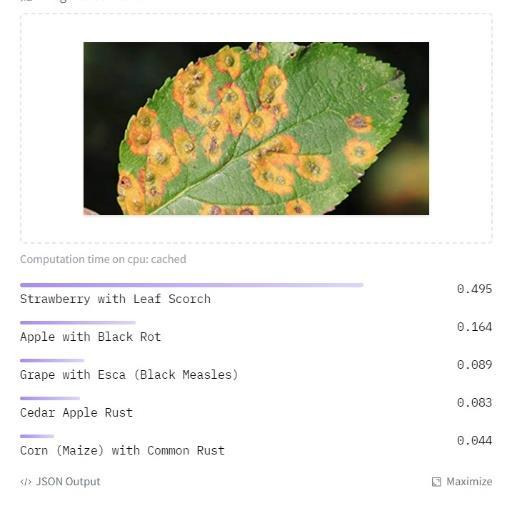
Fig5.PerformanceMatrix
The hardware specification i.e CPU: Intel core i5 or i7, RAM: 8GB of RAM, Storage: 250GB SSD and Software Specification i.e Operating system: Windows 10, Python 3, Frameworks: Transformers 4.27.3, Pytorch 1.13.0, Tokenizers 0.13.2, CNN architecture: Mobillenet is recommendedto carryoutthisproject.
Inconclusion,earlydetectionofplantdiseasesiscrucialto reducecropyieldloss.Theuseofdeeplearningmodelssuch as Mobile Net can help detect plant diseases with high accuracy. The research also highlights the importance of evaluating models using field based database to gain a comprehensive understanding of their capabilities. The proposedmodelidentifiesthetypeofdiseasebasedonthe plantleafimageusingMobileNet.Theresultsofthisresearch havethecapacitytoenhancetheefficiencyandefficiencyof identifyingandtreatingdiseasesintheagriculture.Infuture weareplanningtoimplementitwithdlpowereddronesand internetofthings(IoT)sensorswithmoreaccuracy.
[1]CJakulin,S.Murgavalli,"Acomprehensivereviewon detectionofplantdiseasewingmachinelearninganddeep learning approaches Measurement”: Sensors & September 2022,doi.org/10.1016/j.mesen.2022.100441
[2] Lili Li, SHUJUAN ZHANG AND BIN WANG," "Plant disease detection and classification by deep learning - A Review",Digitalobjectidentifier,April2021
[3]VaishnaviMonigari,G.KhyathiSri,T.Prathima,“Plant LeafDiseasePrediction”,InternationalJournalforResearch inAppliedScience&EngineeringTechnology(IJRASET)ISSN: 2321-9653;ICValue:45.98;SJImpactFactor:7.429Volume9 IssueVIIJuly2021
[4]Torkietal.,"Deeplearningforplantdiseasedeletion: Acomprehensivereview2019
[5]KonstantinosP.Ferentinos,“Deeplearningmodelsfor plant disease detection and diagnosis", Computs and
International Research Journal of Engineering and Technology (IRJET) e-ISSN: 2395-0056
Volume: 11 Issue: 03 | Mar 2024 www.irjet.net p-ISSN: 2395-0072
Elechonis in Agriculture volume 145, Febrary 2018, Pages 311-318,doi.org/10.1016/3.Compag2018.01.00g
[6] DOBROVSKY,ALINE.(2022)'Plant Disease Classification Merged Dataset'.Available at;https://www.kaggle.com/datasets/alinedobrovsky/plantdisease-classification-merged-dataset
[7]DeepAI.“AdamDefinition|DeepAI.”DeepAI,DeepAI, 5AD.
[8]ChristianVersloot.“SparseCategoricalCrossentropy LosswithTF2andKeras–MachineCurve.”MachineCurve,6 Oct.2019.
[9]RadhikaBhagwat,YogeshDandawateComprehensive multilayer convolutional neural network for plant disease detection Int. J. Adv. Comput. Sci. Appl., 12 (1) (2021), pp. 204-211
[10 ]Rehan Ullah Khan, Khalil Khan, Waleed Albattah, Ali MustafaQamarImage-baseddetectionofplantdiseases:from classicalmachinelearningtodeeplearningjourneyWireless Commun.Mob.Comput.,2021(2021),pp.1-13
2023, IRJET | Impact Factor value: 8.226 | ISO 9001:2008