
International Research Journal of Engineering and Technology (IRJET) e-ISSN:2395-0056
Volume: 11 Issue: 03 | Mar 2024 www.irjet.net p-ISSN:2395-0072
International Research Journal of Engineering and Technology (IRJET) e-ISSN:2395-0056
Volume: 11 Issue: 03 | Mar 2024 www.irjet.net p-ISSN:2395-0072
Rishikesh Tiwari1, Mr. Ushendra Kumar2
1Master of Technology, Civil Engineering, Lucknow Institute of Technology, Lucknow, India
2Head of Department, Department of Civil Engineering, Lucknow Institute of Technology, Lucknow, India
Abstract - Special Moment Resisting Frame (SMRF) structures play a critical role in mitigating seismic forces in regions prone to earthquakes. Understanding the effect of lateral forces on SMRFs is essential for ensuring their structuralintegrityandsafety.Thisreviewpaperexploresthe impactoflateralforcesonSMRFstructuresacrossvarioussoil types, as specified by IS 1893 Part-1:2016. Soil type significantly influences the behavior of structures during seismic events, making it imperative to comprehend its interactionwithlateralforces.Throughanextensiveliterature review, this paper examines the response of SMRF structures tolateralforcesindifferentsoilconditions,consideringfactors suchassoilstiffness,dampingcharacteristics,andfoundation design. Additionally, the paper evaluates the seismic performance criteria outlined in IS 1893 Part-1:2016 concerning SMRF structures and soil types. By synthesizing existingresearchfindings,thisreviewaimstoprovideinsights into optimizing the design and performance of SMRF structures under lateral forces in diverse soil environments, ultimately contributing to enhanced seismic resilience in structural engineering practices.
Key Words: Seismic effects, Masonry walls, Reinforced concrete structures, Openings, Structural positioning, Seismicbehavior,Structuraldynamics.
Theconcept ofusing moment resisting framesin building constructiontracesbacktotheearly20thcentury,primarily as a response to the devastating earthquakes that highlightedthevulnerabilityoftraditionalbuildingdesigns. However,itwasnotuntilthelatterhalfofthe20thcentury thatthedevelopmentofSpecialMomentResistingFrames (SMRFs)emergedasasignificantadvancementinseismicresistant structural engineering. In the 1960s and 1970s, pioneering research and experimentation in structural engineering,particularlyin earthquake-proneregionslike California,ledtotherefinementofmomentresistingframe systems. Engineers and researchers sought to create structuraldesignscapableofefficientlydissipatingseismic energy while maintaining structural integrity during earthquakes.
Theterm"SpecialMomentResistingFrame"wasformalized intheseismicdesignprovisionsoftheUnitedStatesinthe 1970sand1980s.Theseframeswerespecificallyengineered toresistlateralforcesgeneratedbyseismicevents,utilizing theductilityofsteelandreinforcedconcretetoabsorband redistributeenergy. Throughoutthelatterpartofthe20th century and into the 21st century, advancements in computational modeling, material science, and seismic analysis techniques further enhanced the design and performance of SMRF structures. This period saw the refinement of design codes and standards, such as the AmericanSocietyofCivil Engineers(ASCE)standardsand the International Building Code (IBC), which provided comprehensiveguidelinesforthedesignandconstructionof SMRFs to withstand seismic forces. The history of SMRF structuresisintertwinedwithsignificantseismiceventsand thelessonslearnedfromtheirimpactonbuiltenvironments. As earthquakes continue to pose a threat to communities worldwide, ongoing research and innovation in structural engineeringensurethatSMRFsevolvetomeetthechallenges ofseismicresilienceinthebuiltenvironment.Today,SMRFs remain a cornerstone of seismic-resistant construction, providing safety and stability in regions prone to earthquakes.
A Reinforced Concrete (RC) frame structure is a stalwart configurationemployedinconstructionprojectsworldwide. Itcomprisesaninterplayofcolumns,beams,slabs,andother reinforced concrete elements meticulously engineered to bear loads efficiently while ensuring structural integrity. Columns,standingasverticalsupports,transmittheweight frombeamsandslabstothefoundation,boastingenhanced strength and flexibility through embedded steel reinforcement.Beams,inturn,horizontallytraversebetween columns, evenly distributing loads and fortifying the structure against bending and shear forces. These componentsconvergewithslabs,formingtheframeworkfor floors,roofs,orceilings,withreinforcementimbuingthem with resilience against structural strains. Joints, critical nexus points, facilitate load transfer and are meticulously designedtowithstandlateralforcessuchaswindorseismic activity. Foundations, the bedrock of stability, anchor the structuretotheunderlyingterrain,oftenconstructedwith
International Research Journal of Engineering and Technology (IRJET) e-ISSN:2395-0056
Volume: 11 Issue: 03 | Mar 2024 www.irjet.net p-ISSN:2395-0072
reinforcedconcretefootingsorpilestomitigatesettlement andensureevenloaddistribution.Withinthisframework, thestrategicplacementanddetailingofreinforcementsteel synergize with concrete, imparting tensile strength and ductility, thus reinforcing the structure's durability and performanceunderdiverseconditions.Inessence,RCframe structures epitomize a harmonious blend of strength, adaptability,andreliability,offeringarobustsolutionfora myriadofarchitecturalendeavors.
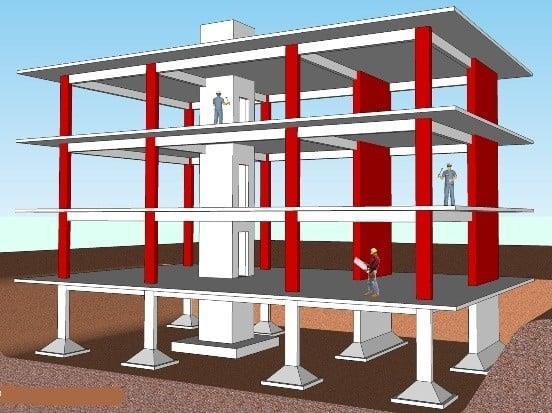
Special Moment Resisting Frames (SMRF) and Ordinary Moment Resisting Frames (OMRF) represent two distinct approachestoaddressinglateralloadsinbuildingstructures. SMRFs are meticulously engineered to withstand seismic forces, characterized by enhanced ductility, robust connections,andadherencetostringentdesignstandards. Theseframesprioritizeresilience,incorporatingspecialized detailing and reinforcement to ensure the structure can undergo significant deformations while maintaining stability. Conversely, OMRFs follow more conventional designpractices,offeringlateralloadresistancesuitablefor regionswithlowerseismicactivityorlessstringentseismic design requirements. While OMRFs may be more costeffective and simpler to construct, they typically exhibit lower levels of ductility and may not withstand severe seismiceventsaseffectivelyasSMRFs.Thechoicebetween SMRFsandOMRFsdependsonfactorssuchasseismicrisk, building codes, and project budget, with SMRFs offering unparalleled seismic performance and safety, albeit at a higher construction cost, while OMRFs provide a balance betweencost-effectivenessandstructuraladequacyinless seismicallyactiveregions.
IS 1893 Part 1:2016 is a code published by the Bureau of Indian Standards (BIS) that pertains to criteria for earthquakeresistantdesignofstructures.Whileitdoesn't specificallyclassifysoiltypes,itdoesprovideguidelinesfor assessing soil properties and their impact on structural design. Soil types are typically classified based on their engineering properties such ascohesion, angle of internal friction, permeability, etc., which are crucial for seismic designconsiderations.Forseismicdesignpurposes,soilsare broadly categorized into different classes based on their characteristics.Theseclassificationsareoftenbasedonthe seismic hazard they pose and their response during an earthquake.Somecommonsoiltypesconsideredinseismic designcodesinclude:
Soft Soil: Softsoiltypicallyincludesloosesands,silts,and clayswithpoorengineeringproperties.Softsoilshavelow shear strength and can undergo significant settlement or liquefaction during an earthquake, leading to amplified ground motion. Structures founded on soft soil may experiencehigheraccelerationsanddisplacementsduring seismic events. Special foundation systems, such as deep pilesorgroundimprovementtechniques,mayberequiredto mitigatetheeffectsofsoftsoilonstructures.
Medium Soil: Medium soil includes soils with moderate stiffness and strength, such as moderately dense sands or siltysands.Thesesoilshavebetterengineeringproperties compared to soft soil but may still experience some amplification of ground motion during earthquakes. The responseofstructuresfoundedonmediumsoilisgenerally lessseverecompared tosoftsoil,butstill requirescareful consideration in seismic design. Foundation design for structures on medium soil may involve a combination of shallowanddeepfoundationelements,dependingonsitespecificconditions.
Hard Soil: Hardsoil includessoilswith high stiffnessand strength,suchasdensesands,gravels,orrock.Thesesoils have excellent bearing capacity and minimal settlement, offering favorable conditions for structural support. Structuresfoundedonhardsoiltypicallyexperienceminimal amplification of ground motion during earthquakes. Foundationdesignforstructuresonhardsoilmayinvolve relatively simple shallow foundation systems, although consideration of site-specific seismic hazards is still necessary.
Special moment resisting frames (SMRFs) serve a critical purpose in structural engineering, primarily designed to withstandlateral forces,notablythoseinducedbyseismic
International Research Journal of Engineering and Technology (IRJET) e-ISSN:2395-0056
Volume: 11 Issue: 03 | Mar 2024 www.irjet.net p-ISSN:2395-0072
activity.Theirprimaryobjectiveistoensurethesafetyand integrity of buildings in regions prone to earthquakes. By offering enhanced seismic resistance, SMRFs minimize structuraldriftduringseismicevents,cruciallysafeguarding against damage and ensuring stability. These frames establish a clear load path for lateral forces, efficiently redirectingthemthroughthestructureandreducingtherisk offailure.Moreover,SMRFsprovidearchitecturalflexibility, allowing for expansive open spaces and fewer interior columns, while still meeting stringent seismic design requirements. They are instrumental in ensuring code complianceinseismic regions,where building regulations mandate the integration of seismic-resistant elements. Despite potentially higher initial costs, the long-term benefits of SMRFs in terms of safety, resilience, and costeffectiveness underscore their indispensable role in structuraldesignandconstructionpractices.
Atthecoreofspecialmomentresistingframes(SMRFs)liesa fundamental principle: the efficient dissipation and resistance of lateral forces, especially those provoked by seismicactivity.Theseframesaremeticulouslyengineered to ensure structural stability and load distribution, embodyingprinciplesofductility,redundancy,stiffness,and strength.DuctilityallowsSMRFstodeformgraduallyunder stress,absorbingseismicenergyandmitigatingtheriskof sudden failure. Redundancy is incorporated to provide multiple load paths, fortifying the system against singlepoint failures. The design carefully balances stiffness to control displacement and strength to withstand applied loadswithoutcompromisingintegrity.Crucially,thedesign of moment-resisting connections between beams and columns is pivotal, demanding meticulous engineering to withstand lateral forces while permitting controlled deformation. Compliance with seismic building codes is essential, dictating minimum standards for structural integrityinhigh-riskregions.Increasingly,SMRFsarebeing designed through performance-based approaches, emphasizingspecificobjectivessuchasdamagelimitation andoccupantsafety.Byadheringtotheseprinciples,SMRFs stand as stalwart guardians against seismic threats, fortifyingstructureswithresilienceandsafeguardinglives andpropertyduringearthquakes.
Theimpactofanearthquakeonareinforcedconcrete(RC) structurecanbesubstantial,potentiallyleadingtovarious formsofdamageandcompromisetothebuilding'sintegrity. Earthquakes exert immense force on structures, inducing movements that can cause structural elements to crack, fracture,orfailentirely.Cracksareacommonmanifestation, appearinginwalls,beams,columns,andotherload-bearing components due to the seismic forces. Such cracks, if left unaddressed, can escalate structural weaknesses and
compromisesafety.Moreover,earthquakescaninduceshear and flexural failures in RC structures, especially when the seismicforcessurpasstheelements'load-bearingcapacities. Theresultcanrangefromlocalizeddamagetocatastrophic collapse,dependingontheseverityoftheearthquakeand thestructural robustness.Additionally,pounding damage, whereadjacentstructurescollideduetolateralmovements, and foundation damage are significant concerns during seismicevents.Non-structuraldamagetointeriorelements and contents is also a risk. Mitigating these risks requires adherencetorigorousseismicdesignstandards,meticulous constructionpractices,andregularmaintenance.Retrofitting existing structures for improved seismic resilience is also crucialinearthquake-proneregions.
In the present review paper, we have delved into the intricacies of the special moment resisting frame of reinforced concrete structures with varying parameters, including but not limited to seismic zone and other significantfactors.Thecruxofeachresearchpaperhasbeen succinctlysummarizedbelowforyourperusal.
Vinay et.al: Inthisstudy,theanalysisoftwotypesofbracing - OMRF (ordinary moment resisting frame bracing) and SMRF(specialmomentresistingframe)-wasconductedin allseismiczones,takingintoaccountvarioustypesofregular and irregular constructions. Both OMRF and SMRF were used at the lintel level. The analytical data led to several important conclusions. Firstly, it was found that buildings withanirregularplazaexperiencedthehighestamountof bending moment, while structures with a standard bare frame had the lowest amount. Additionally, as seismic activity increases in intensity, so does the rate at which bendingmomentrises.ItwasalsodiscoveredthatSMRFis moreeffectivethanOMRFbecauseitminimizesmoments, reducingtheareaofsteelrequired.Infact,SMRFwasfound tobemoreeffectivethananyothertypeofbracinganalyzed inthisstudy.Uponanalyzinggraphsfromallseismiczones, it became clear that a bare frame is the best option for constructionfollowedbysteppedconstructionasasecondbest option. Plaza construction is essential for achieving stability during earthquakes. When compared to OMRF structures, SMRF ones provide greater degrees of informationintheirrespectivediagrams.Thus,choosingthe appropriatetypeofbracingandconstructionstyleiscrucial forensuringstructuralstabilityduringseismicevents.
Prasad, Rama: BasedontheresearchconductedbyRSA,it wasfoundthattheshearpowerofthetaledecreasedover timeinallthreestories.Thefirststoryhadthehighestshear power, while the popular narrative had the lowest. Additionally,masssporadicstructureoutlineswereshown to be able to withstand larger base shear compared to corresponding standard structure outlines. This was confirmedbyRSManalysis,whichrevealedthatthecontrol
International Research Journal of Engineering and Technology (IRJET) e-ISSN:2395-0056
Volume: 11 Issue: 03 | Mar 2024 www.irjet.net p-ISSN:2395-0072
structurehadmorebaseshearthantheunexpectedfirmness structure.Interestingly,theunexpectedfirmnessstructure had larger entomb story floats despite having less base shear. Furthermore, when looking at specific hubs during timehistoryexaminationofmathematicssporadicworking, itwasdiscoveredthatrelocationsweremoresignificantin thesestructurescomparedtoordinarystructuresforupper stories. However, as we move towards lower stories, relocationsinbothtypesofstructurestendtocombine.This phenomenoncanbeexplainedbythefactthatgeometrically uncertaindesignshavelowerrigidityintheirupperlevels duetotheirLshape.Asaresult,whendifficultyislowered andmoretalesareremovedfromthetopspotinrankings, there is a greater tendency for relocations to occur. In summary,thisstudyhighlightsimportantfindingsregarding structuralstabilityanditsrelationtodesigncomplexityand geometry.
Abhay et.al: WhenanOMRFstructureisbeingconsidered, it'simportanttonotethattheaxialloadplacedoncolumnC1 (whichislocatedatthecorner)issignificantlylessthanthat ofanSMRF.However,bothsystemsdistributeaxialloadin thesamemanneracrosscolumnC2.Additionally,anOMRF system experiences a maximum shear force on the floor beam that is about 20-25% lower than that of an SMRF system.Ontheotherhand,SMRFsystemshavebetween1520%lesstorsionintheirstructurewhencomparedtoOMRF systems.Furthermore,eachfloorinanSMRFsystemcarries abendingmomentthatis25-30%lowerthanitscounterpart inanOMRFsystem.It'sworthnotingthatOMRFsystemsare more common. When comparing drift caused by the two systems, it's apparent that drift from SMRF systems is approximately 40% less significant than drift from OMRF systems.Thelateralforcedistributiononeachflooroccurs linearly for both types of structures; however, the SMRF system displays a lower level of attraction of lateral force due to this linear distribution. Finally, it's important to mentionthatwhencomparedtothebaseshearofanOMRF system,thebaseshearofanSMRFsystemisapproximately 40%lesssignificant.
Prakash, Kadali: When it comes to comparing combined footing and pad form footing, it is clear that combined footing shows a significant advantage. Specifically, it has been found that combined footing has 23% fewer occurrences of uneven pressures when compared to rectangle footing resulting from pad form footing. This differencecanbeattributedtothefactthatpadformfooting distributesthehighestamountofaxialforcewhencompared tootherscenarios,whilecombinedfootingdisplaystheleast amountofthisforce.Asaresult,combinedfootingprovides thegreatestsupportresponsepossibleandisconsideredthe finestandmostsuitablealternativefordistributingweightto the soil. It has been observed that deflection values are largest in pad form footings and lowest in oval-shaped circumstances.Therefore,itcanbeconcludedthatdeflection resulting from this condition will be minimal and oval-
shapedfootingswillcomeinasaclosesecondintermsof their prominence. In particular, the deflection in an oval shape is only around 13% total. Cost-effectiveness is an importantconsiderationwhenchoosingbetweendifferent types of footings. Based on quantity estimation and rate analysis performed according to S.O.R., it has been determinedthatcombinedfootingisthemostcost-effective optionfortheseconditions.Incontrast,circularfootingsare more expensive and challenging to construct than either rectangular or oval-shaped options. Therefore, if you are looking for a reliable and economical solution for your foundationneeds,combinedfootingmaybeyourbestbet!
Ambika, Prerana: In order to determine the response reduction factor for each of the ten distinct types of reinforced concrete (RC) structures, a non-linear static analysis is utilized. The Response Reduction Factors obtained from this analysis are then studied further and comparedwithvariousstructuralaspectsofthebuildings. After conducting necessary analyses and interpreting the dataappropriately,severalconclusionscanbedrawnfrom the study. It was found that structures lacking floating columnshaveabaseshearvaluethatisgreaterthanthose with floating columns. Additionally, bringing a floating columnuptothetopfloorofabuildingcausesanincreasein thebaseshearvalueoftheentirestructure.However,this impact is dependent on soil conditions, as buildings with floatingcolumnsatgroundlevelcanonlybeconstructedin circumstances where medium soil conditions are present rather than harder soil conditions. When comparing displacementvaluesbetweenstructureswithandwithout floatingcolumns,itwasdiscoveredthatthereisonlyaslight difference between them. Furthermore, both Ordinary Moment Resisting Frames (OMRF) and Special Moment ResistingFrames(SMRF)exhibitlowervaluesinhardsoil conditionscomparedtomediumsoilconditions.Thistrend holds true for both structures with and without floating columns.
Interestingly,itwasalsofoundthattheresponsereduction factor(designatedbyR)islowerforstructureswithfloating columnsthanthosewithoutthem.Thedifferencebetween these two types of structures' R-values highlights this discrepancyclearly.Additionally,whencomparingR-values offloatingcolumnsonupperlevelsversusthoseonground level, it was discovered that upper levels exhibit much greater values than their ground-level counterparts. Both OMRFandSMRFhavehigherR-valuesinhardsoilconditions compared to medium soil conditions. In conclusion, this studyprovidesvaluableinsightintohowvariousstructural aspects impact RC buildings' response reduction factors underdifferentsoilconditions.
Prasad, Adi: Afterconductingextensiveanalysisonaltered soil conditions while keeping all seismic parameters the same,severalconclusionscanbedrawn.Itisimportantto notethatthisanalysiswasperformedpriortomodifyingthe
International Research Journal of Engineering and Technology (IRJET) e-ISSN:2395-0056
Volume: 11 Issue: 03 | Mar 2024 www.irjet.net p-ISSN:2395-0072
soilconditions.Oneofthemostsignificantfindingswasthat thebaseshearvalueofsoftsoilissubstantiallyhigherthan bothsoftandhardsoil.Additionally,thetaledriftvaluein softsoilisconsiderablygreaterthaninbothsoftandhard soil. As a result, model M1 with soft soil has the highest storeydisplacementvalue, whilemodel M2withhardsoil hastheloweststoreydisplacementvalue.Thisisduetothe fact that as the stiffness property of the soil stratum decreases, so does the storey displacement value. This correlation between stiffness property and storey displacement can be attributed to a decrease in stiffness causinganincreaseinstoreydisplacement.
Valsson: Theisolationofthebaseisahighlypromisingand innovative approach that has the potential to safeguard various structures from the detrimental effects of seismic activity.Thistechniquecanbeappliedtodiversestructures suchasbuildings,bridges,airportterminals,nuclearpower plants,andothertypesofinfrastructure.Incomparisonto fixed-basemodels,base-isolatedmodelsexhibitsignificantly lower levels of variation in the maximum displacement of their stories. It has been observed that as the number of stories within a structure increases, the variation in maximum displacement becomes increasingly significant. One of the most crucial aspects of base isolation is that it results in a stiffer movement for superstructures. This stiffnessreducestherelativestorydisplacementandstory drift of structural elements, which leads to a decrease in internalforcesexertedbybeamsandcolumns.Thelateral weightsappliedtostoriesarealsoreduced,therebyslowing down accelerations provided to them. Consequently, the total quantity of inertia forces generated is ultimately reduced.
When a building is base-isolated, both story overturning moment and story shear are decreased. This reduction causes the superstructure above the isolation plane to becomemorerigidandstiff.Basedonthisevidence,itcanbe concluded that isolated buildings located in earthquakeproneareasmaybenefitsignificantlyfromsuchanapproach asitenhancestheirperformanceefficacy.
Battacharya, Dutta: It is of utmost importance that the seismic risk is thoroughly evaluated and taken into considerationpriortotheconstructionofanymajorortall structures.Thisshouldgowithoutsaying,asfailuretodoso could result in grave consequences. In order to better understandtheimplicationsofsuchananalysis,astudywas conductedonthreedistinctstructures.Thefindingsrevealed that while BSF provides designers with a higher level of safety,itsimplementationcanbequitecostly.Accordingto International Standard 1893 (IS:1893), storey drift is permittedinallsystemsaslongasitfallswithinacceptable parameters(Part1).However,whencomparedtoOMRCF, SMRCF proved to be much more effective. Specifically, SMRCF produced 18.5% more steel due to its larger production capacity, resulting in a decrease of 66.12% in overallstoreydrift.Despitethecostfactor,BSFremainsthe
most reliable option for protecting against lateral loading andextendingtheservicelifeofframedesignsbeyondthat of other alternatives. It is therefore imperative that designerstakethesefactorsintoaccountwhenconstructing large-scalebuildings.
The shrinking of the zone signifies an increase in the likelihood of earthquakes. In such a scenario, structures constructed with BSF or SMRF that have shear walls installedaredeemedthemostappropriateoption.Theuseof lateral bracing in BSF structures minimizes the strain on columns.TheResponseReductionFactorplaysacrucialrole in determining cost differences. OMRCF and SMRCF may experience storey drifts, but BSF has the lowest value. To furtherimprovebuildingperformance,earthquake-resistant constructionmethodslikebaseisolationandshearwallscan beincorporatedintothedesignandconstructionprocess.
Saad et.al: Basedontheinvestigationconducted,ithasbeen foundthatthesafetyofastructureisbetterensuredwhenit isbuiltusingaSpecialRCMomentResistingFrame(SMRF) rather than an Ordinary RC Moment Resisting Frame (OMRF).However,itshouldbenotedthattheSMRFrequires more reinforcement to be installed as compared to the OMRF. Interestingly, both the SMRF and OMRF have been foundtohavehighrisebuildingdisplacementvalueswithin permissiblelimits.ThepercentageofsteelusedinSMRFis higherduetomoretiemembersnearjointsascomparedto theordinarymomentresistingframestructure.Additionally, the results indicate that an SMRF structure with smaller dimensions can withstand greater lateral force than an OMRF structure. When comparing structures built in different seismic zones, it was observed that an SMRF in zoneIIexhibitslessdisplacementthananOMRFinzoneIII. Similarly,thereislessdisplacementinanSMRFinzoneIIIas comparedtoanOMRFinzoneIVandlessdisplacementinan SMRFinzoneIVascomparedtoanOMRFinzoneV.These findingshighlighttheimportanceofconsideringthetypeof moment resisting frame structure used for construction based on seismic zone and necessary reinforcement requirementsforensuringmaximumsafetyandstructural integrity.
Tabata, Massumi: In the context of MRF structures, an increase in the number of bays for the same storey and seismiczone,heightforthesamestoreyandseismiczone,or achangeinseismiczonefromIItoVforthesamestoreyand bayresultsinanincreaseinbaseshearandstoreydrift.Itis financially advisable to use SMRF over OMRF in seismic zones II and III. When comparing MRF structures without shearwallstothosewithshearwalls(Dualsystem)forthe samestorey,bays,andseismiczone,baseshearandstorey driftaregreaterinbareframeconstructionaswellasframe constructionthatincludesinfillwalls.TheDualsystemMRF structure that incorporates a shear wall is more costeffective than the MRF structure without a shear wall in seismiczonesIVandV.
International Research Journal of Engineering and Technology (IRJET) e-ISSN:2395-0056
Volume: 11 Issue: 03 | Mar 2024 www.irjet.net p-ISSN:2395-0072
Whan, Jee: According to the results of the pushover analysis, it has been found that the curve has achieved a displacement greater than the displacement of the OMRF structure in both X and Y directions. This holds true regardless of the direction being considered. The SMRF structurecanbeunderstoodinthisway,asitsbeam-column connectionisparticularlystrongduetothisfactor.However, upon conducting the pushover analysis, it was discovered that the curve had obtained a displacement less than the intended840mmdisplacementinbothXandYdirections, leadingtoacollapsedscenario.Thisoccurredbecausethe curve acquired a displacement lower than planned. As a result, renovations are required for both structures. Additionally, after conducting a response spectrum investigation, it has been revealed that the shear at performanceforbothOMRFandSMRFstructuresislower thanthatatbaselevel;therefore,retrofittingisnecessaryto ensuretheirsafetyandstability.
In conclusion, this review paper has provided a comprehensive analysis of the effect of lateral force on specialmomentresistingframe(SMRF)structuresinvarious soil types according to IS 1893 Part-1:2016. Through a meticulous examination of research studies and design standards,severalkeyinsightshaveemerged.Itisevident that the behavior of SMRF structures significantly varies depending on the type of soil they are founded on. Soil characteristicssuchasstiffness,strength,andliquefaction potential play crucial roles in determining the seismic responseofthesestructures.Theseismicdesignprovisions outlinedinIS1893Part-1:2016offervaluableguidelinesfor engineers to ensure the safety and performance of SMRF structuresunderlateralforces.However,theapplicationof theseprovisionsmustbetailoredtospecificsoilconditions to achieve optimal seismic performance. The review underscorestheimportanceofsite-specificseismichazard assessment and soil-structure interaction analysis in the designprocess.Byaccountingforlocalsoilconditionsand seismic hazards, engineers can enhance the resilience of SMRFstructuresandmitigatepotentialrisks.Inconclusion, whileIS1893Part-1:2016providesarobustframeworkfor seismicdesign, researchanddevelopmentarenecessaryto refine design methodologies and address the complex interplay between lateral forces and soil dynamics. By continuing to advance our understanding of these factors, engineers can effectively design SMRF structures that withstandseismiceventsandensurethesafetyofoccupants andassets.
1. Sheovinay Rai, Rajiv Banarjee, Tabish Izhar, ―A ComparativeStudyOfOmrf&SmrfStructuralSystem Using Different Softwares,‖ International Journal of
InnovativeResearchinAdvancedEngineering(IJIRAE), ISSN:2349-2763,Issue12,Volume2(December2015)
2. P.Ram Prasad, R. Rama Rao, ―Determination Of Moment Resisting Rc Frames Of Response Reduction Factors,‖InternationalJournalofAdvanceResearchin Science and Engineering (IJARSE), ISSN: 2319-8654, Issue12,VolumeNo.4(December2015)
3. Abhyuday Titiksh, Dr. M.K. Gupta, ―A Study of the Various Structural Framing Systems Subjected to Seismic Loads,‖ SSRG International Journal of Civil Engineering(SSRGIJCE)–VolumeNo.2,Issue4,April 2015
4. JayaPrakashKadali,M.K.M.V.Ratnam,Dr.U.RangaRaju, ―StaticAnalysisofMultistoreyedRCBuildingsByUsing PushoverMethodology,‖IJIRST–InternationalJournal for Innovative Research in Science & Technology| Volume1|Issue8|January2015ISSN(online):23496010.
5. Ambika-Chippa, Prerana-Nampalli, ―Analysis and Design of R.C. Moment Resisting Frames with and withoutShearWallforDifferentSeismicParameters,‖ IJISET - International Journal of Innovative Science, Engineering&Technology,Vol.1Issue6,August2014. www.ijiset.comISSN2348–7968
6. G.V.S.SivaPrasad,S.Adiseshu,―AComparativeStudyOf Omrf & Smrf Structural System For Tall & High Rise Buildings Subjected To Seismic Load,‖ IJRET: International Journal of Research in Engineering and TechnologyeISSN:2319-1163|pISSN:2321-7308
7. Valsson Varghese, Yogesh R. Borkar, ―Comperative StudyOfS.M.R.F.BuildingOverO.M.R.F.BuildingWith Seismic And Wind Effect,‖ International Journal of EngineeringResearchandApplications(IJERA),ISSN: 2248- 9622, www.ijera.com Vol. 3, Issue 3, May-Jun 2013,pp.1501-1503
8. K. Bhattacharya and S. C. Dutta, “Assessing lateral periodofbuildingframesincorporatingsoil-flexibility,” Journal of Sound and Vibration, vol. 269, no. 3–5, pp. 795–821,2004.
9. G. Saad, F. Saddik, and S. Najjar, “Impact of soilstructure interaction on the seismic design of reinforced concrete buildings with underground stories,”in Proceedingsofthe15thWorldConferenceon Earthquake Engineering,Lisbon,Portugal,2012.
10. S. H. R. Tabatabaiefar and A. Massumi, “A simplified methodtodetermineseismicresponsesofreinforced concrete moment resisting building frames under influence of soil-structure interaction,” SoilDynamics
International Research Journal of Engineering and Technology (IRJET) e-ISSN:2395-0056
Volume: 11 Issue: 03 | Mar 2024 www.irjet.net p-ISSN:2395-0072
and Earthquake Engineering,vol.30,no.11,pp.1259–1267,2010.
11. P.Raychowdhury,“Seismicresponseoflow-risesteel moment resisting frame (SMRF) buildings incorporating nonlinear soil structure interaction (SSI),” Engineering Structures,vol.33, no.3, pp. 958–967,2011.
12. R. K. Goel and A. K. Chopra, “Period formulas for moment-resisting frame buildings,” Journal of StructuralEngineering,vol.123,no.11,pp.1454–1461, 1997.
13. H.CrowleyandR.Pinho,“Period-heightrelationshipfor existing European reinforced concrete buildings,” JournalofEarthquakeEngineering,vol.8,no.1,pp.93–119,2004.
14. H. Crowley and R. Pinho, “Simplified equations for estimatingtheperiodofvibrationofexistingbuildings,” in Proceedings of the 1st European Conference on Earthquake Engineering and Seismology, p. 1122,Geneva,Switzerland,2006.
15. C. G. Karayannis, B. A. Izzuddin, and A. S. Elnashai, “Applicationofadaptiveanalysistoreinforcedconcrete frames,” JournalofStructural Engineering,vol.120,no. 10,pp.2935–2957,1994.
16. M.J.Favvata,M.C.Naoum,andC.G.Karayannis,“Limit statesofRCstructureswith first-floorirregularities,” StructuralEngineeringandMechanics,vol.47,no.6,pp. 791–818,2013.
17. W.Pong,Z.H.Lee,andA.Lee,“Acomparativestudyof seismicprovisionsbetweeninternationalbuildingcode 2003 and uniform building code 1997,” Earthquake EngineeringandEngineeringVibration,vol.5,no.1,pp. 49–60,2006.
18. A.Do˘gang¨unandR.Livaoˇglu,“Acomparativestudyof thedesignspectradefinedbyEurocode8,UBC,IBCand Turkish Earthquake code on R/C sample buildings,” JournalofSeismology,vol.10,no.3,pp.335–351,2006.
19. S.K.GhoshandM.Khuntia,“Impactofseismicdesign provisionsof2000IBC:comparisonwith1997UBC,”in Proceeding of the 68th Annual Convention-Structural Engineers Association of California (SEAOC ’99), pp. 229–254,SantaBarbra,Calif,USA1999.
20. Y. Singh, V. N. Khose, and D. H. Lang, “A comparative study of code provisions for ductile RC frame buildings,”in Proceedingsofthe15thWorldConference on Earthquake Engineering, pp. 24– 28, Lisbon, Portugal,2012.
21. V. N. Khose, Y. Singh, and D. H. Lang, “A comparative studyofdesignbaseshearforRCbuildingsinselected seismicdesigncodes,” Earthquake Spectra,vol.28,no. 3,pp.1047–1070,2012.
22. N.ImashiandA.Massumi,“Acomparativestudyofthe seismic provisions of Iranian seismic code (standard no.2800)andinternationalbuildingcode2003,” Asian Journal of Civil Engineering: Building and Housing,vol. 12,no.5,pp.579–596,2011.
23. S. H. C. Santos, L. Zanaica, C. Bucur, S. S. Lima, and A. Arai,“Comparativestudyofcodesforseismicdesignof structures,” Mathematical Modelling in Civil Engineering,vol.9,no.1,pp.1–12,2013.
24. JackP.MoehleJohnD.HooperChrisD.Lubke,―Seismic DesignofReinforcedConcreteSpecialMomentFrames: A Guide for Practicing Engineers,‖ NEHRP Seismic Design Technical Brief No. 1, NIST GCR 8-917-1, National Institute of Standards and Technology, U. S. DepartmentofCommerce.
25. Sang Whan Han, N Y. Jee, ―Seismic behaviors of columnsinordinary&intermediatemomentresisting concreteframes‖,www.sciencedirect.com,Engineering structures-27(2005),951-962
26. T. Visnjic, M. Panagiotou & J. P. Moehle,‖ Seismic ResponseofTwo20-StoryReinforcedConcreteSpecial Moment Frames Designed with Current Code Provisions‖,15WCEE–LISBOA2012.
2024, IRJET | Impact Factor value: 8.226 | ISO 9001:2008