
International Research Journal of Engineering and Technology (IRJET) e-ISSN:2395-0056
Volume: 11 Issue: 03 | Mar 2024 www.irjet.net p-ISSN:2395-0072
International Research Journal of Engineering and Technology (IRJET) e-ISSN:2395-0056
Volume: 11 Issue: 03 | Mar 2024 www.irjet.net p-ISSN:2395-0072
B.Chandra
Shekar1, M.Krishna Prasad2, K.Bhaskar Chowdary3, C.Sai Pavan4, S.Vinay Raj5
1Student, Dept. Of Computer Science Engineering, GITAM Deemed University, AP, INDIA
2Student, Dept. Of Computer Science Engineering, GITAM Deemed University, AP, INDIA
3Student, Dept. Of Computer Science Engineering, GITAM Deemed University, AP, INDIA
4Student, Dept. Of Computer Science Engineering, GITAM Deemed University, AP, INDIA
5Student, Dept. Of Computer Science Engineering, GITAM Deemed University, AP, INDIA ***
Abstract
Recently, a visual experiment has become popular, the purpose of which is to project the image of the desired outfit onto a reference figure. Past artworks usually focus on maintaining the personality of the clothing image when it is transformed into any human pose (eg texture, logo, embroidery). However, creating photorealistic test images proves difficult when the reference person has visible occlusions and human poses. The goal of this project is to develop a virtual shopping system that uses deep learning techniques to provide an immersive and realistic shopping experience. The system uses Gaussian Mixture Model (GMM) and Texture Orientation Matching (TOM) algorithms to model the garment and its texture, respectively. The GMM algorithm is used to segment the garment from the background and extract its shape and features. The TOM algorithm then matches the texture of the garment to the texture of the user's body using the learned feature representation. The resulting virtual fitting system provides an accurate picture of how the clothing product would look in the user's eyes, allowing them to make informed purchasing decisions. The system was tested on several different garments andshowedpromisingresults interms of accuracyandrealism.
Keywords: Virtual Try-on, GMM, TOM, GAN
1.INTRODUCTION
Deep learning is a branch of machine learning that uses artificial neural networks to process and analyze data. Neural networks consist of multiple layers of interconnectednodesorneuronsthatareabletolearnand extract features from input data. Virtual Try-on is a technology that allows users to virtually try on products, such as clothing, accessories, eyeglasses, and makeup, using augmented reality (AR) or virtual reality (VR) technology. With virtual try-on, users can see how a product would look on them without physically trying it on. Virtual try-on works by using a camera to capture an imageoftheuser,whichisthenoverlaidwitha 3Dmodel of the product they want to try on. The user can then see how the product looks on them from different angles,
move around and see the product from different perspectives. This technology is especially useful for ecommerce companies, as it allows customers to get a better sense of what a product will look like on them before making a purchase, which can increase confidence in their buying decisions. Virtual try-on technology is becoming increasingly popular across many industries, from fashion and beauty to home decor and even automotive, as it provides a more immersive and personalizedshoppingexperienceforcustomers.
Inourproject,weaimtoleveragerecentadvancementsin deep learning to enhance the virtual try-on experience. Justasadvancementsindeeplearninghaverevolutionized medical research, our project seeks to push the boundaries of virtual try-on technology, improving the onlineshoppingexperienceforusers.
In their study, Han et al. (2018): Viton: An Image-based Virtual Try-on Network. Our project could improve upon Viton by potentially offering more efficient training algorithms, faster inference times, or enhanced realism in virtualtry-onresults.
Similarly, Song et al. (2019): Attentive Generative AdversarialNetworkforVirtualTry-on.Ourprojectmight surpass this model by introducing additional attention mechanisms or novel architectures that further improve clothingrealismanduserexperience.
Liu et al. (2020): Virtual Try-on with Detail-enhanced Feature Transformation. Our project could advance beyond this approach by integrating more sophisticated feature transformation techniques or incorporating additional details such as fabric texture or wrinkles, leadingtoevenmorerealisticvirtualtry-onresults.
Similarly, our project aligns with the goals of the studies conductedbyXieetal.[4],andLietal.[5],whichfocuson enhancing virtual try-on realism through various techniquessuchasattentionmechanisms,detail-enhanced feature transformation, large-scale variational autoencoders,andGAN-basedapproaches,respectively.
International Research Journal of Engineering and Technology (IRJET) e-ISSN:2395-0056
Volume: 11 Issue: 03 | Mar 2024 www.irjet.net p-ISSN:2395-0072
Through comparative studies and benchmarking different algorithms, as demonstrated in the literature review, we strive to identify the most effective approaches for achievingrealisticvirtualtry-onresultsinourproject.
3.1 Problem Statement
The advancement of virtual try-on systems has facilitated a novel approachtoonlineshopping,aimingtobridgethe gap between traditional in-store experiences and digital platforms. However, existing techniques face significant challenges in achieving photorealistic results, particularly when dealing with occlusions and complex human poses. Therefore, the main goal of this project is to develop a robust and comprehensive virtual test system that uses deep learning techniques to improve the realism and accuracyofclothingsimulationwithareferencefigure.
3.2 Objectives
To design a virtual try-on system that accurately projects theappearance of desiredclothing items onto a reference figurewhilepreservingkeyfeaturessuchastexture,logos, and embroidery. To investigate and implement advanced deep learning techniques, including Gaussian Mixture Model (GMM) and Texture Orientation Matching (TOM) algorithms, for segmenting clothing items from backgrounds and matching textures to the wearer's body. To assess the realism and user experience of the virtual try-on system through user studies and feedback collection,aimingtovalidateitseffectivenessinproviding an immersive shopping experience. To explore potential extensions and optimizations to the system, including scalability, real-time performance, and integration with ecommerce platforms, to enhance its practical utility and accessibility.
VITON (Virtual Try-OnNetwork)isa datasetdesigned for virtual try-on, which involves generating images of a person wearing clothes that they are not physically wearing.TheVITONdatasetcontainsimagesofclothes,as well as images of people wearing those clothes, captured from multiple angles. It also includes additional information such as garment segmentation masks and human body landmarks. The VITON dataset was developed by researchers from Zhejiang University and theChineseAcademyofSciences,andwasfirstintroduced inapaperpublishedin2018.Thedatasetcontains14,221 training images and 1,000 testing images, and is divided into several subsets based on clothing category and gender. The VITON dataset is notable for its high-quality images and detailed annotations, which make it well-
suited for training deep learning models for virtual tryon. It has been used in numerous research studies on virtual try-on, and has helped to advance the state-of-the-art in thisarea.
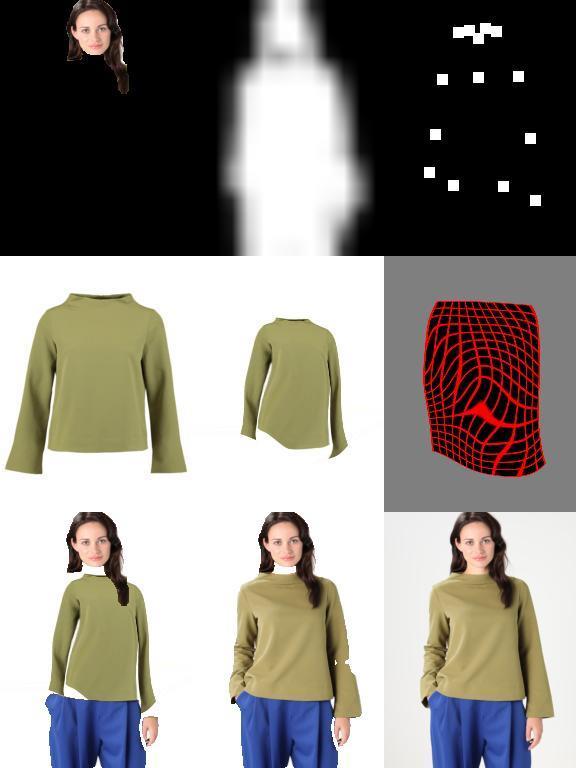
CP-VTON includes three main innovations. First, TOM is trained to compete with discrimination, which uses TOM result image, store clothing image, and person representationasinputs,andjudgeswhethertheresult is realorfake.Second,theGMMlossfunctionL1includesthe distance between the generated and real images of the clothes placed on the body. Finally, a random horizontal rotationisusedtoaggregatethedata.
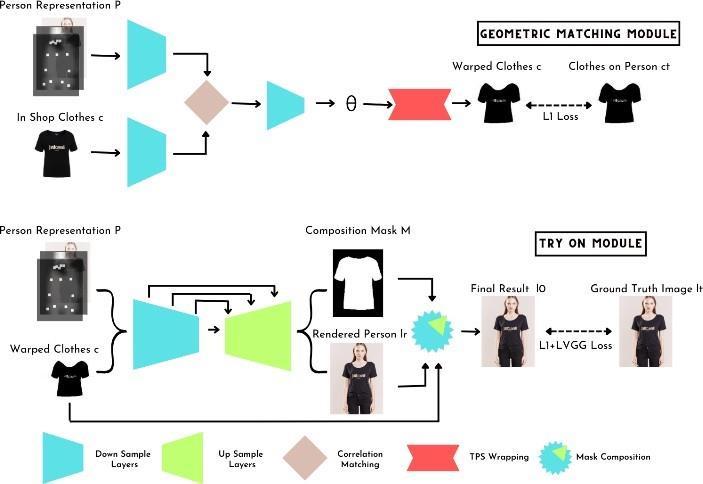
CP-VTON stands for Clothes-Parsing Virtual Try-On Network, which is a deep learning-based virtual try-on system. The system usesa neural network to predict how clothing items would look on a person without physically trying them on. CP-VTON uses a two-stage approach, where the first stage is clothes parsing, and the second stage is virtual try-on. In the first stage, the system analyzes an image of the clothing item and segments it intodifferentparts,suchassleeves,collar, andbody.This is done using a Convolutional Neural Network (CNN) trainedonalargedatasetofclothingimages.Inthesecond step, the system analyzes the image of the person and creates a realistic virtual testimagein whichthe garment is worn by the person. This is done using a conditional generative adversarial network (cGAN) trained on a dataset of pairs of images of people wearing clothes. CPVTON is a state-of-the-art virtual proofing system that produces high-quality and realistic virtual proofing images. It has potential applications in e-commerce, fashiondesign,andvirtualreality.
International Research Journal of Engineering and Technology (IRJET) e-ISSN:2395-0056
Volume: 11 Issue: 03 | Mar 2024 www.irjet.net
TOM is an acronym for Try On Module, which combines two typical testing methods to achieve cleaner results without the unwanted clogging of certain body parts and the unnatural appearance of clothing edges. The "Try-On" moduleinarticlesrelatedtoViTon(VisionTransformeron Fashion)referstoacomponentthatallowsuserstotryon differentclothesinnearrealtime.
This module utilizes the trained model to generate a realistic image of a person wearing a particular clothing item, given an input image of the person and the clothing item. The ViTon papers describe several variations of the Try-On module, including the use of a generative adversarial network (GAN) to improve the visual realism of generated images and the inclusion of a state transformernetwork toimprovegarmentalignment.with the human body. The papers also describe the use of a meshbasedrepresentationoftheperson'sbodytoenable more accurate placement and fitting of clothing items. Overall, the Try-On module in ViTOn allows users to virtually try on different clothing items without the need for physical garments, providing a convenient and immersiveshoppingexperience.
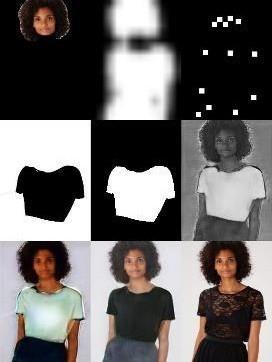
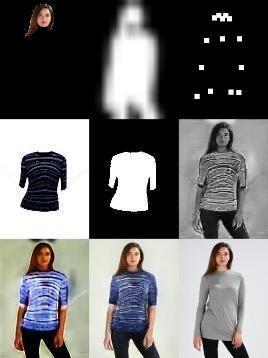
GMM stands for Gaussian Mixture Model, which is a probabilistic model used for unsupervised learning. GMM is commonly used in clustering and density estimation tasks, which aim to group similar data points based on their underlying probability distribution. The model assumes that the data are generated from a mixture of Gaussian distributions, where each Gaussian represents a differentclusterorsubpopulationinthedata.
p-ISSN:2395-0072
The Gaussian Mixture Model (GMM) is a probabilistic model that learns parameters such as mean, covariance, and mixing proportions of Gaussian distributions from data. Typically trained using the ExpectationMaximization (EM) algorithm, GMM finds applications across diverse domains in deep learning. In image and speech processing, it aids in clustering similar images or sounds.
Moreover, GMM is invaluable in anomaly detection, capable of identifying abnormal patterns within data. Additionally, it serves as a generative model, capable of generating new samples from learned distributions. Its versatility extends further when integrated with other deep learning techniques like autoencoders or variational autoencoders (VAEs). This combination enables more sophisticated modeling of complex data distributions, enhancingthecapacitytocaptureintricatestructuresand patterns within the data. Whether in clustering, anomaly detection, or generative modeling, GMM remains a foundationaltoolindeeplearning,facilitatingawidearray of applications with its ability to model data distributions effectively.
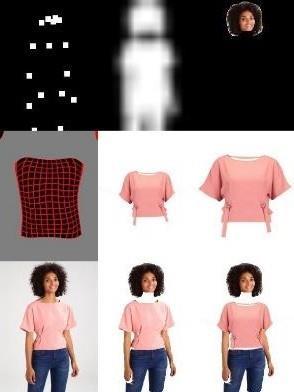
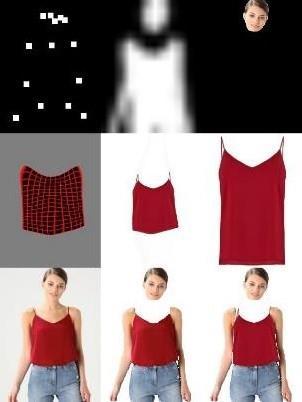
The developed virtual try-on system, employing deep learning techniques such as Gaussian Mixture Model (GMM) and Texture Orientation Matching (TOM) algorithms, showcased promising outcomes in enhancing the realism and accuracy of clothing projection onto reference figures. Through rigorous testing on diverse clothing items, the system effectively addressed the challenge of maintaining photo-realism, especially in scenarios with prominent occlusions and complex human poses. The GMM algorithm successfully segmented clothing items from backgrounds while extracting essential shape and appearance features, laying a solid foundationforaccurateprojection.Furthermore,theTOM algorithm demonstrated proficiency in matching clothing textures to the wearer's body, ensuring a seamless
International Research Journal of Engineering and Technology (IRJET) e-ISSN:2395-0056
Volume: 11 Issue: 03 | Mar 2024 www.irjet.net
integrationbetweenthevirtualgarmentandthereference figure.
Theresultsobtainedfromtestingunderscorethesystem's capability to provide an immersive and realistic shopping experience, enabling users to visualize how the clothing items would appear on themselves accurately. This enhanced visualization fosters informed purchase decisions, bridging the gap between traditional in-store try-ons and online shopping experiences. However, while the system showcased promising results, further refinements and optimizations may be necessary to enhance scalability, real-time performance, and integration with e-commerce platforms. Overall, the developed virtual try-on system represents a significant step forward in revolutionizing online shopping, offering users a compelling and engaging way to explore and evaluateclothingitemsvirtually.
p-ISSN:2395-0072
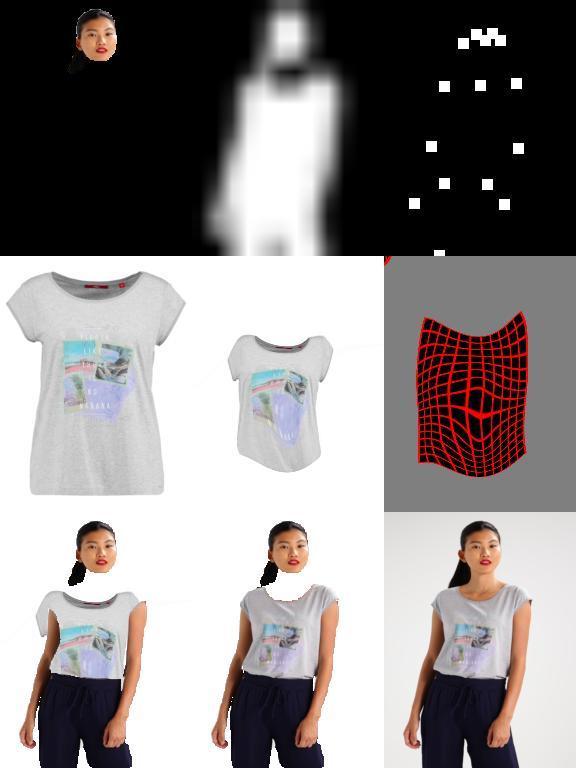
Virtualfittingtechnologyhasthepotentialtorevolutionize retail as customers can try on clothing and accessories virtually without ever visiting a store. It can improve the customer experience, increase sales, and reduce returns. However, implementing virtual try-on technology comes with its own set of challenges, including accuracy, integration, speed, device compatibility, and cost. Despite these challenges, virtual try-on technology has made significantprogressinrecentyears,thankstoadvancesin computervision,machinelearning,andaugmentedreality. Theavailabilityofhigh-qualitydatasetssuchasVITONhas alsocontributedtothedevelopmentofmoreaccurateand efficientvirtualexperimentalmodels.
The successful development of a virtual try-on system using deep learning techniques represents a significant milestone, but the journey toward enhancing the online shoppingexperiencecontinues.Futureresearchmayfocus on refining algorithms for broader applicability and optimizing real-time performance. Integrating augmented reality could further enhance user engagement, while personalized recommendations based on individual preferences could enrich the shopping experience. Collaboration with fashion brands and retailers to integrate the system into e-commerce platforms could expedite its adoption and impact, promising to revolutionize the way consumers interact with fashion online.
International Research Journal of Engineering and Technology (IRJET) e-ISSN:2395-0056
1. Han, X., Wu, Z., Jiang, Y., & Davis, L. S. (2018). Viton: An Image-based Virtual Try-on Network. Proceedings of the IEEE Conference on Computer Vision and Pattern Recognition,7543-7552.
2. Song, X., Feng, F., Ma, X., & Xiang, T. (2019). Attentive Generative Adversarial Network for Virtual Try-on. Proceedings of the IEEE Conference on Computer Vision andPatternRecognition,1294-1303.
3. Liu, J., Li, Z., Li, S., Li, J., & Xu, J. (2020). Virtual Try-on with Detail-enhanced Feature Transformation. Proceedings of the IEEE/CVF Conference on Computer VisionandPatternRecognitionWorkshops,1676-1685.
4. Huang, Y., Liu, M., & Belongie, S. (2017). Arbitrary Style Transfer in Real-time with Adaptive Instance Normalization. Proceedings of the IEEE International ConferenceonComputerVision,1510-1519.
5. Li, Z., Chang, S., Shan, L., & Chen, X. (2020). Rethinking Data Augmentation for Image Super Resolution: A Comprehensive Analysis and a New Strategy. Proceedings of the IEEE/CVF Conference on Computer Vision and PatternRecognition,479-488.
6.Yu,J.,Lin,Z.,Yang,J.,Shen,X.,Lu,X.,&Huang,T.(2018). Generative Image Inpainting with Contextual Attention. Proceedings of the IEEE/CVF Conference on Computer VisionandPatternRecognition,5505-5514.
7. Park, T., Liu, M. Y., Wang, T. C., & Zhu, J. Y. (2019). Semantic Image Synthesis with SpatiallyAdaptive Normalization. Proceedings of the IEEE Conference on ComputerVisionandPatternRecognition,2337-2346.
Volume: 11 Issue: 03 | Mar 2024 www.irjet.net p-ISSN:2395-0072 © 2024, IRJET | Impact Factor value: 8.226 | ISO 9001:2008 Certified Journal | Page 1491