
International Research Journal of Engineering and Technology (IRJET) e-ISSN:2395-0056
Volume: 11Issue: 03| Mar 2024 www.irjet.net p-ISSN:2395-0072
International Research Journal of Engineering and Technology (IRJET) e-ISSN:2395-0056
Volume: 11Issue: 03| Mar 2024 www.irjet.net p-ISSN:2395-0072
Renuka N D1, Aditya Singh2, Ankesh Kumar3,*, Bhopendra Khadka4, Bimanshu Kumar5
Atria Institute of Technology, Bangalore – 560024, Karnataka, India.
Abstract
The traditional pedagogical approach to understanding projectile motion often relies on two-dimensional diagrams, chalkboard explanations, or at best, simple practical demonstrations. While these methods provide foundational knowledge, there is increasing need to implement innovative teaching tools that cater to the digital age, ensuring more immersiveandintuitiveunderstandingforstudents.ThisstudyexplorestheefficacyofusingAugmentedReality(AR)asa tool for teaching and learning the concepts of projectile motion in physics. Using AR, students are able to project trajectoriesontotheirphysicalsurroundings,changeparameterslikeangleofprojection,initialvelocity,andobservethe effectsin real-time.Theapplicationalsooffers instantaneous feedback oncalculations,helpingstudentscomprehend the underlyingmathematicalrelationships.
Keywords
AugmentedReality,ProjectileMotion,PhysicsEducation,InnovativeTeaching,InteractiveLearning
Introduction
Technological developments in this day and age are growing so rapidly. Including its role in various sectors, such as education, agriculture, health, and others. Augmented Reality at present one of the rapidly developing Technology. Philipp A. Rauschnabel et al.[9] AR is a technology that combines the imaginary world andtheactualworldwhereusersareabletoexplorethe actual world in a more interactive and interesting way. Slowly but surely AR technology has provided new options that are changing how we interrelate with each other, learn and play in the 21st century. Using AR technology for education is not something new as it has been done it for assembly training or body organ recognition. Therefore, in this research, researchers try to utilize the same technology for learning concepts in Physics subjects. If we study projectile motion, we will always be presented with illustrative vision of the parabola's motion. Currently, parabolic motion experiment equipment is still quite rare in schools. The equipment that are used to demonstrate the projectile motion are quite expensive. This condition conveys that not all schools have adequate equipment, especially parabolic motion experimental equipment. This causes the learning atmosphere to seem monotonous so that feedback is relatively low. And another problem is that theteachingaidsprovidedbytheschoolcannotbetaken home by students. Therefore, we want to create an application to visualize parabolic motion using AR as a learning medium for students to learn about parabolic motion. The application used to project a real time projectile concept by receiving the input and calculated using physic formula. And with the help of AR technology,theoutlineofaparabolacanbeseendirectly intherealworld.
The traditional educational props used in teaching projectile motion are limited and cannot be used for accuratecalculation.MattBoweretal.[10]theutilization of AR in educational methods may raise curiosity and provide a unique way of learning projectile motion, as the motion can be seen in three dimensions. The use of smartphones in teaching physics laws be effective in engagingstudentsandhelpingthemlearnfaster. Philipp A. Rauschnabel et al.[9] AR is a combination of realworldandvirtual objects,anditcanbeusedtosimulate projectile motion and its velocity more realistically. AR providesa unique wayoflearningprojectilemotionand allows students to see it in three dimensions. Joe Yuan Mambu etal.[2]alsomentionstheusingVuforia SDKto blendreal-worldandvirtualobjects.Overall,usingARin teaching projectile motion can raise curiosity and provide a more engaging and interactive learning experience for students. T B Ding et al. [7] emphasizes the importance of providing students with different technique of understanding a topic, especially when it arrives to essential chapters like projectile motion. It suggests that incorporating technology like AR can help switch from teacher-centered to student-centered learning environments and provide a more inclusive learningexperience.
Mark Billinghurst et al. [1] discusses how AR should provide a way to for providing the possibilities for learning, teaching, study, or creative investigation. AR usesimaginaryobjectsordatathatoverlapenvironment or physical object to create a combine reality in which virtualobjectsandenvironmentscoexistinameaningful manner to increase learning. Applying AR technology in the education sector can result in having an intelligent
International Research Journal of Engineering and Technology (IRJET) e-ISSN:2395-0056
Volume: 11Issue: 03| Mar 2024 www.irjet.net p-ISSN:2395-0072
campus. AR helps to increase students' content understanding, motivation, interaction, and collaboration. AR will be a successful approach to tackling problems in physics. AR technology tools for education have been evaluated systematically, and teaching based on AR will be effective in technical, creativedesigncoursesand softwareeditingcoursesfor students. The utilization of AR in educational methods may raise curiosity and give a unique way of learning projectile motion. Joe Yuan Mambu et al. [2] uses the Vuforia SDK, which can meld the natural world and virtual objects. The virtual objects help a user perform real-world tasks, making them a distinct example of what Fred Brooks terms Intelligence Amplification (IA): using the computer as a gadget to make a task more manageableforahumantoperform.ErgiBufasietal.[3] have focused on fusing real and virtual images and graphics, but AR could be amplified to include sound. This would give the system a chance to cover up picked authentic sounds from the environment by initiating a masking signal that exactly canceled. Instructions might be easier to understand if they were available as 3-D drawings superposed upon the actual equipment, revealingstep-by-stepthetasksthatneedtobedoneand howtodothem.Thesesuperposed3-Ddrawingscanbe animated, making the directions even more explicit. Carlo H. Godoy Jr et al. [4] explores current mobile AR solutions like ARKit and ARCore, highlighting their capabilities in surface detection and object pinning on smartphones. Despite the surface detection proficiency ofmany existingAR systems,thereisa notableneedfor improved object detection and recognition in the real world. Additionally, these systems require increased computationalresourcestorenderhigh-qualityelements effectively.
Awelani V et al. [5] said about common misconceptions about projectile motion, such as the belief that the directionofaccelerationorforcefollowsthedirectionof motion. Various material available for students to explore the effects of varying the velocity and angle of projection Teacherscan designtheirlessonplans based onthesematerialsandprovokediscussionsof projectile motion in a various context Chester Ian S. Pineda et al. [6] talks about projectile motion being used in a variety of real-world applications, such as ballistics, sports, and spacetravel.
The motion of a projectile can be modeled using mathematicalequations,suchastheequationsofmotion and the kinematic equations. Ergi Bufasi et al. [3] explainsthecomputational ofprojectilemotioninvolves usingcomputersimulationstomodelthemovementofa particles that is thrown or launched into the air. Refik Dilber et al.[8] by using computational modeling, students can gain a profound understanding of the physics behind projectile motion and how different
factors, such as mass and velocity, can affect the movementofanobject.
The study of projectile motion using augmented reality (AR) involves combining real-world physics principles with digital simulations to provide an interactive and immersivelearningexperience.
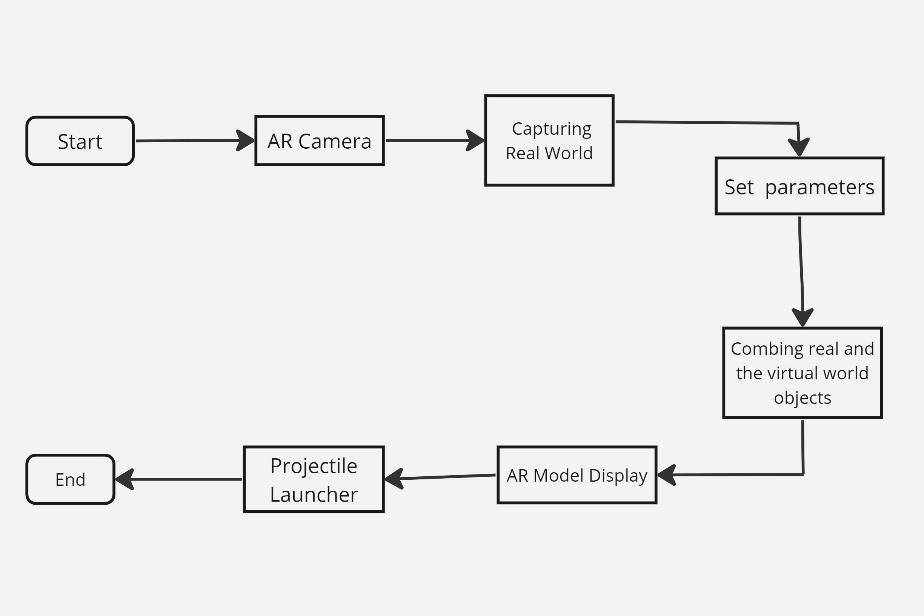
Fig:SystemFrameworkDiagram
Simulation Development: Our team developed an AR application using platforms like Unity and ARCore/ARKit. This involved in creation a virtual environment whereuserscanobserveandinteract with projectilemotionscenarios.
The simulation requires the user to input the initial velocity,angle,andrateofmotionfortheobjecttomove. The simulation then calculates the horizontal and vertical components of the object's momentum, which influence its acceleration as it travels through the air showingparabolicmovement.Thesimulationalsoshows how the object's velocity changes over time, with the horizontal velocity remaining constant and the vertical velocity decreasing due to the force of gravity. The simulation can be used to visually understand the properties of projectile motion, such as why a projectile fallafterreachingacertainheight.
Physics Engine Integration: We integrated a physics engine into the AR application to accurately simulate projectilemotionbasedonreal-worldphysicsprinciples. Unity's physics engine or external libraries like Box2D wereusedforthispurpose.
International Research Journal of Engineering and Technology (IRJET) e-ISSN:2395-0056
Volume: 11Issue: 03| Mar 2024 www.irjet.net p-ISSN:2395-0072
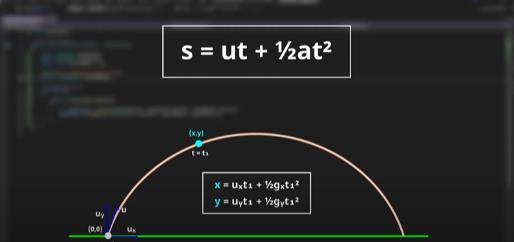
Fig:demonstrationofprojectilemotion
VerticalProjectile Motion
Verticalposition:
Theverticalpositionyoftheobjectatanytimet canbecalculatedusingtheequation:
Where:
yistheverticalpositionattimet
y0istheinitialverticalposition
v0istheinitialverticalvelocity gistheaccelerationduetogravity tistheelapsedtime
Verticalvelocity
Theverticalvelocityvy oftheobjectatanytimet canbecalculateusingtheequation:
Where:
vy istheverticalvelocityattimet
v0istheinitialverticalvelocity gistheaccelerationduetogravity tisthetimeelapsed
Verticalacceleration
The vertical acceleration ay is a constant and equaltotheaccelerationduetogravity(g).
HorizontalProjectile Motion
HorizontalPosition:
The horizontal position x of the object at any timetcanbecalculatedusingtheequation:
Where:
xisthehorizontalpositionattimet
x0istheinitialhorizontalposition
v0istheinitialhorizontalvelocity
HorizontalVelocity:
The horizontal velocity vx of the object remains constant throughout the motion and is equal to theinitialhorizontalvelocity:
Where:
vx isthehorizontalvelocity
v0istheinitialhorizontalvelocity
HorizontalAcceleration:
There is no horizontal acceleration (ax = 0) acting on the object, assuming negligible air resistance.
User Interaction: In our project, we have successfully integrated intuitive user interfaces into the augmented reality (AR) application, facilitating user interaction and customizationofparametersessentialforthesimulation ofprojectilemotion.Usersareempoweredtomanipulate critical variables such as initial velocity, launch angle, and gravitational acceleration, thereby enhancing their engagement and understanding of the underlying physicsprinciples.
To ensure accessibility and ease of use, our team implemented a variety of intuitive input methods inside the AR interface. Users can use the application through touch-based controls, enabling them to directly input valuesoradjustparametersusingfamiliargesturessuch as tapping, swiping, and pinching. Additionally, we have incorporated gesture recognition capabilities, allowing userstointuitivelymanipulatevirtualobjectsandadjust settingsthroughnaturalhandmovementsorgestures.
Thisintuitiveuserinterfacedesignnotonlyenhancesthe user’s experience but also promotes active learning and experimentation. By providing users with the potential todynamicallymodifyparametersandobservereal-time effects on projectile motion simulations, our AR application fosters deeper engagement and comprehensionofphysicsconceptsinanimmersiveand interactivelearningenvironment.
Real-time Visualization: In our implementation, augmented reality (AR) technology serves as the backbone for overlaying dynamic virtual elements onto the physical environment, offering users an immersive and interactive experience. Through AR, we seamlessly integrate virtual representations of projectiles, launch trajectories, and impact points into the user's surroundingsinreal-time.
This approach enables users to visualize and interact with simulated projectile motion directly within their physical environment. As users adjust parameters such as initial velocity, launch angle, and gravitational acceleration, they receive instant visual feedback through the AR interface. Virtual representations of projectiles accurately reflect changes in trajectory and velocity, while impact points dynamically update to reflecttheprojectedlandinglocation.
By leveraging AR technology, our application enhances the learning experience by facilitating users with tangible, real-time visualizations of projectile motion principles. Users can observe the effects of parameter adjustments firsthand, gaining a deeper understanding oftherelationshipbetweeninputvariablesandresulting
International Research Journal of Engineering and Technology (IRJET) e-ISSN:2395-0056
Volume: 11Issue: 03| Mar 2024 www.irjet.net p-ISSN:2395-0072
motion trajectories. This real-time feedback mechanism fostersactiveexperimentationandexploration, allowing userstoengagewithphysicsconceptsinahands-onand intuitivemanner.
Overall, the combination of AR technology into our application transforms the learning process, offering a dynamic and immersive platform for exploring and understandingprojectilemotioninthephysicalworld
Educational Content Integration: In addition to the dynamic visualizations of projectile motion, our AR application incorporates educational content aimed at enhancing users' understanding of the underlying physicsconcepts.Throughtheintegrationofexplanatory text, diagrams, and animations, we provide users with comprehensive support materials that elucidate the principlesgoverningprojectilemotion.
ExplanatorytextisstrategicallyembeddedwithintheAR interface, offering concise explanations of key concepts suchasvelocity,acceleration,andtrajectory.Thistextual guidance serves as a valuable reference for users, providing contextual information and reinforcing their understandingofthephysicsprinciplesatplay.
Diagrams are utilized to supplement textual explanations, visually illustrating the relationships between various parameters and their effects on projectile motion. Users can work alongside with these diagrams within the AR environment, gaining insights into the geometric and mathematical aspects of projectilemotionthroughdynamicvisualizations.
Furthermore, animations bring physics concepts to life, showcasing dynamic simulations of projectile motion phenomena. Users can observe the interplay between different variables in action, gaining a deeper appreciation for the complex dynamics underlying projectilemotion.
By integrating educational content into the AR experience, our application transcends traditional teaching methods, offering a multi-modal learning environment that caters to diverse learning styles and preferences. Users are empowered to explore concepts attheirownpace,engagingwitheducationalmaterialsin ahighlyimmersiveandinteractivemanner.Thisintegral approach not only facilitates comprehension but also fosters a deeper appreciation for the beauty with complexity of physics principles governing projectile motion.
Experimentation and Exploration: Our AR application fosters a culture of exploration and experimentation by encouraging users to manipulate various launch conditions and scenarios. Through this hands-on approach, users gain firsthand experience in observing how changes in parameters such as initial velocity,
launch angle, and gravitational acceleration impact the pathoftheprojectile.
By actively engaging with the simulation and observing the resulting effects on projectile motion, users develop criticalthinkingskillsanddeepentheirunderstandingof the underlying physics principles. This interactive learning experience empowers users to form hypotheses, test different scenarios, and draw conclusions based on their observations, fostering a senseofdiscoveryandinquiry.
Furthermore, the ability to experiment with different launch conditions promotes self-directed learning, allowinguserstoexploreconceptsattheirownpaceand tailor their experience to their individual interests and learning objectives. Through this dynamic and interactiveapproach,ourARapplicationfacilitatesactive learning and cultivates a deeper appreciation for the complexitiesofprojectilemotion.
Integration with Curriculum: By aligning the analysis of projectile motion using AR with educational curricula in informal learning environments, we ensure that learners benefit from a cohesive and relevant educational experience. This strategic integration bridges the gap between formal educational standards and the dynamic learning environments found in museums, science centers, and other informal settings. By incorporating AR technology into these contexts, we provide learners with engaging and interactive opportunities to explore physics concepts in a hands-on manner. This approach enhances retention and comprehension but also encourages learners to make connections between conceptual knowledge and realworld applications. By seamlessly integrating ARenhanced experiences into informal learning environments, we empower learners to develop critical thinking skills, foster a deeper appreciation for science, andcultivatealifelongloveoflearning.
By employing these methods, the study of projectile motion using augmented reality can offer an engaging andeffectivewayforlearnerstoexploreandunderstand fundamentalphysicsconceptsinareal-worldcontext.
Augmentedreality(AR)hasthepotentialtoenhancethe studyofprojectilemotioninvariousways:
Visualization: Augmented reality (AR) offers students an immersive learning experience by providing realistic 3Dvisualizationsofprojectilemotion.WithAR,students can observe the trajectory of the projectile in real-time and from various angles, enhancing their understanding of fundamental concepts such as launch angle, initial velocity,andrange.
International Research Journal of Engineering and Technology (IRJET) e-ISSN:2395-0056
Volume: 11Issue: 03| Mar 2024 www.irjet.net p-ISSN:2395-0072
Byinteractingwithvirtual representationsofprojectiles within their physical environment, students gain precious insights into the dynamics of motion. They can test with different launch conditions and observe how changes in parameters affect the trajectory, fostering a deeper comprehension of the underlying physics principles.
Furthermore, the interactive nature of AR allows studentstoengageactivelywiththematerial,promoting hands-on learning and critical thinking skills. By incorporating AR technology into educational settings, educators can provide students with dynamic and engaging experiences that facilitate deeper learning and retentionofconceptsrelatedtoprojectilemotion.
Interactive Simulations: Augmented reality (AR) applications offer students a dynamic learning experience by enabling interaction with virtual objects representing projectiles. Through these applications, students can actively manipulate parameters such as initialvelocityandlaunchangle,witnessingfirsthandthe impact of these adjustments on the trajectory of the projectile.
This active approach fosters deeper engagement and understanding of the underlying physics principles governing projectile motion. By experimenting with different launch conditions and observing the resulting changes in trajectory, students gain precious insights into concepts such as velocity, acceleration, and projectilemotionequations.
Furthermore, the interactive nature of AR applications encouragesexplorationandexperimentation, promoting criticalthinkingandproblem-solvingskills.Studentsare empoweredtoexplorephysicsconceptsinatangibleand intuitive manner, facilitating a deeper level of comprehensionandretention.
Overall, AR applications provide an immersive and interactive platform for students to explore and understand projectile motion, paving the way for enrichedlearningexperiencesinphysicseducation.
Real-world Context: Augmented reality (AR) technology revolutionizes the study of projectile motion by overlaying virtual objects onto familiar real-world environments. Students can immerse themselves in scenariossuchasthrowingaballinaparkorlaunchinga rocketinaclassroom,creatinganengagingandrelatable learningexperience.
By simulating projectile motion within their immediate surroundings, students can better grasp the concepts andprincipalsinvolved.Theycanobservethetrajectory of virtual projectiles as they interact with the physical environment, gaining a deeper understanding of factors suchaslaunchangle,initialvelocity,andtrajectory.
This experiential approach not only enhances comprehension but also fosters a sense of connection between theoretical knowledge and real-world applications. By contextualizing the study of projectile motion within familiar settings, AR technology makes learning more accessible and meaningful for students of all backgrounds and learning styles. Ultimately, AR empowers students to explore and understand physics concepts in a dynamic and immersive manner, paving thewayforenrichededucationalexperiences.
Experimental Exploration: Augmented reality (AR) offers students the opportunity to conduct virtual experiments related to projectile motion, providing a safe and accessible environment for exploration and learning. With AR, students can simulate experiments that may be challenging or risky to perform in real life, such as launching projectiles at extreme angles or velocities.
By immersing one-another in these virtual environments, students can observe the behavior of virtualprojectilesandanalyzetheresultingdatatodraw conclusions and make predictions. They can manipulate parameters such as launch angle, initial velocity, and projectile mass, observing how these factors affect the trajectoryandrangeoftheprojectile.
This hands-on approach to experimentation fosters critical thinking and problem-solving skills, allowing students to explore physics concepts in a dynamic and interactive manner. Furthermore, by interacting with virtual experiments, students can gain a deeper understanding of projectile motion principles while minimizing safety concerns and logistical constraints relatedwithtraditionallaboratorysettings.
Collaborative Learning: AR applications can support collaborative learning experiences by allowing multiple users to interact with virtual objects simultaneously. Students can work jointly to explore and analyze projectile motion scenarios, fostering teamwork and peer-to-peerlearning.
Using augmented reality (AR) in teaching projectile motion has shown promising results. AR provides a unique and interactive way of learning, allowing students to see the motion in three dimensions and associatewithvirtualobjects.OnestudyusedtheVuforia SDK to simulate projectile motion and its velocity more realistically,allowsstudentstoinputparametersandsee the results. Overall, AR can revolutionize the way we teach and learn projectile motion, providing new opportunities for interactive and immersive learning experiences.However,therearenumerouschallengesto overcome, some of them are cost of AR technology and thepropertraininggiventotheteacherstouseARinthe educationeffectively.
International Research Journal of Engineering and Technology (IRJET) e-ISSN:2395-0056
Volume: 11Issue: 03| Mar 2024 www.irjet.net p-ISSN:2395-0072
References
1. Mark Billinghurst “Augmented Reality in Education”.NewHorizons,2002
2. JoeYuanMambu,AndriaKusumaWahyudi,Brily Latusuay, and Devi Elwanda Supit “Projectile Motion Visualization Application with AugmentedReality”.JournalofSisfoteka,2020
3. ErgiBufasi,MarioHoxha,andSabahudinVrtagic “Using Computational Modeling in Physics: Introduction to Projectile Motion”, 7th International Symposium At: Bosnia and Herzegovina,2021
4. Carlo H.Godoy Jr. “Augmented Reality for Education: A Review of its Use in Different Sectors of Education”, The International Journal of Innovative and Research Technology,June 2020
5. AwelaniV.Mudau,FhatuwaniJ.Mundalamo,and Thomas D. T. Sedumedi “Through The Eye Of The Needle: A Classroom Practice Diagnostic Framework For The Teaching Of Projectile Motion” . Procedia - Social and Behavioral Sciencesjournal,2014
6. Chester Ian S. Pineda “The assessment and developmentofateachingandlearningpackage in projectile motion”. Issue of the Journal of ScienceandScienceEducation(JoSSEd),Volume 1,Issue1,2020
7. TBDing,ZWLin,GWang,andZHe“Analytical Study on the Trajectory of a Projectile Motion with the Quadratic Resistant Law”. Journal of Physics:ConferenceSeries2023
8. Refik Dilber, Ibrahim Karaman, and Bahattin Duzgun “High school students understanding of projectile motion concepts”. K.K Education Faculty of Ataturk University in Erzurum, Turkey,2009
9. PhilippA.Rauschnabel,RetoFelix,ChrisHinsch, Hamza Shahab, Florian Alt “What is XR? Towards a Framework for AR and Virtual Reality".JournalComputersinHumanBehavior, 2022
10. Matt Bower, Cathie Howe, Nerida McCredie, AustinRobinson,andDavid Grover”Augmented Reality in education: cases, places and potentials”. Educational Media International, 2014
2024, IRJET | Impact Factor value: 8.226 |