
International Research Journal of Engineering and Technology (IRJET) e-ISSN: 2395-0056
Volume: 11 Issue: 03 | Mar 2024 www.irjet.net p-ISSN: 2395-0072
International Research Journal of Engineering and Technology (IRJET) e-ISSN: 2395-0056
Volume: 11 Issue: 03 | Mar 2024 www.irjet.net p-ISSN: 2395-0072
1Ankush Nandi, 2G.V. Anil, 3K. Gnana Likhitha, 4Ashmi Raj
1,2,3,4Student, GITAM (Deemed to be University), Visakhapatnam, Andhra Pradesh, India.
Abstract ‐ Plants play a crucial part in preserving the ecosystem's equilibrium and supplying the resources required for human survival. Tomatoes, scientifically known as Solanum lycopersicum, are among the most widely cultivated and consumed vegetables globally. They areagoodsourceofpotassium,folate,andvitaminC,among other important minerals and vitamins. This nutritional valuemakesthemavaluablecropforensuringfoodsecurity and promoting a healthy diet. Despite their significance, tomato crops face several challenges, with diseases being oneofthemajorissues.Theemergenceofdiseasescanlead tosubstantial yieldlossesandqualitydeterioration,posing a significant threat toboth local and international tomato markets.Timelyandaccuratediseasedetectioniscrucialto mitigatetheselossesandmaintaintheeconomicviabilityof tomato cultivation. Our research paper addresses the crucial problem of tomato leaf disease detection in this particular context. To automatically identify tomato leaf diseases like bacterial spot, late blight, early blight, spider mites, mosaic virus, yellow leaf virus, target spot, and septoria leaf spot, we suggested a novel method. utilizing the U-Net architecture and convolutional neural networks (CNN). Our study makes use of a dataset that we gathered frommultiplesourcesthatincludespicturesofbothhealthy and unhealthy tomatoleaves. Based on the research, when compared with VGG16, VGG19, CNN achieved higher accuracy. So, we are trying to employ a CNN for feature extraction and a U-Net for pixel-wise segmentation, allowing us to pinpoint disease-affected areas with high precision. We anticipate that the suggested method's processingtimewillbemuchlessthanthatofthesemodels.
For thousands of years, agriculture has been the main source of human survival. Every year, plant diseases cause significant losses in crop productivity across the world. A vitalroleintheeconomyisplayedbyagriculture,thethreat ofcrop diseasescastsa long shadowover bothcropquality andquantity,buttheyarepronetoanumberofillnessesthat could seriously harm them and reduce their productivity. Thepromptidentification and precise diagnosis of diseases affecting plant leaves is one of the main obstacles in the managementofplantdiseases.
The field of agriculture could be strengthened by automating the detection of leaf disease using image processing techniques like deep learning and machine learning,whichcouldyieldquickandaccurateresults.These methods entail a number of processes, such as feature extraction,machinelearning,segmentation,processing, and image acquisition. Plant leaf diseases can be identified and categorizedfromvisualsusingmachinelearningtechniques. Accurate disease detection and classification are made possiblebytheutilizationofmachinelearningalgorithmsto extract features from which patterns and relationships can belearned
Machine learning is used to identify and classify various fungal, bacterial, and viral diseases in plant leaves. These diseases can significantly affect crop yield and quality. Different machine learning algorithms are employed for disease classification. These comprise artificial neural networks (an ANN), support vector machines, and deep learning models such as GoogLeNet and the network CNN. SVM is used to classifydiseases into multiple classes using the features that are extracted. RGB images of leaves are used as data sources for machine learning. These images contain visual information about the symptoms and characteristics of the diseases. Deep learning models are trained to automatically learn relevant features from the data, which can be particularly effective for image-based tasks.
Deep learning techniques, such as convolutional neural networks, have shown excellent performances in various image analysis tasks, including leaf segmentation, leaf spot detection, and disease classification. CNNs are designed to automaticallylearnhierarchicalfeaturesfromimages.They consist of multiple layers, each responsible for detecting increasingly complex patterns. This hierarchical feature learning allows CNNs to capture relevant information at differentscales,making themhighlyeffectiveinrecognizing intricate details in images. Because CNNs are translationinvariant,theycanrecognizefeaturesnomatterwherethey areinthepicture.Thispropertyisespeciallyvaluablewhen dealing withimagesofplantleaves, wherethepositionand orientation of disease symptoms may vary. Ferentinos developed CNN models to identify and diagnose plant
International Research Journal of Engineering and Technology (IRJET) e-ISSN: 2395-0056
Volume: 11 Issue: 03 | Mar 2024 www.irjet.net p-ISSN: 2395-0072
diseasesusingleafphotosofnormalandinfectedplants.
The approach involved training the models on a dataset of leafimagesandusingthemtoclassifynewimagesaseither normal or infected. They utilized the AlexNet and VGG16 models with optimized hyper parameters for disease detection in tomato crops. The study demonstrated the superiority of deep learning models over traditional machine learning techniques in accurately identifying and classifying crop diseases. It draws attention to the drawbacks of conventional manual inspection techniques, such as theirsubjectivity, labor intensity, and inability to scale.
[1] Seyed Mohamad Javidan and Ahmad Banakar conducted a study that focused on utilizing K-means clustering and machine learning techniques for the diagnosisofdiseasesingrapeleaves.
This research incorporated the use of Support Vector Machines (SVMs) and a novel image processing method to identify grape leaf ailments, including leaf blight, black rot, and black measles. By applying K-means clustering, the study extracted features from both RGB and HSV color models to differentiate between healthy and diseased regions.
To reduce dimensionality, Principal Component Analysis (PCA) was employed, followed by SVM classification, achieving a remarkable accuracy of 98.97%. Furthermore, deeplearningmethods,includingCNNandGoogleNet,were explored, albeit consuming more computational resources and time, yielding accuracies of 86.82% and 94.05%, respectively.
[2] “PlantLeaf Disease Detectionand ClassificationBased on Convolutional Neural Network," authored by B. Swetha and Ravindar Eslavath, delves into the application of the CNNalgorithm[10]thatplaysapivotalroleinthisresearch by extracting valuable features from images through the utilization of convolutional and pooling layers for the detectionofplantdiseases.
[3] Intheirpapertitled"ModifiedU-Netforplantdiseased leaf image segmentation," Shanwen Zhang and Chuanlei ZhangintroducedanimprovedU-Netarchitecture aimedat enhancing the segmentation of images depicting plant leavesaffectedbydiseases.TheconventionalU-Netmodels faced challenges when dealing with the efficient segmentationofcomplex cropdiseased leafimages sothey introduced the Modified U-Net (MU-Net) model, which incorporates a residualblock and a residual path into its
architecture.
[4] In the paper titled "Machine Learning-Based Tomato LeafDiseaseDiagnosisUsingRadiomicsFeatures,"authored by Faisal Ahmed, Manju Rahi, Raihan K. Uddin at. al, analyzedamachinelearningapproachfortheidentification and classification of tomato leaf diseases [9]. In addition to distinguishing healthy leaves, the authors have categorized diseases into three groups: Septoria, Yellow Curl Leaf, and Late Blight. The research methodology involves the extraction of features from tomato leaf images using radiomics-based features and then utilized with a Gradient Boosting Classifier enabling accurate identification and categorizationoftomatoleafdisease.
Thegoalofthisresearchisto
1. Provide effective techniques to precisely identify tomatoplantdiseasesatanearlystage,potentially leveraging artificial intelligence tools such as machinelearningandimageprocessing.
2. To enhance crop management strategies, use contemporary technologies like CNN in image processingfordiseasedetection.
3. By facilitating prompt detection and intervention techniques,strivetolessenthefinancialimpactof plantdiseases.
The prevalence of diseases that affect tomato plants presents serious challenges for the agricultural sector in India. The conventional technique of visually diagnosing plant diseases in rural India is ineffective and frequently results in significant yield losses. Furthermore, the nation lacks the necessary infrastructure to effectively combat these diseases. In a similar vein, leaf diseases seriously jeopardizecropproductivityandeconomicstabilityinrural India, even though the region is a major producer of tomatoes
Theinformationforourworkwasobtainedfromtheonline resourceKaggle.ThedatasetforPlantVillagewasgathered from(Gomaa,2023)andwasutilizedforthisproject.
Over 54,000 high-quality photos of 14 different crop species, including tomato, potato, apple, and grape, have beenincludedinthePlantVillagecollection.
International Research Journal of Engineering and Technology (IRJET) e-ISSN: 2395-0056
Volume: 11 Issue: 03 | Mar 2024 www.irjet.net p-ISSN: 2395-0072
Each image is connected to one of 38 classes, which stand fordifferentplantdiseasesorhealthy conditions.Ourmain target is on tomato leaf and the dataset of tomato has the followingasshowninTable1.
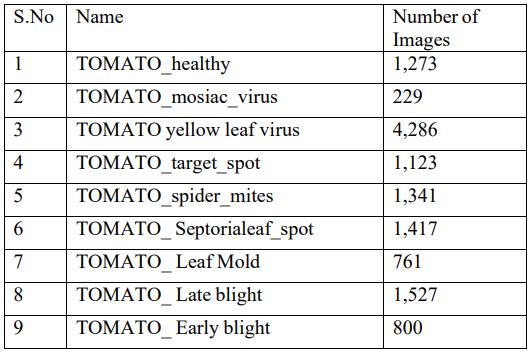
Table1:Dataset
6.Proposed Architecture
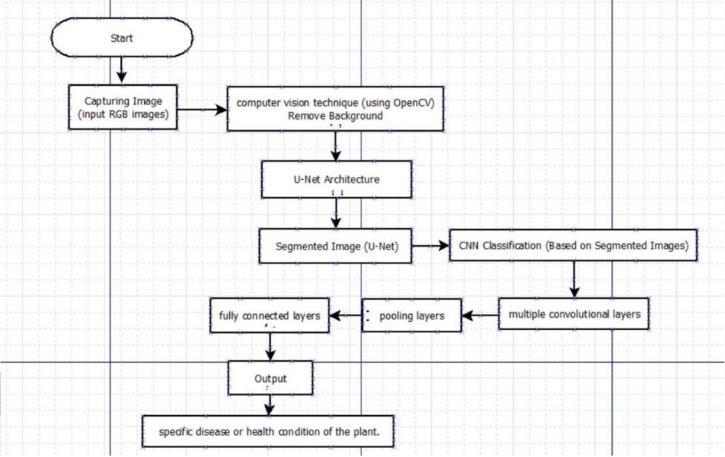
1: OurProposedArchitecture
6.1 Technical Indications
OurproposedarchitectureintheimageFig1 isacomputer vision system for plant disease detection. It has the followingsteps:
Capturing a Picture: The system is capable of taking a picture input from a number of sources, including files, scanners, and cameras. The picture must have three channels red,green,andblue andbeinRGBformat.
Remove Background: The background of the image is eliminated by the system using a computer vision technique. This helps the U-Net architecture segment the leaf more easily and helps the system concentrate on the leafitself.
U-NetArchitecture: Onekindof neural network thatworks well for segmentation tasks is the U-Net architecture. It is made up of a decoder and an encoder. Features are extracted from the input image by the encoder. After that, the decoder uses the features that were extracted to reconstruct the image, but this time, it labels every pixel withaclasslabel.Thevariousleafregionsinthisinstance healthy,diseased,andbackground aretheclasslabels.
CNN Classification: One kind of neural network that works well forimage classificationtasks isthe CNNclassifier. Itis made up of several fully connected, pooling, and convolutionallayers.Thefullyconnectedlayers acquirethe abilitytoclassifytheimageintodistinctclasses, thepooling layers down sample the feature maps to lower the number of parameters and computational complexity, and the convolutional layers learn to extract features from the image. In this instance, the various segments of the segmented leaf are classified into distinct diseaseclasses usingtheCNNclassifier.
Output: The outputof thesystemisthe diseaseclassof the leaf, or a prediction of whether the leaf is healthy or diseased. The system can also output a probability distributionoverthedifferentdiseaseclasses,whichcanbe used to indicate the confidence of the system in its prediction.
Training Dataset: The test's most crucial element is the training dataset. A significant number of photos of leaves with and without illnesses ought to be included. The pictures have to show the many kinds of leaf diseases that onecouldpotentiallycomeacrossinthefield.
Feature Extraction: During this phase, the model learns which leaf characteristics are most crucial for differentiating between healthy and sick leaves. Numerous feature extraction techniques are available for application. Thekindofleafdiseasesunderinvestigationandthecaliber of the training picture will determine which method is optimalforacertainapplication.
Leaf Disease Prediction: The model makes use of the extracteddatatopredictleafdiseasesatthisstage.
Leaf Disease Classification: The model classifies the type of diseaseifitdeterminesthattheleafisill.Numerousdistinct leafdiseasescanbeclassifiedbythemodelonceithasbeen taught.Thequantity andcaliberofthetrainingdataset will determinehowmanydiseasescanbecategorized.
TestingDataset:Thisdatasetisintendedtoassesshowwell the leaf disease classification and recognition model performs.
International Research Journal of Engineering and Technology (IRJET) e-ISSN: 2395-0056
Volume: 11 Issue: 03 | Mar 2024 www.irjet.net p-ISSN: 2395-0072
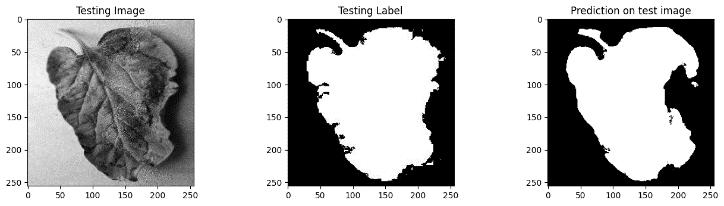
ThebenefitoftheappliedCVmodelinpreciselyidentifying regionsofinterestwithinimagesoftomatoleaveshasbeen demonstrated by its remarkable performance metrics for the semantic segmentation of healthy tomatoes. Before the segmentation process began, plant leaf images were preprocessed by removing the background and then converted to binary segmented images that were used as mask images as shown in fig. Important training data for theU-Net model camefrom thesemask images. The model is ready to acquire strong features necessary for accurate segmentation thanks to careful data preparation that includes image loading, resizing, and normalization. By utilizing the inherent benefits of the U-Net architecture, such as skip connections and encoder-decoder symmetry, the model is able to capture both local and global features, which can be used to accurately segment healthy tomato regions.
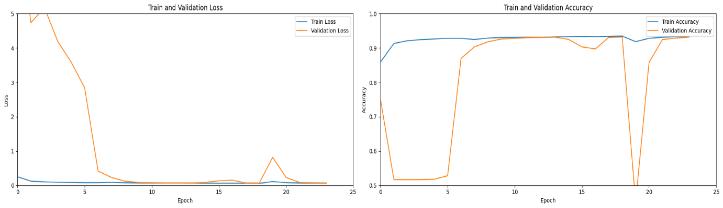
The model demonstrated remarkable learning capabilities duringtraining,landingatanastounding93%accuracyrate as shown in fig 2. This striking precision highlights the model's ability to discriminate between healthy and unhealthy tomato regions, which is important for agricultural applications that seek to monitor crops and identify diseases. At 0.9706, 0.9717, and 0.9712, respectively, the model's precision, recall, and F1-score valueswerealsonoteworthy.Thesemeasuresdemonstrate the model's capacity to reliably produce segmentation results by achieving a high percentage of true positive identifications while reducing false positives and false negatives. Mean Intersection over Union (IoU), a quantitative indicator of segmentation accuracy, was employedinthecomprehensiveassessmentofthemodelto
forecast disease regions within plant leaf images. The model's ability to correctly identify disease-affected areas was revealed by the IoU metric and a visual comparison between model predictions and ground truth masks. We were able to obtain a thorough grasp of the model's segmentation capabilities and its efficacy in assisting with disease diagnosis and management in agricultural contexts byexaminingthediscrepancybetweenpredictedandactual diseaseregions.
In summary, the success of the developed U-Net model in precisely identifying regions of healthy tomatoes is demonstrated, indicating its potential utility as a useful instrument for both researchers and agriculturalists. The model makes a substantial contribution to the fields of computer vision and agricultural technology through its careful implementation, thorough evaluation, and outstandingperformancemetrics.
Ourworkaimstoincreasetheefficiencyindetectingtomato leaf diseases, so we suggested an approach that makes use of CNNs, which areparticularly good at image analysis and classification, and U-Net, which is renowned for its skill at pixel-by-pixelsegmentation,tobenefit fromtheadvantages ofdeeplearning.Wewillbetryingtoimplementthisrobust andaccuratetoolforidentifyingdisease-affectedregions in tomato leaves which might be possible by the combination of feature extraction and high-resolution segmentation. In conclusion,byutilizingimagesegmentationtechniquesand specifically the UNet architecture, our project has made significant progress toward the identification of tomato plant leaf diseases. We have achieved a remarkable 93% accuracy rate as shown in fig, exceeding the standards establishedby earlierresearch.Ourapproachisrobustand effective,asevidencedbyourprecision,recall,andF1-score metrics of 0.9706, 0.9717, and 0.9712, respectively. These outcomesshowhowourmethodologycanbeusedtocreate a sophisticated and reliable tomato leaf disease detection system. To fully implement our approach, more experimental validation and optimization will be required, but the preliminary results point to a promising path towards automated and early disease detection in agriculture, laying the groundwork for more widespread applicationsinplantdiseasediagnosis.
Despite considering the notable achievements of our project, there is still much room for improvement in the field of real-time plant disease detection systems. Despite the remarkable accuracy and effectiveness of our methodology, there is a need to expedite the process for real-time implementation so that farmers and agricultural
International Research Journal of Engineering and Technology (IRJET) e-ISSN: 2395-0056
Volume: 11 Issue: 03 | Mar 2024 www.irjet.net p-ISSN: 2395-0072
practitioners can receive immediate feedback. By enabling quick decisions based on precise and timely information, thecreationofsuchsystemshasthepotentialtocompletely transform agricultural disease prevention and management.Furtherresearcheffortscouldconcentrateon improving the suggested methodology's scalability and adaptability to suit a greater variety of plant diseases and environmental circumstances, thereby expanding its applicationinvariousagriculturalcontexts.
9. Reference
[1] Diagnosis of grape leaf diseases using automatic Kmeans clustering and machine learning by Seyed Mohamad Javidan,AhmadBanakar,2023
[2] Zamani, Abu Sarwar, et al. "Performance of machine learning and image processing in plant leaf disease detection." Journal of FoodQuality 2022(2022):1-7.
[3] Voutos, Yorghos, et al. "A survey on intelligent agricultural information handling methodologies." Sustainability 11.12(2019):3278.
[4] Pandian, J. Arun, et al. "A five convolutional layer deep convolutional neural network for plant leaf diseasedetection." Electronics 11.8(2022):1266.
[5] Ferentinos, Konstantinos P. "Deep learning models for plant disease detection and diagnosis." Computers and electronics in agriculture 145(2018): 311-318.
[6] Zhang, Shanwen, and Chuanlei Zhang. "Modified UNet for plant diseased leaf image segmentation." Computers and Electronics in Agriculture 204(2023): 107511.
[7] InternationalJournalforResearchinAppliedScience & Engineering Technology (IJRASET) ISSN: 23219653; IC Value: 45.98; SJ Impact Factor: 7.538 Volume11IssueVMay2023-www.ijraset.com
[8] Talasila, S., Rawal, K. and Sethi, G., 2023. Deep Learning-Based Leaf Region Segmentation Using High-Resolution Super HAD CCD and ISOCELL GW1 Sensors. Journal of Sensors, 2023
[9] Ahmed,Faisal,MohammadNaimUddinRahi,Raihan Uddin, Anik Sen, Mohammad Shahadat Hossain, and Karl Andersson. "Machine Learning-Based Tomato LeafDiseaseDiagnosisUsingRadiomicsFeatures."In Proceedings of the Fourth International Conference on Trends in Computational and Cognitive Engineering:
TCCE 2022, pp. 25-35. Singapore: Springer Nature Singapore,2023.
[10]Sardogan, Melike, Adem Tuncer, and Yunus Ozen. "Plantleafdiseasedetection andclassification based on CNN with LVQ algorithm." In 2018 3rd international conference on computer science and engineering(UBMK),pp.382-385.IEEE,2018.
[11]Raja Kumar, R., Athimoolam, J., Appathurai, A., & Rajendiran, S. (2023). Novel segmentation and classification algorithm for detectionof tomato leaf disease. Concurrency and Computation: Practice and Experience, 35(12),e7674.
[12]Tugrul B, Elfatimi E, Eryigit R. Convolutional neural networks in detection of plant leaf diseases: A review. Agriculture. 2022 Aug 10;12(8):1192. [13] Pandian, J. Arun, et al. "A five convolutional layer deep convolutional neural network for plant leaf diseasedetection." Electronics 11.8(2022):1266.
[13]Chen,Z.,Wu,R.,Lin,Y.,Li,C.,Chen,S.,Yuan,Z.,Chen, S.andZou,X.,2022.Plantdiseaserecognitionmodel basedonimprovedYOLOv5. Agronomy, 12(2),p.365.
[14]Li, Y. and Chao, X., 2021. Semi-supervised few-shot learning approach for plant diseases recognition. Plant Methods, 17,pp.1-10.
[15]SagarS,SinghJ.Anexperimentalstudyoftomatoviral leaf diseases detection using machine learning classification techniques. Bulletin of Electrical Engineering and Informatics. 2023 Feb 1;12(1):45161.
[16]Jayanthi,M.G.,andD.R.Shashikumar."Eggplantleaf diseasedetectionandsegmentationusingadaptively regularized multi Kernel-Based Fuzzy��-Means and OptimalPNNclassifier."
[17]Attallah, O., 2023. Tomato leaf disease classification via compact convolutional neural networks with transfer learning and feature selection. Horticulturae, 9(2),p.149.