
International Research Journal of Engineering and Technology (IRJET) e-ISSN: 2395-0056
Volume: 11 Issue: 03 | Mar 2024 www.irjet.net p-ISSN: 2395-0072
International Research Journal of Engineering and Technology (IRJET) e-ISSN: 2395-0056
Volume: 11 Issue: 03 | Mar 2024 www.irjet.net p-ISSN: 2395-0072
Sahithi5 , V.Kathyayani6
1Professor, Head Of The Civil Engineering Department, OSD To Hon’ble Vice Chancellor, University College Of Engineering Kakinada(A), Kakinada, Andhra Pradesh, India
2Assistant Professor(C), Department Of Civil Engineering, University College Of Engineering Kakinada(A) , Kakinada, Andhra Pradesh , India
3,4,5,6U.G Students, Dept. Of Civil Engineering, University College of Engineering Kakinada(A), Kakinada, AP, India
Abstract - Themanagementoftheenormousquantitiesof construction and demolition (C&D) materials produced in urbanareasisbecominganincreasinglydifficultproblem.In keepingwiththeseideas,thisstudyrecommendsasuitable proportionofC&Dwastetobeusedinbituminousmixesand focuses on using RCA (recycled concrete aggregate) to improve bituminous mix effectiveness in terms of mechanical,volumetric,andmoisturesensitivity.Theresults ofthisexperimentshowthatattheoptimumbitumenand constructionanddemolitionwastelevels,respectively,the marshalstabilityvaluesincreasedfromtheconventionalmix totheimprovedmix.Fromaconventionalmixtoamodified mix,flowvaluesaredecreased (4.4mm -3.4mm shown in 6.2 and 7 sections). From the results, it is observed that 6% bitumen and 20% C&D waste are suitable to prepare bituminous mix surface layers for medium and light traffic conditions, whereas for heavy and very heavy traffic conditions strength is notsufficientandanothermaterialmust be used as a partial replacement, so molasses was chosen as the partial replacement of bitumen sugar molasses, the addition material investigated in this study, it obtained by boiling sugarcane juice and removing sugarcane crystals so that a thick brown syrup is obtained. Molasses is a relatively cheap material and has not been used as a bitumen modifier before. A material was synthesized using sugar canejuice.The base bitumen was modified with molasses and construction and demolition waste separately to investigate the effects of those modifications on bitumen and bituminous mixture properties by laboratory tests,includingviscosity,penetration, softening point, ductility, and Marshall Stability
Key Words: Bituminous Mix, Molasses, Construction and Demolition Waste, Marshall Stability, Softening Point
1.INTRODUCTION
As traffic demand increases rapidly along with increasing axle loads, there is a requirement for a huge quantity of highway construction materials. Aggregates obtained by processing natural stone form the major portion of these materials. Because natural stone resources are depleting very quickly, highway engineers are concerned about meeting the high demand for natural aggregates for
pavementconstruction.Theyareexploringwasteandlocally available materials to replace natural aggregates to the extentpossibleinviewofcostandpreservationforbetter and essential uses. Also, when such materials are used, sustainability needs to be ensured. With the use of these materials, the environment is highly benefited in terms of naturalresourceconservation,optimizationoflandfilluse, savings in waste-dumping charges, possible emission reductions, and savings in energy use. Concrete is a very common material for buildings and other structures. Demolition of concrete structures because they have attainedtheirexpectedlifeorforotherreasonsisacommon featureinurbanareasandonlargeprojectsites.Thiscreates quantitiesofconstructionanddemolition(C&D)waste.C&D wastes, when recycled and reused as aggregates in new construction, are collectively known as recycled concrete aggregate(RCA).Anumberofstudieshavesoughtpotential usesforthesematerialsinconstruction.Todate,onlylimited literatureisavailableontheuseofRCAinbituminousmixes for roadconstruction.Becausethephysical,chemical,and mechanical properties of RCA are different from those of conventional aggregates, extensive research is needed to substantiate RCA’s suitability for this purpose. In general, RCAisrough,porous,flat,andirregularinfrontageshape.It also has low specific gravity along with high porosity and water absorption compared with natural coarse stone aggregate (Lee et al. 2012; Perez et al. 2012). Bitumen, a viscoelastic material, is the lone deformable element in a bituminouspavingstructureandplaysaveryimportantrole inpavementbehavior.Themostimportantpropertiesofa bituminous mixture are its stability and flow. Optimum stability can handle traffic requirements sufficiently and prevent excess rutting (Kalantar et al. 2012). As for the general performance of bituminous pavement, distress occurs in hot climates as rutting and in cold climates as crackingduetothesensitivityofbitumenandbituminous mixestolowertemperaturesandtraffic.Toovercomethese problemsinaflexiblepavement,theperformanceofeither the bitumen or the mix must be improved. A significant amount of research has been carried out to enhance the properties of these two components in different ways for conventional bituminous paving mixes. Modification of bitumenusingmolassestoimprovebinderpropertiesovera
International Research Journal of Engineering and Technology (IRJET) e-ISSN: 2395-0056
Volume: 11 Issue: 03 | Mar 2024 www.irjet.net p-ISSN: 2395-0072
rangeofvaryingtemperatureshasalonghistory.Theuseof molassesdirectlyinamixispermitted.Theadditivematerial in examination in this study, sugar beet molasses, is producedfromrawsugarjuiceinsugarrefineriesafterthe juiceisheatedandsugarcrystalsareremoved.Duetocost and planning issues, this thick, dark brown syrup with a sugarconcentrationofbetween40and50percentcannotbe utilizedtocrystallizeadditionalthesugarsaccharose.Itis utilizedinvariousindustries,includingthemanufactureof ethanol, animal feed, yeast factories, and fertilizers. On average,20–25%ofitismadeupofwater.Althoughitslow price, sugar beet molasses has never been utilized as a bitumenmodifier.Molasseswasmadefromsugarcanejuice. Thebasebitumenwasmodifiedwithsugarbeetmolassesto investigatetheeffectsofthosemodificationsonbitumenand bituminousmixturepropertiesbylaboratorytests suchas penetration,ductility,softeningpoint,andMarshallStability.
Viscosity for bituminous mixes, whose use in conjunction with RCA has up until now been scanty. Because of its common available size fractions, RCA was used as the replacementfillerinadensebituminousmixwithquerydust as filler. For comparison, similar bituminous mixes were preparedusingfilleronly,withpartialreplacementoffiller and partial replacement of bitumen with molasses and findingoptimumvaluesandfinallyfoundthestrengthofmix
2.1 Mustafa Musleh Razahi1, Avani C. (2020)
ThisarticleexaminestheuseofSisalandCoirfibersasstone matrixasphaltadditives.TheSMAisstrengthenedbyfibers and polymers, which are additions with a high asphalt percentageandcoarseparticlecontent.Coarseaggregates serve the important purpose of providing stone to stone network and intermixing in the mixture, which gives strengthandalong-lasting,richmortar.Stonematrixasphalt added fibers and polymers to prevent the SMA mix from leaking.Thetransportationindustryusesavarietyofnatural fibers, including hemp, banana, coir, and sisal. Stability in SMAmixesdecreasesasthenumberoffibersincreases.The mix's strength and durability are boosted, and it doesn't drainthankstotheadditionofsisalandcoirfibers.Allofthe research showed that the mix's stability, flow value, and volumetriccharacteristicswereevaluatedusingtheMarshall Stability test, and that the mix's stability, flow value, and volumetric characteristics were ascertained using the MarshallMixDesign.AdifferenttestcalledDrainDownwas employedinseveralstudiestocalculatethequantityofDrain DownfromuncompactedStoneMatrixAsphalt(SMA).
2.2 K.
Inthisarticleincludestudyofglassfiberandcarbonfiberin SMA. Carbon fibers will be added to the SMA mixes in additiontotheglass,andthecharacteristicsofthemixtures will be found. It was selected to use carbon fibers in the current research since they are readily available in India.
Preparingasphaltconcrete mixes withtwotypesof fibers (carbonandglass)atdosagesof0.3%,0.4%,and0.5% by weight of the total mix will be used to conduct detailed laboratory experiments. The mixture volumetric characteristicswillbefoundaswellasmarshalstability.
In this study, coconut fiber, banana fiber are used to determinetheMarshallpropertyofmix,Allthesefibersplay animportantroleinprovidingstabilitytobitumenbinderin the mix and preventing drainage during manufacturing, transit,anddevelopment.Basedonlaboratoryexperiments thatlookedatflowandstability,thegoalofthisstudyisto investigateifcoconutandbananafibermaybeutilizedasa stabilizingelementinacombination.Cementisutilizedasa mineralfiller,andVG30gradebitumenisusedasabinder.A stone matrix asphalt mix with a nominal maximum aggregate size of 20mm,10mm is used with fiber as an additivetoimprovestabilityandbulkspecificgravitywhile loweringflowvalue.At0%draindown,coconutandbanana fibers exhibited optimum fiber levels of 0.3 and 0.4%, respectively
Fromtheliterature,itwasfoundthatresearchershaveused different materials like coconut fibers, waste plastics, asbuton,naturalrocks,etc.,toprepareSMAmixes,andthe results were within the permissible limits. In this regard, C&D waste is used to prepare the SMA Mix in the present investigation.
Bitumen-aggregate combinations have been used to pave roadways for ages because they are relatively cheap and easy-to-supplyconstructionmaterials.Althoughtheprimary part of this combination consists of aggregates, bitumen playsamajorroleinpavementperformancebecauseitbinds aggregateparticles,provideswaterproofingproperties,and contributes to the stability and durability of mixtures. Rutting,fatigue,low-temperaturecracking,andstrippingare knownasthemajordistressesofroadwaypavements.Their formationonroadwaypavementisrelatedtothebitumen properties used in the structure. At high temperatures, bitumen loses its cohesion, and one of the prominent pavement distresses, rutting, is formed under heavy loadings. Fatigue cracking occurs when the repetition of trafficloadingsexceedsthethresholdvalue,whichdepends on the material and mixture properties. Low-temperature cracking appears because of bitumen shrinkage at low temperatures.Strippingarisesasaresultofaquaticeffects andpooradhesivebondsatthebitumen-aggregateinterface. Increases in traffic volumes and axle loads, together with extremeweatherconditions,maderesearchersinvestigate feasible ways of improving bituminous mixture performance, one of which may be the modification of bitumenwithadditives.Severaladditivematerialshavebeen used in this regard, such as block copolymers, rubbers, thermoplasticpolymers,thermosettingplastics,andothers.
International Research Journal of Engineering and Technology (IRJET) e-ISSN: 2395-0056
Volume: 11 Issue: 03 | Mar 2024 www.irjet.net p-ISSN: 2395-0072
Literaturestudiesshowthatadditivesthatareusedeitherin bitumen or in bituminous mixtures provide additional resistanceagainsttheformationofdistresses
2.5Rose Mary X. (2018)
Asignificantamountofcoarseaggregatecontentmakesup SMA.Theyareheldtogetherbyathickcoveringofasphalt, stabilized by fibers and mineral filler. Better bonding and superior stone contact are present. There is a severe draining issue with SMA Mix. Stabilizing agents such as polymers, mineral fibers, and cellulose fibers are used to keep the mixture fromdraining. SMA'sstructural features enableittoprovidepavementresilienceandlongevitywhile optimizing resistance to rutting and deformation. The Marshallcharacteristicandvolumetricparametersareused tocalculatetheoptimumbitumenandfibercontentsforthe SMAMix.Severalstudieshavebeenconductedtoassessthe performancecharacteristicsofSMAmixesthatusedifferent types of fibers as stabilizers. The fibers help improve bonding and promote aggregate-aggregate contact. The amountofbinderthatflowsdowndecreasesconsiderably whenfibersareadded.ItmaybepossibletoextendtheSMA researchtoalargergeographicregionbyutilizingarangeof accessible local fibers. Pineapple fiber, which has a high cellulosecontent,maybeusedasastabilizingagentinSMA futurestudies.
2.6Sambhav Jain, Harpreet S., Tanuj C. Et Al. (2017)
This article examines the results of an investigation involving a stone matrix asphalt mix made with VG 30 bitumenandvariousfibersasadditions,includingcoconut fiber, glass fiber, and jute fiber. SMA mixes that include differentkindsoffibers.Thestudyprocedureincludesdrain down testing and SMA mix design. Compared to all other fibers used in stone matrix asphalt, cellulose fiber has a smaller drain down value and greater Marshall Stability. Whereas other types of additions drain within the given limits,cellulosefiberdrainstheleast.Thefindingsshowthat there is very little drain down of a mix based on cellulose fiberduringfieldproduction.
3.OBJECTIVE AND SCOPE
To compare the various properties of the bituminousroadandthemodifiedbituminousroad with molasses and construction and demolition waste
Toidentifytheoptimumproportionofmolassesand constructionanddemolitionwastetobeaddedin thebitumenmixforgetting therequiredstrength for the pavement from medium traffic to heavy trafficandveryheavytrafficconditions
To study the properties of natural aggregate and constructionanddemolitionaggregate.
To convert molasses into binder and decrease environmentpollutionduetobitumen
Todecreasethebitumencontent.
Toincreasethelifeofpavement
Mixes were prepared using conventional VG 30–grade bitumen and molasses with a coarse aggregate fraction comprisingrecycledconcreteaggregate(RCA)andnatural aggregate(NA),alongwithstonedustasthefiller.Eachmix typewasevaluatedintermsofMarshallcharacteristics,flow number. A flowchart of the experimental methodology is showninFig.1
Thedemolitionconcreteusedinthemixdesigns,collected from the University College of Engineering Kakinada campus, Kakinada, India, comprised reinforced cement concrete (RCC) slabs, beams, columns, basements and the like,fromoldbuildingsandfromconcretespecimenscastfor laboratorytestingandresearch(Fig3).Itwasfirstprocessed and then crushed to obtain RC aggregate fractions of the requiredsizes,asshowninFig.2.TheNAusedwascollected from a local stone quarry in the sizes required for the productionofconventionalbituminousmix.Asdetermined inthelaboratory,thephysicalpropertiesoftheRCAandthe NAareprovidedinTable1.ItisobservedthattheRCAhasa higherimpactandlosangels’abrasioncomparedwiththe natural aggregate (NA). The other physical properties specific gravity, aggregate crushing value, and water absorption, flakiness, and elongation were found to be satisfactory for RCA, according to the Ministry of Road TransportandHighways.
(MoRTH2013)specifications
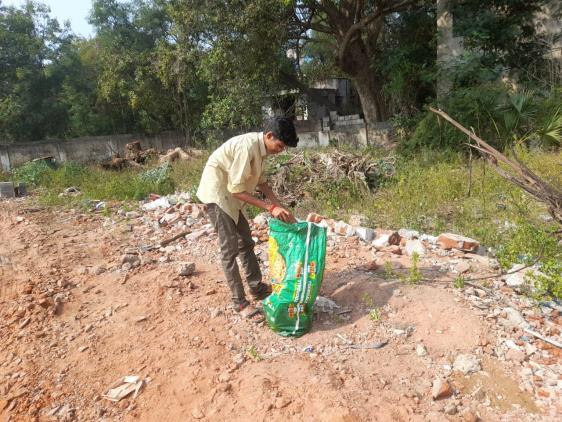
CollectionofRCAFromJntukDismantledBuilding
International Research Journal of Engineering and Technology (IRJET) e-ISSN: 2395-0056
Volume: 11 Issue: 03 | Mar 2024 www.irjet.net p-ISSN: 2395-0072
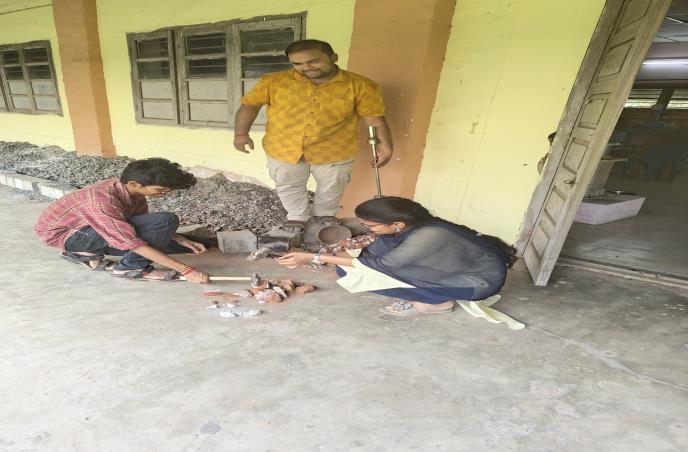
Fig2:PreparationofRCAinTheLaboratory
Preparation of bituminous mixes
Demolition concrete (RCA) Natural aggregate (NA)
Crushed and converted required size
Determination of physical properties of RCA and NA molasses
Marshall mix design Filler (query dust)
Fine aggregate
VG 30 bitumen
Marshall stability Flow number
Bitumen
FIG1:FlowChartOfExperimentalMethodology
TESTS RESULTSNA
RESULTSNARESULTSC&DISSTANDARDSREFERRED CODE IMPACT11.41%24.43%MAX18%IS:2386(IV) CRUSHING21.30%16.51%MAX30%IS:2386(IV) ABRASION8.20%38.20%MAX30%IS:2386(IV) SPECIFICGRAVITY2.731.322.5-3IS:2386(III) WATERABRASION0.59%1.97%MAX2%IS:2386(III)
FINEAGGREGATE specificgravity2.73 - 2.5-3IS:2386(III) waterabsorption0.59 - MAX2%IS:2386(III)
Table1physicalpropertiesofRCAandNA
4.1.2 BITUMEN AND FILLER
InIndia,VG30–gradebitumeniscommonlyusedinlower bituminous layers [IRC 37 (IRC 2012)]. Bitumen acts as a bindingagentforaggregatesinbituminousmixes. Collected from a government organization, it was used for the preparation of the bituminous mixes in this experimental work;itsphysicalproperties whenpartiallyreplacedwith molasses is shown in 6.1.2. Query dust (QD), used as the filler, was collected from local sources. Its specific gravity wasfoundtobe3.14inthelaboratory,showninTable1
4.1.3 MOLASSES (modification of base bitumen)
Sugar beet molasses, which in this paper will simply be called molasses, were sourced from a sugar factory near Kakinada and used directly within the base bitumen in certainamounts.Thespecificationsofthemolassesusedin the modification process of the base bitumen are given in Table3.
International Research Journal of Engineering and Technology (IRJET) e-ISSN:
Volume: 11 Issue: 03 | Mar 2024 www.irjet.net
Table3: SpecificationforMolasses
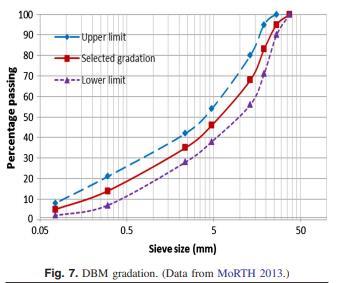
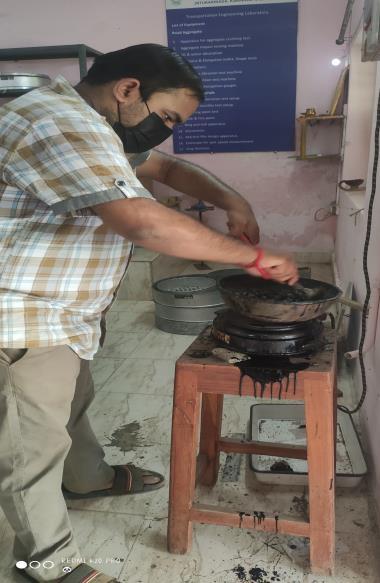
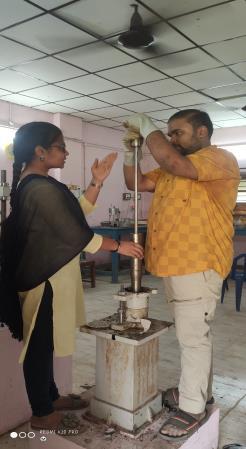
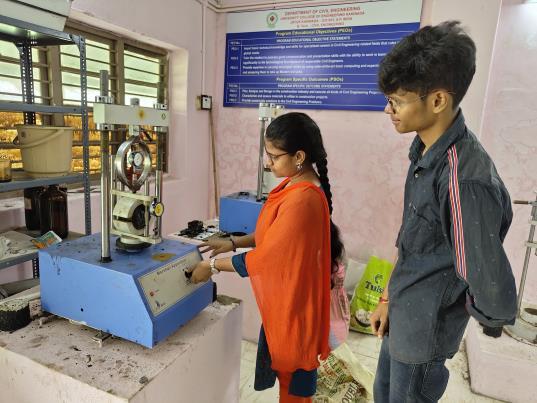
As per the Ministry of Road Transport and Highways (MORTH2013),theaggregategradationrecommendedfora 20-mm nominal maximum aggregate size (NMAS) bituminous mix was considered. Individual mixes were prepared as per the conventional Marshall procedure specifiedinASTMD1559(ASTM1989).Thegradationsare showninFig.7,andthecorrespondingmidpointgradation wasselectedfor thepreparationofMarshall specimens of differentmixeshavingdifferentcoarseaggregatefractions. Before the hot bitumen was added to the preheated aggregatesandfiller,therequiredamountofmolasses(asa partialreplacementforoptimumbitumen)wasaddedtothe heatedbitumen.Themixwasthenmanuallymixed until a uniformmixwasobtained.Optimumbitumencontentwas obtained withvaryingbitumencontentas a percentageof theaggregateweight(i.e.,4%,5%,6%,7%).combinationsof bituminousmixwerepreparedwithvaryingRCA(powdered form), NA optimum value was found and used in the mix; querydustwasusedasthefillerfractioninallofthem.five additional combinations modified by molasses (by replacementwithbitumen)andwithquerydustasthefiller fractionwerealsopreparedwithoptimumvaluesofbitumen and RCA (recycled concrete aggregate). Specimens of all combinations were tested for Marshall and other engineeringcharacteristics.Theoptimumbitumencontent (OBC) was determined on the basis of average bitumen contentcorrespondingtomaximumstability,maximumunit weight,atabitumencontentof6%at3.81%airvoids.The molassescontentvariedby4-8%oftheoptimumbitumen content with optimum RCA. The optimum bitumen and optimum molasses were decided based on the maximum stabilityvalue,satisfyingotherMarshallcharacteristics.
International Research Journal of Engineering and Technology (IRJET) e-ISSN: 2395-0056
Volume: 11 Issue: 03 | Mar 2024 www.irjet.net p-ISSN: 2395-0072
6.RESULTS AND CONCLUSIONS:
6.1 Bitumen Test Results:
6.1.1 Bitumen with Out Molasses WITHOUT MOLASSES
Sno test result IS standard IS code
1 penetration 52.66 50-70mm IS: 1203-1978
2 ductility 108.7cm min 75cm IS:1208-1978
3 specific gravity 0.98 0.97-1.02 IS:1202-1978
4 softening point 53.350 c min 470 c IS:1205-1978
5 viscocity 300pa-s 240-360pa-s IS 1206-PART-2 WITH MOLASSES
6.1.2 With Molasses
Sno test result IS standard IS code
1 penetration 69.66mm 50-70mm IS: 1203-1978
The optimum percentage obtained is 5%, obtained from belowtableandgraphs. WITH MOLASSES
The Optimum value of bitumen content is 6%,which was obtainedfromthebelowtableandgraphs.
Content(%)BulkDensityth
International Research Journal of Engineering and Technology (IRJET) e-ISSN: 2395-0056
Volume: 11 Issue: 03 | Mar 2024 www.irjet.net p-ISSN: 2395-0072
continuationofthetable…
2.4215.73.4519.1518.0265590566.45.1
2.395.444.8610.347.1863.56676674.5
2.363.8113.217.0177.663.57247244.4 2.323.886.6710.5563.2263.56236234.6
Where,
W1:weightofspecimeninair
W2:weightofspecimenafterwaterbath
W3:suspendedweightofspecimeninwaterbath
Graphsfortheabovetableshownbelow:
TheOptimumvalueofRCAobtainedis20%,obtainedfrom thebelowgraphsandtableswheremaximumstabilityseen
International Research Journal of Engineering and Technology (IRJET) e-ISSN: 2395-0056
Volume: 11 Issue: 03 | Mar 2024 www.irjet.net p-ISSN: 2395-0072
The Optimum value of molasses obtained is 6%, where maximumstabilityandminimumflowisseen
Graphsfortheabovetableisshownbelow
9.CONCLUSION
Based on the experimental investigations carried out on DBMmixespreparedwithcoarseaggregates(NA,RCA)with stonedustasfiller,andonmodificationsofthesamemixes withmolasses,thefollowingconclusionsaredrawn:
Atoptimumvaluesmaximumstabilityseen.
TheOptimumbitumencontentis6%
TheOptimumRCAcontentis20%
TheOptimummolassesis6%ofoptimumbitumen.
6% (by total weight of aggregates) +20%RCA (by total weight of aggregates) +6% molasses (by optimum bitumen content) gives the required stability of pavements for heavy and very heavy traffic roads because Marshall stability value requiredismorethan910kg(obtainedis958kg).
Whereas6%bitumen(bytotalweightofaggregates) +20%RCA (by total weight of aggregates) is sufficient for roads with low to medium traffic conditions because Marshall stability required is 545kgto910kg(obtainedis754kg).Thennoneed forpartialreplacementofbitumenwithmolasses.
A decrease in bitumen utilization in pavements directly correlates with a reduction in the cost of layingpavement(using6%aspartialreplacement ofbitumen)soeconomicallygood
The use of the creative technology not only strengthened the road construction but also increasedtheroadlifespanaswellaswillhelpto improvetheenvironmentandalsocreatingasource ofincome(ascostdecreases).
Fromgraphsmaximumloadcarriedisfound
The authors would like to thanks our Institute (JNTUK KAKINADA) All Faculty members of Civil Engineering Department for giving all encouragement needed for completionofProjectsuccessfully
[1]Metin Guru ; M. Kürşat Çubuk; Deniz Arslan; and Sina Aminbakhsh(2016)” Effects of Sugar Beet Molasses and Molasses-Based Boron Oxide Compound on Bitumen Properties” Journal of Materials in Civil Engineering 29(4):04016252
DOI:10.1061/(ASCE)MT.1943-5533.0001790
[2]Shivkumar1;NarayanaHarish,Ph.D.2;SukomalMandal, Ph.D.3 ; and Ramappa Prabhakara, Ph.D.4(2018)” InvestigationsonStoneMatrixAsphaltUsingConstruction Demolition Waste as Partial Replacement to Coarse Aggregates for Sustainable Roads”
DOI:10.1061/9780784482032.036
[3]Mr.RishiDubey1,Mr.TarunKumarNarnaure2(2021)“A ReviewofStudiesonStoneMatrixAsphaltbyusingvarious
International Research Journal of Engineering and Technology (IRJET) e-ISSN: 2395-0056
Volume: 11 Issue: 03 | Mar 2024 www.irjet.net p-ISSN: 2395-0072
Additive”InternationalResearchJournalofEngineeringand Technology(IRJET) Volume:08Issue:10IRJET-AReviewof StudiesonStoneMatrixAsphaltbyusingVariousAdditives byIRJETJournal-Issuu
[4] Jyoti Prakash Giri1 ; Mahabir Panda2 ; and Umesh Chandra Sahoo3” Performance of Bituminous Mixes Containing Treated Recycled Concrete Aggregates and Modified by Waste Polyethylene” Journal of Materials in CivilEngineering,Volume30,Issue8
https://doi.org/10.1061/(ASCE)MT.1943-5533.0002384
[5](Prof.Vasudevan.)“Atechniquetodisposewasteplastics in an ecofriendly way – Application in Construction of flexiblepavements”ConstructionandBuildingMaterialsVol. 8 Department of Chemistry, Thiagarajar College of Engineering,Madurai,TamilNadu,India,pp311–320.
[6]TextbookofHighwayEngineeringbyV.K.Kumawat
[7]Reference book Highway Material Testing & Quality ControlbyG.VenkatappaRao&KRamachandraRao.
[8]TextbookofHighway&TrafficEngineeringbySubhashC Saxena Guidelines of NHAI for Construction of Flexible Pavement(http://nhai.gov.in).
[9] Guidelines of PWD Maharashtra for Construction of FlexiblePavement(www.mahapwd.com).
[10]IRC(IndianRoadsCongress).2012.Guidelinesforthe design of flexible pavements, third revision. IRC 37. New Delhi:IRC.
[11]Lastra-Gonzalez, P., M. A. Calzada-Pérez, D. CastroFresno, Á. VegaZamanillo, and I. Indacoechea-Vega. 2016. “Comparative analysis of the performance of asphalt concretes modified by dry way with polymeric waste.” Constr.Build.Mater.112:1133–1140.
https://doi.org/10.1016/j.conbuildmat.2016.02.156
[12]Mills-Beale, J., and Z. You. 2010. “The mechanical properties of asphalt mixtures with recycled concrete aggregates.” Constr. Build. Mater. 24 (3): 230–235. https://doi.org/10.1016/j.conbuildmat.2009.08.046
[13]MoRTH (Ministry of Road Transport and Highways). 2013. “Specifications for road and bridge works. fifth revision.” In Indian Roads Congress. New Delhi, India: MoRTH.
[14]Paranavithana,S.,andA.Mohajerani.2006.“Effectsof recycled concrete aggregates on properties of asphalt concrete.” Resour. Conserv. Recycl. 48 (1): 1–12. https://doi.org/10.1016/j.resconrec.2005.12.009
[15]Perez,I.,A.R.Pasandín,andL.Medina.2012.“Hotmix asphaltusingC&Dwasteascoarseaggregates.”Mater.Des. 36:840–846.
https://doi.org/10.1016/j.matdes.2010.12.058.
[16]Airey,G.D.(2003). “Rheological propertiesofstyrene butadienestyrenepolymermodifiedroadbitumens. ”Fuel,82(14),1709–1719.
:






NAME:DR DKOTESWARARAO
Qualification: BTech, M.Tech (G.T.E), C.C.A & D.T.W, Ph.D, ProfessoratJNTUK,KAKINADA
NAME:Smt.Md.SajidaSulthana
Qualification:M.Tech.(Jntuk) Assistant professor(C) at JNTUK, KAKINADA
Name:Mr Tarun
Qualification : B.E (Civil) U.G StudentatJNTUK,KAKINADA
Name : Miss.Alekhya Sahithi
Qualification : B.E. (Civil) U.G. StudentatJNTUK,KAKINADA
Name : Mr. Jaya Prakash
Qualification : B.E. (Civil) U.G. StudentatJNTUK,KAKINADA
Name:Miss.kathyayani
Qualification : B.E. (Civil) U.G. StudentatJNTUK,KAKINADA