
International Research Journal of Engineering and Technology (IRJET) e-ISSN: 2395-0056
Volume: 11 Issue: 03 | Mar 2024 www.irjet.net p-ISSN: 2395-0072

International Research Journal of Engineering and Technology (IRJET) e-ISSN: 2395-0056
Volume: 11 Issue: 03 | Mar 2024 www.irjet.net p-ISSN: 2395-0072
Janhavi Banarase1, Mayuri Gawande2, Shreyash Kale3, Shashank Mahalle4
1Student, Dept. of CSE Engineering, PRMIT&R College, Maharashtra, India
2Student, Dept. of CSE Engineering, PRMIT&R College, Maharashtra, India
3Student, Dept. of CSE Engineering, PRMIT&R College, Maharashtra, India
4Student, Dept. of CSE Engineering, PRMIT&R College, Maharashtra, India
Abstract - Sports are evolving day by day andthetechnology that supports these sports is evolving at an exponential rate. Many sports have implemented computer vision to improve referee calls and the overall fairness of the game. Basketballis a fast-paced and dynamic sport that relies heavilyonaccurate and consistent officiating for fair play and a smooth game flow. However, traditional officiating methods depend on human referees, who are susceptible toerrorsinjudgment due to factors like limited viewing angles, fatigue, andthepressure of split-second decisions. These inconsistencies can lead to frustration among players, coaches, and fans, potentially impactingthe game's outcome. VirtualBasketballReferees use artificial intelligence that can distinguish between two major infractions in basketball games: double dribbling and travel. The system tracks players and the basketball in real time by utilizing theYOLOv8object detectionmethodology. Thesystem can precisely identify critical body spots on players, allowing for detection of double dribble violations, by combining pose estimate techniques with object identification. By combining these technologies, a reliable method for automating the identification of these frequent basketball infractions is offered, improving the accuracy and fairness of game officiating.
Key Words: You Only Look Once (YOLO), Convolutional Neural Networks (CNN), Computer Vision, Object Detection, Pose Estimation
Basketballisaverydynamicgamewherethemovementsthe playersmakecanbefastandsubtle,yetfine-grained.Assuch thedifferencebetweenaneventoccurringandnotoccurring can be small and occasionally unnoticeable, and the sequence of frames of which the dribble is done matters tremendouslytodeterminewhetheraviolationtakesplace. As such, a spatio-temporal action verification model is neededtoassistrefereesinmakingdecisions,asitisalmost instantaneous in nature. The challenge is to achieve the balance between speed and accuracy since the violation detection has to be fast enough for real-time use. The Basketball Virtual Refereeis a systemthatusesa YOLOv8 (You OnlyLook Once)machine learningmodel trained on annotatedimagestodetectbasketball,playersinreal-time. Additionally, it utilizes YOLOV8 pose estimation to detect keypointsonthebodyoftheplayers.Bycombiningthese
twotechniques,theBasketballVirtualRefereeiscapableof accurately identifying travels and double dribbles in basketballgames.
2.1
Computer vision is a field of artificial intelligence that enables machines to interpret and understand visual informationfromtherealworld.Overthepastfewdecades, significant advancements have been made in computer visionalgorithmsandtechnologies,leadingtoawiderange ofapplicationsinvariousindustries.Computervisionaims to replicate the human visual system's ability to interpret and understand the visual world. It encompasses a broad rangeoftasks,includingimagerecognition,objectdetection, image segmentation, and scene understanding. Recent advancementsindeeplearninghavesignificantlyimproved theperformanceofcomputervisionsystems,enablingthem to achieve human-level performance on many visual recognition tasks. The key concepts in computer vision include image preprocessing, feature extraction, feature representation, and machine learning algorithms for classification and regression tasks. Convolutional Neural Networks(CNNs)haveemergedasadominantapproachin computervision,achievingstate-of-the-artperformanceon taskssuchasimageclassificationandobjectdetection.
OpenCV(OpenSourceComputerVisionLibrary)isanopensource computer vision and machine learning software library.Ithasacomprehensivecollectionofalgorithmsand toolsforawiderangeofapplications,makingitoneofthe most popular libraries in the field of computer vision. OpenCVprovidesarichsetoffeaturesforimageandvideo analysis, including image processing algorithms such as filtering, edge detection, and morphological operations. FeaturedetectionanddescriptionalgorithmssuchasSIFT, SURF, and ORB. Object detection algorithms such as Haar cascades and HOG (Histogram of Oriented Gradients). Machine learning algorithms for classification, regression, clustering, and dimensionality reduction. Deep learning capabilities through integration with frameworks like TensorFlow and PyTorch. OpenCV has made significant contributions to the field of computer vision research,
International Research Journal of Engineering and Technology (IRJET) e-ISSN: 2395-0056
Volume: 11 Issue: 03 | Mar 2024 www.irjet.net p-ISSN: 2395-0072
including the development of new algorithms and techniquesforimageandvideoanalysis.Benchmarkingand evaluationofexistingalgorithmsanddatasets.Integration with other libraries and frameworks to enhance functionality and performance. OpenCV has a rich set of features, a wide range of applications, and an active community make it a valuable tool for researchers, developers,andpractitionersinthefieldofcomputervision.
Convolutional Neural Networks (CNN) have emerged as a powerful class of models for various tasks in computer vision, achieving state-of-the-art performance in image classification, object detection, and image segmentation. CNNsareatypeofdeepneuralnetworkdesignedtoprocess and analyze visual data. They are inspired by the organization of the animal visual cortex and consist of multiple layers of neurons that learn hierarchical representationsoftheinputdata.Thebasicarchitectureofa CNN consists of convolutional layers, pooling layers, and fullyconnectedlayers.Convolutionallayersapplyfiltersto the input image to extract features while pooling layers reduce the spatial dimensions of the features. Fully connected layers are used for classification or regression tasks. CNNs can have multiple layers of each type, with deeper networks often achieving better performance but requiringmorecomputationalresources.
YOLO(YouOnlyLookOnce)isanobjectdetectionalgorithm that utilizes a single neural network to simultaneously predict bounding boxes along with class probabilities for eachobjectinanimage.YOLOv8isthelatestversionofthe YOLO (You Only Look Once) family of object detection models, developed by Ultralytics, which outperforms previousversionsbyintroducingvariousmodificationssuch asspatialattention,featurefusion,andcontextaggregation modules. These improvements result in faster and moreaccurateobjectdetection,makingYOLOv8oneofthe key object detection algorithms in the field. YOLOv8 introducesnewfeaturesandoptimizationsthatmakeitan ideal choice for various object detection tasks in a wide rangeofapplications.
YOLOv8 is a state-of-the-art deep learning model designedforreal-timeobjectdetectionincomputervision applications. It leverages advanced architecture and algorithmstoenableaccurateandefficientobjectdetection. AmodifiedversionoftheCSPDarknet53architectureforms the backbone of YOLOv8. This architecture consists of 53 convolutional layers and employs cross-stage partial connections to improve information flow between the different layers. The head of YOLOv8 consists of multiple convolutionallayersfollowedbyaseriesoffullyconnected layers.Theselayersareresponsibleforpredictingbounding boxes, confidence scores, and class probabilities for the
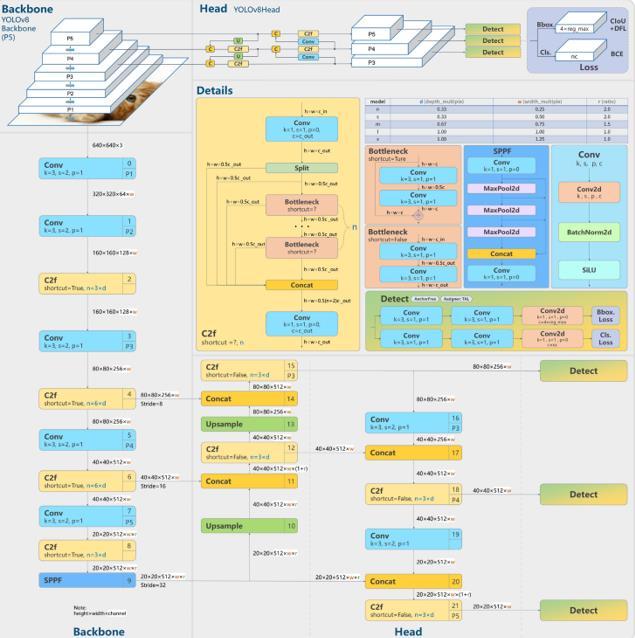
objects detected in an image. One of the key features of YOLOv8istheuseofaself-attentionmechanisminthehead ofthenetwork.Thismechanismallowsthemodeltofocuson different parts of the image and adjust the importance of different features based on their relevance to the task. AnotherimportantfeatureofYOLOv8isitsabilitytoperform multi-scaledobject detection.Themodel utilizesa feature pyramid network to detect objects of different sizes and scales within an image. This feature pyramid network consists of multiple layers that detect objects at different scales,allowingthemodeltodetectlargeandsmallobjects within an image. Here's a brief overview of the YOLOv8 architecture:
Backbone: YOLOv8 uses a backbone network, typically basedontheCSPDarknet53architecture.Thisbackboneis responsibleforextractingfeaturesfromtheinputimage.
Neck: YOLOv8featuresaneckmodulethatfurtherrefines thefeaturesextractedbythebackbone.Thismodulehelpsin improvingtheaccuracyofobjectdetection.
Detection Head: The detection head of YOLOv8 is responsible for predicting bounding boxes and class probabilities for objects in the input image. It typically consistsofseveralconvolutionallayers.
International Research Journal of Engineering and Technology (IRJET) e-ISSN: 2395-0056
Volume: 11 Issue: 03 | Mar 2024 www.irjet.net p-ISSN: 2395-0072
YOLO Layer: YOLOv8utilizesaYOLOlayertogeneratethe finaloutputpredictions.Thislayerprocessesthedetections from the detection head and outputs the bounding boxes along with their associated class labels and confidence scores.
Anchor Boxes: YOLOv8usesanchorboxestoimprovethe detectionofobjectsatdifferentscales.Theseanchorboxes arepredefinedboundingboxesofvarioussizesandaspect ratiosthatareusedtopredictobjectlocations.
Loss Function: The model uses a combination of loss functions, including localization loss, confidence loss, and classification loss, to train the network and improve its accuracyindetectingobjects.
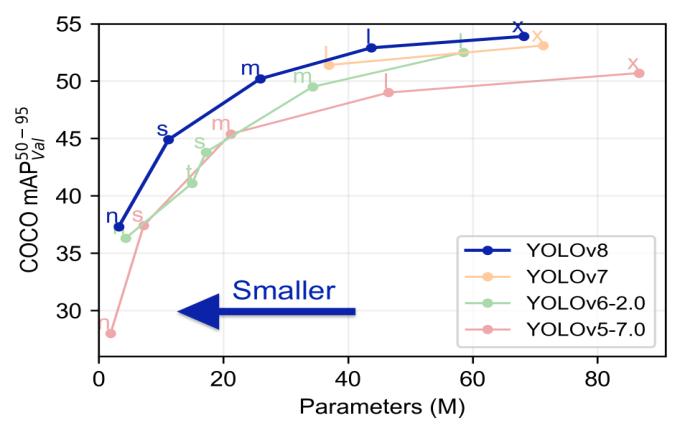
:COCOmAP50-95 vsParametersfordifferent versionsofYOLO
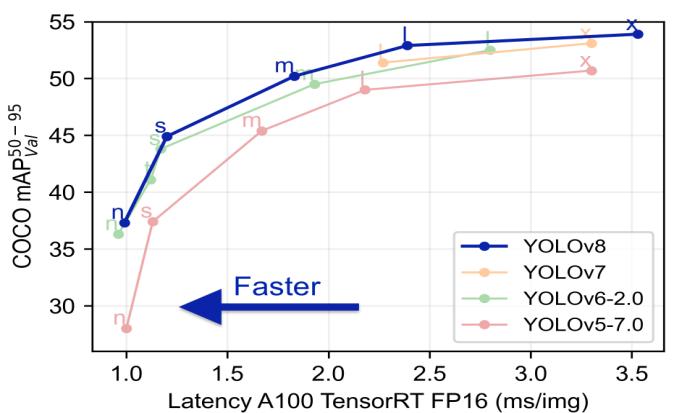
:COCOmAP50-95 vsLatencyA100TensorRTFP16 (ms/img)fordifferentversionsofYOLO
3. METHODOLOGY
Object Detection and Tracking:Detectbasketball,players, and rim using YOLOv8 object detection. Track their movementsinrealtime.
Pose Estimation: Estimateplayerposestoidentifykeybody points.Usethesepointsforadoubledribble.
Double Dribble Detection: Useposeestimationtodetect whenaplayerdouble-dribbles.
Foul Detection & Feedback:Implementlogictodetectfouls basedonplayerinteractionsandmovements.Providesrealtime feedback on detected violations and fouls. Display warningsorpenaltiesonthescreenasnecessary.
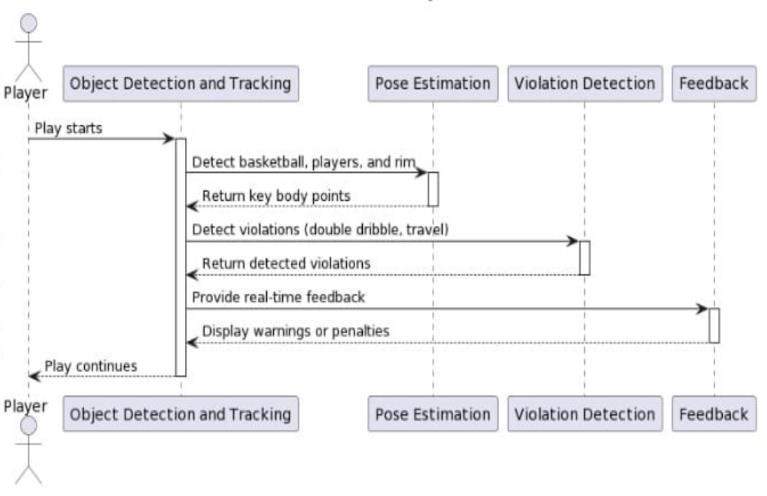
ThefirststepintheBasketballVirtualReferee'ssystem isbasketballdetectionandplayerdetection.A pre-trained YOLOv8 model specifically designed for object detection tasksisloaded.Thismodelhasbeentrainedonadatasetof imagescontainingbasketballgames,allowingittorecognize playersandbasketballswithintheframes.Thevideoframe isfedintotheYOLOv8model.Themodelanalyzestheframe andidentifiesobjectsthatresembleplayersandbasketballs based on the learned patterns from the training data. For each detected object, the model outputs a bounding box indicatingtheobject'slocationintheframeandaconfidence score representing the certainty of the detection being a playerorbasketball.Thesystemgeneratesalistofbounding boxesalongwiththeircorrespondingconfidencescoresfor each detected player and basketball in the frame. This informationprovidesthefoundationforsubsequentstepsin thevirtualrefereesystem,suchastrackingthemovementof
Volume: 11 Issue: 03 | Mar 2024 www.irjet.net
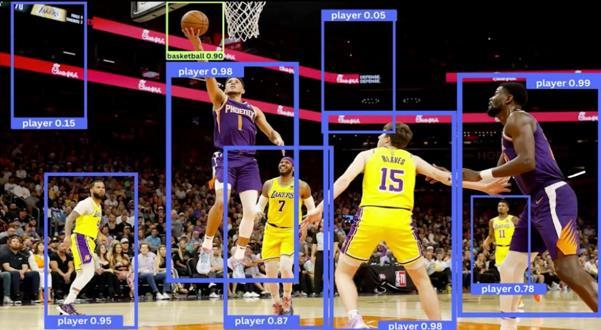
playersandthebasketballthroughoutthegame.Analyzing playerpositionstoidentifypotentialfoulsorviolations.
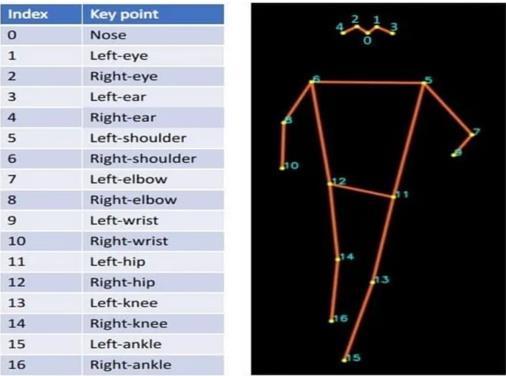
Pose estimation refers to the process of determining the positionandorientationofanobjectorapersoninagiven space,typicallyfromsensordata.Inthecontextofcomputer vision,poseestimationoftenreferstoestimatingtheposeof ahumanbody.Inabasketballvirtualrefereesystem,pose estimationplaysacrucialroleintrackingthemovementsof players and the basketball to analyze the game and make referee-like decisions. In a basketball game, player movementssuchastraveling(movingwithoutdribblingthe ball) and double dribbling (dribbling the ball with both handsorrestartingdribblingafterapause)areconsidered violations. Detecting these violations accurately can be challenging, but it’s crucial for fair gameplay. Once the playersaredetected,thesystemusesYOLOposeestimation toidentifyandtrackkeypointsonthebodyoftheplayers. These key points correspond to body joints such as the ankles, knees, hips, elbows, and wrists. For example, if a player’shandkeypointsmoveinawaythatsuggeststhey aredribblingtheball,buttheirfootkeypointsindicatethey arealsomoving,thiscouldbeflaggedasapotentialtraveling violation. There are typically 16 key points of the human body commonly used in pose estimation and related applications. These points are often referred to as "key points" or "joints" and are used to represent the pose or positionofa person.Thereisalistofthe16keypointsin Fig5.Thesekeypointsareusedinvariouscomputervision tasks, such as human pose estimation, action recognition, andgesturerecognition,tounderstandandanalyzehuman movementsandposes.
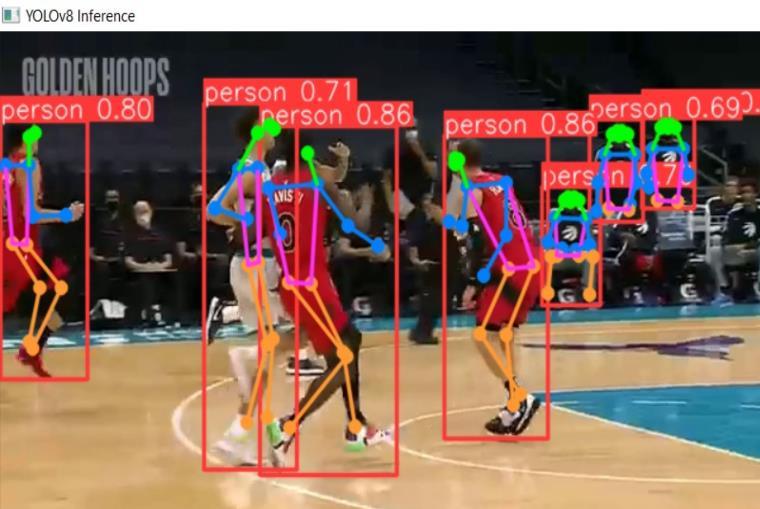
By analyzing the movement of the basketball and the player'skeypoints,thesystemcandeterminewhenaplayer isdribblingtheball.Bytrackingthepositionandmovement oftheplayer'skeypointsandanalyzingtheinteractionswith the basketball, the system can detect situations where a player dribbles the ball, stops, and then starts dribbling againwithoutanotherplayertouchingorpossessingtheball inthemeantime.adoubledribbleisaviolationthatoccurs whenaplayerillegallyresumesdribbling.Thiscanhappenin severalways:
Aplayerendstheirdribblebycatchingorcausing the ball to come to rest in one or both hands and thendribblesitagainwithonehand
International Research Journal of Engineering and Technology (IRJET) e-ISSN: 2395-0056
Volume: 11 Issue: 03 | Mar 2024 www.irjet.net p-ISSN: 2395-0072
A player touches the ball before the ball hits the ground.
A player dribbles the ball with two hands simultaneously
A player stops dribbling and then starts again withoutpassingorshootingtheball
3.4 Real-Time Feedback:
TheBasketballvirtualRefereeprovidesreal-timefeedback on double dribble violations during basketball games. It highlightsthedetectedviolationsonthevideofeed,making it easy for referees or users to identify and assess the accuracyofthesystem'sdecisions.Additionally,thesystem cangeneratelogsoralertstorecorddetectedviolationsfor furtheranalysisorreview.
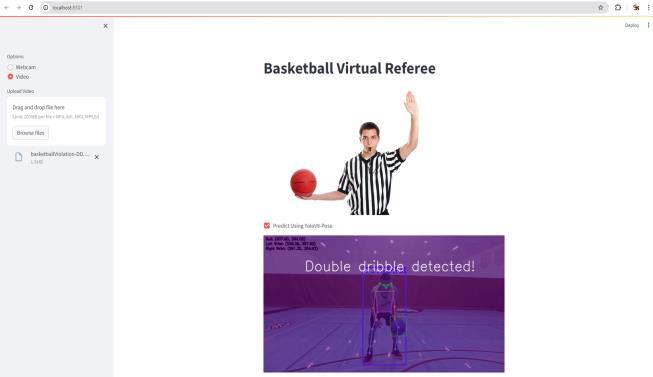
4.1 User Interface using Streamlit: We've developed a Basketball Virtual Referee system using theStreamlitweb application framework that accepts input in the form of video,orwebcam.OpenCVisutilizedforimageprocessing. Whenthe"PredictwithYOLOv8"buttonisselected(fig.6), our YOLOv8 model runs in the background and detects objectswithintheframe.
Thereare2modes:
VideoMode
WebcamMode
4.1.1 Video Mode
ThevideomodeacceptsvariousformatssuchasMP4,AVI, MKV,andMPEG4.Weusedavideoasinput(asseeninfig.6), Byclicking"PredictUsingYoloV8-Pose"activatedtheYolov8 modelinthebackground,resultinginthedetectionviolation calleddoubledribble(asshowninthetableinfig.6).The videohadaframerateof25fps.Userscanuploadbasketball gameplay videos directly. The uploaded video will be displayedwithintheapplication,allowinguserstoplaythe video as needed. The application utilizes computer vision algorithmstoanalyzethevideoframesanddetectinstances of double dribble violations. This detection is done by identifying patterns of dribbling and hand movements typicalofdoubledribbleviolations.Whenadouble-dribble violation is detected, the application highlights the corresponding segment of the video where the violation occurred,makingiteasyforuserstoidentifyandreview.
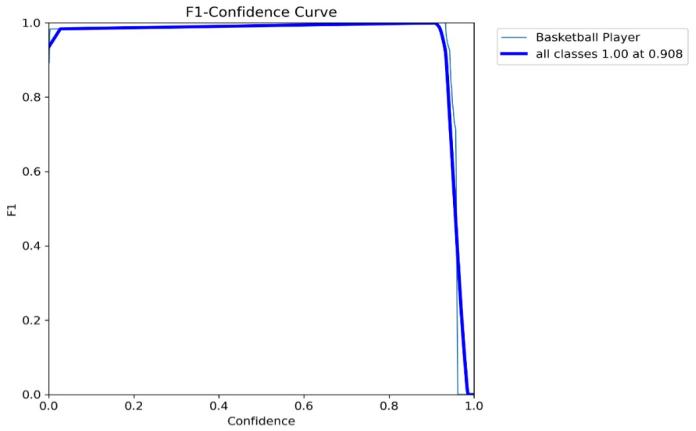
The Graph-3 shows graphs of training results of object detectionusingYOLOv8.Train/valbox_loss:thebounding box loss of the training dataset or validation dataset; the smaller the box is, the more accurate. Train/val cls_loss: train or validation is speculated to be the mean of classificationloss,andthesmallertheclassificationis,the moreaccurate.TheF1confidencecurve(asseeninGraph4) represents the relationship between the F1 score and the confidencethresholdusedtomakepredictions.TheF1score isametricthatcombinesprecisionandrecall,providinga
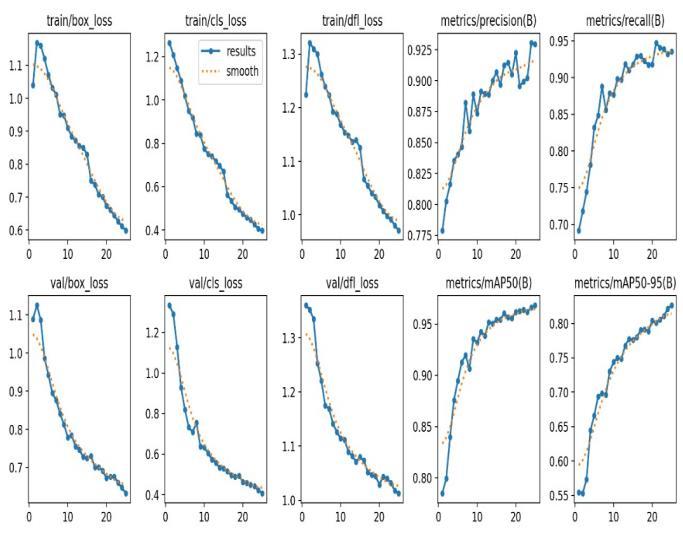
Graph-3:GraphofYOLOv8ObjectDetectiontraining results
balance between these two measures The confidence thresholdisthethresholdabovewhichamodelpredictsthe positive class. The confidence level of a model detecting a basketballincreasesastheconfidencelevelincreases.The confidence level increases until it reaches 0.93 at a confidence threshold of 0.476. The curve shows the precision-recallforallclassesofobjects,withamAP(mean Average Precision) of 0.93 at an IoU (Intersection over Union)thresholdof0.476.
International Research Journal of Engineering and Technology (IRJET) e-ISSN: 2395-0056
Volume: 11 Issue: 03 | Mar 2024 www.irjet.net p-ISSN: 2395-0072
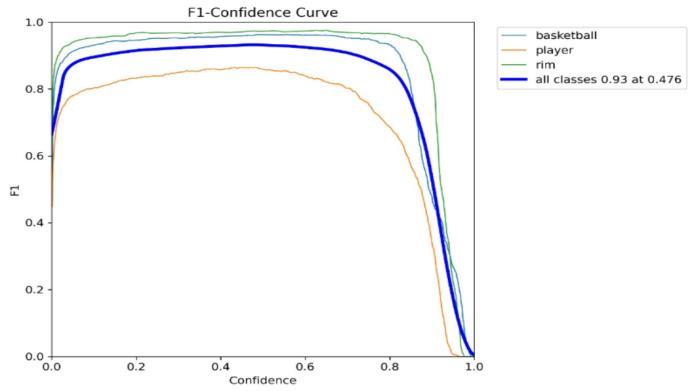
F1-ConfidenceCurveforbasketball,playerand rimdetection
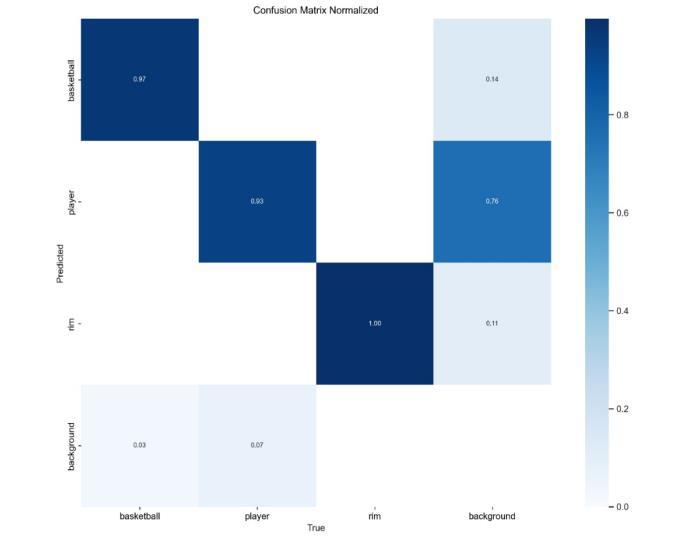
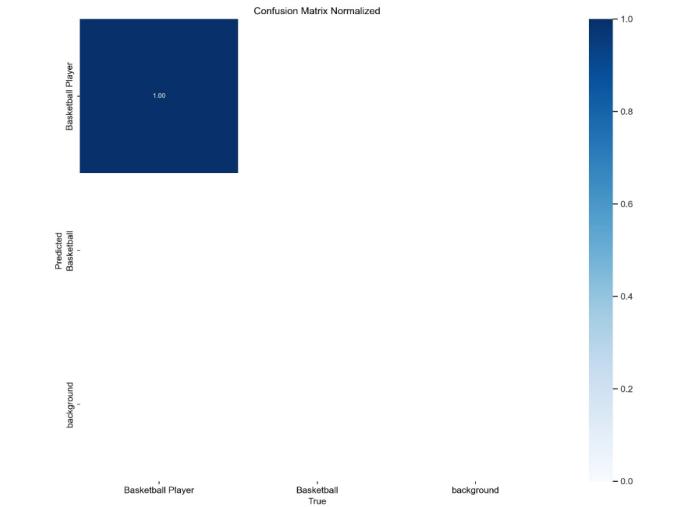
In the normalized confusion matrix(as seen in Fig-7), the countsoftruepositive,truenegative,falsepositive,andfalse negativepredictionsareconvertedintoratesorpercentages, providing a more interpretable view of the classifier's performance.Thenormalizedconfusionmatrixshowsthat theclassifierhascorrectlypredicted97%oftheimagesof basketball,and93%oftheimagesofplayersthatbelongto thepositiveclass.
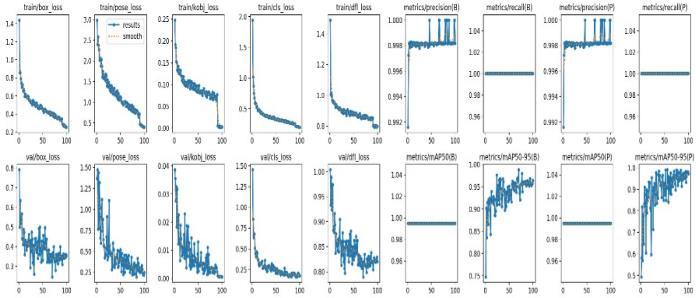
Graph-5showsthePoseEstimationtrainingresultsof the YOLOv8 model. Train/val box_loss: the bounding box lossofthetrainingdatasetorvalidationdataset;thesmaller the box is, the more accurate. Train/val cls_loss: train or validationisspeculatedtobethemeanofclassificationloss, andthesmallertheclassificationis,themoreaccurate.The bluelineonGraph6representstheF1scorefor identifying a“BasketballPlayer.”TheF1scoreremainsat1.0(perfect) untiltheconfidencethresholdreachesapproximately0.908. Beyondthisthreshold,theF1scoredropssharplytozero.It states that for “all classes,” the F1 score is 1.00 when the confidencelevelisupto0.908.
5. CONCLUSIONS
The development of the AI Basketball Virtual Referee representsasignificantadvancementintheintersectionof computer vision and sports technology. Through the utilization of Python programming and cutting-edge computervisionalgorithms,ourprojectaimedtotacklethe intricatetaskofdetectingfoulsandviolationsinbasketball games. Throughout the process of this project, we have
International Research Journal of Engineering and Technology (IRJET) e-ISSN: 2395-0056
Volume: 11 Issue: 03 | Mar 2024 www.irjet.net p-ISSN: 2395-0072
successfully designed and implemented a robust system capable of real-time foul detection with a high degree of accuracy.Byleveragingcomputervisiontechniques,ourAI refereeiscapableofanalyzinglivevideofeedsofbasketball games, swiftly identifying fouls, and alerting officials accordingly.Thisnotonlystreamlinestheofficiatingprocess but also enhances the fairness and integrity of the game. Looking ahead, the AI Basketball Virtual Referee holds immense potential for further refinement and expansion. Withcontinuedresearchanddevelopment,oursystemcould evolvetoencompassabroaderrangeoffoulsandviolations, therebyenhancingitsutilityandimpactwithintherealmof basketballofficiating.
[1] L. Jing, K. Kitahama, M. Yamata and Y. Hoshino, ”BasketballFoulModelandJudgmentSystemProposal”, 2021 IEEE 10th Global Conference on Consumer Electronics(GCCE),Kyoto,Japan,2021,pp.988-991.
[2] Zemgulys, Julius Raudonis, Vidas Maskeli¯ unas, Rytis Damaˇ seviˇcius, Robertas, ”Recognition of basketball referee signals from real-time videos”, Journal of AmbientIntelligenceandHumanizedComputing,2020, pp.979-991
[3] W.Fang,L.WangandP.Ren,”Tinier-YOLO:AReal-Time Object Detection Method for Constrained Environments,” in IEEE Access, vol. 8, pp. 1935-1944, 2020,doi:10.1109/ACCESS.2019.2961959.
[4] Weikun Li ”Research on the application of artificial intelligence in basketball”, Proc. SPIE 12156, International Conference on Algorithms, HighPerformance Computing, and Artificial Intelligence (AHPCAI2021),1215605(21December2021)
[5] I.Culjak,D.Abram,T.Pribanic,H.DzapoandM.Cifrek, ”AbriefintroductiontoOpenCV,”2012Proceedingsof the 35th International Convention MIPRO, Opatija, Croatia,2012,pp.1725-1730.
[6] Chakraborty,BodhisattwaMeher,Sukadev,”Areal-time trajectory-basedballdetection-and-trackingframework for basketball video”, Journal of Optics,2013, pp.156170.
2024, IRJET | Impact Factor value: 8.226 | ISO 9001:2008