
International Research Journal of Engineering and Technology (IRJET) e-ISSN: 2395-0056
Volume: 11 Issue: 03 | Mar 2024 www.irjet.net p-ISSN: 2395-0072
International Research Journal of Engineering and Technology (IRJET) e-ISSN: 2395-0056
Volume: 11 Issue: 03 | Mar 2024 www.irjet.net p-ISSN: 2395-0072
Tanay Chillal1 , Ajinkya Mhatre2 , Dr. S.B Deshmukh3
1Student, Pune Institute of Computer Technology, Pune
2Student, Pune Institute of Computer Technology, Pune
3Professor, Pune Institute of Computer Technology, Pune
Abstract - In the upcoming years, the Medical Cyber Physical Systems (MPCS) will have a huge impact in transforming the healthcare industry. The collected data can be sent by these MCPS to a public or private cloud for processing and archiving. Healthcare practitioners may receive decision support from machine learning algorithms processing this data on the cloud. In addition to it, algorithms running on cloud can provide predictive results based on the medical reports, patient data and background. These systems possess a problem of privacy breach as data to be computed is exposed to cloud vendors.
Fully Homomorphic Encryption (FHE)solvesthisproblemasit allows computations and operations to be performed on encrypted data, without decryptingthedata,andwithouteven needing the decryption key. In this paper, we discuss applications of homomorphic encryption in order to ensure privacy of sensitive medical data and survey conventionaland emerging encryption schemes based on theirabilitytoprovide secure storage, data sharing, and securecomputation.Privacy is preserved as cloud handles only the encrypted data and decryption is performed at the side of patient and authorized health professionals
Key Words: Medical cyber physical systems (MCPS), medical data privacy, homomorphic encryption, attribute-based encryption, disease risk prediction, Internet of Things (IoT).
Inthehealthcaredomain,maintainingtheconfidentialityof sensitivepatientrecordsisparamount.Ensuringtheprivacy ofsuchinformationisachievablethroughencryption,where thedataownerencryptstheinformationbeforeuploadingit to a cloud service. This approach ensures that only the authorizeddataownercanaccessthedatabydecryptingit usingtheirprivatedecryptionkey.However,thisencryption introduces challenges when it comes to outsourcing computationsonexternallystoredinformation,particularly ifthedatacenterlacksaccesstothedecryptionkey.Standard encryption schemes require the decryption key for performing computations on the data, making tasks like searching an encrypted database or conducting statistical analysescomputationallyintensive[1].Nevertheless,these computationaltasksareoftenessentialforderivingbusiness value from maintaining databases of customer or patient information.Forinstance,ahospitalmayseekperformance
evaluations based on patient health records without divulgingspecific details.Similarly,a patient maydesirea centralizedwebservice for storingand managingmedical recordswhileharboringconcernsabouttheconfidentiality ofprivatehealthdata.Insuchcases,obtaininghealthstatus information, such as disease predictions, becomes crucial [2]. Homomorphic encryption provides a solution by enablingcomputationsonencrypteddatawithouttheneed for decryption. This allows scenarios where a cloud predictionservicecanassessthelikelihoodofcontractinga disease without exposing the actual medical record. The computation occurs without decrypting the data, and the result is delivered in encrypted form. The patient, upon receiving the encrypted prediction on a local device, decryptsittoaccesstheprediction.Thisapproachensures that the cloud service only interacts with encrypted data, preservingtheprivacyoftheunderlyinginformation[3].
Traditionalencryptionmethodsarehighlyefficientbutlack thecapabilitytoperformcomputationsonencrypteddata.In contrast,homomorphicencryption(HE)schemesenablethe execution of meaningful operations on encrypted data withoutrevealingtheactualinformation.ByemployingHE, both storage and computation tasks can be delegated to publiccloudoperators,addressingconcernsrelatedtodata privacyinmedicalcloudcomputing.AFullyHomomorphic Encryption(FHE)schemeisachievedwhenitcanevaluate arbitrary functions. To perform such evaluations on ciphertexts,FHEschemesmustconductbothhomomorphic additionandhomomorphicmultiplication,equivalenttothe addition and multiplication of plaintext messages, respectively[4][5].
TheinitialviableFHEschemewasintroducedbyGentryin 2009. Preceding schemes were partially homomorphic, capable of either homomorphic addition or homomorphic multiplication exclusively. The Paillier scheme is solely additivelyhomomorphic,allowingonlyadditionoperations on ciphertexts. On the other hand, FHE facilitates both homomorphic additions and multiplications, enabling arbitrarilycomplexcomputations.Presently,FHEschemes arenotpracticalduetotheirdemandingcomputationaland storage requirements. Ongoing research efforts are dedicatedtoenhancingtheperformanceofFHE.Thissection delves into the details of the Paillier scheme and a recent FHE implementation known as the Brakerski-GentryVaikuntanathan(BGV)scheme[3][23].
International Research Journal of Engineering and Technology (IRJET) e-ISSN: 2395-0056
Volume: 11 Issue: 03 | Mar 2024 www.irjet.net p-ISSN: 2395-0072
PaillierEncryptionschemeisapublic-keycryptosytemthat is additively-homomorphic. Operations on ciphertexts encrypted with Paillier scheme result in additions of messages without observing them [3]. Due to its additive homomorphism, Paillier scheme is widely used in many practical applications. Security of the Paillier scheme is basedondifficultyoffindingthenthresidueofcomposite numbers[3][6]:
Givenzandn2wheren=p·qisacompositenumber,itis hardtofindythatobservesthefollowingrelationship
z=yn modn2
SeveralFHEimplementationshavebeenproposedtodate to improve performance of Gentry’s initial FHE scheme. Currently, the BGV scheme is one of the most promising candidatesforapracticalFHEscheme,incorporatingmany optimizations. The expensive bootstrapping operation is avoidedbyavariantofFHEcalledleveledFHEthatemploys a better noise management technique called modulusswitching.Cipher textsencryptmultiplemessagestoreduce storageoverheadandexecutehomomorphicoperationsin parallelsimilartoSIMD-fashion[20][21][22].
The field of Medical Cyber Physical Systems (MCPS) has witnessed significant growth, with the development of systems that monitor patients through cost-effective, body worn personal devices capturing multiple physiologicalsignalslikeECGandheartrate.Additionally, more advanced devices are available, measuring diverse physiological markers such as body temperature, skin resistance, gait, posture, and EMG [8]. The emergence of these devices, coupled with increased user awareness of their importance in personal health monitoring, has propelled the relentless progress in constructing comprehensivepatienthealthmonitoringsystemssuitable for clinical use [9][10]. In these systems, medical data collected from patients through a distributed sensor networkcanbetransmittedtoeitherprivateorpubliccloud services. Within the cloud, a set of statistical inference algorithms operates to establish correlations between patient data and known disease states [12]. These correlationscanthenberelayedtohealthcareprofessionals, servingasvaluableinformation for decision support. This integrationofdevicesandcloud-basedanalysischaracterizes theMedicalCyber-PhysicalSystems(MCPS)[13][15].
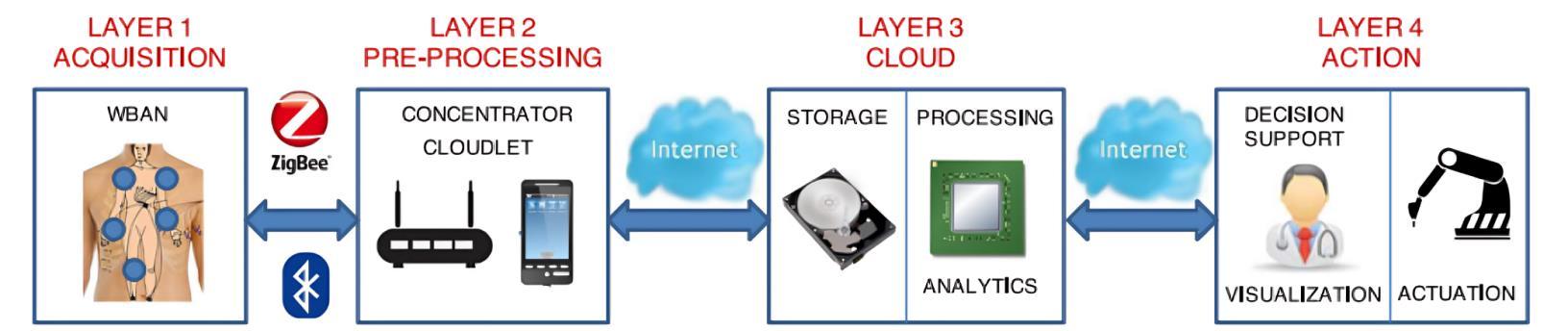
ThearchitectureofMedicalCyber-PhysicalSystems(MCPS) typically comprises four distinct layers, each playing a crucialrole:
This layer, often a Body Area Network (BAN), involves wirelesswearablesensorsforspecificmedicalapplications like monitoring blood pressure and body temperature.[8] BANfacilitatesthecollectionofpatientmedicalinformation, forwardingit to a nearbycomputationally-capabledevice, such as a cloudlet. Battery-operated active sensors in the BANutilizeBluetoothorZigBeeprotocols,whilebattery-less passivesensorsemployRFID[11][12].
DuetothelimitedcomputationalpowerofBANsensors,an intermediate device, either a cloudlet or a concentrator, becomesnecessary.Sensorstransmitgatheredinformation to a gateway server (concentrator) through a Bluetooth connection[12].Theconcentratorisavitalcomponentofan IoT-basedarchitecture,enablingindividuallyweakdevices toexhibitstrongoverallfunctionalitybyconcentratingdata andsendingaggregatedinformationtothecloud.Acloudlet serves a similar purpose but aggregates data from more powerful devices like smartphones. It is typically constructed from a dedicated computer with a dedicated Internetconnection[14][15].
Thecloud’sprimaryfunctionsincludesecurestorage,crucial for accurate diagnosis requiring long-term patient health monitoring information [14][15]. Government health regulationsmandatethestorageofmedicalrecordsforan extended period. Many cloud operators sign Business AssociateAgreements(BAA)tostoremedicaldatasecurely. Medicalinstitutionsutilizeprivateclouds(datacenters)for running applications, employing the cloud’s second significant purpose: processing. Privacy preserving processing in a public cloud is feasible through advanced homomorphic encryption schemes. The cloud’s third functioninvolvesdataanalytics,facilitatingdecisionsupport forhealthcareprofessionals.Statisticalinferencealgorithms are applied to acquired data to predict patient health conditions, particularly emphasized in remote health monitoringsystems[16][17].
The action layer can provide either “active” or “passive” action.Inactiveaction,anactuator,suchasaroboticarm,is activatedbasedontheresultsofalgorithmsrunninginthe cloud. Examples include robot-assisted surgery [17]. In passiveaction,nophysicalactionoccurs.Theoutcomesof analyticsormedical applicationresultsarepresentedto the requesting authority to provide decision support. An exampleisthevisualizationofapatient’slong-term(24-hr) HolterECGmonitoring,allowinga doctorto review20-30 patients’resultswithin10-20seconds[22].
International Research Journal of Engineering and Technology (IRJET) e-ISSN: 2395-0056
Volume: 11 Issue: 03 | Mar 2024 www.irjet.net p-ISSN: 2395-0072
Adhering to the Health Insurance Portability and Accountability Act (HIPAA), safeguarding data privacy within every layer of an MCPS is imperative. Individual encryptionschemesguaranteethataccesstomedicaldatais limited to authorized parties, ensuring data privacy specifically on isolated data blocks. However, establishing system-level security necessitates the formulation of a comprehensivecrypto-architecturefortheMCPSasaunified entity.
Irrespective of the chosen encryption scheme, parties involvedincommunicationmustmutuallyagreeonkeysfor encrypting/decrypting messages. In public-key cryptography,thesenderutilizestherecipient’spublickey forencryption,whiletherecipientusestheirprivatekeyfor decryption. Each user possesses a dedicated public and private key pair generated by a Public-Key Infrastructure (PKI),atrustedthirdpartylikeacertificateauthoritythat authenticates the key pairs by associating them with user identities.Forsymmetric-keycryptography,bothsenderand recipient share the same secret key, generated through a key-exchangeprotocolsuchasDiffie-Hellman[3].
TheacquisitionlayerinFig.1comprisesBANsensordevices with restricted computational capability and battery life [19]. Consequently, encryption schemes safeguarding communication within BAN sensors and BAN-to-cloudlet communications should avoid being computationally intensive.OneviableoptionisemployingtheZigbeeprotocol based on the AES encryption scheme, which can be easily implemented using cost-effective microcontroller-based devices.Securecommunicationbetweendevicescanalsobe achieved by utilizing biomedical signals. For instance, in [19], authors propose a low-power bio-identification mechanism using the interpulse interval (IPI) to secure communicationbetweenBANsensors.
Invariousreal-worldhealthcarescenarios,multipleentities may need access to data, including the patient being monitored, their doctor, and, in emergencies, other healthcarepersonnel.Conventionalencryptionschemesface challengesinhandlingthesharingofthesecretkeyamong multipleparties.Encryptingdatausingeachparty’spublic keyisnota viablesolutionasitresultsindata duplicates, necessitating separate management. Attribute-based encryption (ABE) emerges as a solution, allowing secure data sharing among multiple parties. ABE, a public-key crypto-system,providesfine-grainedaccesscontrolsimilar to Role-Based Access Control [18][20]. In [21], authors propose methods to secure data storage in BANs and distribute data access control, using the ABE scheme to controlwhoaccessespatientdata.ABEencryptionisapplied to data on a nearby local server, and communication between the BAN and the local server is secured using symmetrickeyencryption.
Conventional encryption schemes fall short in enabling computationsonencrypteddatawithoutpriordecryption, requiringtrustedstoragelikehealthcareorganizations’data centers or private clouds. This limitation prevents the execution of analytics, monitoring algorithms (e.g., ECG monitoring),orotheralgorithmsinapubliccloud,hindering potential cost reduction in healthcare [9]. Fully Homomorphic Encryption (FHE) emerges as a solution, allowingcomputationonencrypteddata.ByutilizingFHE, datacanbestoredinuntrustedstorageenvironmentslike publicclouds,andcomputationsonencrypteddatacanbe executedwithoutcompromisingdataprivacy[21].In[23],a privacy-preserving medical cloud computing system is proposedbasedonFHE,demonstratingthatevencomplex operations, such as computing average, minimum, and maximumheartrates,canbeimplementedatareasonable cost.InPaper[23],anMCPSisdescribedasaremotehealth monitoring system taking inputs from the patient’s body (Layer 1) and transmitting to the cloud (Layer 3). Patient medical data should be encrypted using homomorphic
International Research Journal of Engineering and Technology (IRJET) e-ISSN: 2395-0056
Volume: 11 Issue: 03 | Mar 2024 www.irjet.net p-ISSN: 2395-0072
encryptionschemesfordataprivacy.Despitetheresourceintensive nature of HE schemes, an intermediate preprocessing layer is proposed to support HE computationally. The recordings will be stored and processed in the cloud to provide statistics and detection results to doctors, including the assessment of long-term problemsbasedonparameterslikeaverageheartrateand ECGrecordings.
IntheDataConcentration/AggregationLayer,datacollected from wearable sensors, using protocols like Zigbee and Bluetooth,isprocessedsincesensorslackthecomputational capabilitytodirectlytransmitdatatothecloud.Withinthis layer,thecloudletorsmartphoneplaysapivotalroleinIoTbasedarchitecture
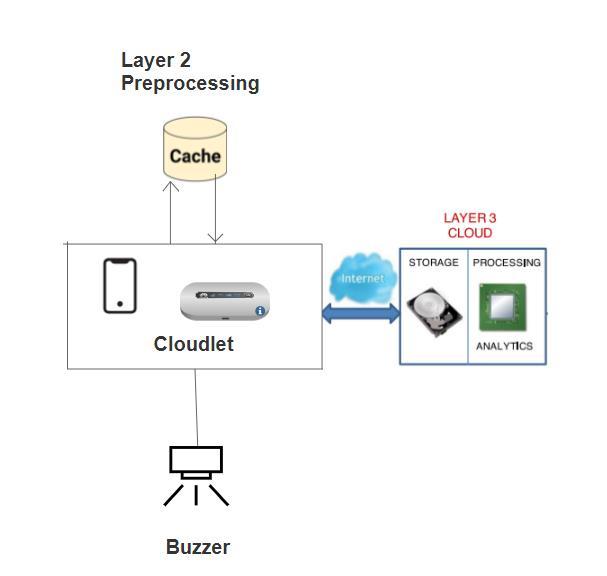
IntheDataConcentration/AggregationLayer,datacollected from wearable sensors, using protocols like Zigbee and Bluetooth,isprocessedsincesensorslackthecomputational capabilitytodirectlytransmitdatatothecloud.Withinthis layer,thecloudletorsmartphoneplaysapivotalroleinIoTbasedarchitecture.However,itcurrentlytransmitsdatafor allhealthparametersatfixedintervalstothecloud,which may not always be necessary. Minor fluctuations in parameters,suchasashiftinheartratefrom90to88ora change in body temperature from 36°C to 36.5°C, are not crucial for predictive analysis. This inefficiency results in increased energy consumption, as redundant and insignificant data issentto thecloud,leading toa heavier
loadandfasterbatterydrainageinthecloudlet,consuming moreelectricity.
Toaddressthisissue,weproposeimplementingacachefor eachhealthparameterinthecloudlet.Thisapproachwould ensurethatonlysignificant spikesandgradual changesin readings are captured and transmitted to the Third Layer (Cloud).Instanceswheretheheartrateabruptlyincreases from90to100ordropsto80,orwhenbodytemperature shifts from 36°C to 39°C, would be selectively sent to the ThirdLayerforpredictionandprocessing.Thismodification aims to reduce computational overhead both at the cloud andthecloudlet,asplaintextdataneednotbeencryptedand transmitted unnecessarily. Additionally, we suggest enhancingthesystembyconnectingthecloudlettoabuzzer. Thisfeaturewouldenablethesystemtogenerateanalertin caseswheresensorreadingsfallbelowaminimumthreshold orsurpassamaximumthreshold.Thebuzzer’snoisecould serveasapromptformedicalstaffpresent,allowingthemto providepersonalizedassistancetothepatient.
These proposed improvements in the Medical CyberPhysical System(MCPS)aimtoenhanceenergyefficiency, reduce unnecessary data transmission, and provide more focusedattentiontothepatient.
Inthispaper,wehavesurveyedimplementationofMedical CyberPhysicalSystems(MCPS)employingcloudensuring privacypreservingusingHomomorphicencryption.Unlike conventionalencryptionssuchasAESandECIES,itallows the cloud to perform computations on encrypted data to provideprivatepredictiveanalysis.
Theupcomingyearswillseeariseinsystemsthatmonitora patientthroughbody-worninexpensivepersonalmonitoring devices that record multiple physiological signals, suchas ECG and heart rate or more sophisticated devices that measurephysiologicalmarkerssuchasbodytemperature, skinresistance,gait,posture,andEMG.Thiswillenablethe constructionofcompletepatienthealthmonitoringsystems andprovideprivatepredictiveanalysis.
WeexpressourgratitudetotheDepartmentofInformation TechnologyatPICT,Punefortheirunwaveringsupportand invaluable guidance during the course of this work. The department’sassistancehasbeeninstrumentalinitsfruition. Additionally, our heartfelt appreciation extends to our esteemed guide, Dr. S.B. Deshmukh, whose expert mentorshipplayedapivotalroleinshapingthisendeavor. His profound insights and continuous support have been
International Research Journal of Engineering and Technology (IRJET) e-ISSN: 2395-0056
Volume: 11 Issue: 03 | Mar 2024 www.irjet.net p-ISSN: 2395-0072
invaluable,ensuringthesuccessofourresearchpaper.We are sincerely thankful for her unwavering dedication and guidancethroughoutourresearchjourney.
[1] JoppeW.Bos,KristinLauter,MichaelNaehrig,”Private predictiveanalysisonencryptedmedicaldata”inJournalof BiomedicalInformatics.
[2] Benaloh J, Chase M, Horvitz E, Lauter K. “Patient controlledencryption:ensuringprivacyofelectronicmedical records” in Proceedings of the first ACM cloud computing securityworkshop–CCSW.ACM;2009.p.103–14.
[3] Xun Yi, Russell Paulet, Elisa Bertino ”Homomorphic EncryptionandApplications”Springer
[4] O.KocabasandT.Soyata,“Towardsprivacy-preserving medicalcloudcomputingusinghomomorphicencryption,”in Enabling Real-Time Mobile Cloud Computing through EmergingTechnologies,T.Soyata,Ed.Hershey,PA,USA:IGI Global,2015,ch.7,pp.213–246
[5] Ovunc Kocabas, Tolga Soyata, and Mehmet K. Aktas “EmergingSecurityMechanismsforMedicalCyberPhysical Systems” in IEEE/ACM TRANSACTIONS ON COMPUTATIONALBIOLOGYANDBIOINFORMATICS,VOL.13
[6] O. Kocabas, R. Gyampoh-Vidogah, and T. Soyata, “Operational cost of running real-time mobile cloud applications,” in Enabling Real-Time Mobile Cloud Com putingthroughEmergingTechnologies.,T.Soyata,Ed. Hershey,PA,USA:IGIGlobal,2015,ch.10,pp.294–321
[7]R.L.Lagendijk,Z.Erkin,andM.Barni,“Encryptedsignal processing for privacyprotection:Conveying theutility of homomorphicencryptionandmultipartycomputation,”IEEE SignalProcess.Mag.,vol.30,no.1,pp.82–105,Jan.2013
[8] A. Pantelopoulos and N. G. Bourbakis, “A survey on wearablesensor-basedsystemsforhealthmonitoringand prognosis,”IEEETrans.Sys.,Man,Cybern.,PartC:Appl.Rev., vol.40,no.1,pp.1–12,Jan.2010.
[9]A.Page,O.Kocabas,T.Soyata,M.K.Aktas,andJ.Couderc, “Cloud-based privacy-preserving remote ECG monitoring andsurveillance,”Ann.NoninvasiveElectrocardiol.,vol.20, no.4,pp.328–337,2014
[10] M.Hassanalieragh,A.Page,T.Soyata,G.Sharma,M.K. Aktas, G. Mateos, B. Kantarci, and S. Andreescu, “Health monitoringandmanagementusinginternet-of-things(IoT) sensing with cloud-based processing: Opportunities and challenges,”inProc.IEEEInt.Conf.Serv.Comput.,Jun.2015, pp.285–292.
[11] A.BenharrefandM.A.Serhani,“NovelcloudandSOAbased framework for E Health monitoring using wireless biosensors,”IEEEJ.Biomed.HealthInf.,vol.18,no.1,pp.46–55,Jan.2014.
[12] S.Babu,M.Chandini, P. Lavanya,K.Ganapathy,and V. Vaidehi,“Cloud-enabledremotehealthmonitoringsystem,” inProc.Int.Conf.RecentTrendsInform.Tech.,Jul.2013,pp. 702–707.
[13] C. O. Rolim, F. L. Koch, C. B. Westphall, J. Werner, A. Fracalossi,andG.S.Salvador,“Acloudcomputingsolution for patient’s data collection in health care institutions,” in Proc.Int.Conf.eHealth,Telemed.,SocialMed.,Feb.2010,pp. 95–99.
[14] G.NalinipriyaandK.R.Aswin,“Extensivemedicaldata storagewithprominentsymmetricalgorithmsoncloud-a protectedframework,”inProc.IEEEInt.Conf.SmartStruct. Syst.,Mar.2013,pp.171–177.
[15]A.F.Hani,I.V.Paputungan,M.F.Hassan,V.S.Asirvadam, andM.Daharus,“Developmentofprivatecloudstoragefor medicalimageresearchdata,”inProc.Int.Conf.Comput.Inf. Sci.,Jun.2014,pp.1–6.
[16]O.KocabasandT.Soyata,“Medicaldataanalyticsinthe cloud using homomorphic encryption,” in Handbook of ResearchonCloudInfrastructuresforBigDataAnalytics,P. R.ChelliahandG.Deka,Eds.Hershey,PA,USA:IGIGlobal, Mar.2014,ch.19,pp.471–488
[17] B.Rao,“Theroleofmedicaldataanalyticsinreducing healthfraudandimprovingclinicalandfinancialoutcomes,” inProc.IEEE26thInt.Symp.Computation-BasedMed.Syst., Jun.2013,pp.3–3.
[18]C.Poon,Y.Zhang,andS.Bao,“Anovelbiometricsmethod to secure wireless body area sensor networks for telemedicineandm-health,”IEEECommun.Mag.,vol.44,no. 4,pp.73–81,Apr.2006.
[19] K. K. Venkatasubramanian, A. Banerjee, and S. Gupta, “PSKA:Usableandsecurekeyagreementschemeforbody area networks,”IEEETrans. Inf.Technol.Biomed.,vol.14, no.1,pp.60–68,Jan.2010.
[20]V.Goyal,O.Pandey,A.Sahai,andB.Waters,“Attributebased encryption for fine-grained access control of encrypteddata,”inProc.13thACMConf.Comput.Commun. Security,2006,pp.89–98.
[21]J.Bethencourt,A.Sahai,andB.Waters,“Ciphertext-policy attribute-based encryption,” in Proc. IEEE Symp. Security Privacy,2007,pp.321–334.
[22]A.Page,T.Soyata,J.Couderc,M.Aktas,B.Kantarci,andS. Andreescu,“Visualizationofhealthmonitoringdataacquired
International Research Journal of Engineering and Technology (IRJET) e-ISSN: 2395-0056
Volume: 11 Issue: 03 | Mar 2024 www.irjet.net p-ISSN: 2395-0072
from distributed sensors for multiple patients,” in Proccedings.IEEEGlobalTelecommunication.Conference., Dec.2015.
[23] Ovunc Kocabas, Tolga Soyata, and Mehmet K. Aktas “EmergingSecurityMechanismsforMedicalCyberPhysical Systems”IEEE/ACMTRANSACTIONSONCOMPUTATIONAL BIOLOGYANDBIOINFORMATICS
© 2024, IRJET | Impact Factor value: 8.226 | ISO 9001:2008 Certified Journal | Page1429