
International Research Journal of Engineering and Technology (IRJET) e-ISSN: 2395-0056
Volume: 11 Issue: 03 | Mar 2024 www.irjet.net p-ISSN: 2395-0072
International Research Journal of Engineering and Technology (IRJET) e-ISSN: 2395-0056
Volume: 11 Issue: 03 | Mar 2024 www.irjet.net p-ISSN: 2395-0072
Mehedi Hasan1, Md. Atiquen Nobi2 , Dr. Himani Goyal Sharma3
Student of Electrical Engineering Department (1, 2)
Professor, Department of Electrical Engineering (3) University Institute of Engineering, Chandigarh University, Gharuan , Mohali, Punjab, India
Abstract - ThegrowingpopularityofLPGasaneconomical andenvironmentallyfriendlyfuel meansthatinexpensiveand dependable gas leak detection devices are needed to improve home and workplace safety. This work describes the development and application of a low-cost LPG gas leak detection system that balances affordability, accuracy, and sensitivity.A microprocessor iscoupledwith agassensorthat has a high sensitivity to LPG in the suggested detector to process data in real time. When the system detects LPG concentrations oversafethresholds,it is intendedtosound an audioandvisualalarmtoalertoccupants inatimelymanner. A greater variety of consumers can use the detector since easilyavailablematerialsandcomponentsare usedtoreduce expenses.Theefficiencyofthedetectorinquicklydetectinggas leaks is demonstrated by the results of studies that simulate differentleakagescenarios.Furthermore,thedevice'slowcost makes itappropriateforbroaddeployment,enhancingsafety standards in settings where LPG is often used.
Key Words: LPG, Arduino-Uno, Low cost, GSM, Sensor Technology, Alarm system, Detection system.
Liquefied Petroleum Gas (LPG) is widely used for cooking andheatinginmanyhouseholdsandindustries.However, the improper handling or leakage of LPG can lead to hazardous situations, including fires and explosions. To ensuresafetyandpreventsuchincidents,thedevelopment oflow-costandefficientgasleakagedetectionsystemshas becomeessential.Onecost-effectiveandpopularsolutionis the use of an Arduino-based gas leakage detector in combinationwiththeMQ-2gassensorandthisisawidely availableandaffordablecomponentknownforitssensitivity toavarietyofgases,includingLPG,methane,propane,and evensmoke.WhenLPGgasisdetectedintheenvironment, the sensor's resistance changes, and this change is monitored and processed by an Arduino microcontroller. The Arduino, a versatile open-source microcontroller platform,isprogrammedtointerpretthesensor'sdataand triggerappropriateresponsesincaseofagasleakage.This can include sounding an alarm, sending alerts through variouscommunicationchannels,andevenshuttingoffthe gas supply to prevent further leakage. The system offers real-timemonitoring,earlydetection,andatimelywarning mechanismtoprotectlivesandproperty.Theadvantagesof using Arduino and the MQ-2 sensor for LPG gas leakage
detection include low cost, ease of customization, and a strong DIY (Do-It-Yourself) community that can help individualsdesignandimplementtheirowngasdetection systems.Itisapracticalandaccessiblesolutionforensuring thesafetyofhomes,commercialkitchens,andotherplaces whereLPGisused.
InpastyearsmanyLPGgasdetectorhavebeenproposedto detectleakageofLPGefficiently.Someusedifferentsensors likeMQinplaceofMQ-2gassensor.Thereisauserwhohas designedtheappliancethatturnsoffthegaslinebysending them a text message. Some even used buzzer and leakage detector system. This paper discusses about the cost and efficientascomparetomarketLPGgasdetectorandendof the time this project is user friendly and very less price. These detectors are essential for maintaining safety in environmentswhereLPG(liquefiedpetroleumgas)isoften utilized, such as homes and businesses. Traditional gas detection systems, such as electrochemical and catalytic combustionsensors,werethemainfocusofearlyresearch. But more recently, materials including metal oxides, polymers, and nanostructures have been used to create innovativesensingtechnologies.Thesedevelopmentshave maintained or even improved detection sensitivity and accuracywhiledrasticallyloweringproductioncosts.Owing to their high sensitivity to LPG and low cost, metal oxidebased sensors have been the subject of numerous investigations. Usually, these sensors detect changes in electricalconductivitywhentheycomeintocontactwithLPG gas.Additionally,thecreationofnanostructuredmetaloxide materials has been made possible by advances in nanotechnology.
I. Affordable and reliable solution for detecting LPGgasleaks.
II. Ensures safety by promptly detecting and alertingforgasleaks.
III. Minimizestheriskofgas-relatedaccidentsand explosions.
IV. Accessibletohouseholds,smallbusinesses,and communitycenters.
V. User-friendly installation and operation with minimalmaintenance.
International Research Journal of Engineering and Technology (IRJET) e-ISSN: 2395-0056
Volume: 11 Issue: 03 | Mar 2024 www.irjet.net p-ISSN: 2395-0072
VI. Optimized sensor technology for accurate detection.
VII. Longlifespan,reducingreplacementcosts.
In this paper following parts are gas sensor, ardunio-uno, piezoandled’s.Themainpartisarduinothatstructureof Atmega328P(Advancevirtualrisemicrocontroller)byusing ArduinoIDE.
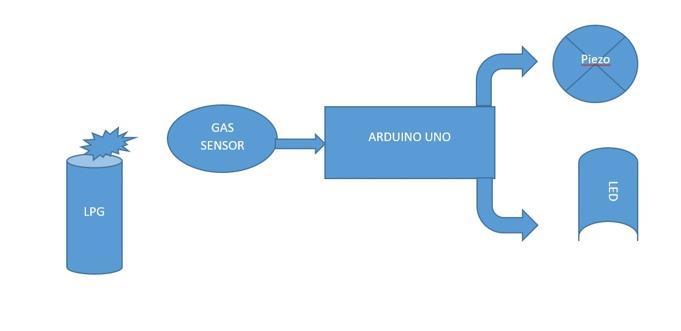
Figure-1: BlockDiagram
5. Design implementation and selection:
Arduino Uno: An ATmega328P-based microcontroller board is the Arduino Uno. It features a 16 MHz ceramic resonator(CSTCE16M0V53-R0),6analoginputs,14digital input/output pins (six of which can be used as PWM outputs), a USB port, a power jack, an ICSP header, and a resetbutton.
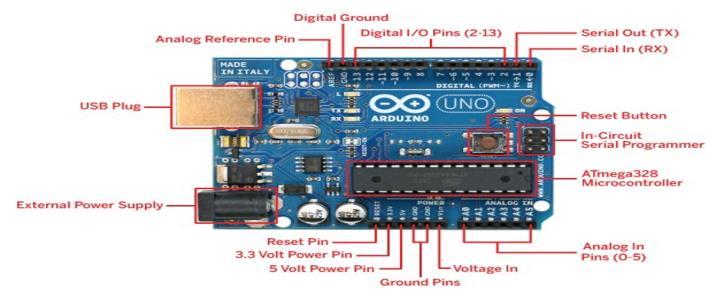
Figure-2:PinexplanationofArduinoUno
It comes with everything essential to support the microcontroller,whichmeansallyouneedtodoispowerit with a battery or an AC-to-DC adapter or connect it to a computer systems via a USB cable to get going. You can experimentwithyourUnowithouttoomuchfearofmaking a mistake;inthe worstcase,youcanreplacethechipand startoverforafewbucks.ThenameArduinoSoftware(IDE) 1.0waschosenwiththemeaningof"uno,"whichisonein Italian.
MQ-2 sensor: Oneofthemostpopularsensormodelsisthe MQ2sensor.MetalOxideSemiconductor,orMOS,isthetype
of sensor it is. Since the sensing material's resistance changeswhenexposedtogases,metaloxidesensorsarealso referred to as chemiresistors.Utilizing about 800mW of power,theMQ2gassensorrunson5VDC.Thesensorhas thisappearancewhentheoutermeshisremoved.Forming thestarshapeisthesensorelementandsixconnectinglegs thatprotrudebeyondtheBakelitebase.
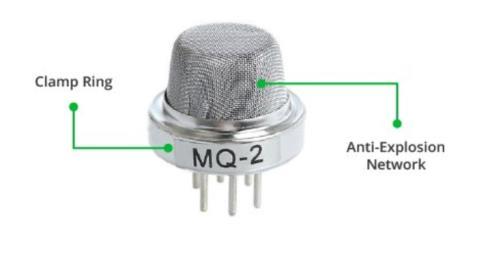
MQ2GasSensor
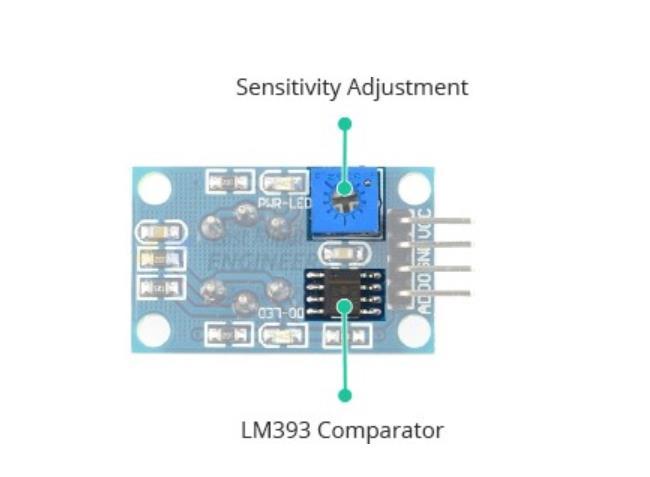
Figure-4: sesnitivityadjustmentofMQ2
It can identify amounts of 200–10,000 ppm of carbon monoxide,hydrogen,methaneintothealcohol,smoke,and propane. The MQ2 sensor is powered by a heater. Consequently, rather of identifying which gas density is changing, the technique is best for sensing variations in a knowngasdensity.Consequently,twolayersoffinestainless steel mesh, described as an "anti-explosion network," are attachedtoit.
Pizeo buzzer alarm: Thewayattractionbuzzersandpiezo buzzersmakesoundisdifferentfromoneanother.Magnetic buzzersuseanalternatingcurrentthatfunctionsinsidethe magneticparticlefield.

Figure-5: Piezoburzzeralarm
International Research Journal of Engineering and Technology (IRJET) e-ISSN:
Volume: 11 Issue: 03 | Mar 2024 www.irjet.net
Piezo buzzer alarm compounds reacted to alternating voltagebychangingtheirform.Themagneticelementofthe buzzer creates a continuous field of magnetic attraction, whichwhencombinationwiththisenablethecoiltovibrate freelyandcreatessound.
Table-1: Operating
Load
Heater
ConcentrationRange
PreheatTime Over24hour
Technical Specifications: The MQ2 gas sensor is a multifunctionalmodulethatcanidentifyvariousgases,such assmoke,LPG,andothers.Itsoperatingvoltagerangeis5V to10V,anditsnormal currentconsumptionis150mA.To detect gasses, the sensor uses a coil that heats in combinationwithasemiconductorlayermadeoftindioxide (SnO2). A potentiometer can be used to optimize its sensitivity to various gas concentrations. The MQ2 sensor performsquicklyforthemajorityofcasesusuallyinamatter ofseconds.
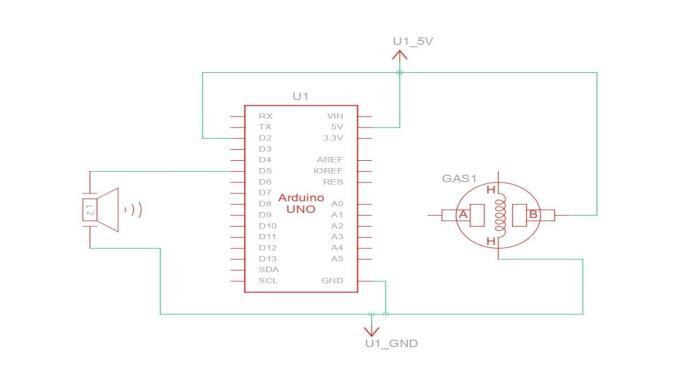
Figure-6: Schematicdiagram(LowcostLPG)
InArduinoUno,wehavetoconnectwithpiezopositivepin with Digital Input (-5) and negative pin connected with Ground(GND).IntheMQ-2gassensorpartB1Pinconnected with5VpowerthenH2pinconnectedwithground(GND)Of ArduinoUno.AfterthatB2pinconnectedwithdigitalinput pinnumber(2).FinallyourproductdetectLPG.
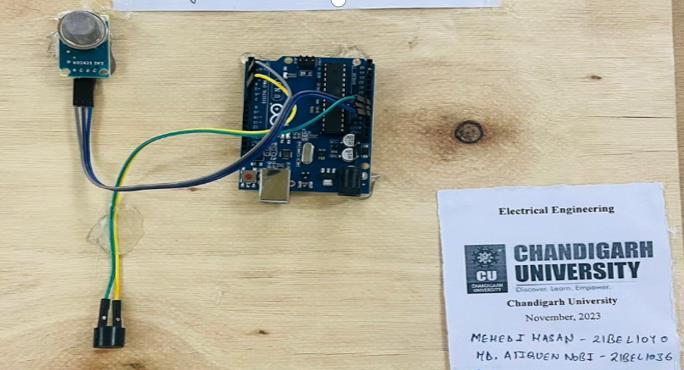
finalhardware(LPGdetector)
6.Methodology:
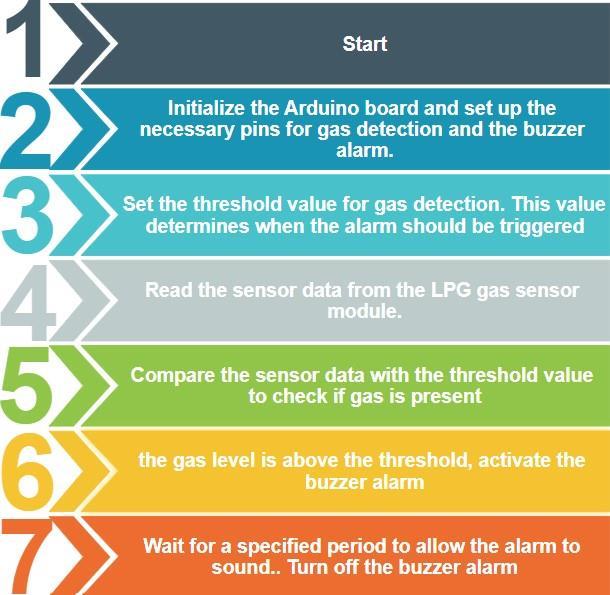
Figure-8: FlowchartofLPGgasdetector
Table-2:
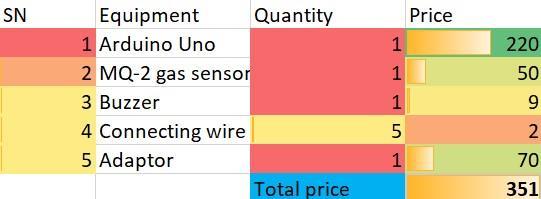
Total cost of our project: If we compare other LPG gas detector product with our product we see that the main differenceispricesinmarket.Wecanmakeitwithlowcost and the size of our product is very small as we say user friendlyanywherewecansetthedetectorofLPG.Wecan make it reasonable prices within 351 rupees in Indian
International Research Journal of Engineering and Technology (IRJET) e-ISSN: 2395-0056
Volume: 11 Issue: 03 | Mar 2024 www.irjet.net p-ISSN: 2395-0072
market. This prices will be also decrease if we bought all equipmentfromwholesellshop.
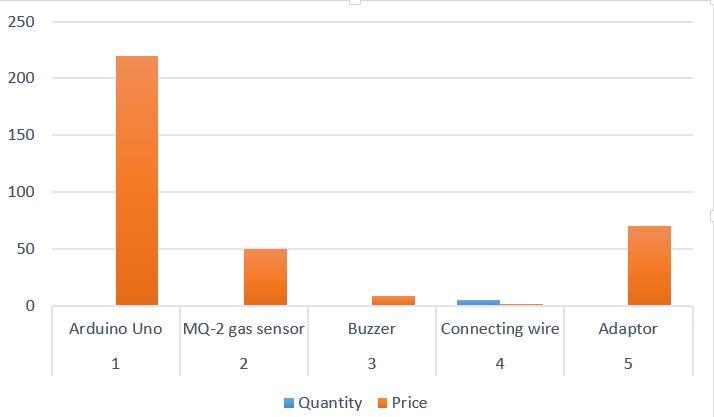
Figure-9:Bargraph(LPGdetector)
The analysis of different market place prices of LPG gas detector:
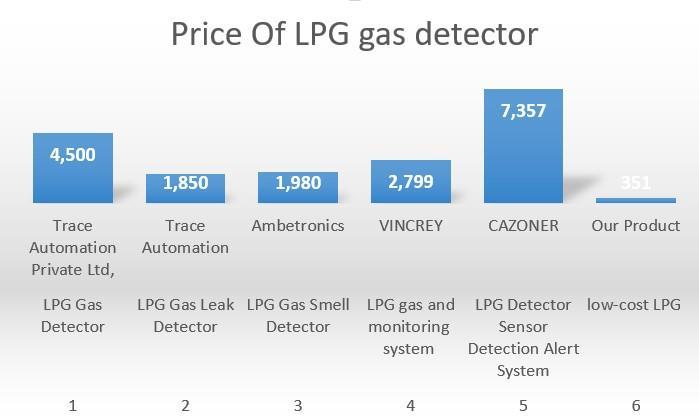
InthisanalysiswehavefindoutlowcostLPGgasdetector. In market LPG gas detector price is too much high as compare to our product. Here this type of product is minimum 2000 rupees but our product can be made very lessprice.Wehavetomakeourprojectunder350rupees.If wewill by equipmentfrom wholesalemarkettheproduct costwillbeless.Sowecanourproductistoomuchgoodfor efficiencyandprice.
Thedesignandanalysisofalow-costLPGgasdetectorwith an Arduino buzzer alarm provide a simple and effective solutionfordetectingandalertingthepresenceofLPGgas. By connecting an Arduino board, LPG gas sensor module, andbuzzer,youcancreateareliablegasdetectionsystemat anaffordablecost.Theimplementationinvolvesconnecting thecomponentscorrectly,writingcodetoreadsensordata, comparing it with a threshold value, and activating the buzzeralarmwhennecessary.Bycontinuouslymonitoring thegaslevel,thedetectorcanquicklyalertuserstopotential
gasleaks,ensuringsafetyinhomesorotherenvironments where LPG gas is used. Remember to adapt the implementationtoyourspecificrequirementsandconsider additionalfeaturesorerrorhandlingmechanismsasneeded. Regulartestingandmaintenanceareessentialtoensurethe proper functioning of the gas detector. With proper implementationandvigilance,thislow-costLPGgasdetector cancontributetocreatingasaferenvironment.
1. Loshali, Geeta, et al. "Design & Implementation of LPGGasDetectorusingGSMModule." Int. J. Emerg. Technol 8.1(2017):98-100.
2. Hannan, M. Abdul, et al. "Development of LPG leakagedetectorsystemusingarduinowithInternet of Things (IoT)." Journal of Telecommunication, Electronic and Computer Engineering (JTEC) 10.2-7 (2018):91-95.
3. AbdulWahhab,H.A.(2021).Investigationofstability limits of a premixed counter flame. International JournalofAutomotiveandMechanicalEngineering, 18(1),8540–8549.
4. Raj, Arun, Athira Viswanathan, and T. Athul. "LPG gas monitoring system." IJITR 3.2 (2015): 19571960.
5. Mahfuz, Nagib, Shawan Karmokar, and Md Ismail HossainRana."AsmartapproachofLPGmonitoring and detection system using IoT." 2020 11th International Conference on Computing, Communication and Networking Technologies (ICCCNT).IEEE,2020.
6. Khatsu,P.;VanWesten,C.J.Urbanmulti-hazardrisk analysisusingGISandremotesensing:acasestudy fromKohimaTown,Nagaland,India.Proceedingsof the26thAsianConferenceonremotesensing,2005, pp.711.
7. Banik, Arijit, Bodhayan Aich, and Suman Ghosh. "Microcontrollerbasedlowcostgasleakagedetector withSMSalert." 2018EmergingTrendsinElectronic DevicesandComputationalTechniques(EDCT).IEEE, 2018.
8. Shrivastava,A.,Prabhaker,R.,Kumar,R.,&Verma,R. (2013). GSM based gas leakage detection system. International Journal of Technical Research and Applications, 1(2),42-45.
9. Ravisankar,B.,Gurubaran,K.,Manoj,D.,Nagendran, R.,Gowrishankar,V.,&Satheesh,R.(2022,March). SmartDetectionSystemforLPGGasLeakageusing IoT. In 2022 6th International Conference on
International Research Journal of Engineering and Technology (IRJET) e-ISSN: 2395-0056
Volume: 11 Issue: 03 | Mar 2024 www.irjet.net p-ISSN: 2395-0072 © 2024, IRJET | Impact Factor value: 8.226 | ISO 9001:2008
Computing Methodologies and Communication (ICCMC) (pp.421-430).IEEE.
10. Juvanna,I.,andN.Meenakshi."Gaslevel detection and leakage monitoring system using a specific technique." InternationalJournalofComputerScience and Mobile Computing 3(2014):2.
11. Barati, S.; De Santoli; L.; and Basso G.L. (2021). Modellingandanalysisofamicrogasturbinefuelled withhydrogenandnaturalgasblends.E3SWebof Conferences,312(2021)08012.
12. Onyishiand, Donatus U., and Charles K. Igbinoba. "Designandconstructionofacarbonmonoxideand liquefied petroleum gas leakage detection system." Tropical Journal of Science and Technology 1.2(2020):1-11.