
International Research Journal of Engineering and Technology (IRJET) e-ISSN: 2395-0056
Volume: 11 Issue: 03 | Mar 2024 p-ISSN: 2395-0072
International Research Journal of Engineering and Technology (IRJET) e-ISSN: 2395-0056
Volume: 11 Issue: 03 | Mar 2024 p-ISSN: 2395-0072
Ranjanee Chattopadhyay*1, Rajpal Srivastav1
1 Amity University Uttar Pradesh, Noida, Uttar Pradesh, India ***
Abstract – Genetic engineering has fascinated the world with its various techniques to manipulate the genes of organisms. The gene silencing technique, known as CRISPR, has now come to the limelight as it has successfully mitigated the long-standing limitations of the previous gene editing techniques. It is cost-effective, faster, accurate, and highly precise. It cansuccessfullysuppress the pathogenicgenes,thus reforming the agricultural and healthcare sector. The advanced CRISPR-Cas9 mediated gene editing has become a leading tool in the therapeutics of genetic diseases and disorders. In this article, the mechanism of the CRISPR-Cas9 gene silencing technique and its recent trends in crop improvement and therapeutics have been highlighted along with regulatory, ethical concerns and prospects.
Key Words: CRISPR, Cas9 protein, Gene editing, Genetically Modified Crops (GMCs), Gene knockdown, Crop improvement, Therapeutics, Epigenetic modification
1.INTRODUCTION
Gene silencing, also known as epigenetic modification of gene expression, is a molecular biological process which involvesgenesilencingand/orgeneknockdownandaimsto controldiseasesbyeliminatingorsuppressingthetargeted genefromthegenome.Sincegenescanberegulatedeitherat thetranscriptionalleveloratpost-transcriptionallevel,gene silencingcanbeinducedinbothlevels.
Researchersarestudyinggenesilencingduetoitspotential todevelopgeneticallymodifiedcrops(GMCs)andplantswith better yield and higher resistance to target pests and also protectnature[1](Zhang Y et al, May 2017).Inthefuture,it may allow opportunities such as human gene therapy [2] (PiergentiliR et al, April2021),programmableRNAtargeting, moreadvancementsinagricultureandthehealthsector,a probablepermanentcurefordiseaseswhichareincurableto date. It may also produce therapeutics to battle cancer, infectious diseases and neurodegenerative disorders [3] (Pickar-Oliver A and Gersbach CA., Aug 2019)andmore[4] (Grand Moursel L et al, April 2021).
Genesilencingisa highlyspecific andtargetedprocedure. With the help of this revolutionary technique, a variety of characteristicsofbothplantsandanimalscanbealteredtoa great extent, which will itself eradicate a lot of problems related to pest control, crop yield, food scarcity, human healthandwell-being.CRISPR-Cas9mediatedgenesilencing
isanewandintriguingtechniquewhichhasfascinatedthe worldwithitsimmensityofopportunities.
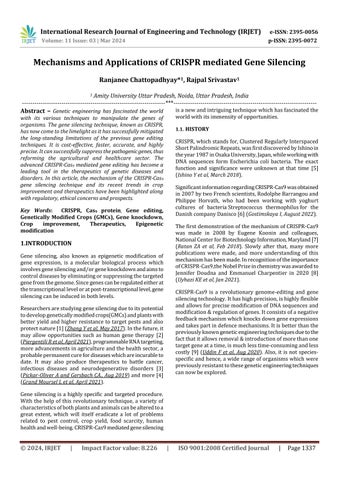
CRISPR,whichstandsfor,ClusteredRegularlyInterspaced ShortPalindromicRepeats,wasfirstdiscoveredbyIshinoin theyear1987inOsakaUniversity,Japan,whileworkingwith DNA sequences form Escherichia coli bacteria. The exact function and significance were unknown at that time [5] (Ishino Y et al, March 2018).
SignificantinformationregardingCRISPR-Cas9wasobtained in2007bytwoFrenchscientists,RodolpheBarrangouand Philippe Horvath, who had been working with yoghurt cultures of bacteriaStreptococcus thermophilusfor the DanishcompanyDanisco[6](Gostimskaya I, August 2022).
ThefirstdemonstrationofthemechanismofCRISPR-Cas9 was made in 2008 by Eugene Koonin and colleagues, NationalCenterforBiotechnologyInformation,Maryland[7] (Ratan ZA et al, Feb 2018). Slowly after that, many more publications were made, and more understanding of this mechanismhasbeenmade.Inrecognitionoftheimportance ofCRISPR-Cas9,theNobelPrizeinchemistrywasawardedto Jennifer Doudna and Emmanuel Charpentier in 2020 [8] (Uyhazi KE et al, Jan 2021).
CRISPR-Cas9 is a revolutionary genome-editing and gene silencingtechnology.Ithashighprecision,ishighlyflexible andallowsforprecisemodificationofDNAsequencesand modification®ulationofgenes.Itconsistsofanegative feedbackmechanismwhichknocksdowngeneexpressions andtakespartindefencemechanisms.Itisbetterthanthe previouslyknowngeneticengineeringtechniquesduetothe factthatitallowsremoval&introductionofmorethanone targetgeneatatime,ismuchlesstime-consumingandless costly [9] (Uddin F et al, Aug 2020). Also, it is not speciesspecificandhence,awiderangeoforganismswhichwere previouslyresistanttothesegeneticengineeringtechniques cannowbeexplored.
International Research Journal of Engineering and Technology (IRJET) e-ISSN: 2395-0056
Volume: 11 Issue: 03 | Mar 2024 p-ISSN: 2395-0072
The CRISPR-Cas9 system isused to introduce pre-planned andtightlyregulatedchangesinthegenome.Itreliesona fewkeymolecules:-
GuideRNA(gRNA) -Approximately20baseslong,theseare pre-designedorsyntheticRNAsequences,andcanbelocated withinalongRNAscaffold.Thesescaffoldsareproducedto be complementary tothe targetDNAsequences. Thisaids Cas9 tomovetothespecificsiteforgeneslicing.
CRISPR scaffold RNAs (scRNAs)proveouttobethefounding models for synthetic locus-specific transcriptional programminginYeast[10](JesseGZalatan,2017).
Protein Cas9 - Protein Cas9, is an endonuclease enzyme whichactasapairof‘molecular scissors’.Theyhavethe capabilitytocutdoublestrandedDNA(dsDNA)atspecific locationsinthegenomeguidedbygRNA.Cas9followsgRNA totheexact,preciselocationintheDNAsequenceandcuts thisdsDNAacrossbothitsstrands.Thisisdonesothatthe required pieces of DNA can be inserted or removed. The
mechanism of CRISPR-Cas9 mediated gene silencing is discussedinfollowingsection.
Theprokaryotesandtheeukaryotescontainaseriesofshort, repetitive DNA sequences known as CRISPR. It contains smallsegmentsofuniqueanddistinctDNAsequencesknown as spacers and are found between the repetitive DNA sequences.
During successive infections, CRISPR sequences are employed to find and remove DNA from related bacteriophages.Asaresult,thespacersserveasmolecular memory.Therefore,thesesequencesplaya crucial partin the organism's antiviral (or anti-phage) defensive system andofferasortofacquiredimmunity[11](FrankHilleetal, March2018).
TheCRISPRarrayistranscribedintoaprecursorRNAandis processedusingtheenzymeCas9 Theytogetherarecalled CRISPRRNAs (crRNAs).Tosimplifythiscomplexprocess,the guide RNA (gRNA) combines with crRNA and hence, they combinetheirfunctionsinasingleRNAmolecule.Itisnow knownasthe Cas9 complex
The Cas9 protein consists of 2 key domains - the HNH domain andthe RuvCdomain.TheHNHandRuvCdomains catalyse cleavage of the complementary and noncomplementarystrands,respectively. Thesetwodomains aidinthecleavingprocess.The Protospaceradjacentmotif (PAM) isa shortsequenceadjacenttothetargetDNAand servesastherecognitionsite[12](GleditzschDetal,April 2019). The Cas9 complex then locates the target DNA and recognizes the PAM. Then the HNH and RuvC domains, cleavethestrandsandcreate double-strandbreak(DSB) in theDNA.
TheCRISPR-Cas9processnowmakesuseofthecell’snatural mechanism of DNA repair. There are two pathways to continuetheDNArepairmechanism. Non-HomologousEnd Joining (NHEJ); In this pathway, the cell often introduces smallinsertionsordeletionsattheDSBsites,thusleadingto gene slicing. Homology-Directed Repair (HDR); This pathwayisusedtoinsertspecificortargetchangesintoDNA [13](XueCetal,July2021).Here,researchersandscientists prepare a repair template, which is basically the syntheticallypreparedpieceofDNAwiththedesiredgenetic changes embedded into it, and this template is inserted into thesiteoftheDSB.Lastly,theDNArepairprocessleads totargetgeneticmodificationsandaidsingeneslicing.
International Research Journal of Engineering and Technology (IRJET) e-ISSN: 2395-0056
Volume: 11 Issue: 03 | Mar 2024 p-ISSN: 2395-0072
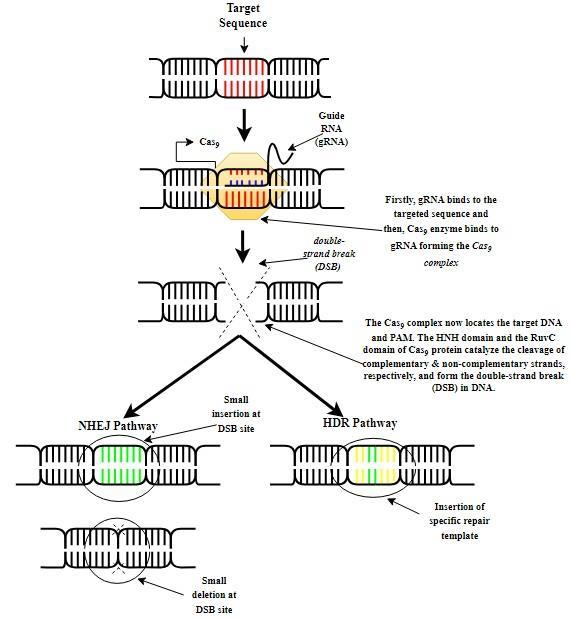
-2:Schematicrepresentationofthemechanismofthe CRISPR-Cas9 genesilencingapproach
3.1. CROP IMPROVEMENT AND AGRICULTURAL SECTOR
Pseudomonas syringae affectstomatoplantsandtheaffected plantsexhibitdarkbrownorblacklesionencircledbyyellow halos in leaves and black lesions in stems and pedicels. CRISPR-Cas9 mediatedmutagenesisofa DMR6 orthologin tomatoplantscanbeusedtocreateenhancedresistanceto bacterialpathogen, Pseudomonas syringae [14](Thomazella DPTetal,July2021).
Salinityhasadverseeffects onriceplants,includingdeath andlossinqualityofrice.Criticalsalinitylevelscanleadto huge loss in rice yield. Research shows how CRISPR-Cas9 targetedmutagenesisof OsRR22 gene enhancesricesalinity tolerance, thus increases the plant’s adaptability to saline conditions[15](Zhang,A.etal,March2019)
Drought stress typically leads to leaf rolling, stunting, yellowing and, in extreme cases, permanent wilting and stomatallossin Arabidopsis.CRISPR-Cas9mediatedtargeting of protein AREB1 leads to drought stress tolerance [16] (RocaPaixãoJ.F.etal,May2019).
Grainwidthandsizearecrucialtraitswhiledeterminingthe plantyieldproduction.Italsoinfluencestheappearanceand marketabilityofthegrain.Inreply,researchindicatesthat rice grain nutritional quality and the aleurone layer are enhanced by a CRISPR-Cas9-mediated mutation in the
GRAIN WIDTH and WEIGHT2 (GW2) locus [17] (Achary V.M.M.etal,Nov2021).
Soyabeanseedscontainapproximately12-15%offattyacid components. India consumes different oils, including soybeanoil,andvegetariansandvegansrelyheavilyonsoy & soy products. It may lead to obesity, coronary heart disease,certaintypesofcancer,cardiovasculardiseases,and early death. Thus, this makes it a bad choice in food applications. Improved oil content in soybeans originated fromasignificantdecreaseintheconcentrationofsaturated fatty acid in soybean seeds induced by the CRISPR-Cas9mediateddeletionof GmFATB1 [18](MaJ.etal,April2021).
Cauliflower Mosaic Virus (CaMV) is a virus which leads to chlorosis,mosaic,veinclearingandstuntingofcauliflower.It impacts the agricultural sector and economical sector. Research on CRISPR-Cas9 mediated mutation of CaMV CP gene could lead to successful resistance to cauliflower mosaic virus(CaMV) [19] (Liu H et al, March 2018)
Fragranceisoneofthemostimportantqualitativetraitsfor ricebreeding.Itmouldsconsumerpreferencesandthusit affectsmarketvalueandplaysavitalroleinglobaltradeand identity. Adding onto this, research conducted on Oryza sativa explainshow CRISPR-Cas9 -mediated editing of the BADH2 gene triggers the revolution of rice fragrance [20] (ImranMetal,Feb2023).
Fusariumoxysporum isasoilbornefungaldiseasecommonly observed in watermelon. It leads to stunting, wilting and earlysystemicyellowingofthewatermelon,leadingtothe early death of the plants. Its known for its destructive characteristicsandsignificantlossintheyieldandindividual weightofwatermelons.Topreventthis,geneeditingofthe Clpsk1 geneusingtheCRISPR-Cas9 mechanism,makesthe watermelons more resistant to Fusarium oxysporum f.sp. niveum [21](ZhangMetal,March2020).
Papaya ringspot virus (PRSV) is a common & destructive diseaseseenin Papayas.Itleadstoyellowingandstunted growthoftheplantandcircularspotsonthefruits&leaves. Economically,ithasdrasticeffectsandisoneofthemajor hurdlesinPapayacultivation.Researchconductedonthis, showshowthemutagenesisof melon Prv gene withthehelp ofCRISPR-Cas9 geneeditingmechanism,helpstheplantto developaresistancetowardsthisdisease[22](NizanSetal, Aug2023).
Fire Blight disease is caused by the bacterium Erwinia amylovora isresponsiblefordeathofappleandpearfruits, twigs,roots,shoots,blossoms,leadingtodeathoftheentire plants.Thishasbecomeamajorlimitingfactorforappleand pearcultivation,ultimatelyleadingtoheavyeconomiclosses. CRISPR-Cas9 geneknockoutof MdDIPM4 canminimizethe adverse effects of this disease [23] (Pompili V et al, Sept 2021).
International Research Journal of Engineering and Technology (IRJET) e-ISSN: 2395-0056
Volume: 11 Issue: 03 | Mar 2024 p-ISSN: 2395-0072
Pathogenic fungus, Ganoderma boninense, is significantly affectingthecultivationoftheOilpalmplants.Itleadstothe rottingofdifferentregionsandanearlydeathoftheplants. Its been observed that within a span of half a year, it can cause about 43% of economic losses in South East Asia. CRISPR-Cas9 mediatedgene knockoutofthe EgEMLP gene has been performed to control this adverse situation [24] (Budianietal,Jan2020).
Xanthomonas oryzae pv. Oryzae isafungalpathogenwhich causes Bacterial blight. It leads to stunted growth of young/newplants,yellow/brownspotsontheleavesleading todrying&earlydeathoftheleavesandplants.CRISPR-Cas9 gene silencing technique is used to understand how the sucrosetransportergene OsSWEET13,whichisidentifiedas thedisease-susceptibilitygenefor PthXo2,canbeexploited
CROP/PLANT TARGET SEQUENCE
Tomato (Solanum lycopersic um L.)
DMR6 ortholog gene
Rice(Oryza sativa) OsRR22 gene
Thale cress (Arabidopsis) protein AREB1
Rice(Oryza sativa) GRAIN WIDTH and WEIGHT2 (GW2) gene
Soyabean (Glycine max)
Cauliflower (Brassica oleracea var. botrytis)
Rice (Oryza sativa L)
Watermelon (Citrullus lanatus)
GmFATB1 gene
CaMV CP gene
BADH2 gene
Clpsk1 gene
Papaya (Carica papaya L.) melon Prv gene
Apple (Malus domestica)
MdDIPM4 gene
Oil palm (Elaeis guineensis) EgEMLP gene
Rice (Oryza sativa OsSWEET13
todeveloparesistancetowardsthisdisease[25](ZhouJet al,May2015).
Pathogens such as Zucchini Yellow Mosaic Virus (ZYMV), Papaya Ringspot Virus (PRSV), andWatermelonMosaic Virus (WMV) belongtothe Potyviridaefamily.Theyareresponsible foryellowingofleaves,leafmosaicpatterns,stuntedgrowth, systemicmottling, and necrosis ofthe plants.Tomitigate thishurdle,geneknockoutofthe elF4E gene hasbeendone usingtheCRISPR-Cas9mechanismandthe resultsshowa profoundresistanceofthediseaseincucumbers[26](Fidan Hakanetal,March2023).
TRAIT
Pseudomonas syringae exhibitsdarkbrownorblacklesion encircled by yellow halos in leaves and black lesions in stems&pedicels
REFERENCE
Thomazella DPT etal,July2021
Death&qualitylossof Oryza sativa duetosalinity Zhang, A. et al, March2019
Drought stress leads to leaf rolling, stunting, yellowing, permanentwiltingandstomatalloss
Accentuationofnutritionalquality,grainwidthandgrain sizeofricetoimprovemarketability
Consumption of soyabeans (containing 12-15% of fatty acids)mayleadtoobesity,coronaryheartdisease,etc
Cauliflower MosaicVirus (CaMV)leadstochlorosis,mosaic, veinclearingand/orstunting
Improving the fragrance aspect impacts consumer preferenceandglobalmarketability
Fusarium oxysporum f.sp. niveum is known for its destructivecharacteristicsandsignificantlossintheyield andindividualweight
Papaya ringspot virus (PRSV) leads to yellowing and stuntedgrowthoftheplantandcircularspotsonthefruits &leaves
Fire Blight disease causedbybacterium Erwiniaamylovora is responsible for death of apple and pear fruits, twigs, roots, shoots, blossoms, leading to death of the entire plant/tree.
Ganoderma boninense causes the rotting of different regions and an early death leading to heavy economic losses
RocaPaixãoJ.F.et al,May2019
Achary V.M.M. et al,Nov2021
Ma J. et al, April 2021
LiuHetal,March 2018
ImranMetal,Feb 2023
Zhang M et al, March2020
NizanSetal,Aug 2023
Pompili V et al, Sept2021
Budiani et al, Jan 2020
Bacterial blight causedby Xanthomonas oryzae pv. Oryzae Zhou J et al, May
International Research Journal of Engineering and Technology (IRJET) e-ISSN: 2395-0056
Volume: 11 Issue: 03 | Mar 2024 p-ISSN: 2395-0072
L) gene leads to stunted growth of young/new plants, yellow/brownspotsontheleavesleadingtodrying
Cucumber (Cucumus sativusL.) elF4E gene The Potyviridae family is responsible for yellowing of leaves, leaf mosaic patterns, stunted growth, systemic mottling,andnecrosis
Porcine ReproductiveandRespiratory Syndrome (PRRS),also knownasBlueeardisease,isacontagiousviraldiseaseand causes diminishing immune responses, respiratory problems,reproductivefailureorinfertilityaswellasdeath inanimals,especiallyinpigs.CRISPR-CAS9 gene editing of the CD163 gene inpigsmakesthemresistanttothishighly pathogenicdisease[27](ChenJetal,Jan2019).
Dehorningofdairyanimalsisapracticedoneondairyfarms to prevent injury of animals or others, including herd members or the caretakers. It involves removal of horns fromtheskullusingchemicals,hotironorbladesandisan excruciatingly painful and traumatic experience. Research produced hornless dairy cattle from genome-edited cell lines,torelievethedairycattle[28](CarlsonDFetal,May 2016).
Malaria is a disease caused by plasmodium parasite and spreadbyfemale Anopheles stephensi mosquitoes.Itmostly causesrecurringfever&chills,nausea,vomiting,diarrhea, anaemiaandjaundiceinhumans. CRISPR-Cas9technologyis beingimplementedto modifythismosquitopopulation to preventthespreadofthisdiseaseinthefuture[29](Gantz VMetal,Dec2015).
Avianleukosis virus (ALV)causes lymphoidleukosis diseasein poultryanimals,especiallychickenswhichcancausetumour formationinliver,spleenand/orinkidneysorsexorgans.It leadstoheavyeconomiclossestothepoultrysector,locally andglobally.CRISPR-Cas9mediatedgeneeditingofthe NHE1 gene has led to resistanceofJsubgroupofALVinchickens [30](KoslováAetal,Jan2020).
Lung carcinoma, commonly known as Lung cancer, is a malignanttumorwhichdevelopsinthelungs.Itcommonly leadstobreathingtroublesandisafataldisease.Smoking mayleadtolungcancer.AccordingtoWHO,lungcancerheld the 2nd position (2.21 million cases) globally, in cancer relateddeathsin2020,justafterbreastcancer.Whilethere aremedicinesandotherclinicalapproachestocurethis,it hasledtoverypoorresultsandcasesofdrugresistancehave also been observed. Since we know briefly that genetic mutations lead to activation of the oncogenes, gene modification technologies, especially CRISPR-Cas9 technology istrying to targetthe tumor-suppressorgenes and the oncogenes which are commonly the sites for mutation and tumor growth, to modify and regulate their
2015
FidanHakanetal, March2023
expressionsincells.Thiscouldprovetobemoreeffective and a persistent cure when compared to conventional methods[31](AkbariKordkheyliVetal,April2021).
Cancer is a deadly disease where a malignant tumor formation takes place. It causes pain, fatigue, weight loss, changes in the brain and nervous system and, in extreme cases,death Variousclinicalapproacheshavebeendevised to fight off cancer. One of them is immunotherapy. In immunotherapy,body’simmunesystemworkstofindand eliminatecancercells.Thisprocessisoftenappliedalongside chemotherapyorradiationtherapy.CRISPR-Cas9technology canfurtherboostthecapacityandtendtothelimitationsof immunotherapy.Withthis,CRISPR-Cas9basedgenome-wide screeningofthetargetoncogenesmightbepossible[32](Liu Z,ShiMetal,Feb2023).
Sickle cell disease is an autosomal recessive blood disease caused by single point mutation of nitrogenous base A insteadofTinthesixth(6th)codonoftheβ-globingene.This leads to a change in amino acids from glutamic acid to valine(V)andfurtherleadstoformationofadistortedsicklelikeredbloodcell.ThisaffectsthelongevityofRBCsandthus they die prematurely. Patients suffering from sickle cell disease, hence, often acquire anaemia, suffer from obstructed blood flow, which may in turn lead to stroke, cardiovascular abnormalities, and early demise. CRISPRCas9isusedintargetdisruptionofthe HBG1 and HBG2 gene promotersinanapproachto treatSickleCell Disease [33] (SharmaAetal,Aug2023).
The HumanImmunodeficiencyVirus,abbreviatedasHIV,isa retrovirus which attacks the immune system of the host organismandrendersithighlyvulnerable.Ithas3phases viz. acute HIV, chronic HIV infection and AIDS (acquired immunodeficiency syndrome). HIV greatly affects the longevityoftheorganism.Manytreatmenttechniquesarein themarketbutnoneofthemcanprovideacompletecurefor this disease or improve the health status of the target individual. Antiretroviral Technology (ART) has been effectiveinsuppressingtheHIVvirusuptoagreatextentbut has severe drug toxicity as one its limitations. Thus, researchersarenowlookingoutfornovelapproacheswhich willhavehighprecision,accuracyandlesstoxic effectson thehostorganism.TheCRISPR-Cas9 techniquehasalready beenusedtotargettheHIV-1genomeinboth in-vivo & invitro studiesinvolvingnon-humanprimates.CRISPRhasthe potential to be launched into the market as the primary genome editing tool to eradicate the HIV virus [34] (BhowmikRandChaubeyB.,Dec2022).
International Research Journal of Engineering and Technology (IRJET) e-ISSN: 2395-0056
Volume: 11 Issue: 03 | Mar 2024 p-ISSN: 2395-0072
Table -2: RecentAdvancementsinTherapeuticsandHealthcareSector
TARGET POPULATION TARGET SEQUEN
Pig(Sus domesticus)
CD163 gene
DISEASE/TRAIT EFFECT
Porcine Reproductive andRespiratory Syndrome (PRRS)
DairyCattle Dehorningisdoneto preventinjuryof animals.
Female Anopheles stephensi mosquitoes
Chicken (Gallus gallus)
Malariaisadisease causedbyplasmodium parasite
NHE1 gene Avianleukosis virus(ALV) causeslymphoid leukosisdisease
Itcausesdiminishing immuneresponses, respiratoryproblems, reproductivefailureor infertilityaswellasdeath
Itinvolvesremovalof hornsfromtheskull blades,chemicalsand otherpainfulmethods
Itmostlycausesrecurring fever&chills,nausea, vomiting,diarrhea, anaemiaandjaundicein humans
Itcancausetumour formationintheliver, spleenand/orinthe kidneysorsexorgans
Homo sapiens Lungcarcinoma Itcommonlyleadsto breathingtroublesandisa fataldisease
Homo sapiens Cancer
Homo sapiens
Homo sapiens
HBG1 and HBG2 genes
Sicklecell disease
Human Immunodeficiency Virus(HIV)and Acquired Immunodeficiency Syndrome(AIDS)
Itcausespain,fatigue, weightloss,changesinthe brainandnervoussystem and,inextremecases, death
Itcausesdistortionofthe RBC,leadingtoreduced lifespanofRBC,canleadto obstructedbloodflow, whichinturnleadsto stroke,cardiovascular abnormalitiesandearly demise
Itcausesfatigue,weight loss,muscleandjointpain, shingles,swellingoflymph nodes.Itrendersthe immunesystemhighly vulnerable,leadingto earlydeath.
REFERENCE
ChenJetal,Jan2019
CarlsonDFetal,May 2016
GantzVMetal,Dec2015
KoslováAetal,Jan2020
AkbariKordkheyliVetal, April2021
LiuZ,ShiMetal,Feb 2023
SharmaAetal,Aug2023
BhowmikRandChaubey B.,Dec2022
International Research Journal of Engineering and Technology (IRJET) e-ISSN: 2395-0056
Volume: 11 Issue: 03 | Mar 2024 p-ISSN: 2395-0072
In recent years, scientists have been utilizing the gene silencing technique in drug development. The pharmaceuticalresearchanddevelopmentteamarealways in steady search of potential new molecules for drug developmentandtherapeutics[35](GrandMourselLetal, April2021).Genesilencingisgrowingtobecomeapowerful toolingeneticengineering.Justlikeeverycoinhastwosides, gene silencing techniques also come with their pros and cons.
Gene silencing is a technique which regulates gene expressioninacellandpreventsexpressionofatargetgene. Once this target gene is silenced using various techniques suchasRNAi,CRISPR-Cas9,TGSorPTGS,itsexpressiongets significantlyreduced.Hence,genesilencingcanbeusedfor epigenetic modification where the gene expression is regulatedandalteredwithoutchangingtheDNAsequencein thetargetplant/croporanimal.
CRISPR-Cas9mediatedgenesilencingisbeingemployedto provideresistancetoinfectiousaswellasfataldiseases[36] (Borrelli VMG et al, Aug2018). Gene silencing can also be employedinsuppressionofviralgenes.Itcanthusbecomea potenttoolinbattlingwithviraldiseasessuchaHIV/AIDS,in thefuture[37](ShahriarSAetal,June2021).
CRISPR-Cas9 helps in improving productive traits and in producingbiomedicalmodelsforresearchanddevelopment [38](Torres-RuizRetal,Jan2017).
Intheagriculturalsector,genesilencingisusedextensively utilizedtogeneratepestresistantcropswhichtargetandkill onlythetargetedinsectsorpests,makingitnon-lethalfor others. It is also used to design commercially important crops having higher nutritional content, higher yield, size, aroma,taste,texture,andotherdesirabletraits.
CRISPR-Cas9alsotakespartinanimalwelfareandreduces thenumberoftheanimalsthatareconstantlybeingusedfor scientificexperiments.Genesilencingisalsobeingusedto target oncogenes to inhibit tumour growth. It is used to design effective cancer treatments [39] (Balon K et al, Jan 2022).
Gene silencing can reform the health and pharmaceutical industry with effective medicines having reduced side effects. It could also prove to effectively suppress disease causing genes. Gene silencing can target genes with high precision, leading to almost zero percent chances of offtargeteffects.
Even though the chances are close to nil, gene silencing mightunintentionallyaffectnon-targetgeneswhichmight causeunexpectedanddrasticconsequences[40](GuoCetal, March2023).
Genesilencingmightnotbeapermanentcure,thusleading tomultiplesessionsoftherapy.Itisalsoahighlychallenging task to efficiently deliver gene silencing molecules to the targetcellsortissues.
Genesilencingmaytriggerimmuneresponses,whichinturn mightleadtounexpectedandadversereactionsinthebody.
Italsoraisesethicalconcernsasitleadstosilencingofgenes andevenknockdownofgenes.Theuseofgenesilencingon thehumangenomeisyettobecompletelylegalizedbythe government[41](ShinwariZKetal,Sept2017).
Itrequirescomplexmachinery&specializedexpertise.Longtermsafetyofgenesilencingtechniques,limitedapplicability andregulatorychallengesarestillundertightinvestigation whichalsoneedstobeaddressed.
The CRISPR-Cas9 system might affect a non-target region whichmightbesimilarinstructureorfunction,leadingto unintendedgeneticmodifications.Thismightposeunknown threats to the crop or organism subjected to the above technology[42](NaeemMetal,July2020).
The ethical, social, and biosafety aspects need to be thoroughlystudiedandunderstoodbeforeintroductionof genetically modified crops [43] (Shinwari ZK et al, Sept 2017). The long-term effects of consumption of crops modified using the CRISPR-Cas9 mechanism are yet to be understoodindepth.
Extensiveresearchanddevelopmentisbeingconductedto understandhoweditingthegermlinebybringingalterations in the sequences of the ovum or the sperm, can affect the futureprogenies.
TheCRISPR-Cas9genesilencingtechniquehasthecapability for precise gene slicing and gene knockout, making it a powerfultool.WhiletheCRISPR-Cas9geneeditinghasbeen implementedinvariouscrops,leadingtoincreasedtolerance to biotic as well as abiotic stress, their impact in the ecosystemisyettobeanalysedandquantified.CRISPR-Cas9 is a recent gene editing mechanism, it further needs welldefined regulatory framework and guidelines which necessitates heavy restrictions and thoughtful ethical implicationsbeforereleasingtheproductsintothemarket.
International Research Journal of Engineering and Technology (IRJET) e-ISSN: 2395-0056
Volume: 11 Issue: 03 | Mar 2024 p-ISSN: 2395-0072
Gene silencing has revolutionized genetic engineering in recentyears.Itisa preciseandpowerful techniquewhich regulatestheexpressionofatargetedgeneandinhibitsits expression.Itcouldbeutilizedintheplant&cropindustry toenhancetheiryield,nutritionalcontent,taste,size,aroma, reduceallergicproperties,andothercharacteristics.CRISPR technologyhasapplicationstoenhancelivestockproduction, takingintoconsiderationtheglobalfooddemand,reducing the impact of farming on the environment, enhancing the overallhealthofhumansandlivestock.
Few of the applications of CRISPR are in animal welfare, providingpestresistanceforplantsbysuppressingthemor altering plants such that they only target pests get eradicated,providingresistancetoinfectiousaswellasfatal diseases,improvingproductivetraits,producingbiomedical models for research, among others [44] (Liu Z et al, June 2022).
Ithasahugecapabilityinmedicalresearchandtherapeutics [45](GrandMourselLetal,April2021).Genesilencingin humangenomeisassociatedwithethicalconcerns.However, efficientandaccurateuseofgenesilencingtechniqueshas thepotentialtotreatthosediseases,includingcancers.With thejudiciousandethicaluseofthispowerfultechnique,the worldwillwitnessaneweraofadvancementandprosperity.
ACKNOWLEDGEMENT
We acknowledge Amity University, Noida, Uttar Pradesh, India,forinfrastructuralsupport.
[1] Zhang Y, Ma X, Xie X, Liu YG. CRISPR/Cas9-Based Genome Editing in Plants. Prog Mol Biol Transl Sci. 2017;149:133-150.doi:10.1016/bs.pmbts.2017.03.008. Epub2017May12.PMID:28712494.
[2] Piergentili R, Del Rio A, Signore F, Umani Ronchi F, MarinelliE,ZaamiS.CRISPR-CasandItsWide-Ranging Applications: From Human Genome Editing to Environmental Implications, Technical Limitations, Hazards and Bioethical Issues. Cells. 2021 Apr 21;10(5):969. doi: 10.3390/cells10050969. PMID: 33919194;PMCID:PMC8143109
[3] Pickar-Oliver A, Gersbach CA. The next generation of CRISPR-Castechnologiesandapplications.NatRevMol Cell Biol. 2019 Aug;20(8):490-507. doi: 10.1038/s41580-019-0131-5.PMID:31147612;PMCID: PMC7079207.
[4] Grand Moursel L, Visser M, Servant G, Durmus S, ZuurmondAM.CRISPRingfuturemedicines.ExpertOpin Drug Discov. 2021 Apr;16(4):463-473. doi:
10.1080/17460441.2021.1850687. Epub 2021 Jan 3. PMID:33322954.
[5] IshinoY,KrupovicM,ForterreP.HistoryofCRISPR-Cas fromEncounterwithaMysteriousRepeatedSequence to Genome Editing Technology. J Bacteriol. 2018 Mar 12;200(7):e00580-17.doi:10.1128/JB.00580-17.PMID: 29358495;PMCID:PMC5847661.
[6] GostimskayaI.CRISPR-Cas9:AHistoryofItsDiscovery andEthicalConsiderationsofItsUseinGenomeEditing. Biochemistry (Mosc). 2022 Aug;87(8):777-788. doi: 10.1134/S0006297922080090. PMID: 36171658; PMCID:PMC9377665.
[7] Ratan ZA, Son YJ, Haidere MF, Uddin BMM, Yusuf MA, Zaman SB, Kim JH, Banu LA, Cho JY. CRISPR-Cas9: a promising genetic engineering approach in cancer research. Ther Adv Med Oncol. 2018 Feb 5;10:1758834018755089. doi: 10.1177/1758834018755089. PMID: 29434679; PMCID:PMC5802696.
[8] UyhaziKE,BennettJ.ACRISPRviewofthe2020Nobel Prize in Chemistry. J Clin Invest. 2021 Jan 4;131(1):e145214. doi: 10.1172/JCI145214. PMID: 33201862;PMCID:PMC7773339.
[9] UyhaziKE,BennettJ.ACRISPRviewofthe2020Nobel Prize in Chemistry. J Clin Invest. 2021 Jan 4;131(1):e145214. doi: 10.1172/JCI145214. PMID: 33201862;PMCID:PMC7773339.
[10] Zalatan JG. CRISPR-Cas RNA Scaffolds for Transcriptional Programming in Yeast. Methods Mol Biol. 2017;1632:341-357. doi: 10.1007/978-1-49397138-1_22.PMID:28730450.
[11] Hille F, Richter H, Wong SP, Bratovič M, Ressel S, Charpentier E. The Biology of CRISPR-Cas: Backward andForward.Cell.2018Mar8;172(6):1239-1259.doi: 10.1016/j.cell.2017.11.032.PMID:29522745.
[12] GleditzschD,PauschP,Müller-EsparzaH,ÖzcanA,Guo X,BangeG,RandauL.PAMidentificationbyCRISPR-Cas effector complexes: diversified mechanisms and structures. RNA Biol. 2019 Apr;16(4):504-517. doi: 10.1080/15476286.2018.1504546.Epub2018Sep18. PMID:30109815;PMCID:PMC6546366.
[13] Xue C, Greene EC. DNA Repair Pathway Choices in CRISPR-Cas9-MediatedGenomeEditing.TrendsGenet. 2021Jul;37(7):639-656.doi:10.1016/j.tig.2021.02.008. Epub 2021 Apr 22. PMID: 33896583; PMCID: PMC8187289.
[14] ThomazellaDPT,SeongK,MackelprangR,DahlbeckD, GengY,GillUS,QiT,PhamJ,GiuseppeP,LeeCY,Ortega
International Research Journal of Engineering and Technology (IRJET) e-ISSN: 2395-0056
Volume: 11 Issue: 03 | Mar 2024 p-ISSN: 2395-0072
A,ChoMJ,HuttonSF,StaskawiczB.Lossoffunctionofa DMR6 ortholog in tomato confers broad-spectrum disease resistance. Proc Natl Acad Sci U S A. 2021 Jul 6;118(27):e2026152118. doi: 10.1073/pnas.2026152118.PMID:34215692;PMCID: PMC8271637
[15] Zhang,A.,Liu,Y.,Wang,F.etal.Enhancedricesalinity tolerance via CRISPR/Cas9-targeted mutagenesis of theOsRR22gene.Mol Breeding39, 47 (2019). https://doi.org/10.1007/s11032-019-0954-y
[16] RocaPaixão,J.F.,Gillet,FX.,Ribeiro,T.P.etal.Improved drought stress tolerance in Arabidopsis by CRISPR/dCas9 fusion with a Histone AcetylTransferase.Sci Rep9, 8080 (2019), https://doi.org/10.1038/s41598-019-44571-y
[17] Achary, V.M.M., Reddy, M.K. CRISPR-Cas9 mediated mutationinGRAINWIDTHandWEIGHT2(GW2)locus improvesaleuronelayerandgrainnutritionalqualityin rice.Sci Rep11, 21941 (2021). https://doi.org/10.1038/s41598-021-00828-z
[18] Ma, J.; Sun, S.; Whelan, J.; Shou, H. CRISPR/Cas9MediatedKnockoutofGmFATB1SignificantlyReduced the Amount of Saturated Fatty Acids in Soybean Seeds.Int. J. Mol. Sci.2021,22, 3877. https://doi.org/10.3390/ijms22083877
[19] LiuH,SoyarsCL,LiJ,FeiQ,HeG,PetersonBA,Meyers BC, Nimchuk ZL, Wang X. CRISPR/Cas9-mediated resistance to cauliflower mosaic virus. Plant Direct. 2018Mar7;2(3):e00047.doi:10.1002/pld3.47.PMID: 31245713;PMCID:PMC6508564.
[20] https://www.researchgate.net/profile/MuhammadImran-215/publication/368329525_CRISPR-Cas9mediated_editing_of_BADH2_gene_triggered_fragrance_r evolution_in_rice/links/63fced2d57495059454ac5e1/C RISPR-Cas9-mediated-editing-of-BADH2-genetriggered-fragrance-revolution-in-rice.pdf
[21] ZhangM,LiuQ,YangX,XuJ,LiuG,YaoX,RenR,XuJ, LouL.CRISPR/Cas9-mediatedmutagenesisofClpsk1in watermelon to confer resistance to Fusarium oxysporum f.sp. niveum. Plant Cell Rep. 2020 May;39(5):589-595.doi:10.1007/s00299-020-02516-0. Epub2020Mar9.PMID:32152696.
[22] NizanS,AmitzurA,Dahan-MeirT,BenichouJIC,Bar-Ziv A,Perl-TrevesR.MutagenesisofthemelonPrvgeneby CRISPR/Cas9breakspapaya ringspot virus resistance andgeneratesanautoimmuneallelewithconstitutive defenseresponses.JExpBot.2023Aug17;74(15):45794596. doi: 10.1093/jxb/erad156. PMID: 37137337; PMCID:PMC10433930.
[23] Piazza S, Campa M, Pompili V, Costa LD, Salvagnin U, NekrasovV,ZipfelC,MalnoyM.TheArabidopsispattern recognitionreceptorEFRenhancesfireblightresistance in apple. Hortic Res. 2021 Sep 1;8(1):204. doi: 10.1038/s41438-021-00639-3. PMID: 34465763; PMCID:PMC8408165.
[24] Budiani,Asmini&Nugroho,Imam&Sari,Dini&Palupi, Inez & Putranto, Riza. (2020). CRISPR/Cas9‐mediated knockout of an oil palm defense‐related gene to the pathogenic fungus Ganoderma boninense. Indonesian Journal of Biotechnology. 24. 100. 10.22146/ijbiotech.52170.
[25] ZhouJ,PengZ,LongJ,SossoD,LiuB,EomJS,HuangS, LiuS,VeraCruzC,FrommerWB,WhiteFF,YangB.Gene targeting by the TAL effector PthXo2 reveals cryptic resistancegeneforbacterialblightofrice.PlantJ.2015 May;82(4):632-43. doi: 10.1111/tpj.12838. PMID: 25824104.
[26] Fidan Hakan, Calis Ozer, Ari Esin, Atasayar Aydin, SarikayaPelin,TekMuminIbrahim,IzmirliAhmet,Oz Yasemin, Firat Gulsah. Knockout of elF4E using CRISPR/Cas9 for large-scale production of resistant cucumber cultivar against WMV, ZYMV, and PRSV. Frontiers in Plant Science, https://www.frontiersin.org/articles/10.3389/fpls.202 3.1143813,DOI=10.3389/fpls.2023.1143813
[27] ChenJ,WangH,BaiJ,LiuW,LiuX,YuD,FengT,SunZ, ZhangL,MaL,HuY,ZouY,TanT,ZhongJ,HuM,BaiX, PanD,XingY,ZhaoY,TianK,HuX,LiN.Generationof Pigs Resistant to Highly Pathogenic-Porcine ReproductiveandRespiratorySyndromeVirusthrough Gene Editing of CD163. Int J Biol Sci. 2019 Jan 1;15(2):481-492. doi: 10.7150/ijbs.25862. PMID: 30745836;PMCID:PMC6367541.
[28] Carlson DF, Lancto CA, Zang B, Kim ES, Walton M, OldeschulteD,SeaburyC,SonstegardTS,FahrenkrugSC. Productionofhornlessdairycattlefromgenome-edited celllines.NatBiotechnol.2016May6;34(5):479-81.doi: 10.1038/nbt.3560.PMID:27153274.
[29] Gantz VM, Jasinskiene N, Tatarenkova O, Fazekas A, Macias VM, Bier E, James AA. Highly efficient Cas9mediatedgenedriveforpopulationmodificationofthe malariavectormosquitoAnophelesstephensi.ProcNatl Acad Sci U S A. 2015 Dec 8;112(49):E6736-43. doi: 10.1073/pnas.1521077112.Epub2015Nov23.PMID: 26598698;PMCID:PMC4679060.
[30] Koslová A,Trefil P,Mucksová J,Reinišová M, PlachýJ, KalinaJ,KučerováD,GerykJ,KrchlíkováV,LejčkováB, HejnarJ.PreciseCRISPR/Cas9editingoftheNHE1gene renders chickens resistant to the J subgroup of avian leukosis virus. Proc Natl Acad Sci U S A. 2020 Jan
International Research Journal of Engineering and Technology (IRJET) e-ISSN: 2395-0056
Volume: 11 Issue: 03 | Mar 2024 p-ISSN: 2395-0072
28;117(4):2108-2112.doi:10.1073/pnas.1913827117. Epub 2020 Jan 21. PMID: 31964810; PMCID: PMC6995012.
[31] AkbariKordkheyliV,RashidiM,ShokriY,FallahpourS, VarijiA,NabipourGharaE,HosseiniSM.CRISPER/CAS System, a Novel Tool of Targeted Therapy of DrugResistant Lung Cancer. Adv Pharm Bull. 2022 Mar;12(2):262-273.doi:10.34172/apb.2022.027.Epub 2021Apr3.PMID:35620343;PMCID:PMC9106967.
[32] LiuZ,ShiM,RenY,XuH,WengS,NingW,GeX,LiuL, Guo C, Duo M, Li L, Li J, Han X. Recent advances and applicationsofCRISPR-Cas9incancerimmunotherapy. Mol Cancer. 2023 Feb 16;22(1):35. doi: 10.1186/s12943-023-01738-6. PMID: 36797756; PMCID:PMC9933290.
[33] Sharma A, Boelens JJ, Cancio M, Hankins JS, Bhad P, AzizyM,LewandowskiA,ZhaoX,ChitnisS,PeddintiR, ZhengY,KapoorN,CiceriF,MaclachlanT,YangY,LiuY, Yuan J, Naumann U, Yu VWC, Stevenson SC, De Vita S, LaBelle JL. CRISPR-Cas9 Editing of the HBG1 and HBG2 Promoters to Treat Sickle Cell Disease.NEnglJMed.2023Aug31;389(9):820-832.doi: 10.1056/NEJMoa2215643.PMID:37646679.
[34] BhowmikR,ChaubeyB.CRISPR/Cas9:atooltoeradicate HIV-1. AIDS Res Ther. 2022 Dec 1;19(1):58. doi: 10.1186/s12981-022-00483-y. PMID: 36457057; PMCID:PMC9713993.
[35] Grand Moursel L, Visser M, Servant G, Durmus S, ZuurmondAM.CRISPRingfuturemedicines.ExpertOpin Drug Discov. 2021 Apr;16(4):463-473. doi: 10.1080/17460441.2021.1850687. Epub 2021 Jan 3. PMID:33322954.
[36] Borrelli VMG, Brambilla V, Rogowsky P, Marocco A, Lanubile A. The Enhancement of Plant Disease ResistanceUsingCRISPR/Cas9Technology.FrontPlant Sci.2018Aug24;9:1245.doi:10.3389/fpls.2018.01245. PMID:30197654;PMCID:PMC6117396.
[37] ShahriarSA,IslamMN,ChunCNW,RahimMA,PaulNC, UddainJ,SiddiqueeS.ControlofPlantViralDiseasesby CRISPR/Cas9: Resistance Mechanisms, Strategies and Challenges in Food Crops. Plants (Basel). 2021 Jun 22;10(7):1264. doi: 10.3390/plants10071264. PMID: 34206201;PMCID:PMC8309070.
[38] Torres-Ruiz R, Rodriguez-Perales S. CRISPR-Cas9 technology:applicationsandhumandiseasemodelling. Brief Funct Genomics. 2017 Jan;16(1):4-12. doi: 10.1093/bfgp/elw025. Epub 2016 Jun 26. PMID: 27345434.
[39] Balon K, Sheriff A, Jacków J, Łaczmański Ł. Targeting CancerwithCRISPR/Cas9-BasedTherapy.IntJMolSci. 2022 Jan 5;23(1):573. doi: 10.3390/ijms23010573. PMID:35008996;PMCID:PMC8745084.
[40] Guo C, Ma X, Gao F, Guo Y. Off-target effects in CRISPR/Cas9 gene editing. Front Bioeng Biotechnol. 2023 Mar 9;11:1143157. doi: 10.3389/fbioe.2023.1143157.PMID:36970624;PMCID: PMC10034092.
[41] Shinwari ZK, Tanveer F, Khalil AT. Ethical Issues Regarding CRISPR Mediated Genome Editing. Curr Issues Mol Biol. 2018;26:103-110. doi: 10.21775/cimb.026.103. Epub 2017 Sep 7. PMID: 28879860.
[42] Naeem M, Majeed S, Hoque MZ, Ahmad I. Latest DevelopedStrategiestoMinimizetheOff-TargetEffects inCRISPR-Cas-MediatedGenomeEditing.Cells.2020Jul 2;9(7):1608. doi: 10.3390/cells9071608. PMID: 32630835;PMCID:PMC7407193.
[43] Shinwari ZK, Tanveer F, Khalil AT. Ethical Issues Regarding CRISPR Mediated Genome Editing. Curr Issues Mol Biol. 2018;26:103-110. doi: 10.21775/cimb.026.103. Epub 2017 Sep 7. PMID: 28879860.
[44] LiuZ,WuT,XiangG,WangH,WangB,FengZ,MuY,LiK. Enhancing Animal Disease Resistance, Production Efficiency,andWelfarethroughPreciseGenomeEditing. Int J Mol Sci. 2022 Jun 30;23(13):7331. doi: 10.3390/ijms23137331. PMID: 35806334; PMCID: PMC92664
[45] Grand Moursel L, Visser M, Servant G, Durmus S, ZuurmondAM.CRISPRingfuturemedicines.ExpertOpin Drug Discov. 2021 Apr;16(4):463-473. doi: 10.1080/17460441.2021.1850687. Epub 2021 Jan 3. PMID:33322954.
BIOGRAPHY

Ranjanee Chattopadhyay
Undergraduatescholar:B.Tech+M.Tech Biotechnology,AmityUniversity, Noida,U.P,India.